
ILCNN: An Improved Lightweight Convolutional Neural Network
Based Recycling Garbage Classification Strategy with Image
Processing Technique
S. G. Balakrishnan, S. Abinaya, M. Harinishree, M. Jansitha and S. Kalaivani
Department of Computer Science and Engineering, Mahendra Engineering College, Tamil Nadu, India
Keywords: Lightweight Network, Garbage Recycling, CNN, Garbage Classification, Image Processing, Convolutional
Neural Network, ILCNN.
Abstract: Domestic garbage has grown at an alarming rate in recent years, making the use of intelligent waste sorting
technology an absolute necessity. Unfortunately, embedded garbage classification devices aren't a good fit for
current garbage classification algorithms due to their high parameter counts and bad real-time performance.
More and more people are using traditional garbage cans, which mean there's a growing need for effective
segmentation and identification algorithms. Modern computer systems' increased processing power and more
effective picture recognition technologies are in line with this desire. By utilizing an image processing logic
known as Improved Lightweight Convolutional Neural Network (ILCNN), a new garbage classification
procedure is established, which decreases the time and expenses associated with waste segregation. This helps
to solve these challenges against test how well the suggested model works, it is compared against a standard
deep learning model known as a Convolutional Neural Network (CNN). Reducing the need for human
involvement and increasing efficiency in garbage segregation are the goals of automating the process. Using
a publicly accessible dataset that included pictures of different kinds of garbage gathered from different
places, we ran the various state-of-the-art deep learning models. On this dataset, we fine-tuned pre-trained
ILCNN models using image augmentation approaches and transfer learning techniques. With its proposed
ILCNN model, the network can classify and recognize garbage with great accuracy while using very little
energy.
1 INTRODUCTION
Sorting garbage, sometimes known as garbage
categorization, is the process of dividing waste into
distinct groups according to its characteristics
(Shanshan Meng, et al., 2020). Simplifying disposal
is the primary goal of the project, which will lead to
improved recycling, less environmental effect, and
support for sustainability. (Sri Kruthika M, et al.,
2024). It is common practice to classify waste into
many types, such as: 1. Organic waste, which
includes things like discarded food, yard trimmings,
and paper goods. 2. Items that may be recycled
include paper, cardboard, glass, specific types of
plastic, aluminum, and metals. 3. Items that are
considered hazardous garbage include old batteries,
electronics, paints, solvents, pesticides, and certain
chemicals. 4. Mixed garbage that cannot be recycled,
including plastic bags, some forms of packaging, used
diapers, and sanitary goods. 5. Industrial, medical,
and construction-related garbage are examples of
specialized waste streams. In most cases,
communities and individuals need to be educated on
the need of waste segregation, separate methods for
collecting and labeling garbage, and facilities for
proper disposal and recycling in order to sort garbage
properly. (Yu Song, et al., 2023).
Governments, local authorities, corporations, and
individuals all have a role to play in promoting
efficient waste management systems and decreasing
the environmental impact of waste. Extensive
research has been conducted in the crucial and
demanding area of object detection within computer
vision. The objective of object detection is to identify
and categorize all items. Its applications are
practically endless: driverless vehicles, medical
imaging, robot vision, intelligent video surveillance,
remote sensing pictures, etc. (Yang Shen, et al.,
2023).
Balakrishnan, S. G., Abinaya, S., Harinishree, M., Jansitha, M. and Kalaivani, S.
ILCNN: An Improved Lightweight Convolutional Neural Network Based Recycling Garbage Classification Strategy with Image Processing Technique.
DOI: 10.5220/0013876900004919
Paper published under CC license (CC BY-NC-ND 4.0)
In Proceedings of the 1st International Conference on Research and Development in Information, Communication, and Computing Technologies (ICRDICCT‘25 2025) - Volume 2, pages
59-69
ISBN: 978-989-758-777-1
Proceedings Copyright © 2025 by SCITEPRESS – Science and Technology Publications, Lda.
59

The quantity of domestic garbage has grown
substantially in recent years due to rising urbanization
and rising living standards. Incineration is the current
gold standard for waste disposal; however, sorting
waste before burning can help make better use of
available resources. Conventional waste sorting
involved transporting household waste to a treatment
facility, where workers would stand on either side of
a conveyor belt and manually sort the material by
hand or with implements. Nevertheless, this method
of garbage sorting requires a lot of workers, doesn't
get the job done very well, and the pollution and smell
coming from the treatment plant might be harmful to
the workers' health (He Bai, et al., 2021).
The burden of post-recycling treatment can be
substantially alleviated if sorting can be finished at
the time of waste collection and recycled in separate
bins according to distinct categories. There has been
a rise in the visibility of intelligent garbage cans,
recycling bins, and machine vision-based intelligent
garbage categorization systems owing to
advancements in AI technology (Yujin Chen, et
al.,2023).
The goal of this project is to create software that
can analyze gathered photographs and identify cases
of abandoned garbage. Create a computer vision
model that can sort waste by material, including
paper, metal, glass, cardboard, and rubbish. To make
recycling the waste materials as easy as possible and
the worker's health may be harmed by the physical
labor (Zhichao Chen, et al.,2022).
As a result, this study uses a self-constructed
rubbish dataset for rubbish detection and
classification for a small, efficient classification
model. To enhance the spatial feature perception of
the network model, we apply the Improved
Lightweight Convolutional Neural Network
(ILCNN) attention mechanism. Highly efficient and
effective models across a range of tasks are produced
by EfficientNet through the application of a
compound scaling approach, which balances the
depth, breadth, and resolution of the models.
Efficiency in terms of parameters and computing cost
allows it to attain extremely excellent performance
(Kishan PS, et al., 2021).
• In order to enhance the recognition performance
of the pre-trained MobileNetV3 model in waste
classification tasks, a dataset was created that
featured four typical forms of waste from
homes.
• Instead of using SE-Net, the model is equipped
with CBAM (Convolutional Block Attention
Module) to improve its spatial perception of
features. This allows it to adaptively emphasize
or suppress distinct feature information based on
the distribution of feature maps.
• The convolution layer employs the Mish
activation function to enhance deep networks'
information representation ability and
generalization performance.
• In order to decrease the model's parameter,
count and prevent overfitting, the classifier opts
for global average pooling rather than a
complete connection layer.
Waste categorization using deep learning
algorithms, especially ILCNN can assist overcomes
some of the problems that come with conventional
machine learning methods. The following are some
examples of how deep learning could help with these
problems: Feature extraction, from unstructured data,
deep learning systems may automatically learn
feature hierarchies. Because of this, diverse machine
learning models no longer require feature engineering
that is done by hand and improving the model's
capacity to distinguish between various forms of
waste, ILCNN use convolutional layers to extract
useful characteristics from rubbish images (Shoufeng
Jin, et al., 2023).
Reduced requirement for massive volumes of
labeled data is a result of size-transfer learning, which
permits fine-tuning of pre-trained ILCNN models
(e.g., trained on ImageNet) on smaller garbage
classification datasets. The ability to generalize to
new contexts and unknown data is strength of pre-
trained models on big and varied datasets.
Additionally, domain adaptation and data
augmentation are two methods that can take model
generalization to the next level. Considerations such
as model complexity, processing resources, and
classification accuracy determine the relative merits
of the many deep learning models available for waste
image categorization (Wei Liu, et al., 2023).
2 RELATED WORKS
Effective environmental sustainability and garbage
management depend on correct garbage classification
(Kirit Rathod, et al.,2024). Typical methods of waste
classification rely on hand sorting. This might be a
somewhat demanding and error-prone procedure that
leads the government to carry out insufficient policy.
In this research, we offer a garbage categorization
method that uses deep learning and GCDN to
automate and enhance the accuracy of the process.
Shoe, green-glass, paper, cardboard, battery,
biological, plastic, metal, brown-glass, white-glass,
and waste are among the twelve types of trash that our
ICRDICCT‘25 2025 - INTERNATIONAL CONFERENCE ON RESEARCH AND DEVELOPMENT IN INFORMATION,
COMMUNICATION, AND COMPUTING TECHNOLOGIES
60

system uses through an extra layer of convolutional
neural networks (CNNs). Utilizing a publicly
accessible dataset that comprises images of diverse
waste materials gathered from numerous sites, we
have educated many cutting-edge deep learning
models. We applied picture enhancing methods
before using transfer learning methods on pre-trained
CNN models on this dataset. We obtained a training
phase classification accuracy of 98.64% and a
validation phase accuracy of 93.23% according to our
results analysis. Experimental findings reveal that
our approach effectively identifies garbage in
challenging environments with different backgrounds
and illumination levels. We also discuss some of the
uses for our technology in smart garbage cans and
recycling facilities to simplify environmental and
consumer sorting of waste.
The appropriate categorization of garbage is
crucial for efficient waste management and the long-
term viability of the ecosystem. Using Convolutional
Neural Networks (CNNs), this study (Al Mahmud Al
Mamun, et al., 2024) thoroughly explores garbage
categorization. Our goal is to develop a deep
learning-based system that can classify waste with
remarkable accuracy. Proving its efficacy in waste
classification, the suggested CNN model attains a
staggering 98.45% accuracy (Wenbo Liu, et al.,
2024). The study covers all aspect, including data
gathering and preprocessing, model creation, training
techniques, and assessment. Results show that CNNs
can transform waste management for the better and
start a more environmentally friendly age.
Incorrect garbage classification may lead to
environmental pollution by means of recycling.
Designed on a convolutional neural network (CNN),
an enhanced garbage sorting and recycling system is
provided to effectively handle this problem. This
article offers an approach based on a well-designed
deep network topology to maximize the model
parameters. With an aim of increasing the processing
speed and accuracy in classification, it then employs
the graphics processing unit (GPU) to achieve parallel
processing and batch processing. With an accuracy
of at least 94% and as high as 99%, the CNN-based
garbage categorization system showed rather good
performance according to the research. Direct
outcome of the system design is better accuracy in
garbage classification. Using autonomous feature
learning and deep network architecture helps the
system to more identify significant components in
waste images. This guarantees efficient garbage
recycling and helps to increase the accuracy of
categorization results.
The destruction of past waste disposal methods is
a logical result of the always faster rate of junk
creation, which forces an unavoidable choice of
garbage classification (Qingqiang Chen, et al., 2020).
Also, much of interest is the accuracy of identification
and the multi-category classification of waste. The
present garbage classification systems lack diversity,
low accuracy, and a single category emphasis that
results in with an average accuracy of 64% and 92
frames per second, the paper proposes to detect 15
objects across 3 categories using the upgraded
YOLOV4 network framework. The upgraded
YOLOV4 fits well with embedded devices as they
increase its capacity to recognize different waste
kinds.
As the world population keeps growing today,
pollution levels are also rising (Volkan Kaya, 2023).
One main cause of environmental contamination is
harmful compounds found in garbage. From
incorrect waste management, damage to ecosystems
and human health is considerable. Particularly as
technology develops, the recyclability of the raw
materials used to create waste products affects both
national demands for resources and energy savings.
As such, recycling facilities do a lot of traditional
chores to re-use recyclable waste across different
countries. These operations start with pre-processing
and physical waste collecting, which depend on
human labor. Apart from endangering people, this
habit damages the surroundings as well.
This fact generates the need for an intelligent
system competent of independently recognizing and
classifying waste items. This work automatically
sorted waste by material using powerful deep learning
algorithms like Xception, InceptionResNetV2,
MobileNet, DenseNet121, and EfficientNetV2S.
Based on transfer learning methods, it also suggested
two further algorithms:
Xception_CutLayer and InceptionResNetV2_CutLa
yer. Using a dataset comprising six different kinds of
garbage, we trained and assessed the suggested
methodologies and deep learning techniques
grounded on artificial intelligence. Utilizing the
suggested Xception_CutLayer technique and 85.77%
utilizing the InceptionResNetV2_CutLayer method,
the study revealed that these methods exceeded the
others in terms of classification success rate 89.72%.
3 METHODOLOGY
In order to manage waste and keep the environment
sustainable, garbage categorization is crucial. The
government's policies may be inadequate since
ILCNN: An Improved Lightweight Convolutional Neural Network Based Recycling Garbage Classification Strategy with Image Processing
Technique
61
traditional waste categorization systems sometimes
rely on manual sorting, which is both labor-intensive
and susceptible to human mistake. Unfortunately,
embedded garbage classification devices are not a
good fit for current garbage classification algorithms
due to their high parameter counts and bad real-time
performance. The volume of waste is causing
cleanup to be quite a hassle. Waste separation, one of
the desirable recycling activities, is by far the most
important step in achieving low-cost recycling.
When thinking about smart and automated cities, one
of the efficiency challenges of waste management as
it is currently done is that there are no developed
systems for garbage collection. These past researches
have lots of drawbacks such as:
• The current method of waste sorting is
inefficient, requires a lot of workers, and may be
harmful to their health due to the pollution and
smell coming from the treatment facility.
• The computing demands on garbage
classification devices are significant because
large-scale models contain a huge number of
parameters. Due to the high level of hardware
limitation, these devices are both large and
expensive.
• In the past, workers would stand on each side of
a conveyor belt and physically sort household
garbage as it came into the waste treatment
facility. They would use their hands or
equipment to separate the different types of
waste.
In comparison to the current technology,
Convolutional Neural Network (CNN), the suggested
technique, Improved Lightweight Convolutional
Neural Network (ILCNN) increases the model's
recognition accuracy and streamlines waste
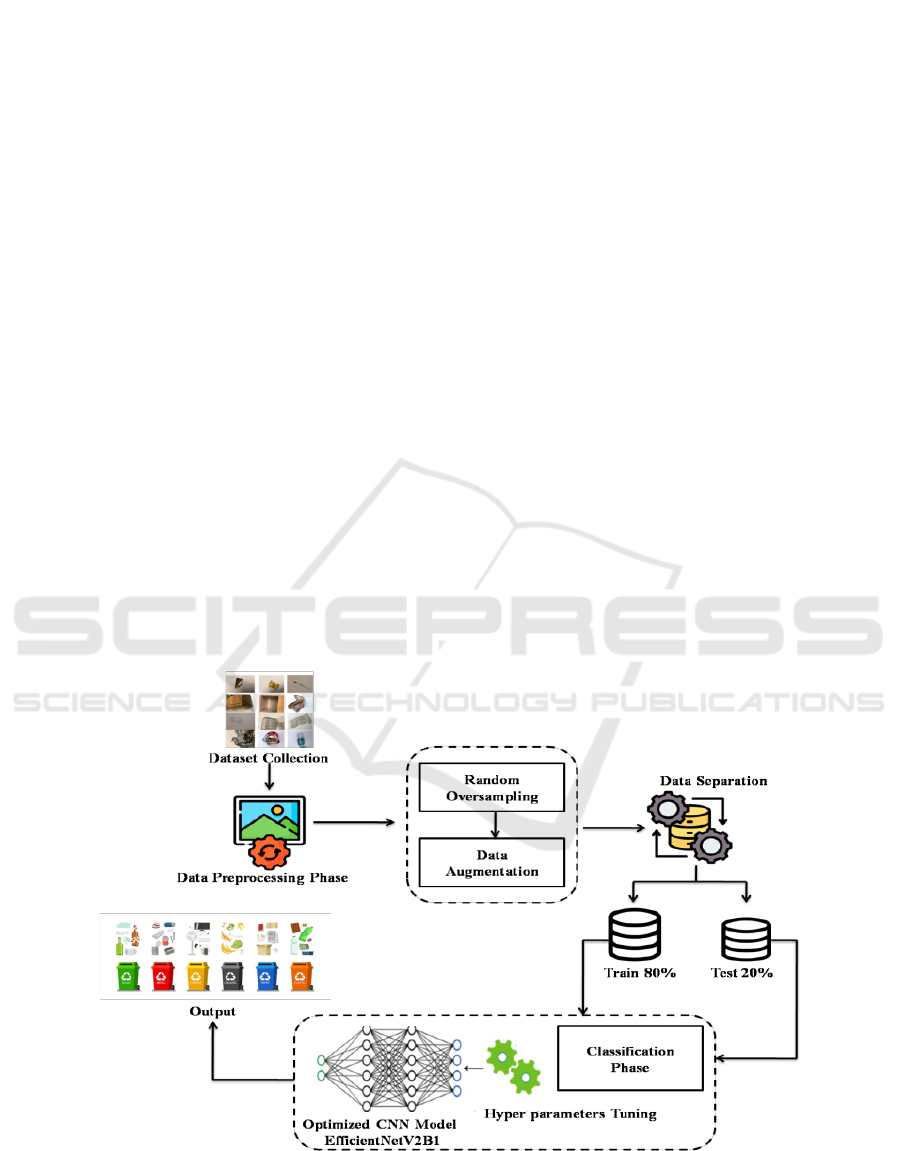
management processes. The following figure 1 shows
the system architecture and the following figure 2
shows the system flow diagram.
Intelligent garbage cans, recycling bins, and
machine vision-based intelligent garbage sorting
systems have recently made headlines, thanks to
advancements in AI technology and suggested a
network-based garbage categorization system that
utilized deep learning to automate and enhance the
accuracy of this procedure. To sort garbage into
different types, such paper, cardboard, plastic, green-
glass, etc., our system leverages an extra layer of
enhanced lightweight convolutional neural networks
(ILCNNs). A publicly accessible dataset including
images of different kinds of waste gathered from
different places has been used to train the various
state-of-the-art deep learning models. Then, we
utilized image augmentation and transfer learning
strategies to this dataset to fine-tune the ILCNN
models that had already been trained.
Figure 1: System Architecture.
ICRDICCT‘25 2025 - INTERNATIONAL CONFERENCE ON RESEARCH AND DEVELOPMENT IN INFORMATION,
COMMUNICATION, AND COMPUTING TECHNOLOGIES
62
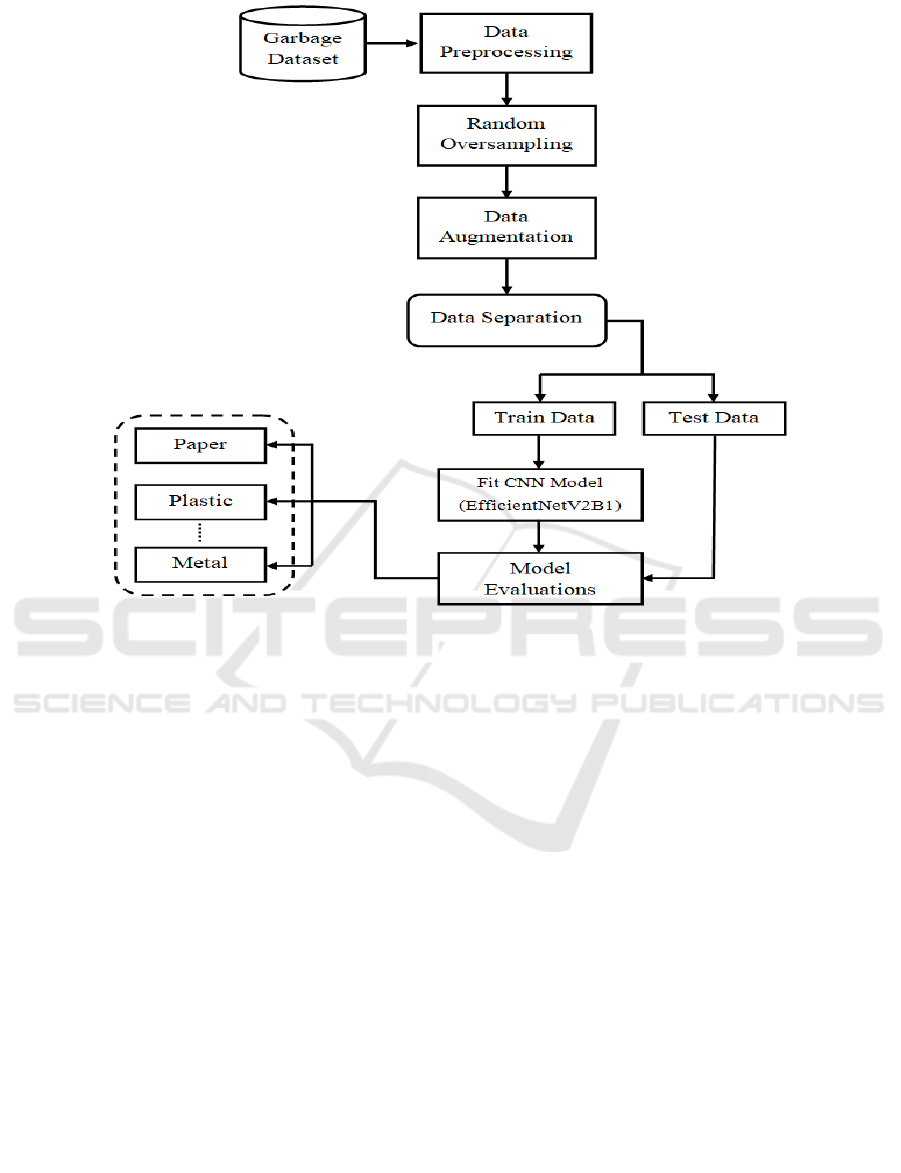
Figure 2: System Flow Diagram.
This improved its recognition performance in
garbage classification tasks.
• The convolution layer makes use of the Mish
activation function to enhance the deep network's
information representation ability and
generalization performance.
• To decrease the model's parameter, count and
prevent overfitting, the classifier opts for global
average pooling rather than a complete
connection layer.
• In order to get the most out of the pre-trained
model for garbage categorization tasks, we built
it using four prevalent forms of household waste.
In the implementation phase, the original theoretical
design for the project is turned into a functioning
system. For this reason, this is the most important
step in the design of a new system that the user will
rely on and trust will work well. The implementation
step will require planning everything out, research on
the existing system and its shortcomings, devising a
plan to switch to a new system, and reflecting on the
effectiveness of that process.
3.1 Data Collection
Although the original MobileNet pre-trained model is
trained on the ImageNet dataset, it is challenging to
guarantee the effectiveness of transfer learning as the
data in ImageNet does not entirely contain the images
we need. To thus fine-tune the model, we require a
dataset including garbage photos. There isn't yet a
standard dataset for waste categorization projects.
Though it has relatively few categories, which is not
in line with the real state of residential garbage
categorization in Indian, the garbageNet dataset for
waste classification is still useful. Thus, this work
generates a data set especially used for visual garbage
sorting through network retrieval and laboratory real
scene shooting, including many scenes such single
object, multiple similar objects, complex background,
and various interference situations such lighting and
motion blur. With 4152 JPG photos overall, it is split
into four categories: kitchen garbage, recyclable
waste, hazardous waste, and other waste.
ILCNN: An Improved Lightweight Convolutional Neural Network Based Recycling Garbage Classification Strategy with Image Processing
Technique
63

3.2 Data Preprocessing
Organize and preprocess the images. Among other
preprocessing methods, this can involve scaling,
normalizing, noise reduction, contrast enhancement,
and other approaches.
3.3 Data Splitting
Three subsets made out of the dataset were validation,
training, and testing. The training set is used to train
the model; the validation set is used to fine-tune the
hyper parameters; the testing set evaluates the
performance of the produced model. This
fundamental stage is needed in the development and
application of machine learning algorithms for image
classification chores. Open your preferred data
analysis tool (python or C) then import the dataset for
depicts categorization. One should verify if the
dataset follows an ordered layout.
• Perform the necessary data preparation
activities prior to data division. Examples of this
are handling waste connected to missing
images.
• Shuffling your dataset before beginning a
machine learning project helps us to avoid our
model from learning patterns that could be
connected to the sequence of the data. A dataset
could be shuffled both before and after the data
loading process.
• The model gets trained with it. Validation set is
used to adjust hyper parameters. Testing set: It
helps to evaluate the performance of the final
model.
3.4 Feature Extraction
Extract relevant information from the images and the
deep learning methods could mean learning
automatically features using convolution layers.
Machine learning methods would extract features for
traditional models using histograms of oriented
gradients. Choose sensible model architecture. For
deep learning techniques, this often involves ILCNN.
Train the given model on the provided training set.
Tune your chosen hyper settings based off of
performance on the validation set. Training involves
adjusting weights of the models so that the loss
function is minimized. Assess the model using the
test set. Common performance measures are
accuracy and other related metrics. Every model can
be optimized further to increase the performance of
the model on the test set. This could mean tuning
hyper parameters, collecting more data, using data
augmentation, regularizing the model to prevent
overfitting, etc. Assess model prediction and errors
to understand the behavior of model. This phase may
highlight the errors of the model and facilitate future
development of the model.
3.5 ILCNN Architecture
After preprocessing the image waste classification,
we selected an ILCNN architecture that performs well
for waste image classification. For classification, we
selected EfficientNetV2B1, and included weights for
this model pretrained from an EfficientNetV2B1-like
dataset. These types of models can be found in deep
learning utilities such as TensorFlow or Pytorch. We
removed the previous classification head from
EfficientNetV2B1 pretrained model and added our
own classification head with the same number of
garbage classes in our dataset. To extract hierarchical
and discriminative features from the garbage images
we utilized ILCNN layers. To tune the model weights
during training we need to use an optimizer such, as
Adam or SGD, and an appropriate loss function, such
as categorical cross-entropy, for multi-class
classification. Finally, to deliver the final waste
classifications, we transferred the extracted features
into the ILCNN architectural scheme, again by
overlaying fully connected layers.
3.6 Training and Testing
After the model is developed, it has to be trained
using a large number of images that have the
necessary objects tagged. Keep in mind that in order
for the EfficientNetV2B1 model to learn to
differentiate between the different classes
appropriately, the data must be balanced. Once the
data is prepared, it has to be put into the
EfficientNetV2B1 model. Dataset size determines
whether this is best done in batches or in one
continuous run. Next, a suitable optimizer, such as
Adam or SGD, has to be used to train the model. In
order for the model to learn to identify different
objects in the images, its weights are modified
continually during the training phase. After then, the
testing set may be used to assess the model's
correctness. There are a number of ways to evaluate
the model's efficacy, including recall, accuracy, and
F1 score. One way to measure the model's
performance is to see how many photos it accurately
labels. It is also possible to test the model on new data
to determine how well it generalizes. The model's
performance with unobserved data will be shown by
this.
ICRDICCT‘25 2025 - INTERNATIONAL CONFERENCE ON RESEARCH AND DEVELOPMENT IN INFORMATION,
COMMUNICATION, AND COMPUTING TECHNOLOGIES
64
4 RESULTS AND DISCUSSION
The goal of this study was to evaluate the efficacy of
the proposed scheme by cross-validating it with the
traditional deep learning model, Convolutional
Neural Network (CNN), and classifying waste as
organic or recyclable using a deep learning-based
model called ILCNN. The research demonstrated that
ILCNN was capable of distinguishing between
different types of garbage, thereby facilitating the
development of more efficient recycling methods.
This study suggested an automated classification
method that utilizes ILCNN for efficient image
recognition. Using an optimization method with a
higher level of classification accuracy, the model that
has been presented emphasizes the role of ILCNN in
automating recycling tasks.
(a)
(b)
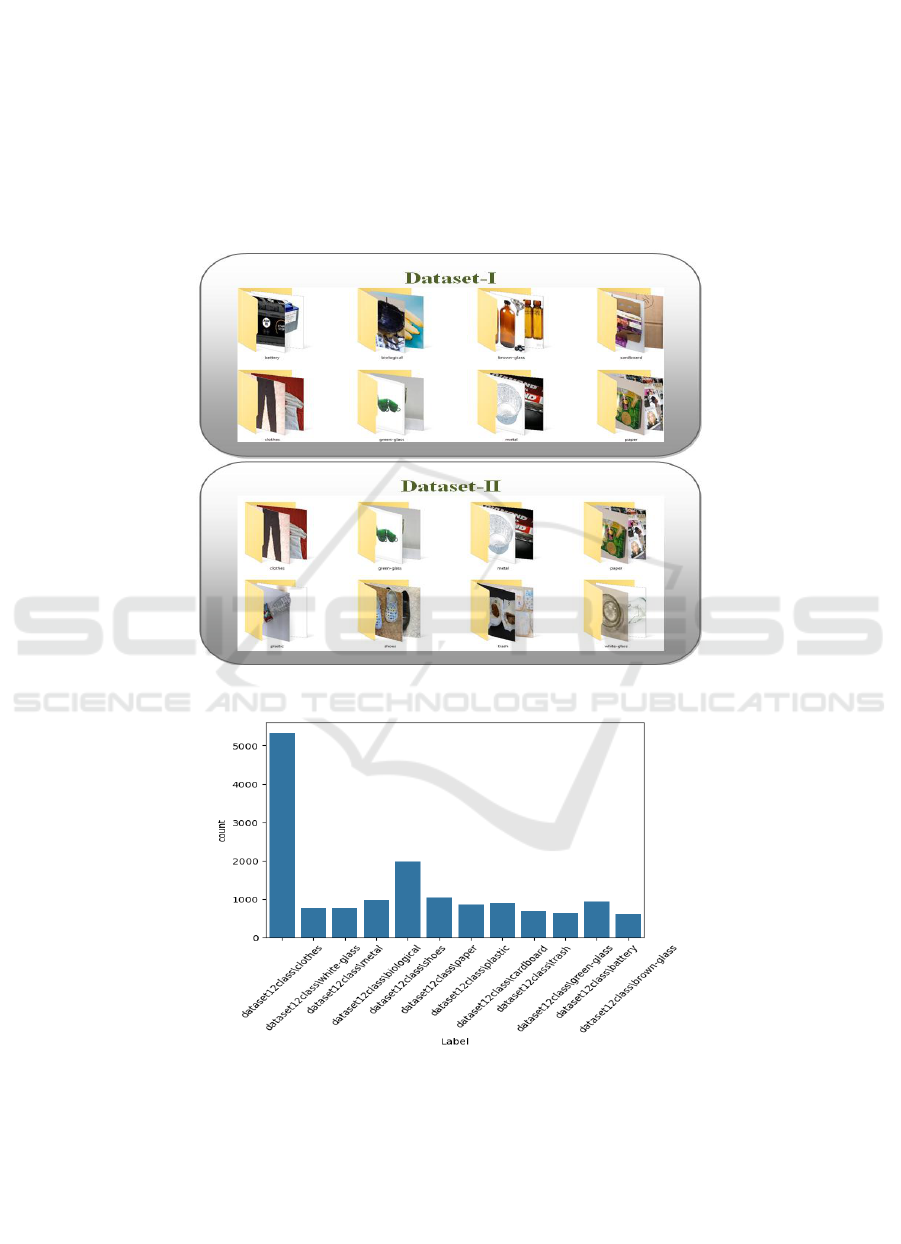
Figure 3: (A) Dataset View and (B) Data Visualization.
The objective of this investigation was to
categorize photographs of waste products into seven
categories: cardboard, glass, metal, organic, paper,
plastic, and refuse. Transfer learning methods were
employed to enhance the model's performance,
thereby emphasizing ILCNN's adaptability in
managing a variety of refuse categories. In a research
article, an ILCNN model was presented that achieved
ILCNN: An Improved Lightweight Convolutional Neural Network Based Recycling Garbage Classification Strategy with Image Processing
Technique
65
a classification accuracy of 98.63% for a variety of
refuse categories. ILCNN's proficiency in automating
garbage categorization duties is illustrated by this
remarkable precision. The results emphasize the
effectiveness of ILCNN in accurately classifying
waste products, and these studies collectively
demonstrate the extent to which ILCNN automates
garbage classification, thereby promoting more
sustainable environmental practices and effective
recycling methods. A clear and concise representation
of the dataset view and the data visualization
perspective is provided in the following figure, which
is referred to as Figure 3.
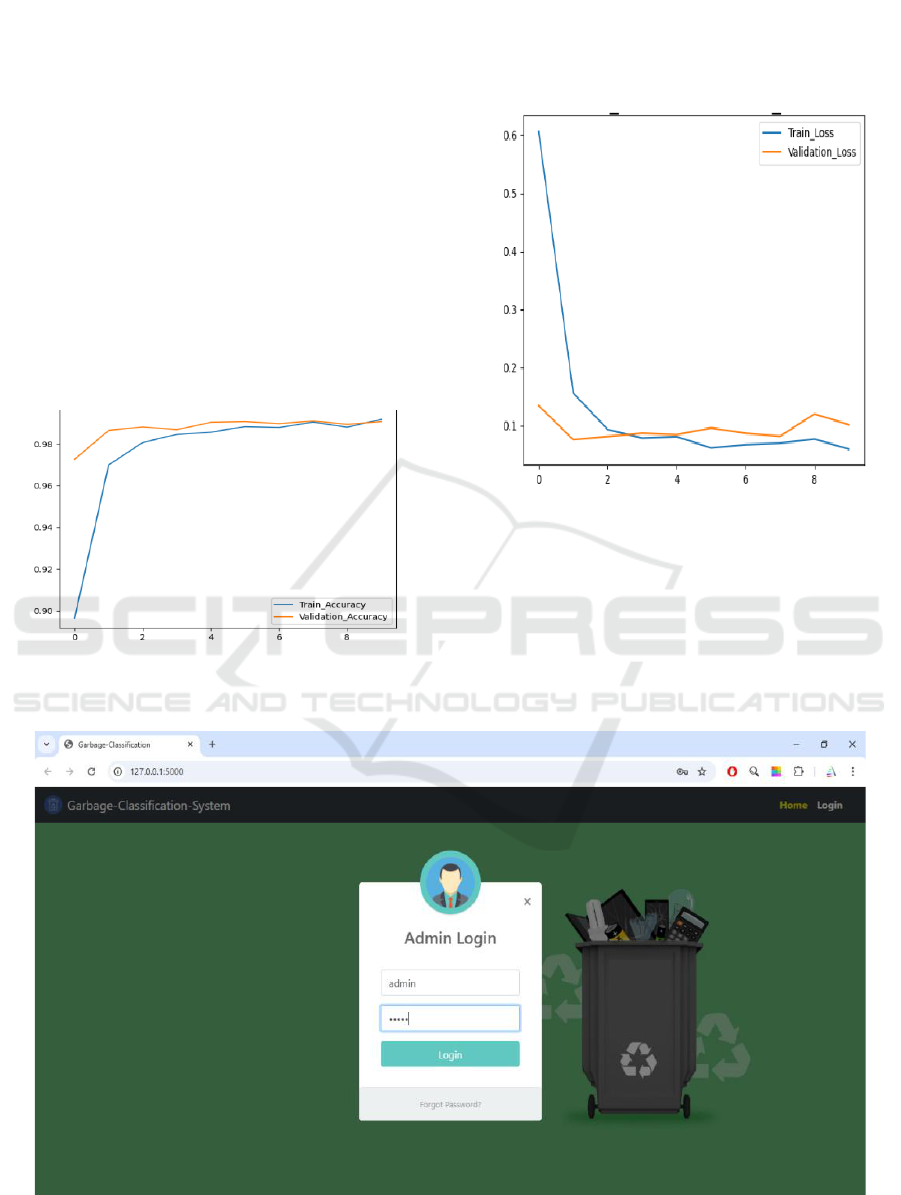
The training accuracy and validation accuracy
assessments of the suggested scheme known as
ILCNN are depicted in the figure that can be seen
below, which holds the designation Figure 4.
Figure 4: Training and Validation Accuracy.
The training loss ratio and validation loss ratio of
the proposed scheme known as ILCNN are depicted
in the figure that can be seen below, which is referred
to as Figure 5.
Figure 5: Training and Validation Loss.
The web page for administrator authentication,
the website for picture uploading, and the page for
result prediction are all depicted in the following
images: Figure 6, Figure 7, and Figure 8. These
representations demonstrate the output of the
suggested method.
Figure 6: Administrator Authentication.
ICRDICCT‘25 2025 - INTERNATIONAL CONFERENCE ON RESEARCH AND DEVELOPMENT IN INFORMATION,
COMMUNICATION, AND COMPUTING TECHNOLOGIES
66
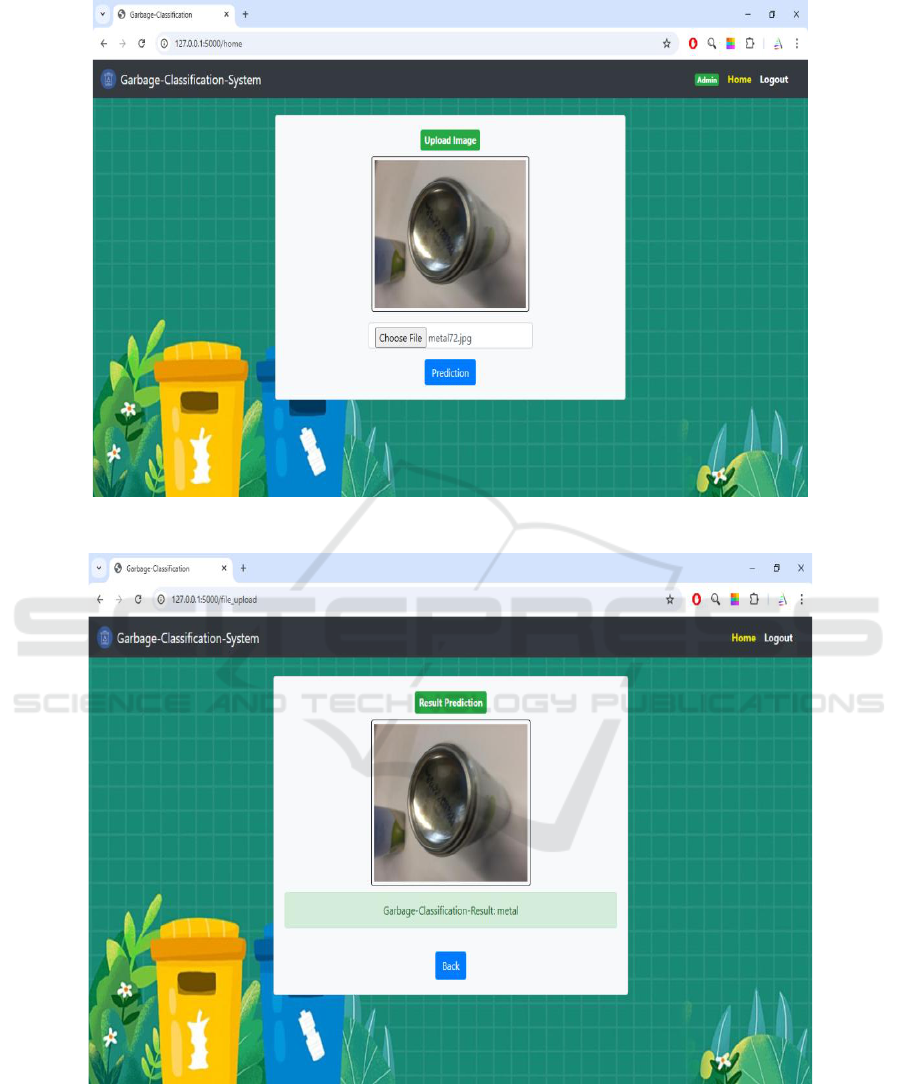
Figure 7: Image Uploading Port.
Figure 8: Result Prediction.
The prediction accuracy of the proposed scheme,
which is referred to as ILCNN, is depicted in the
following figure, which is referred to as Figure 9. In
order to evaluate the prediction accuracy of the
suggested scheme, it is cross-validated with the
traditional deep learning model known as CNN. A
descriptive representation of the same may be found
in the table that follows, which is referred to as Table-
1.
ILCNN: An Improved Lightweight Convolutional Neural Network Based Recycling Garbage Classification Strategy with Image Processing
Technique
67
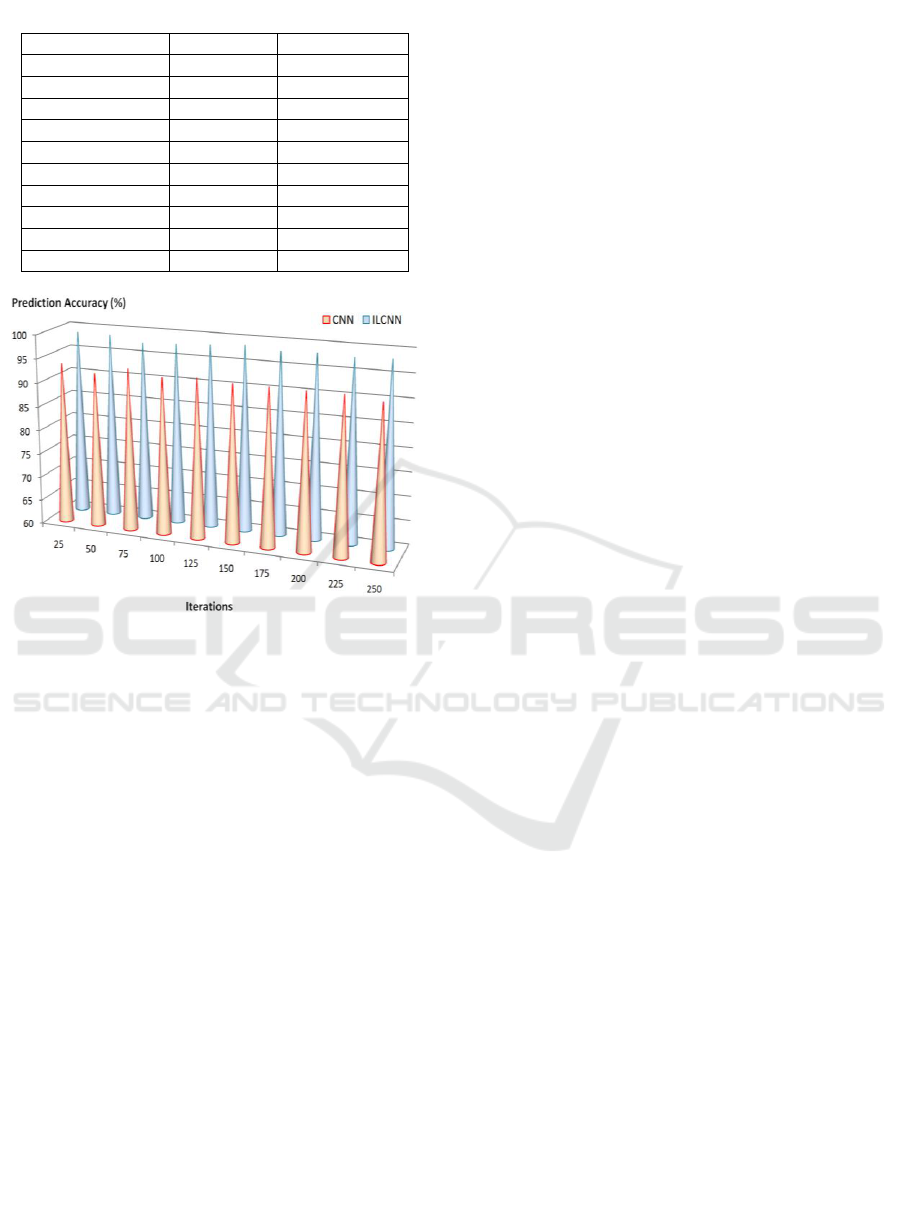
Table 1: Analysis of Prediction Accuracy Between Ilcnn and Cnn.
Iterations
CNN (%)
ILCNN (%)
25
93.64
98.71
50
92.15
98.63
75
93.76
97.49
100
92.55
97.82
125
93.09
98.19
150
92.61
98.74
175
92.61
98.05
200
92.51
98.26
225
92.47
97.93
250
91.69
98.19
Figure 9: Prediction Accuracy Evaluation.
5 CONCLUSIONS AND FUTURE
SCOPE
The garbage detection and classification model is
built on top of an enhanced attention mechanism,
activation function, and classification layer
mechanism on the ILCNN. A recognition accuracy of
96.55% is achieved by the enhanced model on the
self-constructed garbage dataset. Based on the
findings, the suggested system may automate the
categorization work, which in turn reduces operating
expenses and human error, greatly improving the
efficiency of waste management procedures. By
substituting global average pooling for the fully
connected layer, the suggested garbage recognition
model ILCNN demonstrates how to decrease the
model's parameter count while simultaneously
improving the recognition result. To increase the
model's identification performance, the Mish
activation function allows for more precise feature
extraction from the target and better use of the
retrieved visual data.
Going forward, we intend to train the model using
a wider variety of garbage image data in order to
better prepare it for real-world application settings.
Eventually, garbage detection and classification with
little power consumption and great accuracy, serving
as a benchmark for researchers and engineers in the
upcoming years. The system's practical use in waste
management might be further enhanced by enabling
real-time waste categorization in varied situations
through its implementation on edge devices.
REFERENCES
Al Mahmud Al Mamun, et al., "Garbage classification
using convolutional neural networks (CNNs)", Material
Science & Engineering International Journal, 2023.
He Bai, et al., "Design of Garbage Classification System
Based on Artificial Intelligence Technology",
International Conference on Aviation Safety and
Information Technology, 2021.
Kirit Rathod, et al., "Garbage Classification based on Dense
Network (GCDN) using Transfer Learning and
Modified Hyper Parameter", International Journal of
Intelligent Systems and Applications in Engineering,
2024.
Kishan PS, et al., "Garbage Classification and Detection for
Urban Management", IJCTT Journal, 2021.
Qingqiang Chen, et al., "Garbage Classification Detection
Based on Improved YOLOV4", Journal of Computer
and Communications, 2020.
Shanshan Meng, et al., "A Study of Garbage Classification
with Convolutional Neural Networks", Indo – Taiwan
2nd International Conference on Computing, Analytics
and Networks, 2020.
Shoufeng Jin, et al., "Garbage detection and classification
using a new deep learning-based machine vision system
as a tool for sustainable waste recycling", Waste
Management, 2023.
Sri Kruthika M, et al., "Garbage Classification: A Deep
Learning Perspective", International Research Journal
on Advanced Engineering Hub, 2024.
Volkan Kaya, "Classification of waste materials with a
smart garbage system for sustainable development: a
novel model", Frontiers in Environmental Science,
2023.
Wei Liu, et al., "Image Recognition for Garbage
Classification Based on Transfer Learning and Model
Fusion", Mathematical Problems in Engineering, 2022.
Wenbo Liu, et al., "A Garbage Intelligent Classification and
Recycling System Based on Deep Learning", Procedia
Computer Science, 2024.
Yang Shen, et al., "Domestic Garbage Classification and
Incentive-Based Policies in China: An Empirical
Analysis", Water, 2023.
Yu Song, et al., "DEEPBIN: Deep Learning Based Garbage
Classification for Households Using Sustainable
ICRDICCT‘25 2025 - INTERNATIONAL CONFERENCE ON RESEARCH AND DEVELOPMENT IN INFORMATION,
COMMUNICATION, AND COMPUTING TECHNOLOGIES
68

Natural Technologies", Journal of Grid Computing,
2023.
Yujin Chen, et al., "Classification and recycling of
recyclable garbage based on deep learning", Journal of
Cleaner Production, 2023.
Zhichao Chen, et al., "Garbage classification system based
on improved ShuffleNet v2", Resources, Conservation
and Recycling, 2022.
ILCNN: An Improved Lightweight Convolutional Neural Network Based Recycling Garbage Classification Strategy with Image Processing
Technique
69
