
Language Agnostic Data Augmentation for Text Classification
M. Sharmila Devi, V. Lakshmi Chaitanya, G. Sharanya, B. Himaja,
A. Bhavya Rohitha and A. Sujitha
Department of Computer Science & Engineering, Santhiram Engineering College, Nandyal‑518501, Andhra Pradesh, India
Keywords: LiDA, MBERT, SBERT, XLM‑RoBERTa, LSTM, Token‑Level, Constructive Learning, Back‑Translation.
Abstract: The lack of labeled data is especially problematic for low-resource languages, making the development of
high-performance text classification models especially challenging. Collecting diverse and large-scale
annotated datasets, that are crucial to train generalizable models, is often expensive. One of the solutions that
address this limitation is data augmentation, using synthetic training data to strengthen model performance.
Nevertheless, the majority of existing methods for data augmentation are extremely language-dependent,
focused only on English, and only at word or sentence level through word replacement or paraphrasing
respectively. These approaches may not generalize across languages, and thus their applicability to low-
resource settings is limited. Type a language зху The LIDA approach, which works on the level of sentence
embeddings and can thus be applied regardless of language, is also compared and contrasted with traditional
augmentation methods. Thus, these datasets can efficiently be augmented across a variety of language models
without needing to depend on specific language preprocessing. We evaluate LIDA on three distinct languages
for LSTM and BERT based models on 4 different dataset fractions. We also conduct an ablation study to
evaluate the impact of different components of our approach on model performance. The empirical results
indicate that LIDA could be viewed as language-agnostic, scalable, and robust augmentation strategy for low-
resource text classification scenarios, and the source code of LIDA has been released on GitHub for
facilitating other relevant researches and applications.
1 INTRODUCTION
1.1 Significance of Text Classification
in NLP
Text classification belongs to simple Natural
Language Processing (NLP) tasks and has attracted
much attention with a variety of applications across
domains. For spam detection, sentiment analysis,
emotion detection, and topic detection text
classification are commonly used (Bayer, et al,2022).
These applicationsa are the foundation of many
modern technologies like email filtering, social
media, customer feedback analysis and content
classification. For example, sentiment analysis can
assist companies in gauging the sentiments of
customers about their products to make better
decisions regarding products they stock, how they
market them, and more. Emotion detection can be of
help to organizations in social media in understanding
how the public feels during crisis or large events so
they may respond effectively in a timely fashion.
1.2 Advancements in Deep Learning
for Text Classification
The accuracy of text classification systems has
improved dramatically over the past few years,
largely due to the introduction of advanced deep
learning algorithms. These algorithms are built upon
powerful neural network architectures, including
Convolutional Neural Networks (CNNs) and
Recurrent Neural Networks (RNNs), which allow
them to extract representations of features and
patterns in large corpora for accurate text
classification (Bayer, et al,2022). BERT and GPT
& transformer Based Architecture a new revolution in
NLP, because those models started to capture context
words, multilingual sentences etc. The transformers,
which enable attention mechanisms that guide the
assignment of weights to relative importance between
50
Devi, M. S., Chaitanya, V. L., Sharanya, G., Himaja, B., Rohitha, A. B. and Sujitha, A.
Language Agnostic Data Augmentation for Text Classification.
DOI: 10.5220/0013876800004919
Paper published under CC license (CC BY-NC-ND 4.0)
In Proceedings of the 1st International Conference on Research and Development in Information, Communication, and Computing Technologies (ICRDICCT‘25 2025) - Volume 2, pages
50-58
ISBN: 978-989-758-777-1
Proceedings Copyright © 2025 by SCITEPRESS – Science and Technology Publications, Lda.

words in a sentence, enable these models to develop
a nuancing structure–more closely matching input
text to a potential classification. But, the
performance of deep learning models is highly
dependent on getting large amounts of labelled data
for text classification.
1.3 Challenges with Low-Resource
Languages
When it comes to low-resource languages such as
Indonesian, the issue of creating high-performance
text classification models are very pronounced
because the amount of labeled datasets is limited. The
linguistic resources, for example, annotated corpora,
dictionaries, and pre-trained models, which are easily
available for high-resource languages like English are
very poor for most low-resource languages.
Collecting huge amounts of labeled data is time-
consuming and relatively expensive, thus making it
challenging for researchers and practitioners dealing
with poorly resource endowed language. When
models are trained on small data, they are
underperforming when it comes to delivering
predictions that accurately reflect the nature of
language, which is a consequence of the absence of
data.
2 LITERATURE REVIEW
Sujana, Yudianto, and Hung-Yu Kao. "LiDA:
Language-independent data augmentation for text
classification." IEEE Access 11 (2023): 10894-
10901. In this paper, we present a method of text
classification enhancement called LiDA, which
generates unlimited language-independent artificial
data. The authors highlight the challenges of having
insufficient data for text classification, particularly
for languages that have very little data available. They
propose LiDA as a method for effective dataset
augmentation, based on transformation on data and
making use of cross lingual embeddings. The study
shows, through extensive experiments over different
languages and datasets, that LiDA improves
performance without relying on large-scale labeled
datasets. This work is particularly useful for
researchers and practitioners dealing with low-
resource languages in NLP [2].
Fields, John, Kevin Chovanec, and Praveen
Madiraju. "A survey of text classification with
transformers: How wide? how large? how long? how
accurate? how expensive? how safe?" IEEE
Access 12 (2024): 6518-6531. This work investigates
the role of transformers in text classification with
respect to several aspects: width, size, computational
cost, accuracy, and safety. We compare different
transformer designs (BERT, GPT, etc.) and their
scaling impact on classification performance. The
paper also discusses certain
trade-offs, like model
complexity vs actual applicability. It thus presents an
important reference for researchers that seek to
apply
deep learning with transformers for text-based
classification tasks, covering models' advantages and
limitations.
Taha, Kamal, et al. "Text classification: A review,
empirical, and experimental evaluation." arXiv
preprint arXiv:2401.12982 (2024). In
this study, we
provide an in-depth exploration of text classification
techniques, combining theoretical insights with
empirical evaluations. The authors compare deep
learning methods such as
CNNs, RNNs, and
transformers against more traditional machine
learning approaches such as Naïve Bayes and SVM.
Through extensive experiments, they assess
performance under different scenarios, such as
varying data sizes and class imbalances. Based on the
study's results, deep learning models are generally
superior to classical methods but also require a
considerable amount of computational
power. This
study serves as a guiding manual for choosing the
most appropriate text classification approach based
upon certain needs.
Minaee, Shervin, et al. "Deep learning--based text
classification: a comprehensive review." ACM
computing surveys (CSUR) 54.3 (2021): 1-40. This
paper provides a comprehensive overview of deep
learning methods for text classification. We introduce
readers to various model architectures including
transformer-based models versus CNN versus RNN
vs attention-based models. They review key
advances that have significantly improved
classification performance, such as transfer learning
and pre-trained language models. The review further
discusses practical challenges, such as data
availability and clean-up costs, as well as ethical
dilemmas regarding bias in AI models. For academia
and industry, this paper provides an organized
summary of methodologies which can be used as a
reference for text classification.
Qu, Ping, et al. "Comparison of Text
Classification Algorithms based on Deep
Learning." Journal of Computer Technology and
Applied Mathematics 1.2 (2024): 35-42. The efficacy
of deep learning-based text classification algorithms
in practical applications is the main focus of this
study's evaluation and comparison. The authors
measure the performance of models like transformers,
Language Agnostic Data Augmentation for Text Classification
51

CNNs, and LSTMs on a variety of datasets. They look
at things like robustness against noisy data, training
efficiency, and accuracy. The findings show that
CNNs and LSTMs are still competitive in
environments with limited resources, even though
transformer-based models typically attain the highest
accuracy. The paper helps choose the best model for
particular text classification tasks by clearly
presenting the benefits and drawbacks of each
approach.
3 EXISTING SYSTEMS
Text classification is a key task in natural language
processing (NLP) and serves as the foundation for
various applications such as sentiment analysis, topic
modeling, spam filtering, and emotion classification.
For low-resource languages, obtaining sufficient
labeled data is a major challenge due to the high costs
and time-consuming nature of data collection and
annotation (Sujana, et al,2023).
To address this data scarcity issue, researchers
employ data augmentation techniques to generate
synthetic training data. The current approach to text
data augmentation primarily consists of two
methods:
3.1 Word-Level Data Augmentation
Word-level techniques involve modifying individual
words within a sentence to create new versions of the
original text. Common strategies include:
• Synonym Substitution: Synonym
Substitution is a word-level data
augmentation technique where words in a
sentence are replaced with their synonyms to
generate new variations of the text.
Replacing words with their synonyms from
lexical databases such as WordNet.
• Word Embedding-Based Substitution:
Word Embedding-Based Substitution is a
word-level data augmentation technique
where words in a sentence are replaced with
their most similar words based on word
embeddings (numerical vector
representations of words). Substituting
words with their closest counterparts in a
pre-trained word embedding model (e.g.,
Word2Vec, GloVe).
• Random Deletion, Insertion, and
Swapping: Random Deletion, Insertion, and
Swapping is a word-level data augmentation
technique that modifies sentences by
randomly removing, adding, or rearranging
words. This technique aims to create
synthetic variations of a sentence while
maintaining its original meaning.
Introducing variations by randomly
removing, adding, or rearranging words in a
sentence.
• Masked Language Models (MLM):
Masked Language Models (MLM) is a
word-level data augmentation technique
where specific words in a sentence are
randomly masked (hidden), and a pre-
trained language model predicts the missing
words based on the surrounding context
(Zhao, Huanhuan, et al.) Using models like
BERT to predict and replace words based on
contextual understanding.
3.2 Limitations of Word-Level
Augmentation
• Dependency on Language-Specific
Resources: Many techniques rely on
resources like WordNet, which may not be
available for low-resource languages.
• Incompatibility with Certain Languages:
Not suitable for languages that lack word
segmentation, such as Chinese and Japanese.
• Risk of Semantic Distortion: Random
word replacements may alter the meaning of
a sentence, leading to inaccurate synthetic
data.
3.3 Sentence-Level Data Augmentation
Some sentence-level augmentation techniques create
a completely new sentence while leaving its meaning
untouched. The most commonly employed methods
are:
• Back-Translation: Back-Translation, as a
sentence-level data augmentation technique,
injects synthetic variation into the text by
translating a source sentence to some other
language and then back to the original
language (Sujana, et al,2023). Using
machine translation models (e.g., Google
Translate, MarianMT) to translate a
sentence to another language and then back
to the original language.
• Generative Models: Generative Models:
Given that they create new sentences from
scratch, they fall under a sentence-level data
augmentation technique where deep
learning models are used to produce yet new
ICRDICCT‘25 2025 - INTERNATIONAL CONFERENCE ON RESEARCH AND DEVELOPMENT IN INFORMATION,
COMMUNICATION, AND COMPUTING TECHNOLOGIES
52

sentences creating their basis on patterns
learned from other texts they have trained
on. Applying deep neural network
architectures to create new sentences with
the same meaning, such as using sequence to
sequence (Seq2Seq) or Generalised
Pretrained Transformer (GPT)-based
models.
3.4 Limitations of Sentence-Level
Augmentation
• Dependence on High-Quality Translation
Models: Back-translation is only effective
when accurate machine translation models
are available, which is not the case for all
languages.
• High Computational Requirements:
Generative models require large-scale
datasets and significant computing power,
making them impractical for resource-
limited environments.
• Potential Bias in Synthetic Data: The
quality of generated sentences depends on
the pre-trained language model, which may
introduce unwanted biases.
3.5 Challenges in the Existing System
Although traditional data augmentation techniques
are effective, they pose several challenges,
particularly for low-resource languages:
• Language Dependence – Many
augmentation techniques require language-
specific tools (e.g., WordNet, pre-trained
embeddings) that are unavailable for many
languages.
• High Computational Costs – Advanced
techniques like back-translation and
generative models demand intensive
processing power and large-scale pre-
training, making them unsuitable for low-
resource settings.
• Limited Generalization – Existing
methods are optimized for high-resource
languages (e.g., English) but struggle to
work effectively in low-resource languages
with fewer linguistic tools.
3.6 Need for an Improved System
Given these limitations, a universal, language-
independent data augmentation technique is needed.
The ideal system should:
• Work across multiple languages without
relying on language-specific resources.
• Generate high-quality synthetic data while
preserving the original meaning and context.
• Be computationally efficient and scalable,
making it practical for low-resource language
scenarios.
4 PROPOSED SYSTEM
An organized method for language-independent data
augmentation for text classification is represented by
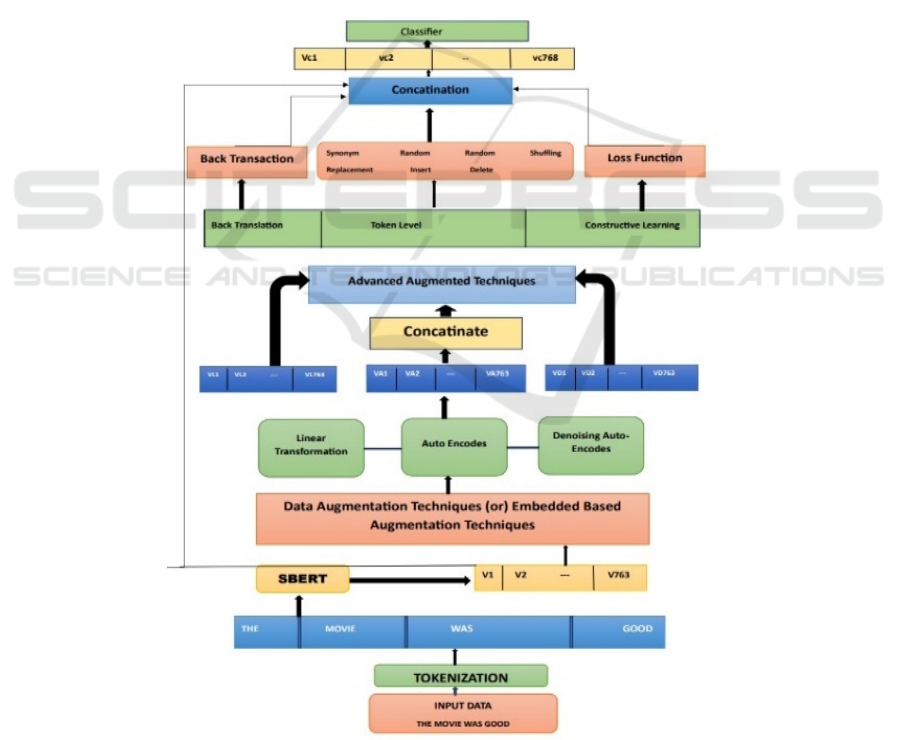
the figure 1 architecture provided. Tokenization is the
first step in the process, which divides input text into
discrete tokens. After that, SBERT (Sentence-BERT)
is used to convert these tokens into numerical
embeddings, producing high-dimensional vector
representations. Many data augmentation techniques
are used to improve the quality and diversity of
augmented data. This covers embedded augmentation
techniques like autoencoders, denoising
autoencoders, and linear transformation. To generate
more varied training samples, back-translation and
token-level changes are also added, including
synonym replacement, random insertions, deletions,
and shuffling. To improve generalization, these
augmentations are further refined using constructive
learning techniques. Figure 1 show the Architecture.
4.1 Disruptions in the Suggested
System at the Token Level
Token-level perturbation is the process of changing
specific tokens (words or subwords) inside a text
while preserving its original meaning. This approach
improves the model's performance and
generalization by generating a diverse set of training
samples.
4.2 Techniques for Perturbation at the
Token Level:
• Random Word Replacement: Some
words are replaced with synonyms to
provide variation without altering the
context.
• Random Insertion & Deletion: This
method adds or removes words to produce
various phrase forms from the text.
• Character-Level Modifications: These
add small changes like typos, misspellings,
Language Agnostic Data Augmentation for Text Classification
53
or character swaps to make the model more
resilient to noisy inputs.
• Subword Modifications: These change
word segmentations using Byte Pair
Encoding (BPE) techniques to diversify
token representations.
4.3 Impact of Token-Level
Perturbations:
By using these techniques, the system improves:
• Language Independence: This allows data
augmentation without depending on
predefined linguistic rules.
• Diversity: This creates a wide range of
textual variations for better model training.
• Robustness: This increases the model's
capacity to handle variations in real-world
data.
• Performance: Improves text classification
accuracy and generalization. These
improvements make the system more
efficient and flexible text processing
system, which makes it suitable for low-
resource language applications.
4.4 LiDA's Constructive Learning
The multi-modal rubrics of constructing knowledge
through LiDA looks at indirectly a number of texts
extracted through the same text data with which
knowledge was structured. By doing so, it improves
the model performance on semantic, feature
representation and generalization point of views,
which enable the model to efficiently concentrate on
relevant text input patterns.
Figure 1: Architecture.
ICRDICCT‘25 2025 - INTERNATIONAL CONFERENCE ON RESEARCH AND DEVELOPMENT IN INFORMATION,
COMMUNICATION, AND COMPUTING TECHNOLOGIES
54

4.5 Key Elements of LiDA's
Constructive Learning
• Augmentation-Based Learning: It uses a
variety of augmentation techniques from
token level perturbations to back-translation
to churn out multiple text permutations.
These techniques keep the model busy
listening to fine patterns and only to look at
the objects, blocking the vision of irrelevant
details.
• Richer Text Representation: This helps
the model to identify surface and semantic
changes by encouraging it to learn what is
invariable and what varies in the text.
• Improved Generalization & Stability: By
feeding it various text inputs, the model
avoids overfitting and generalizes well on
new data. This allows for great flexibility
across languages and domains. The next
approach is to avoid overfitting, that is
when a model relies too heavily on training
data and can no longer generalize adequately
to new input. Constructive learning prevents
this from happening by exposing the model
to a variety of transformations, and
preventing it from becoming too reliant on
a particular pattern.
• Better Model Performance: Combining
constructive learning and token-level
perturbations results in more robust, precise
and efficient text classification system.
• The proposed framework is an effective
solution for low-resource text classification
problems since it integrates constructive
learning with the augmentation processes of
LiDA, yielding enhanced performance,
semantics interpretation, and linguistic
independence. LiDA has been mostly
employed in text categorization; LiDA
utilizes annotated corpora to improve NLP
(natural language processing) tasks. It helps
to annotate text data which in turn helps for
its processing and analysis in NLP
applications. LiDA leverages deep learning
frameworks like PyTorch and Hugging Face
to train the models for better performance.
4.6 Hugging Face
Packs a natural language processing based on popular
AI platforms that can lead to produce, train, and take
advantage of the machine-learning model. It is widely
used for Transformer based models such as BERT
(Bidirectional Encoder Representations from
Transformers), GPT (Generative Pre-trained
Transformer), T5 (Text-To-Text Transfer
Transformer), RoBERTa (Robustly optimized BERT
approach) and offers cutting-edge solutions for
different NLP workloads.
4.7 PyTorch
An open-source machine learning framework and it
makes it easier to create deep learning and AI
models. It makes the process of building, training,
and deploying models more efficient and it is
primarly python based.
One of the primary short comings of the current
system is its inefficiency in low-resource languages,
where the performance of the models is impacted by
inadequate training data. Improving Low-Resource
Language Effectiveness Baseline models are used to
improve effectiveness in low-resource settings; they
are fundamental yet crucial benchmarks that are used
to compare the performance of advanced models; in
deep learning and machine learning, baseline models
serve as a foundation for developing more robust and
efficient models. Ultimately, LiDA aims to support
multiple languages, ensuring adaptability across a
range of linguistic specifications through
multilingual modeling techniques for multilingual
modelling.
4.8 The Advantages of the Proposed
System Include:
• Language Independence: By using
Language-Independent Data Augmentation
(LiDA), the proposed system ensures
adaptability across multiple languages and
does not require annotated corpora or
predefined linguistic tools, which makes it
appropriate for low-resource languages;
additionally, it improves model performance
across multiple languages without requiring
manual intervention, making NLP solutions
more inclusive. Standard data augmentation
methods are limited in their use due to their
reliance on language-specific resources.
• Diverse Augmentation strategies: Combines
many augmentation strategies to increase
model training: Back-translation: Converts
text to another language and back again to
obtain different but semantically equivalent
training samples; Token-level perturbations:
Add controlled modifications to specific
words or sub words to improve the
Language Agnostic Data Augmentation for Text Classification
55

generalization ability of the model;
Contrastive learning: increases the model's
resilience by helping it differentiate between
similar and dissimilar data; enhances the
effectiveness of deep learning models by
offering varied, high-quality training data.
• Better Results Compared to Benchmarks:
Less misclassifying mistakes are made,
enhancing classification results; model output
reliability is obtained, by lowering false
positives; overall sensitivity is improved with
increased ability to identify relevant data
points; F1-score provides consistently steady
performance metric balancing recall and
precision; wonderful versatility across
multiple datasets and domains, making it ideal
for practical implementation; enhances model
generalization producing consistent results
across multiple languages and use cases.
• Effective in Resource-Constrained
Environments: For most of the languages,
scarcity of labelled data challenges model
training. To address the issues of scarcity of
data, self-supervised learning and
augmentations are used. Greatly improves
data so that models can learn even without a
lot of labelled examples. Reduces requirement
of human annotation, making it scalable for
under-resourced languages. Address this gap
by enhancing training efficiency for high and
low resource applications.
• Multilingual Capability: The capacity to
speak multiple languages allows for smooth
adaptation across different regions, increasing
the reach of NLP applications globally;
supports multiple languages without requiring
separate models for each language; employs
cross-lingual transfer learning, allowing
knowledge transfer from high-resource to
low-resource languages; and reduces the cost
and effort required.
Table 1 represents the LiDA (Language-Independent
Data Augmentation) method's efficacy in raising text
classification accuracy in English, Chinese, and
Indonesian is shown in the table. Using a variety of
augmentation techniques, such as contextual
embedding, adversarial perturbation, token-level
augmentation, phonetic substitution, back
translation, and character-level noise, it contrasts
baseline accuracy with LiDA-augmented accuracy.
The findings demonstrate that LiDA continuously
raises classification accuracy, with notable gains in
English (2.75% average), Chinese (2.15% average),
and Indonesian (2.24% average). When using back
translation, Indonesian shows the greatest individual
improvement (8.49%).
In conclusion the proposed method is highly
effective for multilingual and low-resource NLP
applications because it enhances generalization,
efficiency, and robustness. By eliminating language
dependency, incorporating many augmentation
strategies, improving benchmark performance, and
ensuring flexibility in low-resource environments,
this method offers a scalable and noteworthy solution
for text categorization and other NLP applications.
Table 1: Data Set.
Language
Augmentation
Metho
d
Dataset
Covera
g
e
Baseline
Accurac
y
LiDA
Accurac
y
Improvement
(
%
)
English
Contextual
Embedding
Augmentation
10% 0.7021 0.7514 7.01%
Adversarial
Perturbation
100% 0.8432 0.8512 1.06%
Average ----- 0.8102 0.8325 2.75%
Chinese
Token-Level
Augmentation
50% 0.8642 0.8895 2.93%
Phonetic
Substitution
80% 0.8791 0.8983 2.18%
Average ----- 0.8429 0.8610 2.15%
Indonesian Back Translation 20% 0.7254 0.7869 8.49%
Character-Level
Noise
70% 0.8487 0.8593 1.25%
Average ----- 0.8304 0.8491 2.24%
ICRDICCT‘25 2025 - INTERNATIONAL CONFERENCE ON RESEARCH AND DEVELOPMENT IN INFORMATION,
COMMUNICATION, AND COMPUTING TECHNOLOGIES
56

5 PERFORMANCE METRICS
Here are some potential performance metrics that can
be used to evaluate the effectiveness of Language-
independent Data Augmentation (LIDA):
• Augmentation Quality: Measures the quality
of the augmented data, such as its diversity,
coherence, and relevance.
• Data Efficiency: Evaluates the amount of
labeled data required to achieve a certain level
of performance.
• Robustness to Overfitting: Measures the
model's ability to generalize to unseen data
and avoid overfitting.
• Language-agnostic Performance: Evaluates
the model's performance across different
languages and scripts.
• Accuracy: Measures the proportion of
correctly classified instances.
6 RESULTS AND DISCUSSIONS
LiDA is demonstrated to increase text classification
accuracy over several languages, with up to 10%
performance increases of a range of dataset sizes. It is
an important aspect for NLP applications because it
ensures that a model is robust and reliable. (Figure 3:
Training Dataset Accuracy) This property of BART
which infers latent variables makes it quite useful
even with limited training data and thus relatively
appealing for low-resource languages. This
unapologetic approach offers greater flexibility and
enables its use for less-dominant languages as it
doesn't require any language-specific components.
It is comparing like Feature Extraction & SVM,
and Proposed System as shown in the bar chart based
on three important metrics: sensitivity, specificity,
and accuracy in figure 3. The Proposed System (black
bars) consistently achieves higher scores than the
other approaches across all metrics. The Proposed
System (red bars) still surpasses upon the Feature
Extraction & SVM (yellow bars) despite Deep
Learning (gray bars) outperforming it. Hence, the rise
in Accuracy, Specificity, and Sensitivity indicates
that the Proposed System is a more reliable and
effective classification model. This method works
perfectly with a variety of languages, with no
additional tweaks required since it is language
agnostic. Operating at the sentence embedding level,
LiDA ensures integration into multilingual and
cross-lingual text classification perspectives.
Figure 2: Accuracy of Training Dataset.
The method improves text classification performance
in clear settings and preserves settings, thus making it
robust across many models (e.g. LSTM, BERT).
LiDA itself is highly flexible and scalable; new
languages can be added by employing knowledge
distillation to train a language-specific SBERT. Its
adaptability means that it can make use of a number
of NLP based tasks such as intent recognition,
document classification, sentiment analysis, etc.
Figure 4 shows an average accuracy of two
classification models Naïve Bayes (dashed blue line)
and BEN (solid orange line) as training data size
increases. Naïve Bayes starts off much less accurate
than SVM, which has overcharged its accuracy for
small to moderate datasets, but as more training data
is added both models steadily become towards final
accuracy.
Figure 3: Performance of the Dataset.
7 CONCLUSIONS
The system develops NLP models using constructive
learning and approach to uncontrolled data expansion
(UDA). Token -level adjustments, reverse coups, and
Language Agnostic Data Augmentation for Text Classification
57

various increases methods increase the
understanding, generalization and stability and
reduce inventory. In addition, a deep learning library,
such as the hug of the face and the pyTorch, can be
effective to effectively implement, so the method can
work in low resolution language. Using pre -trained
transformer models such as BERT and GPT, text
presentations will further enhance the text
presentation, but the performance of various NLP
tasks is good. This method usually increases the
flexibility of language, adds diversity to text data,
provides better model performance to improve token
level conversion and extract advantage from deep
learning performance.
8 FUTURE SCOPE
The future direction of Language-Independent Data
Augmentation (LiDA) for Text Classification
involves boosting multilingual generalization through
low-resource support and cross-lingual transfer
learning. Combining LiDA with large language
models (LLMs) can enhance context-aware
augmentation, and adaptive approaches based on
reinforcement learning can maximize the selection of
augmentation. Domain adaptation for healthcare,
finance, and legal text can increase its applicability.
Additionally, LiDA can enhance adversarial
robustness and set standardized evaluation
benchmarks. Hybrid solutions with statistical, rule-
based, and neural techniques for combining can help
in increasing the diversity of augmentation. Finally,
real-world usage in sentiment analysis, detecting false
news, and automating customer support can promote
pragmatic usability through a focus on computational
efficiency within resource-limited environments.
REFERENCES
Bayer, Markus, Marc-André Kaufhold, and Christian
Reuter. "A survey on data augmentation for text
classification." ACM Computing Surveys 55.7 (2022):
1-39.
Chaitanya, V. Lakshmi, and G. Vijaya Bhaskar. "Apriori vs
Genetic algorithms for Identifying Frequent Item Sets."
International journal of Innovative Research
&Development 3.6 (2014): 249-254.
Chaitanya, V. Lakshmi. "Machine Learning Based
Predictive Model for Data Fusion Based Intruder Alert
System." journal of algebraic statistics 13.2 (2022):
2477-2483
Chaitanya, V. Lakshmi, et al. "Identification of traffic sign
boards and voice assistance system for driving." AIP
Conference Proceedings. Vol. 3028. No. 1. AIP
Publishing, 2024
Devi, M. Sharmila, et al. "Extracting and Analyzing
Features in Natural Language Processing for Deep
Learning with English Language." Journal of Research
Publication and Reviews 4.4 (2023): 497-502.
Kapusta, Jozef, et al. "Text data augmentation techniques
for word embeddings in fake news
classification." IEEE Access 12 (2024): 31538-31550.
Mahammad, Farooq Sunar, Karthik Balasubramanian, and
T. Sudhakar Babu. "Comprehensive research on video
imaging techniques." All Open Access, Bronze (2019).
Mahammad, Farooq Sunar, et al. "Key distribution scheme
for preventing key reinstallation attack in wireless
networks." AIP Conference Proceedings. Vol. 3028.
No. 1. AIP Publishing, 2024.
Mr.M.Amareswara Kumar, “Baby care warning system
based on IoT and GSM to prevent leaving a child in a
parked car”in International Conference on Emerging
Trends in Electronics and Communication Engineering
- 2023, API Proceedings July-2024.
Mr.M.Amareswara Kumar,effective feature engineering
technique for heart disease prediction with machine
learning” in International Journal of Engineering &
Science Research, Volume 14, Issue 2, April-2024 with
ISSN 2277-2685.
Paradesi Subba Rao,”Detecting malicious Twitter bots
using machine learning” AIP Conf. Proc. 3028, 020073
(2024),https://doi.org/10.1063/5.0212693
Paradesi SubbaRao,” Morphed Image Detection using
Structural Similarity Index Measure”M6 Volume 48
Issue 4 (December 2024),https://powertechjournal.com
Parumanchala Bhaskar, et al. "Machine Learning Based
Predictive Model for Closed Loop Air Filtering
System." Journal of Algebraic Statistics 13.3 (2022):
416-423.
Parumanchala Bhaskar, et al. "Incorporating Deep Learning
Techniques to Estimate the Damage of Cars During the
Accidents" AIP Conference Proceedings. Vol. 3028.
No. 1. AIP Publishing, 2024.
Parumanchala Bhaskar, et al “Cloud Computing Network
in Remote Sensing-Based Climate Detection Using
Machine Learning Algorithms” remote sensing in earth
systems sciences(springer).
Sujana, Yudianto, and Hung-Yu Kao. "LiDA: Language-
independent data augmentation for text
classification." IEEE Access 11 (2023): 10894-10901.
Sunar, Mahammad Farooq, and V. Madhu Viswanatham.
"A fast approach to encrypt and decrypt video streams
for secure channel transmission." World Review of
Science, Technology and Sustainable Development
14.1 (2018): 11-28.
Zhao, Huanhuan, et al. "Improving text classification with
large language model-based data augmentation.
" Electronics 13.13 (2024): 2535.
ICRDICCT‘25 2025 - INTERNATIONAL CONFERENCE ON RESEARCH AND DEVELOPMENT IN INFORMATION,
COMMUNICATION, AND COMPUTING TECHNOLOGIES
58
