
Object Detection Tracking and Alert System for Visually Impaired
Persons
M. Joshna
1
, J. Tharun Kumar
2
, G. Yuvaraju
2
, K. Vishnu Vardhan Reddy
2
and V. Sai Prathap Reddy
2
1
Assistant Professor Department of AI&DS, Annamacharya University, Rajampet, Andhra Pradesh, India
2
Department of AI&DS, Annamacharya Institute of Technology and Sciences, Rajampet, Andhra Pradesh, India
Keywords: Object Detection, Computer Vision, Speech Synthesis, SSD (Single Shot MultiBox Detector), MobileNet V3,
Visually Impaired, Real‑Time Processing, COCO Dataset, YOLO (You Only Look once), Faster‑R CNN
(Region‑Based Convolutional Neural Networks).
Abstract: This project helps the blind in their navigation using advanced computer vision and speech synthesis
technology. Based on the COCO dataset and a combination of SSD MobileNet V3 model with OpenCV's
DNN module, the system detects the mentioned objects in real-time from webcam feeds. The identified
objects are marked with bounding boxes with tags and pyttsx3 is used to convert these text tags to speech
alerts, allowing real-time auditory indicators of what the user’s surroundings are. The SSD MobileNet V3
model was selected for use in this project, as it represented the optimal trade-off between accuracy and
computation – perfect for implementation in real-time applications on edge devices. They use the techniques
of object detection and speech synthesis. It applies the detection algorithm on every frame of the video, draws
a box around the detected object on the frame and activates a speech alert with the detected object name by
utilizing pyttsx3. It also offers users up-to-date, succinct information on objects in their environment and
improving their situational awareness and security.
1 INTRODUCTION
This product caters to the high mobility needs of the
visually impaired person. (
Ahn, et al, 2023) Utilizing
cutting-edge computer vision techniques, the system
detects and tracks objects in real-time. and offers
auditory feedback that allows users to navigate
safely. (
Yang, et al, 2023) This new solution improves
situation alertness by identifying known items as
well as hurdles, delivering brief, accurate audio
feedback for the purpose of overwhelming the user.
(
Liam., et al 2022) At the heart of the system is a trained
object detection model and a robust tracking
algorithm, continuously monitoring out of the
environment. The (
Hou et al, 2019) system is simple
in design, portable and very light, allowing it to be
used over and over. It is also inexpensive through
cheap hardware parts, allowing the machine to reach
more people. This project seeks to build an access
assistive tech that empowers them increases mobility
and independence of visually impaired people. (
Wang,
G., et al, 2018)
By class for detection and tracking
move on to be a helpful and efficient guide for day–
to–day navigating.
2 LITERATURE SURVEY
Within their advancing tech of assistive techs for the
blind people, a substantial improvement in wearable
techs, machine learning, and computer vision has
taken a notable progress. Ahmad et al. Object
detection and tracking are essential for the design of
assistive navigation systems, according to (2023).
Object detection has been largely improved by deep
learning, especially with the use of deep neural
networks like Convolutional Neural Networks
(CNNs). Deep learning, especially Convolutional
Neural Networks (CNNs), has significantly enhanced
the accuracy and effectiveness of object detection.
YOLO and SSD models have been the gold
standard in real- time object detection. Khoshboresh-
Masouleh and Shah- Hosseini (2022) solve target
detection and anomaly in sequential drone imagery
using state-of-the-art deep few-shot learning. It is
unique in that it addresses the problem of small
training sets, a common real-world limitation. Wang
et al. (2020) offer a comprehensive review of person
re- identification (Re-ID) methods, highlighting the
advancements and challenges of the field. They
Joshna, M., Kumar, J. T., Yuvaraju, G., Reddy, K. V. V. and Reddy, V. S. P.
Object Detection Tracking and Alert System for Visually Impaired Persons.
DOI: 10.5220/0013876700004919
Paper published under CC license (CC BY-NC-ND 4.0)
In Proceedings of the 1st International Conference on Research and Development in Information, Communication, and Computing Technologies (ICRDICCT‘25 2025) - Volume 2, pages
45-49
ISBN: 978-989-758-777-1
Proceedings Copyright © 2025 by SCITEPRESS – Science and Technology Publications, Lda.
45

categorize different Re-ID methods based on the
underlying methodology, from deep learning, metric
learning, and transfer learning.
This research highlights the robustness of Re-ID
systems, particularly in difficult and heterogeneous
environments, and is a valuable contribution.
Annotations are necessary for preprocessing
because they contain the labels and bounding boxes
used to indicate points of interest in the pictures.
Time series are developed for video data or
footage to keep track of the movement of an object
over time as this is essential to allow for tracking to
take place. to the security and surveillance industry.
Chen et al. (2019) provide a thorough survey of
applying deep learning approaches to multiple object
tracking (MOT). These textbooks span the transition
from traditional approaches to modern deep learning-
based systems. They cover key challenges such as
occlusion, intra-class variation and real-time
processing in detail. This thorough survey is critical
to grasping MOT progress and current issues.
Hoffmann et al. (2021) present a system for the
detection and tracking of objects in real time which
has been specifically designed for autonomous
vehicles. Such studies are very crucial in improving
the reliability and safety of autonomous technology,
as they focus on accuracy and adaptability across
different driving environments. This research will
play a significant role in the development of
technology based on autonomous vehicles as the
adaptive approach can be used for efficient operation
across heterogeneous environments. The labelled
dataset is split into training (to train the model),
validation (to optimize the model), and test (to test the
accuracy of the model) subsets.
3 DATA COLLECTION AND
PREPROCESSING
To create any project first it begins with a great data
collecting process. This process includes gathering
numerous images and videos from different settings.
These domain types leverage a collection of everyday
scenarios in both indoor domains such as homes,
offices, or public squares, and outdoor domains such
as streets, parks, and public transportation facilities.
To operate in any environment at any time, it is not
only necessary to record these scenes but also to do
so in different lighting conditions, such as day,
twilight, and night. You require objects such as
furniture, doorways, vehicles and so on, and poles and
benches to navigate safely. Using a collection of
sources will enhance diversity and completeness of
the data collection. Open access datasets such as
Common Objects in Context (COCO) provide a large
resource of labeled images. Moreover, cameras can
record customized border data based on the user-
specific requirements and conditions of visually
impaired users. Data contributions — Collaboration
with accessibility communities can be beneficial in
provising useful extent of data contributions. After
collection, raw data undergoes a heap of
preprocessing to prepare it to train models. It starts
with cleaning the dataset, removing common
problems like missing annotations, duplicate entries,
and low- quality images. Some examples of the data
augmentation approaches are rotation, scaling,
cropping, etc., these methods artificially increase the
size of a dataset by forming new content with better
variability of a dataset, which provides better
robustness to the model. Pixel values from different
images.
4 EXISTING WORK
This project is based on some existing models. One
of the leading models in this category is the YOLO
model that is known for its object detection capability
in real time. YOLO gets its strengths from its ability
to detect lots of objects in one image at a fast pace and
high accuracy a trait that suits dynamic environments
where a visually impaired person is located. The
second popular model is Faster R-CNN and is one of
the top performers for accuracy by applying region
proposal networks to detect the objects. It’s also more
reliant on computing power than YOLO, but its
accuracy makes it mandatory for cases where you
wish to accurately detect objects. These aside, SSD
(Single Shot MultiBox Detector) is the one which
form the perfect balance between speed and accuracy,
combining the speed of YOLO and accuracy of Faster
R-CNN. This is done by predicting class scores and
bounding boxes at once directly from feature maps,
which makes the object detection process faster.
5 PROPOSED METHOD
YOLOv8 is designed to perform high-accuracy object
detection in real time, placed within live video
streams and images. YOLOv8 (You Only Look Once
version 8) model is a state-of-the-art object-detection
system that is tested to be efficient and accurate. The
system begins with an input layer that parses images
ICRDICCT‘25 2025 - INTERNATIONAL CONFERENCE ON RESEARCH AND DEVELOPMENT IN INFORMATION,
COMMUNICATION, AND COMPUTING TECHNOLOGIES
46
from a variety of sources, such as live streams,
uploaded video, and so on.In this step, the images go
through pre-processing steps (like resizing, and
normalization) to make them compatible with what
the YOLOv8 model requires. The backbone network
stands at the heart of the YOLOv8 system and it is
essentially a stack of advanced convolutional neural
networks (CNNs). The backbone employs residual
blocks and a number of layers of convolution to see
complex patterns and tricks in the images. Then the
YOLOv8 detection head will convert these feature
maps into predicting the bounding box of objects,
categories and their probability scores.
6 METHODOLOGY
The project serves as a systematic endeavor to
facilitate increased mobility and independence for the
visually challenged individuals. Leveraging
advanced computer vision algorithms for real-time
object recognition and tracking along with auditory
conjoined notifications to provide users with timely
and intuitive information about their environment.
• Principles: Real-time object detection and
tracking are achieved using the YOLOv8
model, which is quick and highly accurate in
handling multiple objects simultaneously.
Auditory feedback is also a central feature,
whereby detected objects are converted to
voice alerts using pyttsx3.
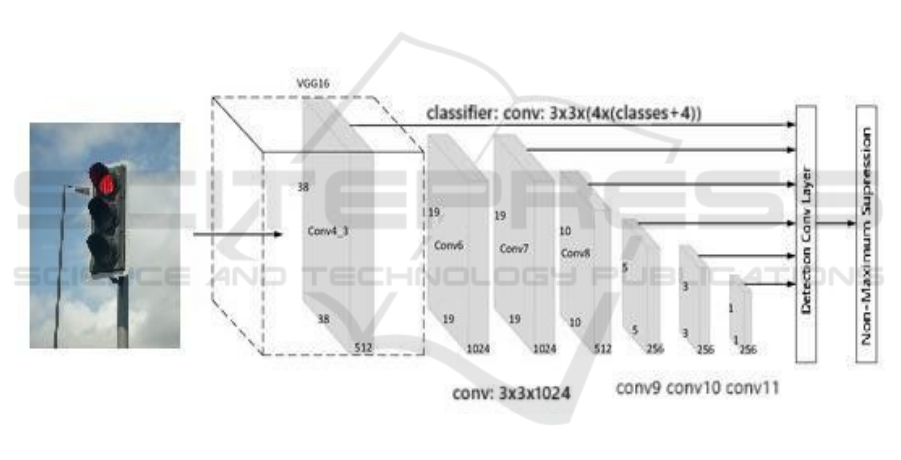
• Data Preprocessing: In below Figure 1,
Preprocessing of data starts with collecting a
diverse dataset of images and videos from
various environments, followed by cleaning
the dataset to address issues like missing
annotations and poor- quality images.
Techniques like rotation, scaling, and
cropping are applied for data augmentation,
while normalization and resizing ensure
consistent pixel values and model
compatibility.
Figure 1: System Architecture.
• Feature Selection: The YOLOv8 model's
backbone network, comprising advanced
convolutional neural networks (CNNs),
extracts detailed feature maps from input
images.
• Model Training: The processed data is
divided into training, validation, and testing
sets, ensuring a structured approach to
model development. The YOLOv8
framework is used to train the object
detection model, optimizing both speed and
accuracy.
• Model Validation: A separate validation set
is utilized to adjust and optimize the model
and prevent overfitting, ensuring it
generalizes well to new data. Performance
metrics are used to evaluate the model, while
the testing set assesses its effectiveness in
real-world scenarios.
7 RESULT AND ANALYSIS
The project exhibits promising results in increasing
freedom of movement and self -reliance for blind
individuals. The system effectively detects objects in
real time and tracks, providing users a timely hearing
alert. Through rigorous testing, the model shows high
accuracy in identifying various objects and obstacles
in both indoor and external environment.
Object Detection Tracking and Alert System for Visually Impaired Persons
47
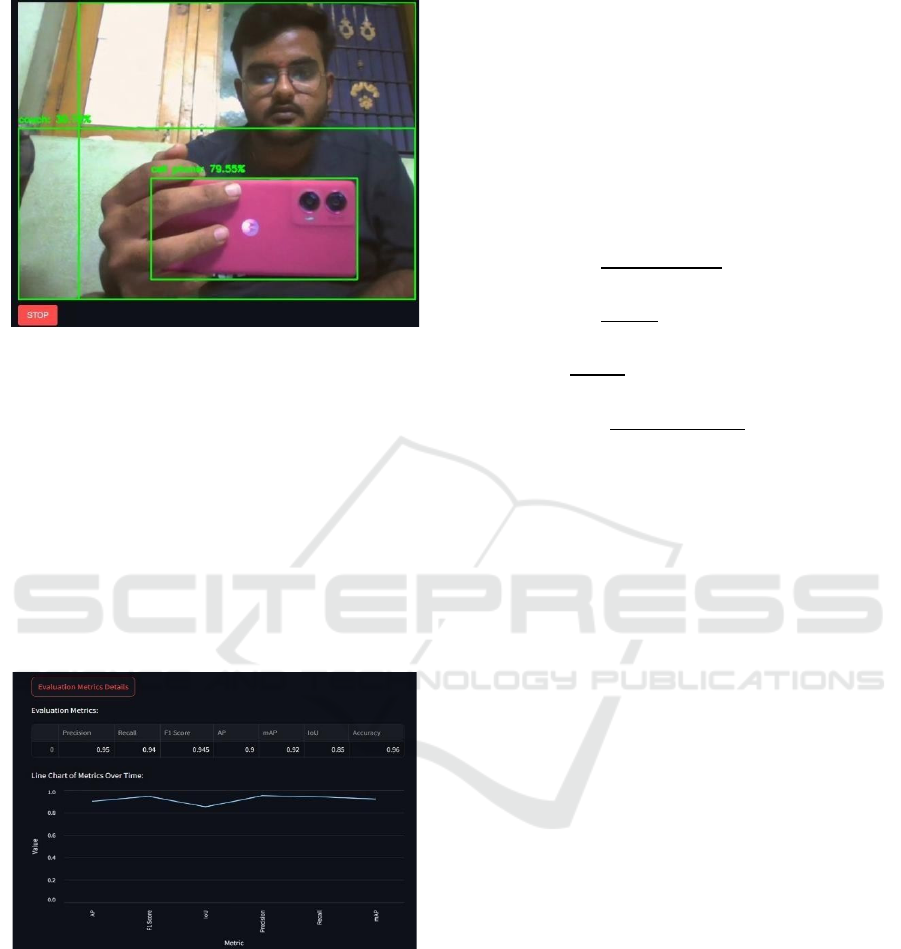
Figure 2: Object Detection.
Figure 2 Displays a cellular smartphone held by a
person. Captured at 1:33. Stepping aside from the
object detection part, the model analyzed the image
and gave results of the individual with 72.59%
confidence and that of a smartphone of 79.55%
confidence. The model is more certain about the
smartphone than the person. This may be due to the
angle of the phone, the lighting, or the quality of the
image. In general, those metrics suggest a strong
performance of the model when detecting objects,
especially more frequent objects (e.g.modes of
mobile devices).
Figure 3: Line Chart of Metrics Used.
The performance of the model throughout time
presented based on important evaluation metrics is
represented in Figure 3. This model obtains a
precision of 0.95, recall of 0.94, and F1-score of
0.945, indicating that the model performs well with
respect to true positive rate while minimizing false
positive detections. An Average Precision (AP) of
0.9 and Mean Average Precision (mAP) of 0.85
indicate that the objects can be easily detected or
classified. Moreover, the IoU score of 0.92 indicates
that detected objects are accurately localized, and an
overall accuracy score of 0.96 indicates its reliability
in real-world applications. Collectively, these metrics
-- precision, recall, F1-score, AP, mAP, IoU, and
accuracy -- illustrate the effectiveness of the model in
both identifying and localizing objects.The results
affirmatively demonstrate the strong performance of
the model with opportunities for additional
enhancements in accuracy detection under varied
conditions leading to reliable and accurate
recognition. To find the performance of the model:
𝐴𝑐𝑐𝑢𝑟𝑎𝑐𝑦 =
( )
(1)
𝑃𝑟𝑒𝑐𝑖𝑠𝑖𝑜𝑛 =
(2)
𝑅𝑒𝑐𝑎𝑙𝑙 =
(3)
𝐹1 𝑆𝑐𝑜𝑟𝑒 = 2.
.
(4)
8 CONCLUSIONS
The Yolov8-based object detection system displays
remarkable real-time detection abilities, which attains
balance between speed and accuracy. Thats why it’s a
powerful tool for many different applications, just
because of how flexible it is in terms of the input it can
handle. Strength analysis with high precision and
recall rates confirms it is a strong model and
generalizes well in different real -world scenarios. It
shows how possible it is to do practical computer
vision tasks using advanced object detection models
(tcvr in our case).
9 FUTURE SCOPE
In the future can deploy yolov 8 in a domain specific
dataset to increase accuracy for special applications.
Moreover, more ways exist to grow the data and more
architectural innovations will increase the accuracy.
It would be important to adapt to the position of
constant updates developing, ensuring continuous
reliability. Such improvements will strengthen the
space of the system as a state -of -the -art equipment
in detecting real -time object. It would be important
to adapt to the position of constant updates
developing, ensuring continuous reliability. Such
improvements will strengthen the space of the system
as a state -of -the -art equipment in detecting real -
time object.
ICRDICCT‘25 2025 - INTERNATIONAL CONFERENCE ON RESEARCH AND DEVELOPMENT IN INFORMATION,
COMMUNICATION, AND COMPUTING TECHNOLOGIES
48

REFERENCES
Ahmad, M., Khan, J., Yousaf, A., Ghuffar, S., Khurshid, K.
(2023). Deep Learning: A Breakthrough in Medical
Imaging. Current Medical Imaging Reviews, 16(10),
Ahn, W.-J., Ko, K.-S., Lim, M. T., Pae, D.-S., Kang, T.- K.
(2023). Multiple Object Tracking Using
ReIdentification Model with Attention Module.
Applied Sciences, 13(3), 4298.
Chen, S., Xu, Y., Zhou, X., Li, F. (2019). Deep Learning
for Multiple Object Tracking: A Survey. IET Computer
Vision, 13(1), doi:10.1049/iet-cvi.2018.5598.
Hoffmann, J. E., Tosso, H. G., Santos, M. M. D., Justo, J.
F., Malik, A. W., Rahman, A. U. (2021). RealTime
Adaptive Object Detection and Tracking for
Autonomous Vehicles. IEEE Transactions on
Intelligent, 6(3), 450-459
Hou, R., Ma, B., Chang, H., Gu, X., Shan, S., Chen, X.
(2019). Interaction-And-Aggregation Network for
Person Re-Identification. In Proceedings of the IEEE
Conference on Computer Vision and Pattern
recognition (CVPR), 9309-9318.
Khoshboresh-Masouleh, M., Shah-Hosseini, R. (2022). 2D
Target/Anomaly Detection in Time Series Drone
Images.
Liu,Q., Chen, D., Chu,Q., Yuan, L., Liu, B., Zhang, L., Yu,
N. (2022, January). Online Multi-Object Tracking with
Unsupervised ReIdentification Learning and Occlusion
Estimation.
Walambe, R., Marathe, A., Kotecha, K., Ghinea, G. (2021,
October). Lightweight Object Detection Ensemble
Framework for Autonomous Vehicles in Challenging
Weather Conditions. Computational Intelligence and
Neuroscience, 2021.
Wang, G., Yuan, Y., Chen, X., Li, J., Zhou, X. (2018).
Learning Discriminative Features with Multiple
Granularities for Person ReIdentification. In
Proceedings of the ACM Multimedia Conference, 274-
282.
Wang, H., Du,H., Zhao, Y., j. (2020). A Comprehensive
Overview of Person Re-Identification Approaches.
IEEE Access, 8, 45556-45583.
Yang, W., Jiang, Y., Wen, S., Fan, Y. (2023). Online
multiple object tracking with enhanced
Reidentification. IET Computer Vision, 17(3),
doi:10.1049/cvi2.12191.
Object Detection Tracking and Alert System for Visually Impaired Persons
49
