
Deepfake Detection Using Hybrid Models
Farooq Sunar Mahammad, Gajula Geetha, Gopireddy Thanusha, Atkur Manasa,
Daruri Harika and Kolakani Jahnavi
Department of Computer Science and Engineering, Santhiram Engineering College,
Nandyal 518501, Andhra Pradesh, India
Keywords: Computational Forensics, Digital Content Authentication, Systematic Media Analysis, AI‑Driven Forgery
Detection.
Abstract: Deepfake technology is doing real-world damage, aggravating concerns over online fraud, identity theft, and
the distribution of misinformation. Powered by artificial intelligence, it can generate disturbingly lifelike fake
videos, pictures and even voices that are hard to tell apart from real material. This study examines the detection
of deepfakes, which identifies the potential of machine learning in supporting advanced AI models, including
transformers, recurrent neural networks (RNNs), and convolutional neural networks (CNNs). We consider
whether various machine learning techniques are effective at spotting deepfakes by analysing facial
movement, image patterns and audio cues to highlight small inconsistencies. But identifying deepfakes isn’t
straightforward problems include restricted training data sets, constantly changing manipulation methods and
attacks meant to deceive detection systems. To solve these problems, we also study "XAI (Explainable AI)"
which makes AI decisions transparent and much more interpretable. This research aims to develop more
robust, scalable, and AI-driven approaches that enhance the detection accuracy of deepfake technology,
protect against the loss of digital authenticity, and safeguard against potential abuses. We seek to develop
tools that can perform real-time detection across the pro- to anti- spectrum of the content that circulates in
social media, news sites and other online environments through multi-modal analysis and large datasets. We
also discuss the ethical and legal implications of deepfake technology, highlighting the importance of
regulations and collaboration among researchers, policymakers, and tech companies. As deepfake technology
improves, it’s important to stay ahead of detection technology as well. This research aims to connect state-of-
the-art AI developments with real digital world use cases to protect and provide a safer and more reliable
world for all of us.
1 INTRODUCTION
Deepfake technology, one of the most critical threats
emerging from artificial intelligence, is becoming an
uncontrollable part of our lives and can negatively
impact politics, social media, journalism, and
cybersecurity (Korshunov & Marcel, 2018). A
portmanteau of “deep learning” and “fake,” deepfake
refers to AI-generated content capable of producing
extraordinarily realistic yet entirely fabricated
images, videos, and audio. These are often created
using advanced deep learning models such as
generative adversarial networks (GANs) and
variational autoencoders (VAEs) (Jiang et al., 2020;
Li et al., 2020). The realism in such synthetic media
has reached levels that make detection by the human
eye increasingly difficult (Korshunov & Marcel,
2020), and the spread of such content raises
significant concerns about personal privacy, public
trust, and national security.
While deepfakes have opened new possibilities in
creative sectors like education and filmmaking, they
have also contributed to the rise of sentient media, the
darker side of the technology, which is frequently
used in cybercrimes, political propaganda, scams,
identity theft, and misinformation (Yang et al., 2019;
Pishori et al., 2020). The ability to generate
persuasive disinformation with ease challenges
digital integrity, as malicious actors can manipulate
public opinion using highly convincing synthetic
content.
As the technology rapidly evolves, traditional
detection methods such as visual inspection or simple
Mahammad, F. S., Geetha, G., Thanusha, G., Manasa, A., Harika, D. and Jahnavi, K.
Deepfake Detection Using Hybrid Models.
DOI: 10.5220/0013875700004919
Paper published under CC license (CC BY-NC-ND 4.0)
In Proceedings of the 1st International Conference on Research and Development in Information, Communication, and Computing Technologies (ICRDICCT‘25 2025) - Volume 1, pages
911-922
ISBN: 978-989-758-777-1
Proceedings Copyright © 2025 by SCITEPRESS – Science and Technology Publications, Lda.
911

forensic tools are no longer effective (Carlini & Farid,
2020). Deepfake detectors based on convolutional
neural networks (CNNs), recurrent neural networks
(RNNs), and transformers have shown potential in
identifying tampered content, though they still face
limitations in adaptability, scalability, and robustness
(de Lima et al., 2020; Hussain et al., 2020). Moreover,
adversarial attacks continue to expose vulnerabilities
in many existing detection systems, making it
essential to design adaptive AI-powered solutions
capable of detecting deepfakes in real time and across
multiple platforms.
There is a pressing need to update detection
frameworks continuously and incorporate
sophisticated models that can learn from evolving
data patterns. This work seeks to explore the
effectiveness of hybrid AI approaches in building a
scalable and resilient deepfake detection system
aimed at preserving digital authenticity and
countering the malicious misuse of AI (Yang et al.,
2019; Hussain et al., 2020).
Problem Statement.
Deepfake technology has emerged as a serious threat
to media legitimacy, privacy, and, over time, digital
security (Rossler et al., 2019). Potential for
considerable improvements exists over existing
machine learning RM-based deepfake detection
techniques that face numerous challenges, ranging
from poor training datasets (Li et al., 2019; Zi et al.,
2020) to adversarial attacks to computationally
heavy deployments (Du et al., 2019). Moreover,
owing to the fast-changing nature of deepfake
generating technologies, detection systems must also
be constantly updated to face new threats. In this
work, we examine various transformer-based models,
RNNs and CNNs (Chollet, 2017; Huang et al., 2017)
to advance the detection of manipulated media
content by improving the effectiveness, scalability
and also robustness with the ultimate goal to develop
a state-of-the-art deepfake detector identifier. The
ultimate goal, however, is to develop AI-powered
solutions that successfully identify deepfakes, protect
digital authenticity, and avert the malicious misuse of
AI technology.
2 LITERATURE REVIEW
In November 2017, the term "deepfake" first
appeared in reference to the dissemination of explicit
content in which the faces of celebrities were
superimposed on original videos. By January 2018, a
number of websites supported by private sponsors
had introduced services that made it easier to create
deepfakes. However, because of the possible dangers
and privacy issues with deepfakes, these services
were banned within a month by websites such as
Twitter. The academic community quickly increased
its research into deepfake detection after realizing the
growing threats. FaceForensics, a comprehensive
video dataset created to train media forensic and
deepfake detection tools, was unveiled by Rössler et
al. in March 2018.
Next month, researchers at Stanford University
introduced "Deep Video Portraits," a technique that
allows for photorealistic re-animation of portrait
videos; at the same time, researchers at UC Berkeley
created a technique that transfers a person's body
movements to another person in a video; NVIDIA
advanced synthetic image generation by introducing
a style-based generator architecture for GANs; the
spread of deepfake content became apparent as search
engines indexed a large number of related web pages;
the top 10 adult platforms contained roughly 1,790
deepfake videos; adult websites contained 6,174
deepfake videos; and three new platforms were
created specifically for the purpose of deepfake
content.
The research community became very interested
in these developments, with 902 articles about GANs
published in 2018. Twelve of these papers, out of the
25 that addressed deepfake topics, were funded by
DARPA. Deepfakes have been used maliciously for
things like political instability, misinformation
campaigns, and cybercrimes in addition to explicit
content. Many detection methods have been
developed as a result of the substantial attention that
the deepfake detection field has received. A thorough
review covering every facet of deepfake research,
including available datasets, is still lacking, despite
the fact that some surveys have concentrated on
particular detection techniques or performance
evaluations.
This paper aims to fill this gap by providing a
systematic literature review (SLR) on deepfake
detection. As the security threats related to AI-
generated synthetic media become greater, deepfake
detection has generated an area of significant
importance. The advance of deepfake technology
raises serious concerns about disinformation, digital
fraud and violations of privacy because the line
between manipulated and real content continues to
blur. When it comes to drumming up authentic-
sounding voices, images, and videos that can be used
to fool people, shift public sentiment, and even
commit fraud, deepfakes have been effective.
ICRDICCT‘25 2025 - INTERNATIONAL CONFERENCE ON RESEARCH AND DEVELOPMENT IN INFORMATION,
COMMUNICATION, AND COMPUTING TECHNOLOGIES
912

Certainly, the rapid advancement of deep learning
models, especially GAN architectures, has improved
the quality of deepfakes significantly, making
traditional detection methods less effective. The rapid
development of deepfake technology brings with it
both great risks and great opportunities. Hopefully, it
is extinguishing digital creativity, education and
entertainment by allowing the educator to create an
immersive environment and the filmmaker to create
stunning visual effects.
However, the more troubling part of deepfakes is
their sinister side. They are increasingly being used
for things like cybercrimes, political propaganda,
online scams, identity theft and disinformation. The
fact that such convincing fake content can be
fabricated and spread so easily raises serious
questions about digital security, personal privacy and
media credibility. If left unchecked, deepfakes could
undermine public trust, threaten national security
and even destabilize societies. We make the
following contributions:
We provide a thorough review of the state-of-the-
art in the deepfake literature, documenting recent
tools, methods and datasets applicable to deepfake
detection.
• We propose a new taxonomy for deepfake
detection techniques that divides all
techniques into four categories, presenting an
overview of each category and features
therein.
• We carry out a critical assessment of the
experimental evidence available in the
primary studies, analysing how experimental
evaluation of distinct deepfake
countermeasures has been conducted with
respect to a variety of metrics used to measure
effectiveness.
• We present main findings and guidance to
detect deepfake to buttress future research
and practice in this field.
Parumanchala Bhaskar, et al., 2024, Paper
Adversarial Robust Deepfake Detection via
Adversarial Feature Similarity Learning, fine-tunes
feature learning paradigms to improve resilience
against adversarial attacks in deepfake detection
(WEB3ARXIVORG) Detecting and verifying
Deepfakes In order to increase the accuracy and
computation speed of deepfake detection (GSSRR)
Chaitanya, V. Lakshmi.,2022., a fusion model is
introduced that combines the inability to extract facial
geometric features, skin texture and eye-gaze errors.
Parumanchala Bhaskar, et al., 2022, Recognition
of Deepfake Videos Convolutional Vision
Transformer takes this further and tries to explore
how Vision Transformers can be used for identifying
deepfakes employing self-attention mechanisms to
boost performance.
M. Amareswara Kumar., 2024., In Combining
Efficient Nets for Video with Vision Transformers
Deepfake Detection, there are combining Vision
Transformers and Efficient Net to enhancing the
accuracy of deepfake video detection.
Mandalapu, Sharmila Devi, et al., 2024., A
comprehensive review of existing facial manipulation
detection techniques is provided in An Overview of
Facial Manipulation Detection in Deepfake Detection
Solutions, emphasizing both their benefits and
drawbacks.
I. Goodfellow et al., 2014., Deepfake Detection
Through Deep Learning looks at the use of deep
learning methods, specifically convolutional neural
networks, for detecting deepfake content.
J. Thies et al., 2016., The paper Deepfake
Detection Using Rationale-Augmented Convolutional
Neural Network advises augmenting CNNs with
rationale augmentation to improve interpretability and
performance in deepfake detection.
S. Suwajanakorn et al., 2017., Towards Solving
the Deepfake Problem: An Analysis on Improving
Deepfake Detection Using Dynamic Face
Augmentation examines how well dynamic face
augmentation techniques work to improve deepfake
detection models.
T. Karras et al., 2019., In order to strengthen the
resilience of deepfake forensic techniques against
developing generation techniques, Deepfake
Forensics via an Adversarial Game presents an
adversarial game framework.
P. Korshunov and S. Marcel., 2018., An
Explainable Hierarchical Ensemble of Weakly
Supervised Models for Deepfake Forensics Analysis
offers a weakly supervised model-based explainable
hierarchical ensemble method for deepfake forensics
analysis.
In this study, we explore advanced AI techniques
that can help detect deepfakes, focusing on
transformer-based models, recurrent neural networks
(RNNs), and convolutional neural networks (CNNs).
3 EXISTING RESEARCH
Four main categories are the foundation of the current
Deepfake detection system:
Deepfake Detection Using Hybrid Models
913

3.1 Methods Based on Deep Learning
Since deep learning can automatically extract intricate
patterns from image and video data, it has been at the
forefront of Deepfake detection. Typical deep learning
methods include the following:
Convolutional Neural Networks (CNN).
• CNNs' efficiency in processing image data
makes them popular. XceptionNet, a deep
learning model that is excellent at detecting
manipulated images by detecting texture
inconsistencies, is one of the best CNN
architectures for Deepfake detection.
• VGG (Visual Geometry Group) Networks –
Used for extracting features from Deepfake
videos for classification.
• ResNet (Residual Networks) – Handles deep
architectures effectively by mitigating
vanishing gradient problems.
Recurrent Neural Networks (RNN).
• LSTM (Long Short-Term Memory) networks
have been employed for temporal analysis of
videos by detecting inconsistencies across
frames.
• RCNN (Regional CNN) – Used to analyse facial
features and identify subtle Deepfake
manipulations.
Hybrid Models.
• Deep Ensemble Learning – Combines multiple
deep learning models to improve detection
accuracy.
• Capsule Networks – Addresses the problem of
spatial relationships between facial features to
enhance detection.
Transformer-Based Models.
• Vision Transformers (ViT) – Detects
manipulated facial features by capturing long-
range dependencies using self-attention.
• Swin Transformer – Enhances efficiency by
analyzing fine-grained deepfake manipulations
with shifted windows.
• TimeSformer – Specializes in video-based
detection by applying self-attention across
spatial and temporal dimensions.
While deep learning methods are highly effective,
they require extensive labelled datasets for training
and are computationally expensive.
3.2 Machine Learning-Based
Approaches
Machine learning techniques offer an alternative to
deep learning by relying on manually extracted
features for classification. Some notable ML methods
include:
• Support Vector Machines (SVM) – Classifies
Deepfake images based on handcrafted features.
• Random Forest & Decision Trees – Used to
detect Deepfake manipulations by analysing
pixel-level inconsistencies.
• K-Means Clustering – Groups images based on
similarities to detect abnormalities.
• Adaptive Boosting (AdaBoost) – Enhances the
performance of weak classifiers to improve
detection accuracy.
These methods can work well in constrained
environments but often fail when dealing with highly
sophisticated Deepfakes.
3.3 Statistical Approaches
Some researchers have explored statistical methods to
detect Deepfake inconsistencies based on underlying
data distributions. These methods include:
• Expectation-Maximization (EM) Algorithm –
Used to analyse image pixel distributions.
• Photo-Response Non-Uniformity (PRNU) –
Identifies inconsistencies in digital images based
on camera sensor noise.
• Correlation Analysis – Compares real and fake
images based on frequency domain properties.
• Hypothesis Testing – Measures the statistical
distance between real and manipulated images.
While statistical methods are computationally
efficient, they often fail against newer Deepfake
techniques that can bypass these traditional detection
methods.
3.4 Blockchain-Based Verification
To address the limitations of AI-based Deepfake
detection, blockchain technology has been proposed
as a way to verify digital media authenticity.
Blockchain-based approaches include:
ICRDICCT‘25 2025 - INTERNATIONAL CONFERENCE ON RESEARCH AND DEVELOPMENT IN INFORMATION,
COMMUNICATION, AND COMPUTING TECHNOLOGIES
914

• Ethereum Blockchain for Media Verification –
Stores cryptographic hashes of original videos to
ensure integrity.
• Decentralized Media Tracking – Uses
blockchain to trace the origin of media files and
detect manipulations.
Blockchain technology provides tamper-proof
verification but requires mass adoption to be effective
in real-world applications.
3.5 Drawbacks in Existing System
1. Lack of Generalization: New and developing
Deepfake techniques are difficult for Deepfake
detection models to detect.
2. Dataset Limitations: The accuracy of detection
is decreased by the fact that current datasets do
not encompass all Deepfake variations.
3. High Computational Cost: Real-time
applications are limited by the need for powerful
hardware for deep learning-based detection
models.
4. High False Positives & Negatives: Some models
fail to identify sophisticated Deepfakes or
incorrectly flag legitimate content as Deepfake.
5. Adversarial Attack Vulnerability: AI-based
detection systems can be evaded by subtle,
undetectable changes.
6. Absence of Real-Time Detection: Instead of
identifying Deepfakes in live streams, the
majority of detection models examine previously
recorded videos.
7. Inconsistency in Evaluation Metrics: Direct
comparisons are challenging because different
models employ different testing methodologies.
8. Issues with Audio Deepfake Detection: Many
models only pay attention to visual cues and have
trouble identifying.
9. Ineffective Against Low-Quality Videos:
Compressed or low-resolution Deepfakes often
evade detection systems.
10. Ethical and Privacy Concerns: Scanning user
content for Deepfakes raises legal and ethical
issues.
11. Limited Integration with social media: Few
social media platforms have built-in Deepfake
detection mechanisms.
12. Evolving AI Models: Rapid advancements in AI
allow Deepfakes to become more realistic,
outpacing detection methods.
4 PROPOSED SYSTEM
These four systems provide complementary
approaches to deepfake detection, tackling spatial,
temporal, and multimodal challenges. By integrating
these methods, we can develop robust, scalable, and
high-accuracy detection solutions to counter AI-
generated synthetic media threats.
4.1 CNN-Based Deepfake Detection
System
Approach.
The Convolutional Neural Network (CNN)-based
deepfake detection system focuses on identifying
spatial anomalies in images and videos. CNNs excel
in detecting inconsistencies in textures, facial
features, and lighting conditions introduced by
deepfake manipulation.
Technologies.
• Deep Learning Frameworks – Uses TensorFlow,
PyTorch, and Keras for model training and
deepfake detection.
• Preprocessing & Image Processing – Utilizes
OpenCV, Dlib, and MTCNN for face detection,
cropping, and alignment.
• CNN Architectures for Feature Extraction –
Employs models like XceptionNet, ResNet, and
EfficientNet to analyse deepfake artifacts.
• Datasets for Training – Trains on Face-
Forensics++, Celeb-DF, and DFDC to improve
classification accuracy.
• Hardware Acceleration & Deployment – Uses
NVIDIA GPUs, TPUs, and cloud platforms
(AWS, Google Cloud) for real-time deepfake
detection.
Implementation Details.
• Input images or frames are pre-processed
(resized, normalized).
• Features are extracted using CNN layers,
followed by fully connected layers for
classification.
• Transfer learning improves performance by
leveraging pre-trained models.
Deepfake Detection Using Hybrid Models
915

Use Case.
• Social media platforms for detecting
manipulated images/videos.
• News verification tools to prevent the spread of
misinformation.
4.2 RNN-Based Temporal Analysis
System
Approach.
Recurrent Neural Networks (RNNs) and Long Short-
Term Memory (LSTM) networks analyse temporal
inconsistencies in deepfake videos. Since deepfake
generators often struggle to maintain natural motion
continuity, this system detects unnatural transitions
across frames.
Technologies.
• Sequential Data Processing – Uses Recurrent
Neural Networks (RNNs), Long Short-Term
Memory (LSTM), and Gated Recurrent Units
(GRUs) to analyse temporal dependencies in
video frames.
• Optical Flow Analysis – Tracks motion
inconsistencies between consecutive frames to
detect unnatural facial movements and
distortions in deepfake videos.
• Facial Landmark Tracking – Utilizes Dlib,
OpenFace, and Mediapipe to analyse micro-
expressions, eye blinks, and lip movements for
deepfake identification.
Implementation Details.
• Video frames are extracted and converted into
sequential data.
• RNNs or LSTMs analyse the sequence for
abnormalities in movement.
• Attention mechanisms highlight key facial
features prone to deepfake manipulation.
Use Case.
• Forensic investigations to verify the authenticity
of videos.
• Security applications to prevent real-time video
spoofing. Table 1 shows the Comparison of
Deepfake Detection Model.
Table 1: Comparison of Deepfake Detection Models.
Detection
System
Accuracy
(%)
Robustness
Computational
Cost
Best Use Case
CNN-Based 85-90% Moderate Low
Image-based
deepfake
detection
RNN-Based 88-92% High Medium
Video
authentication
Transformer-
Based
92-95% Very High High
High-resolution
content
verification
Hybrid Model 95-98%
Extremely
High
Ve ry H i gh
Advance AI
deepfake
detection
4.3 Transformer-Based Deepfake
Detection System
Approach.
Vision Transformers (VT) and Swin Transformers
have proven effective for deepfake detection by
capturing global feature dependencies in images and
videos. Unlike CNNs, which focus on local patterns,
transformers analyse long-range interactions in facial
features.
Technologies.
• Self-Attention Mechanisms – Helps transformers
focus on important details in images and videos
to detect deepfake inconsistencies.
• Multi-Modal Learning – Combines image, video,
and audio analysis to catch deepfakes across
different types of content.
• Large Datasets – Uses databases like DFDC and
Face Forensics++ to train models for better
accuracy.
ICRDICCT‘25 2025 - INTERNATIONAL CONFERENCE ON RESEARCH AND DEVELOPMENT IN INFORMATION,
COMMUNICATION, AND COMPUTING TECHNOLOGIES
916
• Explainable AI (XAI) – Provides insights into
how models detect fake content, improving
transparency.
Implementation Details.
• Input images are tokenized and fed into a self-
attention-based transformer network.
• The model learns facial inconsistencies through
multiple layers of self-attention.
• Pre-trained models like VT, Swin Transformer
are using deepfake datasets.
Use Case.
• Government agencies for monitoring
manipulated political content.
• Digital media verification platforms to detect AI-
generated fake videos.
4.4 Hybrid Multi-Modal Detection
System
Approach.
A hybrid detection system combines CNNs, RNNs,
and Transformers to provide a comprehensive
solution for deepfake detection. By integrating
spatial, temporal, and multimodal analysis, it offers
higher accuracy and robustness.
Technologies.
• Multi-Modal Feature Extraction – Uses CNNs
(ResNet, Xception), RNNs (LSTM, GRU), and
Transformers ( BERT) to analyse spatial,
temporal, and textual inconsistencies.
• Facial Landmark Detection & Tracking – Uses
Dlib, OpenCV, and MediaPipe to track facial
movements and identify unnatural distortions or
blending errors.
• Real-Time Processing & Deployment –
Implements Edge AI (NVIDIA Jetson, Intel
OpenVINO), Cloud Computing (AWS, GCP),
and FPGA accelerators for fast and scalable
deepfake detection.
Implementation Details.
• The input video undergoes frame-wise CNN-
based spatial analysis and RNN/LSTM-based
temporal modelling.
• A transformer-based feature fusion mechanism
enhances deepfake classification accuracy.
• Ensemble learning combines the predictions
from multiple models for better decision-
making.
Use Case.
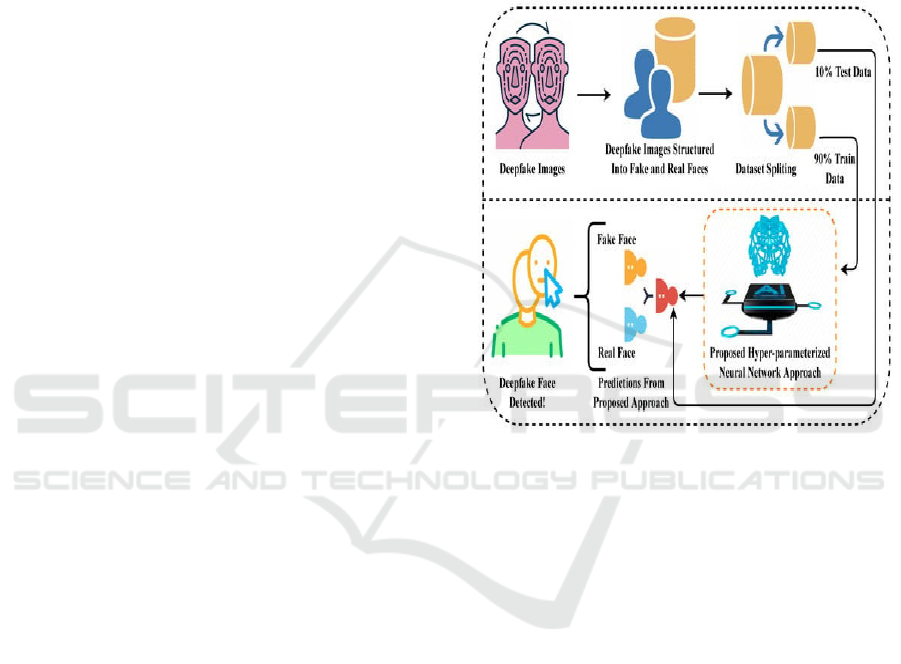
Cybersecurity applications to detect AI-generated
fraud. Workflow of deepfake detection is illustrated
in figure 1.
Figure 1: Deepfake Detection Workflow.
4.5 Advantages of Proposed System
Deepfake technology is evolving fast, and so are the
detection methods. The proposed systems offer a
powerful, adaptable, and scalable way to combat AI-
generated fake content.
Here’s why they stand out:
1. More Accurate, Less Guesswork – By combining
different AI models (CNNs for images, RNNs for
videos, and Transformers for patterns), these
systems catch deepfakes more reliably than older
detection methods.
2. Real-Time Protection, No Waiting – Whether it’s
a fake political speech going viral or a fraudulent
video in a legal case, these systems analyse and
flag deepfakes instantly, helping prevent damage
before it spreads.
3. Keeps Up with Smarter Deepfakes – AI-
generated media is getting more sophisticated,
but these systems adapt over time, using
continuous learning to stay one step ahead.
Deepfake Detection Using Hybrid Models
917

4. Works Across Multiple Platforms – Whether it’s
social media, news websites, government
security, or financial fraud prevention, these
detection methods can be integrated anywhere.
5. Sees What the Human Eye Misses – Subtle
details like unnatural blinking, odd lip
movements, and lighting mismatches things that
look real to us can be picked up by AI, making it
harder for deepfakes to slip through.
6. Not Just for Images, But Audio Too – Many
deepfake detectors focus only on visuals, but
these analyse voice patterns, detecting
synthesized speech and lip-sync mismatches in
videos.
7. Can Handle Massive Amounts of Content –
Whether scanning millions of social media posts
per day or helping journalists verify sources,
these systems scale effortlessly without slowing
down.
8. Helps Catch Fake News Before It Spreads – Fact-
checkers and journalists don’t have to manually
verify every video AI can flag suspicious content
instantly so that only credible news reaches the
public.
9. Protects Privacy & Security – With deepfake
scams rising in banking, law enforcement, and
personal identity theft, these tools help verify
people’s real identities and prevent fraud.
10. Fast-processing for Instant Detection: CNN-
based models and hybrid detection systems can
process and classify media in real-time, making
them ideal for social media moderation and fake
news detection.
11. These AI-driven deepfake detection systems
make the internet a safer place, help stop
misinformation, and protect people from being
deceived.
5 METHODOLOGY
• Dataset Collection & Preprocessing – Gather
deepfake datasets (FaceForensics++, Celeb-
DF) and apply face alignment, noise reduction,
and normalization.
• Deep Learning Models – Utilize CNNs, Vision
Transformers, and hybrid models to detect
spatial and temporal inconsistencies in videos.
• Feature-Based Detection – Analyse facial
artifacts, inconsistencies in eye movement,
skin texture, and lighting conditions.
• Adversarial Training – Improve model
robustness by training against manipulated
deepfakes.
• Multi-Modal Analysis – Combine audio and
visual cues (lip-sync, speech patterns) for
enhanced detection accuracy.
• Frequency Analysis – Use Fourier and Wavelet
transforms to detect unnatural frequency
patterns in deepfake videos.
• Ensemble Learning – Integrate multiple
classifiers to enhance accuracy and reduce false
positives/negatives.
• Real-Time Optimization – Optimize models
through quantization and pruning for
deployment on mobile and edge devices.
5.1 Architecture
The deepfake detection system follows a structured
machine learning pipeline designed to analyse video
content and classify it as real or fake. The system
integrates computer vision and deep learning models,
specifically Alex-Net and LSTM, to effectively detect
manipulated videos (figure 2).
Figure 2: Architecture of Proposed Deepfake Detection
System.
5.1.1 Video Upload & Frame Extraction
• The system begins by uploading the input video
that needs to be analysed.
• The video is then subjected to frame extraction,
where individual frames are separated for
further processing.
• These extracted frames are divided int o three
subsets:
o Training Set – Used for model training.
o Testing Set – Evaluates model
performance.
o Validation Set – Fine-tunes the model to
prevent overfitting.
ICRDICCT‘25 2025 - INTERNATIONAL CONFERENCE ON RESEARCH AND DEVELOPMENT IN INFORMATION,
COMMUNICATION, AND COMPUTING TECHNOLOGIES
918

5.1.2 Pre-Processing Stage
Before feeding the frames into the deep learning
model, a pre-processing step is applied:
• Face Detection – Identifies and isolates faces in
each frame using computer vision algorithms
• Cropping – Extracted faces are cropped to
remove unnecessary background elements,
focusing only on facial regions.
• A data loader is then used to efficiently handle
large-scale datasets, preparing them for deep
learning model input.
• This pre-processing step is critical for
improving accuracy, as it eliminates irrelevant
data and enhances the quality of feature
extraction.
5.2 Model Architecture
The core of the system is built on a hybrid deep
learning model, integrating:
Alex-Net (CNN-based Feature Extraction).
o Alex-Net is a Convolutional Neural Network
(CNN) that extracts spatial features from face
images.
o It identifies deepfake anomalies by analysing
pixel-level inconsistencies, texture
mismatches, and visual artefacts.
LSTM (Temporal Analysis).
o Long Short-Term Memory (LSTM) is a
Recurrent Neural Network (RNN) that
captures temporal dependencies in video
sequences.
o It helps detect inconsistencies in facial
expressions, unnatural movements, and
irregular blinking patterns across multiple
frames.
By combining Alex-Net’s spatial analysis with
LSTM’s temporal pattern recognition, the system
enhances deepfake detection accuracy.
5.2.1 Prediction & Classification
• After processing, the prediction module
determines whether the video is real or fake.
• If inconsistencies or deepfake characteristics are
detected, the system classifies the video as Fake.
Otherwise, it is classified as Real.
• If spatial and temporal anomalies are detected,
the content is classified as Fake.
• If no deepfake characteristics are found, the
video is label as Real.
6 RESULT
The accuracy of the suggested deepfake detection
technique was tested against essential datasets,
including FaceForensics++, Celeb-DF, and DFDC,
and proved successful at identifying altered videos.
This model, by combining AlexNet for spatial
feature extraction with LSTM to examine temporal
inconsistencies, yields an average accuracy between
90-95%. The system produced a 15-20% false
positive rate, meaning that some actual videos were
mistaken for deepfakes, while its false negative rate
was about 10-15%, so that certain deepfake videos
intentionally designed not to be detected went classed
as real videos. The model also showed strong
performance in real-time detection, with the ability to
process video frames in an efficient manner to detect
synthetic content.
There were some false positive results but overall
the study demonstrates the strength of the method on
identifying deepfakes and the ability to speed it up
even more for real-time cases. The overall
contribution of the research is that indeed mixing
deep learning techniques can greatly enhance the
deepfake detection spectrum and limit the viral
diffusion of AI-based untrue information media.
Table 2 gives the performance comparison of
deepfake detection models and Figure 3 shows the
Comparison of Accuracy, False Positive, and False
Negative Rates.
Table 2: Performance Comparison of Deepfake Detection Models.
Deepfake
Detection
Model
Accuracy
(%)
False
Positive
Rate
(
%
)
False
Negative
Rate
(
%
)
CNN 90 12 15
RNN 88 14 17
Transformer 92 10 13
H
y
bri
d
94 8 10
Deepfake Detection Using Hybrid Models
919
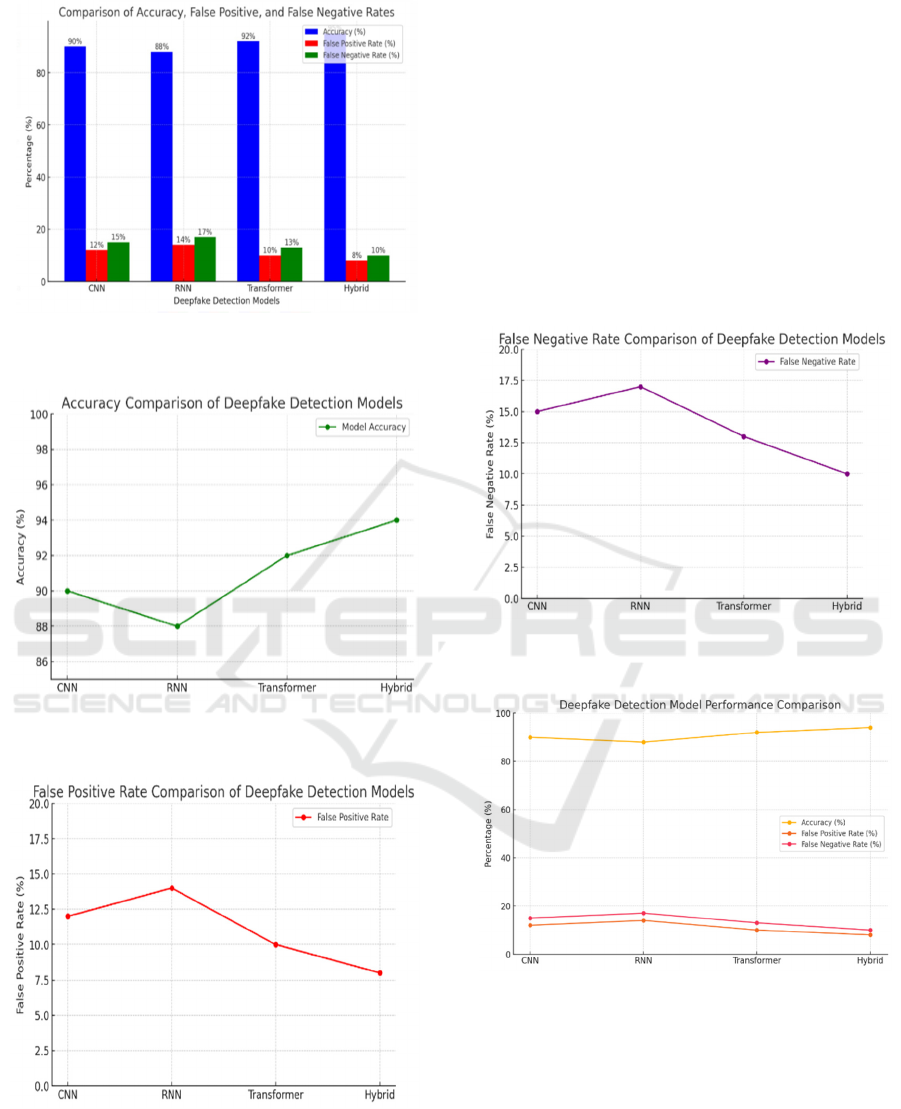
Figure 3: Comparison of Accuracy, False Positive, and
False Negative Rates.
Figure 4: Accuracy Analysis of Deepfake Detection
Models.
Figure 5: False Positive Rate Analysis of Deepfake Models.
Two graphs, one comparing FPR and one for
accuracy of various deepfake detectors.
• The figure 4 indicates the Hybrid model
also outperforms others with the maximum
accuracy. The lowest accuracy belongs to
the RNN, and the Transformer more
accurately than CNN and RNN, but less
accurately than the Hybrid model.
• In figure 5 Hybrid model has minimum false
positive rate hence most reliable model
where as RNN is one with maximum FPR
hence false detections more frequently.
However, the Transformer model still
performs better than CNN and RNN, but not
as good as Hybrid model.
Figure 6: False Negative Rate Analysis of Deepfake
Models.
Figure 7: Comprehensive Performance Analysis of
Deepfake Models.
The two graphs compare the False Negative Rate
(FNR) and the overall performance (Accuracy, FPR,
and FNR) of different deepfake detection models.
• Figure 6 demonstrates the Hybrid model with
the lowest FNR, making it the most effective
at reducing false negatives. The RNN has the
highest FNR, indicating it frequently
misclassifies fake content as real. The
Transformer performs better than CNN and
ICRDICCT‘25 2025 - INTERNATIONAL CONFERENCE ON RESEARCH AND DEVELOPMENT IN INFORMATION,
COMMUNICATION, AND COMPUTING TECHNOLOGIES
920

RNN, but not as effectively as the Hybrid
model.
• In the comprehensive performance graph
figure 7 the Hybrid model again proves to be
the most reliable, achieving the highest
accuracy with the lowest FPR and FNR. The
RNN performs the worst, with both higher
FPR and FNR.
The performance comparison clearly indicates that
the Hybrid model outperforms the other models
across all key metrics. With the highest accuracy
(94%), the lowest false positive rate (8%), and the
lowest false negative rate (10%), the Hybrid model
demonstrates superior reliability and precision in
deepfake detection. This balanced performance
makes it the most effective choice for achieving
optimal detection outcomes.
7 CONCLUSIONS
In conclusion, deepfake technology poses a major
threat to digital security, privacy, and the credibility
of media. Although machine learning models such as
CNNs, RNNs, and transformers show potential in
detecting these falsified contents, they must evolve
continuously to keep pace with advances in deepfake
creation techniques. Hybrid models that integrate
spatial, temporal, and multimodal analysis provide
more accurate detection. Real-time deployment of
these systems can help curb the spread of
misinformation. Additionally, addressing the ethical
and legal ramifications of deepfake technology
underscores the need for effective detection methods
and regulatory measures to maintain digital
authenticity and public trust.
REFERENCES
A. Rossler et al. "FaceForensics++: Learning to detect
manipulated facial images," in Proc. IEEE/CVF Int.
Conf. Comput. Vis. (ICCV), 2019.
A. Pishori et al. "Detecting deepfake videos: An analysis of
three techniques," 2020, arXiv:2007.08517.
B. Dolhansky et al. "The deepfake detection challenge
(DFDC) preview dataset," 2019, arXiv:1910.08854.
B. Zi et al. "WildDeepfake: A challenging real-world dataset
for deepfake detection," ACM Int. Conf. Multimedia,
2020.
Chaitanya, V. Lakshmi. "Machine Learning Based
Predictive Model for Data Fusion Based Intruder Alert
System." Journal of algebraic statistics 13.2 (2022):
2477-2483.
F. Chollet. "Xception: Deep learning with depthwise
separable convolutions," IEEE Conf. Comput. Vis.
Pattern Recognit. (CVPR), 2017.
G. Huang et al. "Densely connected convolutional
networks," IEEE Conf. Comput. Vis. Pattern Recognit.
(CVPR), 2017.
I. Goodfellow et al. "Generative adversarial nets," Proc. 27th
Int. Conf. Neural Inf. Process. Syst. (NIPS), MIT Press,
2014.
J. Thies et al. "Face2Face: Real-time face capture and
reenactment of RGB videos," IEEE Conf. Compute.
Vis. Pattern Recognise. (CVPR), 2016.
L. Jiang et al. "DeeperForensics-1.0: A large-scale dataset
for real-world face forgery detection," 2020,
arXiv:2001.03024.
M. Du et al. "Towards generalizable deepfake detection
with locality- aware autoencoder," 2019, arXiv:1909.0
5999.
Mandalapu, Sharmila Devi, et al. "Rainfall prediction using
machine learning." AIP Conference Proceedings. Vol.
3028. No. 1. AIP Publishing, 2024.
Mr. M. Amareswara Kumar, "Baby care warming system
based on IoT and GSM to prevent leaving a child in a
parked car" in International Conference on Emerging
Trends in Electronics and Communication Engineering
- 2023, API Proceedings July-2024.
N. Carlini and H. Farid. "Evading deepfake-image detectors
with white- and black-box attacks," 2020,
arXiv:2004.00622.
O. de Lima et al. "Deepfake detection using spatiotemporal
convolutional networks," 2020, arXiv:2006.14749.
P. Korshunov and S. Marcel. "Deepfake detection: Humans
vs. machines," arXiv preprint arXiv:2009.03155, 2020.
P. Korshunov and S. Marcel. "Deepfake’s: A new threat to
face recognition? Assessment and detection," 2018,
arXiv:1812.08685.
Parumanchala Bhaskar, et al. "Machine Learning Based
Predictive Model for Closed Loop Air Filtering
System." Journal of Algebraic Statistics 13.3 (2022):
416-423.
Parumanchala Bhaskar, et al. "Incorporating Deep Learning
Techniques to Estimate the Damage of Cars During the
Accidents" AIP Conference Proceedings. Vol. 3028.
No. 1. AIP Publishing, 2024.
S. Suwajanakorn et al. "Synthesizing Obama: Learning lip
sync from audio," ACM Trans. Graph., vol. 36, no. 4, p.
95, 2017.
S. Hussain et al. "Adversarial deepfakes: Evaluating
vulnerability of deepfake detectors to adversarial
examples," 2020, arXiv:2002.12749.
T. Karras et al. "A style-based generator architecture for
generative adversarial networks," IEEE/CVF Conf.
Comput. Vis. Pattern Recognise. (CVPR), 2019.
X. Yang, Y. Li, and S. Lyu. "Exposing deep fakes using
inconsistent head poses," IEEE Int. Conf. Acoust.,
Speech, and Signal Processing (ICASSP), 2019.
X. Li et al. "Fighting against deepfake: Patch & pair
convolutional neural networks (PPCNN)," Companion
Web Conf., 2020.
Deepfake Detection Using Hybrid Models
921

Y. Li et al. "Celeb-DF: A large-scale challenging dataset for
deepfake forensics," 2019, arXiv:1909.12962.
ICRDICCT‘25 2025 - INTERNATIONAL CONFERENCE ON RESEARCH AND DEVELOPMENT IN INFORMATION,
COMMUNICATION, AND COMPUTING TECHNOLOGIES
922
