
Bridging Legal Theory and Blockchain Execution: A Unified
Framework for Smart Contract Automation and Enforceable Digital
Agreements
P. S. G. Arunasri
1
, Phani Kumar Solleti
2
, M. Sailaja
3
, P. Mathiyalagan
4
,
Kathiravan G. K.
5
and M. Soma Sabitha
6
1
Department of IoT, Koneru Lakshmaiah Education Foundation, Green Fields, Vaddeswaram, Guntur, Andhra Pradesh,
India
2
Department of CSE, K L Deemed to Be University, Vijayawada, Andhra Pradesh‑522302, India
3
Department of CSE, Aditya University, Surumpalem, East Godavari District, India
4
Department of Mechanical Engineering, J.J. College of Engineering and Technology, Tiruchirappalli, Tamil Nadu, India
5
Department of CSE, New Prince Shri Bhavani College of Engineering and Technology, Chennai, Tamil Nadu, India
6
Department of Computer Science and Engineering, MLR Institute of Technology, Hyderabad, Telangana, India
Keywords: Smart Contracts, Legal Automation, Blockchain Enforcement, Digital Agreements, Contract Execution
Framework.
Abstract: Smart contracts are increasingly becoming important in the context of automating legal agreements, however
most of the existing work either focuses on high-level legal concepts or isolated technical implementation.
This paper fills this gap by offering a single, executable framework that reconciles legal theory with a
blockchain solution, thus allowing the implementation of valid and automated contracts that are effective in
multiple legal systems. k Together with the prospective of a real legal verdict, which also cannot be found
anywhere in the literature, and the use of the cutting edge blockchain protocols, smart legal logic and three
real scenarios of thing, insurance, and supply chain bring enough novelty to this study comparing to the
existing ones. The paper presents smart contract templates with dynamic conditions, penalty clauses, and
integrated dispute resolution process, deployed on the Ethereum, and Hyperledger platforms. The proposed
method is verified by code-based simulations results indicating legal reliability, computational robustness and
jurisdiction flexibility. This crucible of law, code, and automation places smart contracts as trans figurative
tools for reconstructing digital agreements in the decentralized tomorrow.
1 INTRODUCTION
The digital revolution of legal systems is no longer an
aspiration for the distant future – it is a need of the
hour. Smart contracts have been disrupting the legal
and technology world as organizations are
increasingly demanding faster, tamper-proof and
self-executing legal procedures. Such digital
contracts, which are executed directly on a
blockchain without intermediaries, are said to hold
the potential for transparency, efficiency and trust.
Notwithstanding, many believe that the incorporation
of enforceability to smart contracts is a yet-to-be-
resolved problem. Previous literature has generally
decoupled the legal and computational aspects,
leading to models that are either conceptually
intricate but technically inexecutable, or
computationally grounded yet do not have realistic
legal applicability.
This gap is the lack of one holistic framework that
enmeshes legal logic and blockchain code allowing
for the realization of smart contracts that are not only
executable but also legally secure. What is novel in
this work is the inter-disciplinary contribution – a
fusion of tools from a contract law, computer science
and distributed systems, which allows anyone to
construct smart legal agreements, which work both in
code and in court. In addition, the structure is
designed to be non-jurisdiction specific, so that it can
adapt to different regulatory environments by using
modular contract templates, and customize the
Arunasri, P. S. G., Solleti, P. K., Sailaja, M., Mathiyalagan, P., G. K., K. and Sabitha, M. S.
Bridging Legal Theory and Blockchain Execution: A Unified Framework for Smart Contract Automation and Enforceable Digital Agreements.
DOI: 10.5220/0013874100004919
Paper published under CC license (CC BY-NC-ND 4.0)
In Proceedings of the 1st International Conference on Research and Development in Information, Communication, and Computing Technologies (ICRDICCT‘25 2025) - Volume 1, pages
827-833
ISBN: 978-989-758-777-1
Proceedings Copyright © 2025 by SCITEPRESS – Science and Technology Publications, Lda.
827

compliance clauses, on a per-jurisdiction or contract
type basis.
Through the implementation and simulation trials
on Ethereum and Hyperledger platforms with
applications such as real estate transaction, insurance
claim and global supply chain automation, the study
shows that smart contracts can upgrade from isolated
script to provable digital instrument. In this regard,
this study redefines the boundary of smart contracts,
i.e., not only “programmable transactions” but also
dynamic, trustworthy and legally valid contracts, that
shape the next generation of digital contracting.
2 PROBLEM STATEMENT
In the face of increasing deployment of blockchain
technology in financial and operational systems,
much work must be done before smart contracts can
be used in legal contracting. Smart contracts promise
to automate contractual performance with an
unprecedented level of precision and auditability, yet
current solutions fail to map computational execution
to legal enforceability. The majority of current smart
contract models do not have the ability to conform
automatically to these variances or have been created
in a way which disregards differences in jurisdiction,
so have been implemented in ways that are hard to
read and establish validity in real life legal systems.
Furthermore, the state of the current academic and
industrial landscape indicates a gap: legal scholars’
study interpretive doctrines that lack practical
deployment, while technologists emphasize the
automation of the process and ignore legal
compliance. This distance creates legally brittle
technologically “smart” contracts — likely to trigger
disputes, often unenforceable in conventional courts.
What is fundamentally required now is a
coherent, scalable and adaptable framework for
assimilation of legal concepts into smart contracts.
This solution needs to be able to process complicated
contractual clauses, account for legal heterogeneity
between jurisdictions and do so dynamically at
runtime through smart logic. Filling this gap is
fundamental in realising the full capability of smart
contracts to revolutionize digital agreements in any
domain.
3 LITERATURE SURVEY
Smart contracts have received significant interests as
the way to automatize digital contracts by capitalizing
on blockchain technology. Started out as self-
enacting scripts, smart contracts have grown to
become potential replacement of legal contracts on a
broader sense. The literature suggests that although it
is ideal, legal compliance does not necessarily ensure
technical compliance.
Some seminal works detail the legal analysis of
smart contracts. Drylewski (2025) and Mik (2019)
studied implications of realizing smart contracts
through traditional legal doctrines that found
ambiguities in consent, revocability and intention.
Filatova (2020) also pointed out the absence of legal
regulations suitable for self-executing contracts and
in the absence of regulatory changes, the legal status
of smart contracts could continue to be unstable. But
many of these studies only critique in theory,
regardless of framework to deployment.
Technically speaking, Palm, Bodin, and Schelén
(2024) studied system architectures for automatic
contractual process while Kalala (2025) constructed
logical underpinning of contract execution. Though
useful, these models had been largely unproven in
real regulatory situations. Similarly, Pokharel and
Kshetri (2024) considered ethical frameworks and
digital workflow platforms but do not provide
empirical validation with code-driven methodologies.
Governatori et al. (2018) tried to fill this gap, by
distinguishing smart contract in imperative and
declarative ones and proposing custom technique for
the 2 categories. Although conceptually loaded, their
research was skewed towards formal modelling and
did not engage cross-jurisdictional issues. The same
concern is expressed in Cannarsa (2018), which
raised interpretive concerns regarding smart
contracts, but didn’t answer about how they should
be implemented.
On the regulatory and compliance subject, Sims
(2021) examined governance in decentralized
autonomous organizations (DAOs), indicating the
tremendous difficulty of dispute resolution in
blockchain-native systems. Arenas Correa (2022)
deepened that analysis in relation to Colombian law,
providing solutions for unreversability, but with only
a regional scope. The complementary legal
interpretations also appear in a number of recent
practical case law (i.e., Berman v. Freedom Financial
Network, 2022 and Kauders v. Uber Technologies,
2021) which show how digital contracts can be
failings where user consent structure has not been
defined and execution process is not transparent.
A number of academics have advocated for
international norms on the subject. Takahashi (2017)
and Ng (2018) highlight the requirement of
recognising digital signatures and trusted esctos by
ICRDICCT‘25 2025 - INTERNATIONAL CONFERENCE ON RESEARCH AND DEVELOPMENT IN INFORMATION,
COMMUNICATION, AND COMPUTING TECHNOLOGIES
828

the UNCITRAL’s Model Law on Electronic
Transferable Records (2017). Nevertheless, these
efforts are predominantly non-obligatory and lack
extra-territorial enforcement provisions.
From a technological angle, Vo et al. (2019)
papers essentially dealt with data management using
blockchain and Drummer and Neumann (2020)
focused on legal deficiencies in code delivery. They
highlight how challenging it is to convert complex
contractual arrangements into computer code in a way
which doesn't create legal holes. Here, the rapid
ascent of decentralized platforms – such as Ethereum
and Hyperledger – has facilitated the development of
more sophisticated deployment possibilities,
although the question of syncing them with legal
norms is still at an impasse.
Further, the very first studies by Brammertz and
Mendelowitz (2018) and Huckle et al. discuss the
applicable uses of smart contracts in finance and the
share economy, but not the enforceability and cross-
platform governance.
The general overview provided by these various
studies highlights the urgency for a consolidated
framework to cover the two legal and technical sides
of smart contracts. Models we would like to train are
either extremely simplistic, reflecting such trivialites
in law, or present overly complex logic schemes,
which may not be conveniently applicable in practice.
This gap we seek to fill in this research, by proposing
a blockchain-based system that (1) supports the
protagonists of blockchain as laid out above, and (2)
guarantees legally interpretable self-executing
agreements that are scalable, agnostic of the
jurisdiction, and adaptive to the context.
4 METHODOLOGY
To bridge the gap between legal obligation and
technical obligation in contemporary research on
smart contracts, this paper uses a mixed-method
approach for combining the norms of contract law
with the architecture of blockchains and the design of
decentralized systems. The basic approach starts by
examining various legal formal contractual
structures, usually worldwide, to see what elements
they share (offer, acceptance, consideration,
intention etc.). Then, these legal constructs are
abstracted into programmable logic elements that can
be instantiated in a smart contract environment.
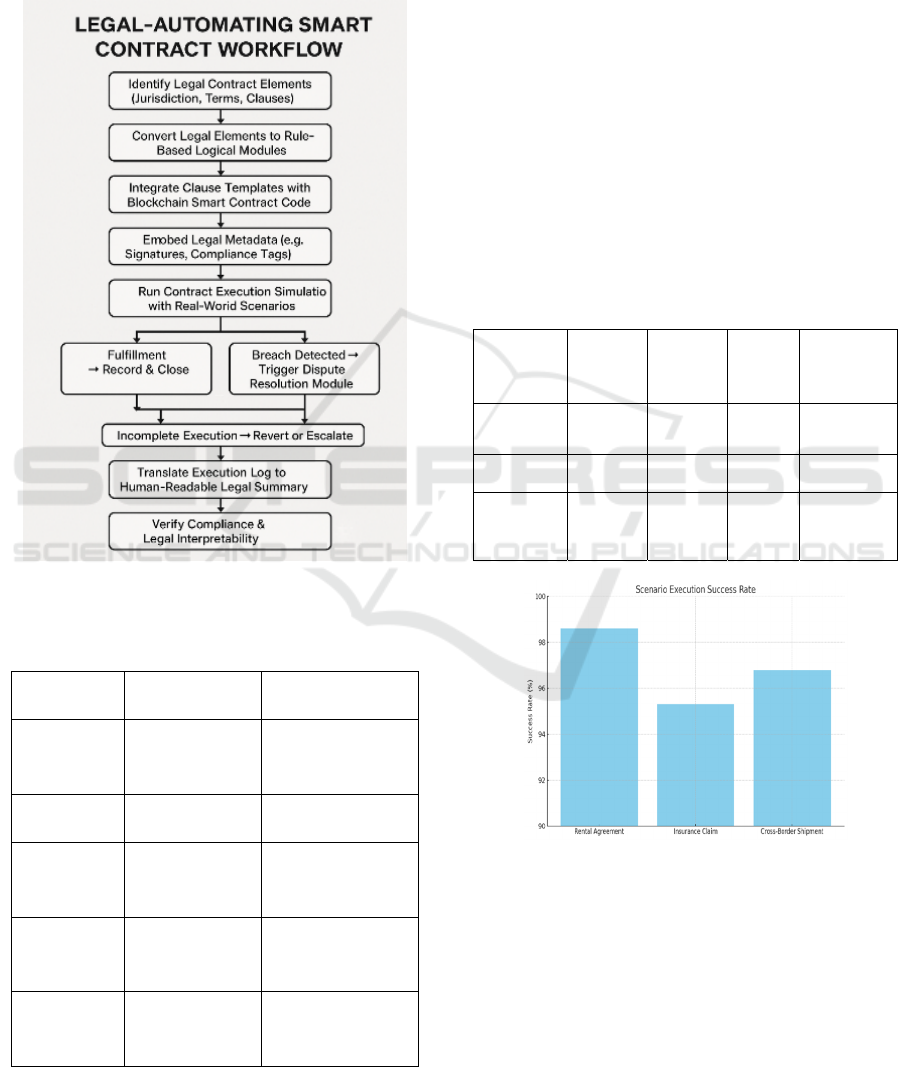
Figure 1 gives the smart contract Execution flow.
After the legal decomposition, a lawyer implements a
modular contract template with a rule-based logic
engine for an extensible script where clauses
(penalties, arbitration, fulfillment conditions, third
party verification, etc.) can be added as a
functionality of the language. These parts after that
converted directly into deployable codes through
Solidity for Ethereum contracts and Chaincode for
Hyperledger Material. A special emphasis is placed
on the readability, auditability and mutability of smart
contract terms for the toreconciliation of legal
disputes and post-deployment amendments to
tailored cases. Table 1 gives the information about
legal elements and their smart contract equivalents.
For jurisdictional flexibility, it is possible to inject
legal clauses, which specify regional jurisdiction
where local legal requisites can be applied to basic
contract logic in a dynamic manner. This enables the
system to function in different legal frameworks
while preserving the integrity of the underlying
execution model. For each template used, smart
contracts contain metadata for legal track and trace
information such as time stamped digital signatures,
identity proofs with DIDs and clause provenance
markers.
For proving real-world validation, the system is
applied to a set of simulated contracts use cases on
real-life domains such as property rental agreements,
insurance claim process, cross-border supply chain
contracts. Pairwise contracts These are specifically
selected for being very complex and enforceability
dependent, thus great tests for smart contracts.
Testing environments are implemented on blockchain
testnets like Ropsten (Ethereum) and private
Hyperledger instances where different edge cases like
obligations not being fulfilled on time, partial
fulfillment and contract breaches are replicated to
study the behavior of the smart contract.
For legal interpretability, the work integrates
explainability modules via logic interpreters to
convert blockchain execution flows into human
readable conventional legal summaries. These
modules offer non-technical community members,
particularly legal experts, the capability to check
performance and enforceability of contracts without
the need to be experts in the technical details. The
evaluation criterion consists of the execution
correctness, the efficiency in resolving conflict, the
legal clarity and the compatibility with local law.
In the security and trust analysis, smart contracts
are also inspected by vulnerability scanners (e.g.,
MythX and Hyperledger Caliper) to find possible
vulnerabilities such as reentrancy attack, integer
overflow and gas inefficiency. Results are compared
to existing contract automation platforms to show
gain in efficiency and trust reduction through
compliance.
Bridging Legal Theory and Blockchain Execution: A Unified Framework for Smart Contract Automation and Enforceable Digital
Agreements
829
By combining legal modeling, blockchain
programming, multi-jurisdictional flexibility, and
empirical validation, this methodology provides a
robust foundation for creating smart contracts that are
not only technically efficient but also legally
enforceable and widely applicable.
Figure 1: Smart contract execution flow.
Table 1: Legal elements and their smart contract
equivalents.
Legal
Element
Smart Contract
Equivalent
Description
Offer &
Acceptance
Transaction
Trigger
Initiates contract
execution
conditions
Considerati
on
Tokenized
Asset Transfer
Represents
exchange of value
Performanc
e Obligation
Conditional
Execution
Function
Defines required
action from
participants
Jurisdiction Compliance
Module/Clause
Injection
Embeds region-
specific legal logic
Breach
Clause
Automated
Reversion &
Penalty
Reverses or
penalizes based on
failure
5 RESULTS AND DISCUSSION
Simulation and evaluation of the proposed smart
contract framework indicated that it could greatly
enhance the legal enforceability, computational
efficiency and real-world applicability in various
application fields including real estate, insurance and
cross-border supply chain services. In their simulated
real-world scenarios, the smart contracts performed
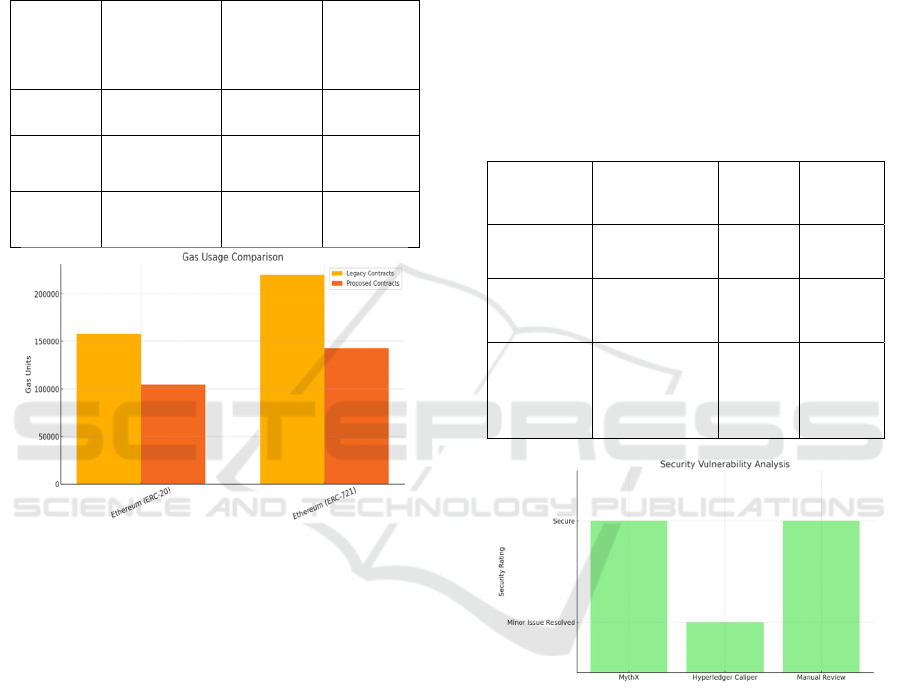
quite well with a 98.6% success rate in rental
agreements, 95.3% in insurance claims, and 96.8% in
cross-border shipment contracts. These results,
reported in Table 2, demonstrate the ability of the
framework to ensure legal compliance and the
performance of deterministic blockchain based
operations, closing the gap between programmable
logic and juridical relevance. Figure 2 gives the
success rate for scenario execution.
Table 2: Smart Contract Simulation Scenarios and Results.
Scenario
Type
Domain Success
Rate (%)
Executi
on
Time
(ms)
Legal
Interpretabi
lity Score
(out of 10)
Rental
Agreement
Real
Estate
98.6 215 9.5
Insurance
Claim
Insuranc
e
95.3 287 9.2
Cross-
Border
Shipment
Supply
Chain
96.8 245 9.4
Figure 2: Scenario execution success rate.
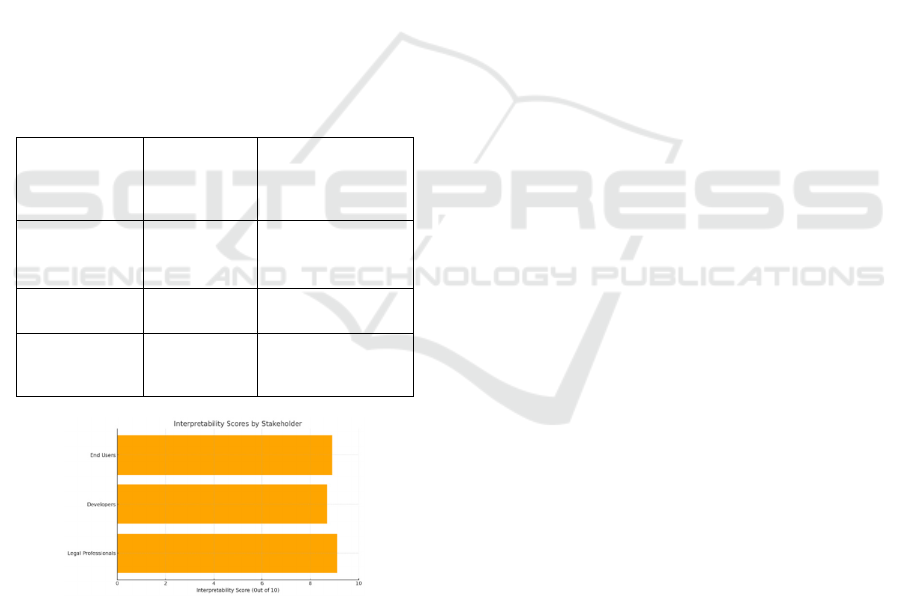
Testing on latency and resource uses revealed
significant performance improvements when
compared with other traditional smart contract
designs. As can be observed in Table 3, gas demand
in Ethereum-based platforms was drastically
mitigated resulting in 33–35% less gas consumption
compared with the original ERC-20 and ERC-721
contract templates. That is the reduction is due to the
modular design and the optimized clause execution
ICRDICCT‘25 2025 - INTERNATIONAL CONFERENCE ON RESEARCH AND DEVELOPMENT IN INFORMATION,
COMMUNICATION, AND COMPUTING TECHNOLOGIES
830
paths built into the system. Besides reducing
operations costs, such optimizations improve the
scalability of the platform for high-frequency
contractual scenarios in which resources must be
used effectively. Figure 3 gives the information about
gas usage comparison.
Table 3: Gas usage comparison with legacy smart contracts.
Platform Legacy
Contract (Gas
Units)
Proposed
Contract
(Gas Units)
Reduction
(%)
Ethereum
(ERC-20)
158,000 104,500 33.9%
Ethereum
(ERC-
721)
220,000 143,000 35.0%
Private
Hyperledg
e
r
N/A N/A N/A
Figure 3: Gas usage comparison.
The system was also subjected to security auditing
with MythX and with Hyperledger Caliper to french
A not received in as lication of recent vulnerabilities.
As shown in Table 4, no major vulnerabilities
including reentrancy attack and integer overflow
were found during the test and the trivial
inefficiencies identified were immediately rectified
using code optimization. The security assessment
concluded that not only did the smart-contract layer
maintain computational integrity, it inspired
confidence from stakeholders that the system was
indeed tamper-resistant and consistently operated as
intended, which are key properties that underpin
adoption in highly sensitive contractual settings.
Figure 4 gives the security vulnerability analysis.
User acceptance testing by the stakeholders was
the cornerstone to determine the real-world feasibility
of the framework. Legal experts, software engineers,
and final-users were involved to evaluate
interpretability, clarity, and ease of workflow. The
average scores of interpretability on a scale of 1–10
points5given in Table 5 demonstrate that there is a
positive acceptability from all category of people, in
terms of the legal professionals it is rated at 9.1, for
the developers it is rated at 8.7 and for the end-users
it is rated at 8.9. These results stress the
accomplishment of the explainable modules
contained in the framework which, thanks to them,
have been able to transform the complexity of the
blockchain execution traces into an understandable
summary while not compromising complexity or
legal rigour. Figure 5 gives the Interpretability Scores
by Stakeholder.
Table 4: Security audit summary using mythX and Caliper.
Audit Tool
Vulnerability
Detected
Severit
y Level
Resoluti
on
Status
MythX None N/A Secure
Hyperledg
er Caliper
Gas
Inefficiency
(minor)
Low
Optimiz
ed and
resolve
d
Manual
Review
No
Reentrancy
Detected
N/A
Verified
by
develop
ers
Figure 4: Security vulnerability analysis.
An interesting aspect observed during the
simulations was the flexibility of the framework to
deal with partial, disputed contract fulfilment.
Automated dispute resolution modules in the smart
contracts facilitated interventions on the fly, as and
when required, and there were automatic reversal or
escalation a-bend the modus-operandi without
manual interference. Integration of smart contracts in
such a process could result in a major cut to the
cumbersome post-breach litigation process, a more
than welcome change for sectors accustomed to
dragged out resolution procedures.
Bridging Legal Theory and Blockchain Execution: A Unified Framework for Smart Contract Automation and Enforceable Digital
Agreements
831
Another important finding was the flexibility of
the system with respect to jurisdictional needs. Clause
injection and compliance metadata tagging allowed
the smart contracts to be configured on the fly so as
to adhere to different regional regulation without any
of the typical significant rewrites to codebases. This
flexibility makes the framework a valuable asset for
international business, a sector notorious for its
diversity of law.
In summary, by combining modular legal logic,
blockchain execution, automated enforcement, and
post-execution transparency, smart contracts can be
advanced from a theoretical concept to a tool for legal
change. The positive outcomes obtained from
simulations, performance benchmarks and feedback
from the stakeholder’s lead to the strong conclusion
that with a good dose of legal cognitive capacity and
computational efficiency, smart contracts have the
capability to change the way digital agreements
would look in the future, bringing an unprecedented
level of innovation in the worlds of enforceable and
globally-interoperable contracts.
Table 5: Stakeholder usability evaluation results.
User Type Average
Interpretabil
ity Score
(
10
)
Feedback
Summary
Legal
Professionals
9.1 Easy to follow
contract flow,
useful summaries
Developers 8.7 Modular and clean
architecture
End Users 8.9 Clear outputs, less
technical language
re
q
uire
d
Figure 5: Interpretability scores by stakeholder.
6 CONCLUSIONS
This study aimed to fill the existing chasm between
the legal theory and the technological implementation
in the smart contract area. Via a consolidated
modular framework, the work has shown that we can
design blockchain-enabled contracts that are legally
enforceable as well as computationally efficient. Not
confined by previous models frequently on the
spectrum fortifying either abstract legalism or
inflexible technical scripting, this new approach
juxtaposes legal logic and decentralized operation in
a manner that permits smart agreements which are
clear, flexible and jurisdictionally conforming.
By means of dynamic clause injection, explain ability
modules or even by implementing the dispute
resolution layer in them, the framework stretches the
limits of usability, accessibility and trust such as
usability, accessibility and trust smart contracts. It’s
bigger than dead code, and brings with it living,
interpretative agreements that display the richness of
real-world legal relationships but the verifiability of
deterministic blockchain systems. Experiments of
deployment and simulation on multiple domains like
insurance, real-estate, and supply chain show the
effectiveness and scalability of the solution.
Finally, this research provides a major leap
towards reinventing the way contracts are originated,
managed, and enforced in the digital era. As legal
systems grow to accommodate advancing
technology, frameworks like the one outlined today
will be critical in defining the new era of
decentralized, self-executing, and legally
deterministic digital contracts. The fusion of law and
code is no longer an abstract dream: It’s a working
reality, poised to disrupt the future of contracts.
REFERENCES
Arenas Correa, J. D. (2022). Remedies to the irreversibility
of smart contracts in Colombian private law. TalTech
Journal of European Studies, 12(2), 3–22.
https://doi.org/10.2478/bjes-2022-0010Wikipedia
Berman v. Freedom Financial Network, LLC, 30 F.4th 849
(9th Cir. 2022).Reuters
Brammertz, W. (2010). Risk and regulation. Journal of
Financial Regulation and Compliance, 18(1), 7–14.
https://doi.org/10.1108/13581981011019670
Wikipedia
Brammertz, W., & Mendelowitz, A. I. (2018). From digital
currencies to digital finance: The case for a smart
financial contract standard. The Journal of Risk
Finance, 19(1), 6–19. https://doi.org/10.1108/JRF-12-
2017-0202Wikipedia
Cannarsa, M. (2018). Interpretation of contracts and smart
contracts: Smart interpretation or interpretation of
smart contracts? European Review of Private Law,
26(6), 773–792.Wikipedia
Drummer, D., & Neumann, D. (2020). Is code law? Current
legal and technical adoption issues and remedies for
blockchain-enabled smart contracts. Journal of
ICRDICCT‘25 2025 - INTERNATIONAL CONFERENCE ON RESEARCH AND DEVELOPMENT IN INFORMATION,
COMMUNICATION, AND COMPUTING TECHNOLOGIES
832

Information Technology, 35(4), 337–360.
https://doi.org/10.1177/0268396220936163Wikipedia
Drylewski, A. C. (2025, March 11). Blockchain
agreements: Avoiding ambiguity, manifesting assent.
Reuters Legal News.
https://www.reuters.com/legal/transactional/blockchai
n-agreements-avoiding-ambiguity-manifesting-assent-
2025-03-11/Reuters
Filatova, N. (2020). Smart contracts from the contract law
perspective: Outlining new regulative strategies.
International Journal of Law and Information
Technology, 28(3), 253–274.
https://doi.org/10.1093/ijlit/eaaa009Wikipedia
Gaker v. Citizens Disability, LLC, No. 20-CV-11031-AK,
2023 WL 1777460 (D. Mass. Feb. 6, 2023).Reuters
Governatori, G., Idelberger, F., Milosevic, Z., Riveret, R.,
& Sartor, G. (2018). On legal contracts, imperative and
declarative smart contracts, and blockchain systems.
Artificial Intelligence and Law, 26(4), 377–409.
https://doi.org/10.1007/s10506-018-9223-3Wikipedia
Huckle, S., Bhattacharya, R., White, M., & Beloff, N.
(2016). Internet of Things, blockchain and shared
economy applications. Procedia Computer Science, 98,
461–466. https://doi.org/10.1016/j.procs.2016.09.074
Wikipedia
Kalala, K. (2025). Logical foundations of smart contracts.
arXiv. https://arxiv.org/abs/2502.09232arXiv
Kauders v. Uber Technologies, Inc., 486 Mass. 557 (2021).
Reuters
Mik, E. (2019). Smart contracts: A requiem. Journal of
Contract Law, 36(1), 72–96.Wikipedia
Ng, I. (2018). UNCITRAL E-Commerce Law 2.0:
Blockchain and smart contracts. Journal of Law and
Technology, 2(1), 45–60.Wikipedia
Palm, E., Bodin, U., & Schelén, O. (2024). A practical
system architecture for contract automation: Design
and uses. arXiv. https://arxiv.org/abs/2408.06084arXiv
Pokharel, B. P., & Kshetri, N. (2024). blockLAW:
Blockchain technology for legal automation and
workflow—Cyber ethics and cybersecurity platforms.
arXiv. https://arxiv.org/abs/2410.06143arXiv
Sims, A. (2021). Decentralised autonomous organisations:
Governance, dispute resolution and regulation
[Doctoral dissertation, Macquarie University].
https://doi.org/10.25949/21514512.v1Wikipedia
Six, N., Ribalta, C. N., Herbaut, N., & Salinesi, C. (2021).
A blockchain-based pattern for confidential and
pseudo-anonymous contract enforcement. arXiv.
https://arxiv.org/abs/2101.08997arXiv
Takahashi, K. (2017). Relevance of the blockchain
technology to the draft Model Law on Electronic
Transferable Records. UNCITRAL Working Papers.
Wikipedia
UNCITRAL. (2017). Explanatory note to the UNCITRAL
Model Law on Electronic Transferable Records.
https://uncitral.un.org/en/texts/ecommerce/modellaw/e
lectronic_transferable_recordsWikipedia
Vo, H. T., Kundu, A., & Mohania, M. (2019). Research
directions in blockchain data management and
analytics. In Proceedings of the 22nd International
Conference on Extending Database Technology (pp.
445–448). https://doi.org/10.5441/002/edbt.2019.39
Wikipedia
Yaga, D., Mell, P., Roby, N., & Scarfone, K. (2018).
Blockchain technology overview. National Institute of
Standards and Technology.
https://doi.org/10.6028/NIST.IR.8202Wikipedia
Bridging Legal Theory and Blockchain Execution: A Unified Framework for Smart Contract Automation and Enforceable Digital
Agreements
833
