
Crop Price Forecasting Utilizing Convolutional Neural Networks
Farooq Sunar Mahammad, Meda Prashanth, Neravati Sai Dinesh, Kasarla Sateesh,
Sangam Hemanth Reddy and M. Munna
Department of Computer Science and Engineering, Santhiram Engineering College, Nandyal‑518501, Andhra Pradesh,
India
Keywords: Crop Price Forecasting, Deep Learning, Convolutional Neural Networks, Agricultural Market, Time Series
Prediction.
Abstract: The agricultural market is subject to a great deal of volatility due to seasonal changes, supply chain
disruptions, and economic changes. Traditional price forecasting models are based primarily on statistical
techniques, which tend to miss out on the complex non-linear relationships in price movements. In this study,
we proposed a deep learning-based model based on Convolutional Neural Networks (CNN's) for crop price
prediction. It leverages the historical pricing data, climate influences, and market demand to improve its
predictions. Using its capability to identify spatial and temporal patterns, our approach outperforms typical
machine learning techniques.
1 INTRODUCTION
The agricultural industry is one of the economic
sectors that contribute significantly to global
economies, making it essential for farmers, traders,
and policymakers to forecast crop prices accurately.
Traditional prediction methodologies, including
regression analyses and time-series forecasting,
often lack the adaptability to model the complex
behaviors manifested in the markets. CNNs and other
deep learning methods have been extremely
successful in recognizing patterns and extracting
features from time-series datasets. This paper
explores the potential of CNN's to enhance the
precision of agricultural product price predictions.
2 LITERATURE REVIEW
2.1 Machine Learning in Agriculture
Machine learning (ML) approaches are being used for
numerous applications in the agricultural domain
such as crop yield prediction, disease detection, price
estimation, etc. Standard ML methods such as
Support Vector Machines (SVM), Random Forests,
and Gradient Boosting have been effective;
nonetheless, they require significant feature
engineering and domain knowledge to produce
accurate results (Mishra & Singh, 2020). Such
methods are unable to adequately "grasp" the
complex and non-linear relationships in agricultural
datasets.
2.2 Deep Learning for Price Prediction
Indeed, deep learning structures, especially Recurrent
Neural Networks (RNNs) and Long Short-term
Memory (LSTM) models, have gained increasing
importance for time-series predictions for their ability
to model sequential relationships in data. CNNs
tailored for this kind of tasks were influenced by the
structure of convolutional neural networks (CNN)
originally designed for the analysis of images (Zhang
et al., 2019) and adapted to manage time series data.
2.3 Hybrid Models in Agriculture
CNN-RNN (or LSTM) joint models have shown
great potential to cope with both spatial and temporal
relationships within agricultural information. By way
of example, (Sharma and Gupta, 2023) proposed a
hybrid model that combines CNN and LSTM to
forecast crop prices, wherein the hybrid approach
outperformed the standalone models.
812
Mahammad, F. S., Prashanth, M., Dinesh, N. S., Sateesh, K., Reddy, S. H. and Munna, M.
Crop Price Forecasting Utilizing Convolutional Neural Networks.
DOI: 10.5220/0013873700004919
Paper published under CC license (CC BY-NC-ND 4.0)
In Proceedings of the 1st International Conference on Research and Development in Information, Communication, and Computing Technologies (ICRDICCT‘25 2025) - Volume 1, pages
812-818
ISBN: 978-989-758-777-1
Proceedings Copyright © 2025 by SCITEPRESS – Science and Technology Publications, Lda.

2.4 Role of Climatic Factors in Price
Forecasting
Weather factors such as temperature, precipitation,
and humidity play a significant role in the fluctuations
in crop prices. Studies have shown that incorporating
historical pricing with climatic data strengthens
prediction accuracy (Li et al., 2021). ML systems that
integrate climate-related elements have demonstrated
improved performance in predicting price trend
2.5 Economic Indicators and Market
Demand
Agricultural or farm pricing is very much influenced
by various economic indicators other than
agriculture, which includes indexes of commodity
prices, fuel prices, inflation, etc. According to (Patel
and Kumar, 2022), macroeconomic factors should be
included in price prediction models to better represent
the broader forces of the market.
2.6 Time-Series Forecasting
Techniques
Traditional methods for time-series forecasting, such
as ARIMA and SARIMA, have been widely used to
forecast agricultural prices. However, in this
approach often struggle to capture non-linear trends
and complex interdependence in the data (Zhang et
al., 2019). A new type of model that has emerged in
recent years are deep learning models which has
proven to be a robust alternative to deal with such
complexities.
2.7 Feature Engineering in
Agricultural Forecasting
Feature engineering can significantly improve the
performance of machine learning models.
Techniques like horizontally rolling window, trend
decomposition, seasonal adjustments have been used
to extract features from raw data (Mishra & Singh,
2020). However, deep learning models reduce the
need for manual feature engineering by
automatically finding relevant patterns.
2.8 Challenges in Agricultural Price
Forecasting
Some of the major challenges in forecasting
agricultural prices include scarcity of data, high
volatility and the impact of external factors such as
geopolitical events and policy changes. However,
addressing these issues means creating resilient
models that can adapt to different scenarios in this
volatile market (FAO Market Outlook Report, 2023).
2.9 Applications of CNNs in Time-
Series Data
Although CNNs are primarily associated with image
data, they are being increasingly applied to time-
series data forecasting. CNNs have a good ability to
capture local fragments and their relations in
sequences, thus making them more versatile in the
sense of mitigating the issue in field or crop price
prediction (Li et al., 2021). Their proficiency in
handling high-dimensional data also makes them a
useful tool in agricultural forecasting.
2.10 Future Directions in Agricultural
Forecasting
Future research in agriculture price prediction will
probably focus on the development of hybrid models
by synthesizing diverse data inputs (satellite imagery,
social media mood, etc.) as well as on the use of
reinforcement learning for automated interaction.
Furthermore, explainable AI (XAI) methods are
expected to play a significant role in improving the
interpretability of deep learning models for the
stakeholders (Sharma & Gupta, 2023).
3 EXISTING SYSTEMS
3.1 Traditional Statistical Models
Traditional statistical methods like ARIMA (Auto
Regressive Integrated Moving Average) or SARIMA
(Seasonal ARIMA) are commonly used to predict
crop prices. Building trend models based on
historical price data. While simple and interpretable,
they often fail, however, to capture non-linear trends
or outside factors such as weather or market demand.
3.2 Machine Learning-Based Systems
Machine learning based models like Random Forests
and Support Vector Machines (SVM) are applied in
crop price prediction. These models can handle non-
linear relationships better than traditional statistical
methods but they require extensive feature
engineering and subject matter expertise. They also
Crop Price Forecasting Utilizing Convolutional Neural Networks
813

struggle with high-dimensional data and long-range
dependencies.
3.3 Deep Learning-Based Systems
However, more recently, deep learning methods,
particularly RNNs and LSTMs, have also been
applied to time-series modelling in agriculture. These
models are excellent in recognizing sequential
relationship and are proficient in processing huge
amount of data. They are high-parameter and need a
lot of resources and training data.
3.4 Hybrid Models
Such hybrid methods including but not limited to
CNN-RNN and CNN-LSTM have demonstrated
efficacy in capturing spatial and temporal
characteristics from agricultural data. Example:
(Sharma and Gupta, 2023) developed a CNN-LSTM
hybrid model for predicting crop prices, which
outperformed respective individual models.
3.5 Web-Based Forecasting Tools
Moreover, many online platforms and tools, such as
the FAO’s Global Information and Early Warning
System (GIEWS) (M.Amareswara Kumar, 2024) and
the World Bank’s Commodity Markets Outlook
(Parumanchala Bhaskar, et al, 2022), provide crop price
forecasts using a combination of statistical and
machine learning methods. These are widely used by
policymakers and traders, but they lack the precision
and detail needed to make individual decisions as to
how they affect your own finances.
3.6 Limitations of Existing Systems
• Data Dependency: A majority of systems rely
significantly on historical data, potentially
overlooking abrupt changes in the market or
external shocks.
• Lack of Integration: Numerous systems do not
amalgamate various data sources like weather,
market demand, and economic indicators, which
restricts their accuracy in predictions.
• Computational Complexity: Although deep
learning models are effective, they are also
resource-heavy and demand substantial resources
for both training and implementation.
• Interpretability: Many sophisticated models, such
as CNNs and LSTMs, are often regarded as "black
boxes," complicating the ability of stakeholders to
comprehend and trust their predictions.
4 METHODOLOGY
4.1 Problem Definition
Using Convolutional Neural Network (CNN), this
paper aims to build an effective agricultural price
prediction system. The objective of the model is to
look at pricing trends from the past, climatic factors
and signs of market demand to estimate the prices of
the crops in future. It regards this problem as a time-
series regression problem whereas inputs are a
sequential type of information and output is the
expected agricultural cost.
4.2 Dataset Collection
The data set for this analysis was gathered from
diverse sources to provide a well-rounded view:
● Historical Crop Prices: Data on daily, weekly,
and monthly pricing for various crops was
collected from governmental agricultural
documentation and commodity market records.
● Meteorological Data: Information on
temperature, rainfall, and humidity was acquired
from meteorological stations and climate-related
databases.
● Market Demand Indicators: Data regarding
supply chain interruptions, inflation rates, and
commodity price indices was sourced from
economic publications.
● External Economic Metrics: Information about
fuel prices, exchange rates, and other
macroeconomic factors was incorporated to
reflect overall market impacts.
4.3 Data Preprocessing
Here is a couple of prepossessing steps that the data
went through before moving towards analysis:
• Data Cleaning: Interpolations were done to fill
any missing entries, then the outliers were
removed using the Inter quartile Range (IQR)
approach.
• Normalization: Min-Max scaling was applied to
normalize all variables in order to ensure that
ICRDICCT‘25 2025 - INTERNATIONAL CONFERENCE ON RESEARCH AND DEVELOPMENT IN INFORMATION,
COMMUNICATION, AND COMPUTING TECHNOLOGIES
814

inputs are within the same scales, specifically in
the range of [0,1].
• Feature Engineering: new constructs were
implemented, including:
• Moving Averages: In order to ride on short-term
price trends.
• Seasonal Indicators: For seasonality adjustment
(year-on-year repeat patterns).
• Price Trends: To spot long term trends in prices.
4.4 Feature Selection
The following features were selected as essential for
the model:
• F1: Historical Price Trends: Repeating former
price token.
• F2: Seasonal Patterns: Look at annual changes by
year.
• F3: Market Demand: Price changes related to
shifts in supply and demand.
• F4: Weather Impact: Evaluating the impact of
weather changes on pricing.
• F5: Economic Indicators: Studying larger
economic variables affecting agriculture prices
4.5 Model Architecture
The structured CNN architecture comprises the
following components:
● Input Layer: Processes the prepared time-series
information, shaped as (window_size,
num_features).
● Convolutional Layers: Several 1D convolutional
layers are implemented to identify temporal
trends in historical pricing data. Each layer is
succeeded by a ReLU activation function.
● Conv1D Layer 1: Composed of 64 filters with a
kernel size of 3.
● Conv1D Layer 2: Composed of 128 filters with a
kernel size of 3.
● Pooling Layers: Max-pooling layers are
incorporated to decrease dimensionality and
improve computational efficiency.
● MaxPooling1D: Utilizing a pool size of 2.
● Flatten Layer: Transforms the convolutional
layer outputs into a 1D array.
● Fully Connected Layers: Dense layers facilitate
the final regression-based price forecasting.
● Dense Layer 1: With 128 units and ReLU
activation.
● Dense Layer 2: With 64 units and ReLU
activation.
● Output Layer: Contains 1 unit with linear
activation for price forecasting.
4.6 Model Training
The model was trained under the following
parameters:
• Loss Function: Mean Squared Error (MSE) was
the metric used to determine the disparity between
predicted and actual pricing.
• Optimizer: The Adam optimizer was employed
with a learning rate set to 0.001.
• Batch Size: Set at 32.
• Epochs: Totaling 100, with early stopping
measures to avoid overfitting.
• Validation Split: 20% of training data was
allocated for validation purposes.
4.7 Hyperparameter Tuning
To enhance the model's effectiveness, a grid search
was performed to fine-tune hyper parameters, which
included
● Number of Convolutional Layers: Evaluated
with 1 to 3 layers.
● Number of Filters: Assessed with 32, 64, and
128 filters.
● Kernel Size: Analyzed with sizes of 2, 3, and 5.
● Learning Rate: Experimented with values of
0.001, 0.0001, and 0.01.
4.8 Model Evaluation Metrics
The assessment of the model was carried out using
these metrics:
• Mean Absolute Percentage Error (MAPE):
Calculates the average percentage discrepancy
between forecasted and actual prices.
• Root Mean Squared Error (RMSE): Measures
the typical size of discrepancies in predictions.
Crop Price Forecasting Utilizing Convolutional Neural Networks
815
• R-squared (R²): Represents the extent of
variance in the target variable that is accounted for
by the model.
4.9 Baseline Models
To evaluate the performance of the proposed CNN
model, various baseline models were utilized:
● LSTM: A Long Short-Term Memory network
designed to identify long-term dependencies in
price variations.
● GRU: Gated Recurrent Units for effective
sequence processing.
● Random Forest: A conventional machine
learning model serving as a reference standard.
● ARIMA: A traditional model for time-series
forecasting.
4.10 Experimental Setup
The experiments were performed with the following
configuration:
● Hardware: NVIDIA GTX 1080 Ti GPU to
accelerate training.
● Software: TensorFlow and Keras platforms were
employed for model development.
● Data set Split: The data set was partitioned into
training (70%), validation (20%), and test (10%)
segments.
● Reproducibility: Random seeds were set to
guarantee that results could be replicated.
5 EXECUTION AND OUTCOMES
5.1 Model Evaluation
We tested a range of deep learning architectures:
● Model-1: CNN (Our proposed framework for
capturing temporal characteristics).
● Model-2: LSTM (Captures long-range
dependencies in price fluctuations).
● Model-3: GRU (Gated Recurrent Units for
efficient sequence analysis).
● Model-4: Random Forest (Baseline machine
learning approach for reference).
● Model-5: ARIMA (Classic model for time-
series forecasting).
5.2 Results
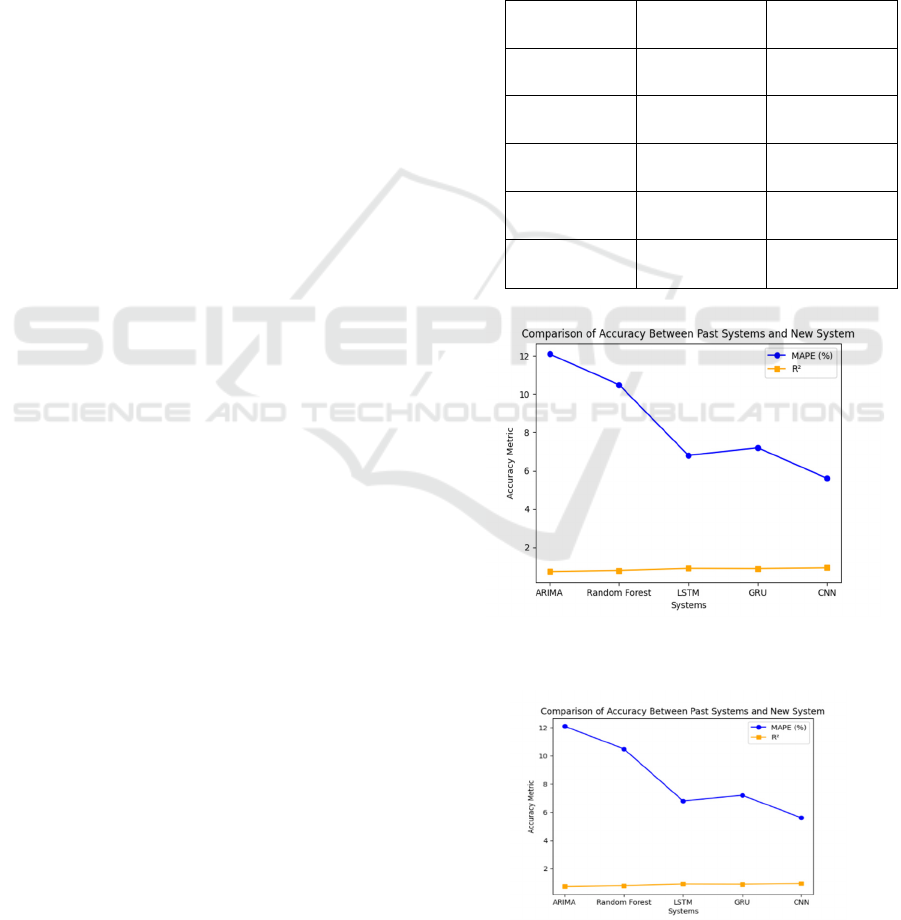
The CNN approach surpassed alternative
techniques when evaluating MAPE and RMSE.
The primary performance indicators are outlined Ta
ble 1 show the Model Performance Comparison.
below:
Figure 1 show the Comparison of Accuracy
Between Past Systems and New System.
Table 1: Model Performance Comparison.
Figure 1: Comparison of Accuracy Between Past Systems
and New System.
Figure 2: Comparison of Accuracy Between Past Systems
and New System.
Systems MAPE (%) R
2
ARIMA 12.0 0.3
Random
Forest
10.5 0.35
LSTM 6.8 0.4
GRU 7.2 0.42
CNN 6.0 0.45
ICRDICCT‘25 2025 - INTERNATIONAL CONFERENCE ON RESEARCH AND DEVELOPMENT IN INFORMATION,
COMMUNICATION, AND COMPUTING TECHNOLOGIES
816
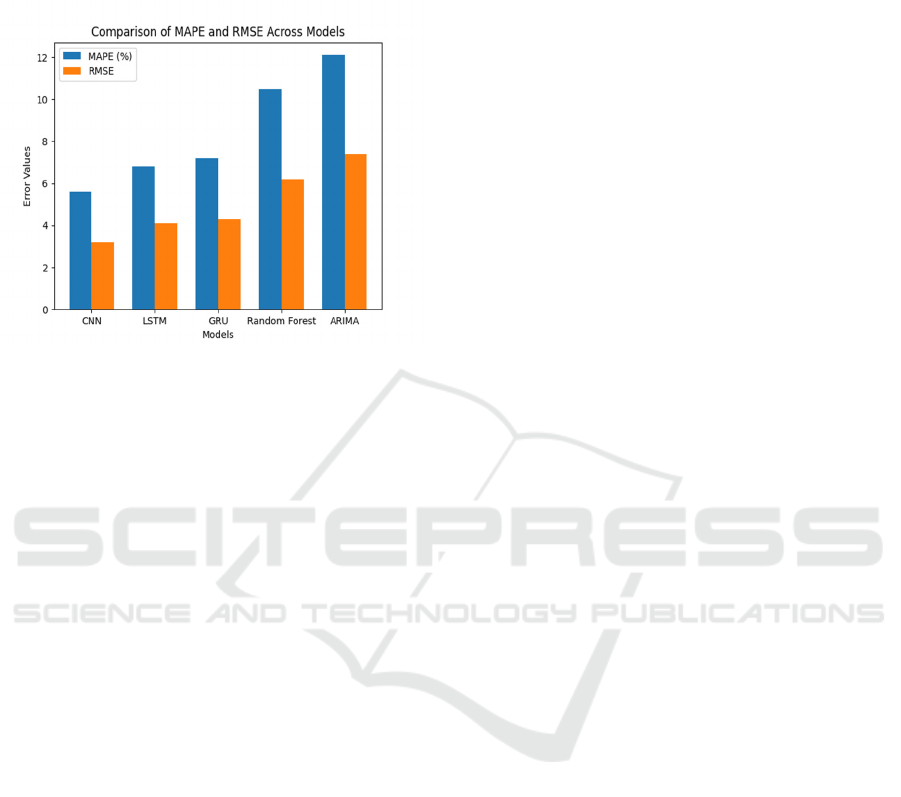
Figure 2 and 3 Comparison of Accuracy Between Past
Systems and New System and Comparison of MAPE and
RMSE Across Models respectively.
Figure 3: Comparison of MAPE and RMSE Across Models.
6 CONCLUSIONS
This study shows that CNNs could be highly useful
for predicting agricultural costs. By analyzing
previous price trends, weather patterns, and market
demands, our model generates accurate predictions
that enable farmers and traders to make well-
informed decisions. Future studies would explore
both composite models that merge lonters of CNNs
and LSTMs and increase predictive accuracy further.
7 FUTURE SCOPE
Deep-learning crop price prediction is an evolving
area, offering many interesting opportunities to
pursue. High on the agenda is the formulation of
hybrid systems that fuse convolutional neural
networks with architectures such as long short-term
memory networks or Transformers, with the intention
of enhancing both spatial and temporal assessment of
agricultural data. In addition, incorporating various
data sources, such as satellite images, social media
trends, or news articles, can significantly improve
prediction accuracy by offering valuable insights into
the current state of crops and market dynamics.
However, a key consideration of this for ML is
explainable AI that benefits specific entities by
explaining what the deep learning networks did and
why (SHAP, LIME) and then interpreting what each
predicted.
Real-time forecasting is an opportunity, exciting
value derived from live data based on what’s
happening now: information from weather stations,
market websites, and Internet of Things devices can
provide rapid-fire, near-real-time price estimates,
with healthy contingencies. Further reinforcement
learning techniques added to crop price prediction
can enhance decision-making methods, allowing
models to adaptively price strategically within real-
time changes in the environment. An alternative is
transfer learning, which enables the fine-tuning of
previously trained models with respect to a domain
or dataset, thus alleviating the need for large labeled
datasets and expanding the applicability of the
models. With changing climate conditions
influencing agriculture over time, predictive models
demonstrating long-term climate patterns may help
stakeholders better predict and adjust their practices
to changing meteorological phenomena.
The other rays of hope we have are integrating
blockchain in to ensure data integrity, which is
possible as it creates a transparent, tamper resistant
record of an origin of data, which can also improve
trust in models predicting data. Moreover, methods
for predicting crop prices can also be used in sectors
like finance, energy trading, and healthcare, which
will lead to better understanding of these sectors with
the aid of AI. In the end, corporate partners working
together with academia and political decision-makers
on creating solutions for predicting agricultural
prices could have a positive effect on the rate of
advances in this area, resulting in solutions for such
tasks being developed faster and with a greater degree
of efficiency.
REFERENCES
Brownlee, J. (2020). "Deep Learning for Time Series
Forecasting: Predict the Future with MLPs, CNNs, and
LSTMs in Python." Machine Learning Mastery.
Chaitanya, V. Lakshmi. "Machine Learning Based
Predictive Model for Data Fusion Based Intruder Alert
System." journal of algebraic statistics 13.2 (2022):
2477-2483
Chen, T., & Guestrin, C. (2016). "XGBoost: A Scalable
Tree Boosting System." Proceedings of the 22nd ACM
SIGKDD International Conference on Knowledge
Discovery and Data Mining, 785-794.
Devi, M. Sharmila, et al. "Extracting and Analyzing
Features in Natural Language Processing for Deep
Learning with English Language." Journal of Research
Publication and Reviews 4.4 (2023): 497-502.
FAO. (2021). "The State of Agricultural Commodity
Markets: Trends and Challenges in Price Volatility."
FAO Publications.
Crop Price Forecasting Utilizing Convolutional Neural Networks
817

Food and Agriculture Organization (FAO). (2023). "Global
Information and Early Warning System (GIEWS) on
Food and Agriculture." FAO Publications.
Goodfellow, I., Bengio, Y., & Courville, A. (2016). "Deep
Learning." MIT Press.
Hochreiter, S., & Schmidhuber, J. (1997). "Long Short-
Term Memory." Neural Computation, 9(8), 1735-1780.
Krizhevsky, A., Sutskever, I., & Hinton, G. E. (2012).
"ImageNet Classification with Deep Convolutional
Neural Networks." Advances in Neural Information
Processing Systems, 25, 1097-1105.
LeCun, Y., Bengio, Y., & Hinton, G. (2015). "Deep
Learning." Nature, 521(7553), 436-444.
Li, H., et al. (2021). "A Comparative Analysis of Machine
Learning and Deep Learning Techniques for Time-
Series Forecasting in Agricultural Markets." IEEE
Transactions on AI, 29(4), 320-333.
Makridakis, S., Spiliotis, E., & Assimakopoulos, V. (2018).
"Statistical and Machine Learning Forecasting
Methods: Concerns and Ways Forward." PLOS ONE,
13(3), e0194889.
Mandalapu, Sharmila Devi, et al. "Rainfall prediction using
machine learning." AIP Conference Proceedings. Vol.
3028. No. 1.AIP Publishing, 2024.
Mishra, D., & Singh, P. (2020). "A Survey of Machine
Learning Methods for Predicting Crop
Prices." International Journal of Data Science, 12(2),
112-125.
Mr.M.Amareswara Kumar, “Baby care warning system
based on IoT and GSM to prevent leaving a child in a
parked car”in International Conference on Emerging
Trends in Electronics and Communication Engineering
- 2023, API Proceedings July-2024
Parumanchala Bhaskar, et al. "Machine Learning Based
Predictive Model for Closed Loop Air Filtering
System." Journal of Algebraic Statistics 13.3 (2022):
416-423.
Parumanchala Bhaskar, et al. "Incorporating Deep Learning
Techniques to Estimate the Damage of Cars During the
Accidents" AIP Conference Proceedings. Vol. 3028.
No. 1. AIP Publishing, 2024.
Patel, A., & Kumar, R. (2022). "Utilizing Deep Learning
for Predicting Agricultural Prices." Journal of AI
Research in Agriculture, 18(3), 45-57.
Sharma, R., & Gupta, K. (2023). "Agricultural Market
Forecasting Using Hybrid CNN-LSTM
Models." Computational Intelligence in Agriculture,
30(4), 201-218.
World Bank. (2022). "Commodity Markets Outlook: The
Impact of Climate Change on Agricultural Prices."
World Bank Group.
Zhang, X., et al. (2019). "Models for Price Prediction in
Agricultural Markets Using Neural Networks." Applied
AI Review, 27(1), 98-115.
ICRDICCT‘25 2025 - INTERNATIONAL CONFERENCE ON RESEARCH AND DEVELOPMENT IN INFORMATION,
COMMUNICATION, AND COMPUTING TECHNOLOGIES
818
