
Experimental Evaluation of Agriculture and Horticulture
Commodities Price Prediction Using Histogram Based Gradient
Boosting Algorithm
S. Saranya, Arul Murugan N., Bharanidharan K., Jeevanantham C. and Jeevak S.
Computer Science and Engineering, Mahendra Engineering College, Namakkal, Tamil Nadu, India
Keywords: Agriculture Price Forecasting, Horticulture, RF, Commodity Price Prediction, Histogram, Gradient Boost,
HGB, Random Forest.
Abstract: Accurately predicting agricultural prices are critical to achieve the sustainable and healthy growth of
agriculture, which is why agricultural price prediction is a prominent study issue in the sector. On the flip
side, it's affected by a lot of things, the most important of which are the fluctuations in agricultural commodity
prices. This paper dives into investigating the pricing patterns of important agricultural commodities among
different producers worldwide, acknowledging the potential of Deep Learning in agricultural applications.
Farmers, dealers, and lawmakers all have a critical responsibility for agricultural price prediction to enable
them to make informed decisions regarding planting, pricing, and distribution. Agriculture is a notoriously
complex and cluttered market, and typical price perspective models have proven themselves incapable. Recent
research has shown that deep learning algorithms analyzing large volumes of historical data to identify
nonlinear dependencies, significantly improves the accuracy of price predictions. We propose Histogram
based Gradient Boosting (HGB), a time series dominate based deep learning model that predicts agricultural
prices. The standard learning model Random Forest (RF) is used to cross-validate the effectiveness of the
proposed model. Along with historical pricing, the proposed model is trained on other influencing factors
such as seasonality, weather, and market demand indicators. The predictions made using the deep learning
one were more accurate and robust in comparison to more traditional models. Experimental results suggest
that this approach can improve on-farm decision-making and result in more efficient and stable market
systems.
1 INTRODUCTION
The agricultural products market is highly sensitive
to price information; large and frequent price spikes
have had a devastating effect on people's ability to
earn a living and on social stability. Apart from the
economic conditions of individual countries or areas,
Agricultural prices forecasting should also be done
with a balance between food supply and demand
across the globe (Girish Hegde et al., 2020) With the
exponential growth of the human population, the
subject of food security has become global. Accurate
forecast of commodity prices should be beneficial to
international organizations, governments, and
agribusinesses in terms of ensuring there is enough
food supply around the world, which maintains the
global food system. Therefore, it is important to
properly predict the prices of agricultural goods to
enhance the quantity-based safety of agricultural
products and promote social and economic
development (Fajar Delli Wihartiko, et al., 2021). More
variables lead to increased impermanence, and, thus,
agricultural commodity prices are more volatile,
complicated and non-stationary than general
commodity prices. Food security on a national and
international scale might be impacted by the regular
and extreme swings in the pricing of agricultural
commodities. Agrarian pricing is heavily influenced
by market forces of supply and demand, according to
the research. Prices are subject to change since
production influences both supply and demand.
Factors including the cost of labour, the cost of
growing, and the state of the global market all have
an impact on the prices of agricultural commodities
(Laveti Krishna Babu, 2024). The practice of using
scientific methods to predict, from current and
historical data, the direction and magnitude of future
730
Saranya, S., N., A. M., K., B., C., J. and S., J.
Experimental Evaluation of Agriculture and Horticulture Commodities Price Prediction Using Histogram Based Gradient Boosting Algorithm.
DOI: 10.5220/0013871900004919
Paper published under CC license (CC BY-NC-ND 4.0)
In Proceedings of the 1st International Conference on Research and Development in Information, Communication, and Computing Technologies (ICRDICCT‘25 2025) - Volume 1, pages
730-737
ISBN: 978-989-758-777-1
Proceedings Copyright © 2025 by SCITEPRESS – Science and Technology Publications, Lda.

price changes in agricultural products is known as
agricultural product forecasting. There are two main
approaches to predicting agricultural prices:
qualitative and quantitative. (Peng Chen et al., 2023.) In
qualitative analysis, all available market price data is
considered, and an overall trend in price direction is
made based on past experience; in quantitative
analysis, all available market price data is compiled,
and specific quantitative judgments about the number
or magnitude of commodity price changes are made
using specific forecasting methods.
Agricultural price forecasting primarily makes
use of quantitative analysis, which can be further
subdivided into several methods based on the
variables being considered, such as univariate and
multivariate forecasting, regression analysis (also
known as causal analysis), machine learning, time
series analysis, and combined models (M. Durga Sai
Sandeep, et al.,2025). Supply and demand, weather
patterns, government actions, market rivalry, foreign
commerce, etc. all have an impact on the pricing of
agricultural products. (Dian Dharmayanti, et Al.,2024) It
is challenging to represent and quantify prices and the
interactions between elements using simple
mathematical models since they are typically
nonlinear, dynamic, and unpredictable. While
conventional methods are simple and quick to use,
they need more a priori knowledge and assumptions
and have poor prediction impacts when dealing with
high-dimensional, nonlinear, and non-smooth data.
There are a number of drawbacks to intelligent
approaches, including their inability to handle
complicated data reliably and consistently, their high
data and computing resource requirements, and their
lack of interpretability and stability (Sourav Kumar
Purohit, et al.,2021).
A significant portion of the overall expenditure on
food production in developing countries is attributed
to inefficient supply networks, as reported by the
World Food Programme. Predictions are crucial to
the handling of these challenges. Everyone from
farmers to lawmakers may benefit from reliable
predictions of global food prices when it comes to
strategic planning and making educated decisions.
An accurate forecast may reduce price volatility by
20%, says the International Food Policy Research
Institute. Progress in AI and ML has led to an uptick
in the precision of predicting models in recent years
(Luana Gonçalves Guindani, et al.,2024). By 2030,
the global agriculture sector could reach into a $2.3
trillion market made possible by digital technologies
like AI and ML, according to the World Economic
Forum. This study covers the history of agricultural
commodity price prediction with the simple solution
methods, hybrid combination models, conventional
and intelligent prediction approaches. (Manas Kumar
Mohanty, et al., 2023) This article has anover view of
the methods that are used for forecasting the prices
of the agricultural products, it states each with their
advantages and disadvantages along with real-life
examples, and then describes the overall pathway of
growth within this area. The present research first
discusses the history of agricultural price forecasting
tools and then analyzes their currently underlying
development status.
2 RELATED WORKS
In this paper, a hybrid forecasting model based on
VMD, EEMD, and LSTM is proposed to address this
problem and solve the large prediction errors caused
by the non-linear features and the large price
fluctuations of agricultural products (Changxia Sun, et
al., 2024). This model is known by the acronym
"VMD-EEMD-LSTM". Starting from the initial time
series of agricultural commodity prices, which is
decomposed using VMD, we see a residual
component that is more complex. So, what you end
up getting from this process is called the VMFs, or
variationally mode functions. After that, the remaining
part is decomposed again using EEMD. Each
component's predictions are then derived by training
an LSTM model with all of the components. Lastly,
the most accurate price prediction is obtained by
linearly combining the forecasts for all components.
We conducted empirical experiments to assess the
VMD-EEMD-LSTM model's efficiency for one-step
and multi-step predictions using weekly pricing data
from China's wholesale agricultural marketplaces for
shiitake mushrooms, cauliflower, Chinese chives, and
pork. This study's composite model improved
predicting accuracy, as shown by the findings.
Accomplishing Sustainable Development Goal 2,
"Zero Hunger” (Anket Patil, et al.,2023), and enhancing
human health and social well-being relies on
achieving food security globally. However, the
volatility of agricultural commodity prices is just one
of several factors that influence food insecurity. This
paper dives into investigating the pricing patterns of
important agricultural commodities among different
producers worldwide, acknowledging the potential of
Machine Learning in agricultural applications. This
paper presents a Hybrid SARIMA-LSTM (HySALS)
to predict the worldwide values of agricultural
commodities based on extensive testing and
performance comparison of appropriate Machine
Learning algorithms. This study examines the
Experimental Evaluation of Agriculture and Horticulture Commodities Price Prediction Using Histogram Based Gradient Boosting
Algorithm
731

suggested method by looking at five key commodities'
price histories: wheat, millet, sorghum, maize, and
rice. Developing nations that produce a major portion
of the world's these crops or are among the top
producers globally are the primary focus of the study,
along with the average production share worldwide.
From 2005 to 2017, we use training data. From 2018
to 2022, we test the model. From 2023 to 2030, we
predict the worldwide prices of key commodities. The
goal of making these forecasts is
to provide farmers and policymakers with more
information they can use to make informed decisions
that will help in the global struggle for food security.
In support of the viability of the economy and
agricultural development, there needs to be stability in
the agricultural futures market (Tingting Zhang, et
al.,2023). Due to the complexity of changes in
agricultural futures prices, it is not easy to overcome
the restrictions that the current data preprocessing
techniques put in place for improvement of the
models’ ability to forecast. In this study, we propose
a novel VMD-SGMD-LSTM model that combines
state-of-the-art quadratic decomposition with an AI
framework. First, we use VMD to clean up the raw
futures price data, and then we let SGMD deal with
the rest of the components. Secondly, several modal
components are predicted using the LSTM model, and
then the result is achieved using the predicted values
from the different components. In addition, using data
from the Chinese agricultural futures market for
wheat, maize, and sugar, this study offers empirical
analysis in one-step, two-step, and four-step forward
forecasting scenarios, respectively. By
outperforming other benchmarked models in terms of
predictive power and resilience across several
agricultural futures, the results show that the VMD-
SGMD-LSTM hybrid model suggested here
overcomes the constraints of earlier research.
Predicting agricultural prices accurately is critical
to achieving the agricultural sector's sustainable and
healthy development, making it a popular study issue
in the sector (Feihu Sun, et al.,2023). It delves into the
many ways of forecasting, including classic,
intelligent, and combination model approaches, and
discusses the difficulties that researchers have when
trying to estimate the prices of agricultural
commodities. The findings of the study propose the
following: (1) the ARIMA and exponential smoothing
price forecasting of agricultural products will be a
developing trend for the future, and understanding the
reasons for the combination will help improve
accurate forecasting; (2) future forecasting models
will continue to incorporate structured, unstructured
data, and variables; and (3) when forecasting these
agricultural product price estimates, accuracy of
values in addition to trend forecasting accuracy will be
advantageous. This manuscript serves to progress a
future durability research agenda, as it reviews and
analyses price forecasting agricultural product
methods.
Predicting agricultural commodity prices with any
degree of accuracy is difficult because of how
complicated and unpredictable these markets are
(Kapil Choudhary, et al., 2025). Predictions made
using current models are generally inaccurate because
they do not account for non-stationary and nonlinear
trends in pricing data. A new hybrid VMD-LSTM
model is introduced to address these challenges; it
combines genetic algorithm, variationally mode
decomposition and long short-term memory (LSTM)
to enhance prediction accuracy. The proposed model
uses GA-optimized VMD, a technique for breaking
down price series into intrinsic mode functions (IMFs)
with the desirable property of sparsity, to speed up the
convergence process. Next, model and forecast each
of these IMFs separately using LSTM models that
have been optimized using GA. The final step in
generating the actual price series is to combine the
predictions of all IMFs. The VMD-LSTM is put to the
test in comparison to three other LSTM and
decomposition-based models using monthly pricing
data for maize, palm oil, and soybean oil (EEMD-
LSTM, CEEMDAN-LSTM). It is possible to measure
the efficacy using directional prediction statistics, root
mean square error and mean absolute percentage
error. As compared to the next best CEEMDAN-
LSTM, VMD-LSTM decreases RMSE by 56.93%,
MAPE by 44%, and palm oil by 21.67% and soybean
oil by 25.85%, respectively. The improved prediction
accuracy of VMD-LSTM is further supported by
TOPSIS and the Diebold-Mariano test. Farmers,
dealers, and policymakers might all benefit from the
proposed model's improved agricultural price
predicting capabilities.
3 METHODOLOGY
The research on the topic of agricultural product price
forecasting is one that is all-encompassing,
interdisciplinary, and constantly evolving. Data
sources, data types, data quality, data processing
techniques, model design techniques, and model
evaluation techniques are always evolving, which
means that the methods used to predict the values of
agricultural goods will also be improved and updated.
The employment of combination optimization
methods by predictive models has been demonstrated
ICRDICCT‘25 2025 - INTERNATIONAL CONFERENCE ON RESEARCH AND DEVELOPMENT IN INFORMATION,
COMMUNICATION, AND COMPUTING TECHNOLOGIES
732
to outperform models utilizing a single optimization
methodology by researchers over an extended period
of time. Combination parameter optimization
techniques have several benefits over single
parameter optimization algorithms, including their
capacity to tackle complicated optimization problems
including discrete, nonlinear, and multi-modal
functions. While the latter have difficulty with issues
like differentiability and convexity, the former
usually necessitate them. One advantage of
combination parameter optimization approaches over
single parameter optimization algorithms is their
ability to avoid local optima, which can be caused by
initial value influence and lead to slow convergence
or inferior solutions. In addition, different problems
have different needs and combination parameter
optimization techniques may respond to that. For
example, the are free to apply neighborhood
structures, multiple fitness functions and crossover
mute strategies. On the other hand, if optimization
algorithms only consider one parameter, they are
usually less flexible and reach more stable results,
which are harder to adapt or improve. Combination
parameter optimization strategies have notable
downsides including their computational complexity,
theoretical analytical reliance, and sensitivity to
parameter selections. So, in real-world applications,
one of the critical challenges is to select the right
optimization algorithms to tackle a certain problem
under a particular set of objectives to make the
required adjustments and to enhance the solution. The
introduction and widespread use of social media has
amplified the influence of public opinion on
consumers and farmers. This influence is complex
and leads to at least unreasonable planting or
purchasing behavior.
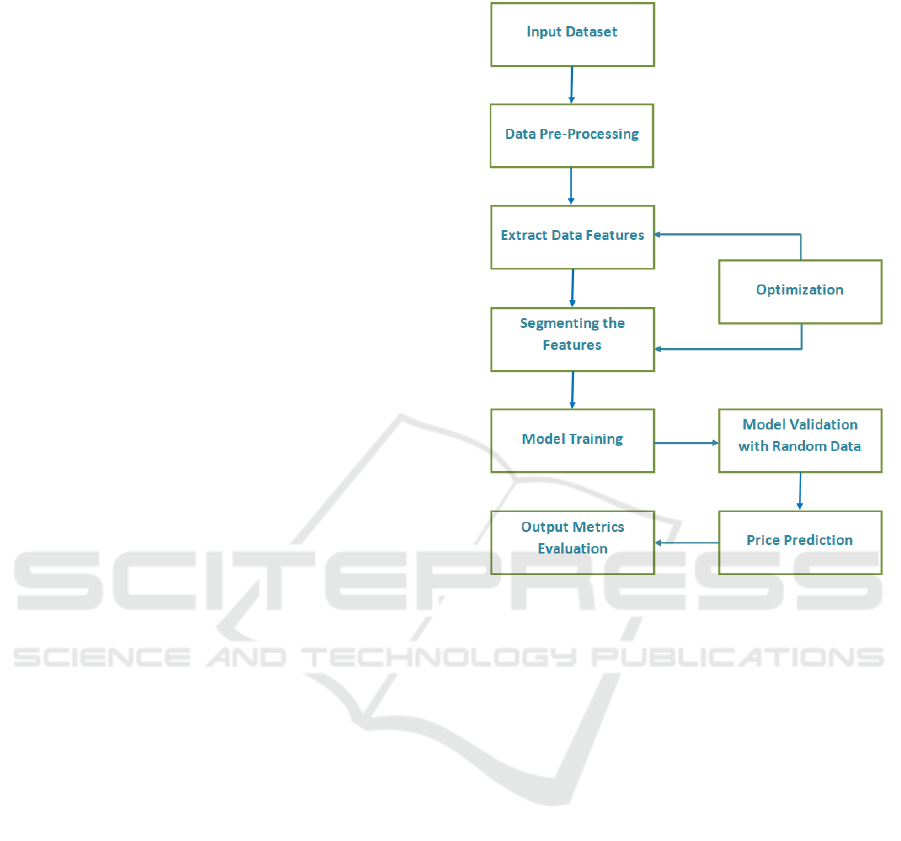
For the purpose of price forecasting and study of
price dynamics, Figure 1 shows the proposed method
flow diagram. The suggested method, Histogram
based Gradient Boosting (HGB), improves upon the
present approach, Random Forest (RF), by making it
more practical and increasing the accuracy of
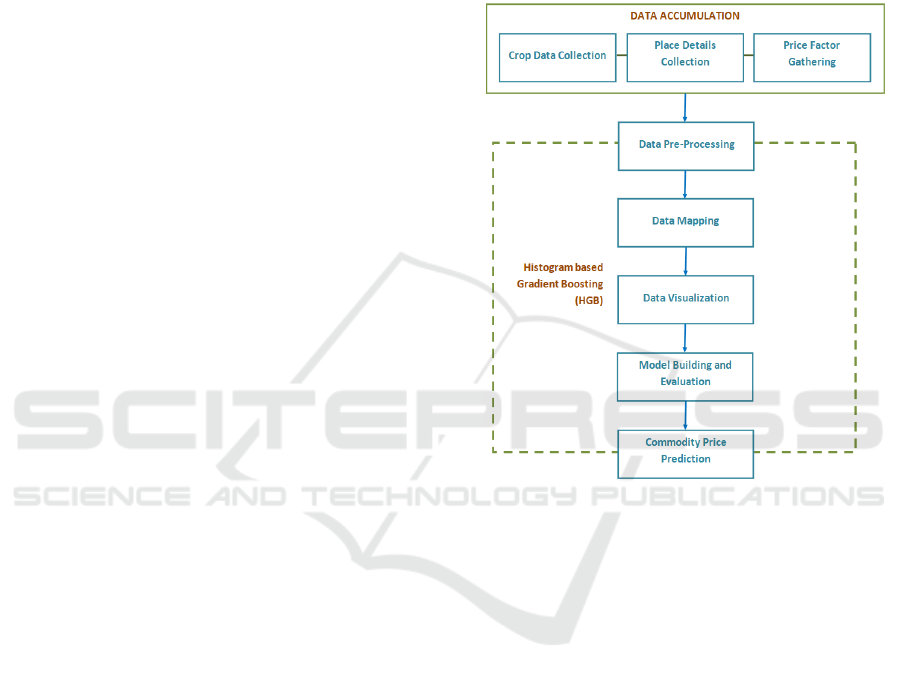
forecasts. Figure 2 of the system architecture above
shows the suggested method for price forecasting and
price dynamics analysis. We consider two types of
data in order to tackle the worldwide food security
problem that this study aims to solve: One is the Crop
data, which includes detailed information on the
commodity, nation, price (in the currency of the
country in which the crop is grown), and quantity (for
each month and year) among other factors that impact
the crop's cost on a worldwide scale. The price data is
another important part of the process since it includes
the nation, month, year, and standard currency value.
These pieces of information are utilized to convert
currency units to US dollars.
Figure 1: System Flow Diagram.
(i) Data Acquisition: To address the issue of food
security on a worldwide scale, this study draws on
two sets of data: The Crop data is one such resource;
it provides comprehensive information on the crop's
worldwide cost by month and year as well as by
product, nation, price (in currency unique to that
country), and quantity. An additional source is the
price data, which includes the following fields:
nation, month, year, and standard currency value.
These fields are utilized for currency unit conversions
to US dollars.
(ii) Data Mapping: Common characteristics, such as
nation, year, and price, are used to map the two sets
of data. More accurate and insightful analysis is
made possible by ensuring thorough and integrated
data generation.
• Data Pre-Processing: The procedures outlined
in the next section are used to pre-process the
data.
• Missing Values Handling: The dataset is filled
up with the average price for each unique set of
country and year to replace any missing values.
Experimental Evaluation of Agriculture and Horticulture Commodities Price Prediction Using Histogram Based Gradient Boosting
Algorithm
733
(iii) Data Grouping: Relevant data points are
grouped from the dataset by filtering and grouping
appropriate nations and commodities within a range.
(iv) Weight Standardization: Weight
standardization is a method for transforming different
weights into a universally accepted amount, in this
case 1 kilogram. This guarantees that all
measurements taken within the system are consistent
and uniform.
(v) Data Validation: In order to verify the accuracy
of the recorded information and the logical coherence
of the values across different features, data
consistency tests were conducted by comparing the
precision of the crop data with the accessible data.
Grey models, regression analysis, and time series
forecasting are some of the most conventional
methods for projecting agricultural prices. These
methods are effective in situations when the variables
are independent, the data is normally distributed, and
the link is either linear or simple nonlinear.
Nevertheless, these requirements are never satisfied
by practical agricultural price forecasting, which
frequently poses complicated issues such
nonlinearity, high dimensionality, and short sample
size. Intelligent forecasting methods are able to
successfully represent nonlinear interactions in price
series and have less modelling constraints and
assumptions than econometric and mathematical-
statistical approaches. Decision trees, support vector
machines, as well as plain Bayes are examples of
conventional machine learning approaches; however,
despite their simplicity, speed to train, and
robustness, these methods struggle with complicated
nonlinear interactions, require human involvement
for feature selection and extraction, and provide poor
generalization.
Feature engineering is unnecessary when deep
learning models are properly supervised, given
sufficient data quantity and quality, and allowed to
extract feature information from the original
sequence. Additionally, they excel at handling
sequences with nonlinear dependencies. Constraints
of the deep learning approach include an inability to
easily alter parameters, a high data volume required,
the risk of overfitting, and a lack of interpretability.
In real-world forecasting scenarios, many forecasting
approaches like RF can be used to solve the same
problem because of diverse modelling systems and
starting points. Various forecasting approaches offer
varying insights, each with their own set of pros and
cons. Rather than being incompatible, they work hand
in hand and complement one another. Agricultural
commodity price forecasting models sometimes have
less-than-ideal characteristics when they are first
established. To get a better prediction model in these
situations, optimizing the parameters is essential.
Parameter optimization commonly employs
techniques such as simulated annealing, particle
swarm optimization, genetic algorithms, grid search,
and cross validation.
Figure 2: Architecture Diagram.
A more scientific way would be to integrate many
valid forecasting methods into one, which is known
as the combined forecasting technique. Combination
forecasting models combine two or more models to
predict variables. They are more accurate,
comprehensive, and make better use of sample data
than individual models. This helps with synthesizing
useful information from different methods and
improves forecasting accuracy. Since the goal of the
project is to forecast food costs throughout the world,
it is necessary to convert all rates into the same
currency. The prices are converted to USD using the
currency rates of the other nations included in the data
at the specified timestamps. The following figure,
Figure 2 represents the system architecture diagram
of the proposed approach.
The annual price trends of many commodities
may be examined through data visualization. To get
a better picture of when crop prices were highest and
lowest, we may sort the price data by year and assign
each one an equal amount of weight.
ICRDICCT‘25 2025 - INTERNATIONAL CONFERENCE ON RESEARCH AND DEVELOPMENT IN INFORMATION,
COMMUNICATION, AND COMPUTING TECHNOLOGIES
734
4 RESULTS AND DISCUSSION
The study applies ML capabilities to address the
fundamental issue of global food security that is
affected by the price of agricultural commodities.
Two significant results are achieved as a result of the
work: In the first place, an examination of the price
fluctuations of important agricultural commodities is
carried out, with a special focus on Wheat, Millet,
Sorghum, Maize, and Rice. The study sheds insight
on the patterns and shifts that have occurred in the
pricing on a worldwide basis. Particular attention is
paid to emerging countries that are either the most
prolific producers of these crops or the ones that attain
the maximum output of this crop in comparison to
other producing countries. The price dynamics study
and anticipated prices provide valuable information
to policymakers, farmers, researchers, as well as other
stakeholders in order to ensure global food security
by mitigating the effects of price-impacting variables,
fostering sustainable agriculture, and making
informed decisions. For stakeholders including
farmers, merchants, and legislators, precise
forecasting of agricultural commodity prices is
essential.
Conventional forecasting methods such as
Random Forest and the like often struggle with the
nonlinear and highly volatile nature of agricultural
price data. Deep learning algorithms have
demonstrated potential for tackling these challenges
due to their ability to capture complex patterns on the
time series. This approach introduced HGF
(Histogram based Gradient Boosting), a new deep
learning method that is particularly useful for
temporal sequence modelling and has been
successfully implemented for price predictions. Four
of the recommended models include external
variables such temperature and precipitation. When
these models were employed on potato, onion, and
tomato's pricing in major Indian markets, they
outstripped traditional statistical and machine
learning approaches, thereby underscoring the
importance of including external entities into
prediction models by realizing diminished error
metrics.
Machine learning techniques, particularly HGB
algorithm and its variants, have shown significant
potential in improving the accuracy of agricultural
commodity price forecasts. Which not only contain
external factors but also cover hybrid models helps
to better accuracy of integration forecasting and thus
can provide useful input for agriculture sector actors
to make reasonably informed decisions. For various
groups including farmers, merchants, and legislators,
accurate forecasting of agricultural prices is critically
important. Agricultural pricing data is nonlinear and
volatile, making it sometimes difficult to handle with
traditional statistical methods. Due to their ability to
capture complex patterns in time series data, deep
learning algorithms have shown promise in
addressing these challenges. Deep learning models
have exhibited potential in addressing these
challenges as a result of their ability to capture
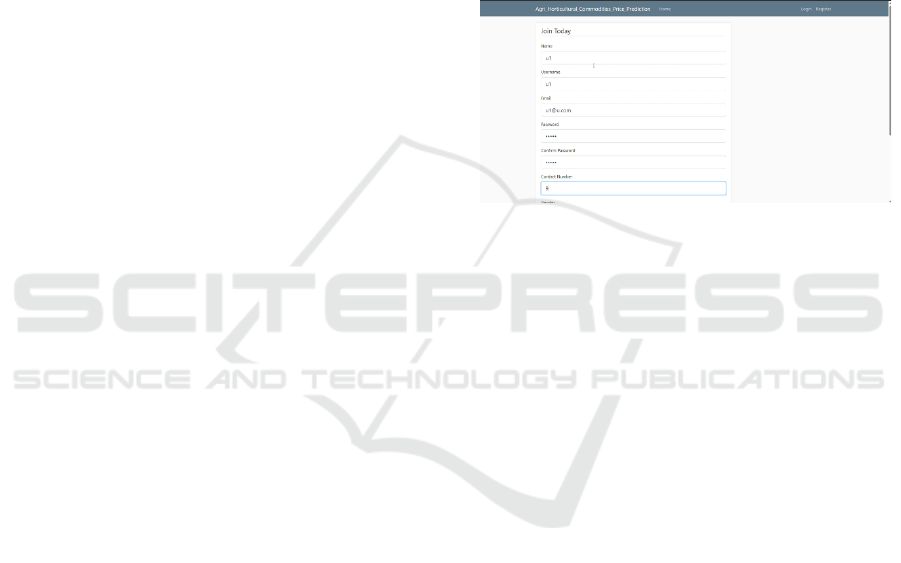
complex regularities within time series data. Figure 3
shows the user registration page of the proposed
method. 3, requires the user or farmer to verify their
identification before visiting to the login page.
Figure 3: User Registration.
The results of the proposed method's user login,
commodity details registration, and commodity price
prediction pages are shown in Figures 4, 5, and 6,
respectively.
The accuracy ratio of the proposed scheme is
evaluated by cross-validating it with the standard
learning model called Random Forest (RF). The
accompanying figure, Figure 7, shows the output
prediction accuracy of the proposed technique HGB.
Table 1 provides a descriptive representation of the
same.
Experimental Evaluation of Agriculture and Horticulture Commodities Price Prediction Using Histogram Based Gradient Boosting
Algorithm
735
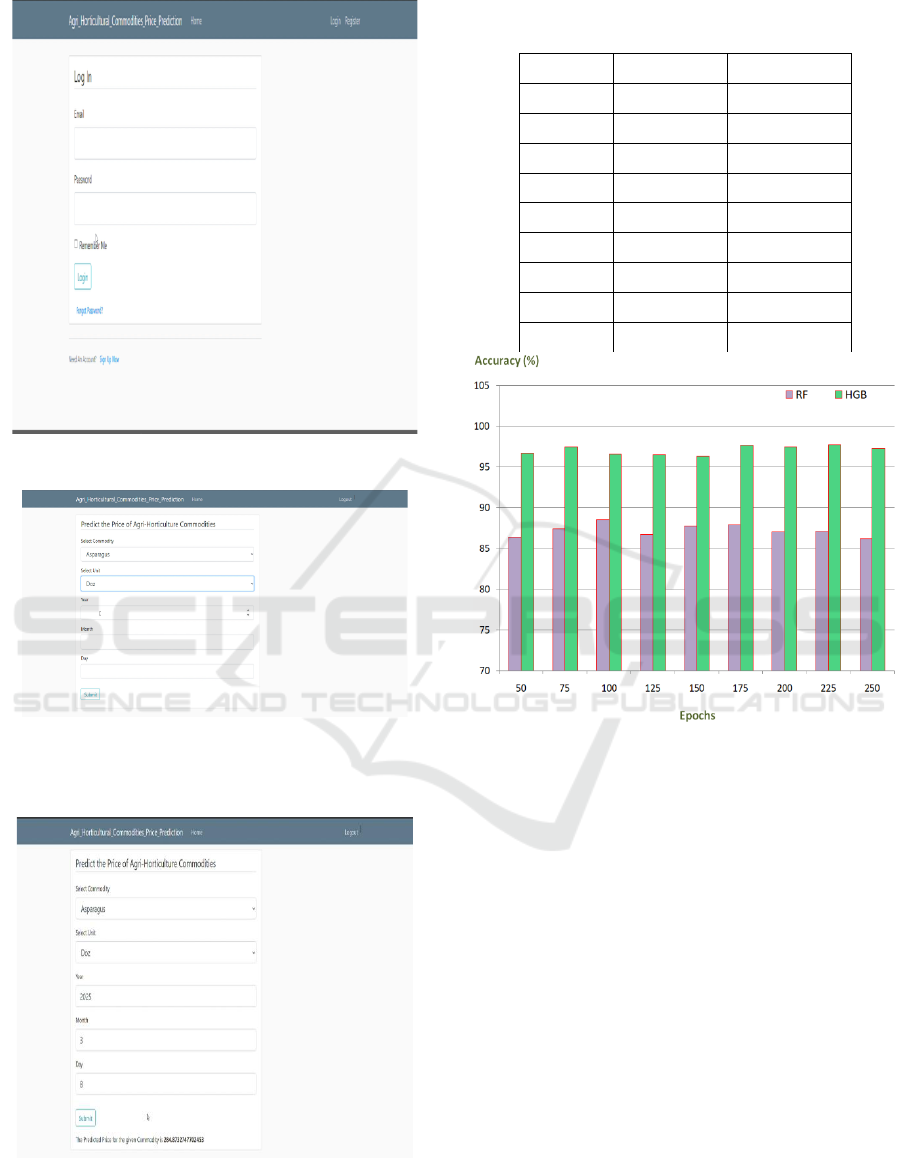
Figure 4: Login Page.
Figure 5: Commodity Details.
Figure 6: Commodity Price Prediction.
Table 1: Analysis of Commodity Price Prediction Accuracy
Between Rf and Hgb.
Epochs
RF (%)
HGB (%)
50
86.36
96.73
75
87.39
97.46
100
88.54
96.59
125
86.67
96.48
150
87.76
96.32
175
87.87
97.64
200
86.98
97.44
225
87.08
97.71
250
86.19
97.28
Figure 7: Commodity Price Prediction Accuracy.
5 CONCLUSION AND FUTURE
SCOPE
The unpredictable and multi-factorial character of
agricultural markets makes agricultural price
prediction a difficult task. In this unit, we saw how
two state-of-the-art deep learning algorithms,
Random Forests (RF) and Histogram-based Gradient
Boosting (HGB), non-traditional methods of
agricultural price forecasting, might better than more
traditional methods. Agricultural prices are affected
by complex non-linear interactions among multiple
variables such as weather patterns, supply and
demand shocks, market trends, etc.: such interactions
were captured using ensemble learning techniques.
The results showed that compared with traditional
methods, both Random Forests and Histogram-based
Gradient Boosting models were more accurate and
ICRDICCT‘25 2025 - INTERNATIONAL CONFERENCE ON RESEARCH AND DEVELOPMENT IN INFORMATION,
COMMUNICATION, AND COMPUTING TECHNOLOGIES
736

differential. Due to its relatively simple interpretation
through feature importance scores (rankings), RF was
particularly successful at identifying non-linear
relationships. In contrast, HGB\u2019s prediction
performance was closer to CTB, which required more
time in terms of prediction, while HGB greatly
improved the efficiency of the training speed in
handling large datasets. Given the complexity of the
data with some structured features such as historical
pricing data to unstructured features like weather and
market demand indicators, the suggested model
performed well. This showcases the algorithms'
capacity of handling the variability of continuous
information throughout different land points for
predicting prices in an agricultural setting. The
evaluations further proved that meticulous
hyperparameter tuning is necessary to achieve high
performance and the disasters showed that the
models can make accurate predictions for agricultural
prices.
In the future, research could focus on price
forecasting by incorporating climate change, quantity
of warehousing, supply to demand ratios per country,
and population dynamics as inputs to Machine
Learning models. Those elements have a large
influence on price dynamics and ultimately on food
security.
REFERENCES
Anket Patil, et al., "Forecasting Prices of Agricultural
Commodities using Machine Learning for Global Food
Security: Towards Sustainable Development Goal 2",
International Journal of Engineering Trends and
Technology, 2023.
Changxia Sun, et al., "A Study on Agricultural Commodity
Price Prediction Model Based on Secondary
Decomposition and Long Short-Term Memory
Network", Agriculture, 2024.
Dian Dharmayanti, Et Al., "Application Of Data Mining
For Predicting Horticultural Commodities Price",
Journal of Engineering Science and Technology, 2024.
Fajar Delli Wihartiko, et al., "Agricultural Price Prediction
Models: A Systematic Literature Review", Proceeding
s of the 11th Annual International Conference on
Industrial Engineering and Operations Management,
2021.
Feihu Sun, et al., "Agricultural Product Price Forecasting
Methods: A Review", Agriculture, 2023.
Girish Hegde, et al., "A Study On Agriculture Commodities
Price Prediction and Forecasting", International
Conference on Smart Technologies in Computing,
Electrical and Electronics, 2020.
Kapil Choudhary, et al., "A genetic algorithm optimized
hybrid model for agricultural price forecasting based on
VMD and LSTM network", Scientific Reports, 2025.
Laveti Krishna Babu, "Analysis of AI-ML Models for
Prices Forecasting of AgricultureandHorticultural
Commodities", International Journal of Research
Publication and Reviews, 2024.
Luana Gonçalves Guindani, et al., "Exploring current
trends in agricultural commodities forecasting methods
through text mining: Developments in statistical and
artificial intelligence methods", Heliyon, 2024.
M. Durga Sai Sandeep, et al., "AI-ML Based Price
Prediction Model for Agri-Horticultural
Commodities", International Journal of Research
Publication and Reviews, 2025.
Manas Kumar Mohanty, et al., "Agricultural commodity
price prediction model: a machine learning
framework", Neural Computing and Applications,
2023.
Peng Chen, et al., "Short-term Forecast of Agricultural
Prices Using CNN+LSTM", Proceedings of the 7th
International Conference on Intelligent Information
Processing, 2023.
Prashantha S, et al., "Agricultural Crop Commodities Price
Prediction Using Machine Learning Techniques",
International Research Journal of Innovations in
Engineering and Technology, 2020.
Sourav Kumar Purohit, et al., "Time Series Forecasting of
Price of Agricultural Products Using Hybrid Methods",
Applied Artificial Intelligence, 2021.
Tingting Zhang, et al., "Agricultural commodity futures
prices prediction based on a new hybrid forecasting
model combining quadratic decomposition technology
and LSTM model", Frontiers in Sustainable Food
Systems, 2024.
Experimental Evaluation of Agriculture and Horticulture Commodities Price Prediction Using Histogram Based Gradient Boosting
Algorithm
737
