
Smart Detection and Prevention of Cloud Based Security Threats
Using Machine Learning
Parumanchala Bhaskar, Somisetty Akhil, R. S. Venkhatesh, Shaik Sajid,
M. Prem Kumar and S. Mansoor Basha
Department of Computer Science and Engineering, Santhiram Engineering College, Nandyal, Andhra Pradesh, India
Keywords: Privilege Escalation, Insider Attack, Machine Learning, Random Forest, Adaboost, XGBoost, LightGBM,
Classification.
Abstract: This task utilizes advanced machine learning to enhance cloud protection, specifically addressing and
mitigating privilege escalation attacks for a greater resilient protection mechanism. With the growth in cloud
adoption, the threat of privilege escalation attacks also escalates. This assignment goals holes in employee get
admission to privileges in cloud services to improve usual protection. The task makes use of machine learning
to facilitate actual-time identification and prevention of privilege escalation attacks. Strategies like as
LightGBM, Random forest, Adaboost, and Xgboost provide a sturdy protection in opposition to rising threats.
Individuals and establishments come upon stronger records protection, cultivating self-assurance in cloud
computing. Cloud service vendors and corporations accumulate guarantee in a comfortable online ecosystem,
reaping the advantages of the task's security upgrades. A vote casting Classifier, integrating predictions from
decision Tree, Random forest, and support Vector machine through a "tender" vote casting method, improves
the system's efficacy in figuring out and countering privilege escalation attacks. A person-friendly Flask
framework with SQLite integration enhances user trying out by way of offering secure signup and signin
functionalities for realistic installation and evaluation.
1 INTRODUCTION
Cloud computing represents a progressive paradigm
for delivering and facilitating offerings through the
internet. The present infrastructure. Cloud storage
organizations put into effect essential security
protocols for their structures and the facts they
manage, encompassing encryption, get entry to
control, and authentication. The cloud gives nearly
infinite ability for storing numerous varieties of data
throughout diverse data storage architectures,
contingent upon accessibility, velocity, and
frequency of statistics retrieval. Data breaches
involving sensitive facts may additionally get up from
the big flow of facts between organisations and cloud
carrier vendors, whether unintended or intentional.
Parumanchala Bhaskar, et al., The attributes that
facilitate consumer-friendliness in online services for
employees and IT structures simultaneously
complicate efforts for companies for preventing
unauthorized access. The Authentication and open
interfaces constitute rising protection issues that
agencies come across with cloud services. Notably
professional hackers employ their information to
infiltrate Cloud infrastructure. Parumanchala
Bhaskar, et al. 2022; Mahammad, Farooq Sunar, et al.
2024, Machine learning to know utilizes numerous
methodologies and algorithms to address security
challenges and decorate data control. Numerous
datasets are confidential and can't be disclosed due to
privacy issues, or they will lack essential statistical
characteristics.
The rapid expansion of the Cloud area engenders
privacy and protection threats regulated via rules.
Worker access privileges may additionally remain
unchanged as they transition to different jobs or
positions inside the Cloud agency. Consequently,
obsolete privileges are exploited detrimentally to
suitable and harm precious data. Every account that
interacts with a computer possesses a positive
diploma of authority. Server databases, sensitive
statistics, and additional services are regularly
restrained to authorized customers. An adverse
attacker can infiltrate a touchy system by seizing
696
Bhaskar, P., Akhil, S., Venkhatesh, R. S., Sajid, S., Kumar, M. P. and Basha, S. M.
Smart Detection and Prevention of Cloud Based Security Threats Using Machine Learning.
DOI: 10.5220/0013871500004919
Paper published under CC license (CC BY-NC-ND 4.0)
In Proceedings of the 1st International Conference on Research and Development in Information, Communication, and Computing Technologies (ICRDICCT‘25 2025) - Volume 1, pages
696-704
ISBN: 978-989-758-777-1
Proceedings Copyright © 2025 by SCITEPRESS – Science and Technology Publications, Lda.

manipulate of a privileged user account and
leveraging or augmenting privileges. According to
Parumanchala Bhaskar, et al, 2024 their desires,
attackers may additionally maneuver horizontally to
advantage manage over extra structures or vertically
to reap administrative and root get entry to until they
achieve complete manipulate over the complete
surroundings. Horizontal privilege escalation occurs
while a person acquires the access permissions of
another person owning the equal get entry to stage. A
culprit may additionally appoint horizontal privilege
escalation to reap information that isn't always
inherently associated with them. An attacker can also
make the most vulnerabilities in a poorly built web
application to get entry to the personal data of others.
The attacker has successfully completed a horizontal
privilege escalation make the most, permitting them
to view, adjust, and duplicate sensitive records.
Adversaries focus on facts repositories due to
their possession of the maximum valuable and touchy
facts. The privacy and security of each cloud user are
compromised if data is misplaced. Insider threats are
unfavourable activities performed by people with
authorized get admission to. Because of the rapid
growth of networks, numerous corporations and
groups have advanced own internal networks. Latest
estimates imply that 90% of corporations perceive
themselves as prone to insider threats. Malefactors
can make the most privilege escalation to create
supplementary assault vectors on a target system.
Insider attackers searching for to attain accelerated
privileges or get right of entry to more touchy systems
via privilege escalation tries. Insider attacks are
difficult to stumble on and thwart because of their
operation below company-level safety protocols and
often possess privileged get entry to the network.
Identifying and categorizing insider threats has come
to be hard and labor-in depth.
Latest research focused at the detection and class
of privileged elevation attacks perpetrated by insider
people. They advised numerous machines getting to
know and deep learning methodologies to address
those problems. Latest studies employed strategies
consisting of "SVM, Naïve Bayes, CNN, Linear
Regression, PCA, Random forest, and KNN". The
requirement for speedy and efficient machine
learning algorithms is greatly esteemed because to the
form of assault types. Therefore, a robust and
efficient approach is vital to discover, categorize, and
alleviate those insider threats. mareswara Kumar,
2024, To enhance protection protection systems, it is
essential to hire wise algorithms, which include
machine learning algorithms, for the class and
prediction of insider attacks.
Moreover, know-how the efficacy of machine
learning algorithms in categorizing insider assaults
enables the choice of the most appropriate algorithm
for every state of affairs, necessitating enhancements
to the algorithms themselves. This permits the supply
of more suitable security features. This study seeks
to enforce powerful and efficient machine learning
algorithms in insider attack conditions to get
advanced and expedited consequences. Machine
learning methods were implemented and assessed in
this context: "Random forest area, AdaBoost,
XGBoost, and LightGBM". The boosting strategy's
approach involves improving a weak classifier to
seriously improve its performance through
augmenting the classification set of rules's
predictions. "Random forest, AdaBoost, and
XGBoost" efficaciously and correctly categorized
insider threats.
2 LITERATURE REVIEW
Cloud computing refers to the on-call for accessibility
of computing infrastructure resources. Particularly
the capacity for information storage and management,
without direct, exclusive oversight by means of the
user. It has offered clients each public and personal
computing and data garage on a unified platform via
the net. In addition, it encounters severa safety risks
and challenges which can impede the adoption of
cloud computing answers. Suman, Jami Venkata, et
al. 2024 This paper discusses the safety troubles,
challenges, methods, and solutions associated with
cloud computing. a multitude of individuals
expressed safety apprehensions in a prior poll. Every
other survey examines the cloud computing
architecture approach, with several detailing
protection worries and methodologies. This text
consolidates all safety issues, challenges,
methodologies, and answers in a single vicinity.
Cloud computing denotes the instantaneous
accessibility of private computer system sources,
specifically statistics storage and processing
capabilities, impartial of the client's intervention.
Emails are often applied for the transmission and
reception of statistics amongst individuals or
businesses. Financial facts, credit reviews, and other
touchy facts are often transmitted over the internet.
Phishing is a fraudulent method employed to obtain
touchy statistics from people via masquerading as
professional sources. The sender can manipulate you
into divulging exclusive data via deception in a
phishing email. The primary difficulty is email
phishing assaults at some stage in the transmission
Smart Detection and Prevention of Cloud Based Security Threats Using Machine Learning
697

and reception of emails. The assailant transmits spam
content by means of e mail and acquires your facts
upon your commencing and reading of the email. In
current years, it has posed a good-sized undertaking
for all. This study employs varying quantities of
legitimate and phishing datasets, identifies clean
emails, and utilizes numerous attributes and
algorithms for categorization. A revised dataset is
generated next to comparing the contemporary
methodologies. Mahammad, et al. 2020; Sharmila, et
al. 2022, We generated a characteristic-extracted
"comma-separated values (CSV)" record and a label
report, then implemented the "support vector machine
(SVM), Parumanchala Bhaskar, et al. 2024; D. C. Le,
et al., 2020, Naive Bayes (NB), and long short-term
memory (LSTM)" algorithms. This test regards the
identification of a phished email as a category trouble.
The comparison and implementation imply that
"SVM, NB, and LSTM "exhibit advanced
performance and accuracy in detecting e-mail
phishing assaults. E-mail attack class using "SVM,
NB, and LSTM" classifiers attained most accuracies
of ninety-nine. Sixty-two%, 97%, and ninety-eight%,
respectively.
With trends in technological know-how and
generation, cloud computing represents the
approaching huge development inside the industry.
Cloud cryptography is a way that use encryption
techniques to guard information. The primary benefit
of cloud storage is its accessibility, decreased
hardware requirements, decrease upkeep, and
protection prices, main to widespread adoption
through corporations. Encryption is the technique of
encoding information to inhibit unauthorized get
admission to. Currently, we aim to guard the data
stored on our computer systems or transferred
through the net from assaults. 4 The cryptography
method relies on response pace, confidentiality,
bandwidth, and integrity. Moreover, safety is a
critical factor of cloud computing for ensuring the
safety of client facts on the cloud. Our research
article evaluates the efficiency, application, and value
of existing cryptographic methods. The evaluation
outcomes imply the most suitable method for
particular records kinds and environments.
The extensive usage of era nowadays has given
rise to numerous security issues. Both public and
industrial sectors allocate a significant amount of
their budgets to protect the confidentiality, integrity,
and availability of their data towards ability attacks.
Insider assaults are more severe than external attacks,
as insiders are legal people with lawful get right of
entry to an agency's sensitive assets. Consequently,
numerous studies in the literature awareness on
developing techniques and gear to identify and
mitigate numerous forms of insider threats. This
newsletter evaluates several procedures and defenses
presented to thwart insider attacks. A complete type
version is proposed to categorize insider danger
prevention techniques into two types: biometric-
primarily based and asset-based metrics. The
biometric category is assessed into physiological,
behavioral, and physical sorts, at the same time as the
asset metric category is classified into host, network,
and aggregate kinds. This class organizes the tested
methodologies which are substantiated via empirical
findings via the grounded principle method for an
intensive literature take a look at. The item
additionally compares and analyzes essential
theoretical and empirical elements that substantially
have an effect on the efficacy of insider hazard
prevention techniques, which includes datasets,
characteristic domain names, type algorithms,
assessment metrics, real-world simulations, balance,
and scalability. Sizable barriers are emphasized that
need to be addressed while imposing real-
international insider hazard prevention systems.
Numerous studies gaps and proposals for destiny
research directions also are delineated.
The net of things is an advancing technology in
which interconnected computing devices and sensors
change records throughout a network to analyze
diverse troubles and offer novel services. The
"internet of things (IoT)" serves because the
fundamental permitting era for smart homes. Clever
home technology offers several capabilities to users,
along with temperature monitoring, smoke detection,
automatic lighting control, and smart locks.
However, it additionally introduces a new array of
security and privacy concerns; for instance,
unauthorized get entry to customers' personal facts
may additionally occur through the manipulation of
surveillance devices or the triggering of false
fireplace alarms, amongst other strategies. Sunar, et
al., 2018, Those challenges render clever houses
susceptible to several safety threats, inflicting
individuals to hesitate in adopting this technology due
to security issues. This survey record elucidates the
"internet of things (IoT)", its growth trajectory, item
standards, the layered architecture of the IoT
ecosystem, and the numerous security problems
associated with each layer in the smart domestic
context. This observe delineates the demanding
situations and issues arising in IoT-based smart
homes while also presenting techniques to mitigate
these security concerns.
ICRDICCT‘25 2025 - INTERNATIONAL CONFERENCE ON RESEARCH AND DEVELOPMENT IN INFORMATION,
COMMUNICATION, AND COMPUTING TECHNOLOGIES
698
3 METHODOLOGY
3.1 Proposed Work
The advised system is a machine learning approach
for the identity and categorization of insider threats in
cloud settings. The utility of Random forest,
Adaboost, XGBoost, and LightGBM algorithms
improves predictive performance. The counseled
approach enhances accuracy in identifying insider
threats by way of using numerous machines learning
techniques, including "Random forest, Adaboost,
XGBoost, and LightGBM". The gadget employs
ensemble learning methods to combine the strengths
of many algorithms, therefore improving prediction
performance for insider danger detection in cloud
environments. The gadget makes use of
comprehensive data pretreatment methods, including
aggregation and normalization, to tackle issues which
include missing values, outliers, and extraneous
features, for this reason enhancing model
performance. Parameters including learning rate,
most depth, and k-fold are calibrated to enhance the
efficacy of machine learning models, facilitating an
extra powerful and customized approach for insider
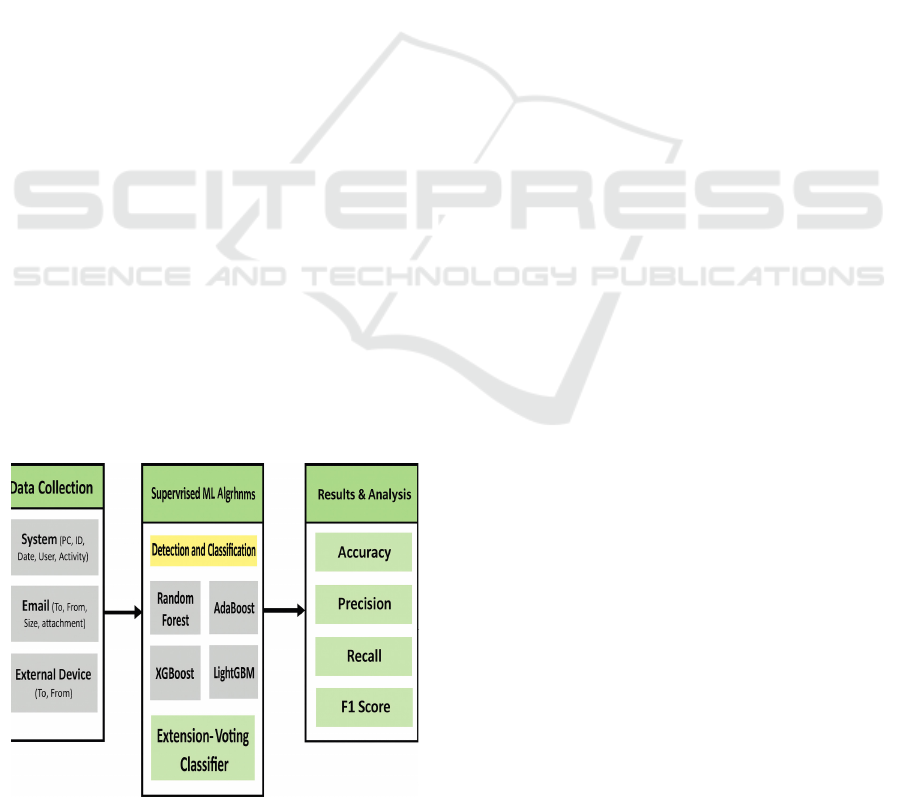
threat identity. Figure 1. Show the Proposed
architecture A voting Classifier, integrating
predictions from decision Tree, Random forest, and
support Vector machine through a "soft" balloting
method, improves the system's efficacy in identifying
and countering privilege escalation assaults. A
consumer-pleasant Flask framework with SQLite
integration complements user testing by offering safe
signup and sign in functionalities for practical
installation and assessment
.
3.2 System Architecture
Figure 1: Proposed architecture.
The system architecture consists of four essential
tiers: facts collecting, data preprocessing,
implementation of supervised machine learning
algorithms, and consequences evaluation. During the
records gathering phase, a tailored dataset extracted
from various files of the CERT dataset is employed.
The collected data is subsequent subjected to
preprocessing, which includes methods like statistics
aggregation, normalization, and feature extraction to
improve its exceptional and relevance. The system's
foundation involves utilizing machine learning
algorithms "Random forest, AdaBoost, XGBoost,
and LightGBM" alongside a voting classifier as an
enhancement, to research the preprocessed statistics
for the identity and categorization of privilege
escalation assaults. The gadget does a comprehensive
evaluation of the results, assessing the efficacy of
each set of rules and imparting insights into the
complete system's success in detecting insider threats.
This structure guarantees a methodical and resilient
strategy for mitigating privilege escalation assaults
via device learning methodologies.
3.3 Dataset Collection
Chaitanya, V. et al 2022; 2014, The dataset utilized
on this experiment is sourced from several files
within the CERT dataset, with a specific emphasis on
e mail-related records.
Table 1. Show the CERT dataset
This curated dataset encompasses many cases
pertinent to insider threat scenarios in email
exchanges. It encompasses several characteristics
and properties referring to user conduct, email
content, and device interactions.
3.4 Data Processing
Data processing is converting unrefined data into
usable facts for corporations. Facts scientists
generally have interaction in facts processing,
encompassing the collection, corporation, cleaning,
validation, analysis, and transformation of records
into interpretable formats along with graphs or
papers. Facts processing may be carried out through
3 methods: manual, mechanical, and digital. The
objective is to beautify the value of facts and
streamline decision-making. This lets in enterprises
to decorate their operations and execute speedy
strategic decisions. Automated records processing
technologies, consisting of computer software
programming, are pivotal on this context. it could
remodel full-size datasets, specifically large facts,
into great insights for first-rate control and decision-
making.
Smart Detection and Prevention of Cloud Based Security Threats Using Machine Learning
699
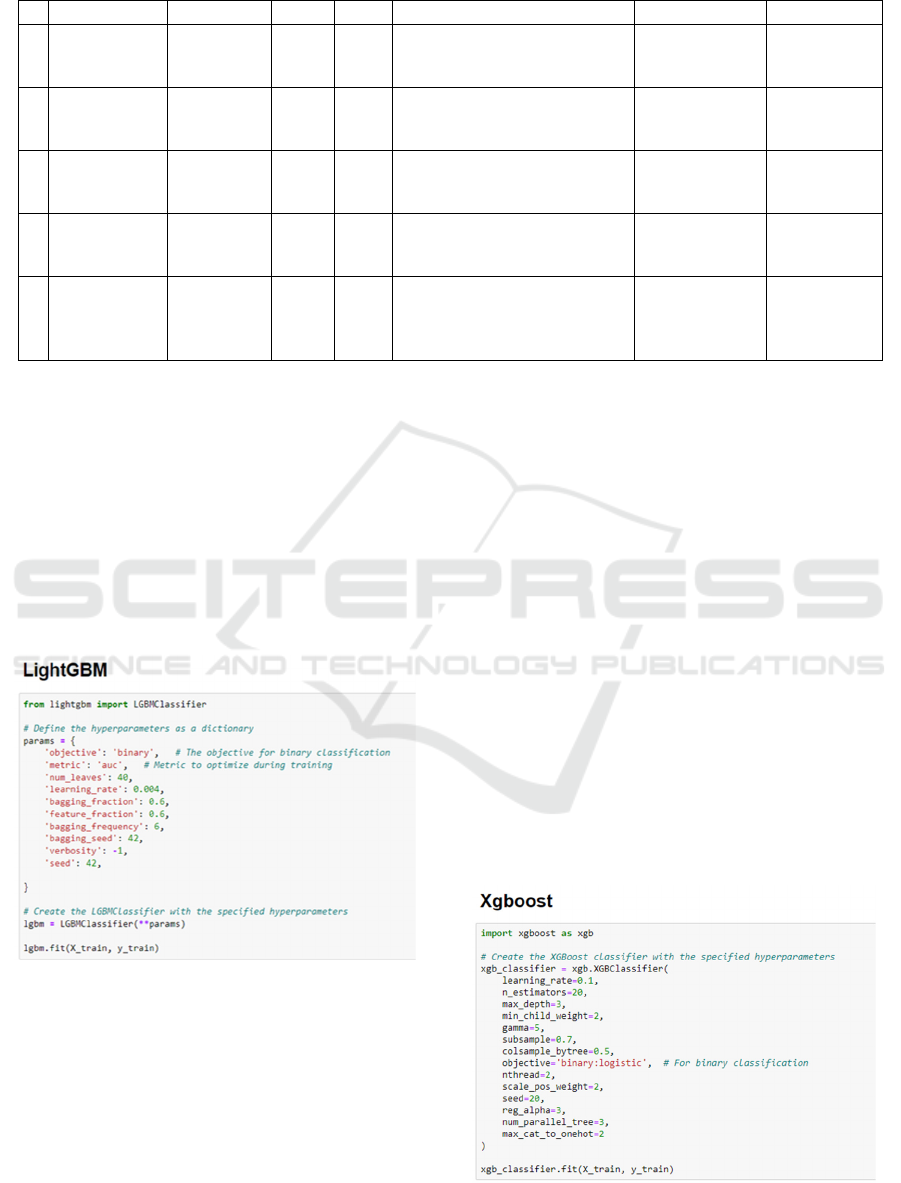
Table 1: CERT Dataset.
id
date
user
pc
to
cc
bcc
0
{R317-
S4TX96FG-
8219JWFF}
01/02/2010
07:11:45
LAP
0338
PC-
5758
Dean.Flynn.Hines@dtaa.com;
Wade_Harrison@lockhe
Nathaniel.Hu
nter.Health@dt
aa.com
NaN
Lynn.Adena.
1
{R0R9-
E4GL59IK-
2907OSWJ}
01/02/2010
07:12:16
MOH
0273
PC-
6699
Odonell-Gage@belisouth.net
NaN
NaN
MOH68
2
{G2B2-
ABXY58CP-
2847ZJZL
}
01/02/2010
07:13:00
LAP
0338
PC-
5758
Penelope_colon@netzero.com
NaN
NaN
Lynn_A_Pra
3
{A3A9-
F4TH89AA-
8318GFGK
}
01/02/2010
07:13:17
LAP
0338
PC-
5758
Judith_Hayden@comcast.net
NaN
NaN
Lynn_A_Pra
4
{E8B7-
C8FZ88UF-
2946RUQQ}
01/02/2010
07:13:28
MOH
0273
PC-
6699
Bond-Raymond@verizon.net;
Alea_Ferrell@msn.com;
NaN
Odonnell-
gage@bell
MOH68
South.net
3.5 Feature Selection
Feature selection is the process of identifying the
most consistent, non-redundant, and pertinent
functions for model development. Systematically
minimizing dataset sizes is crucial even as the volume
and diversity of datasets persist in expanding. The
primary goal of feature selection is to enhance the
efficacy of a predictive model whilst minimizing the
computational rate of modeling.
Figure 2: LightGBM.
Feature selection, a critical aspect of function
engineering, involves identifying the most massive
features for enter into machine learning algorithms.
feature selection techniques are utilized to diminish
the quantity of input variables via excluding
redundant or pointless characteristics, hence refining
the function set to those most pertinent to the system
learning model. The number one blessing of
conducting feature selection ahead, instead of
allowing the machine learning version to decide the
most giant features autonomously.
3.6 Algorithms
LightGBM: "LightGBM" is a gradient boosting
ensemble method employed through the educate the
usage of AutoML tool, utilizing decision trees as its
basis. Figure 2. Show the LightGBM Much like other
decision tree-based techniques, "LightGBM" is
relevant for each category and regression tasks.
"LightGBM" is engineered for advanced overall
performance in distributed systems. XGBoost:
"XGBoost" operates as an efficient and widely-used
open-source implementation of the gradient boosted
trees technique within Amazon Sage Maker.
Figure 3.
Show the XGBoost
Gradient boosting is a supervised
learning technique that seeks to be expecting a target
variable accurately through aggregating the
predictions of a collection of smaller, weaker models.
Figure 3: XGBoost.
ICRDICCT‘25 2025 - INTERNATIONAL CONFERENCE ON RESEARCH AND DEVELOPMENT IN INFORMATION,
COMMUNICATION, AND COMPUTING TECHNOLOGIES
700
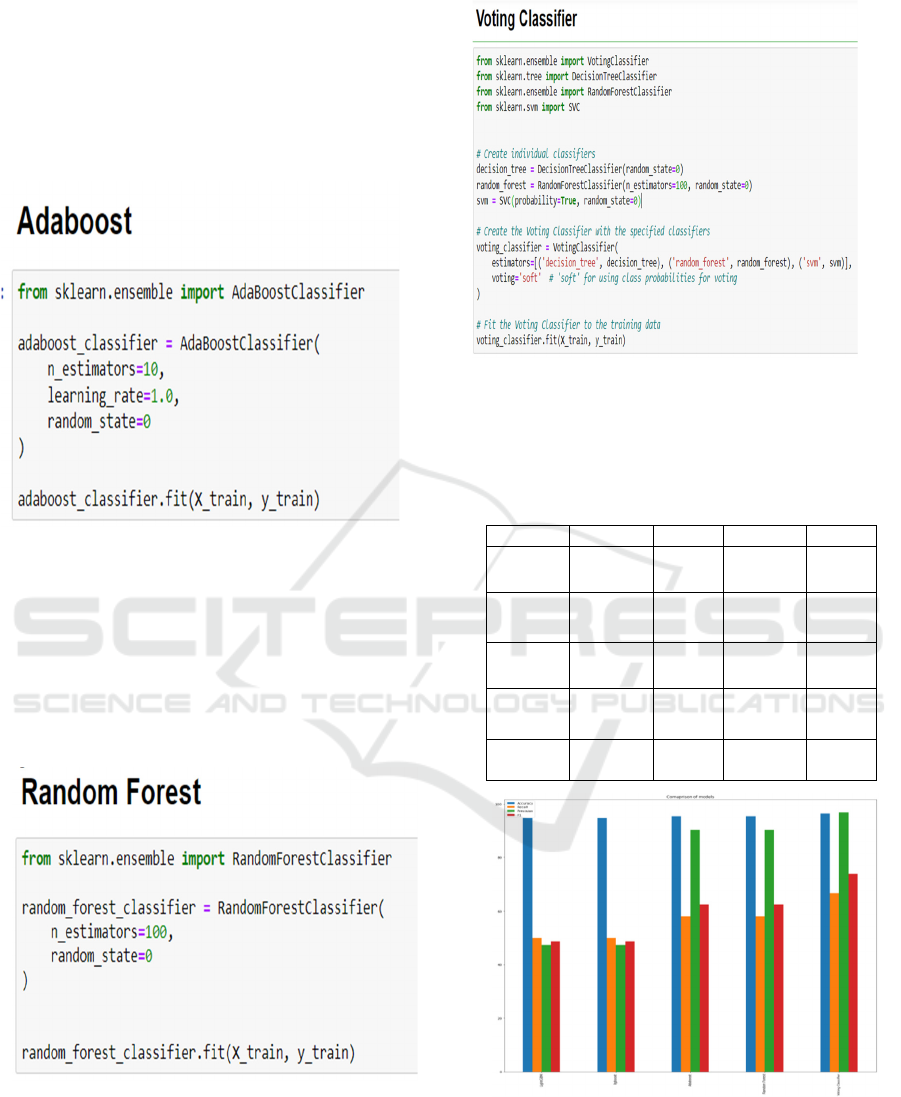
AdaBoost: "AdaBoost, or Adaptive Boosting", is a
"machine learning" method employed as an
Ensemble method. Figure 4. Show the Adaboost the
predominant estimator hired in AdaBoost is a
decision tree with a single stage, indicating a decision
tree with only one break up. Those trees are known
as decision Stumps.
Figure 4: Adaboost.
RF: "Random forest" is an extensively applied
"machine learning" method, patented by Leo Breiman
and Adele Cutler that amalgamates the outputs of
numerous decision trees to get a singular outcome.
Figure 5. Show the Random forest Its person-
friendliness and adaptability have driven its
recognition, because it addresses each type and
regression issues.
Figure 5: Random forest.
VC: A voting Classifier is a "machine learning"
model that aggregates many models and predicts an
output class based on the best probability among them
Figure 6 show the Voting classifier.
Figure 6: Voting classifier.
4 EXPERIMENTAL RESULTS
Table 2: Performance evaluation.
Figure 7: Comparison graph.
Figure 7 So, this is the performance metrics
comparison graph.
The x-axis denotes algorithm names, while the y-
axis indicates performance measures.
Accuracy Recall Precision F1
LightGB
M
94.75 50 47.375
48.652
12
Xgboost 94.75 50 47.375
48.652
12
AdaBoos
t
95.45
58.016
08
90.27778
62.425
81
Random
Forest
95.45
58.016
08
90.27778
62.425
81
Voting
Classifier
96.45
66.640
28
96.82903
73.902
77
Smart Detection and Prevention of Cloud Based Security Threats Using Machine Learning
701
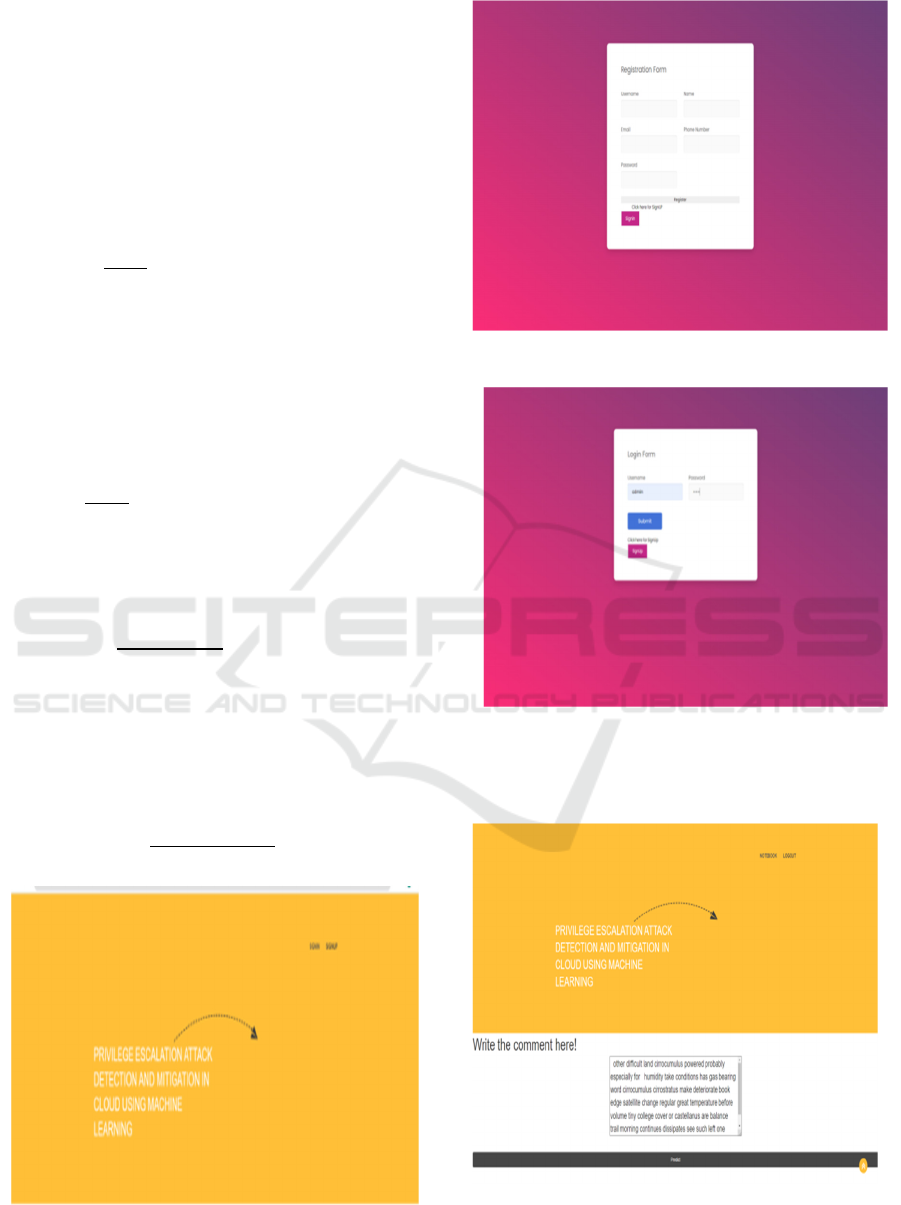
The blue bar signifies accuracy, the orange represents
recall, the inexperienced shows precision, and the red
corresponds to the F1 score.
Precision: Precision assesses the proportion of
accurately classified cases among the ones identified
as positive. Consequently, the formula for calculating
precision is expressed as:
“Precision = True positives/ (True positives + False
positives) = TP/ (TP + FP)” (1)
Precision
(2)
Recall: recall is a metric in "machine learning' that
assesses a model's potential to recognize all pertinent
times of a specific class. It is the ratio of
appropriately anticipated fantastic observations to the
total real positives, offering insights right into a
version's efficacy in identifying occurrences of a
particular class.
Recall
(3)
Accuracy: Accuracy is the ratio of correct
predictions in a classification test, assessing the
overall precision of a model's predictions.
Accuracy
(4)
F1 Score: The F1 score is the harmonic suggest of
accuracy and recall, providing a balanced metric that
money owed for each false positive and false
negative, thereby making it appropriate for
imbalanced datasets.
F1 Score 2 ∗
* 100 (5)
Figure 8: Home page.
Figure 9: Signup page.
Figure 10: Signin page.
Figure 8 and 9 and 10 shows the home page signup page
and signin page respectively.
Figure 11: User input page.
ICRDICCT‘25 2025 - INTERNATIONAL CONFERENCE ON RESEARCH AND DEVELOPMENT IN INFORMATION,
COMMUNICATION, AND COMPUTING TECHNOLOGIES
702
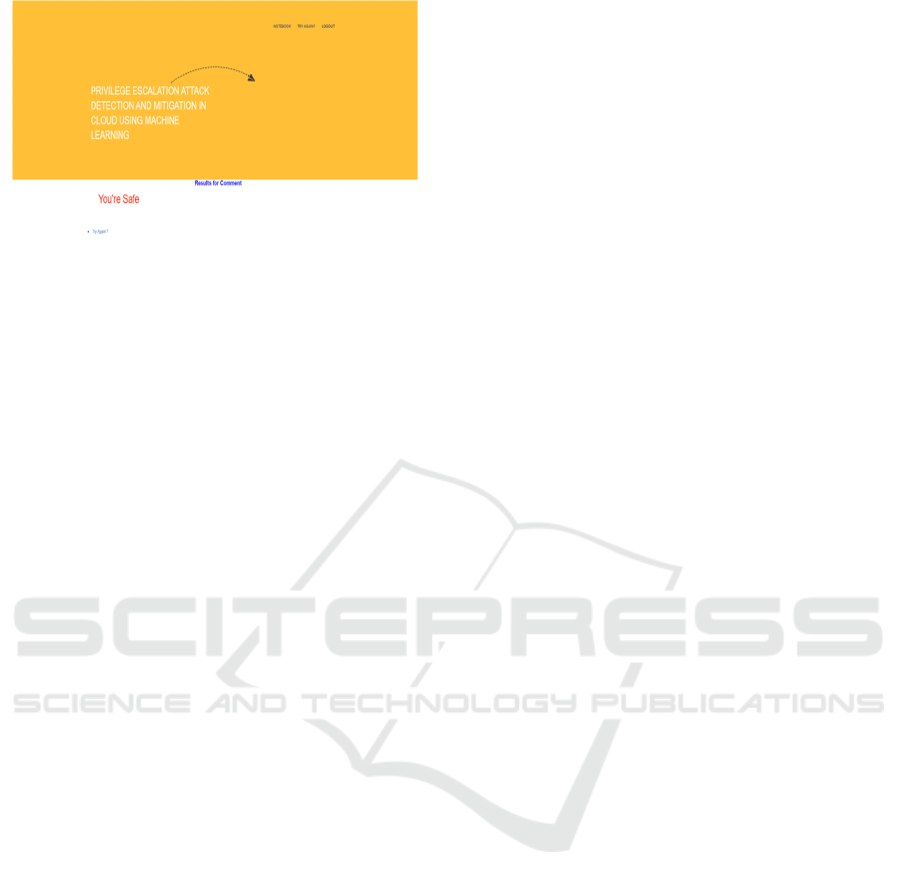
Figure 12: Prediction result.
Figure 11 and 12 show the User input page and
prediction result respectively.
5 CONCLUSIONS
The malevolent insider poses a critical threat to the
company because of their improved access and
chance to inflict substantial harm. Insiders have
exclusive and suitable access to knowledge and
resources, unlike outsiders. This look at present’s
machine learning algorithms for the detection and
classification of insider attacks. Chaitanya, et al.,
2014, This work utilizes a tailored dataset derived
from numerous documents of the CERT dataset. Four
machine learning strategies were implemented at the
dataset, yielding advanced results. The algorithms
consist of Random forest, AdaBoost, XGBoost, and
LightGBM. This research exhibited excellent
experimental findings with greater accuracy within
the categorization document the usage of supervised
machine learning methods. Of the proposed
algorithms, LightGBM achieves the maximum
accuracy at 97%, whilst Random Forest (RF) attains
86%, AdaBoost reaches 88%, and XGBoost records
88.27%. In the future, the proposed models might
also enhance their overall performance by means of
augmenting the dataset in both quantity and variety of
its residences and the emerging dispositions of insider
attackers. This can initiate novel research directions
for the detection and category of insider attacks
across many organizational domains. Groups make
use of machine learning models to facilitate informed
decision-making, and enhanced version
consequences bring about advanced judgments. The
price of errors might be enormous; but, this expense
diminishes with more suitable version precision.
machine learning-based totally research lets in
customers to supply sizable datasets to computer
algorithms, which sooner or later analyze, advise, and
make decisions based totally on the provided data.
6 FUTURE SCOPE
Future improvements need to prioritize increasing the
system's scalability to successfully control
heightened workloads in extensive cloud
environments, ensuring seamless processing as
records complexity and extent growth. Destiny
advancements must contain dynamic reaction
systems that can swiftly hit upon and counteract
newly developing strategies in privilege escalation
attacks, thereby imparting a proactive protection
against evolving insider threats. The incorporation of
methods that yield comprehensible justifications for
model decisions is important. R. Kumar., et al, 2020;
D. Tripathy., et al, 2020, This transparency aids
security analysts in understanding the factors
affecting threat identity, as a result enhancing trust
inside the system's consequences. It is critical to set
up a framework for the constant updating and
diversification of the dataset utilized for model
training. Continuous enhancement guarantees the
device's efficacy in detecting and countering novel
assault vectors and emerging insider threat trends.
REFERENCES
Ajmal, S. Ibrar, and R. Amin, ‘‘Cloud computing platform:
Performance analysis of prominent cryptographic
algorithms,’’ Concurrency Comput., Pract. Exper., vol.
34, no. 15, p. e6938, Jul. 2022.
Chaitanya, V. Lakshmi, and G. Vijaya Bhaskar. "Apriori vs
Genetic algorithms for Identifying Frequent Item Sets."
International journal ofInnovative Research
&Development 3.6 (2014): 249-254.
Chaitanya, V. Lakshmi. "Machine Learning Based
Predictive Model for Data Fusion Based Intruder Alert
System." journal of algebraic statistics 13.2 (2022):
2477-2483
Chaitanya, V. Lakshmi, et al. "Identification of traffic sign
boards and voice assistance system for driving.” AIP
Conference Proceedings. Vol. 3028. No. 1. AIP
Publishing, 2024
D. C. Le and A. N. Zincir-Heywood, ‘‘Machine learning
based insider threat modelling and detection,’’ in Proc.
IFIP/IEEE Symp. Integr. Netw. Service Manag. (IM),
Apr. 2019, pp. 1–6.
D. Tripathy, R. Gohil, and T. Halabi, ‘‘Detecting SQL
injection attacks in cloud SaaS using machine
learning,’’ in Proc. IEEE 6th Int. Conf. Big Data Secur.
Cloud (BigDataSecurity), Int. Conf. High Perform.
Smart Detection and Prevention of Cloud Based Security Threats Using Machine Learning
703

Smart Comput., (HPSC), IEEE Int. Conf. Intell. Data
Secur. (IDS), May 2020, pp. 145–150.
D. C. Le, N. Zincir-Heywood, and M. I. Heywood,
‘‘Analyzing data granularity levels for insider threat
detection using machine learning,’’ IEEE Trans. Netw.
Service Manag., vol. 17, no. 1, pp. 30–44, Mar. 2020.
Devi, M. Sharmila, et al. "Machine Learning Based
Classification and Clustering Analysis of Efficiency of
Exercise Against Covid-19 Infection." Journal of
Algebraic Statistics 13.3 (2022): 112-117.
Devi, M. Sharmila, et al. "Extracting and Analyzing
Features in Natural Language Processing for Deep
Learning with English Language." Journal of Research
Publication and Reviews 4.4 (2023): 497-502.
F. Janjua, A. Masood, H. Abbas, and I. Rashid, ‘‘Handling
insider threat through supervised machine learning
techniques,’’ Proc. Comput. Sci., vol. 177, pp. 64–71,
Jan. 2020.
G. Apruzzese, M. Colajanni, L. Ferretti, A. Guido, and M.
Marchetti, ‘‘On the effectiveness of machine and deep
learning for cyber security,’’ in Proc. 10th Int. Conf.
Cyber Conflict (CyCon), May 2018, pp. 371–390.
H. Touqeer, S. Zaman, R. Amin, M. Hussain, F. Al-
Turjman, and M. Bilal, ‘‘Smart home security:
Challenges, issues and solutions at different IoT
layers,’’ J. Supercomput., vol. 77, no. 12, pp. 14053–
14089, Dec. 2021.
Mahammad, Farooq Sunar, Karthik Balasubramanian, and
T. Sudhakar Babu. "A comprehensive research on
video imaging techniques." All Open Access, Bronze
(2019).
Mahammad, Farooq Sunar, and Y Madhu Viswanatham.
"Performance analysis of data compression algorithms
for heterogeneous architecture through parallel
approach." The Journal ofsupercomputing 76.4 (2020):
2275-2288.
Mahammad, Farooq Sunar, et al. "Key distribution scheme
for preventing key reinstallation attack in wireless
networks." AIP Conference Proceedings. Vol. 3028.
No. 1. AIP Publishing, 2024.
Mandalapu, Sharmila Devi, et al. "Rainfall prediction using
machine learning." AIP Conference Proceedings. Vol.
3028. No. 1. AIP Publishing, 2024.
Mr.M.Amareswara Kumar, “Baby care warning system
based on IoT and GSM to prevent leaving a child in a
parked car”in International Conference on Emerging
Trends in Electronics and Communication Engineering
- 2023, API Proceedings July-2024
Mr.M.Amareswara Kumar, effective feature engineering
technique for heart disease prediction with machine
learning” in International Journal of Engineering &
Science Research, Volume 14, Issue 2, April-2024 with
ISSN 2277-2685.
P. Oberoi, ‘‘Survey of various security attacks in clouds-
based environments,’’ Int. J. Adv. Res. Comput. Sci.,
vol. 8, no. 9, pp. 405–410, Sep. 2017.
Paradesi Subba Rao,” Detecting malicious Twitter bots
using machine learning” AIP Conf. Proc. 3028, 020073
(2024), https://doi.org/10.1063/5.0212693
Paradesi SubbaRao, "Morphed Image Detection using
Structural Similarity Index Measure”M6 Volume 48
Issue 4 (December 2024)
,https://powertechjournaI.com
Parumanchala Bhaskar, et al. "Machine Learning Based
Predictive Model for Closed Loop Air Filtering
System." Journal of Algebraic Statistics 13.3 (2022):
416-423.
Parumanchala Bhaskar, et al. "Incorporating Deep Learning
Techniques to Estimate the Damage of Cars During the
Accidents" AIP Conference Proceedings. Vol. 3028.
No. 1. AIP Publishing, 2024.
Parumanchala Bhaskar, et al “Cloud Computing Network
in Remote Sensing-Based Climate Detection Using
Machine Learning Algorithms” remote sensing in earth
systems sciences(springer).
R. Kumar, K. Sethi, N. Prajapati, R. R. Rout, and P. Bera,
‘‘Machine learning based malware detection in cloud
environment using clustering approach,’’ in Proc. 11th
Int. Conf. Comput., Commun. Netw. Technol.
(ICCCNT), Jul. 2020, pp. 1–7.
S. Zou, H. Sun, G. Xu, and R. Quan, ‘‘Ensemble strategy
for insider threat detection from user activity logs,’’
Comput., Mater. Continua, vol. 65, no. 2, pp. 1321–
1334, 2020.
Suman, Jami Venkata, et al. "Leveraging natural language
processing in conversational AI agents to improve
healthcare security." Conversational Artificial
Intelligence (2024): 699-711.
Sunar, Mahammad Farooq, and V. Madhu Viswanatham.
"A fast approach to encrypt and decrypt of video
streams for secure channel transmission." World
Review of Science, Technology and Sustainable
Development 14.1 (2018): 11-28.
U. A. Butt, R. Amin, H. Aldabbas, S. Mohan, B. Alouffi,
and A. Ahmadian, ‘‘Cloud-based email phishing attack
using machine and deep learning algorithm,’’ Complex
Intell. Syst., pp. 1–28, Jun. 2022.
U. A. Butt, R. Amin, M. Mehmood, H. Aldabbas, M. T.
Alharbi, and N. Albaqami, ‘‘Cloud security threats and
solutions: A survey,’’ Wireless Pers. Commun., vol.
128, no. 1, pp. 387–413, Jan. 2023.
ICRDICCT‘25 2025 - INTERNATIONAL CONFERENCE ON RESEARCH AND DEVELOPMENT IN INFORMATION,
COMMUNICATION, AND COMPUTING TECHNOLOGIES
704
