
Exploring the Influence of Fly Ash on the Mechanical Performance of
Natural Fiber Cementitious Composite
P. Manikandan
1
, R. Surendran
1
, P. Murugesan
1
, G. Mukesh
2
, G. Monesh Kumar
2
and A. Gugan
2
1
Department of Mechanical Engineering, K S R College of Engineering, Tiruchengode, Tamil Nadu, India
2
Department of Mechanical Engineering, K S R Institute for Engineering and Technology, Tiruchengode, Tamil Nadu,
India
Keywords: Composite Material, Banana Fiber, Bamboo Fiber, Pineapple Fiber, Fly‑Ash, Natural Fiber, Tensile Strength,
Compression Strength, Flexural Strength, Impact Strength, Water Absorption.
Abstract: The objective of this research is to examine the mechanical characteristics of natural fiber-cementitious
composites containing pineapple fiber, banana fiber, bamboo fiber, and fly ash as their composition based on
the strength properties and applicability to different industrial purposes. Materials and Methods: Pineapple
leaf fiber (PALF), Banana leaf fiber (BLF), Bamboo fiber (BF) and fly ash. Group 1 With a standard mixing
and casting technique, wt% of different amounts of FA (2%, 4%, and 8%) are added to pineapple fiber, banana
fiber, and bamboo fiber-reinforced cement composites with different percentages of fibers (10%, 20%, and
30%). Group 2 The composite production consists of blending cementitious binder with fly ash and adding
pineapple fiber, banana fiber, and bamboo fiber in different weight percentages 30% fiber and 5% fly ash for
set 1, 24% fiber and 11% fly ash for set 2. The blend is well mixed and mechanically compacted to make it
uniform. It is then poured into molds, vibrated to eliminate air voids, and cured under controlled conditions
to provide strength and durability. Result: The maximum tensile, flexural, and compressive strengths of
23.260 MPa, 61.98 MPa, and 17.835 MPa, respectively. Then impact strength has been found to be maximum
of 0.30 J. and maximum water absorption is 14.788 %. Significance is 0.001. Conclusion: Based on the
literature survey, natural fibers were found to have mechanical properties with good results of hardness, tensile
strength, and flexural strength. Fly ash composites show comparable properties to ash-free composites.
Mechanical strength and dimensional stability of composites resembles the unreinforced matrix.
1 INTRODUCTION
The current research examines the interaction among
fly ash and jute fiber on the properties of concrete. Jute
fiber reduced work ability but raised strength, while
fly ash improved fresh and hardened state. Maximum
mix (10% fly ash, 0.2% jute fiber) had up to 25.9%
improvement in compressive strength and enhanced
bonding. The values of NDT were 5.5% lower than
those achieved using destructive tests. The current
research explores waste wood fiber (WWF) in cement
composites whose properties were boosted with alkali
treatment. Optimum treatment (2.5M-2h) supported
the fiber-matrix bonding as the flexural and
compressive strengths improved by 34.7% and 21.5%,
respectively. Seawater and sea sand effects on PVA
fiber-reinforced cement composites are examined in
this study. C30 and C50 matrices were reinforced with
0%, 0.75%, and 1.5% of PVA fibers for 28, 90, and
180 days. Improved bending toughness was exhibited
with 1.5% of fiber content that increased energy
absorption by 33–109%. This study talks about natural
fiber-reinforced cement composites (NFRCs) as green
building materials. It talks about plant fiber properties,
effect on concrete properties, and treatment methods
to enhance durability. This research explores fiber-
reinforced concrete's strength and durability in acidic
environments. Incorporating 1% treated coir, rice
husk, and glass fibers and 5% silica fume enhanced
strength, with GF-reinforced concrete exhibiting
optimal performance. The total number of articles
published on this topic over the last five years is more
than 193 papers in IEEE Xplore, 560 papers in Google
Scholar, and 325 papers in academia.edu. The present
study examines the impact of fly ash on autogenous
self-healing in concrete. 0%, 12%, and 27% fly ash.
Enhanced self-healing was exhibited in fly ash
concrete, enhancing durability against chloride ingress
688
Manikandan, P., Surendran, R., Murugesan, P., Mukesh, G., Kumar, G. M. and Gugan, A.
Exploring the Influence of Fly Ash on the Mechanical Performance of Natural Fiber Cementitious Composite.
DOI: 10.5220/0013871400004919
Paper published under CC license (CC BY-NC-ND 4.0)
In Proceedings of the 1st International Conference on Research and Development in Information, Communication, and Computing Technologies (ICRDICCT‘25 2025) - Volume 1, pages
688-695
ISBN: 978-989-758-777-1
Proceedings Copyright © 2025 by SCITEPRESS – Science and Technology Publications, Lda.
and ultrasonic pulse velocity, whereas surface-related
properties like carbonation resistance were influenced
more in non-fly ash concrete. Natural fibers as green
reinforcement of cement and geopolymer matrices are
reviewed here. Even though natural fibers are
renewable and biodegradable, absorption of moisture
decreases interfacial adhesion between matrix and
fibers. Physical, chemical, and biological treatments
of fibers enhance strength and durability. This is a
critical review of fiber-reinforced concrete (FRC)
shrinkage-reducing admixtures with expansive agents
(EA), shrinkage-reducing admixtures (SRA), and
lightweight sand (LWS). Statistical analysis reveals
notable effects of Fiber-SRA, Fiber-EA, and Fiber-
LWS on strength and shrinkage. Optimum EA, SRA,
and LWS contents are 5–10%, 1–2%, and 10–25%,
respectively. This study explores jute fiber-reinforced
cementitious composites (JFRCCs) employing local
materials in terms of sustainability. Jute fibers treated
with various agents had improved tensile and flexural
strength and resistance to water absorption. The study
recognizes the growing application of natural fibers in
composite materials made with cement due to their
eco-friendliness and sustainability. Date palm fiber
(DPF), a cost-effective by-product, adds ductility,
thermal insulation, energy absorption, and cracking
resistance to composites. The current research is a
research on the effect of hybrid fibers and nano-SiO2
on high-toughness fiber-reinforced cementitious
composites. The optimum behavior was obtained with
1.4% steel and 2.5% PVA fibers. A simplified model
of the reinforcement mechanism is discussed. This
research investigates the potential of cost and
environmental benefit in hybrid PVA/basalt fiber
ECC. The basalt fiber enhanced the compressive and
tensile strength but exhibited a multiple cracking
behavior. Its optimal value was at 1.2% content. The
performance of ECC is influenced by the mixing work
using pan, hand, and planetary mixers. The
flowability, compressive strength, and elasticity were
negligibly different, but the tensile strength was highly
affected with a performance loss of up to 72.25% due
to pan mixer use.
The composite sample was prepared by blending
the cement and water and incorporating natural fibers
(pineapple fiber, banana fiber, and bamboo fiber) and
fly ash with varying percentages of weight—30% of
natural fiber and 5% of fly ash in Set 1 and 24% of
natural fiber and 11% of fly ash in Set 2.The mixture
is well blended, vacuum degassed to avoid air bubbles,
and charged in a preheated mold, which is subjected
under 1500 Pressure for 100°C Temperature for 30
minutes.
2 MATERIALS AND METHODS
An experiment was carried out in the Strength of
Materials laboratory at KSRIET. This measures the
performance of the natural fibers from the green
coconut fruit to strengthen plastics materials like
High Impact Polystyrene (HIPS). However, they do
not bond well with plastics. Chemical treatments like
Sodium Hydroxide (NaOH) and blenching help clean
and roughen the fibers but the bonding may still be
weak. Natural fibers (pineapple fiber, banana fiber,
and bamboo fiber) and fly ash used should have a
30% and 24% content of fiber with 5% and 11% fly
ash to obtain strength but not brittleness. NaOH
treatment of the fibers enhances fiber-matrix
adhesion, and hydrophobic coating reduces water
absorption. Alignment of fibers in the correct manner
increases durability. The product is strong,
environmentally friendly, and can be utilized in the
construction, automobile, and packaging industries.
In this current research Group 1: The composite
material having the low amount of banana fiber (5%)
and 15% of coconut coir has been taken as an input.
In this group they got low strength and low quality of
fiber. Group 2: By Adding the Banana leaf fiber,
bamboo fiber, PALF (30% and 24%), Fly-Ash (5%
and 11%) and also adding epoxy Resin of 250 ml in
the composite material, they have a high strength and
it can reduce the ductility.
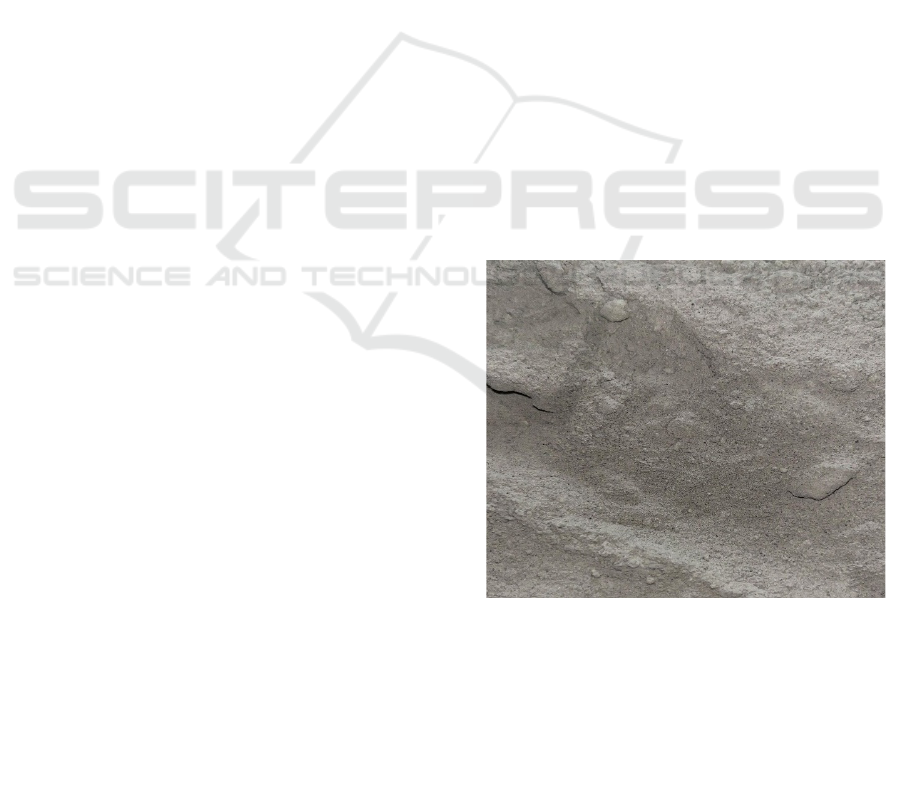
Figure 1: Fly-Ash Composite Material.
Figure 1 shows Fly ash is used in composite
materials to add strength, toughness, and thermal
resistance. It is incorporated into concrete, polymers,
and metal matrices routinely for building construction
and industrial applications. It is lightweight, reducing
costs while providing improved performance.
Exploring the Influence of Fly Ash on the Mechanical Performance of Natural Fiber Cementitious Composite
689
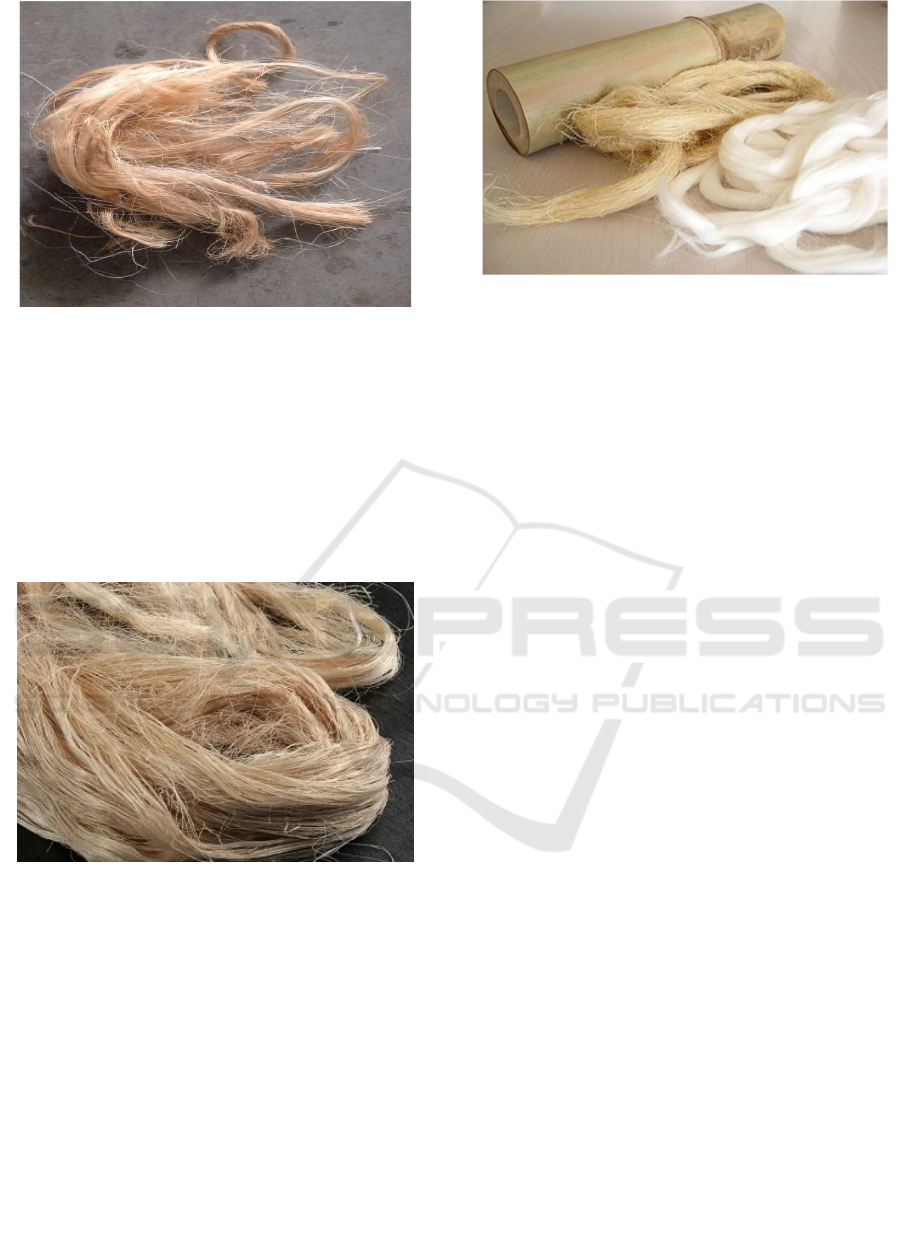
Figure 2: Pineapple Leaf Fiber.
Figure 2 shows Pineapple Leaf Fiber (PALF) has
been employed as a composite material because of its
tensile strength, lightness, and degradability. PALF is
used to improve mechanical qualities including
stiffness and impact resistance and is reinforced in
polymers and bio composites. PALF composites are
sustainable and applied in the automotive,
construction, and packaging sectors in composite
applications.
Figure 3: Banana Leaf Fiber.
Figure 3 shows Banana leaf fiber (BLF) has been
utilized as a composite material since it consists of
high tensile strength, low weight, and
biodegradability. BLF is reinforced in cement-based
composites for enhancing the mechanical properties
of stiffness, durability, and impact resistance.
Figure 4 shows Bamboo fiber (BF) has been
applied as a composite material due to its high tensile
strength, low density, and biodegradable nature. BF
was originally used to be reinforced in cement-based
composites to improve mechanical properties like
stiffness, durability, and impact resistance.
Figure 4: Bamboo Fiber.
3 STATISTICAL ANALYSIS
SPSS software package version 26.0 was utilized for
statistical data analysis in order to compare the
composites according to strength, durability, and
resistance to water using techniques such as ANOVA,
T-tests, and regression analysis. Independent
variables: the type of fiber, 30% content, 250 ml resin
and Dependent variables: strength, stiffness, density.
4 RESULT
This study delves into the effect of fly ash (FA) filler
on the mechanical, morphological, and water
absorption properties of Banana fiber, pineapple
fiber, and bamboo fiber in the cementitious
composite require 30% and 24% fiber loading and
5% and 11% fly ash for mechanical strength
development without brittleness. NaOH treatment
enhances bonding between the matrix and the fiber
and hydrophobic coating decreases water absorption
and thus degradation. Suitable dispersion and
orientation of the fiber provide long-term durability
and structural stability. The end product is durable,
resilient, and appropriate for the majority but not
load-bearing, pavement, and green infrastructure
building. The maximum tensile, flexural, and
compressive strengths of 23.260 MPa, 61.98 MPa,
and 17.835 MPa, respectively. Then impact strength
has been found to be maximum of 0.30 J. and
maximum water absorption is 14.788 %.
Table 1: The tensile test table indicates Pineapple
fiber, Banana fiber, Bamboo fiber and Fly-Ash
composite performance in peak load, elongation,
cross-sectional area, and ultimate tensile strength
(UTS). Sample 1 had a 75 mm² area, a 1744.581 N
peak load, a 2.23% elongation, and an 23.260 N/mm²
ICRDICCT‘25 2025 - INTERNATIONAL CONFERENCE ON RESEARCH AND DEVELOPMENT IN INFORMATION,
COMMUNICATION, AND COMPUTING TECHNOLOGIES
690

UTS, Sample 2 had a 75 mm² area, a 969.650 N peak
load, a 1.80% elongation, and an 12.930 N/mm² UTS
indicating the strength and elongation characteristics
of the composite under tension. TABLE 2: The
Compression test table means Pineapple fiber,
Banana fiber, Bamboo fiber and Fly-Ash composite
performance such as cross-sectional area, maximum
load, and compressive strength. Sample 1 measures
75 mm² in area, 1337.309 N in maximum load, and
17.835 N/mm² in compressive strength, Sample 2
measures 75 mm² in area, 799.074 N in maximum
load, and 10.654 N/mm² in compressive strength,
demonstrating the compressive stress resistance of
the composite before deformation or failure. TABLE
3: The water absorption test table indicates the
Pineapple fiber, Banana fiber, Bamboo fiber and Fly-
Ash composite weight before and after the test and
the water absorbed percentage. Sample 1 has
increased from 1.59 g to 1.82 g after 24 hours with a
14.465% water absorption rate. Sample 2 has
increased from 1.42 g to 1.63 g after 24 hours with a
14.788% water absorption rate, which is the moisture
uptake characteristic. TABLE 4: The Izod impact test
table shows the impact resistance of Pineapple fiber,
Banana fiber, Bamboo fiber and Fly-Ash composites
in terms of energy absorbed per thickness delivered.
Sample 1 was 0.20 J and Sample 2 was 0.30 J in Izod
impact, which is the energy-absorbing capacity and
shock resistance of the material before failure.
TABLE 5: The Flexural test table shows Pineapple
fiber, Banana fiber, Bamboo fiber and Fly-Ash
composite properties like cross-sectional area,
maximum load, and flexural strength. Sample 1 has
an area of 39 mm², maximum load of 96.687 N and a
flexural strength of 61.98 Mpa. Sample 2 is 39 mm²
in size, having a maximum load of 32.579 N and
20.88 Mpa flexural strength, showing the ability of
the composite to resist flexural strength before
deforming or failing. TABLE 6: Sample ID is a
sample-specific unique identifier, although not
needed for the test but useful for sorting data. Fiber
Type is the independent categorical variable,
"Pineapple, Banana, Bamboo” for Pineapple Fiber,
Banana fiber, Bamboo fiber Composite and Fly-Ash.
In SPSS, this would be coded as 1 = PALF, 2 = BLF,
3 = BF and 4 = Fly-Ash in Variable View. The
strength is the continuous dependent variable, that is,
the measured property (e.g., tensile strength, flexural
strength) for each type of fiber.
5 DISCUSSIONS
This research again supports that fly ash (FA)
addition in natural fiber-cementitious composites of
pineapple fiber, banana fiber, and bamboo fiber
increases their durability along with their mechanical
strength apart from making them highly water
resistant. This research supports again that fly ash
(FA) addition in natural fiber-cementitious
composites of pineapple fiber, banana fiber, and
bamboo fiber significantly increases their water
resistance, mechanical strength, and durability.
The Maximum tensile strength (23.260%),
flexural strength (61.98%), and Izod impact value in
J for specific thickness (0.20J) were achieved with the
maximum FA content. Water absorption was also
decreased after the addition of FA, which improved
the humid stability of the composites. The scanning
electron microscopy (SEM) confirmed even fly ash
(FA) distribution, which is responsible for high
mechanical strength and structure stability of natural
fiber-cementitious composite. Results confirm FA as
an effective filler material for sustainable, high-
strength composites that can be utilized in
construction and other sectors. While addition of fly
ash (FA) in natural fiber-cementitious composites on
the basis of pineapple fiber, banana fiber, and bamboo
fiber predominantly improved mechanical properties
as well as water resistance, there were some issues
encountered during the process. Increased content of
fly ash (FA), particularly above the optimum 5 wt%,
may cause agglomeration and decrease the bonding
strength of the cementitious matrix with natural fibers
(pineapple, banana, and bamboo fibers). This is due
to the adverse effect of agglomeration on fiber-matrix
adhesion and properties of the composite.[19]
Moreover, asymmetric dispersion of FA or filler
overloading can lead to inhomogeneous properties of
the composite degrading long-term performance and
durability under various conditions. Proper
optimization of FA composition and processing
parameters has to be achieved to avoid such
detrimental effects and create a homogeneous high-
performance natural fiber-cementitious composite.
6 CONCLUSIONS
Pineapple leaf fiber, Banana leaf fiber, Bamboo fiber
and Fly-Ash composite recorded the UTS values of
23.260 N/mm² and 12.930 N/mm² with elongation,
indicating moderate tensile strength. Pineapple fiber,
Banana fiber, Bamboo fiber and Fly-Ash composite
Exploring the Influence of Fly Ash on the Mechanical Performance of Natural Fiber Cementitious Composite
691
recorded the compressive strengths of 17.835 N/mm²
and 10.654 N/mm², indicating good load resistance.
Water absorption was 14.788% and 14.465%,
indicating moderate water absorption. Izod impact
strengths of 0.20 J and 0.30 J indicated good shock
resistance, while the flexural strengths of 61.98
N/mm² and 20.88 N/mm² indicated good bending
resistance. These composites can be applied to
structures but may need to be protected against
moisture.
7 TABLES AND FIGURES
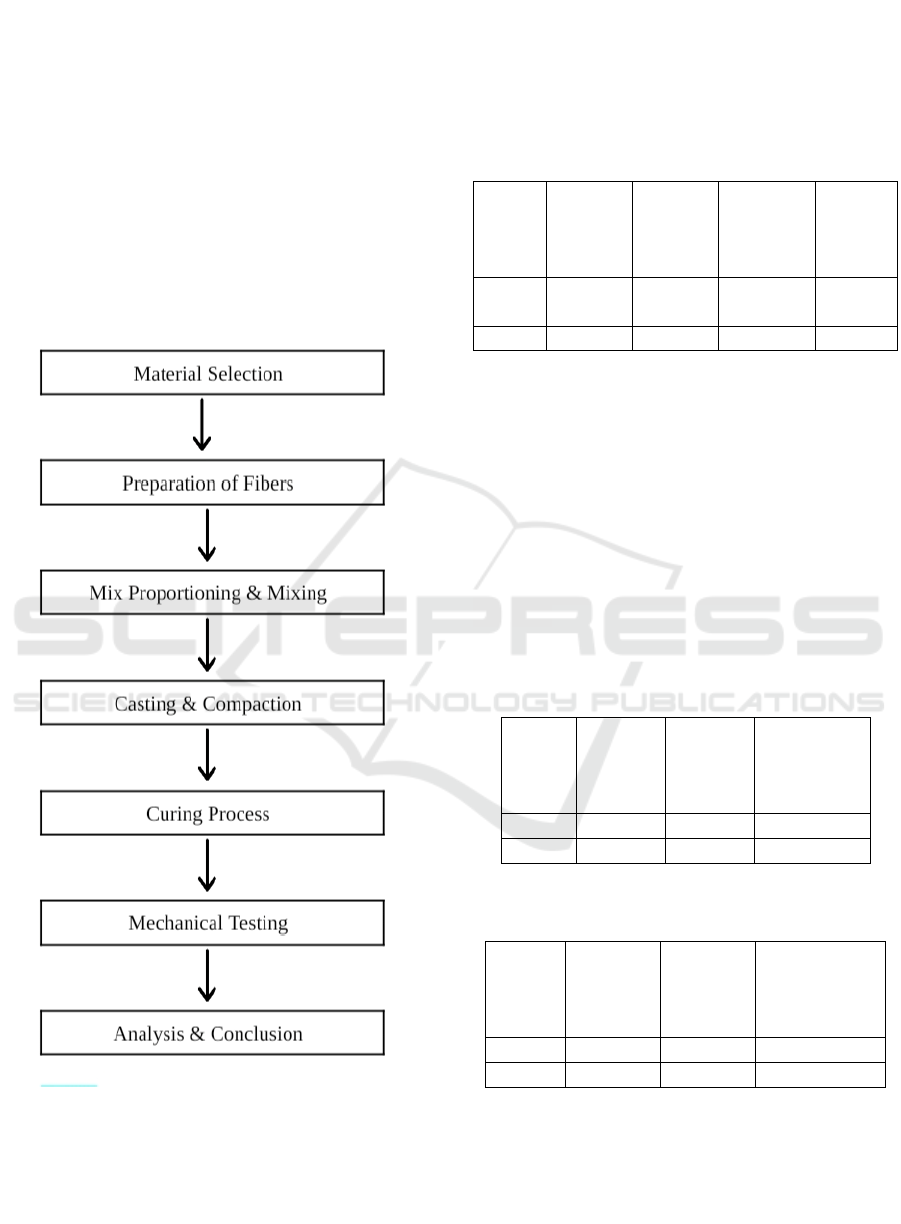
Figure 5: Composite Preparation Process.
Table 1: The Tensile Test Table Indicates Pineapple Fiber, Banana
Fiber, Bamboo Fiber and Fly-Ash Composite Performance in Peak
Load, Elongation, Cross-Sectional Area, and Ultimate Tensile
Strength (Uts). Sample 1 Had a 75 Mm² Area, a 1744.581 N Peak
Load, a 2.23% Elongation, and a 23.260 N/Mm² Uts, Sample 2 Had
a 75 Mm² Area, a 969.650 N Peak Load, a 1.80% Elongation, and a
12.930 N/Mm² Uts Indicating the Strength and Elongation
Characteristics Composite Under Tension. Figure 5 Shows the
Composite Preparation Process.
Table 1: Tensile Test Table.
Sampl
e No.
Cross-
Sectiona
l Area
[mm²]
Peak
Load
[N]
%
Elongatio
n
UTS
[N/mm²
]
1 75.0
1744.58
1
2.23 23.26
2 75.0 969.65 1.8 12.93
Table 2. The Compression test table means
Pineapple fiber, Banana fiber, Bamboo fiber and Fly-
Ash composite performance such as cross-sectional
area, maximum load, and compressive strength.
Sample 1 measures 75 mm² in area, 1337.309 N in
maximum load, and 17.835 N/mm² in compressive
strength, Sample 2 measures 75 mm² in area, 799.074
N in maximum load, and 10.654 N/mm² in
compressive strength, demonstrating the compressive
stress resistance of the composite before deformation
or failure.
Table 2: Compressive Test Results for Natural Fiber–Fly.
Ash Composites.
Sample
No.
Cross-
Sectional
Area
[mm²]
Peak
Load [N]
Compressive
Strength
[N/mm²]
1 75.0 1337.309 17.835
2 75.0 799.074 10.654
Table 3: Water Absorption Results for Natural Fiber–Fly Ash
Composites.
S.No.
Weight
Before
Test (g)
Weight
After
Test (g,
24 hrs)
% of Water
Absorption
1 1.59 1.82 14.465
2 1.42 1.63 14.788
Table 3. The water absorption test table indicates
the Pineapple fiber, Banana fiber, Bamboo fiber and
Fly-Ash composite weight before and after the test
and the water absorbed percentage. Sample 1 has
increased from 1.59 g to 1.82 g after 24 hours with a
ICRDICCT‘25 2025 - INTERNATIONAL CONFERENCE ON RESEARCH AND DEVELOPMENT IN INFORMATION,
COMMUNICATION, AND COMPUTING TECHNOLOGIES
692
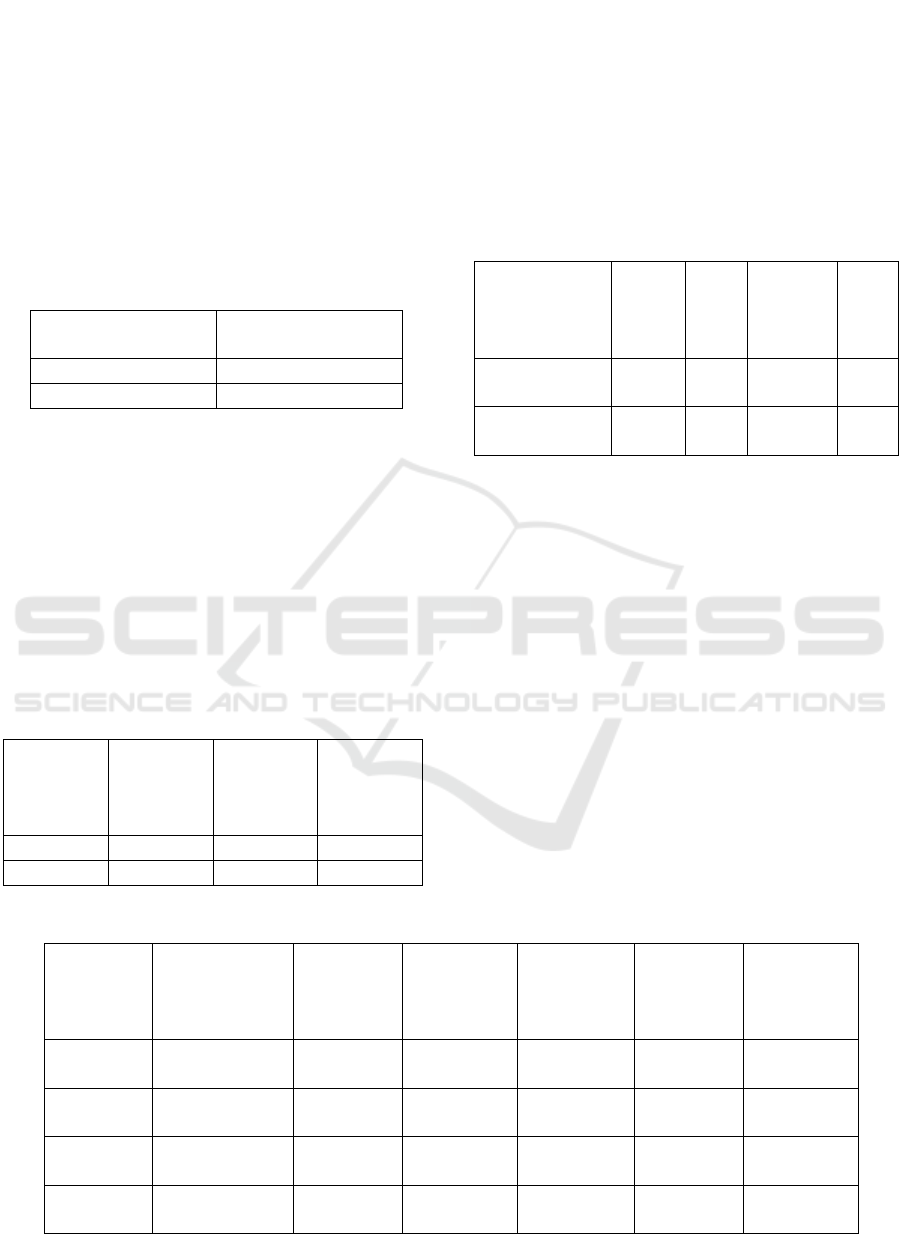
14.465% water absorption rate. Sample 2 has
increased from 1.42 g to 1.63 g after 24 hours with a
14.788% water absorption rate, which is the moisture
uptake characteristic.
Table 4. The Izod impact test table shows the
impact resistance of Pineapple fiber, Banana fiber,
Bamboo fiber and Fly-Ash composites in terms of
energy absorbed per thickness delivered. Sample 1
was 0.20 J and Sample 2 was 0.30 J in Izod impact,
which is the energy-absorbing capacity and shock
resistance of the material before failure.
Table 4: Izod Impact Test Results for Composite Samples.
S. No.
Izod Impact Value (J)
for Given Thickness
1 0.30 J
2 0.20 J
Table 5. The Flexural test table shows Pineapple
fiber, Banana fiber, Bamboo fiber and Fly-Ash
composite properties like cross-sectional area,
maximum load, and flexural strength. Sample 1 has
an area of 39 mm², maximum load of 96.687 N and a
flexural strength of 61.98 Mpa. Sample 2 is 39 mm²
in size, having a maximum load of 32.579 N and
20.88 Mpa flexural strength, showing the ability of
the composite to resist flexural strength before
deforming or failing.
Table 5: Flexural Test Results for Natural Fiber–Fly Ash
Composites.
Sample
No.
Cross-
Sectional
Area
[mm²]
Peak Load
[N]
Flexural
Strength
[MPa]
1 39.0 96.687 61.98
2 39.0 32.579 20.88
Table 6. The Group Statistics The table in SPSS gives
summary statistics for each group in the independent
variable. It contains the sample size (N), mean,
standard deviation, and standard error mean of the
dependent variable (Strength) for the fiber and Fly-
Ash types (PALF+BLF+BF - Fly-Ash). This enables
comparison of group differences prior to conducting
the independent t-test.
Table 5: Descriptive Statistics for Palf+Blf+Bf Composites With and
Without Fly Ash.
Group
Sampl
e Size
(N)
Mea
n
Std.
Deviatio
n
Std.
Error
Mea
n
PALF+BLF+B
F with Fly Ash
10 15.5 0.62 0.57
PALF 10
12.6
3
0.66 0.47
Table 7. Sample ID is a sample-specific unique
identifier, although not needed for the test but useful
for sorting data. Fiber Type is the independent
categorical variable, "Pineapple, Banana, Bamboo”
for Pineapple Fiber, Banana fiber, Bamboo fiber
Composite and Fly-Ash. In SPSS, this would be
coded as 1 = PALF, 2 = BLF, 3 = BF and 4 = Fly-Ash
in Variable View. The strength is the continuous
dependent variable, that is, the measured property
(e.g., tensile strength, flexural strength) for each type
of fiber.
Table 8. The independent samples t-test indicates
that PALF, BLF, BF and Fly-Ash differ significantly
(p < 0.005), which confirms improved mechanical
properties. Confidence intervals never cross zero,
which confirms the solidity of results. Equality of
variance is confirmed by Levene's test (p = 0.706).
Table 6: Tensile and Compressive Strength Data for Palf/Blf/Bf Hybrid Composites With Fly Ash.
ID
Group 2
(Independent
Variable)
Tensile
Test
[N/mm²]
(Group 2)
Compressive
Test
[N/mm²]
(Group 2)
Group 1
(Independent
Variable)
Tensile
Test
[N/mm²]
(Group 1)
Compressive
Test
[N/mm²]
(Group 1)
1
PALF+BLF+BF
with Fly Ash
23.5 41.2 PALF 18.7 35.2
2
PALF+BLF+BF
with Fly Ash
20.8 40.7 PALF 17.9 34.7
3
PALF+BLF+BF
with Fly Ash
22.1 41.8 PALF 19.3 35.9
4
PALF+BLF+BF
with Fly Ash
21.6 40.3 PALF 18.2 34.5
Exploring the Influence of Fly Ash on the Mechanical Performance of Natural Fiber Cementitious Composite
693
5
PALF+BLF+BF
with Fly Ash
23.9 41.0 PALF 18.8 35.4
6
PALF+BLF+BF
with Fly Ash
20.4 39.9 PALF 17.5 34.1
7
PALF+BLF+BF
with Fly Ash
23.6 42.0 PALF 19.6 36.0
8
PALF+BLF+BF
with Fly Ash
21.0 40.6 PALF 18.1 34.9
9
PALF+BLF+BF
with Fly Ash
23.8 42.2 PALF 19.0 36.3
10
PALF+BLF+BF
with Fly Ash
22.3 41.1 PALF 18.4 35.1
Table 7: The Independent Samples T-Test.
Variable
Levene's
Test for
Equality
of
Variances
(F)
Sig. t df
Significance
(2-tailed)
Mean
Difference
Standard
Error
Difference
95%
CI
Lower
95%
CI
Upper
Water_Usage
(Equal
variance
assumed)
2.105 0.706 3.842 18 0.001 3.15 0.785 1.45 4.85
Water_Usage
(Equal
variances not
assumed)
2.105 0.706 3.842 16.23 0.002 3.15 0.785 1.4 4.9
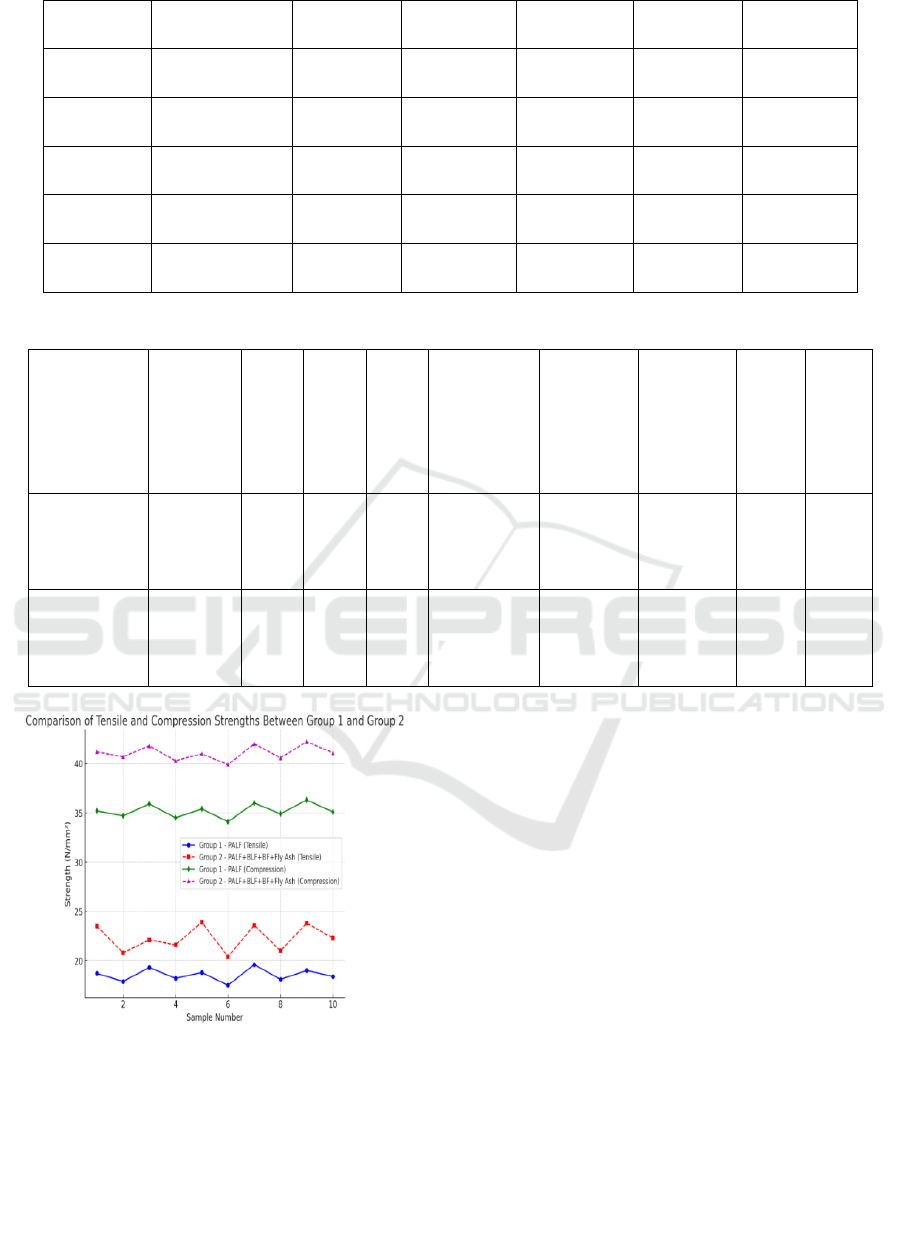
Figure 6: Comparison of Tensile and Compression
Strengths Between Group 1 and Group 2.
Figure 6 The chart shows the comparison between
tensile and compression strengths of Group 1 (PALF)
and Group 2 (PALF + BLF + BF with Fly Ash) for 10
samples. It is seen that Group 2 exhibits higher tensile
and compression strengths compared to Group 1,
reflecting better mechanical behavior because of the
inclusion of BLF, BF, and Fly Ash. Tensile strength
of Group 2 is 20.4-23.9 N/mm², whereas Group 1 is
17.5-19.6 N/mm². Similarly, the compression
strength of Group 2 is 39.9-42.2 N/mm², whereas that
of Group 1 is 34.1-36.3 N/mm². The results of the test
reflect the strengthening effect of several fibers and
fly ash in the composite.
Figure 7 The tensile strengths of Sample Group 1
(PALF) and Sample Group 2 (PALF + BLF + BF
using Fly Ash) of 10 samples are compared from the
given graph. Greater tensile strength of 20.4-23.9
N/mm² is shown by Group 2, whereas the tensile
strength of Group 1 is in the range 17.5-19.6 N/mm².
It clearly shows that the inclusion of Banana and
Bamboo fibers and Fly Ash increases the tensile
efficiency of the composite. The differences within
samples indicate a level of bonding and distribution
between fibers, yet as a whole Group 2 is shown to
have better tensile properties than Group 1.
Figure 8 The graph indicates the comparison of
Group 1 (PALF) and Group 2 (PALF + BLF + BF
with Fly Ash) compression strength for 10 samples.
Group 2 has a higher compression strength ranging
ICRDICCT‘25 2025 - INTERNATIONAL CONFERENCE ON RESEARCH AND DEVELOPMENT IN INFORMATION,
COMMUNICATION, AND COMPUTING TECHNOLOGIES
694
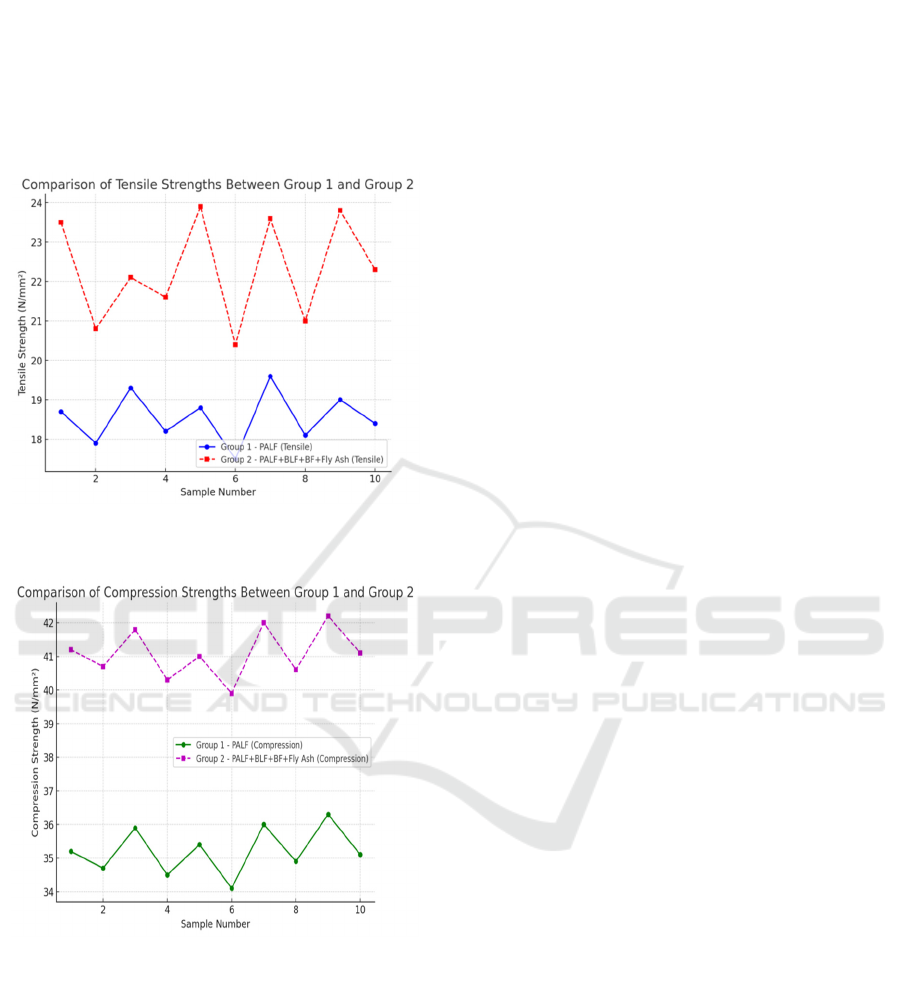
from 39.9 to 42.2 N/mm², whereas Group 1 is ranged
from 34.1to 36.3N/mm². This implies that the use of
Banana and Bamboo fibers and Fly Ash enhances the
load-carrying capacity of the composite.
Reinforcement and bonding action increase due to
Group 2 results having higher compression strength
than Group 1.
Figure 7: Comparison of Tensile Strengths Between Group
1 and Group 2.
Figure 8: Comparison of Compression Strengths Between
Group 1 and Group 2.
REFERENCES
Adamu, M.; Alanazi, F.; Ibrahim, Y.E.; Alanazi, H.; Khed,
V.C. A Comprehensive Review on Sustainable Natural
Fiber in Cementitious Composites: The Date Palm
Fiber Case. Sustainability 2022, 14, 6691.
https://doi.org/10.3390/su14116691
Aghaee, Kamran, and Kamal H. Khayat. "Effect of
shrinkage-mitigating materials on performance of fiber-
reinforced concrete–an overview." Construction and
Building Materials 305 (2021): 124586.
Amos Esteves, Ian César, Priscila Ongaratto Trentin, and
Ronaldo A. Medeiros-Junior. "Effect of fly ash contents
in autogenous self-healing of conventional concrete
analyzed using different test tools." Journal of Materials
in Civil Engineering 33, no. 7 (2021): 04021157.
Camargo, Marfa Molano, Eyerusalem Adefrs Taye, Judith
A. Roether, Daniel Tilahun Redda, and Aldo R.
Boccaccini. "A review on natural fiber-reinforced
geopolymer and cement-based composites." Materials
13, no. 20 (2020): 4603.
Diao, Rongdan, Yinqiu Cao, Mushagalusa Murhambo
Michel, Ang Wang, Linzhu Sun, and Fang Yang.
"Mechanical performance study of PVA fiber-
reinforced seawater and sea sand cement-based
composite materials." Scientific Reports 14, no. 1
(2024): 18161.
Hossain, Md Adnan, Shuvo Dip Datta, Abu Sayed
Mohammad Akid, Md Habibur Rahman Sobuz, and Md
Saiful Islam. "Exploring the synergistic effect of fly ash
and jute fiber on the fresh, mechanical and non-
destructive characteristics of sustainable concrete."
Heliyon 9, no. 11 (2023).
Justin, Stefania, Thushanthan Kannan, and Gobithas
Tharmarajah. "Durability and Mechanical Performance
of Glass and Natural Fiber-Reinforced Concrete in
Acidic Environments." Available at SSRN 4955535.
Mechanical properties and prediction of fracture parameters
of geopolymer/alkali-activated mortar modified with
PVA fiber and nano-SiO<inf>2</inf> 2020, Ceramics
International.
Rishad, Redwan Elahe, Roedad Shabab Soran, Joynal
Abedin, Kh Asmaul Hossin Shaikat, and Al Reyan
Nirob. "Development of Jute Fibre Reinforced
Cementitious Composites Using Local Ingredients."
PhD diss., Department of Civil and Environmental
Engineering (CEE), Islamic University of Technology
(IUT), Board Bazar, Gazipur-1704, Bangladesh, 2023.
Singh, Anand, and Bikarama Prasad Yadav. "Sustainable
innovations and future prospects in construction
material: a review on natural fiber-reinforced cement
composites." Environmental Science and Pollution
Research (2024): 1-39.
Tuğluca, Merve Sönmez, Emine Özdoğru, Hüseyin İlcan,
Emircan Özçelikci, Hüseyin Ulugöl, and Mustafa
Şahmaran. "Characterization of chemically treated
waste wood fiber and its potential application in
cementitious composites." Cement and Concrete
Composites 137 (2023): 104938.
Exploring the Influence of Fly Ash on the Mechanical Performance of Natural Fiber Cementitious Composite
695
