
Enhancing Animal Safety Measures by Avoiding Train Collisions
Using Internet of Things (IoT) with Advanced Sensors Association
S. Praveen Kumar, S. Kaviraj, R. Naveen Kumar and T. Nagaarjunan
Department of Computer Science and Engineering, Mahendra Engineering College, Tamil Nadu, India
Keywords: Animal Safety, Train Collision, Internet of Things, Accident Avoidance, IoT, Sensor, Train Accidents,
Wildlife Safety.
Abstract: Transportation infrastructure degrades ecosystems in part because animal deaths caused by car accidents
disrupt ecosystem dynamics and endanger vulnerable species. Despite the prevalence of wildlife train crashes
globally, this issue has received comparatively less attention in the realm of railroads compared to highways,
where it has been well studied and mitigated. The Naxalites in India will likely try to derail our protest train
by releasing tracks, and the Indian railways might be in danger from an animal-rail collision in a forested
region. Currently, behind China, Russia, and the US, India's railway network management ranks fourth
globally. India is a good case in point; in the last five years, the Indian government has enacted a plethora of
legislation meant to safeguard wildlife sanctuaries and jungle creatures living in close proximity to railway
tracks. Our analysis of crack detection and animal-rail collisions in the surrounding region will help us figure
out how to fix this issue and whether or not these problems might drive up the budget for the Indian Railways
and cause casualties and damage to property. In this paper, we present a cost-effective solution to the problem
of managing rail-animal accidents. We propose using load cells to receive the precise location of the defective
area in the track, which will help with both the protection of animals and other living beings from being run
over by trains and the monitoring of the track's integrity. Many lives can be spared if the affected area is
promptly corrected.
1 INTRODUCTION
Complex interactions between transportation
networks and wild animals are well-documented
(Seiler A, et al., 2017). Numerous species see a
decline in population near roadways, which has the
ability to change community make-up and ecological
processes due to habitat loss, fragmentation,
degradation, and direct death. Some species thrive in
the areas immediately next to the roadway, while
other species are attracted to those areas despite the
high mortality rate, suggesting that roadways do not
carry a universally negative impact on wildlife.
Because railroads are less ubiquitous than highways,
or possibly because they offer lower risk to humans,
strikes on trains have attracted less attention than
strikes on roadways. However, there is evidence that
train strikes can have an impact on populations, and
animals are occasionally hit more frequently by trains
than by roads nearby. Rail workers are much more
motivated to reduce strikes if the populations they
serve are vulnerable or endangered, or if the species
they represent is charismatic, keystone, or socially
significant (N.Selvakumar, et al., 2020),( Irene
Nandutu, et al., 2022),( Surbhi Gupta, et al., 2021).
On railroads, the most effective strategies for
lowering the number of wildlife-vehicle accidents
never work. In order to decrease the incidence of
wildlife-vehicle accidents by as much as 80% while
still allowing ecosystem connection, wildlife
exclusion fences and crossing structures are being
used more and more. Although animals killed by
automobiles have consumptive, passive-use, and
management values, these road mitigation measures
are expensive. There may be a better use of resources
on trains, since strikes seldom harm humans. In areas
where rail traffic is much lighter than on regular
roads, it may not be essential to exclude animals from
advantageous foraging, travelling, and living options
along trains by erecting exclusion fence. Alternatives
to exclusion fence include warning signs or animal
detection systems that increase driver awareness,
which can help them slow down in the event that they
see an animal, thereby avoiding a collision with
680
Kumar, S. P., Kaviraj, S., Kumar, R. N. and Nagaarjunan, T.
Enhancing Animal Safety Measures by Avoiding Train Collisions Using Internet of Things (IoT) with Advanced Sensors Association.
DOI: 10.5220/0013871300004919
Paper published under CC license (CC BY-NC-ND 4.0)
In Proceedings of the 1st International Conference on Research and Development in Information, Communication, and Computing Technologies (ICRDICCT‘25 2025) - Volume 1, pages
680-687
ISBN: 978-989-758-777-1
Proceedings Copyright © 2025 by SCITEPRESS – Science and Technology Publications, Lda.

wildlife. The opposite is true for train operators, who
need minutes of notice time to safely slow down and
cannot alter their path. Road and rail accidents
involving animals are likely lessened by reducing
speeds systematically, which leads to shorter stopping
distances. Animals may run off of the trail if they are
fleeing from thick snow, steep terrain, or bodies of
water; these actions nullify the effect of reduced
speed unless it is reduced severely (Gayathri K K, et
al., 2023), (S.R. Mathu sudhanan, et al., 2025),
(Shanaka Gunasekara, et al.,2021).
Another way to lessen the likelihood of wildlife-
train incidents is to make it more likely that animals
will get off the track when they see a train coming.
Animals and humans alike are at risk of direct
collision or an abnormal flight response, maybe
brought on by fear, if they are unable to recognize an
approaching train. Elements such as vegetation,
terrain, heavy snow, particularly along track
deviations, or competing stimuli from neighboring
rivers or roads may have a large impact on the
visibility and audibility of an approaching train and,
thus, increase the likelihood of these detection
failures occurring. It is reasonable to presume
increased accident risk exists whenever these factors
are present at locations that the animals actively
frequent. Certain scenarios may benefit from the
given a warning signal, one that could not be covered
or disguised, in advance of train arrival to lessen the
likelihood of detection failures. If the signals were
delivered at a steady success time clocked relative to
the train's arrival, and whether stimuli providing
warning signals or conditions related to train arrival
are different, animals could learn to associate warning
stimuli in advance of train arrival (Shizhong Zhao, et
al.,2024). The signal does not have to be aversive, as
ignition near the conveyance in motion is an aversive
unconditioned stimulus. A wildlife caution system
recently utilized these behavioral principles in similar
fashion to human road-railway crossing lights. These
systems are effective, but they are costly and
proprietary, and they need tight interaction with
railway infrastructure. Roadside wildlife warning
systems, including deer whistles and headlight
reflectors, that are less expensive, are mostly useless.
The reason behind this might be because when a
vehicle is close by, reflectors and whistles fail to offer
the same level of spatial and temporal accuracy as
conditioned warning cues (Julia Milewicz, et al.,
2021), (ISTIAK MAHMUD, et al.,2023). We detail
an electronic system that integrates the active warning
system's pinpoint signaling with the passive warning
system's adaptability to different installations and low
cost in order to lessen the frequency of wildlife-train
accidents.
2 RELATED WORKS
There has been a steady rise in the number of vehicle
accidents resulting in injuries and fatalities to both
humans and animals throughout the globe (Atri
Saxena, et al.,2020). Therefore, AVCs, which include
wildlife species, pose a serious risk to road safety. For
road safety and wildlife conservation, it is necessary
to implement a mitigation strategy that will decrease
the frequency of vehicle-wildlife accidents. An
innovative approach for detecting animals and
avoiding collisions utilizing object detection is
presented in this research. For animal detection, the
suggested approach considers neural network
architectures such as SSD and the quicker R-CNN.
This study creates a new dataset with 31,774 photos
from 25 different animal groups. After that, a model
for animal detection is created using SSD and quicker
R-CNN object detection. Mean average precision
(mAP) and detection speed are the metrics used to
compare the new method's performance to that of the
current one. Using faster R-CNN and an SSD, the
suggested technique achieves a detection speed of
82.11% at 10 fps and a mAP of 80.5% at 100 fps.
Wildlife populations are further threatened from
tragic animal incidents on railroads (Balaji Kannan, et
al.,2024). Official figures suggest, on average, twenty
elephants a year die from train accidents across the
nation. Likewise, railroad organizations are
conducting the research required to find the causes and
prevention methods of these occurrences. Regardless,
many incidents are occurring on the railroad lines,
most of them near woodland regions. A well-defined
technical system is required to warn animals to stay
away from the railroad lines in order to lessen the
number of wildlife fatalities caused by these hazards.
Using Machine Learning (ML) frameworks, this
research finds ways to alert both the animals and the
loco pilot as they approach railway rails.
Nearly 190 elephants have perished as a result of
train collisions in India during the previous 20 years,
according to a study by the Ministry of Environment,
Forest, and Climate Change (Kandikonda S V S K
Devi Prakash, et al.,2023). As noted by Indian
Express, from April 2019 to March 2020, trains
supposedly ran over considerable amounts of animals.
Trains operating below capacity killed 2700 cattle
from 2020-2021. According to multiple sources, the
loss of livestock has slowed down a large amount of
rail journeys. Using a railway line tracking system is
Enhancing Animal Safety Measures by Avoiding Train Collisions Using Internet of Things (IoT) with Advanced Sensors Association
681

proposed in this study as a means to lessen animal
mortality. Protecting animals from harm in the event
of a train crash is the driving force behind this study's
development of a system for object movement
detection. Ultrasonic and proximity sensors are used
to detect the object's motion. The impending train is
alerted to by the loco-pilot and the centralized system
by means of an ultrasonic sensor, which also activates
a bell. As a result, it keeps animals safe and helps them
survive. Rails are considered to be around 5 kilometers
from the accident site when the system is triggered. If
not, they do nothing.
Among the main cities in the world, railways are
the most popular and the most widely used mode of
transit (Madhupriya, et al.,2024). The proposed study
discusses self-reliant and IoT-based real-time
monitoring and control. The Internet of Things has the
ability to improve aspects of the railway system.
Automating railways can significantly reduce
accidents and bring the technology up to date for
antiquated legacy systems. We have tested and
improved the proposed methods of human and animal
identification. Automate the monitoring of many
railway-related metrics and provide real-time control.
Create an automated system that uses less human
effort while preserving energy.
Rail operations and passenger safety are
jeopardized in the event of a wildlife-train accident
(WTC), especially with big creatures. To assess the
most perilous WTC sites and their dispersion, we
investigated 1,909 WTCs that took place in the Czech
Republic from 2011-2019 (this study (Vojtěch
Nezval, et al.,2020)). The 208 WTC hotspots were
identified using the KDE technique. They represented
0.7% of the length of the Czech rail network, and
contained 782 accidents (41.2%). By using a
collective risk metric, we located and ranked the WTC
hotspots. More WTCs per unit area occurred near
forests or streams than in other locations on the Czech
rail network, and fewer along agricultural, urban and
industrial land use. Moreover, as most WTCs occurred
in less than 1% of the train network, these results could
inform placement of crash safety intervention.
3 METHODOLOGY
An approach to animal accident prevention that
makes use of load cells and the Internet of Things
(IoT) and Arduino UNO is the central component.
The train's speed will be reduced and it will stop
moving until an object in its path is identified by the
load cell microcontroller. When the sensor senses
that there is no obstacle in its route, the controller will
stop regulating the brakes. The data is instantly
visible on the screen and may also be sent to the
designated individual via the IoT Module.
(a) Power Supply: A transformer is used to reduce
the alternating current (ac) voltage from its
normal 220V rms level to the level of the
required direct current (dc) output. The full-
wave rectified voltage is first filtered using a
simple capacitor filter to create a direct current
voltage, and then it is supplied by a diode
rectifier. Ripple or ac voltage volatility is a
common feature of the resultant dc voltage.
Regulator circuits eliminate ripples and
maintain a constant direct current value
regardless of variations in the input voltage or
the load linked to the output voltage. One of
the common voltage regulator integrated
circuits (ICs) is typically used to provide this
voltage control.
(b) Transformer: From a voltage range of 0-230V,
the potential transformer will reduce it to a
range of 0-6V. The next step is to link the
potential transformer's secondary to the op-
amp-built precision rectifier. Using a
precision rectifier has several benefits, one of
which is that it produces DC output at the peak
voltage, while other circuits simply produce
RMS output.
(c) Bridge Rectifier: A bridge rectifier is a circuit
that uses four diodes in series. The two corners
of the network that are diagonally opposite to
each other receive the input to the circuit,
while the other two corners provide the output.
(d) IC Voltage Regulators: A voltage regulator is
an example of a common integrated circuit.
The circuits which comprise a regulator
embody a source of reference and a
comparator amplifier in addition to being a
control device and an overload protector. IC
devices can regulate an adjustable voltage, a
constant negative voltage, or both. The
regulators have power ratings from milliwatt
to tens of watts, and load currents in the
hundreds of milliampere and tens of amperes
are compatible with these values. The
following figure 1 shows the block diagram of
the proposed system.
ICRDICCT‘25 2025 - INTERNATIONAL CONFERENCE ON RESEARCH AND DEVELOPMENT IN INFORMATION,
COMMUNICATION, AND COMPUTING TECHNOLOGIES
682
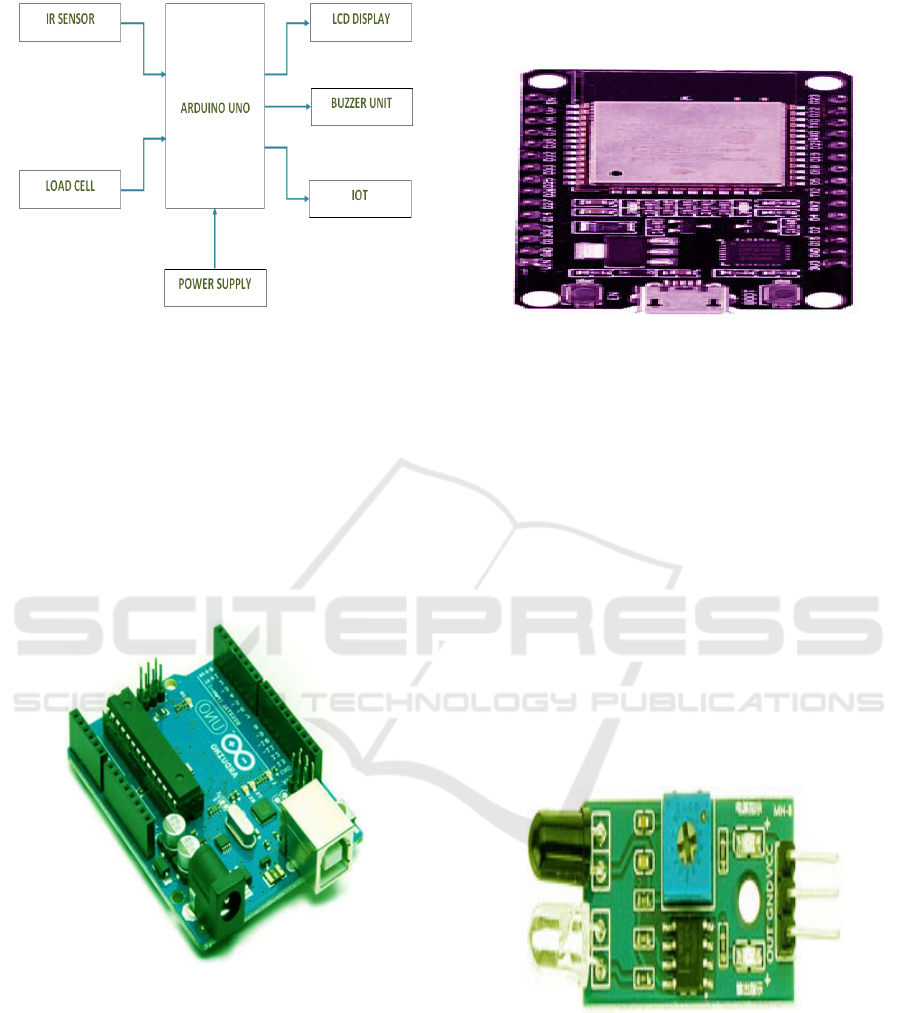
Figure 1: Block diagram.
(i) Arudino UNO: One board that uses the
ATmega328 microcontroller is the Arduino Uno. It
features a 16 MHz crystal oscillator, six analogue
inputs, fourteen digital I/O pins (six of which may be
used as PWM outputs), a power connector, an ICSP
header, a reset button, and a USB connection. It
comes with all the necessary components to support
the microcontroller; all you need is a USB cable, an
AC-to-DC adapter, or a battery to begin. The
following figure 2 shows the Arduino UNO.
Figure 2: Arduino UNO.
(ii) NodeMCU ESP32 IoT Module: The
computational power and inbuilt WiFi and Bluetooth
connectivity of ESP32 NodeMCU are making them
increasingly popular for use in making linked
products. Thanks to its breadboard-compatible
architecture and ease of programming in the Arduino
IDE, the NodeMCU-ESP32 makes comfortable
prototyping a reality. With this board, you get a BT
wireless connection in addition to 2.4 GHz dual-mode
WiFi. The following figure 3 shows the NodeMCU
ESP32 IoT Module.
Figure 3: NodeMCU ESP32 IoT module.
(iii) IR Sensor: Electronic devices that generate light
in order to detect certain environmental factors are
known as infrared sensors. Infrared (IR) sensors can
detect motion and also monitor an object's
temperature. In contrast to active IR sensors, which
generate infrared light, passive IR sensors only detect
the presence of infrared light. Every item typically
emits some kind of heat radiation in the infrared
range. An infrared sensor may pick up on these forms
of radiation that aren't visible to the human eye. An
infrared light-emitting diode (LED) serves as the
source of light, while a photodiode, which is sensitive
to infrared light of the same wavelength, acts as the
detector. These output voltages and the resistances
fluctuate in direct proportion to the intensity of the
infrared light that hits the photodiode. The following
figure 4 shows the IR Sensor.
Figure 4: IR Sensor.
(iv) Buzzer Unit: Buzzers and beepers are electrical
signaling devices that are often seen in vehicles, home
appliances (such microwave ovens), and game shows.
Typically, it's made up of a number of switches or
sensors that are linked to a control unit. This unit then
determines if a certain button was pressed or if a
certain amount of time has passed. In most cases, it
lights up the corresponding button or control panel
Enhancing Animal Safety Measures by Avoiding Train Collisions Using Internet of Things (IoT) with Advanced Sensors Association
683
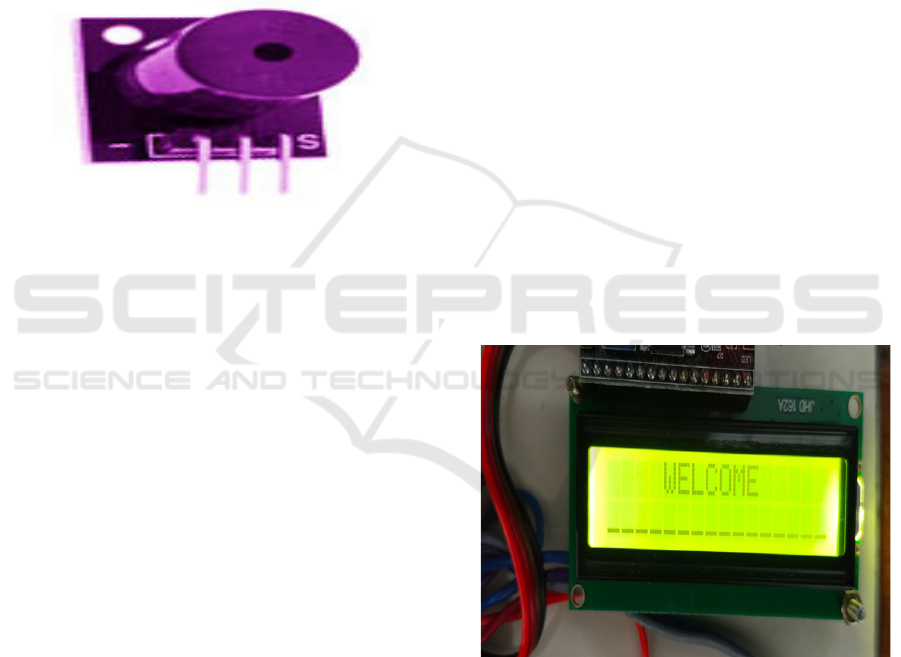
and makes a constantly beeping or intermittent
buzzing noise as a warning. An electromechanical
system, similar to an electric bell but lacking the
metal gong (the source of the ringing sound), was the
original basis of this apparatus. These devices would
frequently be fastened to the ceiling or wall and
would utilize them as a kind of soundproofing. The
first electromechanical buzzers, which were powered
by stepped-down AC line voltage at 50 or 60 cycles,
gave rise to the name "buzzer" due to the rasping
sound they produced. The usage of a ring or beep is
another typical method of signaling the pressing of a
button. The following figure 5 shows the buzzer unit.
Figure 5: Buzzer unit.
4 RESULTS AND DISCUSSIONS
Using deep learning neural networks, an IoT-based
surveillance system was created to identify animals
on railway lines. Cameras and sensors in this system
gather real-time data that is analyzed to find animals
on the rails. Alerts are given to train operators upon
detection, hence allowing quick intervention to stop
collisions. Another method uses image processing to
find hazards-especially animals-on train tracks using
an AI-powered early warning system. The technology
notifies trains via IoT apps and Bluetooth transmitters
and uses machine learning algorithms to find animals.
A buzzer notice warns the train driver to slow down
or halt upon detection, hence lowering the possibility
of crashes. Using the learning algorithm for object
recognition, an Artificial Intelligence (AI) I and IoT
based train collision avoidance system captures real-
time photos of railway tracks with cameras. The
technology emails notifications to authorities,
triggers a buzzer to notify the train driver, and shows
real-time updates on an LCD screen, so guaranteeing
prompt intervention to stop crashes upon finding an
obstruction, such as an animal. Using image
processing technology, a smart siren system finds
animals close to train tracks. Cameras record
photographs of the surrounding region; computer
vision algorithms then analyze them to find animals.
The technology activates a siren to warn animals of
an approaching train, therefore motivating them to
leave the tracks and so lowering the risk of accidents.
AI-based technologies have been used in India to
shield elephants from rail accidents. These gadgets
employ movement patterns and infrared imaging to
identify elephants using sensor technology. Alerts are
transmitted to railway and forest agencies as
elephants are discovered, so allowing train
conductors to halt or slow down and so avoid
accidents. Likewise, Norway has used IoT
technology to safeguard reindeer against rail
accidents. The technology alerts train operators when
they are nearing the reindeer by comparing geo-fence
regions with GPS data from reindeer collars, so
enabling them to take required measures. By use of
IoT and artificial intelligence technology, these
systems and implementations show how well they
may prevent train-animal collisions, hence improving
safety for railway operations as well as wildlife.
These systems and studies show how well combining
IoT and artificial intelligence technologies prevents
train-animal collisions, therefore improving safety for
railway operations as well as wildlife. The proposed
website design's welcome home page outcome is
depicted in the accompanying image, Figure 6.
Figure 6: Welcome message.
Figures 7 and 8 show the suggested hardware unit
design and the findings of the animal detection status
display clearly, illustrating the proposed technique.
ICRDICCT‘25 2025 - INTERNATIONAL CONFERENCE ON RESEARCH AND DEVELOPMENT IN INFORMATION,
COMMUNICATION, AND COMPUTING TECHNOLOGIES
684
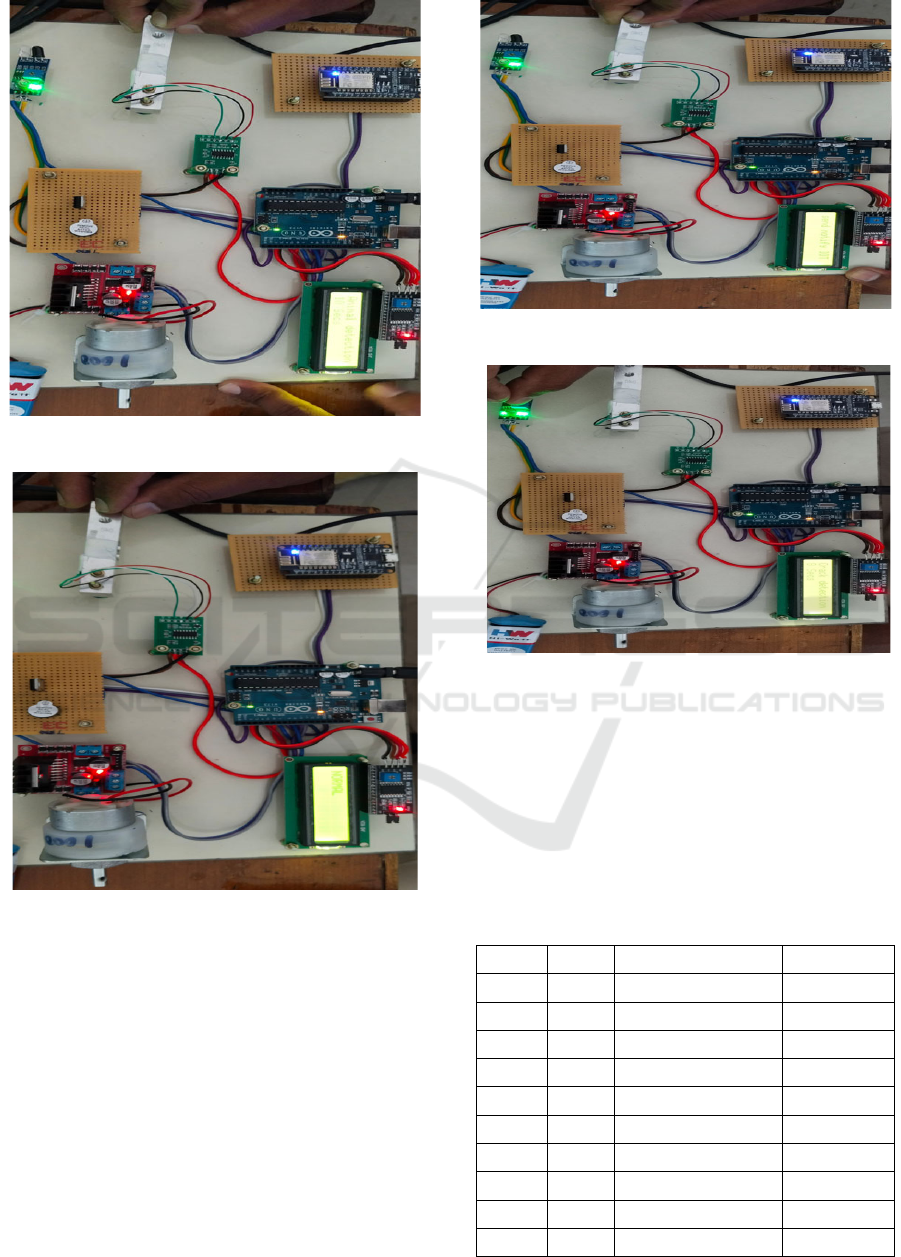
Figure 7: Animal detection.
Figure 8: Proposed hardware unit.
The results of the suggested method's crack
detection status display and the emergency alarm
message raised by IoT web interface are clearly
shown in Figures 9 and 10, respectively.
Figure 9: IoT emergency alert notification.
Figure 10: Crack detection.
Figure 11 shows the results of a cross-validation
between the suggested method, which makes use of
an ESP32 IoT enabled module, and the standard
design, which relies solely on an Arduino UNO
controller. Table 1 provides a descriptive
representation of the same.
Table 1: Analysis of Detection Accuracy Between
Proposed Esp32 Module and Normal Arduino Uno Based
Design.
S.No. Days Arduino UNO (%) ESP32 (%)
1. 5 87.26 97.94
2. 7 85.54 97.14
3. 10 84.39 97.41
4. 14 87.72 97.38
5. 15 89.29 98.54
6. 18 86.51 98.59
7. 27 84.73 98.47
8. 29 85.95 98.63
9. 33 86.18 97.52
10. 36 84.40 98.29
Enhancing Animal Safety Measures by Avoiding Train Collisions Using Internet of Things (IoT) with Advanced Sensors Association
685
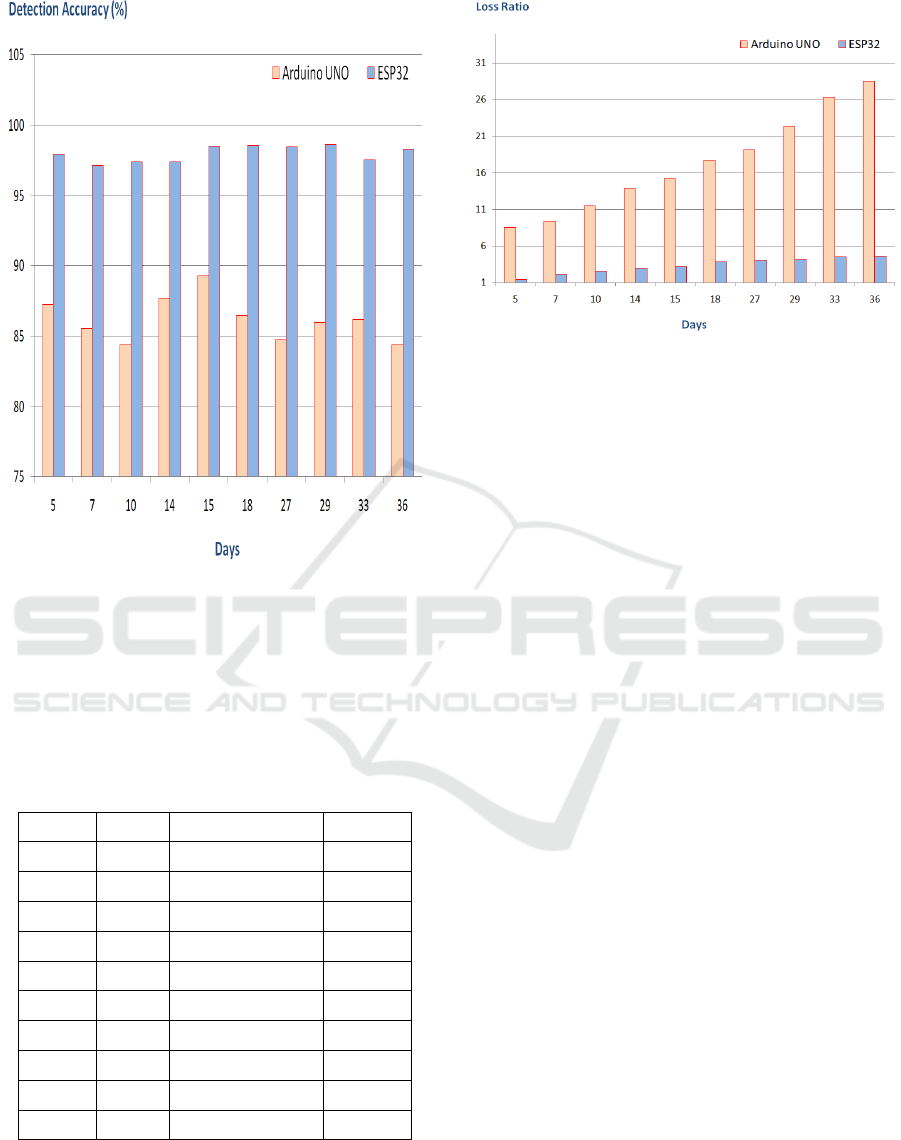
Figure 11: Detection accuracy.
Figure 12 shows the data loss ratio comparison
between the suggested method ESP32 IoT enabled
module and the standard design, which relies solely
on an Arduino UNO controller. Table-2 provides a
descriptive representation of the same.
Table 2: Loss ratio comparison between proposed ESP32
module and normal Arduino UNO based design.
S.No. Days Arduino UNO ESP32
1. 5 8.54 1.39
2. 7 9.36 2.16
3. 10 11.52 2.54
4. 14 13.86 2.89
5. 15 15.26 3.24
6. 18 17.69 3.78
7. 27 19.14 3.99
8. 29 22.36 4.16
9. 33 26.34 4.53
10. 36 28.52 4.61
Figure 12: Loss ratio analysis.
5 CONCLUSIONS
To improve railway safety and protect wildlife, it may
be necessary to install warning systems that are
activated when trains encounter certain animals. Load
cells, internet of things (IoT) sensors, and automation
based on the Arduino platform work together to make
this system capable of detecting obstacles on railway
lines and reacting accordingly by notifying
authorities and reducing train speeds. By combining
infrared sensors with LCD monitors, we can monitor
in real-time and respond quickly to avoid mishaps.
Reducing the financial burden and animal casualties
caused by train-wildlife incidents, this novel solution
improves railway operations while also harmonizing
with environmental preservation initiatives. Train
travel will become safer and more environmentally
friendly as new technologies allow for additional
iterations of this system. Worldwide, transportation
networks pose a threat to both humans and animals.
This paper proposes a novel solution.
REFERENCES
Atri Saxena, et al., "An Animal Detection and Collision
Avoidance System Using Deep Learning", Lecture
Notes in Electrical Engineering, 2020.
Balaji Kannan, et al., "Artificial Intelligence based System
to Prevent Animal Accidents in the Railway Tracks",
8th International Conference on Inventive Systems and
Control, 2024.
Gayathri K K, et al., "Early Warning System to Prevent
Animal-Train Collision", International Journal of
Scientific Research in Science and Technology, 2023.
ICRDICCT‘25 2025 - INTERNATIONAL CONFERENCE ON RESEARCH AND DEVELOPMENT IN INFORMATION,
COMMUNICATION, AND COMPUTING TECHNOLOGIES
686

Irene Nandutu, et al., "Intelligent Systems Using Sensors
and/or Machine Learning to Mitigate Wildlife–Vehicle
Collisions: A Review, Challenges, and New
Perspectives", Sensors, 2022.
ISTIAK MAHMUD, et al., "Advancing Wildlife
Protection: Mask R-CNN for Rail Track Identification
and Unwanted Object Detection", IEEE Access, 2023.
Julia Milewicz, et al., "Methods to reduce wildlife
collisions with rail vehicles", Rail Vehicles, 2021.
Kandikonda S V S K Devi Prakash, et al., "Arduino-based
Railway Line Tracking System for Mitigating Animal
Accidents", International Conference on Computing
Methodologies and Communication, 2023.
Madhupriya, et al., "Detection and Accident Prevention of
Animals in Railway Track using AI and IoT",
International Journal for Multidisciplinary Research,
2024.
N.Selvakumar, et al., "Wildlife and Train Collision
Detection System by Wsn", International Journal of
Advances in Engineering and Management, 2020.
S.R. Mathu sudhanan, et al., "Using Mask R-CNN and
distance transform to detect elephants on railway tracks
for collision prevention", Measurement, 2025.
Seiler A, et al., "Wildlife Deterrent Methods for Railways-
An Experimental Study", Springer, 2017.
Shanaka Gunasekara, et al., "A Convolutional Neural
Network Based Early Warning System to Prevent
Elephant-Train Collisions", IEEE 16th International
Conference on Industrial and Information Systems,
2021.
Shizhong Zhao, et al., "Passive Safety Assessment of
Railroad Trains in Moose Herd Collision Scenarios",
Sustainability, 2024.
Surbhi Gupta, et al., "Deep Vision Based Surveillance
System to Prevent Train-Elephant Collisions",
Research Square, 2021.
Vojtěch Nezval, et al., "Spatial analysis of wildlife-train
collisions on the Czech rail network", Applied
Geography, 2020.
Enhancing Animal Safety Measures by Avoiding Train Collisions Using Internet of Things (IoT) with Advanced Sensors Association
687
