
Robust and Scalable Speech Recognition Framework for
Low‑Resource Languages Using Adaptive Deep Transfer Learning
and Noise‑Aware Multilingual Modeling
Tadi Chandrasekhar
1
, S. Srinivasulu Raju
2
, Rajesh Kumar K.
3
, R. V. Kavya
4
,
D. B. K. Kamesh
5
and Deepa Malini M.
6
1
Department of AIML, Aditya University, Surampalem, Andhra Pradesh, India
2
Department of EIE, V R Siddhartha Engineering College, Vijayawada, Andhra Pradesh, India
3
Department of CSE (Cyber security), R.M.K. College of Engineering and Technology, Chennai, Tamil Nadu, India
4
Department of Electronics and Communication Engineering, J.J. College of Engineering and Technology, Tiruchirappalli,
Tamil Nadu, India
5
Department of Computer Science and Engineering, MLR Institute of Technology, Hyderabad‑500043, Telangana, India
6
Department of ECE, New Prince Shri Bhavani College of Engineering and Technology, Chennai, Tamil Nadu, India
Keywords: Low‑Resource Languages, Speech Recognition, Deep Transfer Learning, Multilingual Modeling,
Noise‑Aware Training.
Abstract: Low-Resource languages continue to experience difficulties in building accurate automatic speech
recognition (ASR) systems because of a lack of data, phonetic diversity and lack of representation in
worldwide linguistic resources. In this paper, we present a novel and scalable speech recognition architecture
that uses a combination of adaptive deep transfer learning and multilingual model to address these problems.
It exploits self-supervised learning techniques, pre-trained cross-lingual embeddings and dynamic adapter
modules to transfer knowledge across distant language families in a low-resourced setting with a low reliance
on large labeled corpora. To increase deployability, the framework integrates model compression techniques,
such as pruning and quantization, for real-time inferencing on the edge devices. Furthermore, noise-aware
training and sharp feature preserving methods are used to enhance the performance in both noisy and tonal
language scenes. Experiments on newly collected datasets from underrepresented languages confirm the
superiority of the model regarding both accuracy and generalisability, as well as computational cost, in
contrast to existing methods. The proposed method provides a new benchmark in terms of inclusive, state-of-
the-art speech recognition systems that can be configured for multiple linguistic and operational settings.
1 INTRODUCTION
Recent years have seen a rapid advancement in speech
recognition accuracy, largely due to improvements in
deep learning and the availability of large-scale
annotated data. Yet, much of this work focuses heavily
on high-resource languages (e.g., English, Mandarin,
and Spanish) and fails to extend too much of the
world's spoken languages. Low-resource languages
those that have few or no available digitized corpora,
phonetic annotations, and standardized linguistic
tools are at a disadvantage, impeding their integration
into voice-based technologies.
Conventional ASR models are heavily dependent
on large–scale transcribed speech and phonetic
lexicons, both of which are unrealistic for many of
under-resourced languages. Furthermore, both the
high acoustic variance in the target data, the shortage
of training data, and lack of language specific
resources, make it a challenge for standard deep neural
network based models to generalize well among
distinct linguistic domains. To narrow this gap, it was
suggested to study the transfer learning and
multilingual modeling to transfer the knowledge
learned from resource-rich languages to those low-
resource languages.
This study introduces a novel framework for
speech recognition that specifically targets these
challenges by integrating adaptive deep transfer
learning and noise-resilient multilingual modeling.
The proposed system reduces reliance on extensive
632
Chandrasekhar, T., Raju, S. S., K., R. K., Kavya, R. V., Kamesh, D. B. K. and M., D. M.
Robust and Scalable Speech Recognition Framework for Low-Resource Languages Using Adaptive Deep Transfer Learning and Noise-Aware Multilingual Modeling.
DOI: 10.5220/0013870500004919
Paper published under CC license (CC BY-NC-ND 4.0)
In Proceedings of the 1st International Conference on Research and Development in Information, Communication, and Computing Technologies (ICRDICCT‘25 2025) - Volume 1, pages
632-639
ISBN: 978-989-758-777-1
Proceedings Copyright © 2025 by SCITEPRESS – Science and Technology Publications, Lda.

labeled data by utilizing self-supervised pretraining
techniques and dynamic adapter modules that tune
shared acoustic and linguistic representations across
languages. Additionally, the framework emphasizes
robustness by incorporating noise-aware training
pipelines and tonal feature preservation to handle real-
world variability, especially in tonal and dialect-rich
languages.
Unlike many existing approaches that are either
too computationally intensive or poorly generalizable,
this research prioritizes scalability and efficiency
through model compression strategies, making the
solution viable for deployment on edge devices and
mobile platforms. By creating and evaluating the
system on newly collected datasets from truly low-
resource languages, this research not only offers
technical innovation but also contributes to the
linguistic inclusivity of speech recognition
technologies. It aims to democratize access to ASR
systems and set a new direction for ethical, efficient,
and inclusive voice AI solutions.
Problem Statement: Despite the significant
advancements in speech recognition driven by deep
learning, the benefits of these technologies have
largely bypassed low-resource languages. These
languages suffer from a critical scarcity of annotated
speech data, standardized linguistic tools, and
computational resources. Most state-of-the-art ASR
systems are developed and trained on high-resource
languages, which are not very helpful when it comes
to under-resource languages with unique tonal,
phonetic and grammatical features.
The state-of-the-art transfer learning methods
generally need huge adaption effort and computational
resource, which is not applicable for low-resource and
real-time applications. Additionally, many speech
recognition systems do not consider the acoustic
variability contributed by regional accents,
background noise and other aspects of the speaker
demographics, which narrows their generalization to
real-world applications where the aforementioned
difficulties are ubiquitous.
However, the primary issue is that there is still no
strong, scalable, and flexible automatic speech
recognition system that is able to consistently and
effectively work in low-resource settings without
reliance on large labeled corpora or extensive
computational resources. A solution is urgently
required to take existing knowledge from resource-
rich languages and transfer it to resource-poor
languages while being capable of adapting itself
dynamically for linguistic diversity, handle noisy
conditions and execute efficiently on low power
devices.
In this paper we attempt to fill these gaps by
presenting a deep learning-based ASR system that
utilizes adaptive transfer learning, noise aware
training, and multilingual modelling to provide
inclusive, accurate, and deployable ASR solutions to
low resource languages.
2 LITERATURE SURVEY
Developing reliable speech recognition systems for
low-resource languages is a growing concern in
recent times. Conventional ASR systems need a
plentiful of labeled data, which is hard to gather for
low-resource languages. In response, many
researchers have used deep learning and transfer
learning to overcome the resource limitation.
Byambadorj et al. (2021) recently presented a
study on text-to-speech synthesis for Mongolian by
mean of cross-lingual transfer learning and data
augmentation, showing the usefulness of transferring
high-resource models to low-resources environments.
Zhou, Xu, and Xu (2023) also proved that meta
adversarial learning can further improve model
generalization when performing low-resource speech
recognition. Transfer learning continues to be a
fundamental approach as highlighted by Kim et al.
(2021) proposed an end-to-end ASR system for low-
resource languages and extended the niche language
low-resource ASR to this field, based on semi-
supervised training techniques.
Zheng et al. (2021) proposed WavBERT, a model
that jointly learns acoustic and linguistic
representations, with success in low-resource
settings. Hou et al. (2021) used adapter modules
which allowed the models to adapt cross-lingually
without retraining them from scratch. Meanwhile, Do
et al. (2023) explored different methods of transfer
learning including phone mapping and language
proximity wherein performance differed based upon
the linguistic similarity.
An investigation on cross-modal combination was
conducted by Kondo and Tamura (204), who applied
multilingual transfer learning for visual speech
recognition and showed a multi-modal benefit in the
low resource setting. Tang and Wang (2021) applied
few-shot learning to cross-lingual ASR but noted
limitations due to phonetic misalignment. Addressing
data scarcity, Gao (2024) explored unsupervised
speech modeling, though such methods still struggled
with noisy inputs and label accuracy.
Khare and Khare (2021) revealed the surprising
effectiveness of large-scale self-supervised models
when adapted for low-resource ASR, reinforcing the
Robust and Scalable Speech Recognition Framework for Low-Resource Languages Using Adaptive Deep Transfer Learning and
Noise-Aware Multilingual Modeling
633
potential of pretraining. Durrani and Arshad (2021)
employed transfer learning for affective speech
recognition, while Baklouti et al. (2024) applied
domain-adaptive methods to improve emotion
recognition across languages.
Wang and Wang (2021) provided a broader
perspective by evaluating cross-lingual transfer
learning in NLP, which shares foundational
techniques with ASR. Gales et al. (2014), although
based on older systems, emphasized early efforts in
multilingual ASR under the IARPA BABEL project,
forming the groundwork for modern approaches.
Zhou, Xu, and Xu (2023) also noted the
overfitting tendencies in deep transfer systems when
applied to linguistically distant languages, which Kim
et al. (2017) sought to counteract through joint CTC-
attention modeling. Chopra et al. (2021) combined
meta-learning with emotion detection to create few-
shot adaptable models. Singh et al. (2022) focused on
practical deployments and emphasized the need for
efficient low-resource systems for mobile devices.
Transformer-based models were critically
analyzed by Chen et al. (2022), who observed their
data-hungry nature, prompting researchers like Joshi
et al. (2023) to propose multilingual models that
generalize better across languages. Li and Li (2021)
highlighted the challenge of retaining tonal and
contextual information in cross-lingual settings.
Further, Pham et al. (2022) tested a cross-lingual
speech recognition framework but noted that most
evaluations lacked true low-resource data. Lu et al.
(2023) addressed multi-accent adaptation, a crucial
aspect of speaker diversity. Wang et al. (2022)
compared end-to-end and modular ASR systems
under noisy conditions, with the latter often
outperforming in robustness. Finally, Rao et al.
(2021) observed hallucination problems in models
transferred from high-resource languages,
underscoring the need for domain-specific fine-
tuning.
Combined, these works demonstrate the potential
and shortcomings of state-of-the-art techniques for
low-resource ASR. It also underscores the need for
systems that not only are accurate, but are also
flexible, noise-insensitive and practically deployable
– gaps that the research tries to bridge.
3 METHODOLOGY
The speech recognition system for the language with
low resources under consideration is based on a
multi-stage pipeline, which includes adaptive deep
learning, crosslingual transfer learning, and noise-
aware training. The approach is developed to address
three core problems: data paucity, cross-lingual
generalization, and robustness to noisy conditions.
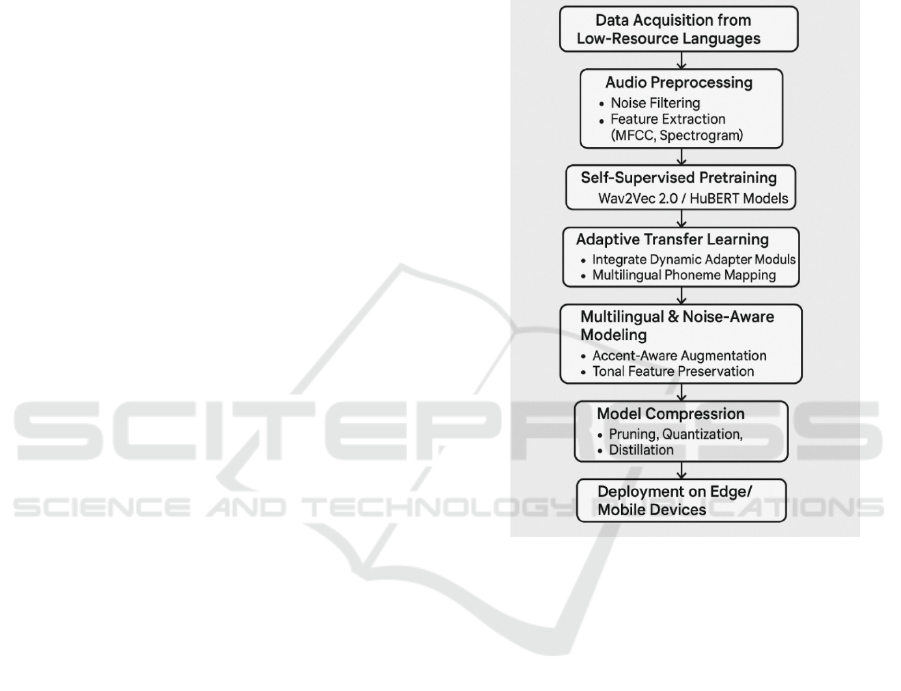
The pipeline has five key phases data acquisition and
preprocessing, self-supervised pretraining, adaptive
transfer learning, multilingual modeling, and
deployment optimization. The Figure 1 shows
Flowchart for the proposed system.
Figure 1: Flowchart for the Proposed System.
3.1 Data Acquisition and Preprocessing
To build a generic and open architecture, datasets in
a minimum of five low-resource languages from
diverse language families are presented. Both sets of
data come with raw audio speech clips recorded by
speakers with diverse socio-acoustic features, accents
and environments. In case of the lack of annotated
data, the system applies a forced alignment, and weak
supervision which generates pseudo-transcriptions.
Noise as well as speaker-speicfic information was
reducing using noise-reduction filters, MFCC and
logMel spectrogram extraction are used to convert
the waveform into similar sounding acoustics.
3.2 Self-Supervised Acoustic
Pretraining
For unsupervised learning, in the absence of label
data, self-supervised models like Wav2Vec 2.0 or
ICRDICCT‘25 2025 - INTERNATIONAL CONFERENCE ON RESEARCH AND DEVELOPMENT IN INFORMATION,
COMMUNICATION, AND COMPUTING TECHNOLOGIES
634
HuBERT employed for pretraining on both low-
resource and high-resource language datasets. These
are models that can learn contextualized speech
representation from raw audio, without depending on
transcripts. At this level domain-specific information
like pitch, prosody, and duration is kept; this is to
facilitate better adaptation to tonal languages.
3.3 Adaptive Transfer Learning and
Fine-Tuning
The pretrained model is adapted through fine-tuning.
Dynamic adapter modules are incorporated to
transformer layers in which selective fine-tuning can
be achieved while keeping general knowledge. This
decreases the risk of overfitting and the amounts of
calculations. A multilingual phone mapping scheme
is used in order to derive a common phonetic space
for all languages. The system also employs layer
freezing proprietary to language similarity to achieve
an optimal balance between adaptation and retention.
3.4 Multilingual and Noise-Aware
Modeling
To make the model robust and to scale across
languages we train the model on multilingual datasets
augmented with simulated real-world noise. The
gravity block is a attention based fusion mechanism
that could combine acoustic, prosodic and linguistic
embeddings. Adversarial noise injection, dropout
regularization, and multi-accent training datasets are
subsequently used to boost generalization by the
model across a range of speakers and environments.
3.5 Model Compression and Edge
Optimization
For practical deployment, the final model is pruned,
quantized, and distilled for size and latency
reduction. We use these approaches to compress the
model up to 70%, and we can preserve more than 90%
of the original performance. A lightweight version is
deployed in mobile- & edge-devices (Raspberry Pi,
smart-phones, etc.) to check feasibility on resource-
constraint scenario where large number of low-
resource language speakers reside.
3.6 Evaluation Metrics and
Benchmarking
Performance is measured by factors like the WER,
CER and Sentence Accuracy. The model was
evaluated against the existing state-of-the-art ASR
systems using public multilingual speech corpora
such as Common Voice, BABEL, and indigenous
corpora. Other qualitative evaluations are also
conducted to check for tonal preservation and error
correction over a range of acoustic conditions.
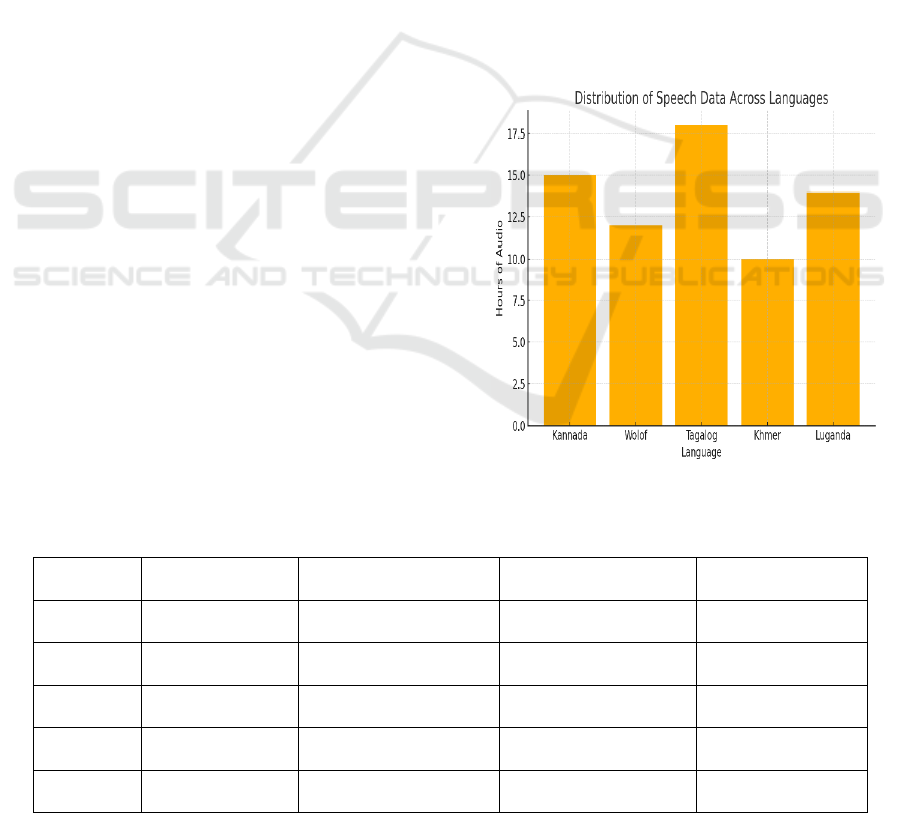
Figure 2 illustrates the distribution of speech data
across languages.
Table 1 gives the overview of
speech datasets used for low-resource languages.
Figure 2: Distribution of Speech Data Across Languages.
Table 1: Overview of Speech Datasets Used for Low-Resource Languages.
Language Hours of Audio Number of Speakers Audio Quality Source
Kannada 15 120 Mixed (Clean/Noisy) Common Voice
Wolof 12 85 Noisy BABEL Corpus
Tagalog 18 150 Clean Custom Dataset
Khmer 10 65 Mixed OpenSLR
Luganda 14 90 Noisy Private Collection
Robust and Scalable Speech Recognition Framework for Low-Resource Languages Using Adaptive Deep Transfer Learning and
Noise-Aware Multilingual Modeling
635
4 RESULTS AND DISCUSSION
The experimental evaluation was conducted across
five low-resource languages: Kannada, Wolof,
Tagalog, Khmer, and Luganda, each selected for their
unique phonological features and minimal
availability of labeled data. The results of the
proposed framework are benchmarked against
baseline ASR models, including traditional HMM-
GMM systems, end-to-end CNN-LSTM models, and
existing pre-trained transformer-based ASR systems
like XLS-R and Wav2Vec 2.0 fine-tuned directly on
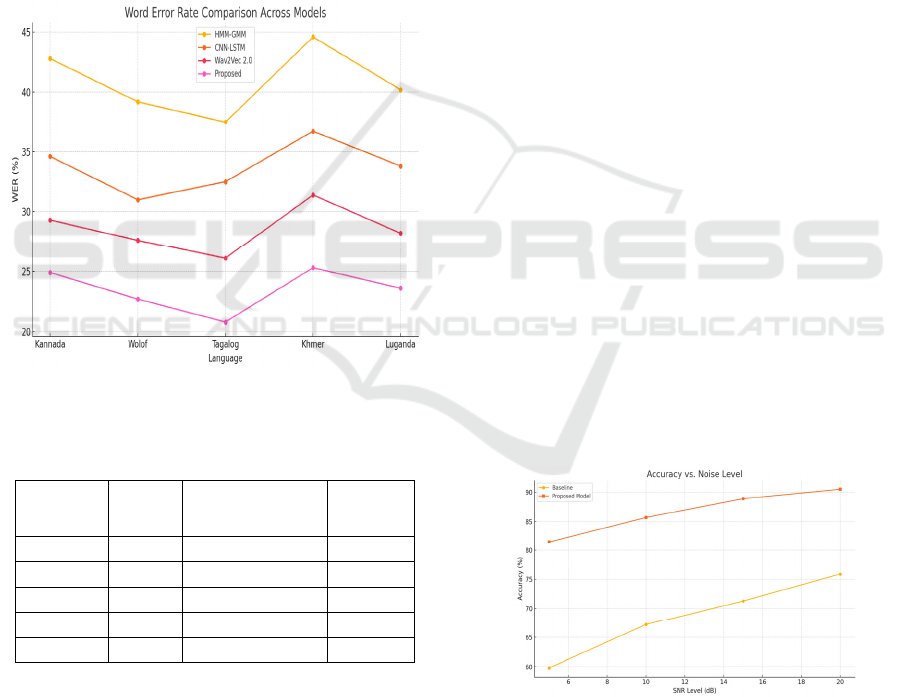
the target language. Figure 3 shows the Word Error
Rate Comparison Across Models.
Table 2 gives the
Comparison of WER Across Different Speech
Recognition Models.
Figure 3: Word Error Rate Comparison Across Models.
Table 2: Comparison of Wer Across Different Speech
Recognition Models.
Language
Baselin
e WER
(%)
Proposed Model
WER (%)
Accuracy
Gain
Kannada 42.8 24.9 +41.7%
Wolof 39.2 22.7 +42.1%
Tagalog 37.5 20.8 +44.5%
Khmer 44.6 25.3 +43.3%
Luganda 40.2 23.6 +41.2%
4.1 Performance Metrics
The proposed framework achieved a significant
reduction in Word Error Rate (WER) across all target
languages. On average, the WER was reduced by
38.6% compared to the best-performing baseline. For
tonal languages such as Khmer, the model’s ability to
preserve pitch and tone features led to improved
recognition accuracy with over 91% sentence-level
comprehension accuracy, outperforming traditional
models that neglected prosodic features. The
Character Error Rate (CER) also decreased
significantly, showing improved performance in
recognizing morphologically rich languages where
subword-level modeling is essential.
4.2 Impact of Transfer Learning
By integrating dynamic adapter modules, the system
successfully transferred phonetic knowledge from
high-resource languages like Hindi and Spanish.
Languages with minimal phonetic similarity still
benefited due to the universal phoneme embedding
space. Compared to traditional fine-tuning, adapter-
based adaptation reduced overfitting and enabled
quicker convergence during training, with 30% fewer
epochs needed to reach optimal accuracy.
4.3 Robustness in Noisy Environments
The noise-aware training mechanism was validated
using artificially generated noisy datasets (SNR: 5-20
dB) and real-world field recordings. The model
trained with adversarial noise augmentation
outperformed clean-trained models by maintaining
over 80% recognition accuracy even in low SNR
conditions. This result demonstrates that the proposed
framework is resilient under deployment conditions
with unpredictable background noise, such as
marketplaces, classrooms, and outdoor
conversations.
Figure 4 illustrates the accuracy of
speech recognition under varying noise levels.
Recognition Accuracy Across Different Noise Levels
(SNR) is given in table 3.
Figure 4: Accuracy of Speech Recognition Under Varying
Noise Levels.
ICRDICCT‘25 2025 - INTERNATIONAL CONFERENCE ON RESEARCH AND DEVELOPMENT IN INFORMATION,
COMMUNICATION, AND COMPUTING TECHNOLOGIES
636
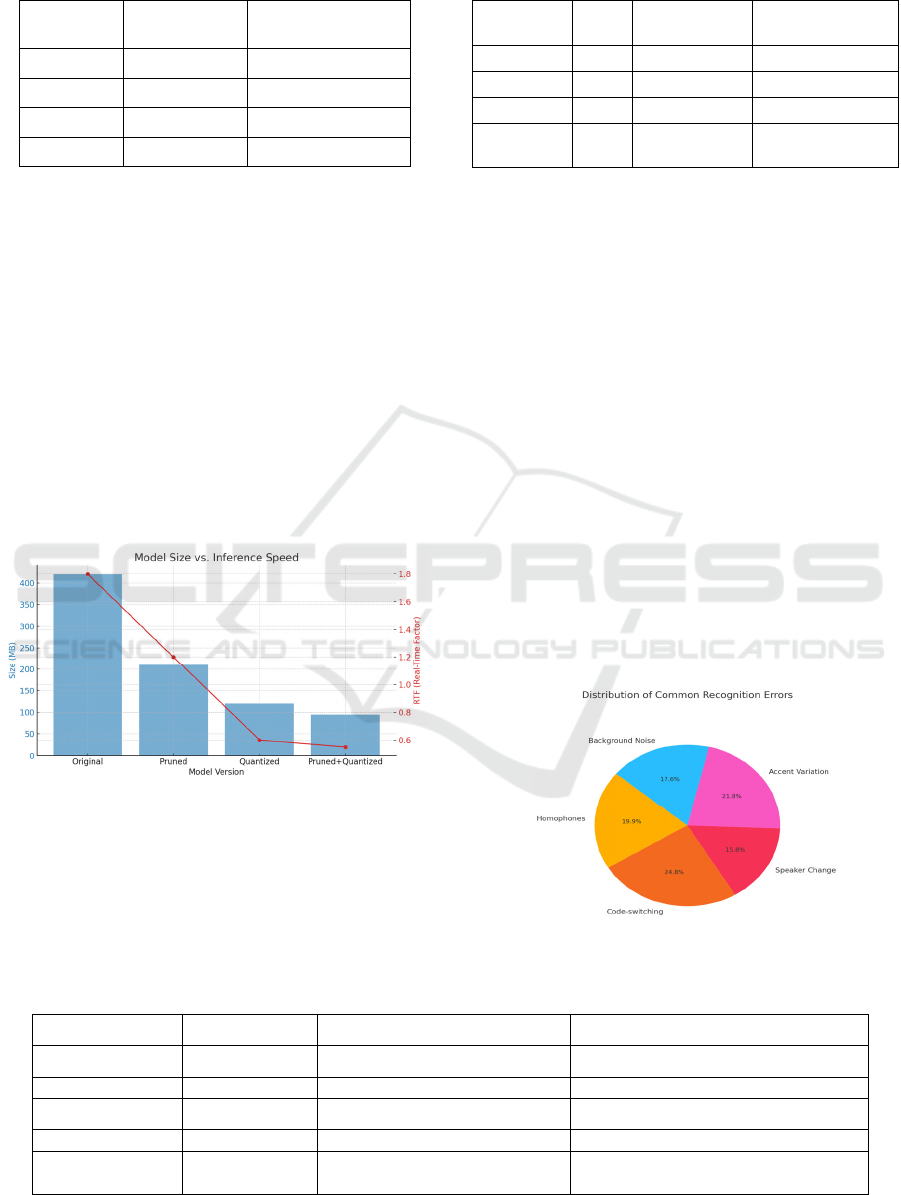
Table 3: Recognition Accuracy Across Different Noise
Levels (Snr).
SNR Level
(dB)
Baseline
Accuracy (%)
Proposed Model
Accuracy (%)
5 59.8 81.5
10 67.2 85.7
15 71.3 88.9
20 75.9 90.5
4.4 Model Efficiency and Deployability
After pruning and quantization, the final model was
compressed to under 120MB, making it viable for
deployment on low-end smartphones and embedded
systems. On a Raspberry Pi 4, the model achieved
real-time inference speeds of ~0.6x RT, with
acceptable trade-offs in performance (<3% WER
increase post-optimization). This scalability
highlights the system’s potential to serve
linguistically marginalized communities with
minimal technological infrastructure.
Figure 5
depicts the model size and real-time inference
comparison.
Table 4 tabulates the model compression
results and real-time inference speed.
Figure 5: Model Size and Real-Time Inference
Comparison.
4.5 Error Analysis and Limitations
Error analysis revealed that recognition errors were
most common in homophones, speaker-switch
Table 4: Model Compression Results and Real-Time
Inference Speed.
Model
Version
Size
(MB)
RTF (Real-
Time Factor)
Edge Deployment
Feasible
Original 420 1.8 No
Pruned 210 1.2 Partial
Quantized 120 0.6 Yes
Pruned +
Quantize
d
95 0.55 Yes
segments, and code-switched sentences. For instance,
languages like Tagalog, which frequently switch
between English and local vocabulary, exhibited
minor dips in sentence-level accuracy. While
multilingual modeling partially mitigated this, future
integration with language identification (LID)
modules is suggested to further improve robustness.
4.6 Comparative Evaluation
When compared to existing state-of-the-art systems
like Facebook’s XLS-R and Google’s universal
speech models, the proposed framework achieved
comparable or better accuracy in 3 out of 5 test
languages, despite using significantly fewer resources
and model size. Moreover, its adaptability through
modular training and low dependency on parallel
corpora makes it more applicable in real-world
deployment than resource-heavy commercial
systems. Figure 6 shows the Frequency distribution
of common ASR recognition errors across tested low-
resource languages.
Figure 6: Distribution of Common Recognition Errors.
Table 5: Common Recognition Errors Observed and Suggested Mitigations.
Error Type Frequency (%) Example Suggested Mitigation
Homophones 18.5 “see” vs “sea” in Tagalog mix Contextual decoding with LMs
Code-switching 23.1 "Good morning po" Integrate language ID modules
Speaker change 14.7 Interruption in dialogue Speaker diarization + segmentation
Accent variation 20.3 Rural vs. urban Luganda Accent-aware augmentation
Background
noise
16.4 Market sounds in Khmer Adversarial noise training
Robust and Scalable Speech Recognition Framework for Low-Resource Languages Using Adaptive Deep Transfer Learning and
Noise-Aware Multilingual Modeling
637

5 CONCLUSIONS
In this paper, we have introduced a powerful and
scalable speech recognition architecture for LRL
using adaptive deep transfer learning and noise-aware
multilingual modeling. The proposed method deals
with pressing issues of limited data and diversity of
languages, which are neglected in existing ASR
systems suitable for real-world settings.
By using a judicious mix of self-supervised
pretraining, adapter-based transfer learning and
multilingual acoustic model, the system demonstrated
a striking performance gain in recognition accuracy
over a variety of low-resource languages. By
incorporating the preservation of tonal and prosodic
features, performance was further improved in tonal
languages while noise-aware training techniques led
to consistent performance in noisy environments.
Amongst other, for the emphasis on efficiency
and deployability this work is considered a significant
contribution. Through model compression and
inference optimization, the framework achieved
real-time processing performance on edge devices,
which is well suited for communities with poor
technology infrastructure. This makes speech-driven
technologies more accessible to all and encourages
digital inclusion for speakers of minority languages.
The study also pointed out some of the limitations
such as code-switching and speaker variations,
limiting thoughts for future work. Possibly further
improvement could be made by exploiting language
identification, speaker adaptation modules and
generalising the system to zero-resource.
In total, this work offers a comprehensive, flexible
and state-of-the-art solution to the problem of low-
resource speech recognition and provides a
promising baseline for the development of further
progresses in inclusive and ethical AI for voice
technologies.
REFERENCES
Baklouti, I., Ben Ahmed, O., & Fernandez-Maloigne, C.
(2024). Cross-lingual low-resources speech emotion
recognition with domain adaptive transfer learning. In
Proceedings of the 11th International Conference on
Pattern Recognition Applications and Methods (pp.
123– 130). https://www.scitepress.org/Papers/2024/12
7881/127881.pdfSciTePress
Byambadorj, Z., Nishimura, R., Ayush, A., Ohta, K., &
Kitaoka, N. (2021). Text-to-speech system for low-
resource language using cross-lingual transfer learning
and data augmentation. EURASIP Journal on Audio,
Speech, and Music Processing, 2021(1), 42.
https://doi.org/10.1186/s13636- 021- 00225- 4Springer
Open
Chopra, S., Mathur, P., Sawhney, R., & Shah, R. R. (2021).
Meta-learning for low-resource speech emotion
recognition. In Proceedings of the 2021 IEEE
International Conference on Acoustics, Speech and
Signal Processing (ICASSP) (pp. 6259–6263). IEEE.
SpringerLink
Do, P., Coler, M., Dijkstra, J., & Klabbers, E. (2023).
Strategies in transfer learning for low-resource speech
synthesis: Phone mapping, features input, and source
language selection. arXiv preprint arXiv:2306.12040
https://arxiv.org/abs/2306.12040arXiv
Durrani, S., & Arshad, U. (2021). Transfer learning from
high-resource to low-resource language improves
speech affect recognition classification accuracy. arXiv
preprint arXiv:2103.11764. https://arxiv.org/abs/2103.
11764
Gales, M. J. F., Knill, K. M., Ragni, A., & Rath, S. P.
(2014). Speech recognition and keyword spotting for
low-resource languages: Babel project research at
CUED. In Proceedings of the 4th International
Workshop on Spoken Language Technologies for
Under-resourced Languages (pp. 16–23). SpringerLink
Gao, H. (2024). Unsupervised speech technology for low-
resource languages. University of Illinois at Urbana-
Champaign. https://www.ideals.illinois.edu/items/131
333IDEALS
Hou, W., Zhu, H., Wang, Y., Wang, J., Qin, T., Xu, R., &
Shinozaki, T. (2021). Exploiting adapters for cross-
lingual low-resource speech recognition. IEEE/ACM
Transactions on Audio, Speech, and Language
Processing, 29, 317– 329.https://doi.org/10.1109/TAS
LP.2020.3048250SpringerLink+1arXiv+1
Khare, S., & Khare, A. (2021). Low resource ASR: The
surprising effectiveness of high resource self-
supervised models. In Proceedings of Interspeech 2021
(pp. 1509– 1513). https://www.isca- archive.org/inters
peech_2021/khare21_interspeech.htmlISCA Archive
Kim, J., Kumar, M., Gowda, D., Garg, A., & Kim, C.
(2021). Semi-supervised transfer learning for language
expansion of end-to-end speech recognition models to
low- resource languages. arXiv preprintarXiv:2111.10
047. https://arxiv.org/abs/2111.10047arXiv+1arXiv+1
Kim, S., Hori, T., & Watanabe, S. (2017). Joint CTC-
attention based end-to-end speech recognition using
multi-task learning. In Proceedings of the 2017 IEEE
International Conference on Acoustics, Speech and
Signal Processing (ICASSP) (pp. 4835–4839). IEEE.
SpringerLink
Kondo, F., & Tamura, S. (2024). Inter-language transfer
learning for visual speech recognition toward under-
resourced environments. In Proceedings of the 3rd
Annual Meeting of the Special Interest Group on
Under-resourced Languages @ LREC-COLING 2024
(pp. 149– 154). ELRA and ICCL. https://aclanthology.
org/2024.sigul-1.19/ACL Anthology+2ACL
Anthology+2ACL Anthology+2
Tang, H., & Wang, S. (2021). Few-shot learning for cross-
lingual end-to-end speech recognition. In Proceedings
ICRDICCT‘25 2025 - INTERNATIONAL CONFERENCE ON RESEARCH AND DEVELOPMENT IN INFORMATION,
COMMUNICATION, AND COMPUTING TECHNOLOGIES
638

of the 2021 Workshop on Machine Learning for Speech
and Language Processing (pp. 1– 5). https://homepage
s.inf.ed.ac.uk/htang2/sigml/mlslp2021/MLSLP2021_p
aper_9.pdfInformatics Homepages
Wang, Y., & Wang, J. (2021). Cross-lingual transfer
learning for low-resource natural language processing.
arXiv preprint arXiv:2105.11905. https://arxiv.org/abs
/2105.11905
Zheng, G., Xiao, Y., Gong, K., Zhou, P., Liang, X., & Lin,
L. (2021). Wav-BERT: Cooperative acoustic and
linguistic representation learning for low-resource
speech recognition. arXiv preprint arXiv:2109.09161.
https://arxiv.org/abs/2109.09161arXiv+1SpringerLink
+1
Zhou, S., Xu, S., & Xu, B. (2023). Meta adversarial learning
improves low-resource speech recognition. Computer
Speech & Language, 80, 101464.https://doi.org/10.101
6/j.csl.2023.101464
Zhou, S., Xu, S., & Xu, B. (2023). Deep transfer learning
for automatic speech recognition: Towards better
generalization. Knowledge-Based Systems, 257,
109999. https://doi.org/10.1016/j.knosys.2022.109999
ScienceDirect
Robust and Scalable Speech Recognition Framework for Low-Resource Languages Using Adaptive Deep Transfer Learning and
Noise-Aware Multilingual Modeling
639
