
Comparative Study of MTCNN and YuNet for Deepfake Detection
M. Tanmay Adithya, C. Tanush, N. Kathyaini and D. Mohit Reddy and G. Mary Swarna Latha
Department of Computer Science and Engineering, Institute of Aeronautical Engineering, Dundigal, Telangana, India
Keywords: Deepfake Detection, MTCNN, YuNet, Deep Learning, InceptionResNetV1, Face Detection.
Abstract: In recent years, deepfakes have become a prominent digital threat, raising concerns about the potential harm
they can inflict on personal privacy and the fabric of society as trust in visual evidence becomes increasingly
compromised. This paper provides an in-depth comparative analysis of MTCNN Vs YuNet face detection
algorithms specifically focused on deepfake detection use cases. This work compares several baseline face
detection models, systematically integrated into an InceptionResNetV1 model for classification to analyze
which preprocessing technique yields the optimal performance for detecting facial manipulation techniques.
To demonstrate the efficacy of this method, thorough experimental evaluations were conducted on the newly
proposed OpenForensics dataset, which is characterized by diverse cases and rich face-level annotations,
leveraging multiple faces in a single image. The results of each of the three reconfigurable system-level
implementations are consistent in that the YuNet-based pipeline gives a significant improvement over the
MTCNN-based system across all the core performance metrics (accuracy 57.2% vs 52.2%; precision 55.0%
vs 51.6%; recall 82.8% vs 81.1%; and F1-score 66.1% vs 63.1%). Moreover, YuNet processes images much
faster, at 0.008 seconds per image on average, compared to MTCNN's 0.024 seconds per image, indicating a
3x computational efficiency improvement. The YuNet pipeline also obtains a more accurate Area Under the
ROC Curve score (0.624 vs 0.544), which measures the ability to accurately classify authentic and
manipulated facial imagery across various classification thresholds. When analyzed more in-depth through
confusion matrices, YuNet shows fewer false negatives as well, proving to be more effective at identifying
deepfake images correctly. These findings collectively suggest that YuNet's enhanced detection capabilities,
coupled with its architecture optimized for low-latency processing, make it significantly more suitable for
real-time deepfake detection applications.
1 INTRODUCTION
Face detection is an essential step in many deepfake
detection pipelines and is often used as a
preprocessing step (G. Gupta, et.al 2023).
Convolutional Neural Networks, a type of deep
learning model, have driven progress in face
detection and deepfake detection. These models have
been demonstrated to be proficient in capturing
complicated features from images and videos to
identify indistinct patterns of manipulation (M. L.
Saini, et.al 2024) Referring to such types of face
detectors, two widely used face detectors, MTCNN
and YuNet, reached popularity for their speed and
accuracy, which make them suitable for the
incorporation of such detectors in the deepfake
detection pipelines. Advanced deepfake technology
makes these signs of detection increasingly difficult
to recognize. As deepfake technology gets better, so
must the detection techniques so that they still work
against the new threats. Deepfake has become a
buzzword to describe the ongoing advances in this
rapidly evolving field that can be threatening if not
properly controlled. Developing reliable deepfake
detection systems is crucial for maintaining trust in
digital media. Deep learning models have become an
essential tool in the detection of deepfakes because
they're capable of detecting hidden patterns and
features inside facial images (V. S. Barpha, et.al 2024)
Certain deepfake detection pipelines perform face
detection as an initial preprocessing step. Next up,
face localization and face alignment: Finding and
cropping facial areas from a single image enables
further analysis to only be conducted within the
specific areas that are more probable to contain
manipulation artifacts (L. Chadha, et.al 2023) With a
face isolated from the background, the detection
process may be more accurate and less
computationally complex since irrelevant background
Adithya, M. T., Tanush, C., Kathyaini, N., Reddy, D. M. and Latha, G. M. S.
Comparative Study of MTCNN and YuNet for Deepfake Detection.
DOI: 10.5220/0013870300004919
Paper published under CC license (CC BY-NC-ND 4.0)
In Proceedings of the 1st International Conference on Research and Development in Information, Communication, and Computing Technologies (ICRDICCT‘25 2025) - Volume 1, pages
615-624
ISBN: 978-989-758-777-1
Proceedings Copyright © 2025 by SCITEPRESS – Science and Technology Publications, Lda.
615

information is no longer present. Moreover, face
detection allows applying methods that study
distinctive aspects of faces, how people express
emotion, and how faces move (G. Gupta, et.al 2023),
all of which are magnified with deepfake
manipulation. For example, analyzing the kind of
blinking patterns which has inconsistencies or lip
movements that are unnatural is more detectable after
the correct facial area has been detected and isolated
(T. T. Nguyen, et.al 2025) Thus, improving the
performance of deepfake detection approaches
strongly relies on the face detection task.
Deepfake Detection by comparison of two widely
used algorithms: MTCNN and YuNetFor the
implementation we start by importing the necessary
libraries. MTCNN–one of the most commonly
employed algorithms for face-detection as in this
study (L. Chadha, et.al 2023). for both accuracy and
speed, which was based on multi-task cascaded
convolutional neural networks. It is able to precisely
identify parts of images containing faces. MTCNN is
the mechanism of choice in many computer vision
tasks due to its great robustness in varying conditions,
including pose, lighting, and occlusion. YuNet is a
newly proposed face detection algorithm that
apparently works better than the state-of-the-art
algorithms (while achieving high accuracy and speed
even on mobile devices). YuNet is designed and
fine-tuned to be very lightweight and super effective,
making it a perfect candidate for both real-time
applications and deployment on computationally
constrained devices, including but not limited to
mobile devices or embedded systems (W. Wu, H.
Peng, et.al 2023) By comparing these two algorithms,
the study intends to provide an informative
perspective on their applicability in the context of
deepfake detection applications in terms of benefits
and drawbacks. The study will evaluate their
performances on detection accuracy, processing
speed, and robustness to changes in the image
conditions like lighting, pose, and occlusion. The
project will also investigate how the choice of face
detection algorithm influences the performance of
InceptionResNetV1, as the latter is used for
classification.
There is a list of related works in Section 2. In
Section 3, the methodology is presented. The results
are presented in Section 4. The discussion is presented
in section 5. The conclusion is presented in section 6.
2 RELATED WORKS
Deepfakes are synthetic media created with the aid of
sophisticated machine learning techniques (most
commonly, Generative Adversarial Networks), and
their rapidly growing prevalence threatens the
veracity of digital information (G. Gupta, et.al 2023)
These deepfakes and cyber-malleable videos and
images possessing a highly realistic nature can make
it challenging for people to differentiate them from
genuineness (G. Gupta, et.al 2023).This has led to a
lot of research work on how to efficiently detect
deepfakes. Early deepfake detection techniques
focused on the visual artifacts left during the forgery
process (S. Lyu, 2020)
Specifics of such artifacts can be among the
blinking patterns (S. Lyu, 2020) unnatural head
movements, and/or differences between lip
movements and uttered words. Although these
methods were effective at first, techniques for
generating deepfakes have since progressed such
that these telltale signs are becoming more subtle and
harder to detect (X. Cao and N. Z. Gong, 2021)
Moreover, how realistic deepfakes are warrants the
advancement of additional detection techniques.
(Xinyooo, 2025) describes several approaches to
deepfake detection, such as those focused on image
quality analysis.
Deep learning has transformed the domain of
computer vision – face detection (Tran The Vinh, et
al.2023) and deepfake detection (M. L. Saini, 2024)
are just some of the examples. Convolutional neural
network models have shown impressive feature
extraction capabilities on images and videos and their
ability to recognize complex manipulation patterns
(M. L. Saini, et.al 2023) Deepfake detection tasks
have shown promising results with architectures like
XceptionNet and EfficientNet (T. Kularkar, et.al
2024).
In addition, (K. Sudarshana, 2021) employed
Recurrent Neural Networks to analyze temporal
inconsistencies in subsets of the video sequence as
another possible approach for deepfake detection.
The performance of InceptionResNetV1 for deepfake
detection has been widely investigated and verified
through existing datasets. By learning very
informative and distinctive face features, it has shown
high detection accuracy and several studies report
accuracy of aliay 95% for the classification of real
and synthetic faces. Furthermore, the architecture
created for this network provides the capacity
necessary without excessive depth, letting it sustain
its processing speed for practical applications of
ICRDICCT‘25 2025 - INTERNATIONAL CONFERENCE ON RESEARCH AND DEVELOPMENT IN INFORMATION,
COMMUNICATION, AND COMPUTING TECHNOLOGIES
616

deepfake detection in real-time. (V. L. L. Thing, et.al,
2023)
Face detection is a crucial stage in many deepfake
detection pipelines and is regularly perform as
preprocessing (G. Gupta, et.al 2023) and (V. S.
Barpha, et.al 2024) Deep learning model
Convolutional Neural Networks have been
responsible for advances in two other areas: face
detection and deepfake detection. These models have
been shown to effectively learn complex features
from images and videos in order to recognize subtle
signatures of tampering (M. L. Saini, 2024) Such
types of face detectors are known and two of them
that have become so common for their speed and
accuracy in detection and are therefore perfect for this
type of detector to be added to the deepfake detection
pipeline are MTCNN and YuNet and hence can also
be referred to as such face detectors.
With deepfake technology constantly changing,
there is an ongoing need for research and
development of new detection solutions to identify
these evolving challenges. (K. Sudarshana, et.al
2021) Explores recent deepfake detection trends, inter
alia the need for more robust and generalized
detection methods. (S. Dhesi, et.al, 2023) calls for
countermeasures against adversarial attacks and more
sophisticated deepfake generation techniques. (M.
Taeb and H. Chi, 2022) provides a detailed account
of various deepfake detection methods, including
artifact-based, biological signal-based, and
behavioral-based approaches. This study also
discusses relevant datasets used for training and
evaluation, such as UADFV and DFTIMIT.
(S. A. Khan and D. Dang‐Nguyen, 2023) presents
a comparative analysis of various deepfake detection
methods, including early CNN-based approaches like
Meso-4 and MesoInception-4, highlighting the
ongoing evolution of detection techniques in response
to increasingly sophisticated deepfake generation
methods. Another study (V. S. Barpha, et.al 2024)
focuses on leveraging MTCNN for feature extraction
in deepfake detection pipelines while also discussing
broader challenges in deepfake detection and the
evolution of generation techniques. These works
collectively emphasize the need for continuous
research and development of robust deepfake
detection methods to keep pace with advancements in
deep fake generation.
3 METHODOLOGY
3.1 Dataset Selection
For the training and evaluation of the system, the
Open Forensics dataset (T. N. Le, et.al 2021) was
chosen. This has various benefits for research on
deepfake detection. It is a dataset released for the
multi-face forgery detection and segmentation with
rich annotations such as forgery type (real/fake),
bounding boxes, segmentation masks, forgery
boundaries, and facial landmarks for each face (T. N.
Le, et.al 2021). Open Forensics focuses on various
scenarios, making it a more diverse dataset than the
majority of baselines, as these datasets typically
consist of shorter videos with near-duplicate frames,
which leads to better generalization capabilities (T. N.
Le, et.al 2021). Its size (number of images and many
different scenes) was appropriate for deep networks
(T. N. Le, et.al 2021). The dataset is divided into
different faces per image; this is often missing from
other datasets and has faces of varying sizes and
resolutions (T. N. Le, et.al 2021).
In addition, as Open Forensics includes diverse
scenes, including a variety of outdoor scenes, it also
contributes to increasing the robustness of trained
models (M. Taeb and H. Chi, 2022) Furthermore, the
focus on fine-grained face-wise annotations, as well
as varying scenarios covered by this dataset,
encourage the development of state-of-the-art deep-
fake detection and segmentation capabilities. In
Table I, we present the dataset distribution
comparison across the training, testing, and validation
splits and ensure that in any set of splits, the model
can be evaluated on equal numbers of real and fake
images.
Table 1: Open Forensics Dataset (Source: T. N. Le, et.al
2021).
Dataset Split
Real
Images
Fake
Images
Total
Training 70,001 70,001 1,40,002
Validation 19,787 19,641 39,428
Testing 5,413 5,492 10,905
Comparative Study of MTCNN and YuNet for Deepfake Detection
617

Figure 1: Sample Images from the Dataset, Including Real
(Left) and Fake (Right) Images Used for Training and
Evaluation.
3.2 Face Detection Models
The face detection algorithm MTCNN J. Du, 2020),
Y. Chai, 2021) (V. S. Barpha, et.al 2024), (G. Gupta,
et.al 2023). has been used a lot due to this multi-task
learning feature. It executes face detection and facial
landmark localization at the same time using a three-
stage cascaded framework:
1. Proposal Network: Rapidly generates
candidate face regions.
2. Refinement Network: Filters the candidate
regions, refining the bounding boxes.
3. Output Network: Further refines the
detections and outputs facial landmarks.
MTCNN being trained on multi-task learning and
the cascade architecture, allows for an efficient and
accurate estimation of face locations in images with
complex conditions including pose, lighting and
occlusion (E. Wahab, et. al 2025) This has already
been shown to be a powerful preprocessing step for
deepfake detection pipelines in (L. Chadha, et.al
2023). One study, MTCNN was used to extract
features for each face and the results improve the
model's accuracy for deepfake detection (L. Chadha,
et.al 2023). However, MTCNN was also shown to be
a strong face detection algorithm when occlusion
was present (E. Wahab, et. al 2025) MTCNN was
implemented using common Deep Learning libraries
such as TensorFlow or PyTorch. As numerous pre-
trained models exist and are available for deepfake
detection pipeline inclusion, it enables fast
deployment. License plate detection has been
recognized as a preprocessing step that adds
significant value in subsequent classification tasks
and thus, detection algorithms such as (MTCNN)
have proved quite efficient in extracting facial
features from the provided data (G. Gupta, et.al
2023).
YuNet W. Wu, H. Peng, et.al 2023), a more recent
face detector, prioritizes speed and efficiency,
particularly on resource-constrained devices. It stands
out as a "tiny" face detector, achieving an 81.1%
Average Precision on the WIDER FACE validation
hard set W. Wu, H. Peng, et.al 2023). As a lightweight
model, YuNet demonstrates its effectiveness on the
WIDER Face dataset, scoring 0.834, 0.824, and 0.708
on the validation set. Optimized for fast detection
with a low computational footprint, YuNet can be
used for real-time applications on low-end devices
and operates on images with face sizes ranging from
10x10 to 300x300 pixels W. Wu, H. Peng, et.al 2023).
However, little is publicly available in terms of its
internal structuring (Tran The Vinh, et al.2023). Note
that the ONNX model uses a fixed input shape, while
OpenCV DNN can read the exact image shape
dynamically W. Wu, H. Peng, et.al 2023).
The cropped facial areas are subsequently applied
as input to a classifier (InceptionResNetV1 in the
present study) trained to recognize the difference
between real and fake faces. The outputs of the two
pipelines are compared and analyzed to assess the
performance of MTCNN and YuNet in terms of
detection accuracy, processing speed, and general
robustness. The pipelines are built in Python and
standard deep learning frameworks. This is to speed
up the development process, as pre-trained models
for MTCNN, YuNet, and InceptionResNetV1 are
used.
3.3 Feature Extraction and
Classification Using
InceptionResNetV1
The faces that have been detected are passed to the
Image Classification step, which uses
InceptionResNetV1 as a feature extractor for
classification. InceptionResNetV1 uses both
Inception and ResNet to learn complex facial features
and patterns that assist it in differentiating between a
real face and fake faces. FMN was selected due to its
demonstrated effectiveness for image classification
tasks (C. Szegedy,2017) So this learning of complex
features, makes it a good candidate for deepfake
detection, where ultimate modifications of images
will be shown. While other architectures such as
XceptionNet have demonstrated promising results,
InceptionResNetV1 was selected in the course of this
study owing to initial performance testing and
computational resource restrictions. Once trained on
this huge dataset of real and fake (manipulated) face
ICRDICCT‘25 2025 - INTERNATIONAL CONFERENCE ON RESEARCH AND DEVELOPMENT IN INFORMATION,
COMMUNICATION, AND COMPUTING TECHNOLOGIES
618

images, the InceptionResNetV1 algorithm can output
dimensionality-reduced embeddings of an input face
that captures detailed information on the fine
differences that make an image real or fake. Lv et
al.'s embeddings form the basis of the key facial
features present in an image, which play a key role in
identifying whether that image is real or fake (L.
Chadha, et.al 2023)
In order to solve the problem, InceptionResNetV1
adopts Inception module with residual connection
attached to them (L. Chadha, et.al 2023) yet another
form of Inception architecture. Residual or skip
connections make the entire network train fast and
achieve better performance (G. Gupta, et.al 2023).
[Then InceptionResNetV1 features are used to train a
binary classifier that would classify the faces as fact
and fake. The classifier is fine-tuned on the deepfake
dataset for detection performance.
3.4 Evaluation Metrics and
Performance Assessment
To comprehensively assess the performance of each
face detection model in the deepfake detection
pipeline, an extensive evaluation framework is
implemented. This framework includes several
complementary metrics that together give a full
picture of the effectiveness of a model on different
points of performance.
The following main metrics are used to evaluate
the performance: accuracy, precision, recall, F1-
score, area under the Receiver Operating
Characteristic (AUC-ROC) curve, and estimation of
computation complexity. Accuracy is the general
ratio of accurately recognized samples (both real and
fake) to the total number of samples passed through
the model. Although this metric gives a rough idea of
model performance, it can be misleading in the case
of class imbalance, thus demanding the inclusion of
more metrics.
Precision measures the model's ability to avoid
false positives and is calculated as the number of
correctly identified deepfakes over the total number
of samples that were classified as deepfakes. This
measure is especially important for applications
where making false accusations of tampering could
be highly damaging. On the other hand, recall (or
sensitivity) measures the ability of the model to
identify real deepfakes by measuring the percentage
of true deepfakes detected over the total number of
real deepfakes present in the dataset. The high recall
value suggests few false negatives, which is vital in
security-critical applications in which a false negative
(i.e., failing to detect a deepfake at all) could cause
severe damage.
To balance the trade-off between precision and
recall, the F1-score the harmonic mean of precision
and recall is computed, providing a single metric that
accounts for both false positives and false negatives.
This balanced measure is especially valuable when
the costs of false positives and false negatives are
comparable. The area under the receiver operating
characteristic curve (AUC-ROC) is examined,
representing the discriminative power of the model
over multiple classification cutoffs. The receiver
operating characteristic curve (ROC curve) is a
graphical plot that illustrates the diagnostic ability of
a binary classifier system by plotting its true positive
rate (Recall) against the false positive rate (Fall-out)
at various threshold settings, and the area under the
ROC curve (AUC) is a value between 0 and 1. An
ideal model would give a perfect AUC of 1, whereas
a random classifier would have an AUC of around
0.5. This measure summarizes the model's
performance over the entire operating range at all
possible thresholds.
Beyond classification performance,
computational efficiency is measured in terms of
processing speed. These encompass the duration of
facial identification, feature extraction, and later
classification of deepfakes. All experiments are run
on the same hardware configurations for fair
comparisons, also providing the average processing
time per image and throughput (images processed per
second).
All models are tested on a held-out test set, which
was not seen by the training data to prevent
overfitting and ensure the validity and reliability of
the results. The diverse range of deepfake types,
facial features, and environmental conditions present
in this test set enables a comprehensive evaluation of
model generalization capabilities. Moreover,
stratified cross-validation is used to reduce the impact
of dataset splitting on the evaluation results.
4 RESULTS AND EVALUATION
4.1 Quantitative Evaluation
Table II shows the overall performance of both the
MTCNN and YuNet face detection methods with the
InceptionResNetV1 model for image binary
classification of deepfakes. The Evaluation was
achieved by calculating some metrics, i.e., Accuracy,
Precision, Recall, and F1-score. Comparing the
performance of both pipelines in terms of applicable
Comparative Study of MTCNN and YuNet for Deepfake Detection
619
metrics, the YuNet-based pipeline outperformed the
MTCNN-based pipeline, as seen in Table II.
Specifically, YuNet has an accuracy of 57.2%, higher
than the 52.2% accuracy achieved by MTCNN, thus
showcasing its overall better efficacy in classifying
the images correctly. In addition, YuNet provides
greater precision (55.0% vs. 51.6%), indicating a
lower false positive ratio. Importantly, they are also
higher for YuNet in terms of recall (82.8% vs.
81.1%) and F1-score (66.1% vs. 63.1%), indicative of
an improvement.
Table 2: Overall Performance (Source: Author).
Metric MTCNN YuNet
Accuracy 0.522 0.572
Precision 0.516 0.550
Recall 0.811 0.828
F1-Score 0.631 0.661
4.2 Detailed Statistics for Fake Images
Table III presents a statistical analysis of MTCNN
and YuNet performance metrics when processing the
fake image subset. The results reveal notable
differences between these face detection algorithms
in deepfake detection tasks. YuNet demonstrates a
significant computational advantage, processing fake
images at 0.008 seconds per image—approximately
three times faster than MTCNN's 0.024 seconds. This
efficiency difference has important implications for
real-time applications and resource-constrained
deployment scenarios.
In terms of detection capability, YuNet has a
slightly higher detection rate (82.8%) than MTCNN
(81.1%), which indicates that YuNet can perform
more robustly while identifying facial areas among
the manipulated content. But MTCNN shows a
slightly higher mean (0.802 vs 0.766) confidence
value, suggesting that while it detects fewer faces
overall, it has a greater confidence value in what it did
detect.
The Area Under the Curve (AUC) score shows
that YuNet (0.624) outperforms MTCNN (0.544) by
8 percentage points. This substantial improvement in
classification performance indicates that the YuNet-
based pipeline possesses superior capability in
distinguishing authentic from manipulated facial
content across various threshold settings. It can be
concluded that YuNet showcases a more cost-
effective solution allowing for bite-size real-time
detection on limited hardware devices, as well as over
a mobile client such as NVIDIA Jetson or a
combination of smartphone devices. This is attributed
to YuNet's higher processing speed, which allows for
faster analysis of images and videos, crucial for real-
time applications. Its lightweight architecture and
efficient computation also make it suitable for
deployment in environments with limited
computational resources.
Table 3: Detailed Statistics for MTCNN and YuNet for
Fake Image Subset (Source: Author).
Statistic
MTCN
N
YuNet
Average Processing Time
(
s
)
0.024 0.008
Detection Rate (%) 81.1 82.8
Average Detection
Confidence
0.802 0.766
Total Fake Images
Processe
d
5492 5492
Fake Images with Faces
Detected
4453 4548
AUC Score 0.544 0.624
4.3 Graphical Analysis
4.3.1 Processing Time Comparison
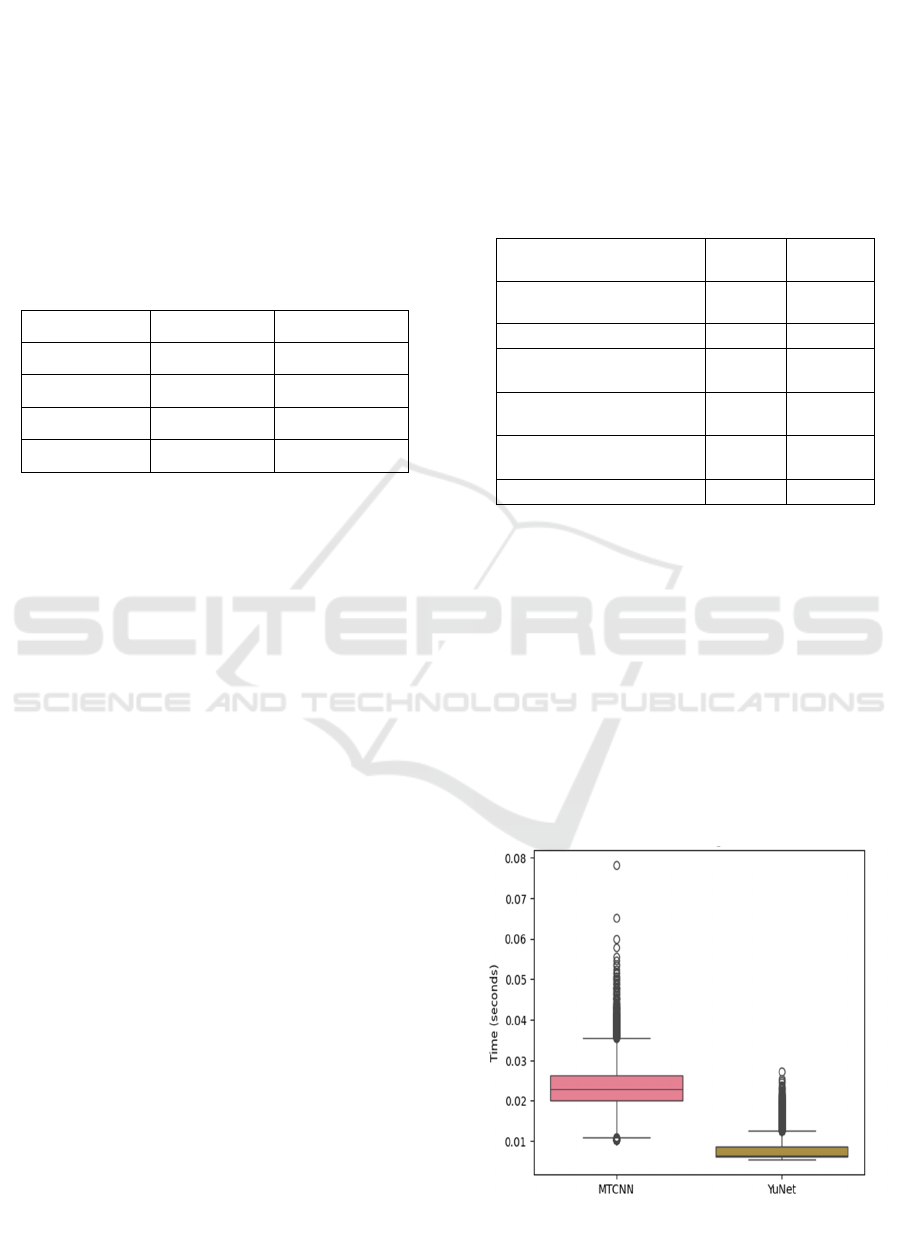
A comparative box plot of the processing times for
MTCNN and YuNet when detecting faces in fake
images is represented in Figure 2. Average processing
time using YuNet: 0.008 seconds per image; 0.024
seconds per image using MTCNN. With this
threefold speedup in the processing speed, YuNet is
efficient and can be applied in use cases like real-time
deepfake detection or analyzing large image datasets
efficiently.
Figure 2: Processing Time Comparison for Fake Images
Using MTCNN and YuNet.
ICRDICCT‘25 2025 - INTERNATIONAL CONFERENCE ON RESEARCH AND DEVELOPMENT IN INFORMATION,
COMMUNICATION, AND COMPUTING TECHNOLOGIES
620
4.3.2 Face Detection Rate
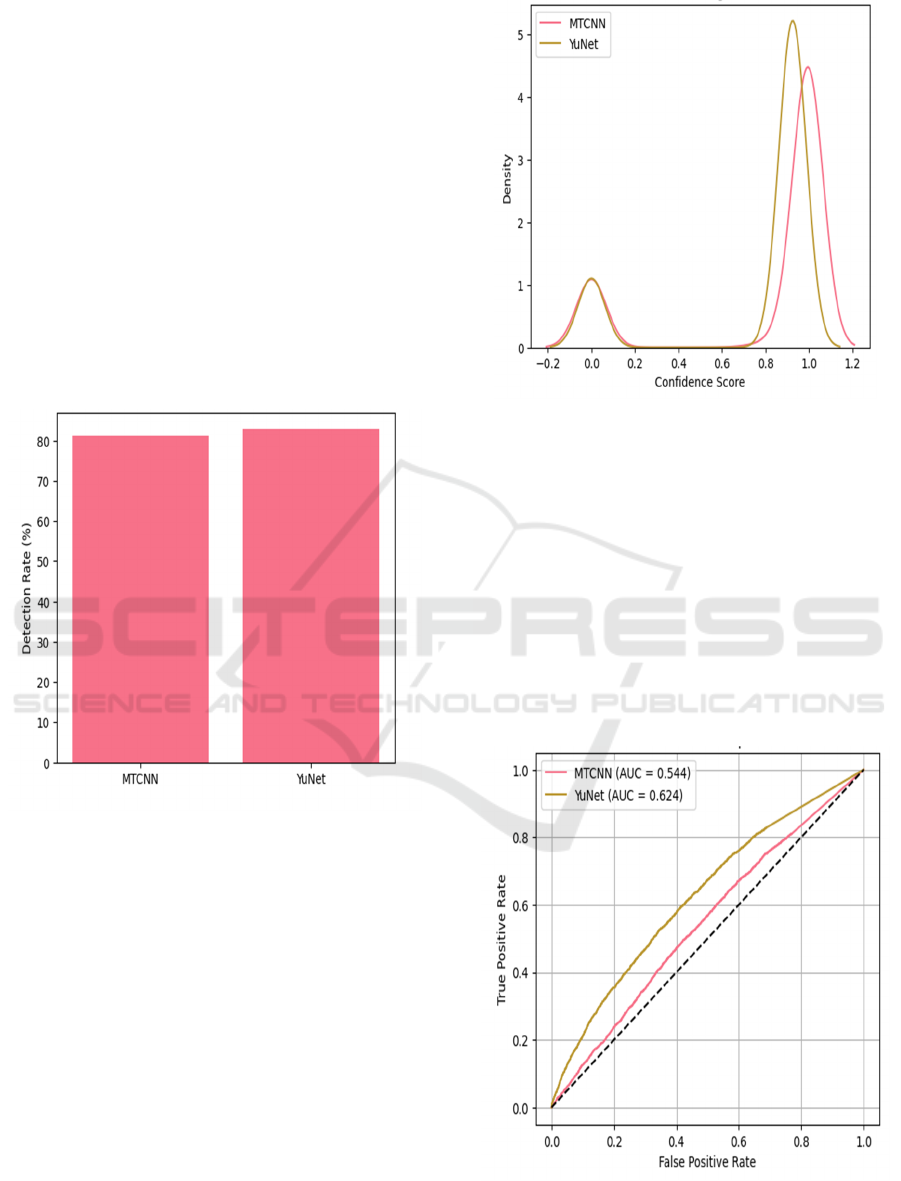
In Figure 3, the comparison of detection rate is
shown, i.e., how well each algorithm manages to
detect at least one face in the fake images. With a
detection rate of 81.1%, MTCNN achieves an
improvement in accuracy, while YuNet shows a small
but significant margin at 82.8%. The data-driven
nature of YuNet's architecture, with a higher number
of parameters, highlights its improved capability in
detecting facial features in manipulated content,
which may allow for better, more nuanced
differentiation of facial features than what is possible
with MTCNN. While the difference in detection rates
may seem minor, it can have a significant impact on
the overall performance of the deepfake detection
system.
Figure 3: Face Detection Rate for Fake Images Using
MTCNN and YuNet.
4.3.3 Detection Confidence Distribution
Figure 4 shows confidence score distributions for the
two algorithms on fake images when detecting faces.
Interestingly, despite having an average confidence
level higher than YuNet, namely 0.802 vs 0.766 for
YuNet, the overall detection performance is not
better. This is an interesting observation and indicates
that confidence scores must be interpreted carefully,
as more confident models might not perform better in
classifying deepfakes well.
Figure 4: Detection Confidence Distribution for Fake
Images Using MTCNN and YuNet.
4.3.4 ROC Curve Analysis
The ROC curves for both detection systems are
presented in Figure 5. The results further show that
while MTCNN achieves an AUC of 0.544, YuNet
obtains an AUC of 0.624. Notably, the large margin
in terms of discriminative ability suggests that
YuNet can achieve more stable classification under
different threshold conditions, resulting in
enhancement in the overall performance of genuine
versus forged face recognition.
Figure 5: Roc Curves for Deepfake Detection Using
MTCNN and YuNet.
Comparative Study of MTCNN and YuNet for Deepfake Detection
621
4.3.5 Confusion Matrices
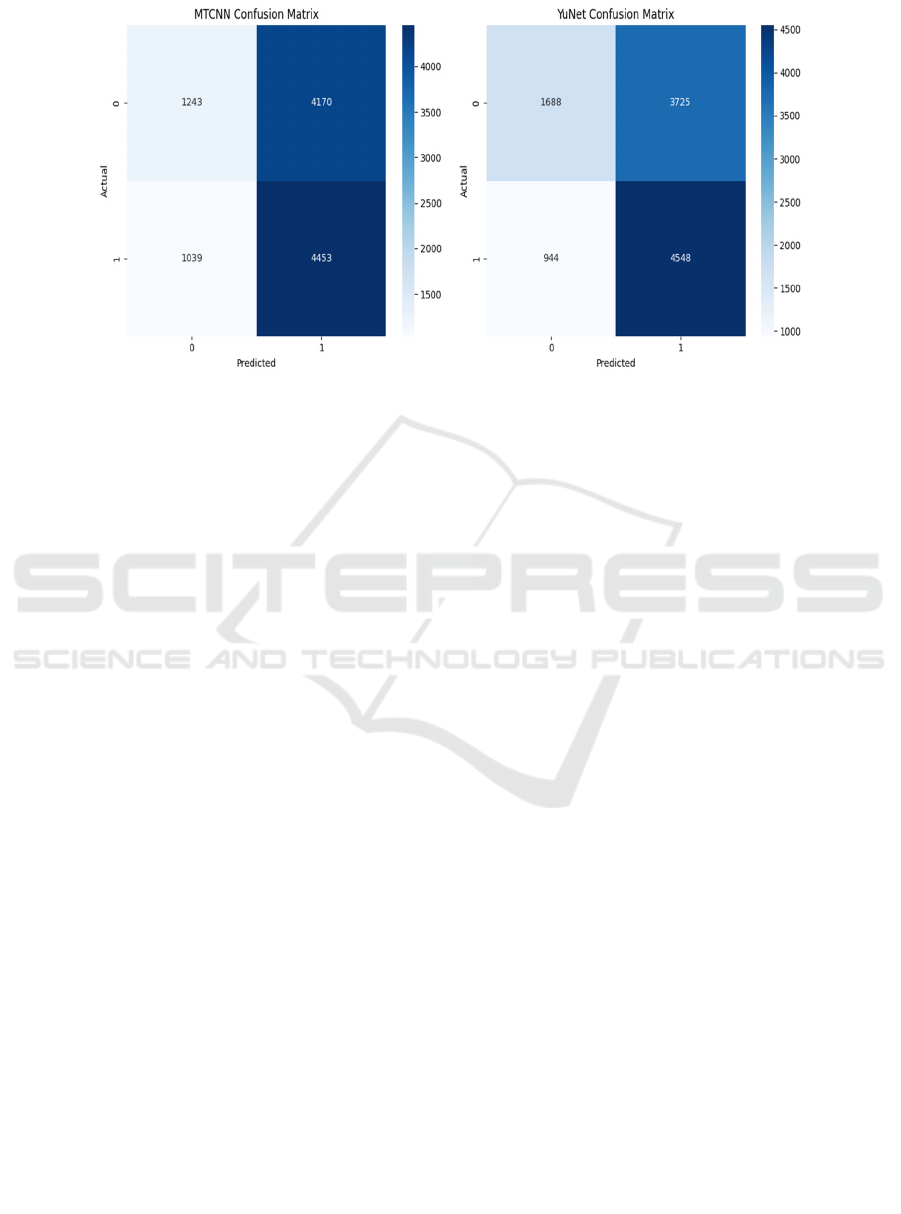
Figure 6: Confusion Matrices for MTCNN and YuNet.
Confusion matrices are a standard tool for analyzing
the results of binary classification tasks. Figure 6
presents the confusion matrices generated for both
models, providing a visual representation of true
positives (TP), false positives (FP), true negatives
(TN), and false negatives (FN). The confusion matrix
analysis revealed a key difference in the models'
performance. For MTCNN, the counts were: 1243
true negatives, 4170 false positives, 1039 false
negatives, and 4453 true positives. For YuNet, the
counts were: 1688 true negatives, 3725 false
positives, 944 false negatives, and 4548 true
positives. Notably, YuNet produced significantly
fewer false negatives (944) compared to MTCNN
(1039). This indicates that YuNet is more sensitive in
detecting manipulated images, meaning it is less
likely to miss a true manipulated instance. This
superior sensitivity is crucial in security-focused
applications where the cost of failing to detect a
deepfake (a false negative) can be substantial.
5 DISCUSSION
The comparative analysis of MTCNN and YuNet for
deepfake detection reveals several significant insights
with important implications for real-world
applications. The YuNet-based pipeline consistently
outperforms the MTCNN-based approach across
multiple performance metrics, establishing it as the
superior choice for deepfake detection systems.
The YuNet-based pipeline outperforms the
MTCNN-based pipeline in terms of accuracy,
precision, recall, and F1-score. The boosted
performance is due to YuNet's improved face
detection, which achieves a higher success rate at
matching even in fake visuals. This higher detection
rate means that deepfakes can be identified more
accurately, which is important in any security or
authentication application.
YuNet-based pipeline has a notably quicker
processing speed than MTCNN. The efficiency
advantage can be explained by the architectural
design of YuNet, optimized especially for low-
latency face detection operations. This three-times
acceleration in processing time is a significant
advantage for any real-time applications where
computational efficiency is a critical factor, including
live video analysis or high-throughput image
processing systems. Moreover, the YuNet-based
pipeline achieves a greater AUC score than the
MTCNN-based pipeline, emphasizing its enhanced
performance in separating the real and manipulated
facial images. This improved discriminative ability is
additionally confirmed via confusion matrix analysis,
which indicates how YuNet yields fewer false
negatives and thus exhibits a higher capability of
accurately recognizing deepfake images. Even
though MTCNN has a slightly higher mean average
of the detection confidence, the detection rate is
lower, which shows that good confidence scores do
not have to equal better classification performance.
This observation emphasizes the need for a more
comprehensive evaluation of deepfake detection
systems based on various complementary findings
instead of confidence scores alone.
ICRDICCT‘25 2025 - INTERNATIONAL CONFERENCE ON RESEARCH AND DEVELOPMENT IN INFORMATION,
COMMUNICATION, AND COMPUTING TECHNOLOGIES
622

The performance metrics of this comparative
study classify the YuNet-based deepfake detection
pipeline to be better than the MTCNN-based
approach in terms of accuracy, processing time, and
robustness. The shown benefits of the YuNet-based
pipeline indicate that it is a feasible option for
practical scenarios in deepfake detection, proving to
be more reliable and more efficient in tackling the
issue of synthetic media manipulation.
6 CONCLUSIONS
The comparative study on MTCNN and YuNet face
detection systems with InceptionResNetV1 as the
core recognition system for deepfake detection
indicates significant advantages of the YuNet-based
pipeline. The experimental results show that YuNet
outperforms MTCNN in terms of all three important
performance factors: detection accuracy, processing
speed, and robustness to different input conditions.
The above benefits are directly attributable to the
improved face detection portion of YuNet and the
architectural modifications made to minimize
latency, which render it especially suitable for low-
latency applications like deepfake detection.
This study lays the groundwork for multiple
intriguing avenues of future work. One promising
direction is utilizing transferable learnings to adapt
pre-trained InceptionResNetV1 models by tuning
them to domain-specific datasets that more accurately
reflect the changing landscape of synthetic media.
While some recent works have focused solely on
detector training with new data through transfer
learning, others have combined architectural
innovations from contemporary state-of-the-art
neural networks, potentially benefiting detection
performance on progressively more advanced
deepfake content that leverage subtle facial artifacts.
Another valuable future work direction is robust
data augmentation strategies. Adopting higher-order
methods like geometric transformations, noise
functions, and adversarial training can increase the
coverage of model generalization to address a
multitude of deepfake generation techniques. Such
techniques would allow detection systems to remain
effective even as deepfake technologies grow in
complexity and subtlety. Ensemble methodologies
also deserve to be thoroughly studied. Ensemble
detection models involving augmenting model’s
expertise such as manipulation models or artifact
domains could pave the way towards more complete
and generalized detection systems. Ensemble
techniques can include combinations of
convolutional neural networks with transformer
architectures, as well as spatial and temporal analysis
for video deepfakes, further enhancing the detection
of synthetic media that often requires multiple inputs.
Beyond the current rendering of facial detection,
future research needs to explore multimodal avenues
that the user considers both with visual and audio
features of media in order to detect discrepancies
typical of deepfakes. In addition, effective detection
pipelines can also focus on developing lightweight
versions and deploying them on edge devices for
broader application of deepfake detection
technologies.
While state-of-the-art models to generate
synthetic media have continued to become more
sophisticated and are also easier to acquire and use,
the effects that deepfakes could potentially have on
different aspects of society are alarming.
This arms race between generation and detection
technology requires that detection methodologies
continue to evolve. This study offers important
contributions to this vital domain by extending the
knowledge of effective strategies for sustaining
digital media authenticity in a world filled with ever-
more persuasive synthetic media.
These results argue for the informativeness of
video as a medium for more effective deepfake
detection systems and the need to continue funding
research in this area to maintain the integrity of the
information across the digital ecosystem. Future
interdisciplinary collaboration between computer
vision specialists, security researchers, and media
forensics experts will be critical to create holistic
solutions to these growing threats.
REFERENCES
C. Szegedy, S. Ioffe, V. Vanhoucke, and A. A. Alemi,
“Inception-v4, Inception-ResNet and the Impact of
Residual Connections on Learning,” Feb. 12, 2017,
Association for the Advancement of Artificial
Intelligence. https://doi.org/10.1609/aaai.v31i1.11231
E. Wahab, W. Shafique, H. Amir, S. Javed, and M. Marouf,
“Robust face detection and identification under
occlusion using MTCNN and ResNet50,” Jan. 19,
2025. https://doi.org/10.30537/sjet.v7i2.1499.
G. Gupta, K. Raja, M. Gupta, T. Jan, S. T. Whiteside, and
M. Prasad, “A comprehensive review of deepfake
detection using advanced machine learning and fusion
methods,” Electronics, vol.13, no.1, p.95, Dec.25,2023.
https://doi.org/10.3390/electronics13010095.
J. Newman, “AI-generated fakes launch a software arms
race,” NiemanLab, Dec. 2018. [Online]. Available:
https://www.niemanlab.org/2018/12/ai-generated-
Comparative Study of MTCNN and YuNet for Deepfake Detection
623

fakes-launch-a-software-arms-race (Accessed: Feb. 20,
2025).
J. Du, "High-precision portrait classification based on
MTCNN and its application on similarity judgement,"
J. Phys.: Conf. Ser., vol. 1518, no. 1, p. 012066, 2020,
doi: 10.1088/1742-6596/1518/1/012066.
K. Sudarshana and M. C. Mylarareddy, "Recent Trends in
Deepfake Detection," in Deep Natural Language
Processing and AI Applications for Industry 5.0, 2021,
pp. 1-28. DOI: 10.4018/978-1-7998-7728-8.ch001.
L. Chadha, H. Kulasrestha, V. Bhargava, and V. Jindal,
“Improvised approach to deepfake detection,” 2023.
M. Taeb and H. Chi, “Comparison of Deepfake Detection
Techniques through Deep Learning,” Mar. 04, 2022,
Multidisciplinary Digital Publishing Institute. doi:
10.3390/jcp2010007.
M. L. Saini, A. Patnaik, Mahadev, D. C. Sati, and R.
Kumar, "Deepfake Detection System Using Deep
Neural Networks," in Proceedings of the 2024 2nd
International Conference on Computer, Communicati-
on and Control (IC4), Indore, India, Feb. 8–10, 2024.
DOI: 10.1109/IC457434.2024.10486659.
S. Lyu, “Deepfake detection: Current challenges and next
steps,” in Proc. IEEE Int. Conf. Multimedia Expo
Workshops (ICMEW), Jun. 9, 2020. https://doi.org/10
.1109/ICMEW46912.2020.9105991
S. A. Khan and D. Dang‐Nguyen, “Deepfake Detection: A
Comparative Analysis,” Jan. 01, 2023, Cornell
University. https://doi.org/10.48550/arxiv.2308.03471.
S. Dhesi, L. Fontes, P. Machado, I. K. Ihianle, F. F. Tash,
and D. A. Adama, “Mitigating adversarial attacks in
deepfake detection: An exploration of perturbation and
AI techniques,” Cornell University, Jan. 1, 2023.
https://doi.org/10.48550/arXiv.2302.11704.
T. T. Nguyen, C. M. Nguyen, D. T. Nguyen, and S.
Nahavandi, “Deep learning for deepfakes creation and
detection,” Cornell University, Sep. 25, 2019. [Online].
Available: http://arxiv.org/pdf/1909.11573.pdf (Acce-
ssed: Jan. 2025).
T. N. Le, H. H. Nguyen, J. Yamagishi, and I. Echizen,
“OpenForensics: Large-scale challenging dataset for
multi-face forgery detection and segmentation in-the-
wild,” Oct. 1, 2021. https://doi.org/10.1109/iccv48922.
2021.00996.
T. Kularkar, T. Jikar, V. Rewaskar, K. Dhawale, A.
Thomas, and M. Madankar, “Deepfake Detection Using
LSTM and ResNext,” 2024 https://www.ijcrt.org/pape
rs/IJCRT2311476.pdf
Tran The Vinh, Nguyen Thi Khanh Tien, Tran Kim Thanh,
“A survey on deep learning-based face detection”.
Applied Aspects of Information Technology. 2023;
Vol. 6 No. 2: 201– 217. DOI: https://doi.org/10.15276
/aait.06.2023.15.
V. L. L. Thing, "Deepfake Detection with Deep Learning:
Convolutional Neural Networks versus Transformers,"
2023. [Online]. Available: https://arxiv.org/pdf/2304.0
3698.
V. S. Barpha, R. Bagrecha, S. Mishra, and S. Gupta,
“Enhancing deepfake detection: Leveraging MTCNN
and Inception ResNet V1,” May 2024.
W. Wu, H. Peng, and S. Yu, “YuNet: A tiny millisecond-
level face detector,” Apr. 18, 2023. https://doi.org/10.
1007/s11633-023-1423-y.
X. Cao and N. Z. Gong, "Understanding the Security of
Deepfake Detection," arXiv:2107.02045, 2021. [Onlin
e]. Available: https://doi.org/10.48550/arXiv.2107.020
45.
Xinyooo, “Deepfake detection,” Jan. 2020. [Online].
Available: https://github.com/xinyooo/deepfake- detec
tion (Accessed: Feb. 24, 2025).
Y. Chai, J. Liu, and Y. Li, "Facial target detection and
keypoints location study using MTCNN model," J.
Phys.: Conf. Ser., vol. 2010, no. 1, p. 012097, 2021, doi:
10.1088/1742-6596/2010/1/012097.
Y. Gautham, R. Sindhu, and J. Jenitta, “Review on
detection of deepfake in images and videos,” Jul. 26,
2024. https://doi.org/10.5120/ijca2024923825
ICRDICCT‘25 2025 - INTERNATIONAL CONFERENCE ON RESEARCH AND DEVELOPMENT IN INFORMATION,
COMMUNICATION, AND COMPUTING TECHNOLOGIES
624
