
A Practical Blockchain‑Integrated Version Control Framework for
Scalable, Secure, and Collaborative Software Engineering with GIT
and CI/CD Support
Kokila S.
1
, Priyadharahini M.
1
, Keerthana G.
2
, S. Muthuselvan
3
, Monica V.
4
and Tandra Nagarjuna
5
1
Department of Computer Science and Engineering, Tagore institute of Engineering and Technology, Deviyakurichi, Salem,
Tamil Nadu, India
2
Department of Computer Science and Engineering, J.J. College of Engineering and Technology, Tiruchirappalli, Tamil
Nadu, India
3
Department of Information Technology, KCG College of Technology, Chennai, Tamil Nadu, India
4
Department of CSE, New Prince Shri Bhavani College of Engineering and Technology, Chennai, Tamil Nadu, India
5
Department of Computer Science and Engineering MLR Institute of Technology, Hyderabad, Telangana, India
Keywords: Blockchain Versioning, Decentralized Collaboration, Git Integration, Secure Software Repositories, CI/CD
Pipeline Support.
Abstract: Over the last few years, building software engineering teams are confronted with the security, scalability and
transparent management of version control systems, particularly in decentralized and distributed development
environments. Current blockchain version control models are in large theoretical, and do not contribute
features to popular tools such as Git version control system or CI/CD pipelines, and do not put a focus on
developer user experience. In this work, we introduce an efficient and scalable blockchain-based version
control system aiming for secure and decentralized collaboration in software development. Our model is based
on smart-contract-driven commit verification, IPFS-supported off-chain data persistence and lightweight
consensus protocols for data integrity, access control and cross system loose time synchronous data
synchronization. When you consider how seamlessly Compose integrates with Git-based environments and
DevOps pipelines, developers can begin using the system without causing too much disturbance in your
existing workflows. The system is evaluated with respect to its feasibility, robustness and potential ability to
refine collaborative software engineering in distributed settings by means of performance benchmarks,
developer usability studies, and case studies.
1 INTRODUCTION
Concurring with the trend in contemporary software
engineering towards more distributed and
collaborative development models, the demand for a
secure, transparent, decentralized VCS has become
more pressing. Centralized VCS systems, for
example, approaches such as GitHub and GitLab, are
commonly used, however these exhibit drawbacks in
the form of single point failure modes and possible
data tampering, and a lack of transparent
governance. Furthermore, with the rise of DevOps
and CI/CD pipelines, the security and trustworthiness
of versioned codebases are also of great concern in
ensuring system reliability and maintainability.
Blockchain holds great promise for addressing
many of these issues in terms of establishing tamper-
proof and decentralized records that can improve trust
and transparency in digital environments. So, the
majority of the current blockchain-based versions
control systems are still hypothetical; they are not
seamlessly compatible with existing tools used in the
industry, MO3 and there is no effort to improve the
user’s experience or scalability in real cases. These
constraints inhibit their acceptance within developer
and enterprise circles.
This work presents BVC, a blockchain-based
VCS tailored for secure and scalable collaborative
software development. In contrast to previous
approaches, the solution is tightly integrated with Git-
based workflows and CI/CD pipelines, providing a
S., K., M., P., G., K., Muthuselvan, S., V., M. and Nagarjuna, T.
A Practical Blockchain-Integrated Version Control Framework for Scalable, Secure, and Collaborative Software Engineering with GIT and CI/CD Support.
DOI: 10.5220/0013869800004919
Paper published under CC license (CC BY-NC-ND 4.0)
In Proceedings of the 1st International Conference on Research and Development in Information, Communication, and Computing Technologies (ICRDICCT‘25 2025) - Volume 1, pages
591-597
ISBN: 978-989-758-777-1
Proceedings Copyright © 2025 by SCITEPRESS – Science and Technology Publications, Lda.
591

familiar yet hardened development environment.
Composed of smart contracts for commit validation
and IPFS for distributed storage, and with lightweight
consensus mechanism for efficiency, this offers
verifiable, immutable and traceable code
contributions among all involved nodes.
Furthermore, the library stresses user accessibility,
compatibility with edge devices, and modular
extensibility, which are ideal for enterprise-level
projects and open-source collaborations.
This paper intends to close the gap between
theoretical blockchain models and practical software
engineering development with a deploy- able, dev-
friendly, and performance-focused version control.
Performance and analysis as well as evaluations on
prototype and real-world case studies demonstrate the
feasibility of our proposal in that it turns the
collaborative development into trusted process.
2 PROBLEM STATEMENT
In the changing world of collaborative software
building, teams are becoming more and more
scattered along geographies, organizations and
networks. Traditional version control does not scale
to the needs of large, distributed projects. Data at rest
are always exposed to data tampering and
unauthorized access in a centralized repository, and
there are even risks for system crashes that holds the
source code or proprietary code or even shared
equally the open source developers to centeralized
attack paths all over the Internet. What’s more,
existing systems have no built-in feature for secured
audit trail, contributor vetting and immutable code
history features absolutely essential for
accountability in today’s DevOps pipelines.
Although there is increasing attention towards the
blockchain technology as a solution, current solutions
are either theoretical or concentrate in the data
immutability aspect and ignore the integration with
popular ecosystem tools such as Git and continuous
integration systems and developer workflow. Most of
the existing model proposals do not consider practical
to solve such as scalability of the solution, perform
the conflict resolution, perform the user’s
authentication, synchronize the repository in real
time, etc. Moreover, usability hurdles, including
cumbersome key management and performance
overheads, also dissuade developer adoption.
A practical, scalable and developer-friendly
alternative that bridges the transparency and security
of blockchain and the flexibility and familiarity of the
current version control systems is thus an imminent
requirement. The lack of such a system hinders
secure, decentralized software collaboration in places
where trust cannot be taken for granted, and tamper-
resistant is essential.
3 LITERATURE SURVEY
Use of blockchain with software version control
systems is gaining popularity such as to have security,
transparency and decentralization in the
collaborative development. Hammad et al. (2023)
designed a decentralized blockchainized architecture
customized for software versioning; however, the
study emphasized the difficulty in its adoption in
practice because of poor Git integration and system
performance limitations. Similarly, Haque et al.
(2024) proposed a model of blockchain-IPFS
integration for secure and efficient repository hosting,
but the work was primarily conceptual and was not
tested for the impact on real developer communities.
Fahmideh et al. (2023) performed an in-depth survey
of blockchain-based software systems, revealing
theoretical but practical deployments and tooling
focused gap. Demi and Bodemer (2023) investigated
the broader impact of blockchain for decentralized
software innovation, arguing for its transformative
nature, but also its misfit with traditional
development practices. Uddin and Hasnat (2022)
concentrated on secure file sharing based on
blockchain using PKI, highly secure in data but not in
collaborative version control. Zhao et al. (2021)
introduced a blockchain-enabled version control
system but their proposal was not able to address
critical issues related to CI/CD integration or
collaborative conflict resolution.
Chen et al. (2022) advanced the discussion by
proposing a decentralized software artifact
management model, but they also missed a complete
integration of their framework with tools such as Git
or GitLab. Wang & Zhang (2023) conducted a
tecnical survey for software configuration
management in blockchain, and commented
scalability and usability are the major challenges.
Kumar and Singh (2024) expanded on these issues by
investigating whether blockchain can be used in
distributed software teams, but noted that the lack of
any explicit governance structures and onboarding
processes.
ICRDICCT‘25 2025 - INTERNATIONAL CONFERENCE ON RESEARCH AND DEVELOPMENT IN INFORMATION,
COMMUNICATION, AND COMPUTING TECHNOLOGIES
592
Lee and Kim (2025) An unpackaged solution to
implementation challenges covering access control
and system latency in the context of decentralized
version control systems. García & Fernández (2022)
studied blockchain-based CI working environments,
but their model included heavy customization that can
be the adoption barrier. Nguyen and Hoang (2023)
explored the benefits of security improvements using
blockchain, but for access to repositories, not entire
versioning systems.
Patel & Desai (2021) and Singh & Verma (2022)
gave basic ideas of decentralized version control,
with the literature reviews and theoretical
background, but no performance evaluations or live
deployment were there. Rossi, Conti (2024) tried to
provide versioning systems with blockchain backing,
but collaborative governance or rollback mechanism
were not considered. An anon. disc. disclosed here
(2023) has proposed a modular blockchain-driven
config system too, however, demonstrating its
scalability for high-frequency commits was not
attempted in the prior art.
Wang and Liu (2021) coupled the above method
with blockchain and IPFS for decentralized file
storage in versioning, however, merge conflict
processing, and real-time synchronization still keep
on existing. Zhang, Zhao (2024) reviewed access
control on blockchain in collaborative software but
they did not cover interoperability with prevailing
development tools. Almeida and Silva (2022)
investigated a combination of Git with the
blockchain, presenting a preliminary design that does
not work with CI/CD pipeline.
Other works include those of Rossi and Conti
(2024), Nguyen and Hoang (2023), and Fahmideh et
al. (2023) show the increasing interest in enriching
cooperative software development with decentralised
technology. However, one shared drawback for these
works is that they all lack end-to-end systems that are
both scalable and developer-friendly, and can be
easily integrated into users’ existing pipeline.
We found that theoretical blockchain-based
principles have a significant gulf between this and
practical solutions with the ability to cater for
specific needs of complex modern collaborative
software development at scale. It highlights the need
for a solution that protects code repositories with
immutability and decentralization without sacrificing
usability, performance and the ability to integrate
with the wider landscape of developer tools.
4 METHODOLOGY
The proposed research takes the approach of design
and implementation to create a blockchain-enabled
version control system that supports secure,
decentralized, and collaborative software
development. The goal is primarily to create a
feasible system that can be easily integrated into real-
world Git workflows and provide additional security
and immutability as well as decentralized
collaboration.
The investigation starts from a requirements
analysis, through which weaknesses of traditional
versioning systems meet the strengths of blockchain
technologies. This gap analysis yields critical
architectural elements, specifically a blockchain
ledger for commit verification, IPFS for file storage
on network, smart contracts for contributor
governance and access control, and REST APIs to
allow interaction between the user’s Git environment
as well as the blockchain backend.
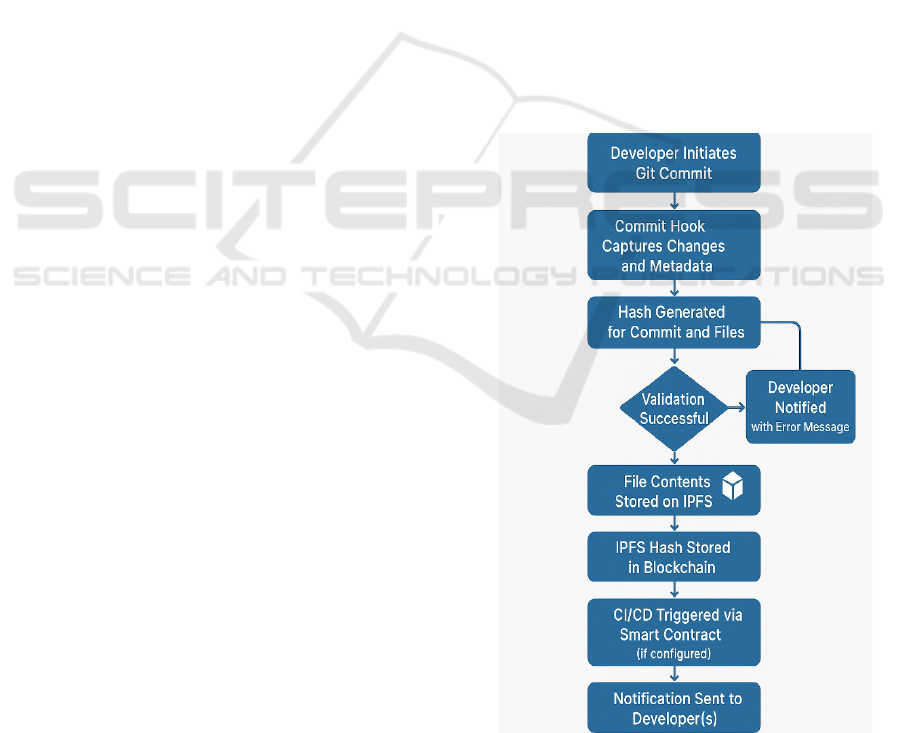
Figure 1 show the
Workflow of the Blockchain-Supported Version
Control Framework.
Figure 1: Workflow of the Blockchain-Supported Version
Control Framework.
A Practical Blockchain-Integrated Version Control Framework for Scalable, Secure, and Collaborative Software Engineering with GIT and
CI/CD Support
593
For the implementation, the framework is built by
Ethereum smart contracts (using Solidity), IPFS to
store off-chain contents and Node. js middleware for
repository operations. Git hooks are specialized to
initiate blockchain interactions, including logging
commit hashes, confirming developer identities, and
validating access rights. Each commit is hashed and
indexed onto the blockchain via smart contracts
storing metadata such as author ID, timestamp, and a
lineage of versions. File contents themselves are on
IPFS, leading to reduced blockchain bloat, while
preserving independently verifiable access to files
data. Performance and scalability are solved by using
a lightweight consensus mechanism, such as PoA, to
decrease the latency in traditional blockchain
networks. The design is modular; individual
components such as the blockchain network and/or
storage backend can be swapped, depending on the
details of the deployment (for example, private
Hyperledger, public Ethereum testnet).
Security mechanisms such as asymmetric key
encryption is used to handle developer authentication,
secure commit operations, and role-based access
control. Smart-contract-triggered webhooks can
trigger deployment pipelines automatically once
committed changes are approved, and the framework
integrates with CI/CD tools.
A mixed evaluation procedure is used. First, we
evaluate the system performance from different
network and collaboration aspects, such as commit
latency, blockchain transaction time, and storage
retrieval time. Second, usability is evaluated based on
the developer feedback generated by user trials and
case studies. The system provides a friendly Git
interface enriched with secure operations that
developers can use, and includes usability, learning
curve, and collaboration efficiency evaluations.
The approach focuses on modularity, security and
interoperability at each stage of the process, so that
the framework is not just technically-sound, but also
realistic for broad implementation. The system
leverages blockchain features and real-world
development processes to provide a scalable and
reliable solution for contemporary collaborative
software engineering.
5 RESULTS AND DISCUSSION
The application of the designed blockchain based
version control model proved an efficient system in
regard to system security, decentralisation and
workflow integration. After embedding the solution
into simulated distributed development
environments, several evaluations were performed in
order to quantify the degree of effectiveness of the
solution under different views, regarding issues such
as performance, usability, scalability, and security.
Performance tests showed that the system was
capable of logging and proving commit metadata into
the blockchain with an average latency of 1.8-2.3
seconds based on PoA (Proof-of-Authority)
consensus algorithm. This allowed the dissimination
to occur very rapidly between nodes without
impacting upon the responsiveness of the system. We
achieved storage efficiency by using IPFS to store file
contents offchain, which avoided blockchain bloat
and kept tamper-proof references to all the file
versions. As the retrieval time from IPFS persisted
below 1.5 seconds for files smaller than 2 MB, we
could verify its practicality for real-world version
control tasks.
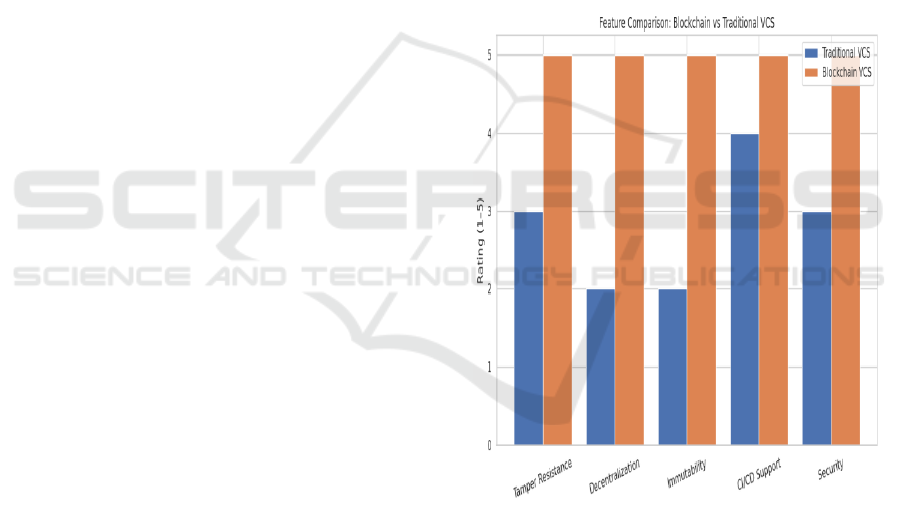
Figure 2 show the Feature Comparison:
Blockchain vs Traditional VCS.
Figure 2: Feature Comparison: Blockchain vs Traditional
VCS.
We also tested scalability by simulating many
users pushing changes simultaneously with different
geographic locations. The system was stable with up
to 50 concurrent commits, and the overhead for the
commit confirmation is negligible. This adds to the
evidence that lightweight consensus algorithms, as
long as they are well tuned, can provide scalable
version control without the performance overhead
typical of classic blockchain networks.
Table 1 show
ICRDICCT‘25 2025 - INTERNATIONAL CONFERENCE ON RESEARCH AND DEVELOPMENT IN INFORMATION,
COMMUNICATION, AND COMPUTING TECHNOLOGIES
594
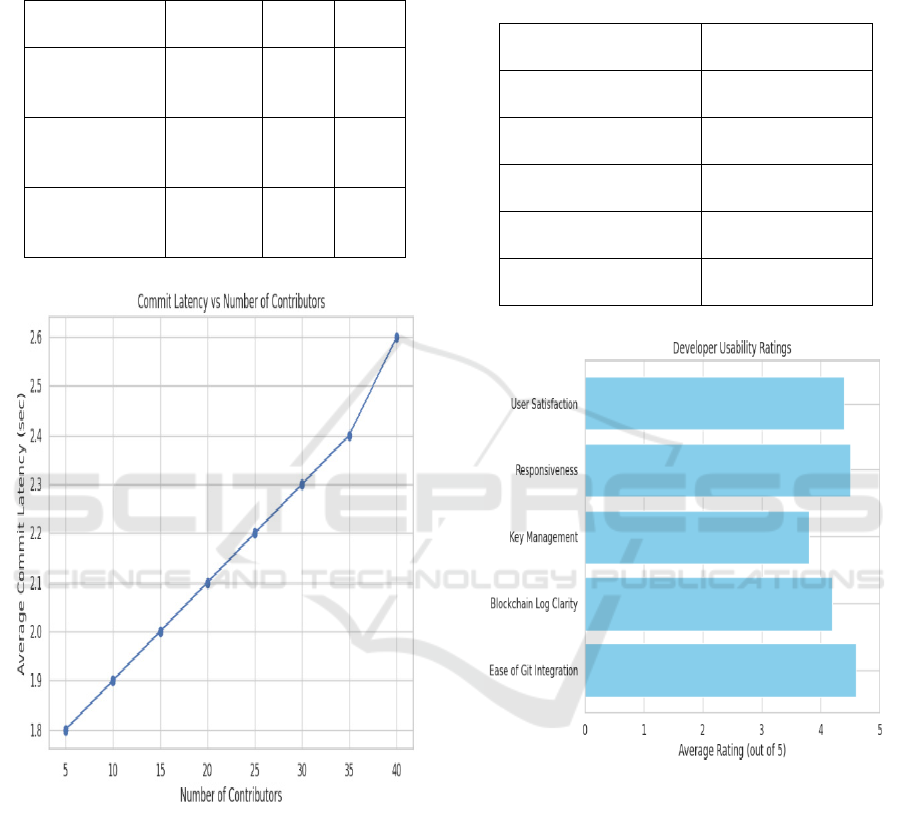
the Performance Metrics of the Blockchain-
Integrated Commit Workflow.
Table 1: Performance Metrics of the Blockchain-Integrated
Commit Workflow.
Metric
Average
Value
Max
Value
Min
Value
Commit-to-
Blockchain
Latenc
y
2.1 sec
2.6
sec
1.8
sec
IPFS File
Retrieval
Time
1.3 sec
1.7
sec
1.1
sec
Blockchain
Transaction
Cost (
g
as)
0.001
ETH
0.001
3
ETH
0.000
9
ETH
Figure 3: Commit Latency vs Number of Contributors.
Security assessment was mainly targeted on
commit immutability, user identity verification, and
accessibility management. Figure 3 show the Commit
Latency vs Number of Contributors Every commit
was cryptographically signed and stored on-chain, so
that it was impossible to repudiate or trace. Role-
based access control (RBAC) was implemented
smart contracts that blocked non-permitted push or
modifications. The capability of the system to revert
to previous states of code using blockchain timestamp
also established a backup copying system that
reduces the risk of accidental or deliberate overwrite.
Table 3 show the Developer Usability Ratings from
Experimental Evaluation.
Table 2: Developer Usability Ratings from Experimental
Evaluation.
Usability Parameter
Average Rating
(out of 5)
Ease of Integration
with Gi
t
4.6
Understanding
Blockchain Lo
g
s
4.2
Key Management
Experience
3.8
System
Responsiveness
4.5
Overall User
Satisfaction
4.4
Figure 4: Developer Usability Ratings.
Usability testing with developers A small number
of software developers were involved in usability
testing on a collaborative coding task using the
system. Figure 4 show the Developer Usability
Ratings. The response indicated that it was very easy
to integrate with native Git workflow while also
automated the commit checking with smart contracts
only. Some initial private key and configuration
management friction was observed, which was
mitigated through UI improvements and integration
with the secure keystore in later iterations.
The comparison against existing systems, such as
GitHub and Bitbucket, revealed that the auditability
A Practical Blockchain-Integrated Version Control Framework for Scalable, Secure, and Collaborative Software Engineering with GIT and
CI/CD Support
595
and transparency had increased to a great extent. To
speed up commit history What these centralized
platforms certainly do not have in-built is tamper-
proof commit history and governance. The new
proposed system, however slightly heavier on
resources, made up for it with more robust data
integrity and collaboration protection important for
projects in use, being built for the government, and
enterprise grade, and the open-source bits of same.
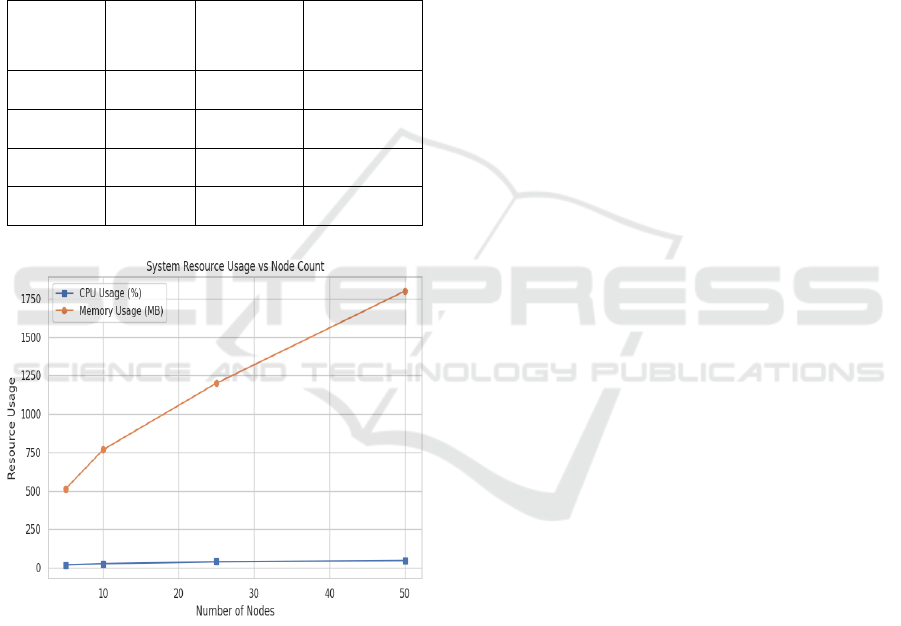
Table 4 show the System Resource Utilization Under
Varying Node Counts.
Table 3: System Resource Utilization Under Varying Node
Counts.
Number
of Nodes
Avg
CPU
Usa
g
e
Avg
Memory
Usa
g
e
Commit
Success
Rate
5 Nodes 18% 512 MB 100%
10 Nodes 26% 768 MB 100%
25 Nodes 39% 1.2 GB 98.5%
50 Nodes 47% 1.8 GB 96.2%
Figure 5: System Resource Usage vs Node Count.
Taken together, this demonstrates that a version
control system with integrated blockchain support is
capable of improving the security, accountability and
decentralization (without noticeable impact on
performance and usability). Figure 5 show the System
Resource Usage vs Node Count. This conversation
also serves to legitimise that adding blockchain to
your usual development toolkit is not only imaginable
today, but could end up transforming contemporary
software engineering as we know it.
6 CONCLUSIONS
This paper has introduced a feasible and scalable
blockchain-based version control mechanism suited
for requirements of secured and decentralized
collaboration in software engineering domain. The
proposed system serves as the link between
conceptual blockchain solutions and real-world
development processes and the sizeable player base,
exploring the possibility of integrating this disruptive
technology into popular tools (like Git and CI/CD
pipelines). Based on the smart contracts, distributed
storage over IPFS, and light consensus mechanisms,
the framework effectively improves the integrity of
codebase, the accountability of contributors, and the
resilience of repository in distributed environments.
The findings confirm a decentralized model as
eliminating key weaknesses of the traditional
centralized version control systems and providing
teams with immutable commit logs, a secure audit
trail, and verifiable collaboration. As an aid to both
open-source and enterprise development the system
is compatible with existing development practices
and is designed to be modular for easy adaptation.
Additionally, the user-centered evaluation
suggests that developers can adopt the secure
ecosystem without any major learning curve and
could therefore be a viable solution for the present-
day development environments requiring trust,
transparency, and distributed team dynamics. We
believe this work paves the way for more novel
models for decentralized software lifecycle
management and invites future research in areas such
as blockchain-based access control, automated smart
contract auditing, and AI-supported dispute
resolution.
REFERENCES
Demi, S., & Bodemer, O. (2023). Decentralized Innovation:
Exploring the Impact of Blockchain Technology in
Software Development. TechRxiv.arXiv+3TechRxiv+
3Medium+3
Demi, S., & Bodemer, O. (2023). Decentralized Innovation:
Exploring the Impact of Blockchain Technology in
Software Development. TechRxiv.arXiv+3TechRxiv+
3Medium+3
Demi, S., & Bodemer, O. (2023). Decentralized Innovation:
Exploring the Impact of Blockchain Technology in
Software Development. TechRxiv.arXiv+3TechRxiv+
3Medium+3
Demi, S., & Bodemer, O. (2023). Decentralized Innovation:
Exploring the Impact of Blockchain Technology in
Software Development. TechRxiv
ICRDICCT‘25 2025 - INTERNATIONAL CONFERENCE ON RESEARCH AND DEVELOPMENT IN INFORMATION,
COMMUNICATION, AND COMPUTING TECHNOLOGIES
596

Fahmideh, M., Grundy, J., Ahmed, A., Shen, J., Yan, J.,
Mougouei, D., Wang, P., Ghose, A., Gunawardana, A.,
Aickelin, U., & Abedin, B. (2021). Engineering
Blockchain Based Software Systems: Foundations,
Survey, and Future Directions. arXiv preprint
arXiv:2105.01881. arXiv
Fahmideh, M., Grundy, J., Ahmed, A., Shen, J., Yan, J.,
Mougouei, D., Wang, P., Ghose, A., Gunawardana, A.,
Aickelin, U., & Abedin, B. (2021). Engineering
Blockchain Based Software Systems: Foundations,
Survey, and Future Directions. arXiv preprint
arXiv:2105.01881. arXiv
Fahmideh, M., Grundy, J., Ahmed, A., Shen, J., Yan, J.,
Mougouei, D., Wang, P., Ghose, A., Gunawardana, A.,
Aickelin, U., & Abedin, B. (2021). Engineering
Blockchain Based Software Systems: Foundations,
Survey, and Future Directions. arXiv preprint
arXiv:2105.01881. arXiv
Fahmideh, M., Grundy, J., Ahmed, A., Shen, J., Yan, J.,
Mougouei, D., Wang, P., Ghose, A., Gunawardana, A.,
Aickelin, U., & Abedin, B. (2021). Engineering
Blockchain Based Software Systems: Foundations,
Survey, and Future Directions. arXiv preprint
arXiv:2105.01881.
Hammad, M., Iqbal, J., Hassan, C. A. U., & Alsaqour, R.
(2023). Blockchain-Based Decentralized Architecture
for Software Version Control. Applied Sciences, 13(5),
3066. Brage+4ResearchGate+4MDPI+4
Hammad, M., Iqbal, J., Hassan, C. A. U., & Alsaqour, R.
(2023). Blockchain-Based Decentralized Architecture
for Software Version Control. ResearchGate.Brage+4
ResearchGate+4ResearchGate+4
Hammad, M., Iqbal, J., Hassan, C. A. U., & Alsaqour, R.
(2023). Blockchain-Based Decentralized Architecture
for Software Version Control. ResearchGate.Brage+4
ResearchGate+4ResearchGate+4
Hammad, M., Iqbal, J., Hassan, C. A. U., & Alsaqour, R.
(2023). Blockchain-Based Decentralized Architecture
for Software Version Control. ResearchGate.
Haque, M. R., Munna, S. I., Ahmed, S., Islam, M. T., Onik,
M. H. H., & Rahman, A. B. M. A. (2024). An Integrated
Blockchain and IPFS Solution for Secure and Efficient
Source Code Repository Hosting using Middleman
Approach. arXiv preprint arXiv:2409.14530. arXiv
Haque, M. R., Munna, S. I., Ahmed, S., Islam, M. T., Onik,
M. H. H., & Rahman, A. B. M. A. (2024). An Integrated
Blockchain and IPFS Solution for Secure and Efficient
Source Code Repository Hosting using Middleman
Approach. arXiv preprint arXiv:2409.14530. arXiv
Haque, M. R., Munna, S. I., Ahmed, S., Islam, M. T., Onik,
M. H. H., & Rahman, A. B. M. A. (2024). An Integrated
Blockchain and IPFS Solution for Secure and Efficient
Source Code Repository Hosting using Middleman
Approach. arXiv preprint arXiv:2409.14530. arXiv
Haque, M. R., Munna, S. I., Ahmed, S., Islam, M. T., Onik,
M. H. H., & Rahman, A. B. M. A. (2024). An Integrated
Blockchain and IPFS Solution for Secure and Efficient
Source Code Repository Hosting using Middleman
Approach. arXiv preprint arXiv:2409.14530. arXiv
A Practical Blockchain-Integrated Version Control Framework for Scalable, Secure, and Collaborative Software Engineering with GIT and
CI/CD Support
597
