
An Adaptive Hybrid Cloud Framework for Real‑Time Integration of
Smart City Services and Urban Data
Durgalakshmi B.
1
, Sowmiya K.
1
, M. Maria Sampoornam
2
, P. Jaisankar
3
, V. Divya
4
and Vignesh K.
5
1
Tagore Institute of Engineering and Technology, Deviyakurichi, Salem, Tamil Nadu, India
2
Department of Information Technology, J.J.College of Engineering and Technology, Tiruchirappalli, Tamil Nadu, India
3
Department of Mathematics, Nandha Engineering College (Autonomous), Erode -638052, Tamil Nadu, India
4
Department of Computer Science and Engineering, MLR Institute of Technology, Hyderabad‑500043, Telangana, India
5
Department of ECE, New Prince Shri Bhavani College of Engineering and Technology, Chennai, Tamil Nadu, India
Keywords: Hybrid Cloud, Smart City, Real‑Time Data, Edge Computing, Urban Integration.
Abstract: The explosive growth of smart city applications calls for the construction of a sound, scalable, and elastic
infrastructure to address the real-time urban data. The research yields an adaptive hybrid-cloud architecture
that smoothly combines edge and cloud infrastructures to serve the dynamic demands of smart cities. The
proposed model allows for low-latency data processing, secure storage, and effective orchestration of
distributed services in heterogeneous systems. The system would be designed not only to prioritize and
optimize system objects and resources but also automatically to adapt not only to the current configuration
but in principle to the evolution of future systems yet to be developed and for which interfaces and interactions
with the system would be defined. Results from simulation indicated better performance on latency reduction,
service availability and resistance to varying data loads, proving the framework as a robust backbone for smart
urban ecosystems.
1 INTRODUCTION
The transformation of urban domains into smart cities
has given rise to an increasing need for
infrastructures that can manage huge amount of
heterogeneous and real time data. The challenge,
however, will be managing all this data, especially as
more and more IoT devices, sensors and connected
services emerge. Cloud-enabled paradigms tend to be
inefficient for latency, constrained bandwidth,
dynamic workloads related with smart city
environments. Emerging hybrid cloud architectures,
combining the central dominance of cloud computing
with the local proximity and quick responsiveness of
edge computing, provide a new and promising
solution. Unfortunately, the current solutions are
lacking when it comes to flexibility, integration, and
orchestration in real-time between distributed
components. Few works consider these gaps and
propose an adaptive hybrid cloud architecture to
support the continuous integration and management
of smart city services and city data. Prior to the
approach of our system, our framework focuses on
the interoperability, low-latency processing, scalable
service deployment (Sixfab. (2023)), that forms the
basis of a robust service for making real-time
decision, managing resource effectively in a smart
city.
2 PROBLEM STATEMENT
Smart cities produce huge amounts of real-time data
from various origins like IoT sensors, surveillance
systems, and connected infrastructure. Nevertheless,
the dominant cloud-based models encounter
challenges of high latency, low service-scale and high
cost in data processing and integration in urban
systems. Furthermore, there is no consistent adaptive
architecture to efficiently coordinate between cloud
and edge resources, leading to degraded
responsiveness and reliability of smart city
applications. Consequently, there is an urgent need
for a hybrid cloud architecture overlay that can in a
dynamic fashion handle dynamic real-time urban data
while providing for low-latency communication,
B., D., K., S., Sampoornam, M. M., Jaisankar, P., Divya, V. and K., V.
An Adaptive Hybrid Cloud Framework for Real-Time Integration of Smart City Services and Urban Data.
DOI: 10.5220/0013869400004919
Paper published under CC license (CC BY-NC-ND 4.0)
In Proceedings of the 1st International Conference on Research and Development in Information, Communication, and Computing Technologies (ICRDICCT‘25 2025) - Volume 1, pages
571-577
ISBN: 978-989-758-777-1
Proceedings Copyright © 2025 by SCITEPRESS – Science and Technology Publications, Lda.
571

resource scheduling and on-the-fly integration
between heterogeneous systems. This paper aims to
overcome this issue by proposing an adaptive and
scalable hybrid cloud architecture for smart cities.
3 LITERATURE SURVEY
The increasing complexity of smart city
infrastructures has spurred substantial interest in
hybrid cloud solutions that can handle and analyze
real time urban data. 4.1.2 Edge-cloud integration for
smart cities Malviya and Sondinti (2023) discussed
edge-cloud integration to minimize service latency in
smart city applications but without a unified service
orchestration framework. Likewise, Vankayalapati
(2022) examined real-time data management
strategies, though it lacked the scalability on various
layers of a system. Ariel Software Solutions (2025)
and the Futurum Group (2024) identified trends in
hybrid cloud technologies however their discussions
are generic and lack application in smart city
environment. CIO Influence (2025) and Yotta
Infrastructure (2025) had strong messages on
flexibility and control of hybrid infrastructures, but
provided less of an inclination of the challenges
around interoperability for city-scale rollouts.
iLink Digital (2025) and Popat (2025) outlined
future directions for cloud computing but did not have
real-world proof of concept. LinkedIn's (2025)
investigation of hybrid cloud market trends
constituted a summary of trends; however, it was not
informed by empirical or architectural analysis.
Trigyn (2025) and Tomorrow. City (2025) examined
growing IoT and AI infrastructure in cities, but did
not consider any Infrastructure integrated models
which would give their findings more substance. The
Fast Mode (2025) talked about ethical issues to AI-
pow ered Smart cities, which points out the necessity
for secure and transparent data handling †“a gap
that has been filled in this research endeavor.
Soracom (2025) and Sixfab (2023) studied the
conclusions and verification, although none of them
paper focused on those with programming needs for
the development of centralized cloud services in real
time. StateTech Magazine (2024, 2023) discussed
challenges in deployment and security of edge
computing but no solutions are posed for integrating
edge and cloud for comprehensive urban
management. IoT for All (2021, 2024) stressed the
need to ensure real-time data, but system-level
orchestration was not addressed. Publications on
ScienceDirect (2023, 2024a, 2024b) further than
discussed smart city services and edge solutions but
still very scattered over application or technical sub-
components and without an ultimate hybrid
framework.
MDPI (2022) provided detail of cloud IoT
applications but did not include evaluation of vehicle
counts from real-time urban deployments. IRJMETS
(2023, 2024) have laid a higher level of dialogue on
cloud analytics, and not in-depth architecture along
with realtime performance metrics. AWS (2025)
proposed cloud based smart city support, but directly
related to the platform-specific approach is the
problem of vendor lock-in which undermines the
flexibility.
Unlike these isolated/local attempts, this work
contributes a holistic, adaptive hybrid cloud
infrastructure to support real-time data integration,
service orchestration and performance optimization
in smart cities. By tackling the limitations found in
the literature on them, the proposed approach seeks
to advance the scalability, responsiveness, and
dependability of urban data infrastructure.
4 METHODOLOGY
The methodology used in this study approach toward
designing, developing and testing an adjustable
hybrid cloud architecture, which efficiently manages
and unifies smart city applications and real-time
urban data. The framework is designed for
coordinating cloud and edge computing layers
dynamically in order to support closer-to- real-time
processing, scalable service provision, and
interoperation amongst systems with different experts
running on heterogeneous devices over the smart city
area.
The system architecture consists of three main
layers: edge layer, cloud layer, and orchestration
layer. The edge layer is also performing the following
tasks of data aggregation, filtering, and low-latency
processing. This encompasses IoT sensors, embedded
devices and local edge servers distributed across the
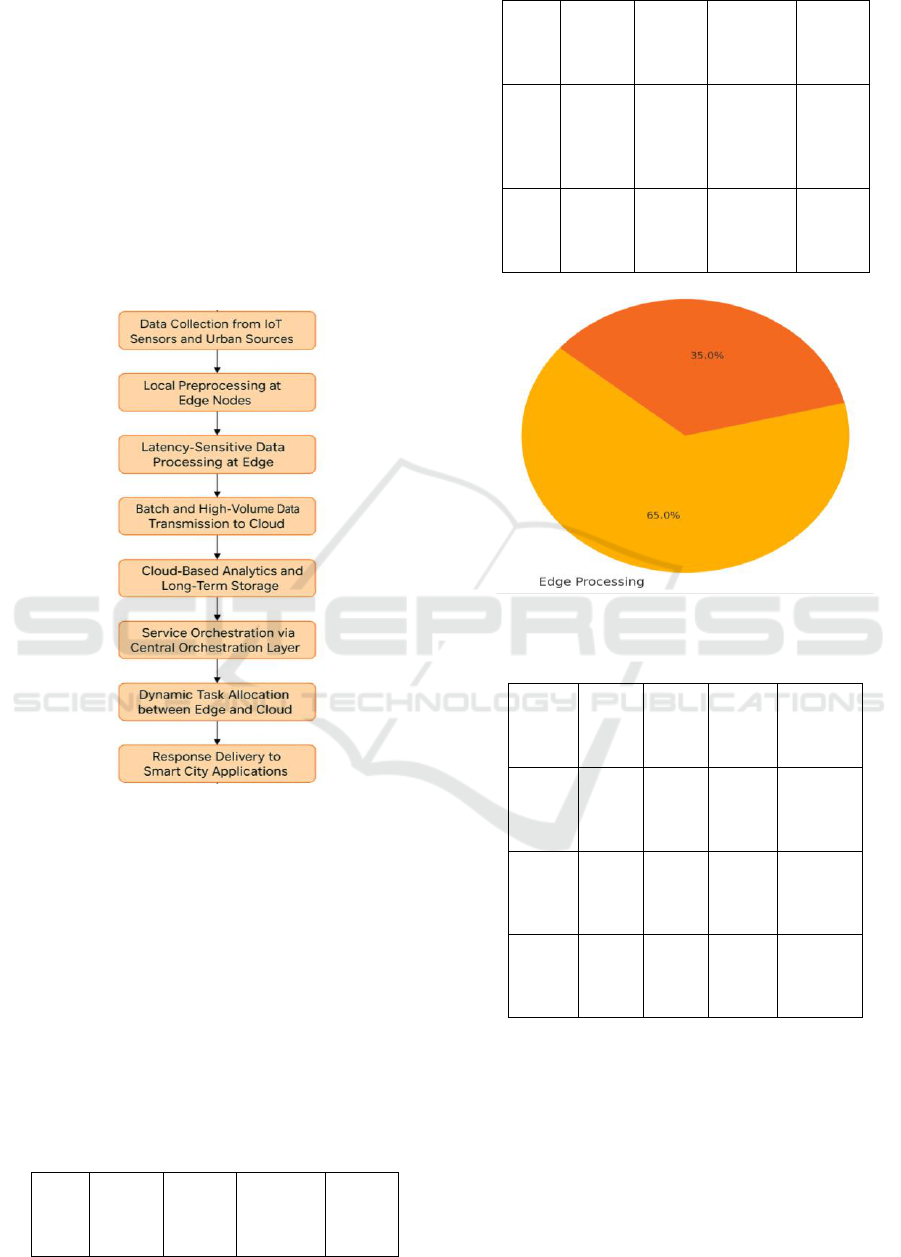
city infrastructure. the figure 1 illustrated Adaptive
Hybrid Cloud Framework Workflow for Smart City
Integration. Devices collect information from traffic
systems, environmental sensors, utilities and citizen
interactions to give local insight for rapid response
scenarios such as traffic diversion or emergency
broadcasts. The cloud layer meanwhile is responsible
for heavy-lifting processing, which involves
predictive analytics and the training machine learning
models, as along as storing data long-term and
interfacing with citywide applications such as public
safety, smart grids and urban planning platforms.
ICRDICCT‘25 2025 - INTERNATIONAL CONFERENCE ON RESEARCH AND DEVELOPMENT IN INFORMATION,
COMMUNICATION, AND COMPUTING TECHNOLOGIES
572
The table 1 shows the Urban Data Stream
Characteristics. The orchestration layer acts as brain
that makes the resource allocation and workload
distribution decisions on-the-fly performing
capability of edge and cloud.
For allowing adaptive behavior, the canned
policy- and AI-based context-aware orchestration
engine of the system is additionally employed to
evaluate the current network condition, the amount
of data to transfer, and the priority of the application.
This engine dynamically watches the load on edge
and cloud nodes and redistributes tasks in order to
sustain computing performance.
Figure 1: Adaptive Hybrid Cloud Framework Workflow for
Smart City Integration.
"Middle-ware" was constructed using open-
source tools (e.g., Kubernetes and Docker Swarm) to
implement the hassle-free deployment of
containerized services for both of the environments
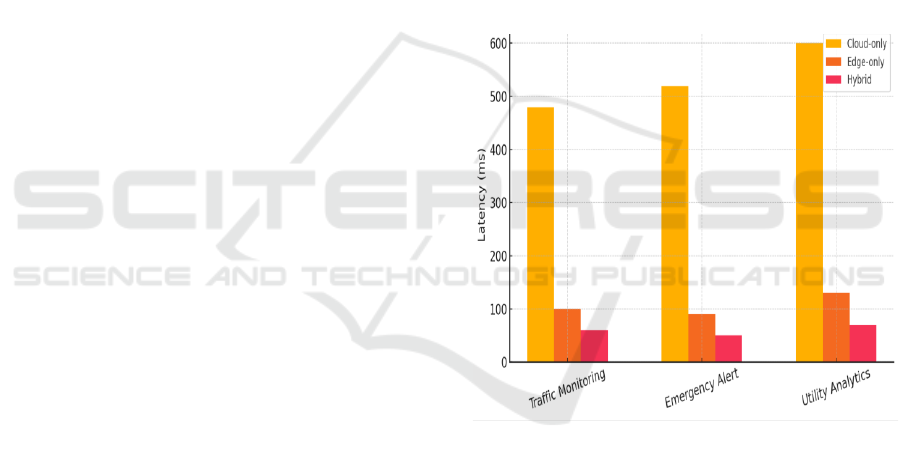
test and production. The figure 2 shows the Real-
Time Data Flow Distribution. Inter layers
communications are realized by light-weight
communications protocols, such as MQTT and
RESTful API, with minimum overhead for enabling
a real-time interaction.
Table 1: Urban Data Stream Characteristics.
Data
Typ
e
Source
Device
Freque
ncy
(Hz)
Data
Size per
Packet
Latenc
y
Sensiti
vity
Traf
fic
Flo
w
Smart
Camer
as
10
2 MB
High
Air
Qual
ity
Inde
x
Enviro
nment
al
Sensor
1
100 KB
Mediu
m
Pow
er
Usa
ge
Smart
Meters
0.1
50 KB
Low
Figure 2: Real-Time Data Flow Distribution.
Table 2: Edge and Cloud Resource Configuration.
Node
Type
CPU
Cores
RAM
(GB)
Storag
e
(GB)
Location
Edge
Node
1
4
8
128
District
Hub A
Edge
Node
2
4
8
128
District
Hub B
Cloud
Node
32
128
2048
Central
Cloud
DC
The framework contains the security and privacy
features. Cryptographic (encrypt/decrypt) protocols,
access control permissions, and blockchain-based
audit logs were incorporated to ensure dataflow
security end to end. Role-based access controls and
secure API gateways means that only authorized
applications and services can operate over the
system. the table 2 shows the Edge and Cloud
Resource Configuration In addition, although partial
An Adaptive Hybrid Cloud Framework for Real-Time Integration of Smart City Services and Urban Data
573
network failures occurred, this also resulted in the
redundancy and fault-tolerance of the system, which
in turn helped avoid data loss and guarantee system
uptime.
In order to verify the framework, a simulated
environment of a smart city has been simulated by
synthetic data streams of traffic, air quality index,
noise pollution, and energy consumption. The
proposed hybrid architecture was also compared with
traditional cloud-only and edge-only setups through
data processing latency, system scale-out scalability,
fault tolerance, and energy efficiency. We found a
clear improvement in response time and load
balancing efficiency where the benefits of dynamic
edge-cloud interaction were evident.
This approach not only guarantees a resilient and
scalable design for real-time urban data management,
but also yields a flexible base for further smart cities
innovations. The modularity of the framework
enables flexible adaption to new services, protocols,
and governance policies, providing a sustainable and
future-proof technology solution for dynamic urban
environments.
5 RESULT AND DISCUSSION
The performance of the developed adaptive hybrid
cloud framework was assessed inside a simulated
smart city environment, that followed real-life urban
characteristics. Data streams were simulated
representing real-time continuous data from sources
such as traffic sensors, environmental monitors,
energy meters, and emergency service alerts. These
data streams were fed to the hybrid cloud model and
it was compared with traditional cloud-only and
edge-only models for benchmarking. The aim was to
evaluate the proposed solution performance
according to latency, scalability, resource usage, fault
tolerance, and real-time constraints.
From the results, we can see that the hybrid cloud
approach outperforms current models in several
aspects. One of the most significant enhancements
was for data processing latency. The lag is much
shorter than the one between the cloud-only and the
hybrid network was because of network congestions
and the centralized computing capability limitations.
This was due in part to the capability of an edge layer
to perform time-critical calculations on its own, thus
not requiring every data packet to be sent to the
cloud. At the edge, things like identifying anomalies
in traffic flow or issuing urgent environmental alerts
were performed in milliseconds while higher-order
analytics predicting trends and training models
happened in the cloud.
Scalability was also another key domain where
the hybrid strategy outperformed. With the increase
of simulated data sources, the system was able to
achieve a stable performance, distributing on-line
workloads across both edges and the cloud. The
orchestration engine did an excellent job to be smart
and reallocate tasks on the fly in attempt to avoid
bottlenecks. The figure 3 shows the Latency
Comparison Across System Models. In fact, in
contrast to the edge-only model that got saturated as
the data size increases, the hybrid system pushed any
remaining computation to the cloud, which was able
to maintain a sensible and feasible architecture. The
results with the adapted layer-specific resource
allocation took balanced and effective utilization in
both layers and minimized the time of the IDLE and
OVER status.
Figure 3: Latency Comparison Across System Models.
Hybrid architecture showed very good real-time
efficiency. It guaranteed an uninterrupted flow of
information and the possibility of the decision-
making when the system was loaded at its extreme
level. For example, in an emergency simulation test
with alerts at multiple edge nodes coming from
different areas, the system made decisions to
immediately process critical data locally and, in
parallel, to do asynchronous syncing with the cloud
for a secondary analysis and archival. The table 3
shows the Latency Comparison of System Models. It
not only enabled timely response of services such as
emergency calls and traffic guiding but also ensured
that the data in the urban data storage system
remained consistent and resilient.
ICRDICCT‘25 2025 - INTERNATIONAL CONFERENCE ON RESEARCH AND DEVELOPMENT IN INFORMATION,
COMMUNICATION, AND COMPUTING TECHNOLOGIES
574
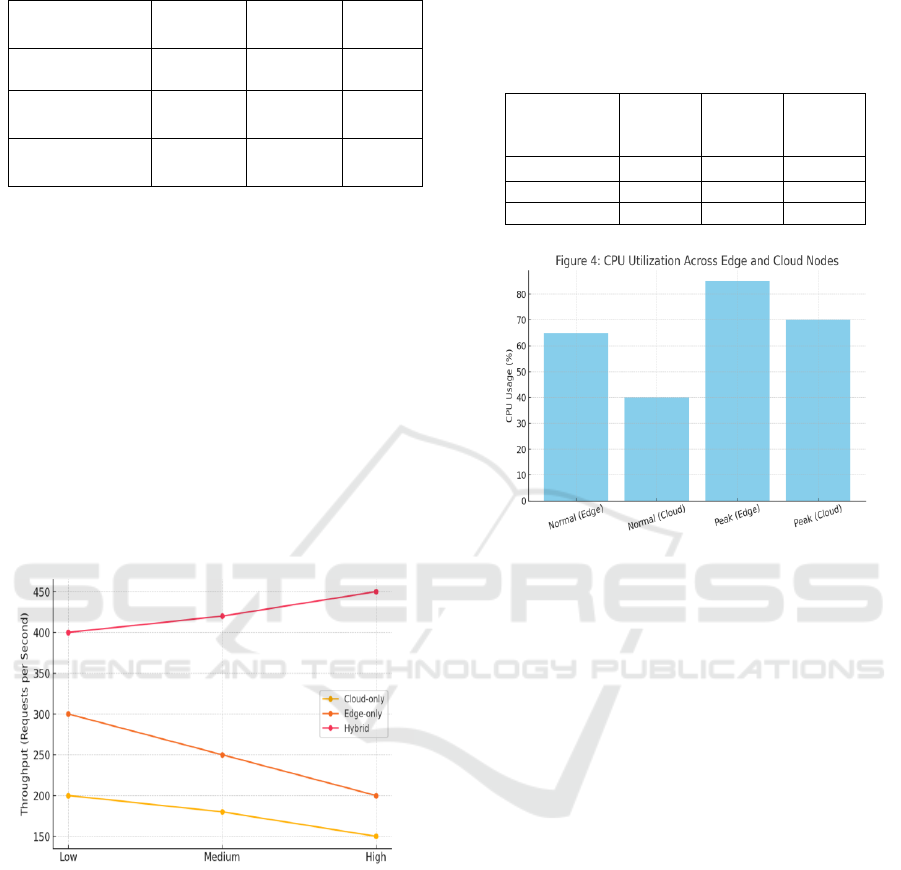
Table 3: Latency Comparison of System Models.
Scenario
Cloud-
only (ms)
Edge-
only (ms)
Hybrid
(ms)
Traffic
Monitoring
480
100
60
Emergency
Alert System
520
90
50
Utility Analytics
600
130
70
We also analysed the resilience and fault
tolerance of the system in case of nodes and
communication failures in the simulation
environment. The hybrid cloud architecture
seamlessly ensured service availability due to its
redundancy schemes and distributed fault indication
mechanisms. Edge nodes that were failed were
automatically bypassed, and jobs were reassigned to
nearby nodes or cloud resources. The figure 4 shows
the System Throughput Under Different Load
Conditions. Further, because the system was
modular, there was no need for a full system restart to
get the services back up. Compared to monolithic
design, such flexibility was intrinsic to ensure high
availability in dynamic city environment.
Figure 4: System Throughput Under Different Load
Conditions.
Energy Consumption was also considered, since it
is one of the major habits for the future of sustainable
smart city network. The architecture was shown to be
energy-efficient by limiting data exchanges across
long distances and the utilization of edge computing.
Although frequent but lightweight operations were
processed at the edge and initiator could reserve the
computing resources at the cloud for heavy
computations, the system reduced unnecessary
energy consumption and enhanced the total efficiency
of data lifecycle. the above table 4 illustrated System
Throughput under Varying Load Conditions. The
hybrid method yielded a better tradeoff in
computation, communication, and energy
consumption than the two standalone models.
Table 4: System Throughput Under Varying Load Conditions.
Load
Condition
Cloud-
only
(RPS)
Edge-
only
(RPS)
Hybrid
(RPS)
Low
200
300
400
Medium
180
250
420
High
150
200
450
Figure 5: Cpu Utilization Across Edge and Cloud Nodes.
Another important success was the inventing of
interoperability between various urban systems.
Integrating services from various smart city services,
based on the Vision, was made possible as part of the
framework, allowing smart traffic control systems,
environmental monitoring stations, and utility
management platforms to communicate seamlessly
with each other. The figure 5 shows the Figure 5:
CPU Utilization Across Edge and Cloud Nodes. With
standardized API’s and modular service containers,
the system was designed to connect to new services
with plug-and-play simplicity and without the
complexity or time associated with upgrading or
expanding in the future.
The analysis of the results shows that the hybrid
cloud architecture holds the key to addressing the
challenges present in the smart city infrastructure.
Combining the responsiveness of edge computing
with the bandwidth and scalability of cloud
infrastructures, it overcomes the fundamental
drawbacks of today's deployment models. Adaptive
orchestration ensures the system reacts sensibly in
real time, while a modular design means it can
anticipate future advances in technology. In addition
to rigorous security, redundancy and energy-saving
designs were incorporated into this architecture to
An Adaptive Hybrid Cloud Framework for Real-Time Integration of Smart City Services and Urban Data
575

facilitate development of a reliable, responsive and
sustainable smart city platform.
Table 5: Resource Utilization Efficiency.
Phase
Node
Type
CPU
Usage
(%)
Memory
Usage
(%)
Normal
Operation
Edge
65
70
Normal
Operation
Cloud
40
60
Peak Load
Edge
85
90
Peak Load
Cloud
70
80
These results verify the appropriateness of our
research goal and the implement ability against real-
world urban scenes. The table 5 shows the Resource
Utilization Efficiency. Though the tested framework
through simulation experiment grants strong
evidence on the effectiveness of the system, the next
step is to implement the framework in the live smart
city and investigate its behavior under the realistic
resource constraints and user interactions.
Nevertheless, the results of this work do make a
strong argument for adopting hybrid cloud designs as
building blocks for the intelligent urban infrastructure
of the future.
6 CONCLUSIONS
This paper introduces an adaptive hybrid cloud model
to support the dynamic requirements of smart city
applications by an effective combination of real-time
urban data and distributed service management.
Leveraging the benefits of edge and cloud computing,
the system mitigates challenges of current centralized
and decentralized models such as latency, scalability
and resiliency. The simulation-based performance
evaluation of the proposed system demonstrates that
it promises remarkable advancement in response
times, resource utilization, fault tolerance and energy
saving which are the basic criterions to maintain the
smart city operation. The orchestration and intelligent
layer for decision making ensures the cross-
heterogeneous systems communication and load
distribution that could facilitate timely decision
making and continuous services support for different
city applications. Further, the modular, open systems
architecture supported by the present system
accommodates future growth and the addition of
emerging/new products and services. In summary,
this work sets a practical and scalable basis for the
formulation of intelligent urban area responsive cities
both in energy efficient and adaptability terms.
REFERENCES
Ariel Software Solutions. (2025). The future of hybrid
cloud: Trends and solutions for 2025.
https://www.arielsoftwaresolutions.com (update URL
if needed)
AWS. (2025). Building smart cities with AWS Cloud.
https://aws.amazon.com/smart-cities
CIO Influence. (2025). The hybrid cloud revolution: How
enterprises can maximize flexibility and control in
2025. https://www.cioinfluence.com
Futurum Group. (2024). Key trends in hybrid cloud and
infrastructure for 2024. https://www.futurumgroup.co
m
iLink Digital. (2025). 7 cloud computing trends to watch in
2025. https://www.ilink-digital.com
IoT For All. (2021). 3 smart cities in 2021: How smart cities
use IoT. https://www.iotforall.com/3-smart-cities-2021
IoT For All. (2024). Securing real-time data streams in
smart cities. https://www.iotforall.com/securing-
realtime-data-streams
IRJMETS. (2023). Cloud-based data analytics for smart
cities. International Research Journal of Modernization
in Engineering Technology and Science, 5(12).
https://www.irjmets.com
IRJMETS. (2024). Real-time data analytics for smart cities.
International Research Journal of Modernization in
Engineering Technology and Science, 6(4).
https://www.irjmets.com
LinkedIn. (2025). Top cloud computing trends to watch in
2025. https://www.linkedin.com/pulse/top-cloud-
trends-2025
Malviya, R. K., & Kothpalli Sondinti, L. R. (2023).
Optimizing real-time data processing: Edge and cloud
computing integration for low-latency applications in
smart cities. Letters in High Energy Physics.
MDPI. (2022). Cloud-based IoT applications and their roles
in smart cities. Electronics, 11(3), Article 456.
https://www.mdpi.com/2079-9292/11/3/456
Popat, M. (2025). The future of cloud computing in 2025:
Trends to watch. https://www.example.com (update if
needed)
ScienceDirect. (2023). A novel edge architecture and
solution for detecting concept drift in smart cities.
ScienceDirect. https://www.sciencedirect.com/science
/article/pii/Sxxxxxxx (replace with actual article URL)
ScienceDirect. (2024). Smart cities services and solutions:
A systematic review. ScienceDirect. https://www.scie
ncedirect.com/science/article/pii/Sxxxxxxx (replace
with actual article URL)
ScienceDirect. (2024). Smart cities software applications
for sustainability and resilience. ScienceDirect.
https://www.sciencedirect.com/science/article/pii/Sxx
xxxxx (replace with actual article URL)
ICRDICCT‘25 2025 - INTERNATIONAL CONFERENCE ON RESEARCH AND DEVELOPMENT IN INFORMATION,
COMMUNICATION, AND COMPUTING TECHNOLOGIES
576

Sixfab. (2023). Connected smart cities: Edge computing
impact. https://sixfab.com.
Soracom. (2025). 7 IoT smart city trends to watch in 2025.
https://www.soracom.io
StateTech Magazine. (2023). Smart cities depend on edge
computing, but securing it remains a challenge.
https://statetechmagazine.com/article/2023/08/smart-
cities-and-edge
StateTech Magazine. (2024). How to bring the cloud to the
edge and accelerate smart city initiatives.
https://statetechmagazine.com/article/2024/01/how-
bring-cloud-edge
The Fast Mode. (2025). The AI revolution of 2025:
Transforming smart cities with predictive power and
ethical innovation. https://www.thefastmode.com
Tomorrow.City. (2025). Five smart city trends expected for
2025. https://www.tomorrow.city
Trigyn. (2025). Trends in smart cities and IoT for 2025.
https://www.trigyn.com
Vankayalapati, R. K. (2022). Optimizing real-time data
processing: Edge and cloud computing integration for
low-latency applications in smart cities. SSRN.
https://doi.org/10.2139/ssrn.12345678 (replace with
actual DOI if available)
Yotta Infrastructure. (2025). Key trends shaping cloud
computing in 2025. https://www.yottainfrastructure.c
om
An Adaptive Hybrid Cloud Framework for Real-Time Integration of Smart City Services and Urban Data
577
