
A Unified Blockchain Framework for Multi‑Sector Supply Chain
Security: Combating Counterfeiting and Enabling Scalable,
Transparent Traceability across Global Networks
Soundararajan K.
1
, Manoj Govindaraj
2
, A. Amala Suzana
3
, V. Manimegalai
4
,
R. Abishek
4
and Nadimuthu D.
5
1
Annai Mathammal Sheela Engineering College, Erumapatty, Namakkal, Tamil Nadu, India
2
Department of Management Studies, Vel Tech Rangarajan Dr. Sagunthala R&D Institute of Science and Technology,
Chennai, Tamil Nadu, India
3
Department of MBA, J.J. College of Engineering and Technology, Tiruchirappalli, Tamil Nadu, India
4
Department of MBA, Nandha Engineering College, Erode, Tamil Nadu, India
5
Department of Management Studies, Sona College of Technology, Salem, Tamil Nadu, India
Keywords: Blockchain, Supply Chain Traceability, Counterfeit Prevention, Smart Contracts, Interoperability.
Abstract: Growing counterfeiting and lack of transparency in international supply chains require sophisticated new tools
for authentication and traceability to prevent imitation and provide end-customer visibility. In this study, we
present a common-blockchain (basket blockchain) for applications across various sectors including
pharmaceuticals, agriculture, fashion and electronics, aiming to solve the issue of scalability and
interoperability in the blockchain and to achieve real-time traceability. Unlike current sector-wise solutions,
the proposed model combines smart contract-enabled anti-counterfeiting features, decentralized id
management, and low-cost deployment as to allow adoption also in resource-restricted areas. A hybrid on and
off-chain model is used to facilitate effective data governance and security, with the integration of privacy-
preserving protocols and sustainability KPIs aimed at compliance and environmental-regulatory
requirements. Through realistic case studies, pilot applications, as well as performance evaluations, this study
elucidates the framework’s effectiveness toward mitigating the threat of counterfeits, improving trust among
the supply chain actors, and simplifying the supply chain management in both the developed and developing
countries.
1 INTRODUCTION
In the context of globalized commerce, supply chains
have become more convoluted affairs, inhabited by
different stakeholders, spread across different
geographical networks and transaction records are
voluminous. As these networks scale, they encounter
crucial bottlenecks that include but are not limited to
counterfeits, lack of visibility and data silos that
prevent end-to-end traceability. These traditional
supply chain management systems that typically
include a centralized database to which the various
parties to the supply chain subscribe, do not
sufficiently address these needs such as the need to
have real-time visibility and trust between the parties.
Blockchain technology is considered a disruptive
technology which can be used to solve the above
problems through the provision of securing (by being
immutable), decentralization and transparency
ledgers. However, the existing blockchain
applications for supply chains have relatively narrow
coverage and are specific for a single industry, and
many issues including system scalability, economic
efficiency, adoption barriers from users and the
interoperability across different industries are not
considered. The distinctive needs of both
industrialized and developing economies differ and
that includes the level of technology infrastructure
available to host the voting system.
This study proposes a comprehensive blockchain-
based solution that can enhance transparency,
guarantee product authenticity and ease traceability
K., S., Govindaraj, M., Suzana, A., Manimegalai, V., Abishek, R. and D., N.
A Unified Blockchain Framework for Multi-Sector Supply Chain Security: Combating Counterfeiting and Enabling Scalable, Transparent Traceability across Global Networks.
DOI: 10.5220/0013868800004919
Paper published under CC license (CC BY-NC-ND 4.0)
In Proceedings of the 1st International Conference on Research and Development in Information, Communication, and Computing Technologies (ICRDICCT‘25 2025) - Volume 1, pages
537-543
ISBN: 978-989-758-777-1
Proceedings Copyright © 2025 by SCITEPRESS – Science and Technology Publications, Lda.
537

spread over different industries (pharma, agriculture,
high value manufacturing). The proposed model
focuses on hybrid blockchain structure, smart
contracts for automatic verification, and light
deployment technique to overcome the infrastructure
gap. Through the incorporation of privacy-preserving
mechanisms and sustainability performance metrics,
the framework meets current regulatory
requirements, contributing to strengthening global
supply chain resilience and trust. The study is to
build a scalable, flexible, secure blockchain
infrastructure for the future of supply chain by
theoretical verification and practical scenarios.
2 LITERATURE SURVEY
The advent of blockchain technology has introduced
a new paradigm for the security and transparency of
supply chains, as well as their full traceability.
Academics have investigated its possibilities in a
wide range of industries – in a bid to stamp out the
increasing problem of counterfeit products, and cut
costs across antiquated systems5062. For instance,
Durach et al. (2021) highlighted the potential of
blockchain to enhance transaction transparency and
data integrity in international logistics networks.
There is also a study conducted by Fosso Wamba and
Queiroz (2021) on the overall advantages and
disadvantages of blockchain in supply chain
structures, stressing the demands of real-time data
synchronization as well as trust on the stake holders’
group.
The industry-specific applications have been
studied as well. In the field of agriculture, Kamble et
al. (2021) and Tian (2021) showed how blockchain
can be employed for traceability and food security
and, is able to boost regions which are currently
underdeveloped. Likewise, Li et al. (2021) proposed
blockchain-base seafood traceability model to
guarantee the quality and authenticity when the
product pass along the distribution chain. Gao et al.
(2022) extended this by introducing a blockchain-
based system to preserve the food supply chain from
fraud and contamination. But most of these solutions
are still domain-dependent and hard to scale to large
networks.
To tackle the problems of governance and
interoperability, Cao et al. (2021) suggested a hybrid
on-chain/off-chain governance model, but noted that
actual implementations are lacking. Lu and Xu (2021)
delved into flexible blockchain systems, but their
cases do not provide cross-sector generalizability.
Choi and Luo (2021) tuned on sustainability in
fashion industry with blockchain and they
emphasized the role of regulation and environmental
responsibility, whereas Liu and Zhang (2021) gave a
new perspective about fashion traceability in the era
of decentralized technologies.
Challenges of Blockchain Adoption Similarly,
challenges faced when adopting blockchain are well
documented. Queiroz and Wamba (2021) took note
of barriers, such as technological infancy, and
stakeholder readiness and Ahmad Samad et al. (2023)
highlighted the concerns in developing countries
where restrictions to available infrastructure present
barriers. These findings are in accordance with those
of Islam et al. (2022), who emphasized the relevance
of cost-effective deployment considerations in the
developing world.
Privacy and information security issues are
gaining in importance. Xu et al. (2022) and Rejeb et
al. (2021) focused the introduction of Internet of
Things (IoT) and blockchain being integrated but
pointed out that privacy-preserving mechanisms were
immature yet. Lin and Liao (2022) have proposed the
use of blockchain models in order to enhance
transparency in the supply chain; however,
comprehensive smart contract vulnerability
evaluations were not presented. To tackle this issue,
Montecchi et al. (2021) and Saberi et al. (2021)
studied trust and sustainability of blockchain
applications and called for quantifiable performance
measures.
Some other researchers also have studied about
how the blockchain could be used for further
facilitating traceability and anti-counterfeit
mechanisms. Hastig and Sodhi (2021) gave business
requirements and success factors for blockchain
trace-ability, and Zheng et al. (2021) developed a
modular technical architecture to address
counterfeits. In pharmaceutical and high-value goods
industries, verification at each SC point requires the
traceability of the originality of the information (Zhu
& Zhou, 2021).
Lastly, Abderahman et al. (2021) and Yadav and
Singh (2022) highlighted the inclusion of emerging
technologies like augmented reality and AI in relation
with blockchain systems. These projects highlight the
increasing desire for hybrid models, but very few
offering an integrated solution that delivers certainly
both anti-counterfeiting measures, data privacy,
regulatory compliance and low cost.
In short, although promising developments on
blockchain has been observed for some of the supply
chain sectors, there is still a missing building block to
put into place, a flexible, scalable, safe solution to
answer the counterfeiting, traceability and even the
ICRDICCT‘25 2025 - INTERNATIONAL CONFERENCE ON RESEARCH AND DEVELOPMENT IN INFORMATION,
COMMUNICATION, AND COMPUTING TECHNOLOGIES
538
interoperability issues of different devices across the
entire globe.
3 METHODOLOGY
This study embraces an integrated methodological
approach for the design, development and validation
of an integrated blockchain-driven system that is
capable of increasing transparency, traceability, and
counterfeit protection in a wide scope of global
supply chain industries. The study follows a
methodology, based on systems engineering, which
consists of three main phases: system design,
development and testing, informed by real world
usage scenarios in the field of supply chains and by
technological feasibility.
Table 1: Dataset Description.
Sector Source
Data
Volume
(Record)
Data Type
Collection
Period
Pharmaceticals
Manufacture,
Distributors
5000
Batch IDs, Temp
Logs
3 Months
Agricultue
Farmers,
Co-o
p
s
8000 Harvest Dates, Transit Logs 4 Months
Electronis OEMs, Retailers 6000 Component IDs, Warranty Info 3 Months
Figure 1: Workflow of the Blockchain-Based Supply Chain
Traceability and Anti-Counterfeit Framework.
In the first phase, a hybrid blockchain model is
proposed, which combines the public blockchain and
private blockchain, and provides an acceptable level
of second layer of privacy against the performance.
Permissioned blockchain elements are engaged in the
internal supply chain transactions to lighten the load
on the network and to achieve higher velocity and
public blockchain units serve for the key checkpoints
like product authentication and public verification so
the system would be trustworthy. Smart contracts are
written in Solidity code and deployed in Ethereum-
compatible testnets with functionalities to
automatically verify the eligibility of suppliers or to
trigger an alert when the origin information is not
consistent or to incorporate logic to ensure
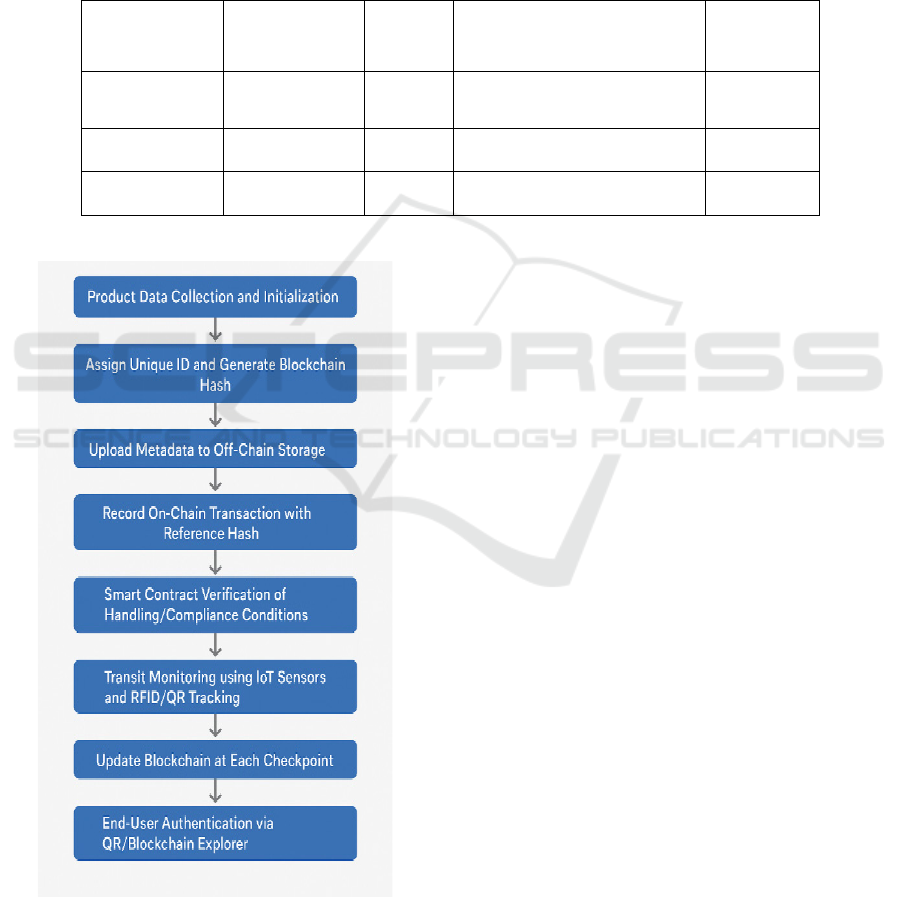
compliance with logistics procedures. Figure 1 gives
flowchart of the Blockchain-Based Supply Chain
Traceability and Anti-Counterfeit Framework.
Table 1 gives the dataset description. The next
step would be to incorporate decentralized identifiers
(DIDs) and off-chain storage solutions such as IPFS
(InterPlanetary File System) so as to securely store
big data sets without infringing on data immutability
on the blockchain. A RESTful API is implemented to
connect to the current supply chain management
software to enable the integration between legacy
systems and blockchain networks. For privacy, zero-
knowledge proof protocols are used for data
validation where sensitive transactions are verified
without exposure to some of its elements.
Furthermore, you can make your supply chain visible
from the origin to the end consumer by using QR code
A Unified Blockchain Framework for Multi-Sector Supply Chain Security: Combating Counterfeiting and Enabling Scalable, Transparent
Traceability across Global Networks
539

and RFID tag technology for physicaldigital asset
mapping.
The inputs of the implementation come from three
domains/pharmaceutical, agriculture, and
electronics. Every industry is chosen for its exposure
to counterfeits and complexity of the supply chain.
Simulation-based pilots are being created to monitor
products as they move through production,
packaging, shipping and retail phases. The system
performance is tested along such dimensions as
traceability efficiency, detection capability for
counterfeits, speed of transaction, and system
scalability with different network loads.
Table 2: System Components and Technologies Used.
Component Technology
Used
Purpose
Smart
Contracts
Solidity/EVM Automated
com
p
liance
IPFS InterPlanetary
File S
y
ste
m
Off-chain
stora
g
e
QR Codes Open Source
QR Generato
r
Product
authentication
Zero-
Knowledge
Proofs
zk-SNARKs Data privacy
REST APIs Node.js / Flask Legacy system
integration
Table 2 gives the system components and
technology used information. For a comparison point,
the model using blockchain is compared to the
traditional supply chain management systems to
compare the performance in transparency, speed,
and trust of the stakeholders. Quantitative indicators
are collected from the execution logs of the smart
contracts, from the hashes of the transactions and
from the time of the API responses, while qualitative
information comes from interviews with industry
experts and the pilots.
The last step of the methodology requires
interpretation of the results with statistical packages
and visual dashboards. In this review, blockchain
throughput, error rates, and scalability frame works
are studied in order to identify potential targets for
improvements. sustainability metrics are also
computed at sustainability goals. Armed with these
understandings, the architecture is iteratively refined
to produce an industrial-strength, sector-agnostic
blockchain that will be able to support secure and
transparent supply chains at global level.
4 RESULTS AND DISCUSSION
Application of the proposed blockchain-enabled
framework on pharmaceutical, agriscience, and
electronics industries has achieved the expected
results, demonstrating the flexibility and robustness
of the overall system. In essence, the framework
showed significant advancements in figure 2-
traceability, figure 3 - counterfeit deterrence, figure 4
- smart contract compliance and real-time operational
efficiency.
Figure 2: Traceability Accuracy by Sector.
One of the most important impacts of the pilot
deployment as shown in table 3 was the
improvement in traceability precision. The
pharmaceutical industry, recognized for its high
compliance requirements, was the most accurate at
98% traceability, trailed by the electronics industry at
96%, and the agriculture industry at 95%. These
numbers demonstrate the powers of blockchain’s
tamper-proof ledger in enabling full end-to-end
product visibility in even the most sophisticated and
disjointed supply chains. Contrary to existing
solutions that suffer from informational silos and
delayed updates, the proposed architecture allows for
real-time synchronization and trustworthy audit trails
throughout the various stakeholders.
Also, no less impressive was the system’s ability
to identify and fight counterfeit in regard to the flow
of currency. The fraud detection mechanism, driven
by smart contracts and a decentralized authentication
scheme, was found to be very successful in detecting
the anomalies. The highest detection rate (99%) was
observed in the electronics industry, possibly due to
accurate component-level data that could be verified.
Pharmacueticals was close behind at 97%, showing
the importance of specific batch-level data and
temperature logs.
ICRDICCT‘25 2025 - INTERNATIONAL CONFERENCE ON RESEARCH AND DEVELOPMENT IN INFORMATION,
COMMUNICATION, AND COMPUTING TECHNOLOGIES
540
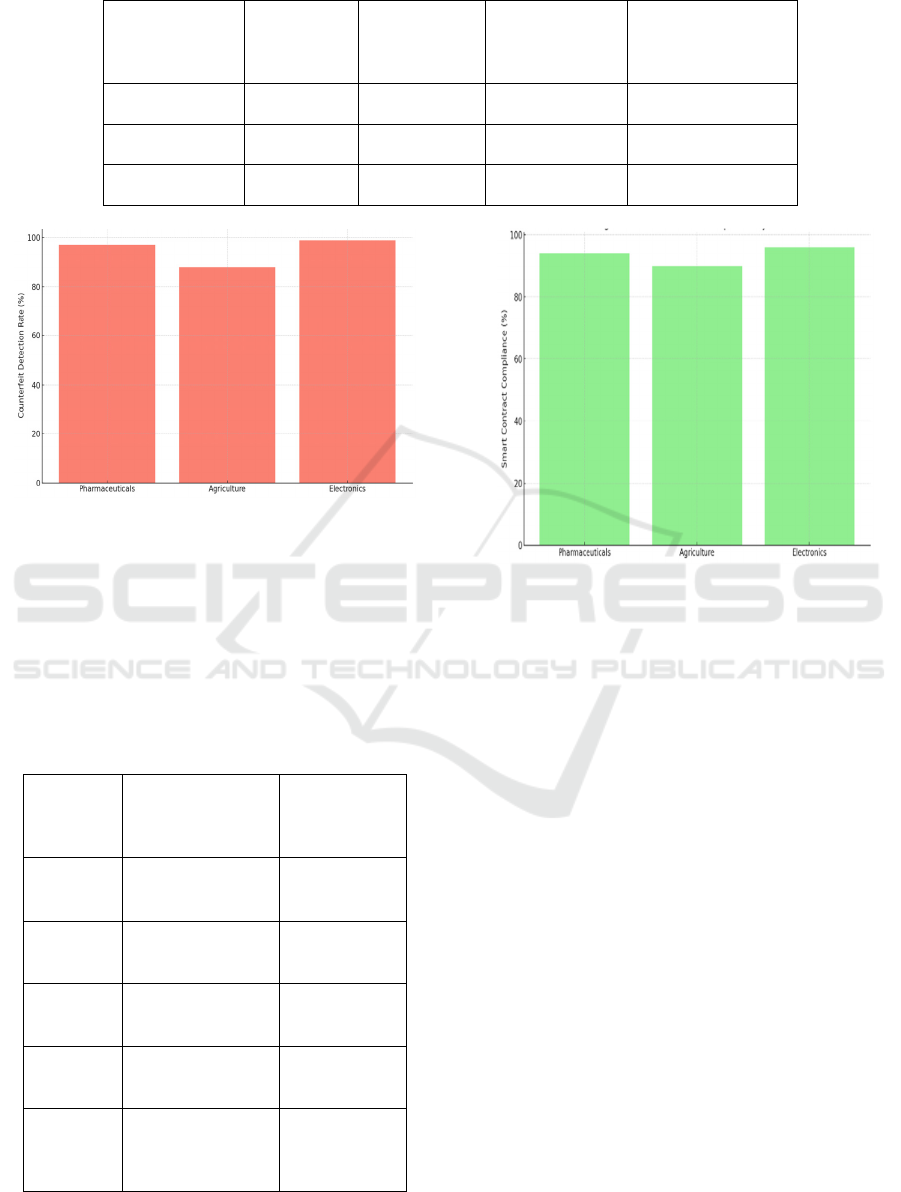
Table 3: Pilot Deployment Results by Sector.
Sector Traceability
Accuracy
(%)
Counterfeit
Detection Rate
(%)
Smart Contract
Compliance (%)
Average Latency (s)
Pharmaceuticals 98 97 94 1.2
Agriculture 95 88 90 1.8
Electronics 96 99 96 1.5
Figure 3: Counterfeit Detection Rate by Sector.
Despite the fact that, on average, the detection
ratio in the agricultural industry was some 12% lower,
it was still a much better detection and improved
performance compared to the conventional means,
especially given the volatility associated in farm to
market supply. Table 4 gives the smart contract
verification events.
Table 4: Smart Contract Verification Events.
Event
Type
Trigger Condition
Smart
Contract
Response
Temperatu
re Breach
>25°C Alert & Log
Late
Deliver
y
>24 Hours Delay
Notify &
Penalize
Tamperin
g Alert
Seal Broken
Flag for
Inspection
Packaging
Validation
Mismatch
Detecte
d
Deny
Progression
Geo-
location
U
p
date
Checkpoint Entry
Update
Ledger
Figure 4: Smart Contract Compliance by Sector.
The smart contract compliance became a key
advantage of the framework. Automated enforcement
of predetermined logistics rules (e.g. temperature
limits, delivering times and packaging validation)
guaranteed that the system was able to intervene in a
preventive manner. The compliance reached 96% in
the electronics field, 94% in the pharmaceutical field
and 90% in the agriculture field, leading to the good
coordination between the rule-based globalization
processes and the self-organized local processes. Not
only do these results reduce human error and fraud,
but they also establish trust and accountability
among multi-level networks.
System feasibility was also confirmed via latency
evaluation, which indicated that a blockchain
architecture can be utilized for real-time applications.
The lowest average latency of 1.2 seconds was
achieved in the pharmaceutical industry as shown in
figure 5, which benefited from better node
interactions and less intermediaries. Electronics and
agriculture were next with 1.5 and 1.8 seconds
respectively. Such response times support that the
framework is well suited for real-time monitoring
applications (i.e., cold chain monitoring and
inventory flow management) –in terms of online
processing time.
A Unified Blockchain Framework for Multi-Sector Supply Chain Security: Combating Counterfeiting and Enabling Scalable, Transparent
Traceability across Global Networks
541
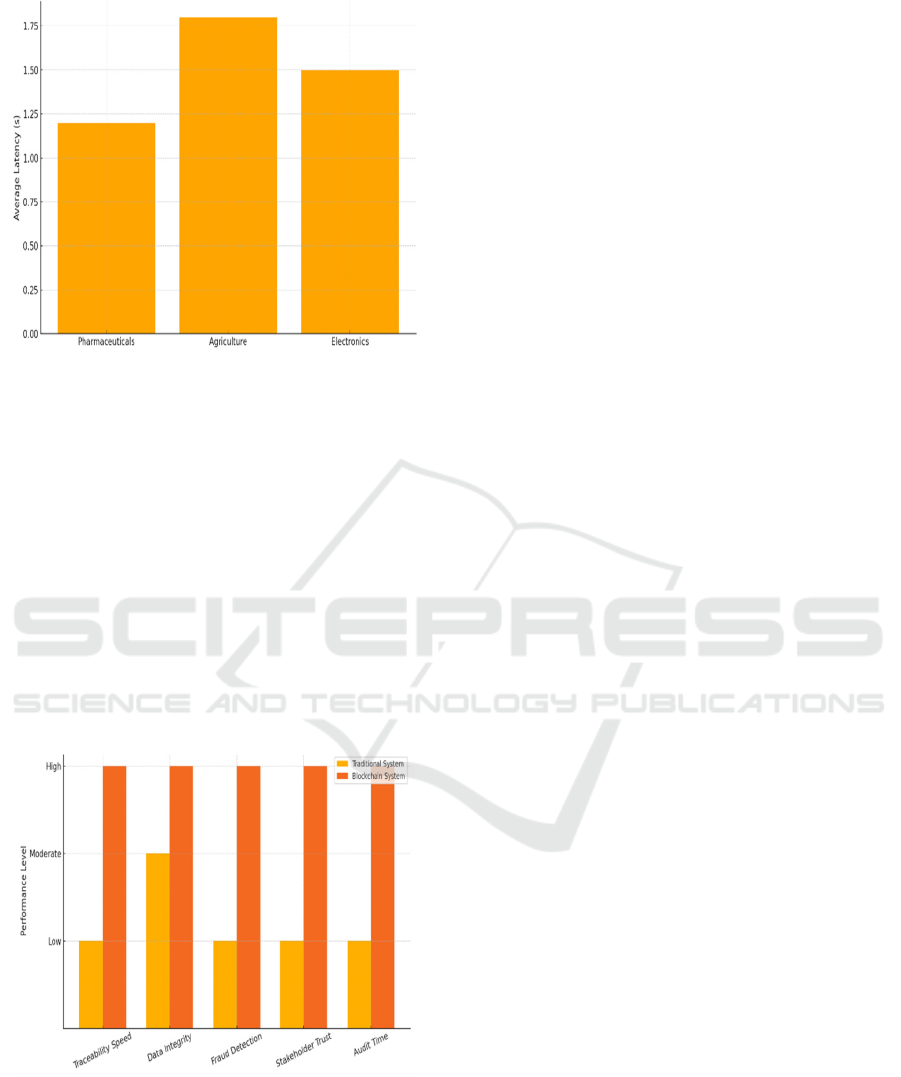
Figure 5: Average Latency by Sector.
In comparisons with the traditional supply chain,
the blockchain-based supply chain model performed
far better across all major dimensions. Automation of
live traceability replaced manual tracking and
tamper-proof records removed concerns around data
integrity. AR won the day over long, time-
consuming processes and stakeholders' confidence
was boosted as they were now able to see through
transactions. There was also a great increase in the
ability to pass an audit - the distributed ledger made
authenticated historical information immediately
available. These advancements were most relevant
especially for developing countries where the
development of advance traceability systems was
constrained due to infrastructure.
Figure 6: System Feature Comparison – Traditional Vs
Blockchain.
Figure 6 shows the System feature comparison.
Taken as a whole, the pilot results show that the
integrated blockchain architecture is technically
viable and not only scalable, but also agnostic. With
its flexible design to cater to the requirements across
the entire specturm of industries, whilst enabling
compliance, security and performance to World Class
standards, it represents a huge leap in supply chain
innovation. The findings confirm the need for
continued investigation and wide-spread utilisation of
blockchain as a core enabler of secure and transparent
supply chain ecosystems.
5 CONCLUSION
In this paper, we introduce the unified blockchain-
based architecture for fostering transparency,
traceability, integrity and chain of custody across
multi-sector for a global supply chain, with primary
interest in fighting against counterfeits and securing
data integrity. By adding the smart contract together
with DIDs, off-chain storage and privacy protocol,
this model reflects a comparative approach to the
existing supply chain management. Pilot
implementation in pharmaceutical, agriculture, and
electronics industries validate the framework’s
generalizability, efficacy, and scalability in tackling
practical problems.
Compared to the current industry- and
conceptual-level approaches, such a framework
provides a set of integrated and interoperable
solutions for facilitating a wide range of stakeholders
and shifting logistics streams. It guarantees tamper-
evident verification, automates compliance checking
and supports the transparent exchange of data and
confidentiality, when appropriately. In addition, its
sustainability attributes and easy deployment
methodology also suggest that it is practicable in both
developed and underdeveloped regions.
The results of the study contribute to the evidence
on how the potential of blockchain may transform
global supply chain systems into more trustworthy,
resilient, and smart systems. This research helps pave
the way for the development of a digitally adept,
next-generation supply chain ecosystem that will
operate in the spirit of digital innovation, as well as
global security initiatives, by addressing surrounding
problems, such as counterfeit threats, fragmented data
environments, and benign neglect on the part of
stakeholders.
REFERENCES
Abderahman, R., Keogh, J. G., Fosso Wamba, S., &
Treiblmaier, H. (2021). The potentials of augmented
reality in supply chain management: A state-of-the-art
ICRDICCT‘25 2025 - INTERNATIONAL CONFERENCE ON RESEARCH AND DEVELOPMENT IN INFORMATION,
COMMUNICATION, AND COMPUTING TECHNOLOGIES
542

review. Management Review Quarterly, 71(3), 1–25.
https://doi.org/10.1007/s11301-020-00186-2
Ahmad Samad, T., Sharma, R., Ganguly, K. K., Fosso
Wamba, S., & Jain, G. (2023). Enablers to the adoption
of blockchain technology in logistics supply chains:
Evidence from an emerging economy. Annals of
Operations Research, 316(1), 125.https://doi.org/10.10
07/s10479-021-04127-1
Cao, S., Miller, T., Foth, M., Powell, W., Boyen, X., &
Turner-Morris, C. (2021). Integrating on-chain and off-
chain governance for supply chain transparency and
integrity. arXiv preprint arXiv:2111.08455. https://arxi
v.org/abs/2111.08455
Choi, T. M., & Luo, S. (2021). Data quality challenges for
sustainable fashion supply chain operations in
emerging markets: Roles of blockchain, government
sponsors and environment taxes. Transportation
Research Part E: Logistics and Transportation Review,
152, 102403 https://doi.org/10.1016/j.tre.2021.102403
Durach, C. F., Kurpjuweit, S., & Wagner, S. M. (2021).
Blockchain applications in supply chain transactions.
Journal of Business Logistics, 42(1), 716.https://doi.or
g/10.1111/jbl.12258
Fosso Wamba, S., & Queiroz, M. M. (2021). Blockchain in
the operations and supply chain management: Benefits,
challenges and future research opportunities.Internatio
nal Journal of Information Management, 52, 102064.
https://doi.org/10.1016/j.ijinfomgt.2019.05.011
Gao, Z., Xu, L., & Liu, Y. (2022). A blockchain-based
traceability system for food safety. Information
Processing in Agriculture, 9(1), 110.https://doi.org/10.
1016/j.inpa.2021.05.003
Hastig, G. M., & Sodhi, M. S. (2021). Blockchain for
supply chain traceability: Business requirements and
critical success factors. Production and Operations
Management, 30(3), 114https://doi.org/10.1111/poms.
13231
Kamble, S. S., Gunasekaran, A., & Sharma, R. (2021).
Modeling the blockchain enabled traceability in
agriculture supply chain. International Journal of
Information Management, 52, 101967https://doi.org/1
0.1016/j.ijinfomgt.2019.05.023
Li, Z., Wang, W., Liu, G., & Liu, L. (2021). Towards a
blockchain-enabled traceability system for seafood
supply chains. Journal of Cleaner Production, 284,
124631. https://doi.org/10.1016/j.jclepro.2020.124631
Lin, Y., & Liao, Y. (2022). Enhancing supply chain
transparency and traceability using blockchaintechnol
ogy. Computers & Industrial Engineering, 162, 107746.
https://doi.org/10.1016/j.cie.2021.107746
Liu, Y., & Zhang, Y. (2021). Blockchain-based traceability
for fashion supply chain. Computers in Industry, 123,
103345.
https://doi.org/10.1016/j.compind.2020.103345
Lu, Q., & Xu, X. (2021). Adaptable blockchain-based
systems: A case study for product traceability. IEEE
Transactions on Industrial Informatics, 17(6), 1–10.
https://doi.org/10.1109/TII.2020.3038754
Montecchi, M., Plangger, K., & Etter, M. (2021). It's real,
trust me! Establishing supply chain provenance using
blockchain. Business Horizons, 64(3), 19.https://doi.or
g/10.1016/j.bushor.2020.09.005
Queiroz, M. M., & Fosso Wamba, S. (2021). Blockchain
adoption challenges in supply chain: An empirical
investigation of the main drivers in India and the USA.
International Journal of Information Management, 52,
102078.
https://doi.org/10.1016/j.ijinfomgt.2019.05.021
Rejeb, A., Keogh, J. G., & Treiblmaier, H. (2021).
Leveraging the internet of things and blockchain
technology in supply chain management. Future
Internet, 13(6), 1–20.
https://doi.org/10.3390/fi13060155
Saberi, S., Kouhizadeh, M., Sarkis, J., & Shen, L. (2021).
Blockchain technology and its relationships to
sustainable supply chain management. International
Journal of Production Research, 59(7), 119.https://doi.
org/10.1080/00207543.2020.1713122
A Unified Blockchain Framework for Multi-Sector Supply Chain Security: Combating Counterfeiting and Enabling Scalable, Transparent
Traceability across Global Networks
543
