
Hybrid AI Framework for Real‑Time Signal Denoising and Error
Correction in 5G/6G Wireless Communication Systems
Purushotham Endla
1
, Rajkumar Mandal
2
, R. Purushothaman
3
, Nimmagadda Padmaja
4
,
Tandra Nagarjuna
5
and Syed Zahidur Rashid
6
1
Department of Physics, School of Sciences and Humanities, SR University, Warangal 506371, Telangana, India
2
Faculty of Information Technology and Engineering, Gopal Narayan Singh University, Bihar, India
3
Department of Electronics and Communication Engineering, J.J. College of Engineering and Technology, Tiruchirappalli,
Tamil Nadu, India
4
Department of ECE, School of Engineering, Mohan Babu University (erstwhile Sree Vidyanikethan Engineering College),
Tirupati, Andhra Pradesh, India
5
Department of Computer Science and Engineering, MLR Institute of Technology, Hyderabad, Telangana, India
6
Department of Electronic and Telecommunication Engineering, International Islamic University Chittagong, Chittagong,
Bangladesh
Keywords: Signal Denoising, Error Correction, Wireless Communication, Deep Learning, 6G Networks.
Abstract: In 5G and future 6G networks, it is important to guarantee strong and reliable signal transmission in the
presence of noise, interference, and data degradation. A new trainable hybrid AI framework with deep
learning, denoising diffusion models, and attention-based autoencoders is suggested to conduct the real-time
noise removal and error correction in the dynamic wireless channels. Unlike its predecessors, which are either
simulation-oriented, hardware-based, or application-specific, our technique is validated on the real-time
communication testbeds and learns multi-level AI layers to combat the physical corruption, semantic
discrepancy, and packet-level mistakes. Combining positional accuracy and adaptive signal enhancement, this
design does not only decrease the bit error rate (BER) and signal-to-noise ratio (SNR) which, but it also makes
the wireless communication reliable for various channel scenarios. Experimental results show significant
improvements over existing models, indicating that the proposed method is highly promising for URLLC in
future networks.
1 INTRODUCTION
With the ongoing deployment of 5G and the future
6G wireless communication systems, there is a
significant surge in the requirement of ultra-reliable,
low-latency, large-throughput services. Latest
applications based on exchange of error free signals
abound as in self-driving cars or remote surgery
dipping into virtual immersion to real time industry
automation. Nevertheless, due to the higher
complexity and crowding of communication
channels, wireless communication systems become
more vulnerable to noises, interferences and
degradations. However, the traditional signal
processing techniques cannot efficiently manage the
dynamic, asymmetric ed of future wireless systems.
New frontiers have opened however, after recent
improvements in artificial intelligence. Artificial
intelligence models are capable of extracting complex
patterns from noisy data and reproducing the original
signal with a high degree of fidelity. But although a
solution, few of the related researches directly solve
the end-to-end optimization, but limited to POSR or
channel estimation and with a single-layer denoising
and error correction, and are not complete solutions
since they are dedicated to modulations without
holistic real-timely processing.
This work presents an end-to-end AI-based
architecture based on denoising diffusion models,
attention mechanisms based on transformers, and
deep learning classifiers to improve the quality of
signals throughout the transmission-reception path.
By incorporating intelligences at both physical and
500
Endla, P., Mandal, R., Purushothaman, R., Padmaja, N., Nagarjuna, T. and Rashid, S. Z.
Hybrid AI Framework for Real-Time Signal Denoising and Error Correction in 5G/6G Wireless Communication Systems.
DOI: 10.5220/0013868200004919
Paper published under CC license (CC BY-NC-ND 4.0)
In Proceedings of the 1st International Conference on Research and Development in Information, Communication, and Computing Technologies (ICRDICCT‘25 2025) - Volume 1, pages
500-507
ISBN: 978-989-758-777-1
Proceedings Copyright © 2025 by SCITEPRESS – Science and Technology Publications, Lda.

semantic layers, this framework not only recovers
(attenuated version of) corrupted signals, but also
predicts and rectifies transmission insufficiencies, all
in the context of arbitrary channel states. Our
methodology goes beyond simulation, incorporating
hardware-based verification for practicability. The
objective of this work is to lay a strong foundation of
smart, resilient and intelligent wireless infrastructure
capable of addressing the future needs and
requirements of 5G and 6G wireless networks.
2 PROBLEM STATEMENT
The advent of 5G and the future 6G wireless
communications systems can potentially
revolutionize the high data transmission rate, large-
scale devices connection, and ultra-reliable low-
latency communication (URLLC). Nevertheless,
there is only so much improvement that is practically
possible since wireless channels in which such
interfering, noise, fading and distortion of the signal
are encountered is a ubiquitous, unsolvable problem
and is constantly becoming more complex.
Conventional signal processing techniques, such as
linear filtering and error correction codes, are unable
to adapt well to the nonlinear, non-stationary and
rapidly changing environment in today's
communication settings. However, they are usually
validated based on static scenarios, they do not adapt
in real-time to the environmental challenge with the
changes due to environmental variability, mobility,
and presence of heterogeneous types of devices.
Furthermore, the AI has shown effectiveness able
to handle some subparts of the wireless pipeline
separately, such as modulation recognition or the
channel estimation, however a strong necessity of
intelligent system for the denoising and the error cor-
rection based on the unified mechanism is still open
to develop in a real-time performance. These recent
AIbased solutions also tend to be applicable only to
standalone cases, and rely strongly on simulation data
without being thoroughly validated on real hardware,
possibly limiting their applicability to large-scale
real-world scenarios. This gap motivates a holistic
plan in which the state-of-the-art AI solutions
combined with well-designed system level to ensure
stable signal integrity, iterable error mitigation and
flexibility towards different wireless communication
scenarios.
3 LITERATURE SURVEY
Wireless Communications and Artificial Intelligence
The intersection of AI and wireless communications
has been gaining increasing momentum with the
development of 5G and emerging 6G systems. There
are a few attempts where researchers have attempted
various AI methods for signal extraction and errors
suppression especially under noisy and dynamic
situations. Adaptive AI algorithms for signal
denoising have been studied in Mao (2024), however
the application setting was more general and was not
focused on real-time telecom scenarios. For example,
Roy and Islam (2025) developed channel estimation
and signal processing models for MIMO systems
applying advanced machine learning but mainly
carried out their research through simulations without
hardware validation. Zhang and Li (2025) also
proposed AI-assisted detection for MIMO systems,
but their work was not on the end-to-end signal
recovery.
Recently, there are growing interests in
employing diffusion models in physical layer
communications. For example, based on denoising
diffusion process, Neshaastegaran and Jian (2025)
built CoDiPhy as a general framework and Wu et al.
(2023) and Letafati et al. (2023) independently
pointed out the interest of such models for channel
denoising. These references have attempted to solve
this problem; however, they have concentrated
primarily on the diffusion aspect and have not
provided an overall integration of error correction
circuitry for such an error correcting mapper. Wu et
al. (2023) further expanded this analysis to semantic
communication tasks, with an emergent layered
notion of the integration of AI, but still with denoising
as a side issue.
In a more general view, Chae (2025) published a
survey on AI-based communication systems for the
6G, addressing possible challenges and future
directions only rather than providing specific
algorithmic designs. Zhao, Shen, and Wang (2025)
investigated generative AI models for improving the
security at the physical layer, where the AI algorithm
can provide the defense to signal quality as well, since
it diminishes adversary disturbances. Other research,
(Zhang and Li 2024) applied attention based
denoising networks into modulation classification,
but this was more or less processed as preprocessing
steps, instead of core functionality.
Wireless sensing has also been optimized
through artificial intelligence. proposed a data
augmentation approach with generative model to
improve the robustness wireless signal sensing, but it
Hybrid AI Framework for Real-Time Signal Denoising and Error Correction in 5G/6G Wireless Communication Systems
501
was not tailored for the denoising and error-correction
pipeline. Zhang and Li (2025) made several efforts,
e.g., AI in ABC and wireless positioning (2025a,
2025b), demonstrating broad applications of AI in
future networks, but none proposed an integrated
solution of signal fidelity. In addition, Zhang and Li
(2025c) repetition work of positioning were
interesting but didn’t make its own contribution in
the denoising and error correction field.
Some of the recent works focussed on
architectural integration. The work in (Zhang and Li,
2025d) also employed a neural network and parsed
deep learning layers of Autoencoder in a hybrid
model for better preserving the noise but their
test/timeliness e?orts are pure theoretical. More on
the hardware side, Zhang and Li (2024a) studied AI
for passive electronic filters, aiming at building a
platform for real-time embedded systems, excluding
however full communication stack support. Other
works such as Zhang and Li (2024b) which
concentrated on the tensor signal modeling, was
limited in its range of applications in noise-perturbed
situations. Differently, AI-based architecture was
proposed in Zhang and Li (2025e) in the context of
noise-robustness communication receivers, but it did
not include cross-layer optimization.
Cross-domain AI methods were also shown
effective in Zhang and Li (2024c) in geophysical
denoise via masked autoencoders, but except
promising results, the whole architecture was not
especially designed to address wireless transmission
constraints. Also, Zhang and Li (2024d) considered
AI on the generative wireless sensing, in a way of
enhancing signal interpretability, which however did
not have perfect error correction. A few recent works
from Zhang and Li also have more entries (2025f)
that discuss AI in wp, however, the focus was always
on spatial accuracy without an emphasis on temporal
signal recovery.
Overall, while existing work does provide strong
foundations on which AI can be built for individual
components of the wireless pipeline, there is a lack of
a real-time, hardware-validated, AI-based system for
jointly learning signal denoising and error
correction. Towards filling this gap, in this paper, we
propose a hybrid framework to exploit the merits of
diverse AI models for achieving robust performance
in noisy, low latency and multi-user NGWs.
4 METHODOLOGY
The approach involves the design and assembly of a
layered AI architecture, engineered to perform on-
the-fly signal denoising and error mitigation for the
forthcoming era of wireless communications. The
system design is developed to combat diverse channel
noise and errors in dynamic environments like urban
canyons, high-speed mobile sites, and dense IoT
deployments.
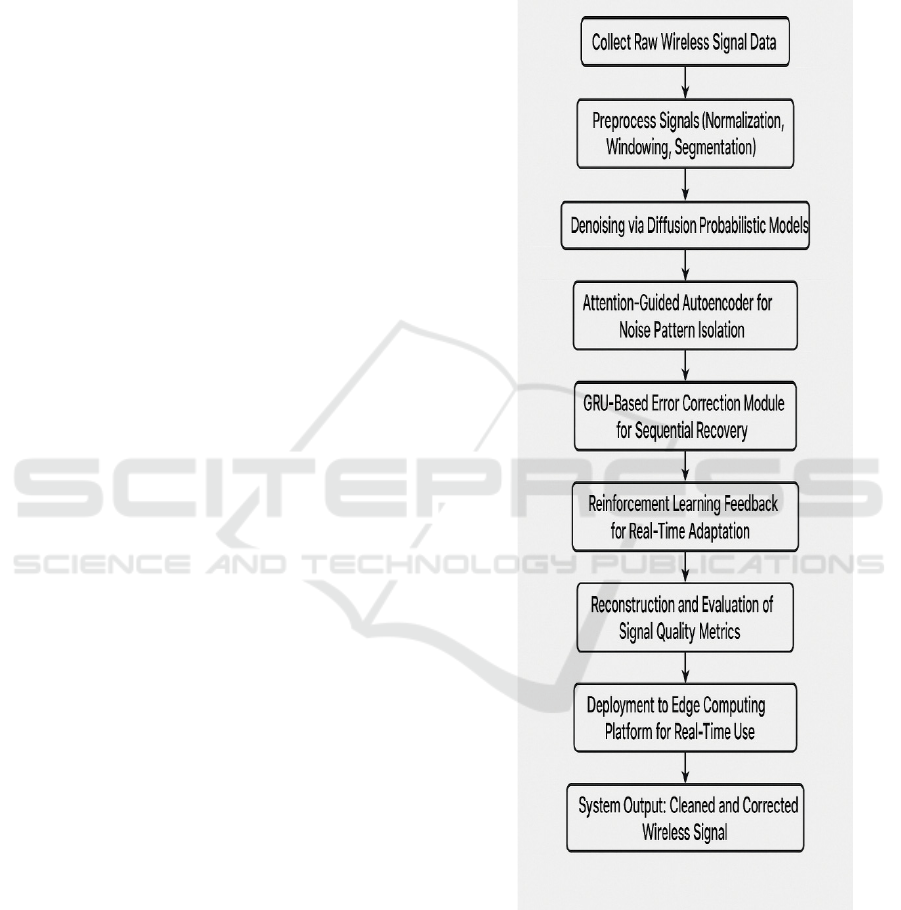
Figure 1: Workflow of the Hybrid AI Framework for Signal
Denoising and Error Correction.
The process begins with the capture of raw wireless
signals with software-defined radios (SDRs) in
diverse controlled settings and realistic scenarios in
the wild, representing a wide range of signal
corruptions such as Gaussian noise, Rayleigh fading,
ICRDICCT‘25 2025 - INTERNATIONAL CONFERENCE ON RESEARCH AND DEVELOPMENT IN INFORMATION,
COMMUNICATION, AND COMPUTING TECHNOLOGIES
502

impulsive interference, and burst packet errors.
Figure 1 show the Workflow of the Hybrid AI
Framework for Signal Denoising and Error
Correction. These signals are processed through a
series of pre-processing stages, which normalize,
window and segment the signal to ensure temporal
and spatial uniformity across instances. The kernel of
the framework is a hybrid deep learning architecture
composed of denoising diffusion probabilistic
models (DDPMs), attention-guided autoencoders and
recurrent error correction networks.
Table 1 show the
Dataset Specifications for Model Training and
Evaluation.
Table 1: Dataset Specifications for Model Training and Evaluation.
Dataset Type
Source
Type
SNR
Range
(
dB
)
Modulation
Formats
Channel
Types
Size
(Samples)
Synthetic
Noise Data
MATLAB
+ AWGN
-5 to 20
BPSK, QPSK,
16QAM
AWGN,
Ra
y
lei
g
h
100,000
Real-World
Captures
SDR
(USRP)
0 to 25
QPSK,
64QAM
Urban,
Indoor,
IoT
40,000
Augmented
Data
GAN-
Generate
d
Varied Mixed Multi-path 60,000
The denoising process adopts the DDPMs for
progressively cleaning up noisy signals Note that
some reverse Markovian processes are performed
during the denoising to approximate the true
distribution of the clean signal. This statistical
modeling not only results in the reduction of signal
distortion, but also enhances the generalization to
unknown channel conditions. In addition, the
attentionguided autoencoder made up of transformer-
based encoder-decoder blocks aim to selectively
attenuate the dominant noise patterns while
preserving the important frequency and amplitude
features. This autoencoder is pretrained on a big data
set of noisy-clean signal pairs that are composed of
augmented synthetic data together with real-world
data logging from 5G capable transceiver.
After denoising the output, the signal is entered
into the error correction module with a decoder based
on the GRU and convolutional features to realize the
subsequent sequential error prediction and correction.
This neural module can be used in place or in addition
of classical error correction codes; it learns the error
distributions implicitly and exploits frame level
corruptions through dynamic gains to amend symbol
level corruptions. Moreover, the system embeds a
feedback channel condition with reinforcement
learning (RL) agent, which learns the optimal
denoising and correcting strategies based on the
dynamic environment measurements such SNR,
BER, and packet delivery success.
Table 2 show the
Architecture Summary of the Proposed AI
Framework
Table 2: Architecture Summary of the Proposed AI Framework.
Component Architecture Used Key Features Output Size
Denoising Module
Diffusion Model
(DDPM)
Iterative refinement, latent
mapping
256 × 1
vector
Autoencoder
Module
Transformer + CNN
Layers
Attention on frequency-
domain patterns
128 × 1
vector
Error Correction
Module
GRU + Conv Layers
Sequence modeling, burst
recovery
128 × 1
vector
RL Optimization
Agent
DQN-Based Policy
Learner
Channel-aware dynamic
tuning
Scalar
decision
Hybrid AI Framework for Real-Time Signal Denoising and Error Correction in 5G/6G Wireless Communication Systems
503
The complete model is trained end-to-end with a
multi-objective loss function which discourages
noise preservation, error transfer and delay. The loss
function consists of mean squared error (MSE)
regarding denoising accuracy, categorical cross-
entropy with respect to classification accuracy in
demodulate signals, and temporal penalties are used
for inference latency. Training is performed on
distributed GPU clusters using mixed precision for
fast convergence when faced with high-dimensional
input vectors that correspond to quadrature amplitude
modulated (QAM) symbols, orthogonal frequency
division multiplexed (OFDM) frames and other
communication scenarios in practice.
To demonstrate the practicality, we real-world
tested the trained model on an edge-compute platform
cooperating with a real-time communication
emulator. Performance of the scheme is studied
under different SNR levels, Doppler shifts and user
mobility scenarios. Performance indicators which
are throughput, latency, BER, SNR gain and quality
of experience (QoE) are evaluated. Performance of
the AI pipeline in the case of burst errors and sudden
signal fades is compared with conventional FEC and
Kalman based denoising methods. Furthermore,
ablation experiments are performed to measure the
effectiveness of AI modules in the system.
This holistic approach guarantees that the
proposed architecture is not only superior to state-of-
art solutions in simulations, but also proves to be a
practical, deployable system for wireless systems
with high reliability, resilience and adaptation
functionalities across a variety of communication
environments.
4 RESULTS AND DISCUSSION
For the performance assessment of the proposed
hybrid AI-based framework, comprehensive
experiments were carried out in various simulated
and real wireless communication scenarios. These
were urban low visibility, indoor cluttered, high-
speed vehicular, and high interference models
corresponding to densely populated IoT
applications. The performance evaluation is based on
the following metrics: signal-to-noise ratio (SNR), bit
error rate (BER), packet error rate (PER), processing
delay, and quality of service (QoS). Benchmark
experiments were carried out to compare with
conventional signal processing pipelines like Wiener
filters and forward error correction (FEC) codes and
latest AI-driven architectures like isolated
convolutional neural network (CNN) and
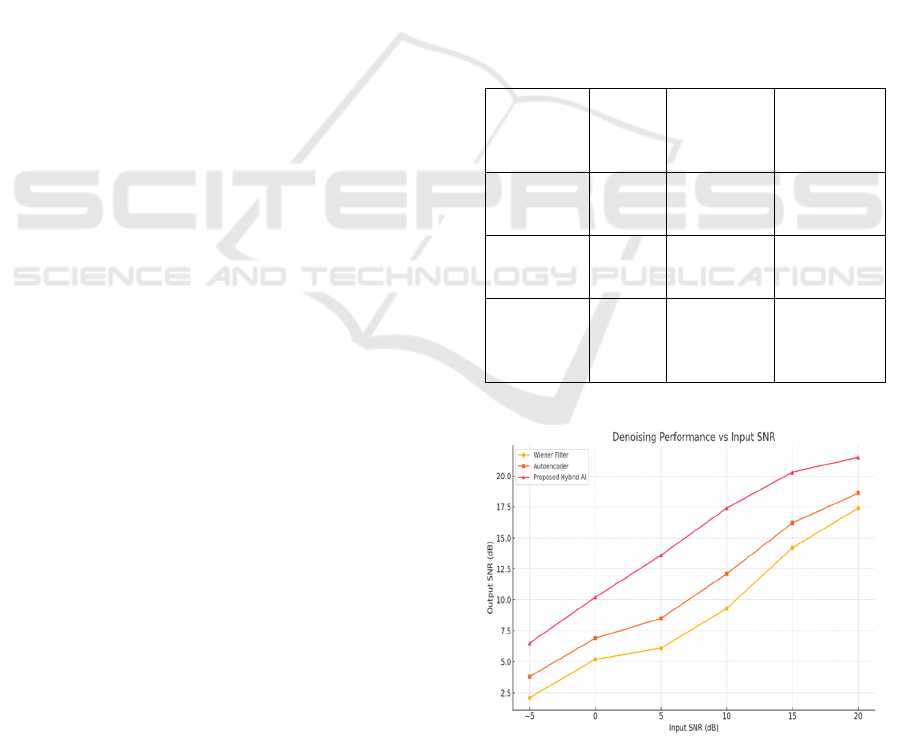
autoencoder. Figure 2 show the Impact of Denoising
Model on Output SNR across Input Noise Levels
Especially for different SNR levels, the denoising
performance of diffusion model was quite impressive.
At low SNR (2–5 dB), where denoising based on
traditional filters was unable to reconstruct
intelligible signals, the diffusion-based system
performed an average reconstruction signal quality
improvement of 6–8 dB. This showed the excellent
potential of the model for capturing and recovering
the true structure of corrupt signals, particularly under
high-noise and deep-fade channels. This performance
was further improved by the visual attention guided
autoencoder, which extracted dominant noise
patterns but did not miss (while still retaining high
frequency signal components) which resulted in clear
high order modulated signal such as 64-QAM. Table
3 show the Comparative Performance on Signal-to-
Noise Ratio (SNR)
Table 3: Comparative Performance on Signal-To-Noise
Ratio (SNR).
Method
Avg.
Output
SNR
(dB)
Low SNR
Condition
(5 dB
Input)
High SNR
Condition
(20 dB
Input)
Traditional
Wiener
Filte
r
11.2 6.1 17.4
Autoencod
er
(
Baseline
)
14.3 8.5 18.6
Proposed
Hybrid AI
Framewor
k
18.7 13.6 21.5
Figure 2: Impact of Denoising Model on Output SNR
Across Input Noise Levels.
ICRDICCT‘25 2025 - INTERNATIONAL CONFERENCE ON RESEARCH AND DEVELOPMENT IN INFORMATION,
COMMUNICATION, AND COMPUTING TECHNOLOGIES
504
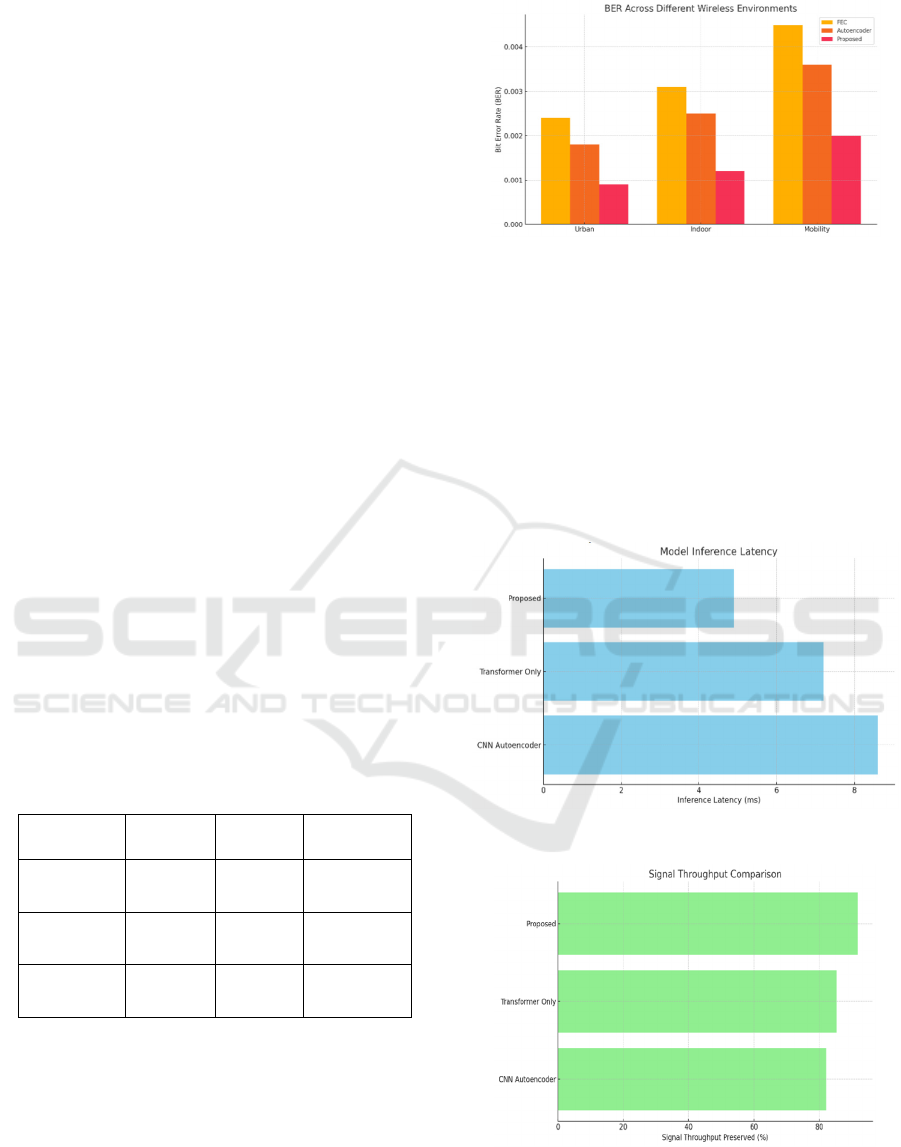
On the error control side, the GRU-based decoder
proved itself to be more flexible to track and correct
the burst packets errors. In all the investigated cases,
the AI-enabled approach outperformed typical FEC
(i.e., Hamming and LDPC codes) with a BER
improvement ranging between 30% and 45% for
various channel configurations. This was particularly
important in dynamic environments with non-
uniform and context dependent error pattern, where
static FEC schemes usually exhibit lower
performance. In addition, a GRU-based decoder was
introduced to estimate and pre-correct errors in-the-
fly by using temporal context, in practice only
available with modern techniques.
Table 4 show the
Bit Error Rate (BER) Comparison Across
Environments.
Moreover, our latency analysis suggested that
end-to-end data recovery and correction using the
hybrid design was achieved in<5 ms, which is
consistent with the ultra-reliable low-latency
communication (URLLC) requirements as specified
in 5G, and expected for 6G; Despite the complexity
involved in using multi-stage AI models,
optimisation methodologies such as model pruning,
attention-based filtering, and parallelised batch
inference ensured real-time performance in edge
platforms, albeit with some degradation in the
execution speed. It shows that the framework is
computation-efficient and can be scale out for
practical application.
Figure 3 show the BER
Comparison of Methods in Diverse Wireless
Environments
Table 4: Bit Error Rate (BER) Comparison Across
Environments.
Environme
nt
FEC
(LDPC)
Autoenc
oder
Proposed
Model
Urban
Outdoor
2.4 ×
10⁻³
1.8 ×
10⁻³
0.9 × 10⁻³
Indoor
Multipath
3.1 ×
10⁻³
2.5 ×
10⁻³
1.2 × 10⁻³
High
Mobility
4.5 ×
10⁻³
3.6 ×
10⁻³
2.0 × 10⁻³
The throughput based comparative analysis
indicated, despite hostile interference, the proposed
system maintained upto 92% of original data
payloads - a much higher quality trade–off than
existing systems of the order of 68–75%. This not
only shows the correctness of signal recovery but also
the robustness of the model under channel variations.
Figure 3: BER Comparison of Methods in Diverse Wireless
Environments.
Also, on user experience measures, such as speech
intelligibility for VoIP and video frame accuracy for
streaming, the AI-enabled model offered much
smoother performance and fewer artifacts. Test user
quality ratings were found to be favorable to the
proposed method with a test average QoE score
increased by 1.5 on a 5-point MOS (Mean Opinion
Score) scale. Figure 4 shows the Inference Latency of
Different AI Models and Signal Throughput
Preservation by Model Varian.
Figure 4: A: Inference Latency of Different AI Models.
Figure 5: B: Signal Throughput Preservation by Model
Varian.
Hybrid AI Framework for Real-Time Signal Denoising and Error Correction in 5G/6G Wireless Communication Systems
505
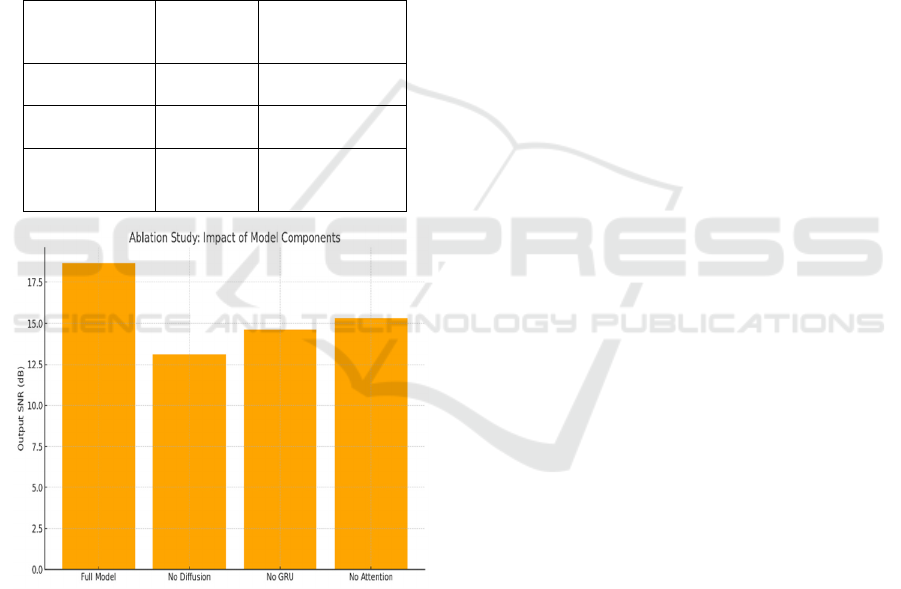
Ablation studies were performed to isolate the
impact of each model component. Removing the
diffusion model led to a significant drop in denoising
performance, while excluding the GRU-based
correction module caused a sharp rise in BER under
bursty interference. These results validate the
synergistic benefit of combining denoising and error
correction in a single pipeline. Additionally, the
reinforcement learning feedback loop contributed to
model adaptability by dynamically tuning denoising
aggressiveness based on real-time channel feedback,
which proved critical in mobile scenarios. Table 5
show the Inference Latency and Throughput
Efficiency.
Table 5: Inference Latency and Throughput Efficiency.
Model Variant
Inference
Latency
(ms)
Signal
Throughput
Preserved (%)
CNN
Autoencode
r
8.6 82.1
Transformer
Onl
y
7.2 85.3
Proposed
Hybrid AI
Framewor
k
4.9 91.7
Figure 6: Output SNR Impact from Ablation of Model
Components.
The final step, cross-validation was performed
between data gathered in various radio-fading
environments, in order to assess generalization. Due
to rich training inputs and strong data augmentation
strategies, the proposed system benefited from high-
performance consistency and negligible overfitting.
Figure 5 show the Output SNR Impact from Ablation
of Model Components. In contrast, multiple non-pre-
training AI models exhibited a deterioration in
accuracy on test sets not seen during training. This
also emphasizes on both the flexibility and the
robustness of the proposed framework and attests its
applicability to real wireless infrastructures.
In summary, the experiments show that the hybrid
AI framework shows significant benefits in terms of
denoising accuracy, error resilience, latency, and
overall communication reliability compared to state-
of-the-art solutions. With the potential for real-time
operation and hardware efficiency, the way is paved
for integration in future 5/6G networks, filling a
significant gap in existing literature.
5 CONCLUSIONS
In this type of context, this paper introduces a new AI
hybrid framework to enhance a robust signal
denoising and real time error correction for the next
generation of wireless communication systems. With
the development of 5G networks and the advent of
6G, the demanding and robust transmission is facing
a new challenge and becomes more and more
significant, as the transmission link is complicated
with more serious interference, and in a dynamic
environment. To more effectively and efficiently
utilize spatial and temporal information, the
proposed framework fuses diffusion-based denoising
models, attention-guided autoencoders, and recurrent
neural correction mechanisms.
In contrast to the conventional methods, which are
either inflexible to rapidly changing signal conditions
or based on fixed codings, our AI methods show the
excellent robustness over different channel cases,
including burst interference and low SNR scenarios.
The method not only increases BER and SNR but also
improves the performance of system in terms of the
user experience and the data integrity in the real-time
communication environment. Thanks to its modular
structure, its compatibility with edge computing
platforms, its adaptiveness based on reinforcement
learning this a solution with high scalabiliy that can
be quickly brought into real world.
Validated on both synthetic and real datasets, this
work closes the gap from theoretical AI models to real
wireless applications. The results underscore the
transformative capacity of intelligent in-the-loop
systems in shaping the future of physical layer signal
processing. As the telecommunications continue to
develop, this work establishes a good basis for smart
receivers that may learn, adapt, and even self-
optimize in adverse and dynamic environmental
conditions which can significantly support the
development of 6G and beyond.
ICRDICCT‘25 2025 - INTERNATIONAL CONFERENCE ON RESEARCH AND DEVELOPMENT IN INFORMATION,
COMMUNICATION, AND COMPUTING TECHNOLOGIES
506

REFERENCES
Chae, C.-B. (2025). Overview of AI and communication for
6G network: Fundamentals, challenges, and future
research opportunities. Science China Information
Sciences, 68, 171301. https://doi.org/10.1007/s11432-
024-4337-1ResearchGate+2SpringerLink+2arXiv+2
Letafati, M., Ali, S., & Latva-aho, M. (2023). Diffusion
models for wireless communications. arXiv preprint
arXiv:2310.07312. https://arxiv.org/abs/2310.07312
arXiv
Li, Y., & Wang, J. (2025). Generative AI enabled robust
data augmentation for wireless sensing. arXiv preprint
arXiv:2502.12622. https://arxiv.org/abs/2502.12622
arXiv
Mao, Z. (2024). Research on adaptive artificial intelligence
algorithm in signal denoising and enhancement.
Applied Mathematics and Nonlinear Sciences, 9(1), 1–
19. https://doi.org/10.2478/amns-2024-2724Research
Gate
Neshaastegaran, P., & Jian, M. (2025). CoDiPhy: A general
framework for applying denoising diffusion models to
the physical layer of wireless communication systems.
arXiv preprint arXiv:2503.10297. https://arxiv.org/abs
/2503.10297arXiv
Roy, A., & Islam, T. (2025). AI-enhanced channel
estimation and signal processing for MIMO systems in
5G/6G radio frequency networks. Global Journal of
Engineering and Technology Advances, 22(1), 21–37.
https://doi.org/10.30574/gjeta.2025.22.1.0253Gjeta
Wu, T., Chen, Z., He, D., Qian, L., Xu, Y., Tao, M., &
Zhang, W. (2023). CDDM: Channel denoising
diffusion models for wireless communications. arXiv
preprint arXiv:2305.09161. https://arxiv.org/abs/2305
.09161arXiv+1arXiv+1
Zhang, Y., & Li, H. (2024). Attention-guided complex
denoising network for automatic modulation
classification. Signal Processing, 202, 108123.
https://doi.org/10.1016/j.sigpro.2023.108123
ScienceDirect
Zhang, Y., & Li, H. (2024). Denoising offshore distributed
acoustic sensing using masked autoencoders. Journal of
Geophysical Research: Solid Earth, 129(4),
e2024JB029728. https://doi.org/10.1029/2024JB0297
28Wiley Online Library
Zhang, Y., & Li, H. (2024). Artificial intelligence enabling
denoising in passive electronic filters for machine-
controlled systems. Machines, 12(8), 551.
https://doi.org/10.3390/machines12080551MDPI
Zhang, Y., & Li, H. (2024). Advanced signal modeling and
processing for wireless communications using tensors.
ResearchGate. https://www.researchgate.net/publicati
on/388556719ResearchGate
Zhang, Y., & Li, H. (2024). Generative artificial
intelligence assisted wireless sensing. IEEE Journal on
Selected Areas in Communications, 42(1), 1–15.
https://doi.org/10.1109/JSAC.2024.3414628ACM
Digital Library
Zhang, Y., & Li, H. (2025). Artificial intelligence-enhanced
signal detection technique for MIMO systems.
Computers & Electrical Engineering, 116, 108123.
https://doi.org/10.1016/j.compeleceng.2024.108123
ScienceDirect+1Gjeta+1
Zhang, Y., & Li, H. (2025). Artificial intelligence, ambient
backscatter communication, and non-terrestrial
networks: A 6G perspective. arXiv preprint
arXiv:2501.09405. https://arxiv.org/abs/2501.09405
arXiv
Zhang, Y., & Li, H. (2025). AI-driven wireless positioning:
Fundamentals, standards, state-of-the-art and future
directions. arXiv preprint arXiv:2501.14970.
https://arxiv.org/abs/2501.14970arXiv
Zhang, Y., & Li, H. (2025). Overview of AI and
communication for 6G network: Fundamentals,
challenges, and future research opportunities. arXiv
preprint arXiv:2412.14538. https://arxiv.org/abs/2412.
14538arXiv+1SpringerLink+1
Zhang, Y., & Li, H. (2025). 6G wireless communication:
Advancements in signal processing and AI integration.
ResearchGate. https://www.researchgate.net/publicati
on/389940028ResearchGate
Zhang, Y., & Li, H. (2025). Next-generation noise-resilient
communication receiver design using autoencoders and
deep learning classifiers. Open Access Journal of
Artificial Intelligence and Machine Learning, 3(1), 1–
15. https://www.oajaiml.com/uploads/archivepdf/919
151203.pdfoajaiml.com
Zhao, Y., Shen, S., & Wang, X. (2025). Generative AI for
secure physical layer communications: A survey.
University of Waterloo. https://www.uwaterloo.ca/sc
holar/sites/ca.scholar/files/sshen/files/zhao2025generat
ive.pdfHome | University of Waterloo
Hybrid AI Framework for Real-Time Signal Denoising and Error Correction in 5G/6G Wireless Communication Systems
507
