
A Novel Methodology to Detect Epileptic Seizure Based on EEG
Signals Using Deep Learning Assisted Classification Principle
S. G. Balakrishnan, Kishore Kumar A., Naveenprasanth S.,
Mouleshwaran G. R. and Naidu Raj Kumar
Department of Computer Science and Engineering, Mahendra Engineering College, Tamil Nadu, India
Keywords: Epileptic Seizure, Disease Detection, Electroencephalogram, EEG Signal, Deep Learning, CNN,
Classification, Neural Classifier, NCOL, Convolutional Neural Network.
Abstract: Analyzing the signals generated by neurons in the brain can reveal the presence of epilepsy, a severe and
persistent neurological condition. A web of interconnected connections allows neurons to send and receive
messages, as well as communicate with other parts of the body. The monitoring of these brain impulses is
commonly done using electrocorticography (ECoG) and electroencephalography (EEG) equipment. These
complex, noisy, non-linear, and non-stationary signals produce a mountain of data. As a result, detecting
seizures and learning about brain-related topics is a challenging endeavor. Using Deep Learning classifiers,
EEG data can be efficiently categorized, seizures can be identified, and relevant sensible patterns may be
shown. As a result, several approaches to seizure detection have emerged, all utilizing Deep Learning
classifiers and statistical data. The biggest challenge is choosing the right classifiers and attributes. The goal
of this study is to present a comprehensive experimental review of the many different techniques that have
arisen in the field of Deep Learning classifiers and statistical features in the past several years. In this paper,
a new algorithm called Neural Classifier with Optimized Learning (NCOL) is presented. It can handle all the
scenarios listed above and gives clear results. To test how well the algorithm works, it is cross-validated with
the traditional Convolutional Neural Network (CNN) model. Seizure detection and categorization, as well as
future research directions, may be better understood with the help of the offered state-of-the-art methodologies
and concepts.
1 INTRODUCTION
The ancient Greek and Latin words "epilepsia"
meaning "seizure" or "to seize upon" are the
etymological roots of the modern English word
epilepsy. This neurological condition is quite
dangerous and has distinct symptoms, the most
prominent of which are repeated seizures. The
Babylonians recorded a medical literature including
contextual knowledge (Zakareya Lasefr, et al., 2023)
about epilepsy almost 3,000 years ago. Apart from
other animals, like dogs, cats, rodents, etc., the
disease can afflict people as well. The disorder is
widespread and prevalent; hence the name "epilepsy"
has nothing to suggest about the origin or degree of
seizures (Wei Zeng, et al., 2023). A number of
hypotheses concerning the origin have been put forth.
Malformations, low blood sugar, and an absence of
oxygen after delivery are among the causes of
electrical activity disruption inside the brain, which is
the primary symptom. Roughly 50 million
individuals throughout the world deal with epilepsy,
and 100 million will experience (Mingkan Shen, et
al., 2024) it at some point in their lives. The stated
prevalence rate is between half a percent and one
percent, and it is responsible for one percent of the
global illness burden. Having more than one seizure
every day is the most prominent sign of epilepsy. An
abrupt disruption or abnormal brain activity (Khati, et
al., 2020) triggers an involuntary change in the
patient's behavior, feeling, and temporary loss of
consciousness. Usually lasting anywhere from few
seconds to many minutes, a seizure will not always be
accompanied by an aura. From this can come
fractures, burns, even death (Afshin Shoeibi, et al.,
2021). Based on the symptoms they cause,
neurologists divide seizures into two main categories:
partial and generalized. Sometimes referred to as a
focal seizure, a partial seizure affects only one side of
the brain. One knows both simple- and complex-
Balakrishnan, S. G., A., K. K., S., N., R., M. G. and Kumar, N. R.
A Novel Methodology to Detect Epileptic Seizure Based on EEG Signals Using Deep Learning Assisted Classification Principle.
DOI: 10.5220/0013868000004919
Paper published under CC license (CC BY-NC-ND 4.0)
In Proceedings of the 1st International Conference on Research and Development in Information, Communication, and Computing Technologies (ICRDICCT‘25 2025) - Volume 1, pages
485-492
ISBN: 978-989-758-777-1
Proceedings Copyright © 2025 by SCITEPRESS – Science and Technology Publications, Lda.
485

partial seizures. A patient in the simple-partial stage
is unable to express themselves enough yet does not
pass out. The complex-partial is characterized by a
"focal impaired awareness seizure," in which the
affected individual becomes disoriented and exhibits
aberrant behavior such as muttering and chewing.
However, with generalized seizures, the entire brain
is impacted and entire networks of neurons are
damaged rapidly. Convulsive and non-convulsive
generalized seizures are the two main classifications
of these numerous forms of seizures (Pankaj
Kunekar, et al., 2024).
Epilepsy affects almost 50 million people
globally, making it one of the most prevalent
neurological ailments, according to the World Health
Organization. Unpredictable and abrupt seizure
activities characterize epilepsy. The quality of life for
people affected with epilepsy is greatly diminished.
It is characterized by a lifetime of recurring events.
Various reasons, including genetic predisposition,
malignancies, skull fractures, and other medical
conditions, can lead to epileptic seizures (Anis
Malekzadeh, et al., 2021). An epileptic seizure is
defined as an abrupt and transient disruption of
regular brain function, marked by an excess of
aberrant electrical activity. Symptoms of this
electrical activity can range from mild aches and
pains to full-blown seizures and coma, and in rare
cases, unanticipated death (Wesley T Kerr, et al.,
2024). The precise diagnosis of epilepsy and the
development of individualized treatment plans
depend on the reliable detection of seizures in
individuals with the disorder. Early identification and
regular monitoring of seizures can offer a better
quality of life and decrease life risks (Afshin Shoeibi,
et al., 2021). Examining individuals with a history of
seizures allows for the precise diagnosis of seizure
type through the analysis of electroencephalogram
data, which capture electrical activity in the brain.
Intense patterns linked with seizures can be captured
by the dynamic depiction of brain activity provided
by epileptic EEG recordings. Electrodes placed on
the scalp capture electrical activity in the brain.
Electrodes like this pick up on the brain's natural
electrical signals.
Unprocessed EEG data sometimes includes
background noise and other details (Deepa B, et al.,
2022). In order to clean and improve the signals,
preprocessing processes are used, including filtering,
artifact removal, and baseline correction.
Classification of electroencephalogram (EEG)
signals is an important step in detecting epileptic
seizures when preprocessing is complete. The raw
signal lacks discriminative information compared to
data obtained by extracting pertinent features from
signals. Among the many medical uses for machine
learning and deep learning is the extraction and
classification of significant characteristics, which has
tremendous promise for use in epilepsy diagnosis and
other areas. The duration, intensity, and appearance
of epileptic seizures can range greatly. Regular brain
activity is the product of complex neuronal
connection via electrical impulses. Seizures occur
when neurons in the brain fire inappropriately or too
rapidly in those who suffer from epilepsy. Based on
their features and the areas of the brain where they
start, seizures may be categorized into many
categories.
2 RELATED WORKS
For one-fourth of patients with medication-resistant
seizures, ongoing maintenance of seizure detection
and management is essential to control unplanned
episodes (Taeho Kim, et al., 2020). The diagnosis of
seizures can benefit from electroencephalogram
(EEG), electromyography (EMG), electrocardiogram
(ECG), motion detection, oxygen saturation levels,
artificial sounds, or visual indications acquired on
audio or video recordings of the human head and
body. Recent developments in classification
algorithms, time-or frequency-domain analysis, and
seizure sensor signal processing allow the detection
and grouping of seizure phases. We then present a
promising future for contemporary, non-invasive
brain stimulation technology in seizure treatment.
This work reviews the principles of brain stimulation
techniques for treating seizures with an eye toward
transcranial magnetic stimulation (TMS), transcranial
direct current stimulation (tDCS), and transcranial
focused ultrasonic stimulation (tFUS). Our goal in
writing this review was to provide readers a bird's-eye
perspective of the current diagnostic and therapy
landscape for seizures. Both new and seasoned
researchers would benefit from this information as it
would allow them to better track developments in
seizure sensing, detection, categorization, and
therapy. Finally, we suggest future areas of study that
seizure researchers and engineers might be interested
in.
Common tool for seizure identification is an
electroencephalogram (EEG), which records brain's
electrical activity (G. Yogarajan, et al., 2023). The
symmetry or asymmetry of the EEG signals guides
one to detect epileptic events. Typically, the patterns
of an electroencephalogram (EEG) on one side of the
brain are identical to those on the other. On the other
ICRDICCT‘25 2025 - INTERNATIONAL CONFERENCE ON RESEARCH AND DEVELOPMENT IN INFORMATION,
COMMUNICATION, AND COMPUTING TECHNOLOGIES
486

hand, an asymmetrical EEG signal could be caused by
a rapid spike in electrical activity in one cerebral
hemisphere during a seizure. The existence of
epileptic activity can be revealed by seeing
asymmetric spikes or sharp waves in interictal EEG
recordings from individuals with epilepsy. As a result,
seeing asymmetry or symmetry in EEG data can help
with epilepsy diagnosis and treatment. Remember
that interpretation of EEG data should always consider
the medical background and findings from other
diagnostic tests of a patient. We introduce in this
study a Deep neural network (DNN) and Binary
dragonfly algorithm (BDFA)-based enhanced
automated seizure detection system using
electroencephalogram (EEG) data. The DNN model
learns the characteristics of the EEG signals by using
nine different statistical and Hjorth parameters
obtained from various levels of decomposed data
gathered by the Stationary Wavelet Transform. The
next step was to use the BDFA to minimize the
extracted features; this would allow the DNN to be
trained more quickly and with better performance.
With a sensitivity, specificity, and F1 score of 100%
in comparison to previous methods, our results
suggest that using a subset of characteristics chosen
with a 13% success rate helps in correctly
differentiating between normal, interictal, and ictal
signals.
Automated seizure detection (Paul Vanabelle, et
al., 2020) is addressed by using machine learning
algorithms applied to clinical electroencephalograms
(EEGs) kept in the TUSZ database Temple University
Hospital. Results on this complex dataset have
therefore so far fallen short of expectations. This
experiment aims to discover how much additional data
will help to improve the outcomes. We demonstrate
that the extracted features aid in accurate
discrimination between normal, interictal, and ictal
signals using a subset of features picked with a success
rate of 13%. Our results outperform prior
methodologies with sensitivity, specificity, and F1
score of 100%. The achieved results are comparable
to those of deep learning models previously reported
in the literature. By sorting performances according
to seizure kinds and determining which attributes are
most important, we are able to provide context for our
findings. Compared to focal seizures, our data shows
that generalized seizures are typically far easier to
forecast. When trying to differentiate between seizure
and background activity in EEG, we find that certain
channels and characteristics are more significant than
others.
Electroencephalography (Rekha Sahu, et al.,
2020) is one method to detect illnesses connected to
the electrical activity of the brain seizure conditions.
In order to diagnose patients accurately and provide
them the right medication, it is necessary to discover
patterns of brain activity and how they relate to
symptoms and illnesses. In order to better understand
and anticipate epileptic seizures, this study seeks to
classify electroencephalography data recorded on
several channels. The dataset includes 179 pieces of
information and 11,500 occurrences derived from
electroencephalography recordings. The signs of an
epileptic seizure are one of five types of instances. We
have demonstrated the efficacy of deep machine
learning approaches, classical methods, and ensemble
methods in detecting epileptic seizures. It makes use
of a one-dimensional convolutional neural network in
conjunction with ensemble ML methods such as
stacking, boosting (including AdaBoost, gradient
boosting, and XG boosting), and bagging. Decision
trees, random forests, additional trees, ridge
classifiers, logistic regression, K-Nearest Neighbors,
Naive Bayes (gaussian), and Kernel Support Vector
Machine (polynomial, gaussian) are some of the
traditional machine learning techniques used for
epileptic seizure classification and prediction. We
preprocessed the dataset by removing superfluous
characteristics using the Karl Pearson correlation
coefficient before using ensemble and conventional
methods. Each classifier's Receiver Operating
Characteristic Area under the Curve is used to alter the
classifiers' classification and prediction accuracy
using k-fold cross-validation procedures. Our method
sorting and comparing findings demonstrate that the
convolutional neural network and extra tree bagging
classifiers perform the best among other ensemble and
conventional classifiers.
An attribute of the medical condition known as
epilepsy, an erratic, too fast firing of neurons in the
brain influences the normal electrical activity of the
brain (Ferdaus Anam Jibon, et al., 2023). Using
electroencephalograms (EEGs), which track electrical
activity generated by nerve cells in the cerebral cortex,
has become somewhat more common in the diagnosis
and treatment of epilepsy during the past few years.
Physiological data often has irregular topologies,
making it impossible to think about it as a matrix, even
though this would be beneficial. This contrasts with
present deep learning-based automated seizure
detection systems using raw EEG signals, which
mostly depend on grid-like data. Graph neural
networks have drawn a lot of attention as a way to
leverage the implicit information available for seizure
detection. Edges link interacting nodes in these
networks; anatomical connections or temporal
correlations allow one to ascertain the weights of the
A Novel Methodology to Detect Epileptic Seizure Based on EEG Signals Using Deep Learning Assisted Classification Principle
487
edges. To get over this drawback, we provide a new
hybrid design that uses DenseNet in conjunction with
an LGCN to identify epileptic episodes.
Improvements in feature propagation across all layers
and a solution to the vanishing gradient problem allow
DenseNet to outperform earlier deep learning
networks in terms of computational accuracy and
memory economy. The Stockwell transform (S-
transform) is used for the first preprocessing of the raw
EEG data. The resulting matrix is subsequently
inputted into the LGCN for feature selection by
grouping it into time-frequency blocks. Next,
Densenet is used for categorization. The proposed
hybrid system outperformed the state-of-the-art in
seizure detection tasks, achieving 98.60% specificity
and 98% accuracy, according to extensive testing
conducted on the publicly accessible CHB-MIT EEG
dataset.
3 METHODOLOGIES
Deep learning is being used to improve results on
health and biological data sets. Improving seizure
detection is a top priority for researchers and
scientists across disciplines, with a focus on data
mining and deep learning. Finding reasonable and
significant patterns in various domain datasets has
been a major use of deep learning. Numerous fields,
including healthcare, rely on it, and it has the ability
to solve their difficulties. Seizure detection, epilepsy
lateralization, discriminating seizure states, and
localization are some of the other uses of deep
learning on brain datasets. Several learning
classifiers, including ANN, SVM, decision forest,
decision trees, and random forests, have
accomplished this. Previous studies on seizure
detection, applied features, classifiers, and claimed
accuracy have definitely mostly overlooked the
challenges faced by data scientists investigating
datasets related to neurological diseases. This work
investigates comprehensively Epileptic seizure
detection and related knowledge discovery issues as
deep learning applications. The examined papers
come from notable journals in related disciplines and
also considered other highly acclaimed conference
papers. The literature has addressed in great detail
the thorough investigation of several features and
classifiers applied in EEG datasets for seizure
identification. The processes of feature extraction
and applying classification methods are both difficult.
The use of deep learning classifiers to meaningfully
extract patterns from electroencephalogram (EEG)
data has recently seen a surge in research, leading to
remarkable advancements in our understanding of
seizure identification, brain region of origin, and
related topics. Jean Gotman, 30 years ago, examined
EEG data, used several computational and statistical
methods for automatic seizure identification, and
developed a model for their practical use. In addition,
many data science and signal processing
methodologies have been used in the research to
improve the results. The suggested technique, Neural
Classifier with Optimized Learning (NCOL),
outperforms the current method, Convolutional
Neural Network (CNN), in classifying epileptic
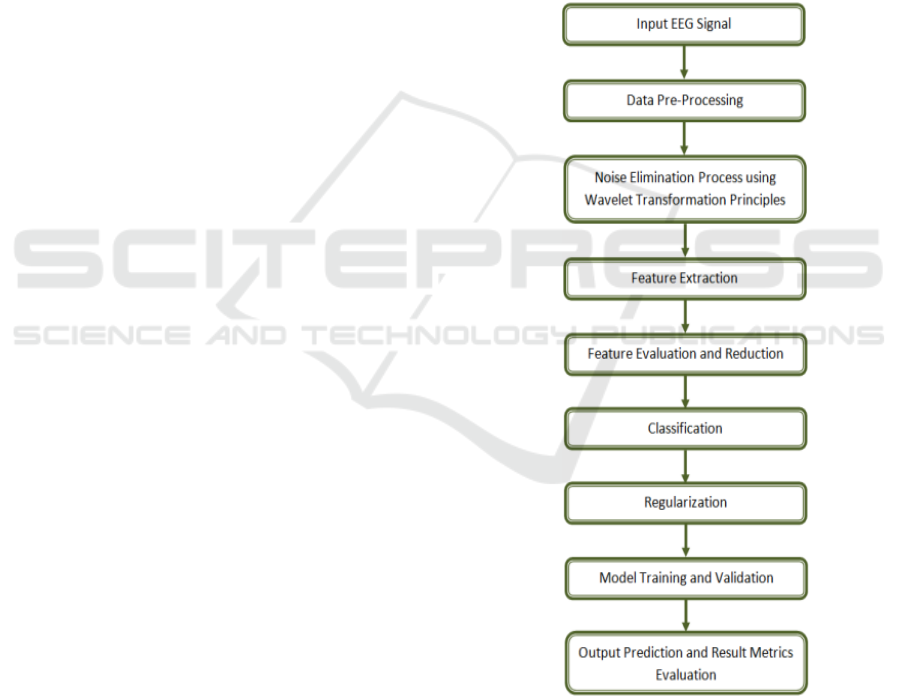
episodes. The following figure 1 shows the system
flow diagram and the following figure 2 shows the
system architecture.
Figure 1: System flow diagram.
ICRDICCT‘25 2025 - INTERNATIONAL CONFERENCE ON RESEARCH AND DEVELOPMENT IN INFORMATION,
COMMUNICATION, AND COMPUTING TECHNOLOGIES
488
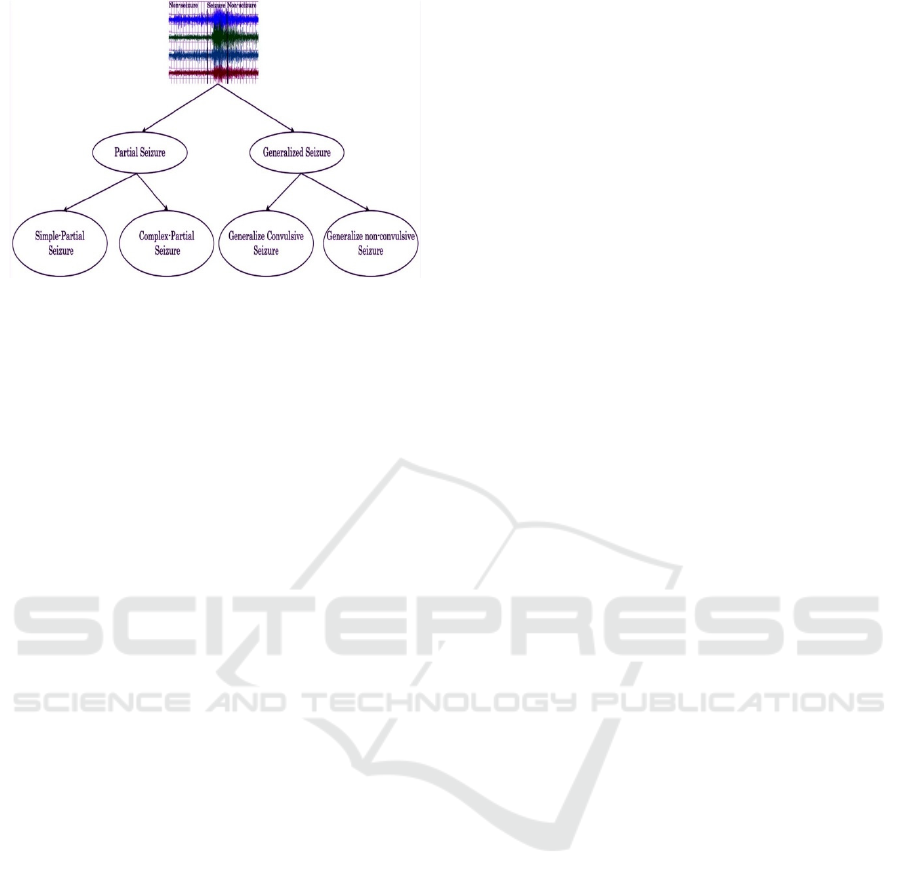
Figure 2: System architecture.
(i) Data Collection: Gathering the dataset of brain
signals is the first step. Various monitoring tools are
utilized for this purpose. Since the electrodes or
channels of EEG and ECoG are often glued to the
scalp in accordance with the 10-20 International
system at various lobes, these devices are usually the
most commonly employed. They are all connected to
the EEG equipment and give real-time information on
voltage fluctuations and other spatial and temporal
characteristics. Electrodes are worn by the patient to
record electrical impulses from their brainwaves. The
raw data from the EEG monitoring equipment is then
shown on a screen. The analyst has also
painstakingly recorded these unprocessed signals and
classified them as "seizure" or "non-seizure."
(ii) Data Transformation: An important first step
after data collecting is turning the signal data to a two-
dimensional table form. The goal is to facilitate
analysis and supply essential information, such as
seizure detection, in this way. Due to the lack of
processing, this data is considered raw. Giving
relevant information will thus be improper. Different
approaches of feature selection have been applied for
processing. This procedure also gives possible class-
values for the class attribute, therefore guiding the
dataset.
(iii) Dataset Preparation: Data processing, a
necessary first step in data transformation, is
extracting pertinent information from the gathered
raw dataset. Several feature extraction methods were
therefore applied. Usually, these techniques are
implemented on the dataset of extracted EEG signals.
Several statistical measure values are abundant in the
raw dataset. After feature extraction, the dataset
gains additional useful information, which helps the
classifier gain a better grasp of the problem. In order
to achieve a high rate of accurate seizure
identification, various supervised and unsupervised
deep learning techniques have been used to explore
relevant information from the EEG processed dataset.
(iv) Classification: There are "class attribute" and
"non-class attributes" in dataset D, which are used for
classification. Since both of them have a high
correlation for possible categorization, they are the
main components and their relevant information is
quite crucial. Defining the target characteristic as the
"class attribute," C, it consists of more than one class
value—that of seizure and non-seizure among others.
Conversely, features are sometimes referred to as
"non-class attributes," or predictors. Popularly used
classifiers in seizure detection include the ones listed
below. In order to identify seizures, the processed
EEG data is run through popular classifiers including
support vector machines, decision trees, and decision
forests.
(v) Performance Evaluation: Various approaches
are assessed using the precision of the acquired
results. With tenfold cross-valuation, the most
popular training approach, the remaining nine
segments serve as the training dataset while each fold,
or one horizontal segment, is considered the testing
dataset. Apart from their accuracy, classifier
performance is usually assessed using measures like
precision, recall, and f-measure.
4 RESULTS AND DISCUSSION
Recent research has shown that deep learning models
can effectively detect epileptic seizures automatically
from EEG data, doing away with the necessity for
human feature extraction. By comparing it to the
conventional deep learning model known as a
Convolutional Neural Network (CNN), the suggested
Neural Classifier with Optimized Learning (NCOL)
model is able to determine how well it performs in
identifying epileptic seizures based on the features
that have been assessed and the training scenarios that
have been set up. This technique improved the
efficiency and performance of model training by
decomposing EEG signals using the noise elimination
strategy to extract statistical and Hjorth parameters,
and then by applying the suggested NCOL to
minimize feature dimensionality. Frameworks based
on NCOL that can handle raw EEG data
automatically, without the need for human feature
extraction, have also been the subject of research. In
order to identify seizures accurately and in a timely
manner, these models can differentiate between three
A Novel Methodology to Detect Epileptic Seizure Based on EEG Signals Using Deep Learning Assisted Classification Principle
489
states: seizure, preictal, and interictal. Research has
looked into ways to make deep learning models more
transparent, such as analyzing the frequency patterns
learned by NCOL model layers and identifying EEG
waveforms that greatly impact seizure predictions,
both of which are important for clinical adoption of
the models. Building trust and easing the
incorporation of deep learning models into clinical
practice are the goals of these endeavors. The use of
deep learning algorithms to detect epileptic seizures
using EEG data has made great strides in the field.
Accurate and capable of automating feature
extraction; models such as CNN and NCOL have
shown themselves. Improving model interpretability
and creating hybrid systems to boost detection
performance are active areas of research. The
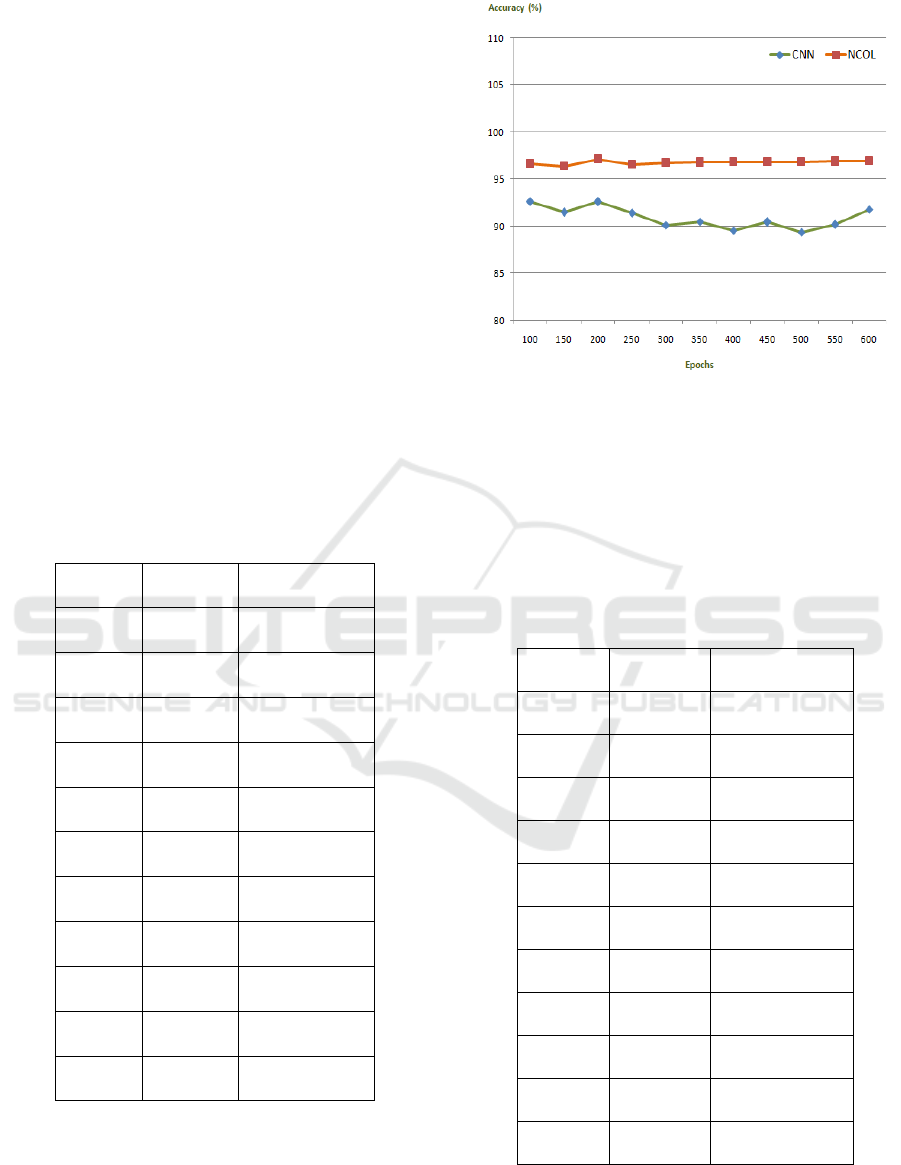
accuracy comparison between the NCOL and CNN
techniques is depicted in the accompanying image,
Figure 3, in order to evaluate the effectiveness of the
suggested scheme in a clear manner. As an additional
descriptive resource, the accompanying table (Table-
1) displays the identical data.
Table 1: Accuracy evaluation between CNN and NCOL.
Epochs CNN (%) NCOL (%)
100 92.65 96.67
150 91.47 96.39
200 92.58 97.09
250 91.36 96.56
300 90.12 96.73
350 90.47 96.78
400 89.56 96.80
450 90.45 96.83
500 89.34 96.86
550 90.16 96.89
600 91.77 96.92
Figure 3: Accuracy analysis.
The precision ratio comparison between the
proposed NCOL method and the existing CNN
technique is depicted in the accompanying image,
Figure 4. This comparison is intended to assess the
precision ratio of the proposed scheme in an accurate
manner, and Table-2 provides a descriptive
representation of the same.
Table 2: Precision comparison between CNN and NCOL.
Epochs CNN (%) NCOL (%)
100 91.45 98.59
150 90.67 98.64
200 89.38 97.73
250 90.46 97.48
300 89.52 97.61
350 91.77 97.46
400 89.66 97.39
450 89.75 98.49
500 90.24 98.52
550 91.46 97.47
600 90.17 98.69
ICRDICCT‘25 2025 - INTERNATIONAL CONFERENCE ON RESEARCH AND DEVELOPMENT IN INFORMATION,
COMMUNICATION, AND COMPUTING TECHNOLOGIES
490
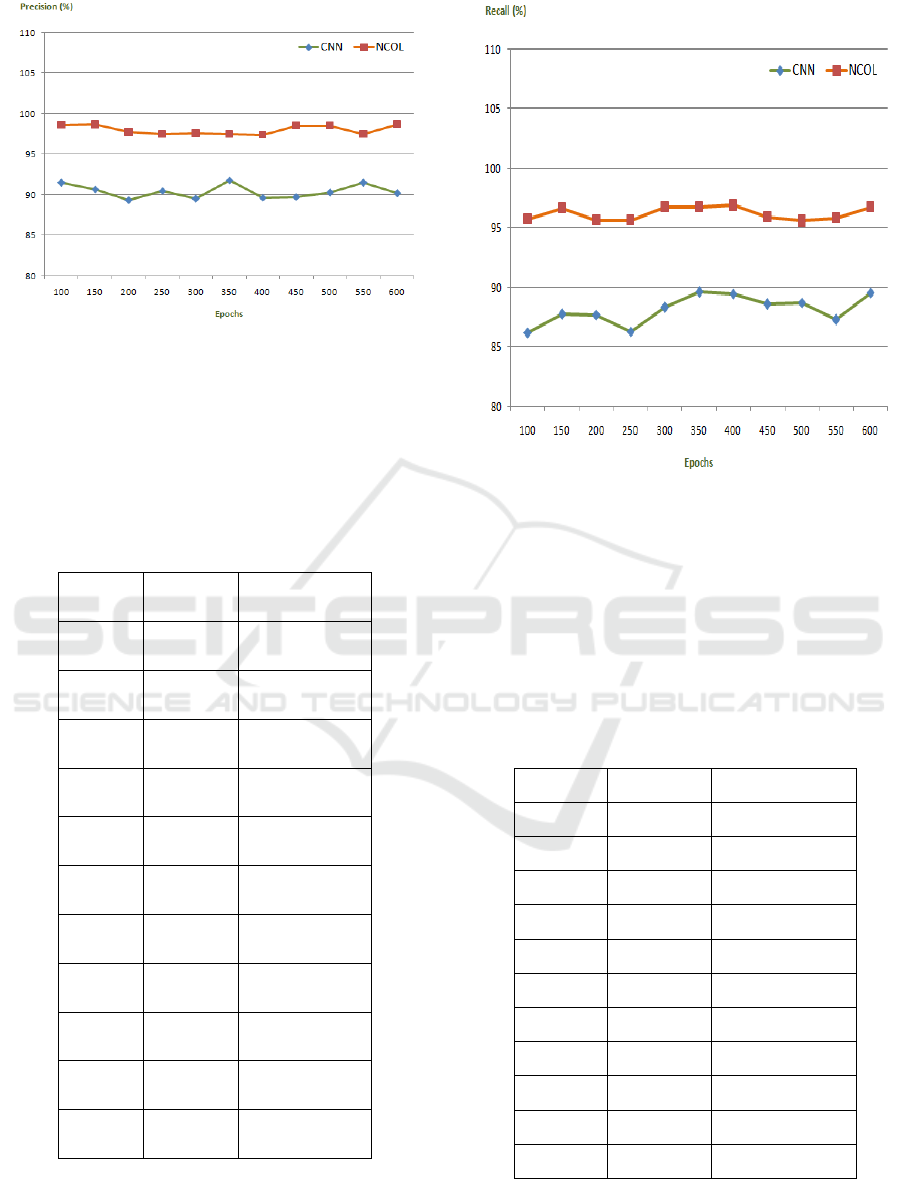
Figure 4: Precision analysis.
The recall ratio comparison between the proposed
NCOL technique and the existing CNN strategy is
depicted in the accompanying image, Figure 5. This
comparison is intended to assess the recall ratio of the
proposed scheme in an accurate manner, and Table-3
provides a descriptive representation of the same.
Table 3: Comparison of Recall Between Cnn and Ncol.
Epochs
CNN
(%)
NCOL (%)
100 86.17 95.71
150 87.73 96.63
200 87.66 95.59
250 86.27 95.64
300 88.29 96.76
350 89.59 96.73
400 89.47 96.87
450 88.58 95.88
500 88.69 95.57
550 87.27 95.82
600 89.54 96.77
Figure 5: Recall.
The F1-Score ratio comparison between the new
NCOL technique and the existing CNN strategy is
depicted in the accompanying figure 6. This
comparison is made in order to evaluate the F1-Score
of the suggested scheme in an accurate manner. The
same information is also provided in the following
table, Table-4, in a descriptive manner.
Table 4: Comparison of F1-score between CNN and
NCOL.
Epochs CNN (%) NCOL (%)
100 90.02 97.82
150 91.19 97.63
200 88.72 96.17
250 91.09 96.51
300 87.47 96.59
350 88.16 96.34
400 88.13 96.19
450 87.57 97.29
500 85.44 97.25
550 86.36 96.56
600 87.27 97.45
A Novel Methodology to Detect Epileptic Seizure Based on EEG Signals Using Deep Learning Assisted Classification Principle
491
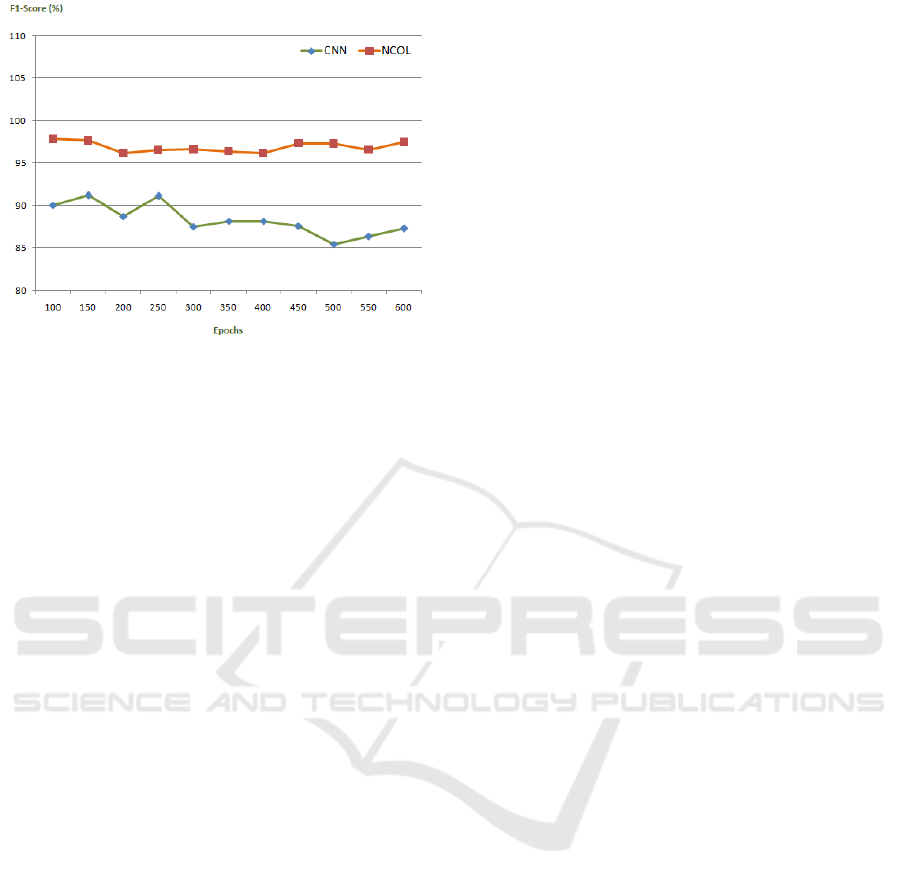
Figure 6: F1-score.
5 CONCLUSION AND FUTURE
SCOPE
In summary, this paper suggested a framework that is
based on deep learning model and is capable of
identifying Epileptic Seizure occurrences from EEG
records. The Neural Classifier with Optimized
Learning (NCOL) model, which was proposed,
effectively extracted perceptive features from raw
EEG signals using discrete wavelet transform
analysis. NCOL also assisted in the removal of noises
and artifacts that were present in the original signal.
The presence of these elements presents a significant
challenge during the succeeding phases of feature
extraction. The dimensionality of the data was
substantially reduced by 85% in the first run through
feature selection, which led to a remarkable
improvement in terms of performance and
computation cost. The classifiers were trained in
approximately 57% less time when only the pertinent
features were used. By combining information from
several physiological signals, such as
electroencephalography, electrocardiography and
others, a more complete picture of a patient's health
may be revealed. The specificity and sensitivity of
seizure detection can be enhanced by multimodal
techniques.
REFERENCES
Afshin Shoeibi, et al., "Epileptic Seizures Detection Using
Deep Learning Techniques: A Review", Int J Environ
Res Public Health, 2021.
Afshin Shoeibi, et al., "Epileptic Seizures Detection Using
Deep Learning Techniques: A Review", International
Journal of Environmental Research and Public Health,
2021.
Anis Malekzadeh, et al., "Epileptic Seizures Detection in
EEG Signals Using Fusion Handcrafted and Deep
Learning Features", Sensors, 2021.
Deepa B, et al., "Epileptic seizure detection using deep
learning through min max scaler normalization",
International Journal of Health Sciences, 2022.
Ferdaus Anam Jibon, et al., "Epileptic seizure detection
from electroencephalogram (EEG) signals using linear
graph convolutional network and DenseNet based
hybrid framework", Journal of Radiation Research and
Applied Sciences, 2023.
G. Yogarajan, et al., "EEG-based epileptic seizure detection
using binary dragonfly algorithm and deep neural
network", Scientific Reports, 2023.
Khati, et al., "Feature extraction for epileptic seizure
detection using machine learning", Current Medicine
Research and Practice, 2020.
Mingkan Shen, et al., "A real-time epilepsy seizure
detection approach based on EEG using short-time
Fourier transform and Google-Net convolutional neural
network", Heliyon, 2024.
Pankaj Kunekar, et al., "Detection of epileptic seizure in
EEG signals using machine learning and deep learning
techniques", Journal of Engineering and Applied
Science, 2024.
Paul Vanabelle, et al., "Epileptic seizure detection using
EEG signals and extreme gradient boosting", J Biomed
Res., 2020.
Rekha Sahu, et al., "Epileptic seizure detection: a
comparative study between deep and traditional
machine learning techniques", J. Integr. Neurosci.,
2020.
Taeho Kim, et al., "Epileptic Seizure Detection and
Experimental Treatment: A Review", Frontiers in
Neurology, 2020.
Wei Zeng, et al., "Epileptic seizure detection with deep
EEG features by convolutional neural network and
shallow classifiers", Frontiers in Neuroscience, 2023.
Wesley T Kerr, et al., "The present and future of seizure
detection, prediction, and forecasting with machine
learning, including the future impact on clinical trials",
Front Neurol., 2024.
Zakareya Lasefr, et al., "An Epileptic Seizure Detection
Technique Using EEG Signals with Mobile Application
Development", Appl. Sci., 2023.
ICRDICCT‘25 2025 - INTERNATIONAL CONFERENCE ON RESEARCH AND DEVELOPMENT IN INFORMATION,
COMMUNICATION, AND COMPUTING TECHNOLOGIES
492
