
Facial Recognition and Feature Mapping with Machine Learning
G. Prathibha Priyadarshini, G. Utejitha, D. Tejaswini, K. Swathi and A. Renuka
Department of CSE, Ravindra College of Engineering for Women, Kurnool, Andhra Pradesh, India
Keywords: Facial Recognition, Feature Mapping, Deep Learning, Convolutional Neural Networks, Biometric
Authentication.
Abstract: Facial recognition and machine learning-based feature mapping have become key security, authentication,
and human-computer interaction technologies. This research discusses the application of deep learning-based
facial recognition systems that map and analyze facial features to perform robust identification and
verification. The system utilizes convolutional neural networks (CNNs) to extract and classify features for
enhanced accuracy and the ability to counter light, pose, and occlusion variations. Feature mapping methods
like key point detection and embedding generation facilitate effective face matching and identification. The
approach improves security, reduces and embedding generation facilitate effective face matching and
identification. The approach improves security, reduces false positives, and offers a scalable solution for real-
time surveillance, biometric, and personalized user experience applications. Experimental results prove the
model's effectiveness in delivering high recognition accuracy with optimized computational efficiency.
1 INTRODUCTION
Facial recognition and feature mapping are now
central to contemporary security, authentication, and
human-computer interaction systems. Facial
recognition systems have greatly in terms of real-time
capability, robustness, and accuracy due to advances
in machine learning and deep learning. The older
techniques were based on handcrafted features and
statistical models, whereas new techniques utilize
convolutional neural networks (CNNs) and deep
learning methods for automatic feature extraction and
classification. Facial recognition is the detection,
analysis, and identification of a person's face by
extracting distinguishing facial features like positions
of eyes, nose, and mouth. Feature mapping refines
this by generating organized representations of facial
features to facilitate efficient identification in varying
lighting, poses, and occlusions.
This study aims at creating a facial recognition
system using machine learning that involves feature
mapping methods for higher accuracy and scalability.
The system employs deep learning models to learn
meaningful facial embeddings with high precision in
verifying identities. The proposed method has usage
in multiple applications such as surveillance,
biometric authentication, access control, and
personalized user interfaces.
The rest of the paper explains methodology, dataset,
model structure, performance measurement, and
possible uses of the system with its advantages and
disadvantages.
2 RESEARCH METHODOLOGY
2.1 Research Area
Personalized face feature mapping and facial
recognition systems completely rely on machine
learning, especially the most sophisticated deep
learning techniques, into heightening speed and
accuracy. The entire process is complete with data
collection, preprocessing, model selection, training,
testing, and deployment.
Data Collection.
• It collects all the dataset of face images from
an archive of public databases as well as
captures every single day.
• Robustness added over these images is
created with lights, poses, expressions and
occlusions.
478
Priyadarshini, G., Utejitha, G., Tejaswini, D., Swathi, K. and Renuka, A.
Facial Recognition and Feature Mapping with Machine Learning.
DOI: 10.5220/0013867900004919
Paper published under CC license (CC BY-NC-ND 4.0)
In Proceedings of the 1st International Conference on Research and Development in Information, Communication, and Computing Technologies (ICRDICCT‘25 2025) - Volume 1, pages
478-484
ISBN: 978-989-758-777-1
Proceedings Copyright © 2025 by SCITEPRESS – Science and Technology Publications, Lda.

Data Preprocessing.
• asl's methodology offers a solution for face
detection by two algorithms: MTCNNs
(multi-task cascaded deep convolutional
networks) and haar cascades.
• Histogram equalization and affine
transformations are used to align and
normalize the faces present into maximum
uniformity as in features.
• Model generalizes using some different
methods like n-data augmentation based on
rotation, flipping, or brightness adjustment.
Feature Extraction & Mapping.
• Face embedding extraction through
Convolutional Neural networks (i.e.,
VGGFace, FaceNet, or ResNet)
• Dimensionality reduction provides much
closer approximation to given features as
PCA or t-SNE does.
• Assign facial key points with geometric
relationships of features improve
recognition.
Model Training & Optimization.
• First, the face features are extracted from a
user and then they are going to be matched
against the ML classifiers such as SVM, k-
NN, or Softmax classifiers for deep learning
models.
• Adam and RMSprop, for example, with
batch normalization will be utilized to
facilitate convergence.
• Hyper-parameter tuning by use of dropout
and transfer-learning to improve the
efficiency of the mode.
Performance Evaluation.
• The performance of the model measures by
standard values like accuracy, precision,
recall, F1-score, and confusion matrix.
• Strength of the real-world test concerning
variations in pose, illumination, and
occlusion.
• As an enrichment comparison with current
models in the facial recognition field.
System Deployment.
• Real-world deployment of trained models
today happens through edge computing,
cloud computing, or now embedded models
in systems.
• Also, profusely studies are underway on
integrating these into security systems,
mobile apps, or biometric verification.
2.2 Research Area
This research involves the related fields of computer
vision, machine learning, artificial intelligence, and
biometrics with the following common objectives:
• Deep Learning in Facial Recognition:
Application of the method to the actual question
of face recognition was tackled using a very deep
architecture of convolutional neural networks.
• Feature Mapping Techniques: The methods of
feature mapping include geometric and
embedded methods that carry the power to
achieve enhanced accuracy in the domain of
facial recognition.
• Biometric Authentication: Innovations to
provide secure and reliable verification based on
face biometrics.
• Real-time Image Processing: Lowering the
algorithm's overhead for deployment in real-time
applications such as surveillance, security, and
personalized AI systems.
• Edge Computing and IoT Integration:
Application of facial recognition models in
embedded platforms for smart surveillance and
authentication solutions.
3 LITERATURE REVIEW
3.1 Parkhi, O: M., Vedaldi, A., &
Zisserman, A - (2015)
Title: Deep Face Recognition.
Abstract: Here in, the research is interested in the
process of deep learning for face recognition through
a very strong deep convolutional neural network that
makes use of a very large dataset for the training
process. In fact, the model very quickly learns high-
dimensional feature embeddings for discriminating
between individuals with great accuracy from
millions of face images. So, the paper demonstrates
the importance of feature representation and shows
the significance of the model over any previous
classical methods. The authors also mention different
loss functions and optimization methods for
calculating the performance of the face verification.
The effectiveness of deep learning for facial
Facial Recognition and Feature Mapping with Machine Learning
479

recognition is validated by high benchmark datasets
equivalent like LFW that show very high accuracy for
recognition experiments.
3.2 Schroff, F., Kalenichenko, D., &
Philbin, J: (2015)
Title: FaceNet: A Unified Embedding for Face
Recognition and Clustering.
Abstract: Nowadays, FaceNet introduces a pure end-
to-end deep learning model which maps a given
person's face images directly to a compact Euclidean
space in which distances correspond to how similar
the faces seem to be. Instead of a classifier, FaceNet
learns to project all facial images into the feature
space through a triplet loss function to ensure that
photos of the same person's face appear closer while
having maximum distance with the different ones. It
achieves very high accuracy in face verification and
clustering tasks, where it overcomes many of the
traditional methods which were feature-based and
hand-crafted. The research demonstrated a scalable
and efficient face recognition of real-world
applications with deep neural networks.
3.3 Taigman, Y., Yang, M., Ranzato,
M., & Wolf, L: (2014)
Title: DeepFace: Closing the Gap to Human-Level
Performance in Face Verification.
Abstract: DeepFace introduces a deep learning-
driven facial recognition model that comes close to
human-level accuracy. The authors use a deep neural
network that is trained on a massive set of labeled face
images to enhance facial feature extraction and
representation. Using 3D face alignment methods and
deep network structures, the system greatly enhances
the robustness of recognition in different poses and
illumination conditions. The model exceeds 97%
accuracy on benchmark data and poses a new
standard for deep learning-based biometrics. The
work highlights the efficacy of deep learning in
closing the gap between the facial recognition
capability of machines and humans.
3.4 He, K., Zhang, X., Ren, S., & Sun,
J: (2016)
Title: Deep Residual Learning for Image
Recognition (ResNet).
Abstract: As the present paper does not restrict itself
to face recognition, it introduces the structure of
ResNet that is almost entirely based on a deep
learning model and scales image classification tasks.
Deep residual learning is suggested by the authors to
assist with the issue of the vanishing gradient and to
allow training deep networks at an extremely high
level. This factor of skip connection, induced by
ResNet, improves feature extraction and
generalization, thus becoming one of the most widely
preferred backbones among the latest face
recognition models. This paper encompasses various
ways in which deep residual networks improve
accuracy and efficiency on complex vision tasks in
areas such as face recognition and feature mapping.
3.5 Cao, Q., Shen, L., Xie, W., Parkhi,
O: M., & Zisserman, A - (2018)
Title: VGGFace2: A Dataset for Recognizing
Faces across Age, Pose, and Illumination.
Abstract: Presented is a large dataset for facial
recognition against variation in age, pose, and
illumination. The principal idea is to strengthen deep-
learning face-recognition models by introducing
large binomial variations in pose, age, and lighting
conditions. The authors train a CNN-based face-
recognition model on the dataset in an attempt to
achieve improved generalization on real applications.
The work demonstrates the importance of having
such robust datasets in constructing efficient face-
verification systems. Further, the paper ends with
benchmark analyses and comparisons among several
CNN architectures, strengthening the need for high-
quality training data for pattern recognition.
4 EXISTING SYSTEM
Facial recognition systems have evolved throughout
the ages, utilizing classical image-processing
methods but now mostly favoring deep-learning
paradigms. The existent methods of facial recognition
deal with several aspects relating to feature
extraction, classification, and matching of images to
identify a particular individual.
4.1 Traditional Methods
The older facial recognition systems relied on
handcrafted feature-extraction techniques such as
Eigenfaces, Fisher faces, and LBP1. They aimed at
statistically analyzing the facial structure but suffered
from variations in lighting, posing, and occlusions,
ICRDICCT‘25 2025 - INTERNATIONAL CONFERENCE ON RESEARCH AND DEVELOPMENT IN INFORMATION,
COMMUNICATION, AND COMPUTING TECHNOLOGIES
480

leading to degraded performance of recognition
systems in terms of accuracy.
4.2 Machine Learning-Based
Approaches
The accuracy of support vector machine (SVM), K-
nearest neighbor (KNN), and principal component
analysis (PCA) models was improved because of
improvements in machine-learning technology. Yet,
these models were unable to overcome the different
limitations they possessed. They also need extensive
preprocessing to handle the intricate facial variations
present within their range of analysis.
4.3 Deep Learning-Based Systems
Current face recognition methods tend to involve
deep learning architecture (particularly convolutional
neural network) like DeepFace, FaceNet, and
VGGFace. They rely on models learned from many
features of high-dimensionality drawn directly from
the images and consequently achieve significantly
increased accuracy and insensitivity compared to
conventional models. They are expensive in terms of
very large databases, immense processing power
required during training, and hi-end computing
machines to apply in real time.
4.4 Limitations of Existing Systems
• High Computational Cost: Deep learning
programs are rampantly run on high-end
GPUs and require enormous processing
power.
• Data Privacy Concerns: Storage and
processing facial data also mean security
and privacy risks.
• Vulnerability to Spoofing: Most systems
can be spoofed with the help of images,
videos, or 3D masks posing a security threat.
• Challenges with Variations: Though AI
has advanced, issues like lighting, pose, or
occlusion remain pertinent.
5 PROPOSED SYSTEM
The proposed next-generation facial feature mapping
and recognition system enhances match accuracy,
security, and efficiency through the use of real-time
processing with state-of-the-art deep learning
methods. In contrast to older approaches, the new
system offers a deep learning-based model, such as
FaceNet or VGGFace2, directly mapping facial
features into an embedding space for further
recognition under varying conditions. A newly
introduced hybrid feature mapping technique
combines deep-learning methods with statistical
methods such as Principal Component Analysis
(PCA) for optimal performance under adverse
conditions such as low-light or occlusion and Local
Binary Patterns (LBP).
Enabling its real-time recognitions using Edge
AIs, running simple neural networks on embedded
hardware like NVIDIA Jetson Nano, or Google Coral
TPU. This tremendously saves on computation cost
and latencies, as opposed to cloud-dependent systems
which enable the facial matching procedure to be
faster and efficient. Advanced anti-spoofing
mechanisms-deep sensors, blink detection, micro-
expression analysis, and infrared imaging are
designed to make the system spoof resistance against
photo, video, or 3D mask attacks.
Data privacy is one of the major issues in
biometric systems and is addressed by the proposed
system through on-device processing to keep facial
data from being analyzed off devices. Private
biometric data should be stored as encrypted
embeddings rather than raw images. This prevents
unauthorized access through the secure hashing and
encryption of biometric data. By thus keeping private
information out of reach of unauthorized users, it
increases trust by users among other conditions for
compliance with data protection standards while
maintaining a high-security level.
5.1 Architect
This system enables a large-scale application by
connecting it to a secure cloud-based facial
recognition service. This makes it possible to have a
centralized database and remote access, along with
scalability, on encrypted communication for data
security. The proposed system, therefore, combines
deep learning, real-time processing, advanced
security measures, and privacy-preserving techniques
to greatly enhance accuracy, efficiency, and
reliability in real-world scenarios for facial
recognition.
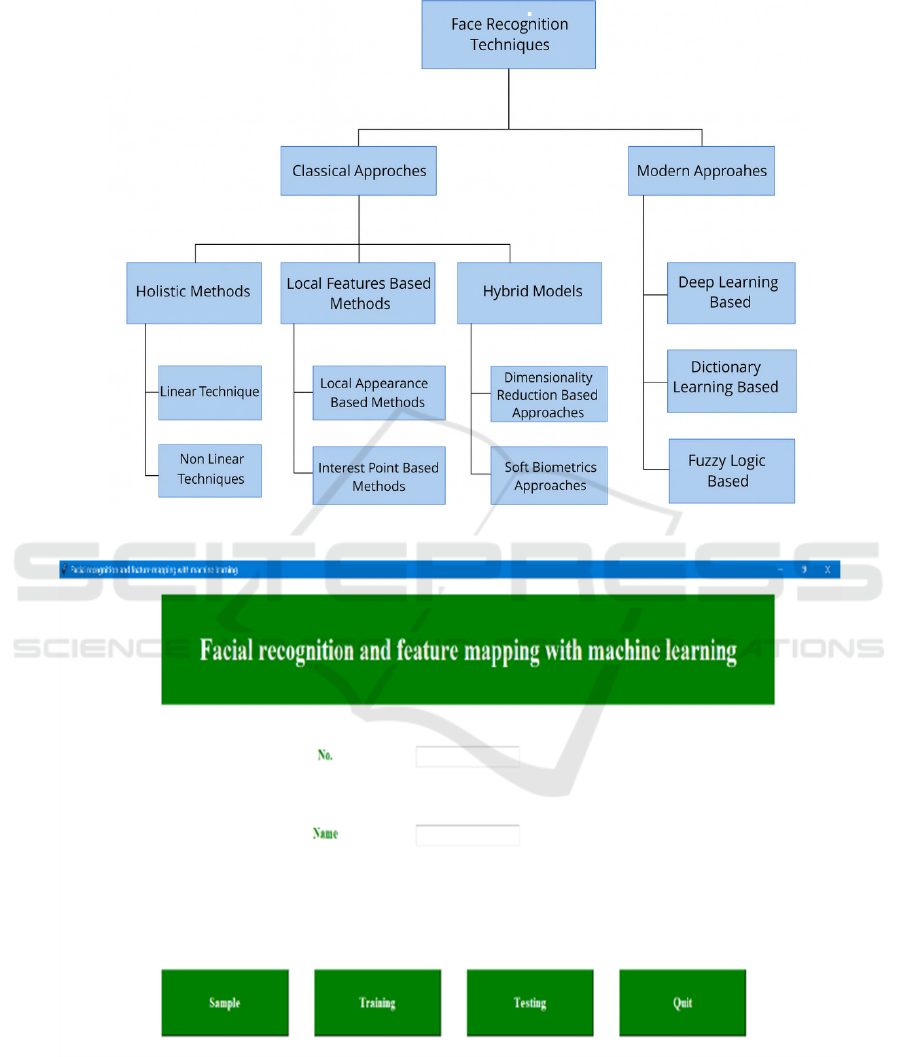
Figure 1 shows the Face Rec Taxonomy.
Figure 2 shows the Facial Recognition GUI. Figure 3.
Shows the Facial Recognition Training Console.
Facial Recognition and Feature Mapping with Machine Learning
481
6 RESULTS
Figure 1: Face Rec Taxonomy.
Figure 2: Facial Recognition Gui.
ICRDICCT‘25 2025 - INTERNATIONAL CONFERENCE ON RESEARCH AND DEVELOPMENT IN INFORMATION,
COMMUNICATION, AND COMPUTING TECHNOLOGIES
482
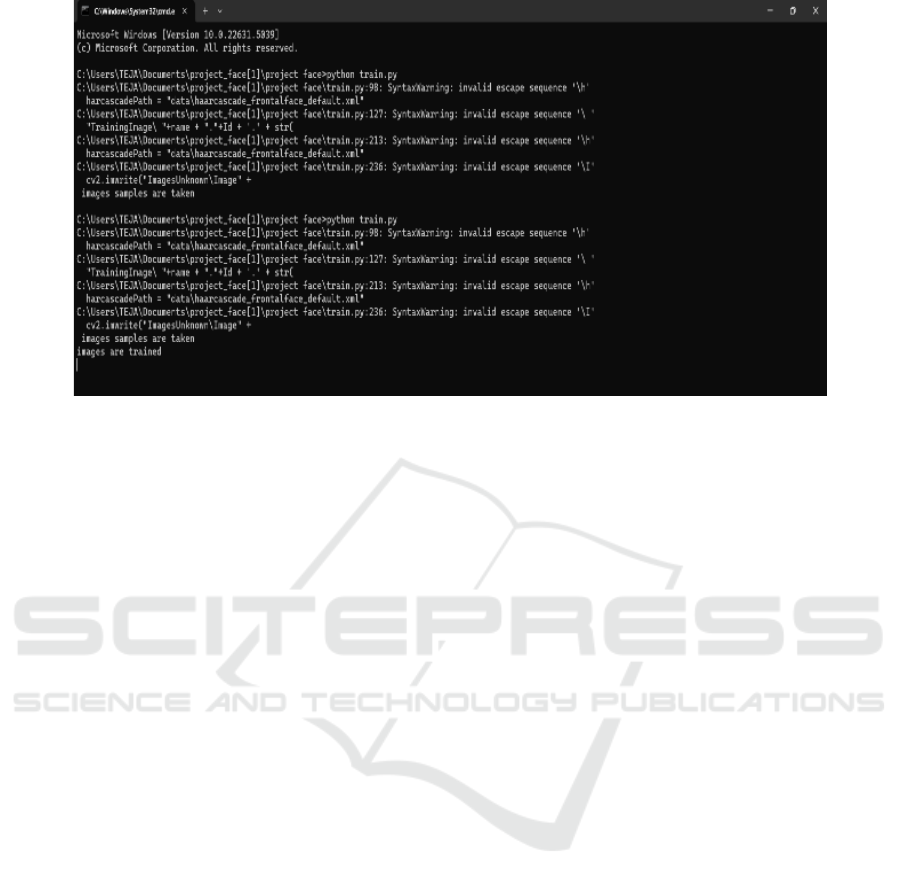
Figure 3: Facial Recognition Training Console.
7 CONCLUSIONS
Facial recognition and feature mapping have certainly
evolved remarkably with all the difficulties
associated with accuracy, safety, and real-time
processing. The developed system features well
optimally deep learning models, well advanced
hybrid-feature extractions, and Edge AIs for facial
recognition at the minimal cost. Moreover, it uses
deep learning-based embedding and statistical feature
mapping techniques that improve recognition with
dynamic conditions such as low-light, occlusions, and
pose changes.
The incorporation of real-time processing through
Edge AI will cater to fast execution of functions,
along with reduced dependency on clouds for making
the system cost-effective and scalable. Also, the anti-
spoofing, depth sensing, and micro-expressions
analyses further provide the security of the system
against fraud access. Thus, this model becomes more
robust in its applications in the real world-from
surveillance security to high-end biometric
authentication.
The critical aspect of the biometric systems is
privacy and data security, which are addressed in the
proposed technique through device processing and
encryption of biometric data storage. Moreover,
assuring that the facial data is stored in no raw images
but processing securely, the system minimizes any
unauthorized access and breach risks. Additionally,
this increases trust and regulatory compliance making
the system a more reliable candidate for large-scale
roll-out.
In summary, this brings a paradigm shift in the
entire ecosystem of today in so far as facial
recognition systems are concerned. It will be
characterized by high accuracy, real-time
performance measures, strong security mechanisms,
and best-in-class privacy protection. Deep learning
and hybrid feature mapping would be a fundamental
reason for Edge AI's wide popularity in applications
such as surveillance, identity verification, and access
control as it speeds and scales the leap to secure,
intelligent, and biometrically recognized
technologies.
REFERENCES
Abate, A. F., Nappi, M., Riccio, D., & Sabatino, G. (2007).
2D and 3D face recognition: A survey. Pattern
Recognition Letters, 28(14), 1885–1906.
Ahonen, T., Hadid, A., & Pietikainen, M. (2006). Face
recognition with local binary patterns. IEEE
Transactions on Pattern Analysis and Machine
Intelligence, 28(12), 2037–2041.
Computer Vision and Pattern Recognition (CVPR), 815–
823.
Conference on Computer Vision and Pattern Recognition
(CVPR), 770–778.
Dutta, A., Chattopadhyay, A., & Chaudhuri, S. (2019).
Liveness detection in facial recognition using deep
learning. Journal of Visual Communication and Image
Representation, 60, 532–543.
He, K., Zhang, X., Ren, S., & Sun, J. (2016). Deep residual
learning for image recognition. Proceedings of the
IEEE
Facial Recognition and Feature Mapping with Machine Learning
483

Li, H., Lin, Z., Shen, X., Brandt, J., & Hua, G. (2015). A
convolutional neural network cascade for face
detection. Proceedings of the IEEE Conference on
Computer Vision and Pattern Recognition (CVPR),
5325–5334.
Masi, I., Wu, Y., Hassner, T., & Natarajan, P. (2019). Deep
face recognition: A survey. Proceedings of the IEEE
International Conference on Automatic Face & Gesture
Recognition (FG), 1–8.
Parkhi, O. M., Vedaldi, A., & Zisserman, A. (2015). Deep
face recognition. British Machine Vision Conference
(BMVC), 1–12.
Phillips, P. J., Grother, P., Micheals, R. J., Blackburn, D.
M., Tabassi, E., & Bone, M. (2003). Face recognition
vendor test 2002: Evaluation report. NIST Technical
Report, 1–37.
Schroff, F., Kalenichenko, D., & Philbin, J. (2015).
FaceNet: A unified embedding for face recognition and
clustering. Proceedings of the IEEE Conference on
Sun, Y., Wang, X., & Tang, X. (2014). Deep learning face
representation from predicting 10,000 classes.
Proceedings of the IEEE Conference on Computer
Vision and Pattern Recognition (CVPR), 1891–1898.
Taigman, Y., Yang, M., Ranzato, M., & Wolf, L. (2014).
DeepFace: Closing the gap to human-level performance
in face verification. Proceedings of the IEEE
Conference on Computer Vision and Pattern
Recognition (CVPR), 1701–1708.
Turk, M., & Pentland, A. (1991). Eigenfaces for
recognition. Journal of Cognitive Neuroscience, 3(1),
71–86.
Viola, P., & Jones, M. (2001). Rapid object detection using
a boosted cascade of simple features. Proceedings of the
IEEE Conference on Computer Vision and Pattern
Recognition (CVPR), 511–518.
Wang, M., Deng, W. (2020). Deep face recognition: A
survey. Neurocomputing, 429, 215–244.
Zhang, K., Zhang, Z., Li, Z., & Qiao, Y. (2016). Joint face
detection and alignment using multi-task cascaded
convolutional networks. IEEE Signal Processing
Letters, 23(10), 1499–1503.
ICRDICCT‘25 2025 - INTERNATIONAL CONFERENCE ON RESEARCH AND DEVELOPMENT IN INFORMATION,
COMMUNICATION, AND COMPUTING TECHNOLOGIES
484
