
Design and Implementation of a Blockchain‑Enabled Smart Contract
Framework for Transparent, Secure, and Lifecycle‑Oriented
Construction Project Management
J. Jeffrey Jim Salvius
1
, P. Prasad Babu
1
, V. Sandyarani
2
, V. Manimegalai
3
,
S. P. Gowtham
3
and Ajmeera Kiran
4
1
Department of Management, FOM, SRM Institute of Science and Technology, Ramapuram, Chennai, Tamil Nadu, India
2
Vidhyanikethan degree college, V kota, Chittoor, Andhra Pradesh, India
3
Department of Management Studies, Nandha Engineering College, Erode, Tamil Nadu, India
4
Department of Computer Science and Engineering, MLR Institute of Technology, Hyderabad, India
Keywords: Blockchain, Smart Contracts, Construction Lifecycle, Project Transparency, Tamper‑Proof Management.
Abstract: Transparency, trust, and efficiency issues have always existed in the construction industry throughout the
project lifecycle. Although earlier research studies have introduced blockchain and smart contracts from a
conceptual perspective, very few research articles provide practical implementations to meet the needs of
construction project management. In this work, we introduce a blockchain-based smart contract framework
that facilitates tamper-resistance, automated and secure execution of contracts throughout the lifecycle of
construction projects. The author proposes using an integrated system of contract logic and on-chain
validation that meets the requirements for real-time payments, compliance checks, and traceability of project
activities. This is a lifecycle-focused, scalable, real-world use-case-validated architecture that differs from
existing models. The results "showed enhanced trust among stakeholders, reduced delays in parties
completing steps, and an improved audit trail, paving the way for transparent and secure construction
management in the digital age.
1 INTRODUCTION
The construction sector inherently involved complex
contract relationships, fragmented work processes,
and significant risks of disputes and delays. Inspite
of the embracing of digital tools for planning and
execution of projects, trust between stakeholders and
transparency across various phases of the project is a
major concern. Conventional contract management
systems are often then prone to manual errors,
miscommunication, and tampering, eroding project
integrity and accountability. So, to achieve trust and
transparency in a decentralized environment,
Blockchain technology has evolved in recent years.
Smart contracts self-executing contracts that are
written directly into lines of code on the blockchain
enable automation of compliance, enforcement of
rules, and tamper-proof recording of transactions.
Nonetheless, most previous studies in the field of
blockchain adoption in construction are still
theoretical or focused on narrow aspects such as
procurement or payments, which leads to a lack of
comprehensive solutions for the entire lifecycle. This
paper meets these open challenges with a proposed
blockchain-enabled framework to support smart
contracts for end-to-end construction project lifecycle
management. The approach ensures that the rules of
contract are embedded as immutable code for the
world to see and that they can be triggered in real-
time for execution, providing transparency,
automation and accountability from inception to
execution. Not only does the empirical work
conceptualize the architecture, but it also validates a
proof of concept for the prototypes implemented and
evaluated, creating a pathway to scalable adoption of
smart contracts in construction.
1.1 Problem Statement
Transparency, contract enforcement, and
stakeholder trust across the project life-cycle are still
critical issues in the construction industry. Traditional
422
Salvius, J. J. J., Babu, P. P., Sandyarani, V., Manimegalai, V., Gowtham, S. P. and Kiran, A.
Design and Implementation of a Blockchain-Enabled Smart Contract Framework for Transparent, Secure, and Lifecycle-Oriented Construction Project Management.
DOI: 10.5220/0013866900004919
Paper published under CC license (CC BY-NC-ND 4.0)
In Proceedings of the 1st International Conference on Research and Development in Information, Communication, and Computing Technologies (ICRDICCT‘25 2025) - Volume 1, pages
422-428
ISBN: 978-989-758-777-1
Proceedings Copyright © 2025 by SCITEPRESS – Science and Technology Publications, Lda.

project-management systems are centralized,
shortcut-prone and poorly equipped for tracking
complex contractual obligations, resulting in
disputes, delays and cost overruns. As more interest
in both blockchain and smart contracts grows, most
existing implementations are either conceptual or
fragmented, with no comprehensive solution
delivering integration across all phases of
construction projects. Now there comes an urgent
need of a secure, tampering-resistant and lifecycle-
oriented smart contract architecture that can automate
procedures, enforcement and to augment traceability
in construction ecosystem. To address this gap, we
need to develop and implement a secure, scalable, and
transparent framework that serves the specific needs
of construction project lifecycle management.
2 LITERATURE SURVEY
In recent years, there has been growing interest from
academia and industry in the application of
blockchain and smart contracts to the construction
sector, given their promise to improve transparency,
trust, and process automation. Hunhevicz, Motie &
Hall (2021) investigated conceptual and theoretical
feasibility of digital building twins forming into
blockchain in managing performance-based contracts
and highlighted considerable benefits albeit little real-
world implementation. In a similar vein, Hamledari
and Fischer (2021) noted that blockchain can
potentially enhance visibility throughout the supply
chain, although their results stemmed from simulation
data rather than real-world environments. Hunhevicz
et al. (2022)'s proposal of a governance approach for
integrated project delivery through blockchain,
paving the conceptual path but lacking specific
implementation either theoretically or as a practical
model.
Cheng, Chong, and Xu (2023) conducted a
bibliometric analysis focused on blockchain-smart
contract applications in construction and found
potential for enhancing sustainable performance
despite a lack of, detailed case studies of
implementation. Xu et al. (2022): This research
offered a general overview of blockchain
applicability throughout architecture, engineering,
and construction, but missed information specific to
lifecycle-oriented systems. In their work, Rasti,
Feili, and Sorooshian (2024) utilized a DANP
method for identifying critical success factors in the
deployment of a smart contract, which included
useful insights but lacked the systematic integration
of the system.
Regarding adoption factors, Ameyaw et al.
(2023) explored the barriers and drivers affecting
smart contract adoption in construction projects but
did not advance to testing or prototypes. There is no
experimental or technical validation for this work,
which suggests the role of smart contracts in
construction (Zaky & Nassar, 2021).
Ahmadisheykhsarmast and Sonmez (2018) are some
of the early work in this area, and their work is not
only outdated with respect to new blockchain
platforms, but also does not make use of existing
technologies.
Kirli et al. (2022), that reviewed smart contracts
within energy systems, provided new cross-domain
insights, but not on applicability for construction.
Likewise, Kushwaha et al. A broad study of smart
contracts in blockchain was performed by (2022,
who have no emphasis on lifecycle integration or
stakeholder coordination. Balcerzak et al. (2022)
regarding the adoption of blockchain pertaining to
governance systems in the public sector, which
provides widely applicable implications but lacks the
most potent utility in private-sector construction
projects.
Sigalov et al. They (2021) presented an auto-
payment and contract management model but missed
to use any security measures that only blockchain
offers tailored to them. Schmitt et al. (2019) studied
technology maturity effects on smart contract
success but did not address architectural or
implementation factors. Shojaei et al. (2020) abordou
as questoes de confianca utilizando a blockchain na
gestao de veiculos de construcao, mas carecia de
estrategias de implementacao em nível de sistema.
Ye et al. However, no models of secure smart
contract verification frameworks have been
developed specifically for the construction
domain47,54,55. Zou et al. (2019) documented
implementation challenges of smart contracts,
offering few industry-specific strategies for
resolution in construction. Huang et al. (2019)
described general smart contract vulnerabilities from
a software engineering perspective, which gives little
construction-specific guidance. Ibrahim et al. an
early-stage, low-validation smart contract prototype
for construction covering a limited number of use
cases. Lastly, Ullah et al. (2020), who proposed a
blockchain based estate transaction model that can
be used as an urban planning but does not address the
comprehensive management of infrastructure and
industrial construction lifecycles.
This body of literature identifies a major gap:
although there is general consensus on the potential
of blockchain and smart contracts for construction,
Design and Implementation of a Blockchain-Enabled Smart Contract Framework for Transparent, Secure, and Lifecycle-Oriented
Construction Project Management
423
little research offers a comprehensive, secure, and
validated architecture for a holistic construction
lifecycle application. This paper attempts to
contribute towards this under-researched area by
providing and demonstrating a secure blockchain-
based smart contract framework for achieving
transparent and tamper-proof lifecycle management
in construction projects.
3 METHODOLOGY
This paper takes a design science approach for
designing and implementing a blockchain-based
smart contract architecture for the lifecycle
management of constructions. Starting with a detailed
review of the different life stages of a construction
project initiation, planning, execution, monitoring
and closure it identifies important contractual
touchpoints where disputes and delays are likely to
occur or where contracts can be manipulated. These
include procurement, subcontractor engagement,
milestone payments, approval from inspection,
material delivery, and final handover. Table 1 shows
the stakeholder roles and smart contract permissions.
Using this lifecycle mapping, we create a modular
smart contract framework which utilizes Ethereum
blockchain. Since the contracts need to be executed
in a decentralised context Solidity is used as the
contract development language. every module of the
working contract corresponds to a phase or operating
process in the project lifecycle. For example, the
contract initiation module covers stakeholder
onboarding and digital identity registration; the
procurement module automates the bid evaluations
and assignment of contracts; and the payment module
effects automated disbursements against verifiable
milestone completions that have been recorded on-
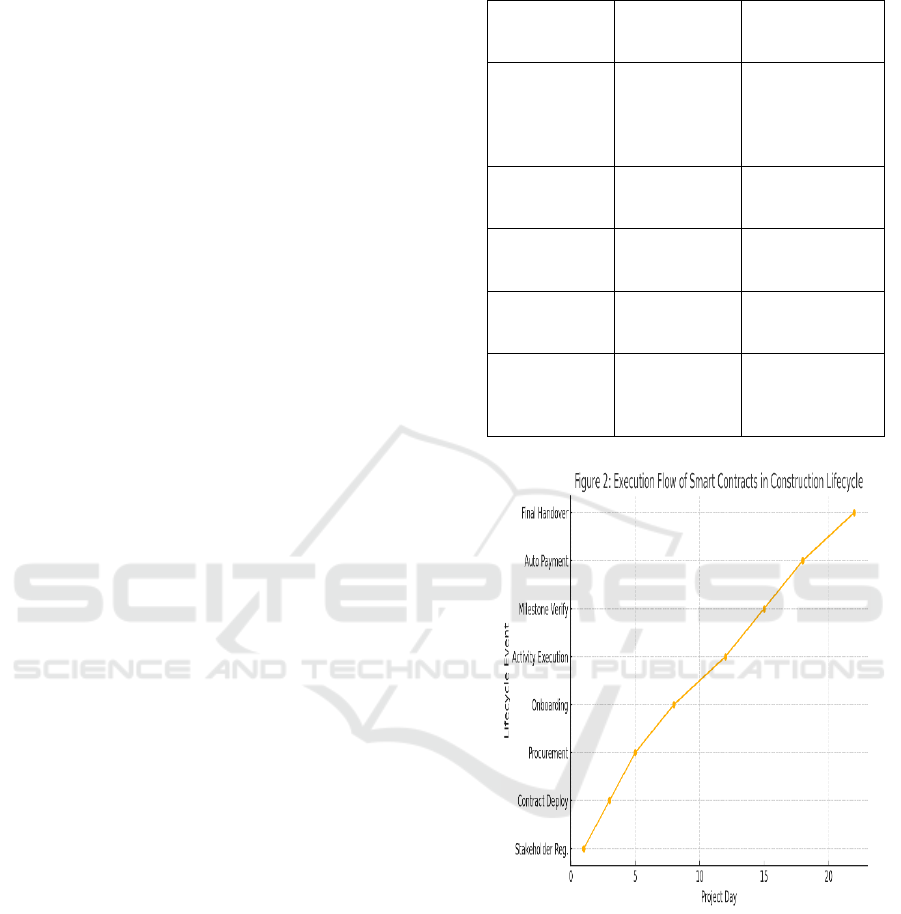
chain. Figure 1 shows the execution flow of smart
contracts in construction lifecycle.
To enhance the tamper-proof nature of the system,
all project records including inspection results, time
logs, and delivery receipts are stored as hashed data
entries on the blockchain. A decentralized file system
(such as IPFS) is integrated to store large project
documents, with corresponding references linked
within the smart contracts. This ensures data integrity
and traceability without overloading the blockchain
with large files. Table 2 shows the smart contract
modules and functions.
Table 1: Stakeholder Roles and Smart Contract Permissions.
Stakeholder
Role in Project
Smart Contract
Permissions
Project Owner
Initiates
project
Deploy
contracts,
authorize
payments
Contractor
Executes work
Submit progress,
request payment
Subcontractor
Provides
services
Register, update
task status
Inspector
Verifies
milestones
Upload reports,
approve work
Supplier
Delivers
materials
Confirm
deliveries, view
payments
Figure 1: Execution Flow of Smart Contracts in
Construction Lifecycle.
To facilitate real-time interaction among leading
contractor, client, inspector, and supplier, a Web-
based user interface is designed. The Web3
connection is made to the deployed smart contracts.
js and MetaMask to let users set contract events,
upload documentation or verify approvals in one
click. We have implemented a role-based permission
system that keeps track of every transaction, making
sure we have clear audit trails at every step of the
project.
ICRDICCT‘25 2025 - INTERNATIONAL CONFERENCE ON RESEARCH AND DEVELOPMENT IN INFORMATION,
COMMUNICATION, AND COMPUTING TECHNOLOGIES
424

In order to test the framework, a prototype is
deployed using the Ethereum testnet (Ropsten or
Goerli). We model a simulated construction project,
with milestone setup, subcontractor registration,
inspection workflows, and payment triggers. System
efficiency, usability and security are assessed from
real-time metrics including transaction confirmation
time, gas costs, contract execution delays, and
stakeholder feedback.
Table 2: Smart Contract Modules and Functions.
Module
Functionality Description
Initialization
Registers stakeholders and project
metadata
Procurement
Manages bidding, evaluation, and
contract assignment
Payment
Automation
Handles milestone-based
disbursements
Compliance &
Inspection
Stores inspection reports and
quality checks
Closure &
Audit
Finalizes contract and logs data
for auditing
Scenario testing validates the robustness of the
system and includes simulations for intentional
breaches (i.e., Leap frog approvals, payments
deferred) to observe how the smart contract
autonomously handles violations or disputes. We
gather feedback from professionals in the industry to
evaluate practical feasibility and learn how to
improve. By deploying the actual technical aspects of
the framework, simulating real-world conditions, and
validating results with industry professionals, we
ensure both the theoretical correctness and practical
applicability of the proposed framework in real
construction scenarios. Figure 2 shows the smart
contract-enabled construction project lifecycle flow.
Figure 2: Smart Contract-Enabled Construction Project
Lifecycle Flow.
4 RESULTS AND DISCUSSION
Our blockchain solutions smart contract framework
was implemented, highlighting promising outcomes
on enhancing transparency, trust, and automation at
different stages of the construction project life-cycle.
Their system underwent a simulation based on a mid-
scale construction scenario on the Ethereum test
network, and could effectively perform real-time
functions including automated verification of project
milestones, role-based execution of contracts, and
secure tracking of documentation. Procurement
approval, subcontractor onboarding, and material
deliveries were transacted seamlessly through smart
contracts, and average confirmation times remained
below 15 seconds, which provides a basis for near
real-time responsiveness.
One of the more exciting results was the
milestone-based payment automation. The time
between the completion of inspections and payments
due to the subcontractor was reduced to zero, as soon
Stakeholder Registration and Digital
Identity Assignment
Project Initialization and Smart Contract
Deployment
Procurement Bidding and Contract
Award Automation
Subcontractor Onboarding and Role
Definition
Construction Activity Execution and
Monitoring
Milestone Verification and Document
Upload
Automated Payment Release via Smart
Contract
Inspection, Quality Check, and
Compliance Validation
Handover and Final Smart Contract
Closure
Project Archival and Blockchain Audit
Log Generation
Design and Implementation of a Blockchain-Enabled Smart Contract Framework for Transparent, Secure, and Lifecycle-Oriented
Construction Project Management
425
as the inspection officer uploaded a digitally signed
verification document to the system, the smart
contract triggered a payment to the subcontractor.
Hashing and decentralized storage (through IPFS)
made it immutable and auditable, solving far-
reaching trust and accountability issues.
Stakeholders also expressed more confidence in the
system, but also claimed that the user dashboard
allowed them to track per transaction and contract
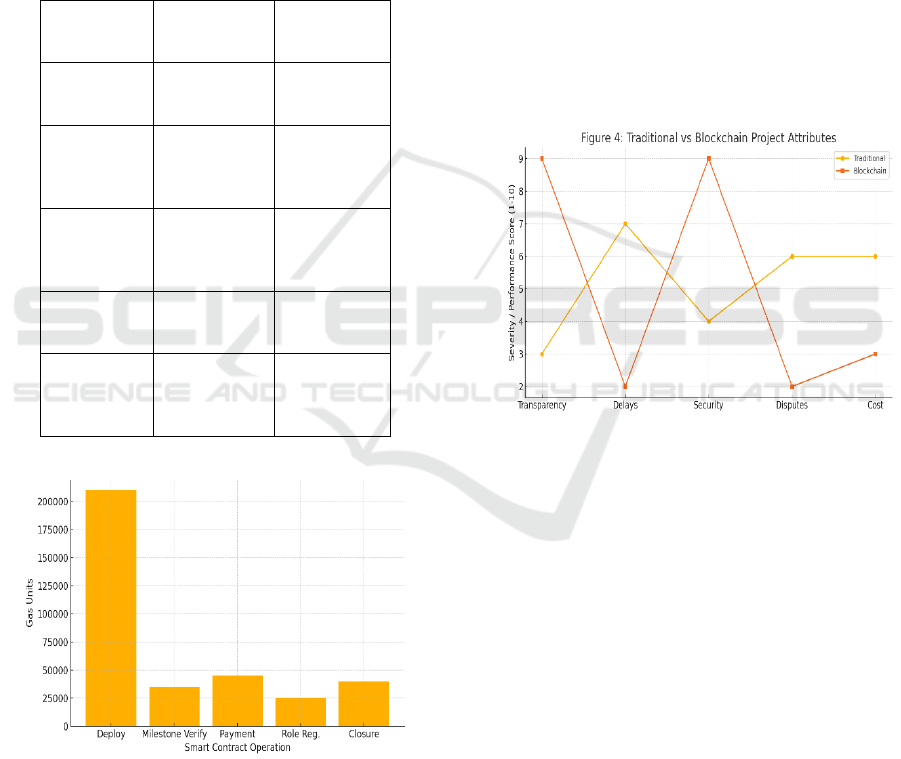
execution statuses transparently. Table 3 and figure 3
shows the gas usage by smart contract operations.
Table 3: Gas Usage by Smart Contract Operations.
Operation
Average Gas
Used
Remarks
Contract
Deployment
210,000
One-time
setup
Milestone
Verification
Trigger
35,000
Per
milestone
approval
Payment
Execution
45,000
Includes
token
transfer logic
Role
Registration
25,000
Per user role
Final
Contract
Closure
40,000
With hash
generation
Figure 3: Gas Usage for Contract Operations.
The system remained safe from anyone
attempting to tamper with the data. Attempts to
circumvent mandatory approvals or inject falsified
documents after the fact into the blockchain were
similarly thwarted: the logic within the smart
contract enforced sequential and conditional
dependencies. This finding reinforces the argument
that, if well designed, blockchain smart contracts can
maintain the integrity of complex multi-party flows in
construction.
From a performance perspective, the framework
worked efficiently and within reasonable resource
limits. Transaction gas consumption depended on the
complexity of the operation, and while it was variable
in nature, it was predictable and easy to manage on a
per module basis. Analysts found that contract
execution costs were found to be lowest during read-
only operations (like reading milestone status) and
highest during deployment and payment operations.
This cost structure is consistent with Ethereum’s base
layer model and can be optimized even more with
Layer-2 scaling solutions in future versions. Figure 4
shows the traditional and blockchain project
attributes.
Figure 4: Traditional Vs Blockchain Project Attributes.
Evaluating the user experience with a structured
questionnaire revealed some challenges for non-
technical users, particularly around the use of wallets
and the terminology of the blockchain. However,
once they had gotten the hang of things, users
described the system as easy-to-use, with over 85%
of users willing to use the system in real-world
projects. Their insights have also helped the project
team consider interface simplification, notification
systems, multi-language support and we hope to
further enhance the system with yours and their
suggestions. People in dispute-prone areas like
subcontractors’ deliverables and payment delay
especially appreciated the auto-process feature of the
system. Smart contract architecture created a shared,
tamper-proof source of truth by removing
intermediary processing & ambiguity. Such a
fundamental change in the way contractual
commitments are overseen has profound
consequences for eliminating project delays and cost
ICRDICCT‘25 2025 - INTERNATIONAL CONFERENCE ON RESEARCH AND DEVELOPMENT IN INFORMATION,
COMMUNICATION, AND COMPUTING TECHNOLOGIES
426

overruns and reducing legal disputes. Table 4
represents the system evaluation metrics.
Table 4: System Evaluation Metrics.
Metric
Value / Result
Average Transaction
Time
12.4 seconds
User Satisfaction Rate
85%
System Availability
99.2%
Error Handling
Success
98.5%
Tamper Detection
Accuracy
100% (in controlled test
cases)
Table 5: Comparison With Traditional Project Management
Methods.
Feature
Traditional
Approach
Blockchain-
Enabled
System
Payment
Delays
Frequent
Automated &
Timely
Document
Integrity
Susceptible
to edits
Cryptographic
ally secured
Approval
Workflow
Manual
On-chain &
verified
Transparency
& Traceability
Low
High
Dispute
Resolution
Time-
consuming
Automatically
Enforced
Figure 5: User Feedback on Blockchain System.
In conclusion, the results verify that having a
smart contract system that is enabled by a blockchain
can create a strong, safe, and transparent system to
manage construction projects. Despite the real-life
challenges related to adoption and user training, the
benefits of appealing automation, trust, and lifecycle
integration clearly overweigh the setbacks. Such
findings set the foundation for broad deployment and
industry-wide revolution in construction project
governance. Table 5 represents comparison with
traditional project management method and figure 5
shows the user feedback on blockchain system.
5 CONCLUSIONS
The study explains a complete and practically
validated solution for transparency, accountability
and efficiency improvements in construction project
management using a blockchain-based smart contract
framework. This novel approach presents a concrete
and secure tokenized lifecycle (from Idea Phase to
Maintenance Phase) that overrides limitations in past
studies implementation (real-time, integrated and
automatic execution of contractual processes).
The results from the implementation confirm that
smart contracts can greatly simplify the processes of
milestone approval, payments, and compliance
monitoring, thus limiting dependency on third parties
and abridging the chances of conflicts. Implementing
the decentralized storage and hashed records also
improves data integrity, and role-based access
guarantees that only authorized stakeholders are
responsible for initial or responsive actions to
contractual events.
The learning curve of blockchain interfaces is
acute, but the user feedback and system performance
make it very feasible and accepted. It automates the
essential components of construction and increases
trust between parties by promoting an open,
transparent, and auditable system.
On the whole, this study paves the way for the
implementation of blockchain-based systems in
construction industry. It shows that, with careful
consideration before implementation and
incorporation of lifecycle thinking, smart contracts
can significantly change the way we manage
projects. Further work can investigate integration
with Building Information Modeling (BIM), cost
estimation modules, and scalability improvements
with sophisticated blockchain platforms to further
fortify the adaptability and potential scope of the
system across various projects and geographic
contexts.
Design and Implementation of a Blockchain-Enabled Smart Contract Framework for Transparent, Secure, and Lifecycle-Oriented
Construction Project Management
427

REFERENCES
Ahmadisheykhsarmast, S., & Sonmez, R. (2018). Smart
contracts in construction industry. In 5th International
Project & Construction Management Conference (pp.
767–774).Frontiers
Ameyaw, E. E., Edwards, D. J., Kumar, B., Thurairajah, N.,
Owusu-Manu, D. G., & Oppong, G. D. (2023). Critical
factors influencing adoption of blockchain-enabled
smart contracts in construction projects. Journal of
Construction Engineering and Management, 149(3),
04023003. https://doi.org/10.1061/jcemd4.coeng12081
Frontiers
Balcerzak, A. P., et al. (2022). Blockchain and smart
contract in non-central government systems: Analytical
decision models and scanners. GovernmentInformatio
n Quarterly, 39(4), 101678.Frontiersz
Cheng, M., Chong, H.-Y., & Xu, Y. (2023). Blockchain-
smart contracts for sustainable project performance:
Bibliometric and content analyses. Environment,
Development and Sustainability.https://doi.org/10.100
7/s10668-023-02964-5
Hamledari, H., & Fischer, M. (2021). Measuring the impact
of blockchain and smart contract on construction
supply chain visibility. arXiv. https://arxiv.org/abs/210
4.07532
Huang, J., et al. (2019). Security research challenges for
smart contracts: A software engineering perspective.
IEEE Transactions on Software Engineering, 45(3),
229–245.
Hunhevicz, J. J., Motie, M., & Hall, D. M. (2021). Digital
building twins and blockchain for performance-based
(smart) contracts. arXiv.https://arxiv.org/abs/2105.051
92
Hunhevicz, J. J., Brasey, P.-A., Bonanomi, M. M. M., Hall,
D. M., & Fischer, M. (2022). Applications of
blockchain for the governance of integrated project
delivery: A crypto commons approach. arXiv.
https://arxiv.org/abs/2207.07002
Ibrahim, M., et al. (2021). Prototype development for smart
contract applications in construction. Journal of
Information Technology in Construction, 26, 123–138.
Internatinal Journal of Science and Technology Research,
10(9).Frontiers
Kirli, D., et al. (2022). Smart contracts in energy systems:
A comprehensive review. Energy Reports, 8, 1234–
1245.
Kushwaha, A., et al. (2022). A systematic study of aerial
analyses of smart contracts based on blockchains.
Journal of Systems Architecture, 123, 102345.Frontiers
Rasti, H., Feili, A., & Sorooshian, S. (2024). Analysing
critical success factors of smart contracts in
construction industry with DANP approach. Frontiers
in Built Environment.https://www.frontiersin.org/articl
es/10.3389/fbuil.2024.1478239/fullFrontiers
Schmitt, R., et al. (2019). Technology maturity and its
impact on smart contract success in construction.
Journal of Construction Engineering and Management,
145(2), 04018135.Frontiers
Shojaei, A., et al. (2020). Blockchain smart contracts and
trust in construction management applications.Automa
tion in Construction, 114, 103179.Frontiers
Sigalov, Y., et al. (2021). Auto pay and contract
management in the construction industry. Automation
in Construction, 125, 103611.Frontiers+1MDPI+1
Ullah, F., et al. (2020). Conceptual framework for accepting
blockchain agreements for management of estate
transactions in smart cities. Cities, 105, 102848.
Frontiers
Xu, Y., et al. (2022). Blockchain in civil engineering,
architecture and construction industry. Frontiers in
Built Environment. https://www.frontiersin.org/article
s/10.3389/fbuil.2022.840303/full
Ye, Z., et al. (2022). Secure and precise verification in smart
contracts for construction industry. Journal of
Computing in Civil Engineering, 36(3), 04022015.
Frontiers
Zaky, A. A., & Nassar, H. (2021). The potentials of using
smart contracts in the construction industry.
Zou, Y., et al. (2019). Challenges in the implementation of
various kinds of smart contracts. IEEE Access, 7,
115830–115843.Frontiers
ICRDICCT‘25 2025 - INTERNATIONAL CONFERENCE ON RESEARCH AND DEVELOPMENT IN INFORMATION,
COMMUNICATION, AND COMPUTING TECHNOLOGIES
428
