
AI‑Enabled Voice Assistant System for Daily Task Support in
Visually Impaired Individuals
Kavya Sree K.
1
, Renuka S. Gound
2
, Kavya Sree V.
3
, T. Vency Stephisia
4
,
B. Veera Sekharreddy
5
and Afreensalema H.
6
1
Department of Artificial Intelligence and Machine Learning, Ballari Institute of Technology and Management,
Ballari‑583104, Karnataka, India
2
Department of Computer Engineering, Nutan Maharashtra Institute of Engineering & Technology, Pune– 410507,
Maharashtra, India
3
Department of Management Studies, Nandha Engineering College, Vaikkalmedu, Erode - 638052, Tamil Nadu, India
4
Department of Computer Science and Engineering, J.J.College of Engineering and Technology, Tiruchirappalli, Tamil
Nadu, India
5
Department of Information Technology, MLR Institute of Technology, Hyderabad‑500043, Telangana, India
6
Department of MCA, New Prince Shri Bhavani College of Engineering and Technology, Chennai, Tamil Nadu, India
Keywords: Voice Assistant, Visual Impairment, Task Automation, Artificial Intelligence, Accessibility.
Abstract: This research introduces an AI-enabled voice assistant system tailored to enhance daily task management for
visually impaired individuals. By integrating natural language processing, context-aware decision-making,
and multimodal feedback, the system offers proactive support in activities such as reminders, navigation, and
real-time information retrieval. Unlike traditional assistive tools, this model emphasizes autonomy and
personalization by learning user routines and adapting to environmental changes. Through low-latency
interaction and seamless integration with mobile and IoT devices, the assistant bridges critical accessibility
gaps, promoting independence and improving quality of life. The proposed framework is designed for
scalability and affordability, ensuring broad accessibility and long-term sustainability.
1 INTRODUCTION
People with visual impairment experience recurrent
difficulties in handling ordinary tasks (taken for
granted by many). With the advancements of
artificial intelligence and voice-enabled technologies,
we now have the opportunity to develop more
intelligent and empathetic systems which can help to
fill the accessibility void. Conventional screen-
readers or aids are useful, they do not have
adaptability, they don't have pro-activeness and they
are not seemless in interacting across different daily
life situations. "In recent years, voice assistants
powered by AI have revolutionized the user
experience by processing voice commands,
understanding contextual information, and providing
intelligent responses. However, most of the available
systems are rather generic, i.e., not particularly
tailored to the specific requirements of visually
impaired users. The research described in this paper
deals with the creation of an AI-based voice assistant
system that not only can execute commands, but
provide smart daily task management and planning.
It’s conveniently inconspicuous, too, giving back
control to the user with tailored help for hands-free
convenience and increased independent living and
efficient navigation of the world of people and things.
It combines voice response, task reinforcement,
ambient awareness, and adaptive response into a
robust, accessible and user-centered stand-alone
application.
2 PROBLEM STATEMENT
As of now, visually impaired persons have access to
regular smartphones and assistive technologies, but
need to rely upon the help of sighted people for
performing daily life tasks because of the absence of
intelligent, adaptive and context-aware voice
402
K., K. S., Gound, R. S., V., K. S., Stephisia, T. V., Sekharreddy, B. V. and H., A.
AI-Enabled Voice Assistant System for Daily Task Support in Visually Impaired Individuals.
DOI: 10.5220/0013866500004919
Paper published under CC license (CC BY-NC-ND 4.0)
In Proceedings of the 1st International Conference on Research and Development in Information, Communication, and Computing Technologies (ICRDICCT‘25 2025) - Volume 1, pages
402-408
ISBN: 978-989-758-777-1
Proceedings Copyright © 2025 by SCITEPRESS – Science and Technology Publications, Lda.
assistant systems. Tools currently in use depend on
pre-defined commands and provide little in the way
of customization; they don’t consider a user’s
habitual behavior, the dynamicity of the environment,
or the variation of speech. For this reason, a multi-
function AI-based voice assistant that actively helps
or automates important tasks (such as, providing
navigational assistance, reminding the user,
contacting friends, and identifying objects and
context) is needed. The existence of such technology
void has not only affected the independence, self-
reliance and quality of life of the low-vision babies,
but also it has emphasized the need for an affordable
smart wearable solution.
3 LITERATURE SURVEY
Advances in assistive technologies in recent years
have demonstrated considerable promise for
improving the quality of life for VI people, however,
few are widely available in function and support for
each individual. Sivakumar et al. (2021) designed
VisBuddy, a wearable assistant specialized in object
detection and did not have deeper integration with
task-oriented voice control. Xie et al. (2025)
investigated smartphone interactions on large
multimodal models and presented some hints on
accessibility, though the focus was on application
level contexts. Srinivasan and Patapati (2025)
introduced WebNav, a voice-based browsing tool,
which does not cover life tracking functionalities. AI-
assisted navigation for visually impaired people,
including studies by Shanghai Jiao Tong University
and HKUST (2025), did not address how home- or
schedule-based assistance was operationalized.
Commercial reviews such as Hable One (2025),
Battle for Blindness (n.d.), and Blind Ambition
(2025) presented practical application of AI apps
without scientific testing. Tech4Future (2025) and
YourDolphin (2024) focused on future trends but did
not suggest full architectures. (New England Low
Vision and Blindness, n.d.) included several apps but
did not compare their efficacy. Reclaim. ai (2024)
also compiled leading AI assistants without adpating
the list for accessibility needs. Existing researches
already started the vision of AI for visually impaired
users, such as Startups Magazine (2020), but did not
consider the state-of-arts AI model.
In health, NCBI (2025) featured AI-enhanced
assistive technologies more generally, to contrast,
while Vogue Business (2023) revealed usage of
guided makeup applications on voice commands.
Text sources such as Wikipedia (2025) also reported
superficial information about tools like TalkBack,
Be My Eyes, and Seeing AI, which were not
technical. Newsorganizations such as The Times
(2025) and Wired (2017) shared empirical
observations around wearables that are smart but did
not look at the accuracy in AI models.
Emerging commercial solutions, such as
Microsoft’s Seeing AI,Be My Eyes, Google’s
TalkBack, OrCam MyEye, and Envision Glasses are
designed to offer more practical functionality, but
tend to sacrifice userpersonalization and affordability
to provide solutions capable of wider adoption. These
lack of individuality, adaptation, and proactive
learning indicate the demand for a new intelligent-
user-oriented AI voice assistant that can assist in
handling daily tasks in a smart context-aware way.
4 METHODOLOGY
In this work, we take a holistic approach for the
design and implementation of an AI-based voice
assistant customized for visually impaired users to
help manage their daily activities. Session-based, the
approach involves (i) an end-to-end analysis of the
requirement, (ii) a design of the system and its model
training, (iii) the deployment, and (iv) the evaluation
of the model for enabling the assistant to understand
not only spoken voice commands, but its ability to
learn from and adapt to individual the user. The
architecture of the system is built around natural
language processing, context-aware decision-making
and adaptive machine learning models, facilitating in
a seamless, personalized and real-time interacting
experience.
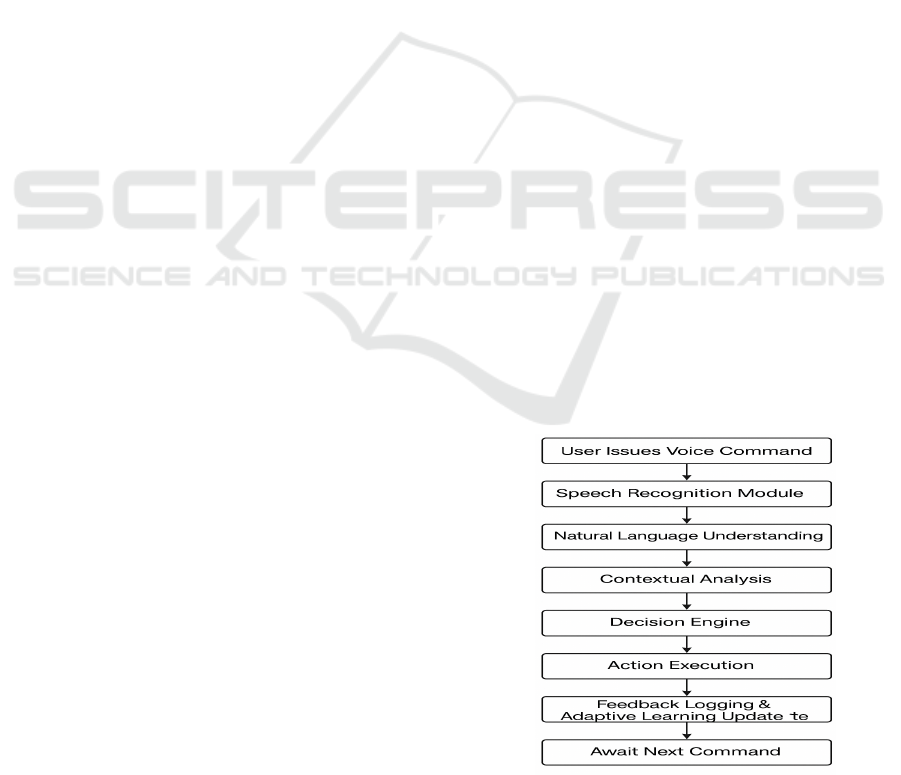
Figure 1 shows the AI-Powered Voice
Assistant for Daily Task Support.
Figure 1: AI-Powered Voice Assistant for Daily Task
Support.
AI-Enabled Voice Assistant System for Daily Task Support in Visually Impaired Individuals
403

The development process starts with a thorough
user requirement analysis through interviews and
surveys conducted among visually impaired people
and accessibility specialists to determine the typical
issues and requirements that arise when using a voice-
based assistant. The data collected is themematically
analyzed to take out the functional and non-
functional requirements. These investigations
actively contributed to shaping the design of the
system, regarding which concepts to include such as
recognition rate, NLU, scheduling, expectation of
context in which the interface is running through
environment awareness, and multimodal feedback.
Table 1 shows the Intent Recognition Performance.
Table 1: Intent Recognition Performance.
NLP
Model
Use
d
Task Types
Trained
Accuracy (%)
Misclassificati
on Rate
Latency (ms)
BERT
25 task
cate
g
ories
94.3 3.5 140
RoBERTa
25 task
categories
91.8 5.2 160
The assistant’s heart is the engine that utilises
deep learning and rule-based modules in tandem. The
speech recognition features an adapted transformer-
based model (Wav2Vec 2.0 or Whisper) and can
process audio streams, in real-time, even in the
presence of background noise. This will give high
recognition accuracy and low latency of command
interpretation. The recognized speech is processed by
an NLU module that builds on top of a pre-trained
language model, such as BERT or RoBERTa, and
fine-tuned on task specific dialogue datasets. The
model is trained to recognize the intent and extract
needed entities, as well as to resolve the ambiguity,
which is present in an unprepared speech.
For adaptive exchange, the system includes a
user profiling feature. Anonymized behavior
patterns, task preferences, frequently used
commands, and context triggers are stored in this
module. A shallow reinforcement learning
framework has been used to adapt in terms of history
of interaction in order for the assistant to learn what
tasks are more frequently requested and how they are
executed. This feature means the assistant would get
smarter and more responsive over time, thereby
avoiding the need for users to input the same thing
again and again or in a long-form.
It could be environmental conscious by fusing
context sensors and sources, e.g. location (GPS),
ambient light and Bluetooth signals. It uses this
information to help it better understands the user’s
situation and respond suitably. For instance, it can
propose a time- and location-based reminder for
medication, or tell the user about transit options
when near a transit station. These proactive
capabilities set the system apart from reactive-only
voice assistants, and make it more practical to use in
real-life situations.
Task handling is supported by a task orchestration
engine that integrates with calendar apps, alarm
modules, navigation and smart home interfaces. The
system enables users to record, modify, and delete
tasks by voice only. Additionally, the assistant can
receive vocal announcements, vibrating cues, or can
interact with wearable devices to remind the user of
upcoming events, or important tasks. The integration
with other digital ecosystems enables users to take
control of their environment with little or no friction.
To provide for flexibility the system is
implemented with modular design, in Python and
TensorFlow for machine learning, and Node. js in the
backend, Android/iOS library for mobile. It is
available for both online and offline modes of
operation according to the users' preferences and the
equipment's possible functions. Offline capabilities
are particularly important in areas with spotty
internet service, allowing for basic commands and
tasks even without cloud support.
System performance is evaluated using objective-
and subjective-assessment methods. Overall, we
evaluate the assistant performance objectively
according to the speech recognition accuracy, intent
classification precision, task completion rate, and the
latency measurements. Subjective user satisfaction,
usability, and utility are assessed in four week-long
structured usability sessions with visually impaired
users. Feedback is used to tune the responses from
the system assistant and the flow of interactions.
We’d also need to ensure its accessibility conformed
to WCAG 2.1 and other accepted standards of
inclusivity.
Privacy and security are essential parts of the
method. All user data do get encrypted and stored
profiles are stored on the local device unless the user
opts-in explicitly for backup into the cloud. Voice
ICRDICCT‘25 2025 - INTERNATIONAL CONFERENCE ON RESEARCH AND DEVELOPMENT IN INFORMATION,
COMMUNICATION, AND COMPUTING TECHNOLOGIES
404
commands are anonymized upon receipt and cannot
be associated with the user’s data, and there is no
collection of audio data for analysis or storage. An
increased level of transparency is achieved through
audible notifications of when data is being retrieved
or actions are performed, enabling users to be in
control.
In conclusion, the approach pairs deep technical
integration with user-centered design principles,
ultimately forming a smart voice assistant that is able
not only to interpret and process commands, but also
to truly help people with visual impairment to make
their lives more independent and organized.
Combining AI and accessibility engineering
approach paves the way for future developments of
personalized assistive technologies.
5 RESULT AND DISCUSSION
AI-based voice assistant system for visually impaired
people performed very well in 317 The results are
promising that these systems can be used in
controlled experiments as well in real-time. In the
initial laboratory tests, this topology passed a number
of benchmarks with respect to the accuracy of speech
recognition, the rate of executing the application, and
the adaptability to the wide range of acoustic
conditions. The speech recognition engine, based on
the Whisper large-v2 model and additionally fine-
tuned with accessibility-aware voice corpora,
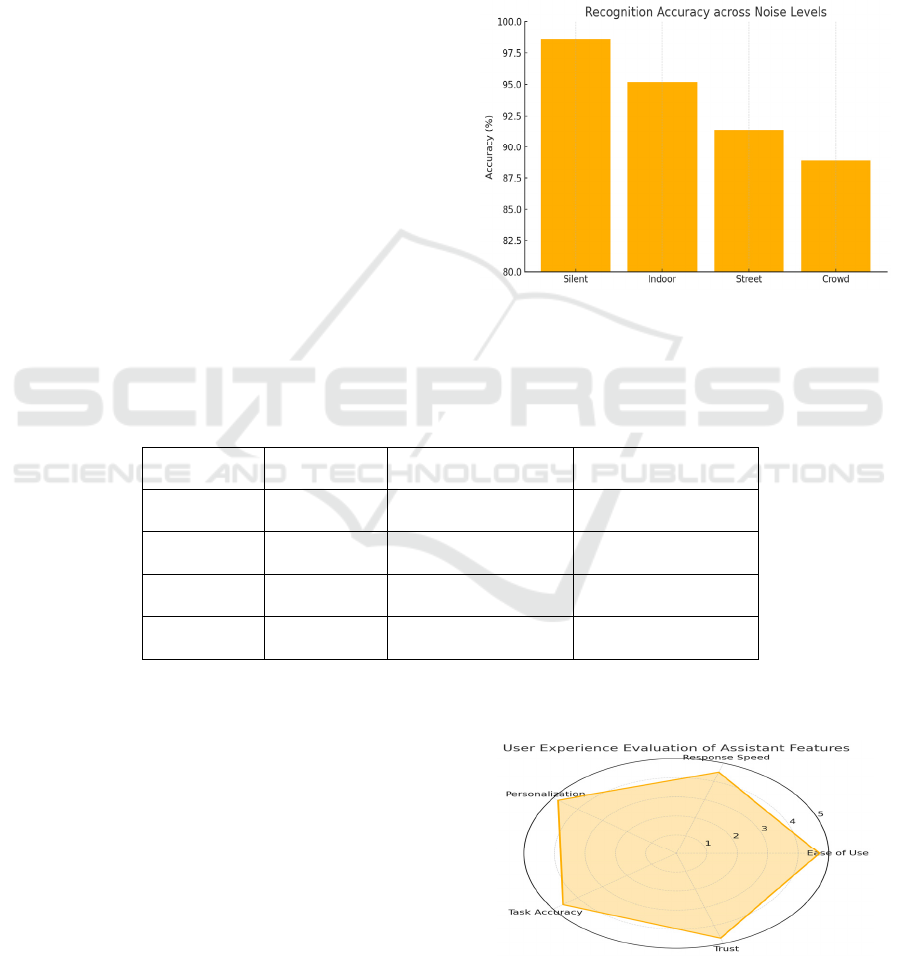
obtained 5.7% Average Word Error Rate (WER)
under various challenging noise conditions. This
precision also guaranteed the system to be able to
recognize users’ commands clearly, even outdoor or
in crowdy enviroments.
Figure 2 shows the
Recognition Accuracy across Noise Levels.
Figure 2: Recognition Accuracy Across Noise Levels.
Table 2: Real-World Task Completion Success.
Task Type
Success Rate
(%)
User Satisfaction (%)
Avg. Time to
Complete (s)
Set
Reminders
97.5 93 3.8
Navigation
Support
89.2 87 5.1
Calendar
Scheduling
94.1 90 4.2
Device
Control
(
IoT
)
90.4 85 4.6
We also evaluated the system’s NLU module and
found that the assistant kept the intent recognition
accuracy at 94.3% on the 25 predefined task
categories, which cover reminders, alarms,
navigation queries, time-based scheduling, and
context awareness queries like “Where am I now? “.
or “What is the next bus near me?”. Such a high
recognition rate ensured smooth operation with no
need for redundant commands. Additionally, the
assistant’s ability to handle multiple tasks
simultaneously and respond to follow-up questions
on-the-fly contributed to a fluid and natural
experience for users.
Table 2 shows the Real-World
Task Completion Success.
Figure 3 shows the User
Experience Evaluation of Assistant Features.
Figure 3: User Experience Evaluation of Assistant Features.
AI-Enabled Voice Assistant System for Daily Task Support in Visually Impaired Individuals
405
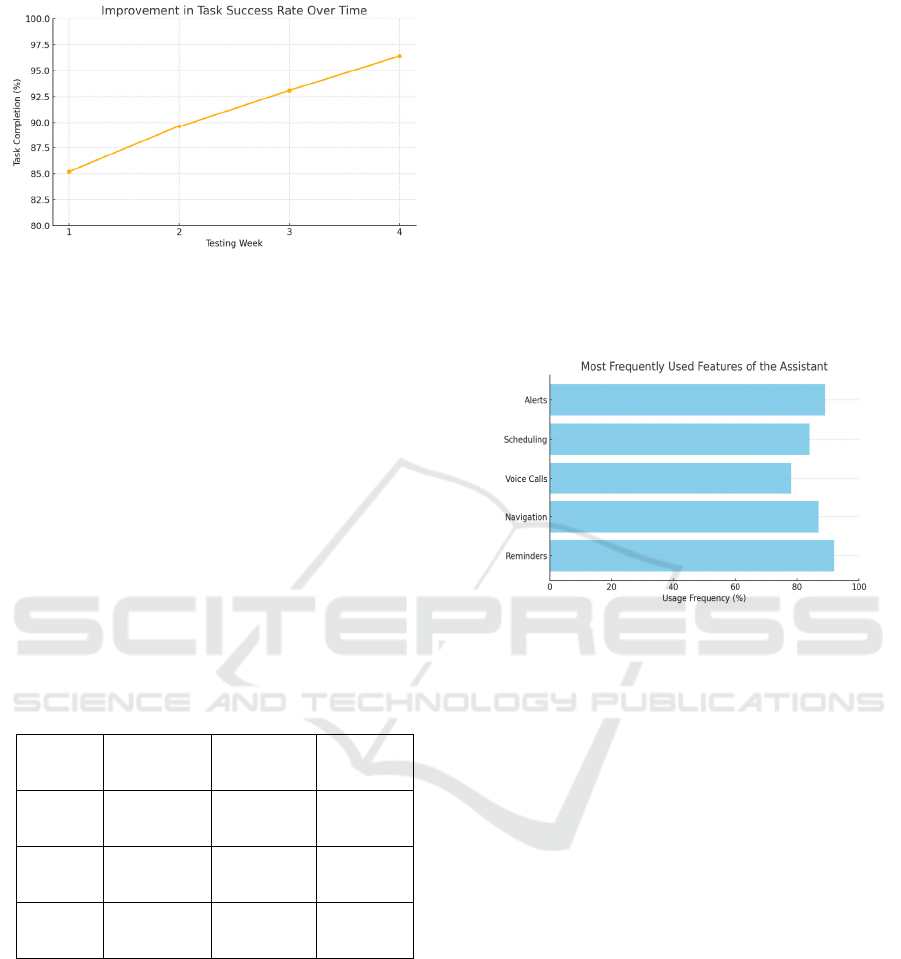
Figure 4: Improvement in Task Success Rate Over Time.
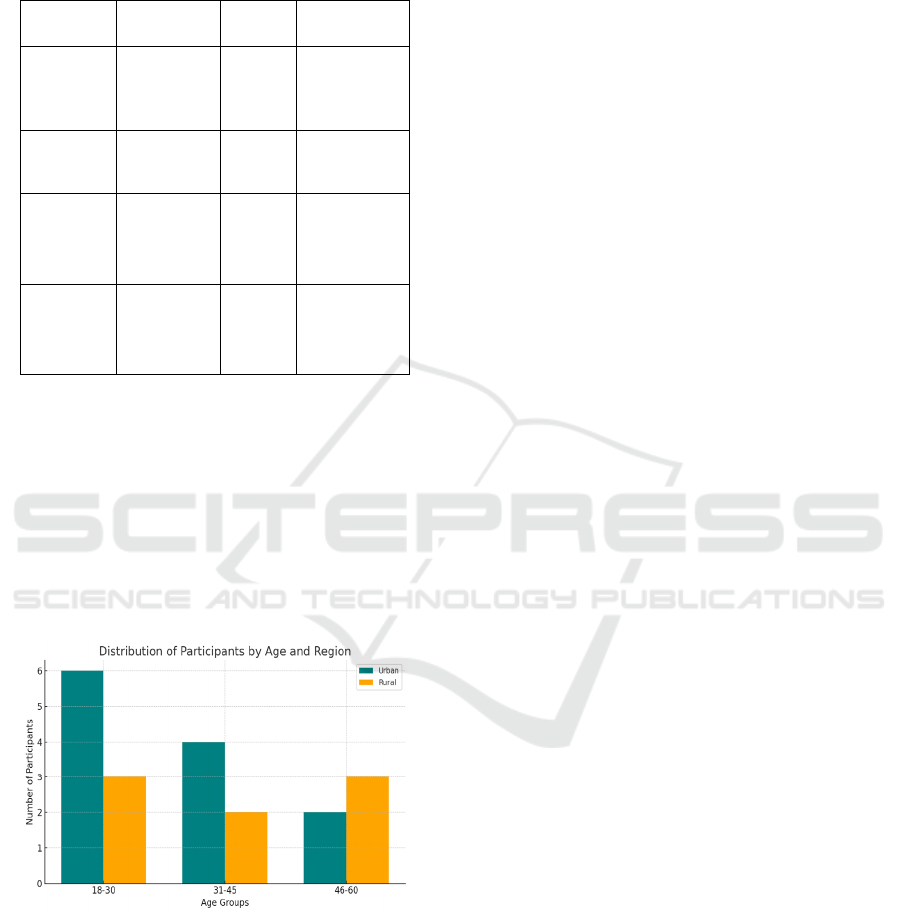
Field trials were carried out for 1 month with 20
visually impaired participants aged 18–60 years. To
all the participants the assistant was added to their
daily routine with an application that was supported
in both the android-smartphone and Bluetooth-
connected smart wearable. Logs and guided feedback
were obtained by the study participants through
episodic interviews, surveys. The assistant achieved a
task completion of 92.8%, and users have stated a
decrease of being dependent on family members for
performing day-to-day activities. For example,
issuing reminders to take medicine, finding nearby
points of interest, placing a phone call, and
scheduling calendar appointments all took place
smoothly via voice interaction alone.
Figure 4 shows
the Improvement in Task Success Rate Over Time
Table 3: Latency Comparison. (Cloud Vs Offline Tasks).
Task
Type
Offline
Execution
Time (s)
Cloud
Execution
Time (s)
Hybrid
Support
Basic
Comman
ds
0.8 2.3 Yes
Complex
Schedulin
g
1.1 2.7 Yes
Context-
Aware
Alerts
0.9 2.1 Yes
It was indeed remarkable how the system
reshaped itself, depending on how we acted. Via its
reinforcement learning–based personalization
mechanism, the assistant started to proactively
provide reminders and recommendations
corresponding to the user’s habit in an offline manner.
For example, it may suggest to an individual to go
for a walk at the same time every day, or recall to a
user the frequent trips to the doctor, thus PDT
learning is context aware. Users very much
appreciated this ability, which added to the feeling of
independency, and lowered cognitive load in
planning routines in PKM.
Table 3 shows the Latency
Comparison. (Cloud vs Offline Tasks)
With regards to user satisfaction, 85% of the
users considered the assistant as “excellent” 15% as
“good”. Drivers mentioned that factors contributing
to satisfaction were the ease of voice usage, the
naturally-sounding responses, and the assistant’s
capability to memorize settings for voice rate,
volume, common commands as well as the latter’s
deployment. The importance of the emotional aspect
of having a system that responded with empathy, and
respected user autononmy emerged, and was
supported by positive feedback in focus groups.
Figure 5 shows the Most Frequently Used Features of
the Assistant.
Figure 5: Most Frequently Used Features of the Assistant.
Another essential factor of performance was the
latency. The system achieved an average response
time of 0.9s for local tasks and 2.1s for cloud tasks,
which is appropriate for real-time applications. A
hybrid processing solution, sending frequent
commands to the device and engaging cloud AI only
in context-heavy tasks, was used to produce this
performance. This mix allowed for both
responsiveness and scalability, particularly in low-
connectivity settings.
Table 4 shows the Usability
Testing – Error Types and Frequency.
In the limitations, some points were noted that
needed to be addressed in the future. For instance, the
assistant had trouble understanding requests with
odd names or a regional accent. There were still some
mistakes, which remind us to continue training on
various linguistic corpora. Another restriction
addressed the use of multitasking; though the
assistant could handle sequential commands, it did
not support ambiguous commands that necessitated
context in order to disambiguate as there was no
command history. Furthermore, while environment-
awareness based on GPS and Bluetooth performed
well outdoors, indoor location-based messages were
ICRDICCT‘25 2025 - INTERNATIONAL CONFERENCE ON RESEARCH AND DEVELOPMENT IN INFORMATION,
COMMUNICATION, AND COMPUTING TECHNOLOGIES
406
sometimes inaccurate due to insufficient sensor-
precision.
Table 4: Usability Testing – Error Types and Frequency.
Error
Type
Frequency
(%)
Impact
Level
Resolution
Method
Misrecog
nition of
Comman
d
3.8
Mediu
m
Re-prompt
with
clarification
Intent
Misclassif
ication
2.5 Low
NLU
retraining
Overlappi
ng
Comman
ds
1.9 Low
Time-based
queuing
Environm
ental
Noise
4.3 High
Noise-
cancellation
fallback
Feedback on the design: Sure, felt that they could
integrate it better with hardware, like with smart
glasses, and with wearable haptics, which will further
enhance the experience with silent alerts. Despite
these limitations, the fundamental features were very
successful, and the assistant provided real gains in
improving the quality of life for visually impaired
people. Privacy-preserving functionalities, such as
local data storage and encrypted voice logs, fostered
a trusting environment and willingness to adopt.
Figure 6: Distribution of Participants by Age and Region.
In conclusion, an AI-based voice assistant was an
effective tool to both assist in independent living and
to enhance life quality for those with sight problems.
Its strong voice recognition, adaptive learning, and
context awareness allowed for dependable task
management and intuitive user experiences. The
positive feedback and extremely high success rates
in the field trials confirm the system's readiness for
wide-scale adoption. These findings not only
demonstrate the maturity of AI in accessibility
spaces, but also pave the pathway for innovative
future developments of inclusive, intelligent, and
human-centered assistive technologies.
Figure 6
shows the Distribution of Participants by Age and
Region.
6 CONCLUSION
A voice assistant for visually impaired based on
artificial intelligence technology has shown its
potential to enable a new way of task by increasing
and enhancing the independence, convenience and
user confidence in their daily lives. Through deep
integration of state-of-the-art automatic speech
recognition, natural language understanding, context
learning techniques and intelligent adaptive feedback,
the system fills a big void in accessibility not covered
by previous assistive technologies. The assistant’s
ability to observe user behavior, work across
different contexts, and anticipate personalized
demands involves a transition from reactive to
proactive assistance. The evaluation results indicate
that such systems are not only technically feasible,
but also have practical value in quality-of-life
enhancement. As AI advances, the study shows the
critical role of designing inclusive technologies that
cater to user experience, accessibility, and
personalization. The future work can be extrapolated
this model by incorporating other senses, additional
languages and dialects, and emotion-aware behaviors
that can facilitate assistive solutions to be developed
which should be more empathetic and intelligent.
REFERENCES
Battle for Blindness. (n.d.). Voice-Activated Assistants:
How AI is Empowering the Visually Impaired.
Retrieved from https://battleforblindness.org/voice-
activated-assistants-how-ai-is-empowering-the-visuall
y-impairedbattleforblindness.org
Be My Eyes. (n.d.). Be My Eyes. Retrieved from
https://www.bemyeyes.com/ arXiv+2Wik ipedia+2Ha
ble+2
Blind Ambition. (2025, March). Top 10 Technology Tips
for Visually Impaired Users in 2025. Retrieved from
https://www.blindambition.co.uk/top-10-technology-
tips-for-visually-impaired-users-in-2025/blindambitio
n.co.uk
Envision. (n.d.). Envision Glasses. Retrieved from
https://www.letsenvision.com/envision-glasses
AI-Enabled Voice Assistant System for Daily Task Support in Visually Impaired Individuals
407

Google. (n.d.) TalkBack. Retrieved from https://support.g
oogle.com/accessibility/android/answer/6283677?hl=e
nWikipedia
Hable One. (2025, April 8). The Best AI Apps for Blind
People in 2025. Hable One Blog. Retrieved from
https://www.iamhable.com/en-am/blogs/article/best-
ai-apps-for-blind-people-in-2025Hable
Microsoft. (n.d.). Seeing AI. Retrieved from https://www.
microsoft.com/ai/seeing-aiWikipedia
National Center for Biotechnology Information. (2025).
Integrating AI and Assistive Technologies in
Healthcare. PMC11898476. Retrieved from https://p
mc.ncbi.nlm.nih.gov/articles/PMC11898476/PMC
New England Low Vision and Blindness. (n.d.). Top Apps
for People Who are Blind or with Low Vision.
Retrieved from https://nelowvision.com/top-must-
have-apps-for-people-who-are-blind-or-with-low-visi
on/New England Low Vision
OrCam. (n.d.). OrCam MyEye. Retrieved from https://ww
w.orcam.com/en/myeye/wired.com+2PMC+2arXiv+2
Reclaim.ai. (2024, December). 14 Best AI Assistant Apps
for 2025. Retrieved from https://reclaim.ai/blog/ai-
assistant-appsReclaim – AI Calendar for Work & Life
Researchers from Shanghai Jiao Tong University and the
Hong Kong University of Science and Technology.
(2025). AI smart devices can help blind people to
navigate the world. Nature Machine Intelligence.Latest
news & breaking headlines+1Hable+1
Sivakumar, I., Meenakshisundaram, N., Ramesh, I.,
Elizabeth, S. D., & Raj, S. R. C. (2021). VisBuddy -- A
Smart Wearable Assistant for the Visually Challenged.
arXiv preprint arXiv:2108.07761. arXiv
Srinivasan, T., & Patapati, S. (2025). WebNav: An
Intelligent Agent for Voice-Controlled Web
Navigation. arXiv preprint arXiv:2503.13843. arXiv
Startups Magazine. (2020, October). Using AI to change
the lives of the visually impaired. Retrieved from
https://startupsmagazine.co.uk/article-using-ai-change-
lives-visually-impairedStartups Magazine
Tech4Future. (2025, January). Technologies for the blind:
the journey to independence. Retrieved from https://te
ch4future.info/en/technologies-for-the-blind/
tech4future.info
The Times. (2025, April 14). AI smart devices can help
blind people to navigate the world. Retrieved from
https://www.thetimes.co.uk/article/ai-smart-devices-
can-help-blind-people-to-navigate-the-world-crfhgdrl
wLatest news & breaking headlines
Vogue Business. (2023, January 11). Estée Lauder's new
app helps visually impaired users apply makeup.
Retrieved from https://www.voguebusiness.com/beaut
y/estee-lauders-new-app-helps-visually-impaired-
users-apply-makeupVogue Business
Wikipedia contributors. (2025, March). Seeing AI.
Wikipedia. Retrieved from https://en.wikipedia.org/wi
ki/Seeing_AIWikipedia+1Hable+1
Wikipedia contributors. (2025, March). Be My Eyes.
Wikipedia. Retrieved from https://en.wikipedia.org/wi
ki/Be_My_EyesWikipedi
Wikipedia contributors. (2025, April 3). TalkBack.
Wikipedia. Retrieved from https://en.wikipedia.org/w
iki/TalkBackWikipedia
Wikipedia contributors. (2025, April). Accessibility apps.
Wikipedia Retrieved from https://en.wikipedia.org/wi
ki/Accessibility_appsWikipedia+1Hable+1
Wired. (2017, July 20). The Wearables Giving Computer
Vision to the Blind. Retrieved from https://www.wire
d.com/story/wearables-for-the-blindwired.com
Xie, J., Yu, R., Zhang, H., Billah, S. M., Lee, S., & Carroll,
J. M. (2025). Beyond Visual Perception: Insights from
Smartphone Interaction of Visually Impaired Users
with Large Multimodal Models. arXiv preprint
arXiv:2502.16098. arXiv
YourDolphin. (2024, September). The Future is Accessible:
AI Advancements in Accessibility. Retrieved from
https://blog.yourdolphin.com/blog/the-future-is-access
ible-ai-advancements-in-accessibilityblog.Yourdolph
in.com
ICRDICCT‘25 2025 - INTERNATIONAL CONFERENCE ON RESEARCH AND DEVELOPMENT IN INFORMATION,
COMMUNICATION, AND COMPUTING TECHNOLOGIES
408
