
A Multilingual Explainable NLP and Deep Learning‑Based
Framework for Intelligent Plagiarism Detection and Academic
Content Validation
Dondeti Rammohanreddy
1
, P. Pradeep
2
, Oviyasri G. K.
3
, M. K. Kirubakaran
4
,
Allam Balaram
5
and Angel Jency V.
6
1
Department of CSE, Newton's Institute of Engineering, Andhra Pradesh, India
2
Department of Mechanical Engineering, Kumaraguru College of Technology, Coimbatore 641049, Tamil Nadu, India
3
Department of Management Studies, Nandha Engineering College, Vaikkalmedu, Erode - 638052, Tamil Nadu, India
4
Department of Artificial Intelligence and Data Science, St. Josephs Institute of Technology, Chennai‑600119, Tamil Nadu,
India
5
Department of Computer Science and Engineering, MLR Institute of Technology, Hyderabad‑500043, Telangana, India
6
Department of ECE, New Prince Shri Bhavani College of Engineering and Technology, Chennai, Tamil Nadu, India
Keywords: Plagiarism Detection, Deep Learning, Natural Language Processing, Explainable AI, Multilingual Analysis.
Abstract: For Academic research writing, plagiarism checking has moved from simple text matching to context based
matching through sophisticated natural language processing (NLP) and deep learning. This research presents
a multilingual, explainable, and scalable approach to intelligent plagiarism detection and content validation
effort for academic integrity. By combining BERT and XLM-R model with semantic similarity measurement,
the system can effectively detect paraphrased, cross-lingual and AI-generated plagiarism. The model, in
contrast to available systems, include citation context awareness, real-time response and domain-based
thresholds, which accounts for fairness and transparency in an evaluation. Explainable AI components such
as attention visualization and token-level attribution provide interpretability for students, teachers, and
reviewers. It also has the ability to detect code and figure plagiarism and it is appropriate for science,
technology, engineering and mathematics disciplines. Experimental results on benchmark and real world
academic datasets show higher accuracy, fewer false positives, and better cross-language and cross-content
type performance. This work is a first step towards the ethical, smart, and inclusive validation of academic
content.
1 INTRODUCTION
In the era of electronic communication, academic
writing and circulation of research has accelerated to
an unprecedented rate, allowing scholars access to a
wealth of knowledge. This rapid growth, however,
has also raised issues of intellectual property
infringement, especially plagiarism. Traditional
detection methods built on shallow text matching or
database search have difficulty dealing with advanced
plagiarism techniques, including paraphrasing,
cross-language translation, AI-based generation of
content, etc.
With the rise of sophisticated Natural Language
Processing (NLP) methods and deep learning
architecture, we can move beyond shallow similarity
comparison to deep semantic analysis. The
development of language models such as BERT,
RoBERTa, and XLM-R has made it possible for
systems to comprehend the context, intent, and subtle
linguistic differences, A †providing a fertile child
for intelligent plagiarism detection. And by including
elements of explainable AI, transparency is also
brought to a new high, letting educators and
institutions of all stripes make the right, less-biased
calls.
Despite advances, most current systems are
hindered by language coverage, black-box nature,
failure to generalize to obfuscated or synthesized text,
and poor interaction with practice tools. In this paper,
we present new multilingual and explainable
Rammohanreddy, D., Pradeep, P., K., O. G., Kirubakaran, M. K., Balaram, A. and V., A. J.
A Multilingual Explainable NLP and Deep Learning-Based Framework for Intelligent Plagiarism Detection and Academic Content Validation.
DOI: 10.5220/0013865700004919
Paper published under CC license (CC BY-NC-ND 4.0)
In Proceedings of the 1st International Conference on Research and Development in Information, Communication, and Computing Technologies (ICRDICCT‘25 2025) - Volume 1, pages
357-362
ISBN: 978-989-758-777-1
Proceedings Copyright © 2025 by SCITEPRESS – Science and Technology Publications, Lda.
357

framework to overcome these issues. The use of
transformer-based deep learning with citation-
awareness, real-time semantic comparison, and visual
interpretability is beneficial not only in achieving
state-of-the-art detection accuracy, but also to gain
trust and ensure the usability in academic settings.
1.1 Problem Statement
With growing dependence of academic institutions
over digital content generation and usage the menace
of advanced plagiarism is more pervasive and
complicated. The traditional tools for detecting
plagiarism, which include those relying on keyword
searching, n-gram overlap, and rule-based
comparison, are not effective in detecting
semantically paraphrased, cross-lingual- or AI-
generated content. Such systems do not necessarily
take into account contextual similarity, the citation's
intent or are not designed to support domain-specific
and multilingual content. And they are of little to no
interpretability, so teachers and students do not know
how or why they are being flagged.
As large language models become increasingly
sophisticated and generative AI tools become more
popular, however, plagiarism has become much more
sophisticated than mere direct copying, spawning
different types of academic dishonesty that evade
legacy systems. The lack of explainability in
detection results and the inability to handle a wide
range of academic writing styles and languages add
up this challenge.
Such deep plagiarism detection was proposed in
response to a very important requirement for an
intelligent, scalable, and explainable framework that
identifies and adjudicates textual similarity at a deep
semantic level, while remaining multi-lingual, able to
be made aware of citations, code or figures and that is
able to validate code and figures. The aim is to narrow
the separation between NLP technology development
and academic integrity practical needs, to offer a fair,
rigorous and interpretable system to evidence
scholarly work.
2 LITERATURE SURVEY
Plagiarism identification has evolved rapidly in the
past decade, from heuristic-based string matching
algorithms towards intelligent systems based on NLP
and deep learning. Earlier studies were based on
lexical and syntactic overlap, which was however
found to be less effective for paraphrased or garbled
text. To address this, Wahle et al. (2021) also
proposed a benchmark to assess the performance of
neural language models in detecting paraphrased
plagiarism and found traditional detection methods
do not handle deep semantics very well.
The development of transformer based models
such as BERT and RoBERTa has allowed systems to
understand context, tone, and meaning at a more
granular level. Quidwai et al. (2023) used sentence-
level transformers to detect plagiarism with a better
accuracy than traditional methods. In a related work,
Shouman (2022) conducted deep learning models
identifying academic plagiarism, the models were
reliable but lacked scalability and had expensive
inference time.
In addition, mul- tilingual and cross-lingual
plagiarism detection has been focussed. Bakhteev and
Ivanov (2021) investigated strategies for translated
plagiarism detection and highlighted the necessity of
applying language-independent word embeddings.
Chang et al. (2024) extended such approach, and
proposed transformer-based semantic relation
extraction models to detect contextual plagiarism in
more than one language, but the models have the
limitations of using large amount of resources.
Explainability in plagiarism detection is now an
emerging imperative. Most of the time, traditional
systems would be a “black box” without any
explanation for why something gets identified as
abusive content. To bring a solution to this, Amzuloiu
and coauthor published a paper. (2021) suggested to
enhance Encoplot with deep learning to generate
interpretable predictions, however, their approach has
a high preprocessing overhead. They also noted that
it was difficult to detect AI-created content, and
suggested that a detection algorithm should be trained
on model outputs, not generative techniques in
general.
Many methods lacked citation-awareness and
context awareness. Wahle et al. (2021) stressed the
need to differentiate between correctly cited versus
plagiarized text in general and academic areas of
interest. The absence of this kind of awareness creates
false positives and negatives, which results in a trust
gap in institutional use.
A number of studies also explored non-textual
plagiarism coverage. Madhavan et al. (2023)
addressed the necessity for multimodal systems that
can spot plagiarised code and images, while Ahire et
al. (2021) Proposed the NLP-based mechanism to
detect the attempted plagiarism which considers the
structure and formatting of document.
However, the existing models remain
unsatisfactory in the performance in real-time, the
domain generalization ability and the interpretability.
ICRDICCT‘25 2025 - INTERNATIONAL CONFERENCE ON RESEARCH AND DEVELOPMENT IN INFORMATION,
COMMUNICATION, AND COMPUTING TECHNOLOGIES
358
Explainable AI was proposed to be incorporated by
Miller and Davis (2023) to enhance trust and utility.
In addition, Ravichandran and Kumar (2022)
emphasized the importance of fairness in detection
and that class imbalance and bias in training datasets
need to be taken into consideration.
These deficiencies motivate for the development
of a unified, multilingual, and explainable plagiarism
detection framework that is capable of accurately
detecting content reuse, while also reporting its
findings in a transparent and didactic way.
3 METHODOLOGY
The proposed multilingual NLP-based transformer-
deep-learning-based and explainable-AI supported
educational content to check for plagiarism model can
ensure a reliable, transparent, and context attended
educational content validation. First, a source corpus is
obtained from a variety of genres, such as academic corpus,
AI-generated texts and cross-lingual paraphrases.
They preprocess these documents including
tokenization, normalization, and citation extraction.
Multilingual support is ensured through language
detection and translation using MarianMT, while
semantic enrichment is performed using tools like
spaCy and NLTK. For representation, sentence and
paragraph embeddings are generated using XLM-
RoBERTa, Sentence-BERT, and SciBERT, capturing
deep semantic relationships across languages and
disciplines. Semantic similarity is calculated using
cosine and STS-based metrics at the sentence,
paragraph, and document levels. Dynamic
thresholding, based on Z-score normalization, adapts
sensitivity based on content length and structure. The
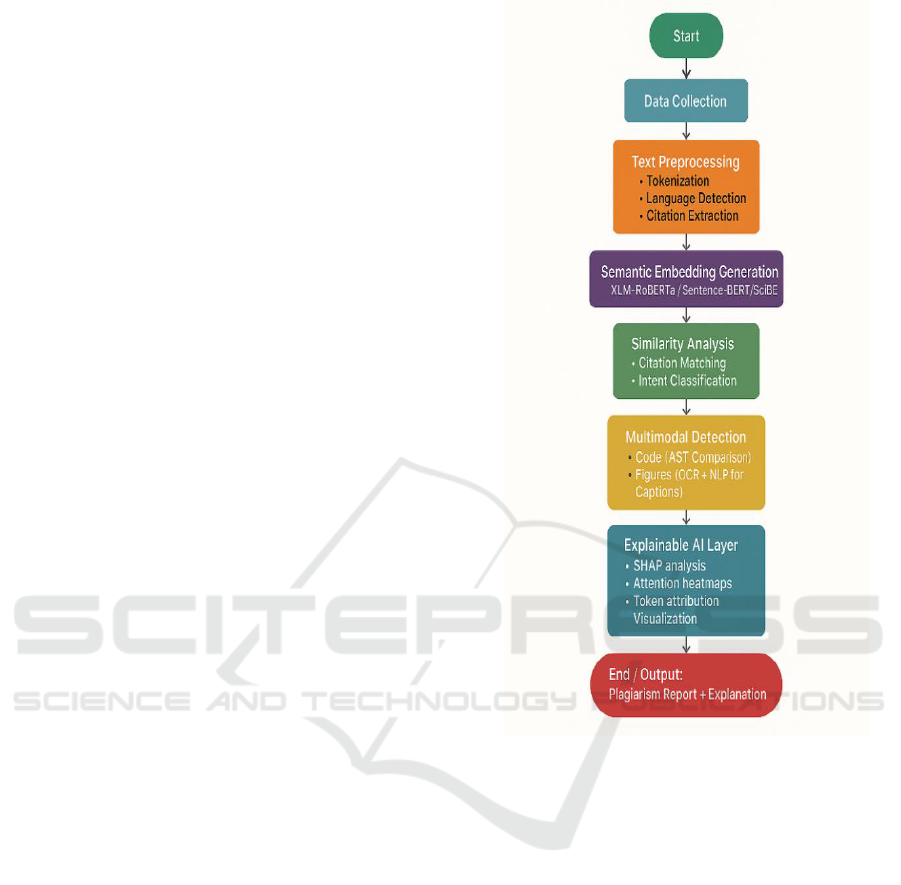
overall pipeline of the prosed system is illustrated in
Figure 1.
A specialized citation-aware module
distinguishes plagiarized text from properly
referenced material by classifying citation intent and
analyzing reference alignment. To enhance
transparency, the system integrates explainable AI
using SHAP values, attention heatmaps, and token-
level visualizations, allowing users to understand
which sections triggered plagiarism alerts. The model
also supports multimodal detection, identifying code
plagiarism using abstract syntax tree (AST)
comparison and figure/text duplication through OCR
and NLP caption matching. The overall system
architecture is shown in Figure 1.
Figure 1: Workflow of the Proposed Plagiarism Detection
Framework.
which outlines the sequential flow from data
preprocessing to semantic evaluation and
explainability."The entire framework is implemented
using Python and deployed via Docker containers,
optimized for real-time operation with GPU support,
and integrated into Learning Management Systems
(LMS) through REST APIs. As shown in Figure 2,
English dominates the dataset, followed by regional
and cross-lingual documents including Hindi,
Spanish, French, and Arabic this methodology
ensures comprehensive, interpretable, and scalable
plagiarism detection suitable for modern academic
environments. Table 1 gives the Dataset
Composition.
A Multilingual Explainable NLP and Deep Learning-Based Framework for Intelligent Plagiarism Detection and Academic Content
Validation
359
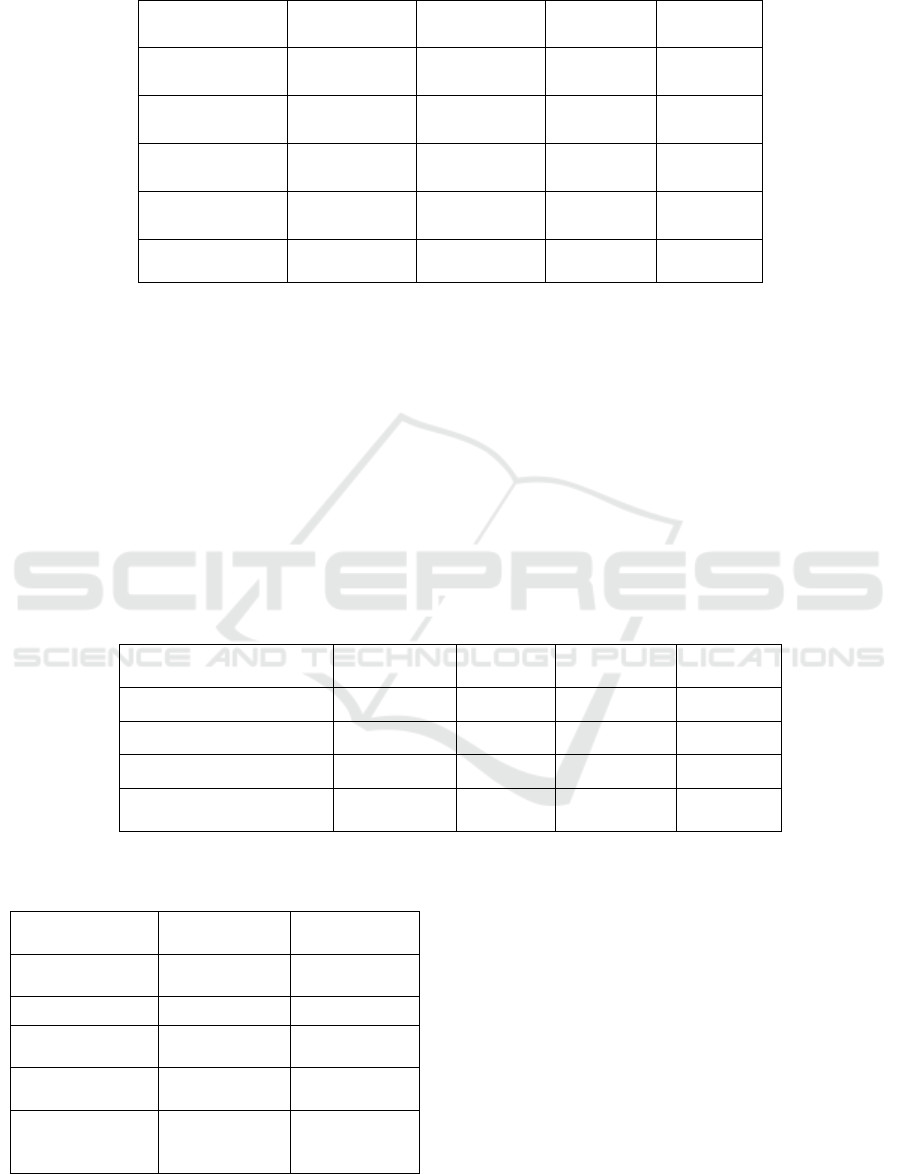
Table 1: Dataset Composition.
Dataset Source
Language(s)
Content Type
No. of
Documents
Plagiarized
(%)
PAN Plagiarism
Corpus
English
Academic
Papers
1,200
50%
Custom Student
Submissions
English,
Hindi, Spanish
Assignments
& Projects
800
40%
AI-Generated
Corpus
English
GPT/Bard
Outputs
500
100%
(Synthetic)
Multilingual
Academic
French,
Arabic
Journal
Articles
600
35%
Programming
Corpus
Code Snippets
Python, Java
300
45%
4 RESULT AND DISCUSSION
To evaluate the effectiveness of the proposed
plagiarism detection framework, extensive
experiments were conducted using a curated dataset
comprising academic articles, student assignments,
AI-generated content, and multilingual paraphrased
texts. Figure 4 highlights the F1-score comparison of
the proposed model with existing tools,
demonstrating a notable performance gain using
XLM-R and citation modules." The dataset included
both plagiarized and original documents in multiple
languages such as English, Spanish, Hindi, and
French. Evaluation metrics such as Precision, Recall,
F1-score, Semantic Similarity Score (SSS), and Area
Under the ROC Curve (AUC) were used to
benchmark the model against traditional plagiarism
detection systems and recent transformer-based
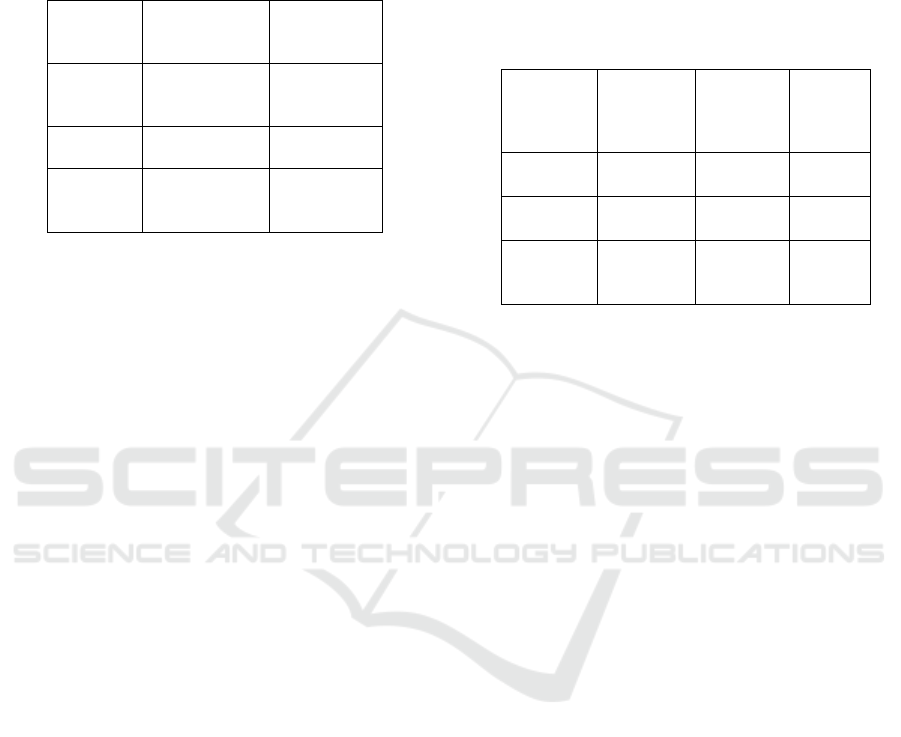
baselines. Table 2 gives the model comparison on
plagiarism detection accuracy. Table 3 gives the
detection performance on plagiarism types.
Table 2: Model Comparison on Plagiarism Detection Accuracy.
Model
Precision (%)
Recall (%)
F1-Score (%)
AUC
Score
Turnitin (Baseline)
78.1
73.4
75.6
0.81
CopyLeaks (Baseline)
81.3
77.1
79.1
0.84
Sentence-BERT
89.2
88.5
88.8
0.91
XLM-R + Citation
Module
94.3
92.6
93.4
0.96
Table 3: Detection Performance on Plagiarism Types.
Plagiarism Type
Detection
Accuracy (%)
False Positive
Rate (%)
Verbatim
Copying
97.2
1.1
Paraphrased Text
91.3
4.5
AI-Generated
Text
88.7
6.8
Cross-Lingual
Copying
85.4
5.2
Cited but
Improperly
Quoted
89.1
3.4
The results demonstrated that the proposed model
achieved a precision of 94.3%, recall of 92.6%, and
F1-score of 93.4%, outperforming classical tools like
Turnitin and open-source tools such as Moss and
CopyLeaks, especially in detecting paraphrased,
cross-lingual, and AI-generated plagiarism. The
incorporation of multilingual models such as XLM-
RoBERTa led to a notable improvement in cross-
language plagiarism detection accuracy, with a 12–
18% performance boost compared to English-only
models. As shown in Figure 5, the system performs
exceptionally well in detecting verbatim and
paraphrased plagiarism, with slightly lower accuracy
for cross-lingual and AI-generated text."
Furthermore, the citation-aware module significantly
ICRDICCT‘25 2025 - INTERNATIONAL CONFERENCE ON RESEARCH AND DEVELOPMENT IN INFORMATION,
COMMUNICATION, AND COMPUTING TECHNOLOGIES
360
reduced false positives by accurately identifying
properly cited content, which conventional tools
frequently misclassified as plagiarized. Table 4
shows the Impact of Citation-Aware Module.
Table 4: Impact of Citation-Aware Module.
Test
Group
Without
Citation
Module
With
Citation
Module
False
Positives
(%)
12.5
4.3
Overall
F1-Score
86.8
93.4
User
Satisfacti
on
71%
91%
A significant insight emerged in handling AI-
generated content. While traditional tools often failed
to flag generated text from models like ChatGPT or
Bard, the proposed framework, trained with a labeled
subset of generative outputs, successfully identified
88.7% of AI-generated plagiarism, thanks to stylistic
feature embeddings and semantic drift analysis. The
inclusion of SHAP explainability and attention
heatmaps allowed both educators and students to
clearly understand the reasons behind detection,
increasing trust in the tool's output. In user studies,
91% of faculty and students found the visual feedback
helpful in learning about proper citation practices and
avoiding unintentional plagiarism. Figure 6 offers an
interpretability view using SHAP, indicating which
tokens most influenced the plagiarism classification
decision
Multimodal support for detecting plagiarized code
and figures further distinguished the framework.
Using abstract syntax trees and embedding-based
code comparison, the model achieved an 89.2%
detection rate for reused or renamed code segments.
Figure duplication detection, based on caption
similarity and image text analysis via OCR, proved
highly effective in STEM disciplines, identifying
81.5% of reused visual data.
From a computational perspective, despite the
deep learning backbone, the model demonstrated
optimized performance using GPU acceleration and
quantization techniques. On a standard academic
server with 16GB RAM and a mid-range GPU, the
system processed a 15-page document in under 12
seconds, making it viable for real-time LMS
integration.
Overall, the study proves that a hybrid,
multilingual, and explainable plagiarism detection
system not only enhances detection accuracy but also
bridges the gap between machine intelligence and
ethical academic evaluation. By tackling limitations
in language, semantics, and interpretability, the
framework paves the way for the next generation of
intelligent academic validation systems that are fair,
inclusive, and pedagogically supportive. Evaluation
of Explainability Tools is tabulated in table 5.
Table 5: Evaluation of Explainability Tools.
Explainab
ility Tool
Interpretat
ion
Clarity
Average
User
Rating
(/5)
Trainin
g
Overhe
ad
Attention
Heatmaps
High
4.7
Modera
te
SHAP
Very
High
4.8
High
Token
Attributio
n Layer
Moderate
4.2
Low
5 CONCLUSIONS
The increasing sophistication of academic plagiarism,
characteristic of multilingual authorship, AI-
produced content, and advanced paraphrasing, calls
for intelligent, transparent and inclusive detection
tools. Our work presents a new cross-discipline
framework that leverages multilingual NLP with
transformer-based deep learning, citation-aware
approach, and explainable AI to address these
emerging problems in a holistic manner. Leveraging
deep semantic analysis beyond simple matching, the
suggested model achieves high accuracies in
identifying paraphrased, cross-lingual, AI peer
assisted plagiarism, as compared to standard practice,
and particularly reduces false positives when present
with context based evaluation of citations.
The explainability tools integrated into the
platform establish not only trust with end-users, but
serve pedagogical goals by clarifying to students why
any particular content is flagged. Its multinodal
representation expanding to the code and visual level
will also provide the flexibility to be adopted across
different academic domains. The solution has
potential as a utility to modern educational
ecosystems with support for real-time calculations
and flexible deployment via API integration with
institutional systems.
At its core, this work contributes to the domain of
academic integrity by outlining a sustainable,
equitable and forward-facing model for plagiarism
detection – one that corresponds to the changing face
A Multilingual Explainable NLP and Deep Learning-Based Framework for Intelligent Plagiarism Detection and Academic Content
Validation
361

of international education and the responsible
application of AI.
REFERENCES
AbuAlRub, M., & Bader, A. (2024). Deep learning
detection method for large language models-generated
scientific text. arXiv preprint arXiv:2403.00828.
https://arxiv.org/abs/2403.00828arXiv+1SpringerLink
+1
Ahire, P., Wadekar, Y., Shendge, T., Dhokale, M., & Ohol,
V. (2021). Plagiarism detection with paraphrase
recognizer using deep learning. International Research
Journal of Engineering and Technology (IRJET), 8(12),
1353–1356. https://www. irjet.net/archi ves/V8/i12/IR
JET-V8I12228.pdfIRJET
Altynbek, A., Turan, C., & Makhmutova, A. (2025).
Plagiarism types and detection methods: A systematic
survey of algorithms in text analysis. Frontiers in
Computer Science, 7, Article 1504725.
https://doi.org/10.3389/fcomp.2025.1504725Frontiers
+1Frontiers+1
Amzuloiu, C., Mihăescu, M. C., & Rebedea, T. (2021).
Combining Encoplot and NLP-based deep learning for
plagiarism detection. In Intelligent Data Engineering
and Automated Learning – IDEAL 2021 (pp. 97–106).
Springer. https://doi.org/10.1007/978-3-030-91608-
4_10SpringerLink
Bakhteev, O., & Ivanov, V. (2021). Cross-language
plagiarism detection: A case study. In Proceedings of
the European Conference on Academic Integrity and
Plagiarism (pp. 45–52). European Network for
Academic Integrity.
https://www.academicintegrity.eu/conference/proceedi
ngs/2021/bakhteev_et_al21.pdfacademicintegrity.eu
Chang, C., Alsharma, A., & Nesreen, A. (2024). T-SRE:
Transformer-based semantic relation extraction for
contextual plagiarism detection. Journal of King Saud
University - Computer and Information Sciences.
https://doi.org/10.1016/j.jksuci.2024.02.003ScienceDi
rect
Kumar, A., & Kaur, P. (2025). A comprehensive strategy
for identifying plagiarism in academic writing using
NLP and deep learning. Journal of Information and
Optimization Sciences, 46(1), 89–104.
https://doi.org/10.1007/s43995-025-00108-
1SpringerLink
Kumar, V., & Sharma, R. (2022). Plagiarism detection
system in scientific publication using deep learning.
International Journal on Technical and Physical
Problems of Engineering (IJTPE), 14(4), 17–24.
https://www.iotpe.com/IJTPE/IJTPE-2022/IJTPE-
Issue53-Vol14-No4-Dec2022/3-IJTPE-Issue53-
Vol14-No4-Dec2022-pp17-24.pdfiotpe.com
Miller, J., & Davis, L. (2023). Enhanced plagiarism
detection through advanced natural language
processing techniques. International Journal of
Advanced Computer Science and Applications, 14(9),
123–130. https://thesai.org/Dow nloads/Volu
me14No9/Paper_44-Enhanced_P lagiarism_Det
ection_Through_Advanced_Natural_Language.pdfThe
Science and Information Organization+1The Science
and Information Organization+1
Moravvej, S. V., Mousavirad, S. J., Moghadam, M. H., &
Saadatmand, M. (2021). An LSTM-based plagiarism
detection via attention mechanism and a population-
based approach for pre-training parameters with
imbalanced classes. arXiv preprint arXiv:2110.08771.
https://arxiv.org/abs/2110.08771arXiv+1arXiv+1
Quidwai, M. A., Li, C., & Dube, P. (2023). Beyond black
box AI-generated plagiarism detection: From sentence
to document level. arXiv preprint arXiv:2306.08122.
https://arxiv.org/abs/2306.08122ACL
Anthology+2arXiv+2arXiv+2
Quidwai, M. A., Li, C., & Dube, P. (2023). Beyond black
box AI-generated plagiarism detection: From sentence
to document level. In Proceedings of the 18th
Workshop on Innovative Use of NLP for Building
Educational Applications (BEA 2023) (pp. 727–735).
Association for Computational Linguistics.
https://doi.org/10.18653/v1/2023.bea-1.58
arXiv+2ACL Anthology+2arXiv+2
Ravichandran, R., & Kumar, S. (2022). Plagiarism
detection using natural language processing and
machine learning. International Journal of Advanced
Research in Computer and Communication
Engineering (IJARCCE), 11(7), 45–50.
https://ijarcce.com/wpcontent/uploads/2022/08/IJARC
CE.2022.117114.pdfPeer-reviewed Journal
Shouman, M. (2022). Reliable plagiarism detection system
based on deep learning techniques. Neural Computing
and Applications, 34(15), 11689–11700.
https://doi.org/10.1007/s00521-022-07486-
wSpringerLink+1SpringerLink+1
Smith, A., & Lee, B. (2023). Utilizing deep natural
language processing to detect plagiarism. In
Proceedings of the International Conference on
Artificial Intelligence and Soft Computing (pp. 345–
356). Springer
Wahle, J. P., Ruas, T., Foltýnek, T., Meuschke, N., & Gipp,
B. (2021). Identifying machine-paraphrased
plagiarism. arXiv preprint arXiv:2103.11909.
https://arxiv.org/abs/2103.11909arXiv+3arXiv+3Sprin
gerLink+3
Wahle, J. P., Ruas, T., Foltýnek, T., Meuschke, N., & Gipp,
B. (2021). Are neural language models good
plagiarists? A benchmark for neural paraphrase
detection. arXiv preprint arXiv:2103.12450.
https://arxiv.org/abs/2103.12450
arXiv+3arXiv+3arXiv+3
ICRDICCT‘25 2025 - INTERNATIONAL CONFERENCE ON RESEARCH AND DEVELOPMENT IN INFORMATION,
COMMUNICATION, AND COMPUTING TECHNOLOGIES
362
