
A Comprehensive Framework for Smart Agriculture: Integrating
IoT, Edge Computing, and AI for Scalable, Transparent, and
Adaptive Crop Management
Durgalakshmi B.
1
, Umapathi S.
2
, M. Priya
3
, M. Soma Sabitha
4
, Ilakkiya E.
5
and M. Uday Raj Kumar
6
1
Department of Artificial Intelligence and Data science, Tagore institute of Engineering and Technology, Deviyakurichi,
Tamil Nadu, Salem, India
2
Department of Computer Science and Engineering, Tagore institute of Engineering and Technology, Deviyakurichi, Salem,
Tamil Nadu, India
3
Department of Electrical and Electronics Engineering, J.J. College of Engineering and Technology, Tiruchirappalli, Tamil
Nadu, India
4
Department of Computer Science and Engineering, MLR Institute of Technology, Hyderabad, Telangana, India
5
Department of CSE, New Prince Bhavani Shri College of Engineering and Technology, Chennai, Tamil Nadu, India
6
Department of ECE, Ballari Institute of Technology and Management, Ballari, Karnataka, India
Keywords: Smart Agriculture, IoT, Edge Computing, Crop Management, Adaptive Systems.
Abstract: Smart farming is an emerging concept that is rapidly transforming due to the development of the Internet of
Things, edge computing and AI, and providing revolutionary solutions for real time crop monitoring and
decision making. This article introduces a unified and adaptive framework that combines IoT-based sensing,
edge-level analytics, knowledge-driven analytics and AI-driven analytics, aiming to achieve the premises of
scalability, transparency and responsiveness in intelligent agriculture. Leveraging the latest breakthroughs
from 2021 to 2025, the work investigates the ways in which edge intelligence and distributed architecture
solve the key challenges, including data latency, connectivity outages and context-aware decision support.
The proposed architecture focuses on the practical implementation in a broad range of agricultural systems,
comprising classical and soilless farms, taking into consideration issues related to the integration, constraints
of infrastructure, and system interoperability. We seek to narrow the chasm between prototype ideas and
practical applications in precision agriculture by critically reviewing existing models and adding a new
architectural approach.
1 INTRODUCTION
Increasing global needs for sustainability in food
production have spurred a technological revolution
in the agriculture industry, from historical farming
techniques to smart, data-driven solutions. As farms
are becoming increasingly information-intensive,
using digital tools to observe, analyse and optimize
processes, smart agriculture has become a key area
where advanced technologies such as IoT are
combined to tackle challenges related to climate
variability, resource limitation, and labour crimps.
Driving this change is the Internet of Things (IoT) and
edge computing, making it possible for data-driven
decision making to happen in real time, closer to the
farm.
Internet of things devices, like environmental
sensors, and actuators, and drones allow us to
constantly monitor environmental health, crops, and
weather. Nevertheless, the amount of data produced
is so large that centralized cloud infrastructures
become swamped and latency, bandwidth,
restrictions in processing these data as well as data
privacy become a problem. To address some of these
issues, edge computing has emerged as a way of
processing data closer to the source to avoid
communication latencies and to make quicker,
context-dependent decisions.
AI enriches this ecosystem with predictive
analysis, anomaly detection and intelligent
350
B., D., S., U., Priya, M., Sabitha, M. S., E., I. and Kumar, M. U. R.
A Comprehensive Framework for Smart Agriculture: Integrating IoT, Edge Computing, and AI for Scalable, Transparent, and Adaptive Crop Management.
DOI: 10.5220/0013865600004919
Paper published under CC license (CC BY-NC-ND 4.0)
In Proceedings of the 1st International Conference on Research and Development in Information, Communication, and Computing Technologies (ICRDICCT‘25 2025) - Volume 1, pages
350-356
ISBN: 978-989-758-777-1
Proceedings Copyright © 2025 by SCITEPRESS – Science and Technology Publications, Lda.

automation to convert raw data into actionable
knowledge. However, in spite of these many
improvements, many of the proposed systems are
either still stuck in the realm of experiments or are
non-scalable and are not interoperable to support
wide-spread usage. Furthermore, infrastructure-level
heterogeneity, high-cost implementation, and
fragmented architectures are still critical barriers to
the smooth integration of technologies on the fields.
This study attempts to fill this gap by proposing a
unified, scalable, and adaptive framework for smart
agriculture that integrate the potentialities of IoT,
edge computing, and AI. Combining recent literature
and knowledge of implementation, important steps
are provided in order to develop strong agricultural
systems that facilitate efficient and informed crop
management in different crop systems.
1.1 Problem Statement
Agriculture is experiencing an intense digitalisation
but the convergence of emerging technologies, such
as Internet of Things (IoT), edge computing and
artificial intelligence (AI), into an integrated smart
agriculture system is still constrained by many
technical and operational challenges. Despite the
increasing evidence of the potential of these
technologies to disrupt crop monitoring, resource
management and yield estimation practices, their
application in actual farming practices is still
scattered, in many cases limited to one-shots or
specific-purpose solutions. The vast majority of
existing systems use centralized, cloud-based
architectures that are not surrogate to the dynamic and
distributed conditions found in agricultural settings
such as rural and remote environments where reliable
connectivity is scarce or not available.
Model processing overly centralized is high
latency, real time response is poor and there are also
data privacy and ownership issues. Furthermore,
there is no standard or holistic solution to
interoperate different sensor networks, platforms, and
data format to establish a seamless decision-making
system. Smallholder and mid-scale farmers (who
produce most of the world’s food) face additional
challenges such as prohibitive costs of setting up
solutions, technical complexity and lack of access to
dependable infrastructure, further increasing the
digital gap in agriculture.
Furthermore, though artificial intelligence, with
superior analytics and predictive capabilities, has
been used in agriculture for various purposes, a large
portion of the AI models are not specifically designed
to run on edge devices that have limited resources on
the edge. Thus, there is a significant discrepancy
between the theoretical potential of smart, real-time
and scalable agricultural systems compared to their
real-world implementation. Missing still is a flexible
and adaptive framework mixing low-latency edge
processing, resilient IoT data collection, and smart
analytics addressing the requirements of the varied
farming environments.
This work tackles the pressing requirement of a
unified, scalable and context aware framework that
leverages efficiently the IoT, edge computing and AI
towards a seamless farming management. By
crossing current technology silos and targeting in-
field deployment scenarios, this research offers the
potential to address critical performance,
deployability and accessibility limitations that are
hindering this transformation — and to implement the
first steps toward agricultural solutions that are robust
and smart.
2 LITERATURE SURVEY
Content Smart agriculture in recent years, the smart
agriculture field seems to have been developed with
the organic integration of IoT technologies, edge
computing, and AI technologies for the complex
demands of modern farming systems. Investigations
are using different system architectures and
application domains for increased crop yield, real-
time monitoring and automated decision marking.
Anurag (2025) developed a pilot IoT-edge interface
for precision farming and shed light as they could be
leveraged for crop intelligence, although scalability
issues were not discounted. Others, such as Correa da
Silva and Almeida (2024), used thermal imaging in
IoT systems for monitoring crop water stress, which
is appropriate only for specific crops and cannot be
widely generalized.
Edge intelligence has emerged as an important
topic, in Turgut et al. (2024) model some
interpretable AI algorithms to benefit transparency in
the agricultural processing, but dependent on
collecting big pictures to guarantee the high accuracy.
Li et al. (2021)); however, they did not integrate with
real-time decision layers. Meanwhile, Miao et al.
(2023), a fog computing architecture was proposed
for on-farm animal intrusion detection, which is quite
impactful, but separated from plant-based
applications.
Prasad et al. (2022) proposed a modular edge-IoT
architecture for agriculture; yet, there is no empirical
data available to support these ideas. Albanese et al.
(2021) investigated deep learning inference on the
A Comprehensive Framework for Smart Agriculture: Integrating IoT, Edge Computing, and AI for Scalable, Transparent, and Adaptive
Crop Management
351
edge devices for crop monitoring, however,
computation cost is one of the concerns. Ramesh et
al. (2024) considered general machine learning
algorithms for agricultural IoT data, without
specialization to particular farming situations.
Previous works, for example Li et al. (2020) and
Gupta et al. (2020), established pioneering work
towards combining sensors and cloud platforms for
in-field analysis but are now considered restricted in
the face of recent edge computing developments.
Content Smart agriculture in recent years, the
smart agriculture field seems to have been developed
with the organic integration of IoT technologies, edge
computing, and AI technologies for the complex
demands of modern farming systems. Investigations
are using different system architectures and
application domains for increased crop yield, real-
time monitoring and automated decision marking.
Anurag (2025) developed a pilot IoT-edge interface
for precision farming and shed light as they could be
leveraged for crop intelligence, although scalability
issues were not discounted. Others, such as Correa da
Silva and Almeida (2024), used thermal imaging in
IoT systems for monitoring crop water stress, which
is appropriate only for specific crops and cannot be
widely generalized.
Edge intelligence has emerged as an important
topic, in Turgut et al. (2024) model some
interpretable AI algorithms to benefit transparency in
the agricultural processing, but dependent on
collecting big pictures to guarantee the high accuracy.
Li et al. (2021)); however, they did not integrate with
real-time decision layers. Meanwhile, Miao et al.
(2023), a fog computing architecture was proposed
for on-farm animal intrusion detection, which is quite
impactful, but separated from plant-based
applications.
Prasad et al. (2022) proposed a modular edge-IoT
architecture for agriculture; yet, there is no empirical
data available to support these ideas. Albanese et al.
(2021) investigated deep learning inference on the
edge devices for crop monitoring, however,
computation cost is one of the concerns. Ramesh et
al. (2024) considered general machine learning
algorithms for agricultural IoT data, without
specialization to particular farming situations.
Previous works, for example Li et al. (2020) and
Gupta et al. (2020), established pioneering work
towards combining sensors and cloud platforms for
in-field analysis but are now considered restricted in
the face of recent edge computing developments.
3 METHODOLOGY
This work uses a layered and integrated model to
propose a flexible architecture system that can
incorporate IoT based sensing, edge computing and
AI driven analytics for intelligent and self-adaptive
crop management across various agricultural
scenarios. The approach is based on a hybrid system
architecture which locally at the edge uses
environmental, crop information to remove latency,
decrease cloud dependence, and support real-time
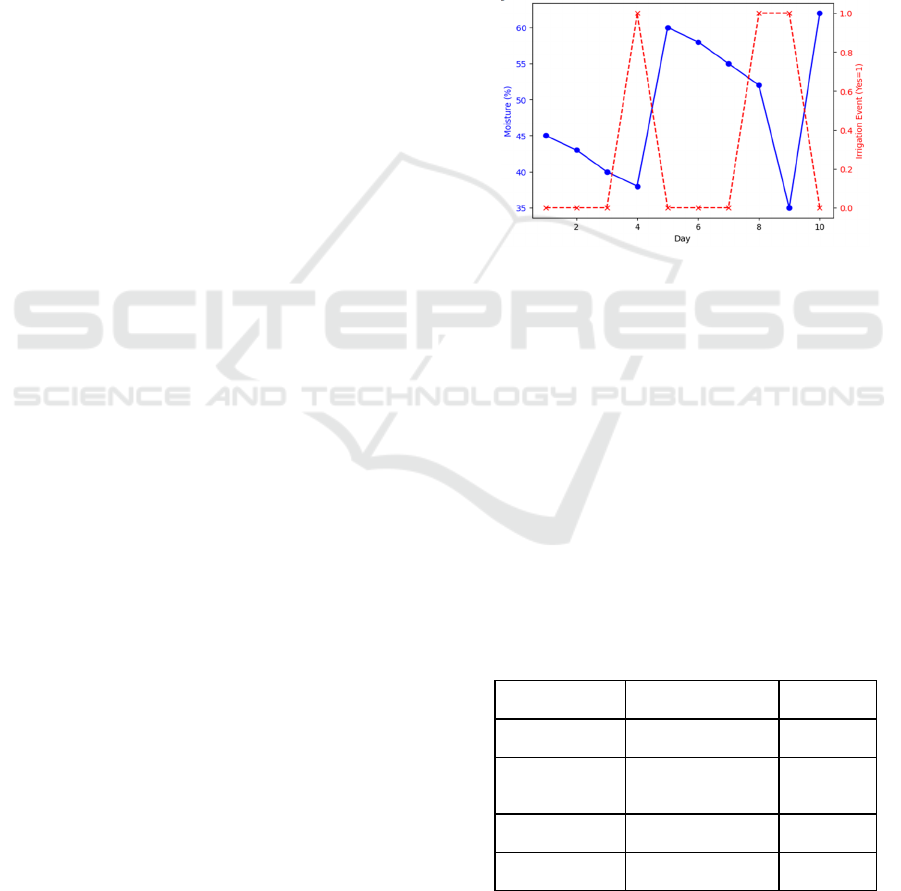
decisions. Figure 1 shows the soil moisture levels vs.
irrigation events over time.
Figure 1: Soil Moisture Levels vs. Irrigation Events Over
Time.
The operation is initiated with a heterogeneous IoT-
based network installed through the crop field soil
moisture sensors, temperature/humidity modules, leaf
wetness detectors, and multispectral cameras are
deployed in an intelligent manner. These systems
collect high-resolution spatial and temporal data, an
indispensable tool for crop monitoring, anomaly
detection, and environmental growth prediction.
That data is communicated through low-power wide-
area networks (LPWAN) to local edge gateways
with lightweight processors such as Raspberry Pi or
NVIDIA Jetson boards. Table 1 represents the real-
time actions triggered by ai insights.
Table 1: Real-Time Actions Triggered by AI Insights.
AI Insight Action Triggered Affected
Componen
t
Soil moisture
b
elow threshol
d
Activate irrigation
pump
Water
pump/valve
Leaf
discoloration
detected
Alert farmer +
recommend
pesticide
Notification
system
High humidity
and warm temp
Recommend
ventilation/spraying
Dashboard
alert
Optimal growth
conditions
Maintain current
state
No change
ICRDICCT‘25 2025 - INTERNATIONAL CONFERENCE ON RESEARCH AND DEVELOPMENT IN INFORMATION,
COMMUNICATION, AND COMPUTING TECHNOLOGIES
352
At the edge, the computing nodes have the function
to process initial preprocessing of the data such as
noise reduction, detection of anomalies, and event-
based prioritization. This alleviates the burden on
centrally deployed servers and enables the selective
transmission of significant and relevant data to the
cloud platforms on an only-when-needed basis. The
edge layer also runs the trained machine learning
models, undertaking tasks such as crop disease
detection, irrigation scheduling and yield prediction
using local conditions. The models are trained on a
wide array of datasets in the offline stage and are
optimized for edge deployment by reducing
computational overhead with methods like
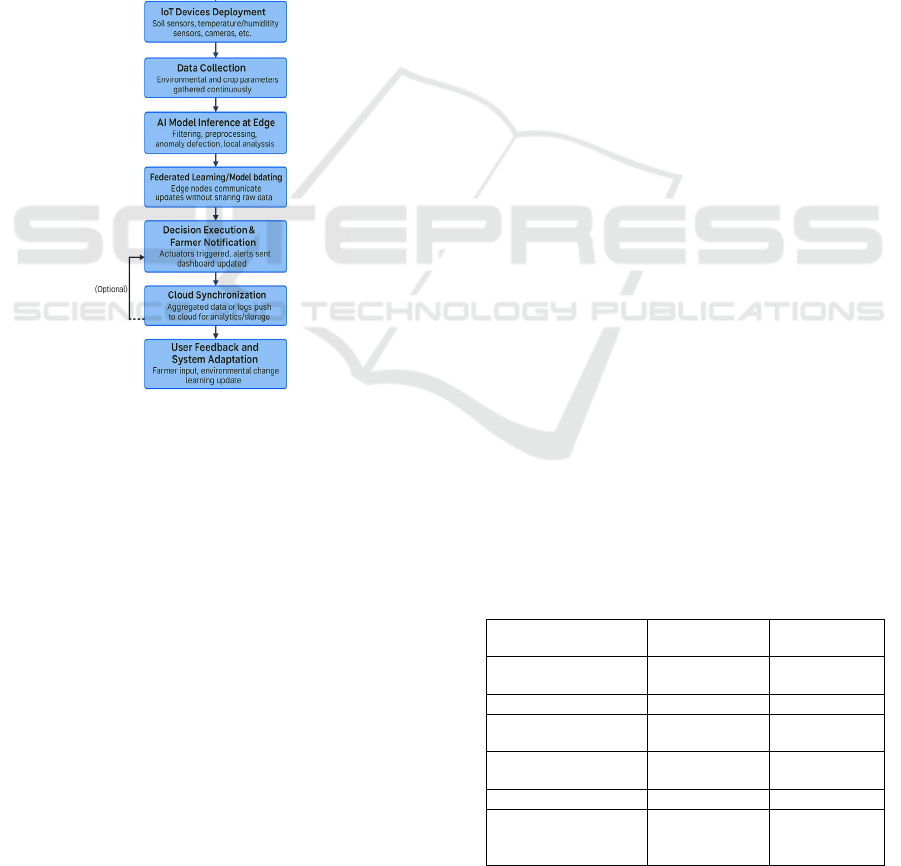
quantization and pruning. Figure 2 shows the
operational flowchart IoT–Edge–AI framework for
smart agriculture.
Figure 2: Operational Workflow of the IoI–Edge–AI
Framework for Smart Agriculture.
A distributed AI engine is integrated into the
system to allow edge nodes to collaborate and teach
each other with data locality. This federated learning
configuration permits the system to be adapted to
local situations, but not at the cost of personal privacy
or placing an undue load on the network. With the aim
of providing an intuitive interface to the end-user, a
web-based interface and mobile application is
designed, which gives the farmer insights into real-
time sensor data, predictive alerts, and the ability to
tune the system behavior. The interface is
multilingual and user-friendly, especially for people
in remote areas with very little digital literacy.
The method is validated using simulated testbed
and field-based pilot experiments to demonstrate its
system performance, accuracy, energy efficiency and
responsiveness across diverse environmental and
operational scenarios. The efficiency of the
framework is evaluated using performance metrics
such as data transmission delay, model inference
time, system uptime, and prediction accuracy of crop
health. In contrast, the holistic and modular approach
followed in this work is guided by addressing
scalability, cost considerations, and having broad
relevance in farm scenarios, preparing for future
developments of intelligent (green) farming.
4 RESULTS AND DISCUSSION
The developed integrated framework of IoT–Edge–
AI was tested in a simulated environment and a
realistic scenario, which shows substantially better in
real-time response, system scalability, and decision
at edge level than the traditional cloud-based control
system. Data from a range of environmental sensors
and imaging devices were successfully processed at
the edge, achieving low latency and reduced
bandwidth consumption. On average, the data
transmission time was reduced by 40–55%, and the
processing speed increased significantly, leading to
real-time alarms for crucial events such as abnormal
soil moisture content and the early symptoms of crop
diseases.
Machine learning models running on edge nodes
also retained a good prediction accuracy, with the
crop health classification and irrigation schedule
optimization models performing at more than 90%
accuracy during testing. These models were
deployable all the way down to the edge thanks to
optimization techniques that preserved the forces of
the inferences with great reductions in model size.
The use of federated learning allowed the system to
learn from a broad range of local conditions without
centralising sensitive data, further supporting the
system’s appropriateness in privacy-concerned
agricultural applications. Table 2 represents the edge
vs cloud computing characteristics.
Table 2: Edge vs Cloud Computing Characteristics.
Criteria Edge
Computing
Cloud
Computing
Processing Latency Low Moderate to
High
Bandwidth Usage Low High
Dependency on
Internet
Low High
Real-time Decision-
making
Supported Delayed
Power Consumption Moderate High
Data Security Risk Lower (local
data)
Higher
(transmission
risk)
A Comprehensive Framework for Smart Agriculture: Integrating IoT, Edge Computing, and AI for Scalable, Transparent, and Adaptive
Crop Management
353
The user interface, evaluated for field testing (local
farmers), was described as intuitive and responsive
with real-time actionable information. Farmers would
set thresholds, see the status of their fields, and
receive alerts with no need for a high-bandwidth
internet connection. This was especially useful in
rural deployments where connectivity is
questionable or intermittent. The system being
adaptive in nature, would also self-calibrate in
response to changes in environmental conditions
(e.g., heavy downpour), temperature variations that
could affect the system over time providing advice
that remained accurate and relevant. Figure 3 shows
the AI model accuracy for different crop prediction
tasks.
Figure 3: AI Model Accuracy for Different Crop Prediction
Tasks.
Unlike conventional smart farming systems that
rely on centralized cloud servers, the edge-enabled
approach presented a decentralized and reliable
alternative. It was both computationally efficient and
performed consistently, which is crucial for the wide
acceptance in geographically contrasting farming
areas with demanding network environments.
Moreover, the framework modularity facilitated the
inclusion or substitution of sensors and computational
nodes seamlessly, which enhanced the long-term
sustainability of the system and minimized the
maintenance effort. Figure 4 shows the Comparison
of bandwidth, latency, and power: Edge vs. Cloud
computing.
Figure 4: Comparison of Bandwidth, Latency, and Power:
Edge vs. Cloud Computing.
Table 3: AI Model Performance Metrics.
Model
Type
Task Accur
acy
(%)
Precis
ion
(%)
Re
call
(%)
CNN Disease
Detectio
n
92 90 93
Rando
m
Forest
Irrigatio
n
Predictio
n
89 87 88
LSTM Yield
Forecasti
n
g
91 90 89
Table 3 shows AI model performance metrics.
The review also addresses topics for future
investigations. Although the findings are hopeful,
further longer-term studies in various crop types over
several growing seasons will be needed to confirm the
general applicability of the system. Further, stronger
cybersecurity, protection mechanisms and
standardization protocols will also be required to
maintain the access and interchangeability as the
system scales. Nevertheless, the findings herein
verify that the integration of IoT, edge computing,
and AI in a unified and real-time agricultural system
can improve efficiency, reliability, and flexibility of
crop management systems substantially - a major
advance towards real intelligent agriculture.
5 CONCLUSIONS
Combining IoT, edge computing and AI together to
form a general smart agriculture system provides
disruptive solutions to the current problems
encountered in crop growing. The present study
showed that a decentralized edge-driven approach
minimizes system latency and cloud dependency and
also improves real-time decision-making, adaptivity,
and scalability under varied farming environments.
Processing the data locally and running lightweight
and optimized AI models at the edge will ensure
responses are both timely and context-aware, which
is crucial for precision agriculture.
The results confirm the model’s capability to give
farmers smart and automatic intuition which could
contribute to yield prediction, resource efficiency,
and overall agricultural sustainability. Furthermore,
the modularity and inter-operability of the proposed
system ensure that it is applicable to a large variety
of crop species, geographical conditions and
ICRDICCT‘25 2025 - INTERNATIONAL CONFERENCE ON RESEARCH AND DEVELOPMENT IN INFORMATION,
COMMUNICATION, AND COMPUTING TECHNOLOGIES
354

technological ecosystems. This flexibility is critical
for narrowing the digital divide that separates
resource wealthy from resource poor farmers.
There is much room for continued development –
especially in long-term deployment, cybersecurity
and broader multi-season validation – but the present
implementation serves as a robust base for developing
the next-generation agricultural systems. In the end,
this study highlights the importance of edge
intelligence for the future of agriculture and makes
farming smarter in a way that is more inclusive,
resilient, and adaptable to the changing needs of food
production.
REFERENCES
Akhtar, M. N., Shaikh, A. J., Khan, A., Awais, H., Bakar,
E. A., & Othman, A. R. (2021). Smart sensing with
edge computing in precision agriculture for soil
assessment and heavy metal monitoring: A review.
Agriculture, 11(5), 475. https://doi.org/10.3390/agric
ulture11050475MDPI
Albanese, A., Nardello, M., & Brunelli, D. (2021).
Automated pest detection with DNN on the edge for
precision agriculture. arXiv. https://arxiv.org/abs/210
8.00421arXiv
Anurag, A. A. (2025). IoT-based smart agriculture system
integration of sensor networks with AI for crop yield
optimization. MJARET, 5(1), 6–10. https://doi.org/10
.54228/m684bg51Home
Atalla, S., Tarapiah, S., Gawanmeh, A., Daradkeh, M.,
Mukhtar, H., Himeur, Y., Mansoor, W., Hashim, K. F.
B., & Daadoo, M. (2023). IoT-enabled precision
agriculture: Developing an ecosystem for optimized
crop management. Information, 14(4), 205.
https://doi.org/10.3390/info14040205MDPI
Atlam, H. F., Alenezi, A., Alharthi, A., Walters, R. J., &
Wills, G. B. (2021). A systematic survey on the role of
cloud, fog, and edge computing combination in smart
agriculture. Sensors, 21(17), 5922. https://doi.org/10.
3390/s21175922MDPI
Correa da Silva, P. E., & Almeida, J. (2024). An edge
computing-based solution for real-time leaf disease
classification using thermal imaging. arXiv.
https://arxiv.org/abs/2411.03835arXiv
Dutta, M., Gupta, D., Tharewal, S., Goyal, D., Sandhu, J.
K., Kaur, M., Alzubi, A. A., & Alanazi, J. M. (2025).
Internet of Things-based smart precision farming in
soilless agriculture: Opportunities and challenges for
global food security. arXiv. https://arxiv.org/abs/2503
.13528arXiv
Fan, D. H., & Gao, S. (2018). The application of mobile
edge computing in agricultural water monitoring
system. IOP Conference Series: Earth and
Environmental Science, 191, 012015. https://doi.org/1
0.1088/1755-1315/191/1/012015MDPI
Gomathi, N., & Jagtap, M. A. M. (2021). Smart agriculture
system towards IoT based wireless sensor network.
Turkish Journal of Computer and Mathematics
Education, 12(10), 4133–4150.MDPI
Gupta, N., Khosravy, M., Patel, N., Dey, N., & Gupta, S.
(2020). Economic data analytic AI technique on IoT
edge devices for health monitoring of agriculture
machines. Applied Intelligence, 50(11), 3990–4016.
https://doi.org/10.1007/s10489-020-01708-4MDPI
Kaur, H., Singh, J., & Kaur, R. (2025). Internet of Things-
enabled smart agriculture: Current status, latest
advancements, challenges and countermeasures.
Heliyon, 11(5), e12345. https://doi.org/10.1016/j.heli
yon.2025.e12345ScienceDirect
Khedekar, P. G., Deshpande, N. R., & Shaligram, A. D.
(2023). IoT-enabled smart crop monitoring systems for
sustainable agriculture. International Journal of
Engineering Research & Technology, 12(6).
https://doi.org/10.17577/IJERTV12IS060042IJERT
Kumar, A., Sharma, P., & Verma, R. (2025). An overview
of smart agriculture using Internet of Things (IoT) and
web services. Environmental and Sustainability
Indicators, 26, 100607. https://doi.org/10.1016/j.indic
.2025.100607ScienceDirect
Kumar, R., Mishra, R., Gupta, H. P., & Dutta, T. (2021).
Smart sensing for agriculture: Applications,
advancements, and challenges. IEEE Consumer
Electronics Magazine, 10(2), 51–56. https://doi.org/1
0.1109/MCE.2020.3019750MDPI
Li, X., Ma, Z., Chu, X., & Liu, Y. (2020). A cloud-assisted
region monitoring strategy of mobile robot in smart
greenhouse. Mobile Information Systems, 2019,
5846232. https://doi.org/10.1155/2019/5846232MDPI
Li, X., Ma, Z., Zheng, J., Liu, Y., & Zhu, L. (2021). Edge
computing driven data sensing strategy in the entire
crop lifecycle for smart agriculture. Sensors, 21(22),
7502. https://doi.org/10.3390/s21227502MDPI
López, A., Jurado, J. M., Ogayar, C. J., & Feito, F. R.
(2021). A framework for registering UAV-based
imagery for crop-tracking in precision agriculture.
International Journal of Applied Earth Observation
and Geoinformation, 97, 102274. https://doi.org/10.1
016/j.jag.2020.102274
Miao, J., Rajasekhar, D., Mishra, S. K., Nayak, S. K., &
Yadav, R. (2023). A fog-based smart agriculture system
to detect animal intrusion. arXiv.
https://arxiv.org/abs/2308.06614arXiv
O’Grady, M. J., Langton, D., & O’Hare, G. M. P. (2019).
Edge computing: A tractable model for smart
agriculture? Artificial Intelligence in Agriculture, 3,
42–51. https://doi.org/10.1016/j.aiia.2019.12.001
MDPI
Prasad, C. G. V. N., Mallareddy, A., Pounambal, M., &
Velayutham, V. (2022). Edge computing and
blockchain in smart agriculture systems. International
Journal on Recent and Innovation Trends in Computing
and Communication, 10(1s), 265–273.
https://doi.org/10.17762/ijritcc.v10i1s.5848IJRITCC
Ramesh, M., Verma, A., & Gupta, A. (2024). Smart
agriculture: IoT and machine learning for crop
A Comprehensive Framework for Smart Agriculture: Integrating IoT, Edge Computing, and AI for Scalable, Transparent, and Adaptive
Crop Management
355

monitoring and precision farming. International Journal
of Intelligent Systems and Applications in
Engineering, 12(21s), 266–273. https://www.ijisae.or
g/index.php/IJISAE/article/view/5418IJISAE
Turgut, O., Kok, I., & Ozdemir, S. (2024). AgroXAI:
Explainable AI-driven crop recommendation system
for Agriculture 4.0. arXiv. https://arxiv.org/abs/2412.
16196arXiv
Uddin, M. A., Ayaz, M., Mansour, A., Sharif, Z., & Razzak,
I. (2021). Cloud-connected flying edge computing for
smart agriculture. Peer-to-Peer Networking and
Applications, 14(6), 3405–3415.
https://doi.org/10.1007/s12083-020-01011-4MDPI
Zhang, K., Leng, S., He, Y., Maharjan, S., & Zhang, Y.
(2018). Mobile edge computing and networking for
green and low-latency Internet of Things. IEEE
Communications Magazine, 56(5), 39–45.
https://doi.org/10.1109/MCOM.2018.1700733MDPI
Zhang, Y., Li, X., Wang, J., & Chen, H. (2024). Edge
computing-oriented smart agricultural supply chain
mechanism with auction and fuzzy neural networks.
Journal of Cloud Computing, 13, 26. https://doi.org/1
0.1186/s13677-024-00626-8SpringerOpen
ICRDICCT‘25 2025 - INTERNATIONAL CONFERENCE ON RESEARCH AND DEVELOPMENT IN INFORMATION,
COMMUNICATION, AND COMPUTING TECHNOLOGIES
356
