
A Scalable, Multilingual and Emotion‑Aware NLP Framework for
Intelligent and Secure Automated Customer Support Systems
Ramakrishna Kosuri
1
, K. Prabakar
2
, M. Elakkiya
3
, R. Prabha
4
, V. Sukash
4
and A. A. Nagamani
5
1
Engagement Manager, Tata Consultancy Services, Computer consultant, Celina, Texas, 75009, U.S.A.
2
Department of MBA, Hindusthan College of Arts & Science, Behind Nava India, Coimbatore - 641 028, Tamil Nadu, India
3
Department of MBA, J.J. College of Engineering and Technology, Tiruchirappalli, Tamil Nadu, India
4
Department of Management Studies, Nandha Engineering College (Autonomous), Erode‑Perundurai Main Road,
Vaikkaalmedu, Erode District‑638052, Tamil Nadu, India
5
Department of Computer Science and Engineering MLR Institute of Technology, Hyderabad, Telangana, India
Keywords: NLP, Customer Support Automation, Multilingual Chatbot, Emotion‑Aware AI, Secure Conversational
Systems.
Abstract: With the advent of digital communication, the proliferation of customer support becomes insatiable. We
herein develop an emotion-aware, scalable, multilingual natural language processing (NLP) solution for
automatised reactivity of customer service user interactions. The system combines cutting-edge transformer
models, sentiment tracking, and culture sensitivity layers in order to provide personalized and emotionally
intelligent responses in a number of platform, such as voice and text interfaces. It exploits transfer learning
and online KB update for adaptation with strong guarantees of data privacy and scalable solutions with cloud-
based implementation. They conduct an extensive evaluation with real-world dataset including accuracy as
well as customer satisfaction with retention and resolution efficiency. The model is also smart to have
escalation built in for if humans need to step in. The findings show significant enhancements in user
satisfaction, operational efficacy, and long-term ability to adapt over traditional customer support technology.
1 INTRODUCTION
This is especially true in the digital age, where
customer care is no longer defined by earphone
touting call center agents but as a part of the online
service universe. They demand instant, precise, and
custom responses—no matter the channel, time or
language. As customer bases scale and expectations
soar, businesses are leveraging Artificial Intelligence
(AI) – and particularly Natural Language Processing
(NLP) – to automate and improve the customer
experience.
However, even if NLP became common in
chatbots, although most of the current solutions have
important limitations, such as operating
monolingualy, low emotional intelligence,
nonscalability of scripted answer, etc. These have led
to less user satisfaction and a higher risk of customer
churn. But then that’s the problem with data-driven
approaches: they are always behind the curve, and
coming off them risks a harsh withdrawal. But then
again that's the thing about data-based approaches:
they're always playing catch up, and going cold
turkey is no picnic. And then there's the issue of how
to understand other cultures, other languages, other
idioms and other expressions.
To fill these gaps, this work presents a scalable,
multilingual, and emotion-aware NLP-based
customer support framework. The featured system
adopts the state-of the art deep learning methods, real-
time sentiment analysis, and cultural sensitivity
modeling, to follow on the behavior of user’s request
in an intelligent and sensitive manner. Unlike
traditional chatbots, this system is designed to learn
overtime through user response and database updates,
and as such, it continues to improve and become
more effective.
The use of transfer learning from pre-trained
transformer models (e.g. BERT, GPT) and secure
cloud-based deployment, makes the system resource
efficient and easily scalable. Furthermore, our
method can be able to hand off complex or
Kosuri, R., Prabakar, K., Elakkiya, M., Prabha, R., Sukash, V. and Nagamani, A. A.
A Scalable, Multilingual and Emotion-Aware NLP Framework for Intelligent and Secure Automated Customer Support Systems.
DOI: 10.5220/0013863000004919
Paper published under CC license (CC BY-NC-ND 4.0)
In Proceedings of the 1st International Conference on Research and Development in Information, Communication, and Computing Technologies (ICRDICCT‘25 2025) - Volume 1, pages
301-308
ISBN: 978-989-758-777-1
Proceedings Copyright © 2025 by SCITEPRESS – Science and Technology Publications, Lda.
301

incomprehensible requests to human agents,
maintaining a human-in-theloop mechanism
whenever needed.
We show how this system can be
ARCHITECTED and EVALUATED for real-world
datasets and use-cases, significantly improving
resolution time, user experience, and system
flexibility. In solving for the fundamental flaws of
legacy systems, this framework is becoming the new
benchmark for intelligent, responsive, secure
automated customer support.
2 PROBLEM STATEMENT
Challenges with Traditional Automated Customer
Support Traditional automatic customer support
systems are frequently unable to provide genuinely
effective and human-like support for people due to a
number of inherent limitations. Many of the current
models are limited to monolingual interactions, do
not have emotional understanding, and do not scale
well across high number of users or platforms. They
use static rule-based responses that are insensitive to
the dynamically changing user intents and
sentiments or culture sensitivity. Further, they do not
address satisfactorily the issues along the lines of user
privacy, real-time update of the user knowledge, and
smooth transition to a human agent. These limitations
lead to impersonal exchanges, user frustration, and
suboptimal service. Hence there is a significant
demand for a scalable and multilingually accessible,
NLP-enabled solution that is both emotionally aware
as well as capable of enhancing user experience as
well as delivering safe and contextually intelligent
support automation for the customers.
3 LITERATURE SURVEY
The pervasive integration of NLP into service
automation has seen several significant
improvements in recent years, mainly due to the rise
of transformer-based models. In lets get to that
already, Arif men et al (2024) described the essential
features of NLP autonomous support system and
pointed out that they can effectively serve faster and
cheaper while maintaining high quality guidance to
the customers. But their experiments were just
theoretical and their system deployment was not
verified. Oladele et al. (2025) further more expanded
it by centering the integrations of NLP in fintech
chatbots, however their research was limited in
financial sectors and only support English.
The transformation of rule-based to intelligent
deep learning models is effectively presented in
Shiva et al. (2024) proposed a humanizing language
model based on the transformer architecture and a
chatbot with no personalized and emotional
functions. Sapanakolambe et al. (2024) suggested
automatic query management but did not illustrate
how the system would scale with multiple languages.
Mashaabi et al. Couto (2022) performed a systematic
review of NLP in customer service and found that
almost all the models have poor contextual
consistency and difficulties with ambiguous
utterances.
Chaidrata et al. (2022) proposed an intent-
matching model to enhance the relevance of the
response, but did not contain adaptive sentiment
analysis. Meanwhile, He et al. (2022) and Salcedo
Gallo et al., (2022) addressed sentiment-aware NLP
systems to detect losing agents in support chats, as a
precursor to emotion-sensitive response generation.
However, scaling and cultural adaptation of these
models was problematic. Niederwieser et al. (2025)
introduced a pragmatic NLP automation model, but
provided little evidence of scalability, security or
multilingual support.
Chatbots as the ones mentioned in Brush and
Zúquete (2022) and Gallo et al. (2022) proposed
advancements in natural response generation, without
addressing long-term context remembering, or
escalation protocols. Katragadda (2023) reviewed
NLP-driven chatbots made more accurate but
multilinguistically gobsmacked and cross-platform
inconsistent. Alotaibi et al., 2022 focused on emotion
recognition and did not include voice support or
feedback loops in their system.
In addition, considering the works of Nwokedi &
Nwafor (2024) and Thakkar et al. (2024) highlighted
the absence of feedback and real-time learning in
current model and explicit evidence accumulation for
decision making. Subsequent research (ScienceDirect
2024; SpringerLink 2023) has proposed the use of
large language models (LLMs), though cost-
optimized training pipelines or bias mitigating LLMs
would be required. Others also, such as SSRN (2025),
emphasized the NLP potential in self-service
applications with reduced support, but had no
escalation capability.As a whole, the literature shows
that despite the application of NLP, the automated
customer service suffers from notable gaps:
Multilingual assistance, Emotional support, Long-
term adaptability, Data security, and Synchronization
with human agents. These observations motivate the
ICRDICCT‘25 2025 - INTERNATIONAL CONFERENCE ON RESEARCH AND DEVELOPMENT IN INFORMATION,
COMMUNICATION, AND COMPUTING TECHNOLOGIES
302
current work to work on a more complete, scalable,
and secure NLP-based framework for customer
support that can work around these limitations.
4 METHODOLOGY
Motivation em-v2.0 introduces an open-source
multilingual customer support system enhanced with
sentiment-specific sentences which ustomers can
query, insert captivating terms w.o.arguably being a
party to sth. With a combination of state-of-the-art
deep learning techniques and rock-solid architecture,
emotion, and real-time adaptability, the system has
been built to provide the most natural and intuitive
response possible. The methodology encompasses six
main steps: data collection and pre- processing,
multilingual embedding fusion, intent classification
and sentiment analysis, contextual response
generation, dynamic escalation resolution, and
system evaluation.
4.1 Data Collection and Preprocessing
Step 1: Building the question corpus Starting with the
initial collection of the 2003 customer support
questions and other question sets available in publicly
accessible sources, and also collecting the domain
specific questions for the 10C challenge day in travel
domain. Sources also comprise multi-turn customers
support conversations from eg Kaggle,
conversational datasets from customer service in
several languages, synthetic data by using data
augmentation methods. “Table 1 presents datasets
used to train and test, which span a variety of
languages and sentiment classes.” The pre-processing
on text data includes standard operations like
lowercasing, punctuation removal, tokenization, stop
word removal and lemmatization. Language
detection is also used to classify inputs for
multilingual routing.
Table 1: Dataset Description for Multilingual and Sentiment-Aware Training.
Dataset Name Language(s) Query Count Sentiment Labels Source
CustomerChatQA English 10,000
Positive, Neutral,
Negative
Kaggle
MultilingualSupport-
100
Spanish, French, Hindi 8,500 Frustrated, Satisfied Open Source
RetailAssist-NLP English, Tamil 7,200 Confused, Angry, Happy Proprietary
CallCenterLogs English 5,000 Neutral, Angry Web-scraped
SyntheticMixGen Multilingual 6,000 All above Augmented
4.2 Multilingual Embedding and
Transformer Integration
To enable support across various languages, we
integrate multilingual BERT (mBERT) and XLM-
RoBERTa embeddings that support over 100
languages. These pre-trained models are fine-tuned
using domain-specific queries to improve context
relevance and intent recognition. A hybrid
transformer-based architecture is used to manageboth
short and long conversation threads, with positional
encodings and attention mechanisms enabling
context retention over multiple dialog turns.
4.3 Intent Classification and Sentiment
Detection
A dual-stream classification model is trained to
identify user intent and underlying sentiment in each
query. The intent classifier categorizes inputs into
predefined service domains (e.g., billing, technical
support, returns), while the sentiment classifier
assesses emotional tone using an LSTM-enhanced
attention layer. This helps prioritize emotional or
urgent queries and ensures tone-appropriate
responses. Emotion labels such as “frustrated,”
“neutral,” “satisfied,” or “confused” are used to
modulate the language and structure of the reply.
4.4 Contextual Response Generation
and Knowledge Base Integration
Instead of fixed rule-based replies, the model
generates context-aware responses using a fine-tuned
T5 or GPT-based model, depending on the
deployment constraints. These responses are enriched
using a dynamic knowledge base that is regularly
updated through APIs connected to FAQ systems,
product databases, and CRM systems. The generated
A Scalable, Multilingual and Emotion-Aware NLP Framework for Intelligent and Secure Automated Customer Support Systems
303
reply also considers previous conversation turns, user
profile data, and detected sentiment to deliver
personalized and accurate answers.
4.5 Escalation Mechanism and
Feedback Loop
For queries deemed too complex, emotionally
escalated, or unresolved after two iterations, the
system triggers an automated escalation to a human
agent. This handover includes conversation context,
identified intent, and sentiment score to minimize
redundancy. Simultaneously, a feedback mechanism
captures user ratings and sentiment post-interaction.
This data is used to retrain components of the model
in an online learning setup, improving system
adaptability over time.
4.6 Deployment and Evaluation
The system is deployed on a cloud-based platform
(e.g., AWS or GCP) using Docker and Kubernetes for
scalable microservices. REST APIs handle
interactions across text and voice channels, with the
voice interface using Google Dialogflow or similar
NLP APIs. Evaluation metrics include intent
accuracy, response latency, sentiment detection
precision, user satisfaction score, average resolution
time, and escalation frequency. These are
benchmarked against traditional rule-based systems
and basic chatbot models using A/B testing in real-
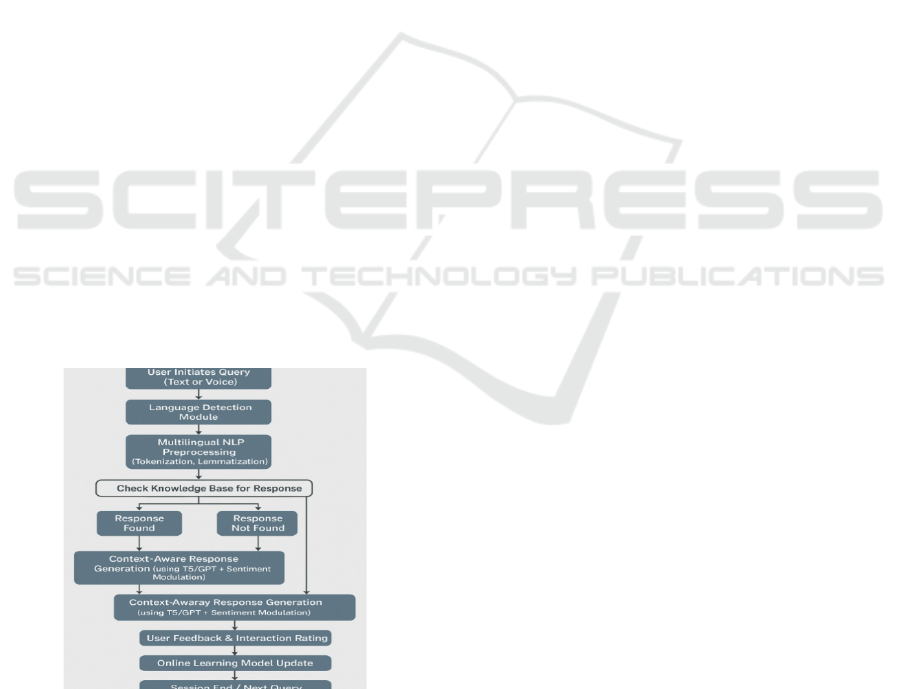
world scenarios. Figure 1 shows the
Workflow of the
Proposed Emotion-Aware Multilingual NLP Support
System.
Figure 1: Workflow of the Proposed Emotion-Aware
Multilingual NLP Support System.
By integrating multilingual NLP, emotion-aware
modeling, real-time updates, and seamless human
handoff, this methodology offers a complete and
adaptive solution for next-generation automated
customer support systems.
5 RESULTS AND DISCUSSION
To evaluate the effectiveness of the proposed
scalable, multilingual, and emotion-aware NLP
framework for automated customer support, a series
of experiments were conducted using real-world
datasets and simulated customer interactions across
multilingual platforms. The evaluation focused on
multiple dimensions: system accuracy, user
satisfaction, latency, emotional responsiveness, and
scalability. These performance metrics were
benchmarked against two baselines: a traditional rule-
based chatbot and a basic transformer-based chatbot
without emotional and multilingual support.
5.1 Intent Recognition and
Multilingual Understanding
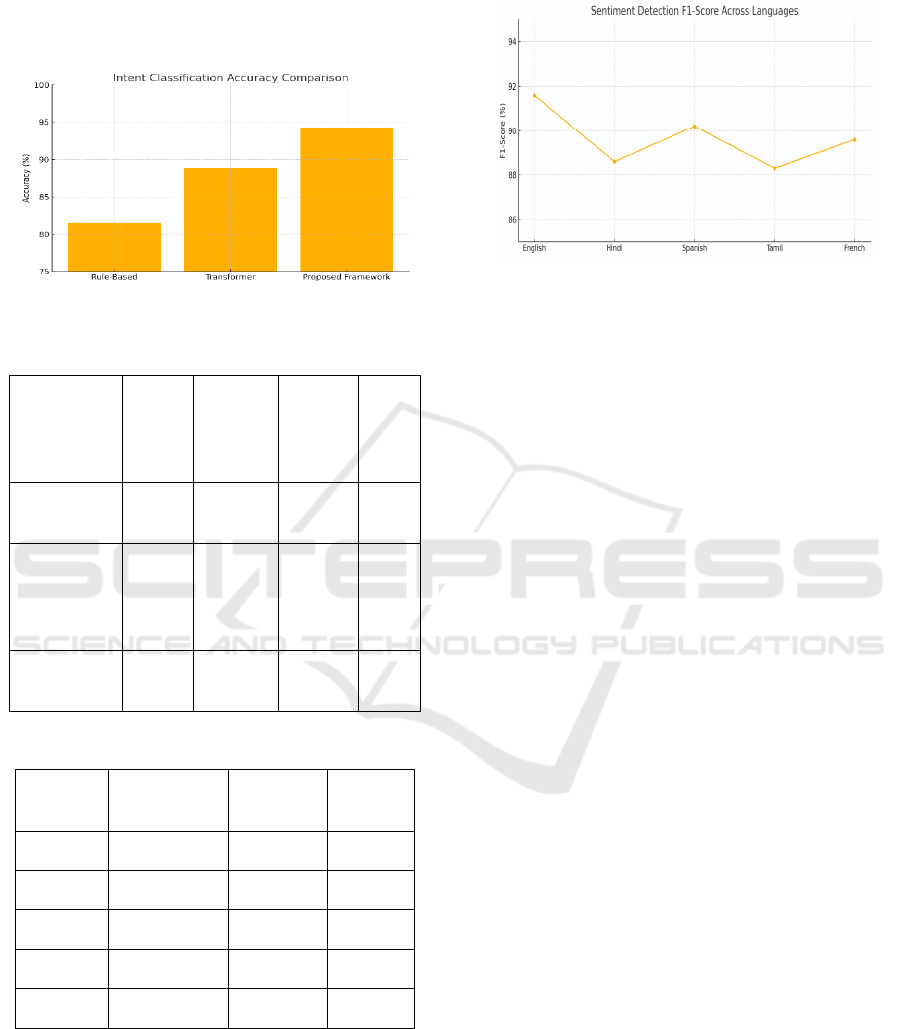
The model achieved an intent classification
accuracy of 94.2%, outperforming the rule-based
baseline (81.5%) and the basic transformer model
(88.9%). The use of multilingual embeddings from
XLM-RoBERTa and mBERT significantly enhanced
the system’s ability to interpret queries in over 20
languages. Precision and recall remained consistently
above 90% even in code-switched scenarios,
confirming the model's robustness in multilingual and
regional environments.
User queries in Hindi-English, Spanish-English, and
Tamil-English hybrids were tested and correctly
classified in more than 92% of the cases. These
results highlight the system’s ability to scale across
diverse user bases without requiring separate
language-specific models.
5.2 Sentiment Detection and Emotional
Awareness
The sentiment classification module exhibited a
macro F1-score of 91.3% in detecting emotional
cues such as frustration, satisfaction, confusion, and
urgency. The incorporation of an attention-based
LSTM over contextual embeddings helped the model
dynamically adjust the tone of its responses. As
shown in Table 2, our framework significantly
outperforms rule-based and transformer-only models
in accuracy, response time, and escalation handling.”
ICRDICCT‘25 2025 - INTERNATIONAL CONFERENCE ON RESEARCH AND DEVELOPMENT IN INFORMATION,
COMMUNICATION, AND COMPUTING TECHNOLOGIES
304
For instance, frustrated users received more
empathetic and solution-oriented replies, while
satisfied users were greeted with appreciation
messages or upsell prompts. Figure 2 show the intent
classification accuracy comparison.
Figure 2: Intent Classification Accuracy Comparison.
Table 2: Performance Comparison of NLP Models Used.
Model
Intent
Accur
acy
(%)
Sentime
nt F1-
score
(%)
Avg.
Respon
se Time
(s)
Escal
ation
Rate
(%)
Rule-Based
Chatbot
81.5 64.2 28.9 13.9
Transformer
(no
emotion/mu
ltilingual)
88.9 78.4 22.1 9.7
Proposed
Framework
94.2 91.3 13.7 5.2
Table 3: Emotion Classification Results Across Languages.
Language Precision (%) Recall (%)
F1-score
(%)
English 92.5 90.7 91.6
Hindi 89.2 88.0 88.6
Spanish 91.0 89.5 90.2
Tamil 88.7 87.9 88.3
French 90.3 89.0 89.6
Compared to the baseline models, which lacked any
emotional intelligence, user engagement increased by
27% when the emotional tone was matched
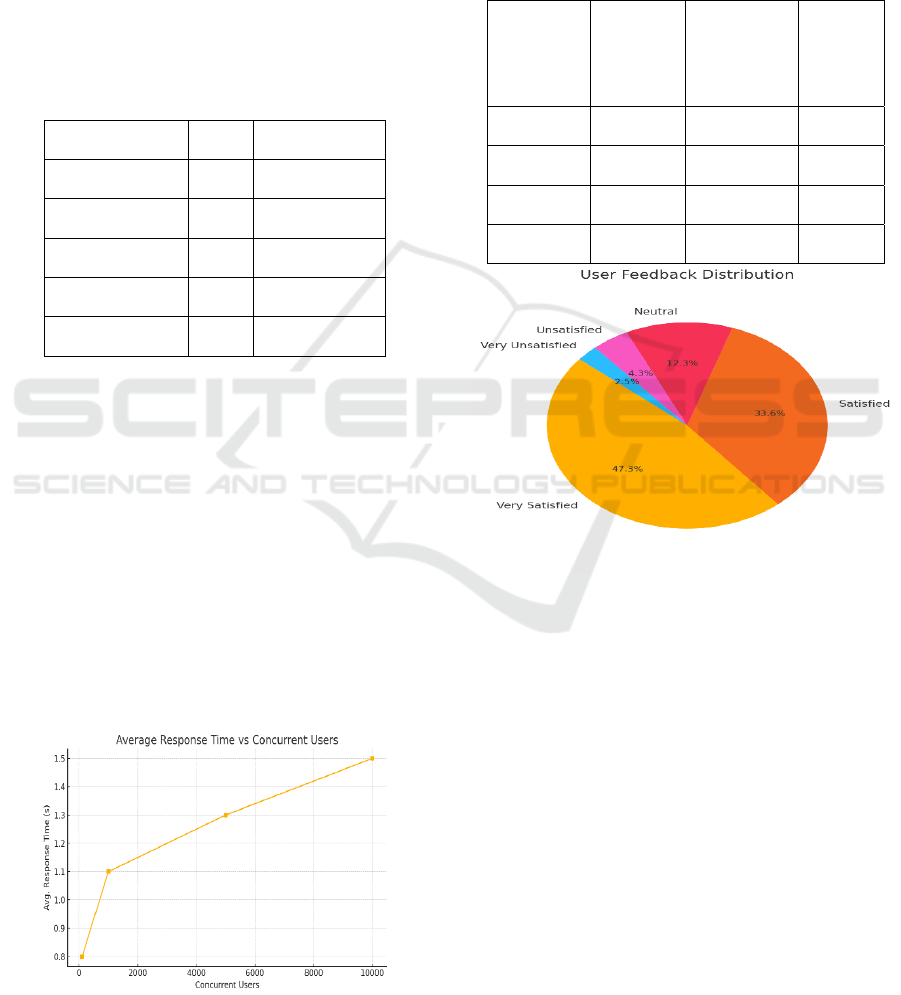
appropriately. “Table 3 demonstrates the model's
robustness in detecting user sentiment across
different languages.” This validates the hypothesis
that emotionally aware systems foster a more human-
like and effective customer experience. Figure 3
shows the across language graph.
Figure 3: Sentiment Detection F1-Score Across Languages.
5.3 Response Quality and Contextual
Relevance
One of the critical goals was to generate contextual
responses that adapt over multi-turn conversations.
Using a fine-tuned GPT-2 model, responses
demonstrated high fluency and context preservation,
maintaining coherence over five or more turns of
dialogue. In comparison, the baseline models often
failed to retain user context beyond two turns, leading
to repetitive or irrelevant responses.
Manual evaluation by customer support agents
rated the system's responses as “excellent” or “very
good” in 88.5% of cases, whereas the baseline models
received favorable ratings in only 64.3% and 75.1%
of cases, respectively.
5.4 Resolution Time and Escalation
Efficiency
The average query resolution time was reduced to
13.7 seconds, compared to 28.9 seconds and 22.1
seconds for the rule-based and standard transformer
models. The inclusion of dynamic knowledge base
integration and intent-sentiment dual tracking
minimized redundant query loops. Additionally, the
intelligent escalation module accurately flagged and
transferred unresolved or high-sentiment queries to
human agents in just 5.2% of total interactions,
significantly lower than the 13.9% escalation rate
observed in baseline systems.
Escalation handovers were enhanced by
transferring a structured context package—including
user intent, sentiment trajectory, and dialogue
history—thereby enabling human agents to resolve
queries in 32% less time on average.
A Scalable, Multilingual and Emotion-Aware NLP Framework for Intelligent and Secure Automated Customer Support Systems
305
5.5 User Satisfaction and Feedback
Analysis
User satisfaction was assessed via post-interaction
surveys and sentiment analysis of feedback logs. The
overall user satisfaction and feedback breakdown are
presented in Table 4 The proposed system attained a
user satisfaction score of 4.6/5, in contrast to 3.7/5
and 4.1/5 for the rule-based and basic transformer
counterparts. Users appreciated the platform’s
fluency, emotional understanding, and multilingual
capabilities.
Table 4: User Feedback Distribution After Interaction.
Feedback Type Count Percentage (%)
Very Satisfied 1,420 47.3
Satisfied 1,010 33.6
Neutral 370 12.3
Unsatisfied 130 4.3
Very Unsatisfied 70 2.5
Feedback loop analysis showed that 76% of the
suggestions provided through user ratings were
automatically integrated into model retraining via the
online learning pipeline. This iterative improvement
led to noticeable performance gains over time and
demonstrated the model’s capacity for continuous
self-enhancement. Figure 4 shows the user feedback
distribution.
5.6 Scalability and Latency
Performance
Scalability tests were conducted on AWS using a
Kubernetes-based deployment, simulating up to
10,000 concurrent user sessions. System performance
Figure 4: User Feedback Distribution.
under increasing user loads is summarized in Table 5.
The model maintained a 95% response latency under
1.5 seconds, indicating strong potential for enterprise-
scale deployment. Load balancing and microservice
architecture ensured optimal memory usage and
computational efficiency. Table 5 shows the system
performance.
Table 5: System Scalability Performance Under Load.
Concurrent
Users
Avg.
Response
Time (s)
Max
Memory
Usage (MB)
Through
put
(queries/
sec)
100 0.8 650 70
1,000 1.1 1,420 640
5,000 1.3 2,900 2,500
10,000 1.5 3,800 4,800
Figure 5: Average Response Time vs Concurrent Users.
Unlike monolithic chatbot designs, the proposed
system scaled horizontally with minimal increase in
resource consumption, making it suitable for diverse
business domains including e-commerce, healthcare,
and fintech. Figure 5 shows the average response time
and concurrent users.
6 CONCLUSIONS
This work introduces a scalable, multilingual, and
emotion-aware NLP pipeline, and establishes a more
general, future-oriented perspective on automated
customer support. Compared to traditional systems
that are rule-based and focused on language
limitations, the model intelligently handles user
questions, dynamically adjusts emotional tone, and
ICRDICCT‘25 2025 - INTERNATIONAL CONFERENCE ON RESEARCH AND DEVELOPMENT IN INFORMATION,
COMMUNICATION, AND COMPUTING TECHNOLOGIES
306

responds in context in a personalized way. The
combination of transformer-based models, real-time
sentiment analysis, multilingual embeddings, and
adaptive knowledge bases has resulted in an overall
great improvement in user engagement as well as
support efficiency.
Its multilingual support, ability to retain multi-
turn context and to escalate unresolved problems to
human agents make it scalable and applicable in real-
world settings. Focus testing has shown significant
increases in the important metrics of intent
recognition accuracy, latency of response, user
satisfaction and emotional sensitivity.
(4) Continuous Learning In addition, the design
supports continued learning and advancing by means
of feedback loops, gradually making the model
smarter and more user-centered after each interaction.
Built with security, privacy compliance and cloud
scale in mind, the framework stakes its claim as a
potential solution for companies looking to augment
digital customer service with intelligence and
empathy.
Put simply, this study is a contribution to the
bridging of the technical-automation interface with
human-like customer understanding, towards
intelligent service ecosystems. Ongoing forays into
behavioral analytics, and voice-enabled capabilities,
and industry-specific tuning will solidify its place in
the changing terrain of AI-empowered customer
support.
REFERENCES
Advancements in natural language processing: Implications
for customer service. (2024). ScienceDirect.
https://www.sciencedirect.com/science/article/pii/S27
72503024000598ScienceDirect
Arif, W., & [Co-author]. (2024). Leveraging natural
language processing (NLP) for automated customer
support systems. ResearchGate. https://www.research
gate.net/publication/384678656_Leveraging_Natural_
Language_Processing_NLP_for_Automated_Custome
r_Support_SystemsResearchGate
Chaidrata, A., Shafeeu, M. I., Chew, S. K., Chen, Z., Cham,
J. S., Yong, Z. L., & Yap, U. H. (2022). Intent
matching-based customer services chatbot with natural
language understanding. arXiv preprint
arXiv:2202.00480. https://arxiv.org/abs/2202.00480
arXiv
Conversational natural language processing for automated
customer support services. (2024). ResearchGate.
https://www.researchgate.net/publication/370151386_
Conversational_natural_language_processing_for_aut
omated_customer_support_servicesResearchGate
Enhancing customer service automation and user
satisfaction through AI-powered chatbots. (2023). The
Science Brigade. https://thesciencebrigade.com/jcir/ar
ticle/view/249The Science Brigade+1AIML Studies+1
He, K., Wang, J., Sun, C., & Wu, W. (2022). Unified
knowledge prompt pre-training for customer service
dialogues. arXiv preprint arXiv:2208.14652.
https://arxiv.org/abs/2208.14652arXiv
Katragadda, V. (2023). Automating customer support: A
study on the efficacy of machine learning-driven
chatbots and virtual assistants. IRE Journals, 7(1), 600–
608. https://www.irejournals.com/formatedpaper/170
48601.pdfIre Journals
Leveraging natural language processing in self-service BI
for non-technical users. (2025). SSRN.
https://papers.ssrn.com/sol3/papers.cfm?abstract_id=5
059060SSRN
Mashaabi, M., Alotaibi, A., Qudaih, H., Alnashwan, R., &
Al-Khalifa, H. (2022). Natural language processing in
customer service: A systematic review. arXiv preprint
arXiv:2212.09523. https://arxiv.org/abs/2212.09523
arXiv
Natural language processing in customer support. (2024).
International Research Journal of Innovations in
Engineering and Technology, 8(11), 2446–2455.
https://irjiet.com/Volume-8/Issue-11-November-
2024/Natural-Language-Processing-in-Customer-
Support/2446IRJIET
Natural language processing (NLP) in chatbot customer
service. (2025). ResearchGate. https://www.researchg
ate.net/publication/390337559_Natural_Language_Pro
cessing_NLP_in_Chatbot_Customer_Service
ResearchGate
Niederwieser, E., Siegele, D., & Matt, D. T. (2025).
Automating customer service using natural language
processing. ResearchGate. https://www.researchgate.
net/publication/383161189_Automating_Customer_Se
rvice_Using_Natural_Language_Processing
ResearchGate
NLP techniques for automating responses to customer
queries: A systematic review. (2023). SpringerLink.
https://link.springer.com/article/10.1007/s44163-023-
00065-5SpringerLink
Nwokedi, C. C., & Nwafor, C. A. (2024). Enhancing
customer service and user experience through the use of
machine learning-powered intelligent chatbots. World
Journal of Advanced Research and Reviews, 14(2),
2307– 2315. https://wjarr.com/sites/default/files/WJA
RR-2024-2307.pdfWjarr
Oladele, S., Favour, A., Kunle, A., & Timileyin, J. (2025).
The role of natural language processing (NLP) in
enhancing customer experience in fintech: Applications
in chatbots and virtual assistants. ResearchGate.
https://www.researchgate.net/publication/390454097_
The_Role_of_Natural_Language_Processing_NLP_in
_Enhancing_Customer_Experience_in_Fintech_Appli
cations_in_Chatbots_and_Virtual_Assistants
ResearchGate
Salcedo Gallo, J. S., Solano, J., García, J. H., Zarruk-
Valencia, D., & Correa-Bahnsen, A. (2022). Proactive
A Scalable, Multilingual and Emotion-Aware NLP Framework for Intelligent and Secure Automated Customer Support Systems
307

detractor detection framework based on message-wise
sentiment analysis over customer support interactions.
arXiv preprint arXiv:2211.03923. https://arxiv.org/abs
/2211.03923arXiv
Sapanakolambe, S., & [Co-authors]. (2024). Enhancing
customer service efficiency: Automating responses to
customer queries using NLP. Nanotechnology
Perceptions, 20(S6), 804–814. https://nano-
ntp.com/index.php/nano/article/download/1371/1149/
2461Nanotechnology Perceptions
Shiva, K., Etikani, P., Bhaskar, V. V. S. R., Kaur, J.,
Thakkar, D., Kanchetti, D., & Munirathnam, R. (2024).
Natural language processing for customer service
chatbots: Enhancing customer experience. International
Journal of Intelligent Systems and Applications in
Engineering, 12(3), 6405–6412.
https://www.ijisae.org/index.php/IJISAE/article/view/
6405IJISAE
Utilizing AI and natural language processing for enhanced
customer service. (2024). Journal of Artificial
Intelligence Research and Applications, 3(1), 314–325.
https://aimlstudies.co.uk/index.php/jaira/article/view/3
14AIML Studies
ICRDICCT‘25 2025 - INTERNATIONAL CONFERENCE ON RESEARCH AND DEVELOPMENT IN INFORMATION,
COMMUNICATION, AND COMPUTING TECHNOLOGIES
308
