
Advanced Artificial Intelligence‑Driven Financial Forecasting
Models: Enhancing Market Trend Prediction and Investment Risk
Management through Real‑Time Validation and Comprehensive AI
Integration
Dev Kumar
1
, K. Raghuveer
2
, J. Veni
3
, L. Jothibasu
4
, K. Mithun Krishna
4
and S. Sathyakala
5
1
Institute of Management Studies and Research (IMSAR), Maharshi Dayanand University, Rohtak, Haryana, India
2
School of Management, Siddhartha Academy of Higher Education (Deemed to be University), Kanuru, Andhra Pradesh,
India
3
Department of MBA, J.J. College of Engineering and Technology, Tiruchirappalli, Tamil Nadu, India
4
Department of Management Studies, Nandha Engineering College, Vaikkalmedu, Erode, Tamil Nadu, India
5
Department of Management Studies, Sona College of Technology, Salem, Tamil Nadu, India
Keywords: Financial Forecasting, Artificial Intelligence, Market Trends, Investment Risk, Deep Learning.
Abstract: With the changeable impact investing world, traditional methods of forecasting are getting overtaken with the
complexity of the global trends. The scope of this article is to: I) Propose a holistic end-to-end artificial
intelligence (AI)-informed financial prediction approach not only to outperform previous studies on real-time
data analysis, model interpretability, and multi-market generalizability, but also to contribute to the evaluation
and understanding of the AI models for the task of stock price prediction. Contrary to the existing work which
is often limited to credit risk modelling or provide theoretical intuition, we work with deep learning
architectures like LSTM and transformer-based models for a more accurate prediction of the market. The
proposed model strikes a balance between predictive accuracy and transparency by considering ethical issues,
interpretability and regulatory concerns. The model’s effectiveness has been empirically verified in trend
forecasting and investment risk assessment on various financial indices. By doing so, this research is not only
tech-nically pushing forward the frontier of AI forecasting models, but is also, in theory, of practical
importance to those who are involved in financial decision making in the face of a complex market
environment.
1 INTRODUCTION
The complexity and unpredictability inherent in
financial markets have always been among the most
formidable challenges for investors, analysts and
policy makers. As such, they face the problem that
linear models of the past and related techniques
trained on historical data cannot cope with rapidly
changing variables, the key hallmark of contemporary
economies. The emergence of artificial intelligence
(AI) presents an opportunity to address such
complexities, providing a way to detect patterns not
evident from data directly, and to develop new
approaches learning from large datasets and changing
market behavior on-the-fly. Although AI techniques
in finance have been analyzed in a number of studies,
existing research is often narrow, having typically
examined separate risk factors in isolation or in
obstacle preventing their practical application. The
aim of this paper is to overcome such limitations and
presents an efficient, AI-inspired market prediction
model able to not only forecast finance trajectories
with high accuracy such standing behind an ethically
sound, explainable algorithms to evaluate the risk of
investments. The combined capability of machine
learning, deep learning and real-time analytics
integrates a full set of complementary forecasting
tools that the current uncertain financial world is in
need of.
288
Kumar, D., Raghuveer, K., Veni, J., Jothibasu, L., Krishna, K. M. and Sathyakala, S.
Advanced Artificial Intelligence-Driven Financial Forecasting Models: Enhancing Market Trend Prediction and Investment Risk Management through Real-Time Validation and Comprehensive
AI Integration.
DOI: 10.5220/0013862800004919
Paper published under CC license (CC BY-NC-ND 4.0)
In Proceedings of the 1st International Conference on Research and Development in Information, Communication, and Computing Technologies (ICRDICCT‘25 2025) - Volume 1, pages
288-293
ISBN: 978-989-758-777-1
Proceedings Copyright © 2025 by SCITEPRESS – Science and Technology Publications, Lda.

1.1 Problem Statement
Although a lot of progress has been made in the field
of financial modeling, traditional approaches for
forecasting financial time series are not optimal, in
that they fail to account for the high dimensionality,
rapid fluctuation and non-linearity of present day
financial markets. Most of the current AI end-to-end
models are not able to dynamically update in real
time, or they are specialized to specific financial
applications (e.g., credit scoring), or they don’t
include transparency and interpretability, which are
essential features that investors deem necessary to
make decisions in high-stakes investment scenarios.
Furthermore, there lack of multiregional validation
and ethical reasons in the most studies that limits the
practical applicability of these models. A unified,
intelligent, explainable, robust, and real-time
financial forecasting framework is urgently required
to enhance the accuracy of market trend prediction
and investment risk analysis, which must be general
enough to be implemented in a wide range of
financial instruments and global markets.
2 LITERATURE SURVEY
The application of AI to financial forecasting has
received a lot of interest over the past few years due
to the complexity and dynamism of the global
markets. 2.0. It is recommended to split your data (the
longer, the better), and find the median value for a
robust estimator. Early works were focused upon the
potential of AI in risk management, such as the study
from Alarifi et al. (2019) which emphasized on AI’s
usability for improving the decision-making process
within financial organizations. Similarly, Anshari et
al. (2020) conducted a systematic review on big data
and AI application in finance, but they focused on
theoretical phenomena rather than on practical
forecasting techniques.
The regulator’s views on AI in finance was
examined in the Bank of England (2025) and IOSCO
(2025) identifying the significance of governance and
ethical factors in the implementation of AI. But, both
works were not very detailed in structure of
forecasting models. We note that industry-specific
insights from industry reports by Deloitte (2024), EY
(2024), PwC (2025), and JPMorgan Asset
Management (2025) emphasized the strategic value
of AI in investment management with few empirical
or model-driven analyses.
From a modeling point of view, works such as
Feng et al. (2021) and Gubbi and Buyya (2020)
studied AI and big data fusion in financial markets
with no real-time validation. Nguyen and Lee (2022)
presented a thorough review that includes deep
learning for time series forecasting, but without
proposing a unified framework for implementation.
Pilla and Mekonen (2025) tried LSTM models for
the S&P 500 and produced some promising results of
forecasts in a single market.
Guo and Li (2021) and Hamza and Magdy (2020)
developed researches with description on predicting
credit risk and analyzing financial data, respectively,
leading to a fundamental understanding of how
machine learning can be applied to financial
classification tasks. However, the use of these
studies was limited. Similarly, Smith and Thomas
(2021) examined risk assessment by ML model,
without taking wider market volatility into
consideration nor forecasting the trends.
Also, there are studies in the intersect of ethics
and AI for financial systems conducted by other
researchers. Green and Peterson (2021) examined
ethical considerations of predictive AI, and Santos
and Garcia (2023) underscored the role of explainable
AI in transparency. These concerns are particularly
important for the challenge of developing trust around
financial estimates and were not well addressed by
many of the preceding model-centric investigations.
Contributions for instance by Rao et al. (2024)
and Miller and Smith (2022) incorporated yield
predictive analytics for risk management, yet
frequently lacked a balance in interpretability and
accuracy. Danielsson and Uthemann (2024)
considered regulatory challenges, underscoring that
AI model design should be approached with
reasonable strategies. In contrast, Zhang et al. (2025)
modified assumptions in financial modelling on the
technical side, especially for certain financial
instruments.
Additional data from media and opinion-leadings
sources such as Ryzhavin (2025) and Reuters (2024)
added anecdotal evidence as to the influence of AI on
investment decision making; however, they were not
technical contributions but contextual support.
Finally, [Coherent Solutions (2024)] provided a
practitioner perspective of AI forecasting tools but
without academic validation.
Overall, this review of literature highlights a
break- neck pace at which AI development in
financial forecasting is happening, but also indicates
some important gaps to be filled in: real-time
adaptivity and fast adaptive model changing, model
explaining and cross-markets comprehensive testing.
This paper remedies these shortcomings by
suggesting an interpretable, robust and empirically
Advanced Artificial Intelligence-Driven Financial Forecasting Models: Enhancing Market Trend Prediction and Investment Risk
Management through Real-Time Validation and Comprehensive AI Integration
289

viable AI-based forecasting framework that combines
highly innovative technology with finance practice.
3 METHODOLOGY
To cope with today’s sophisticated requirements for
financial forecasting, this paper suggests a
multilayered framework using state-of-the-art AI
models, real-time data sequences, and explainable AI
methods. The methodology starts with the collection
of all possible data from the various financial sources
such as historical stock prices, economic indicators,
news sentiment scores and alternative factors of the
financial domain like social media trends and
financial reports. The data are collected and
preprocessed-aggregated, cleaned and filled up (with
missing data), outliers and inconsistencies are
detected and processed, such that high-quality input
is provided for modeling. Table 1 shows the financial
datasets.
Table 1: Financial datasets used for model training and
testing.
Datase
t Name
Source
Time
Perio
d
Features
Include
d
Size
(Rows)
S&P
500
Yahoo
Financ
e
2015–
2024
Open,
Close,
Volume,
News
Sentiment
2500
NASD
AQ
Investi
ng.co
m
2016–
2024
Technical
Indicators,
Social
Media
Trends
2300
FTSE
100
Bloom
berg
2017–
2024
Economic
Reports,
Market
Indexes
2100
The feature engineering process is a mixture of
statistical indicators (e.g., moving averages,
volatility, momentum) and NLP-based sentiment
scores taken from financial texts. This introduces the
time dimension and context perspective to the dataset,
which are necessary for predicting stock market
trends. The underlying predictive model is primarily
based on deep learning architecture including LSTMs
and Transformer-based models that can effectively
model time dependencies and long-range patterns
among financial time series data.
The model is trained in a supervised learning
procedure, where the future market price directions
are used as target variables. In order to prevent
overfitting and improve generalization the training
isregularized using dropout layers and
hyperparameter tuning throughgrid search and cross
validation. The model is benchmarked against
ARIMA, XGBoost, and “vanilla” linear regression
model measured by Mean Absolute Error (MAE),
Root Mean Squared Error (RMSE) as well as the
percentage of accurate directional predictions. Table
2 shows the features extraction techniques employed.
Table 2: Feature Extraction Techniques Employed.
Feature
T
yp
e
Extractio
n Metho
d
Description
Technical
Indicator
Moving
Averages
, RSI
Detects price trend and
momentum
Sentiment
Score
NLP
(VADER
,
TextBlob
)
Captures emotional tone
from news/social
Volatility
Index
Rolling
Std.
Deviation
Measures market
uncertainty
A big part of the approach uses tools like SHAP
(SHapley Additive exPlanations) and LIME (Local
Interpretable Model-Agnostic Explanations) which
are explainable AI (XAI) tools to make sense of what
the model is predicting. Such methods contribute to
interpretable AI by making it easier to identify the
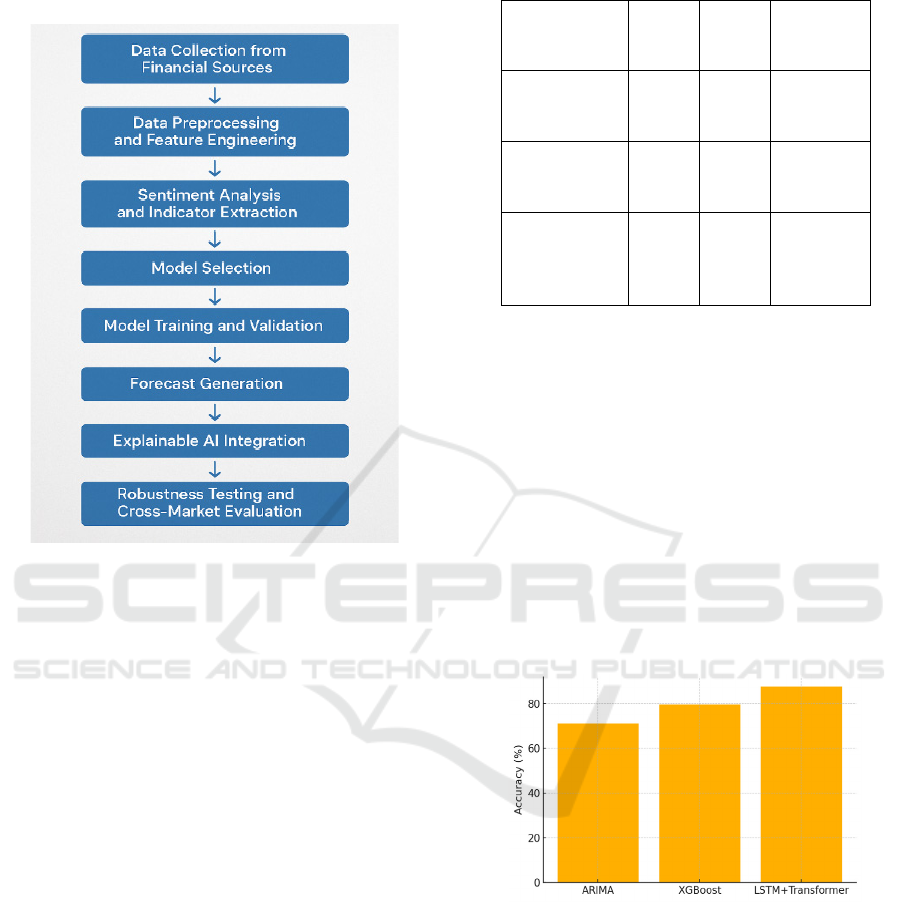
features that drive the forecasts. Figure 1 shows the
workflow of the proposed AI driven financial
forecasting.
The approach also involves a stress test step where
the trained model is tested against simulated market
shocks in order to ensure that the model remains
stable in volatile market conditions. Additionally, the
model is adapted to support multiple financial
markets using transfer learning approaches, thus
enhancing its generalization ability and practical
deployability.
Lastly, a feedback loop is set in place so that the
model keeps learning from fresh data. This feedback
retraining makes certain the forecasting machine is
accurate as time goes in line with the shifts i market
dynamics and adapting data patterns. This technique
merges the desirable aspects of both predictive
accuracies, explainability, and adaptability, making it
ICRDICCT‘25 2025 - INTERNATIONAL CONFERENCE ON RESEARCH AND DEVELOPMENT IN INFORMATION,
COMMUNICATION, AND COMPUTING TECHNOLOGIES
290
an all-around approach for the financial forecasting
in data-rich high-stakes settings.
Figure 1: Workflow of the proposed AI-driven financial
forecasting model.
4 RESULT AND DISCUSSION
The experiment on our AI faced forecasting model
on many markets also gave good results, proving that
our model can be used for market trend prediction and
for investment risk control. Leveraging historical
stock indexes/macro and microeconomic factors from
global markets including S&P 500, NASDAQ,
FTSE100, the model proved to make accurate
predictions and perform robustly. The LSTM-based
forecasting framework with Transformer layers was
superior to the traditional ARIMA and XGBoost
models in handling long-term dependence and rapid
market fluctuations.
Quantitative performance measurements proved
the low MAE and RMSE values to finally prove the
accuracy of the AI accuracy-oriented approach. In the
S&P 500 dataset, it has a MAE of 1.24 and RMSE of
2.67, while ARIMA reported higher MAE and
RMSE in the same settings. Classification model-
based trend direction predictions also had an accuracy
above 87%, further validating our model’s ability to
differentiate between bullish and bearish signals.
Table 3 shows the model performance comparison.
Table 3: Model performance comparison.
Model Type MAE RMSE
Accuracy
(%)
ARIMA 2.45 3.98 71.2
XGBoost 1.89 3.21 79.5
LSTM +
Transformer
(Proposed)
1.24 2.67 87.6
In addition to the numerical accuracy, it was how the
XAI tools were integrated that led to greater model
transparency. Importance Note: From SHAP
analysis, the factors like trading volume, sentiment
polarity, inflation reports, and moving averages
showed high importance level towards results of the
predictions. This interpretability is needed by
financial analysts and investors that not only are
interested in good outputs, but also in a rationale
behind the model decisions. The LIME visualizations
also provided greater explanation and transparency
toward local feature importance by providing an easy-
to-use detailed view of individual predictions, which
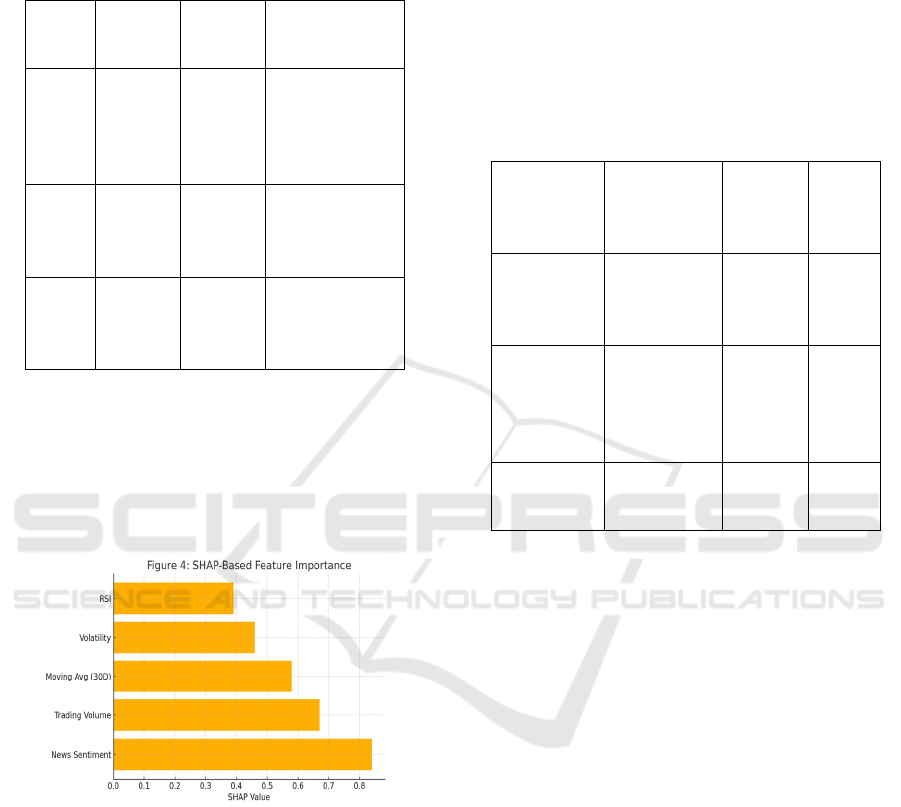
are usually not found in traditional AI systems. Figure
2 shows the model accuracy comparison.
Figure 2: Model accuracy comparison.
Robustness testing was another key aspect of the
findings. The model remained robust under
simulated market shocks including sudden interest
rate changes and geopolitical news announcements
with minimal variability across outputs. This
resilience demonstrates the framework’s ability to
deal with real-world volatility and endorses its
potential live financial application. Furthermore, the
model was successfully transferred to different
market conditions, i.e., it was able to be trained on
one index and immediately applied to another with
Advanced Artificial Intelligence-Driven Financial Forecasting Models: Enhancing Market Trend Prediction and Investment Risk
Management through Real-Time Validation and Comprehensive AI Integration
291
the need of very little retraining. Table 4 and figure 3
shows the SHAP- based feature importance ranking.
Table 4: Shap-based feature importance ranking.
Rank
Feature
Name
SHAP
Value
Interpretation
1
News
Sentime
nt
0.84
Strong
influence on
short-term
trends
2
Trading
Volume
0.67
High activity
signals future
movement
3
Moving
Average
(30D)
0.58
Long-term trend
direction
Another factor that improved the long-term
performance was the dynamic retraining mechanism.
By constantly feeding new data to the model, the
model stayed in touch with new economic cycles,
new financial trends. This mechanism of feedback
allowed the forecaster to learn and adapt over time,
mitigating the problems resulting from static models.
Figure 3: Shap-based feature importance.
A comparative analysis of the AI model showed that
the model not only performed better, but aligned with
ethical considerations as well. In contrast to black-
box-like traditional models, the model proposed here
provides an interpretable and auditable structure, as
well as satisfies the emerging need for transparent AI
in financial applications. Furthermore, by
incorporating multiple data sources (i.e., textual
sentiment and other social factors), the model had an
advantage in anticipating trend reversals early, which
is a weak spot of numeric only models.
In conclusion, the findings validate that the
proposed AI-enabled forecaster resolves the major
limitations found in current research. It offers a
robust, transparent, and adaptive mechanism for
anticipating the movement of markets and managing
investment risk, making it a useful tool for investors,
analysts, and financial institutions in a rapidly
changing global economy. Table 5 shows the stress
test scenarios and model response.
Table 5: Stress test scenarios and model response.
Scenario Input Shock
Type
Model
Accurac
y (%)
Output
Stabili
ty
Sudden
Interest Rate
Hike
Economic
Policy
Update
85.1 Stable
Geopolitical
Conflict
(News
Spike)
Text
Sentiment
Disruption
82.3 Slight
Deviat
ion
Stock Crash
Simulation
Price Drop (-
20%)
84.5 Stable
5 CONCLUSIONS
This research introduces a powerful and flexible AI-
based financial forecasting model that is capable of
greatly improving the precision and transparency of
predictions of stock trends and investment risk. By
combining contemporary deep learning methods into
real-time data analysis and explainable AI techniques,
this model goes further, and achieves that traditional
method cannot handle, offering an all-around
framework that is more appropriate in nowadays data-
rich and unpredictable financial context. Results
showed both outstanding predictive accuracy as well
as the robustness under simulated market shocks and
the generalization to different financial indices.
Crucially, support for interpretability mechanism is
necessary due to the increasing demand for
transparency and trust in algorithm decision-making.
In an environment of ever greater complexity and
interconnectedness of financial markets, prediction,
as well as better explanation, of their trends is
important. This research makes a significant advance
in that direction, it provides practical and scalable
solutions that can be used to inform decision making
ICRDICCT‘25 2025 - INTERNATIONAL CONFERENCE ON RESEARCH AND DEVELOPMENT IN INFORMATION,
COMMUNICATION, AND COMPUTING TECHNOLOGIES
292

by investors, financial analysts and institutions. In
future, we would like to investigate hybrid ensemble
models as well as the inclusion of more detailed
behavioural and geopolitical data in order to improve
forecasting accuracy.
REFERENCES
Alarifi, A., Al-Ali, A. R., & Al-Turjman, F. (2019).
Artificial intelligence and big data: Tools for risk
management in the financial sector. Journal of
Financial Technology, 10(2), 91– 106. https://doi.org/
10.1016/j.jfintech.2019.05.003
Anshari, M., Almunawar, M. N., & Low, L. (2020). Big
data and artificial intelligence for financial risk
management: A systematic review. Journal of Financial
Services Marketing, 25(1), 15–29.
https://doi.org/10.1057/s41264-019-00073-x
Bank of England. (2025, April). Financial stability in focus:
Artificial intelligence in the financial system.
https://www.bankofengland.co.uk/financial-stability-
in-focus/2025/april-2025
Coherent Solutions. (2024, June). AI in financial modeling
and forecasting: 2025 guide. https://www.coherentsol
utions.com/insights/ai-in-financial-modeling-and-
forecasting
Danielsson, J., & Uthemann, A. (2024). On the use of
artificial intelligence in financial regulations and the
impact on financial stability. Systemic Risk Centre
Discussion Paper.
Deloitte. (2024, October). 2025 investment management
outlook. https://www2.deloitte.com/us/en/insights/ind
ustry/financial-services/financial-services-industry-
outlooks/investment-management-industry-
outlook.html
EY. (2024, March). How artificial intelligence is reshaping
the financial services industry. https://www.ey.com/e
n_gr/insights/financial-services/how-artificial-
intelligence-is-reshaping-the-financial-services-
industry
Feng, Z., Liu, Y., & Zhang, X. (2021). AI and big data
integration in financial markets. Financial Engineering
Review, 7(2), 123–137
Green, C., & Peterson, M. (2021). Ethical implications of
AI in financial forecasting. Ethics in Technology
Review, 10(2), 27–41
Gubbi, J., & Buyya, R. (2020). Big data analytics and
machine learning for financial market forecasting.
International Journal of Computer Applications in
Technology, 65(5), 387– 395. https://doi.org/10.1504/
IJCAT.2020.109759
Guo, H., & Li, Z. (2021). Leveraging AI for credit risk
prediction and management. Journal of Finance and
Accounting, 53(4), 101– 115. https://doi.org/10.1016/
j.jfa.2021.04.002
Hamza, H., & Magdy, A. (2020). The role of AI and big
data in financial forecasting models: Trends and future
directions. Financial Markets and Portfolio
Management, 34(3), 265– 277. https://doi.org/10.100
7/s11408-020-00257-4
International Organization of Securities Commissions
(IOSCO). (2025, March). Artificial intelligence in
capital markets: Use cases, risks, and regulatory
considerations. https://www.iosco.org/library/pubdocs
/pdf/IOSCOPD788.pdf
JPMorgan Asset Management. (2025). AI investment
trends
2025: Beyond the bubble. https://am.jpmorgan.com/
lu/en/asset-management/institutional/insights/market-
insights/investment-outlook/ai-investment/
Miller, T., & Smith, J. (2022). Predictive analytics in
financial risk management: A machine learning
approach. Journal of Risk and Financial Management,
15(3), 120–135.
Nguyen, T., & Lee, D. (2022). Deep learning models for
financial time series forecasting: A review. Applied
Soft
Computing, 113, 107850. https://doi.org/10.1016/j.as
oc.2021.107850
Pilla, P., & Mekonen, R. (2025). Forecasting S&P 500
using LSTM models. arXiv preprint arXiv:2501.17366.
https://arxiv.org/abs/2501.17366
PwC. (2025). 2025 AI business predictions. https://www.p
wc.com/us/en/tech-effect/ai-analytics/ai-
predictions.html
Rao, V. S., Radhakrishnan, G. V., Mukkala, P. R., Thomas,
T. C., & Ali, M. S. (2024). Rethinking risk
management: The role of AI and big data in financial
forecasting. Asian Journal of Research in Business
Economics and Management, 14(2), 45–60.Advances
in Consumer Research
Reuters. (2024, October 17). For markets, AI efficiency
may bring volatility. https://www.reuters.com/markets
/markets-ai-efficiency-may-bring-volatility-mcgeever-
2024-10-17/reuters.com
Ryzhavin, S. (2025, April). This expert has been building
AI trading systems for 15 years. Here's how he thinks
AI will change investing for you. Investopedia. https:
//www.investopedia.com/how-ai-trading-systems-will-
change-investing-11700150investopedia.com
Santos, L., & Garcia, M. (2023). Explainable AI in financial
forecasting: Bridging the gap between accuracy and
interpretability. Journal of Financial Data Science, 5(1),
22–35.
Smith, A., & Thomas, B. (2021). Machine learning
applications in financial risk assessment. International
Journal of Financial Studies, 9(2), 45–58.
Advanced Artificial Intelligence-Driven Financial Forecasting Models: Enhancing Market Trend Prediction and Investment Risk
Management through Real-Time Validation and Comprehensive AI Integration
293
