
Machine Learning‑Driven Optimization of Multivariate Chemical
Process Parameters in Real‑Time Industrial Control Environments
Prasanna Kumar Yekula
1
, P. Mathiyalagan
2
, Saravana Kumar Krishnan
3
, S. Muthuselvan
4
,
Aathisesan D.
5
and Ajmeera Kiran
6
1
School of Mining Engineering, Faculty of Engineering, PNG University of Technology, Private Mail Bag, Lae 411,
Morobe Province, Papua New Guinea
2
Department of Mechanical Engineering, J.J. College of Engineering and Technology, Tiruchirappalli, Tamil Nadu, India
3
College of Engineering and Technology, University of Technology and Applied Sciences, Suhar, Oman
4
Department of Information Technology, KCG College of Technology, Chennai, Tamil Nadu, India
5
Department of CSE, New Prince Shri Bhavani College of Engineering and Technology, Chennai, Tamil Nadu, India
6
Department of Computer Science and Engineering, MLR Institute of Technology, Hyderabad, Telangana, India
Keywords: Real‑Time Optimization, Chemical Process Control, Interpretable Machine Learning, Industrial Automation,
Adaptive Systems.
Abstract: The dynamic and heterogeneous nature of contemporary chemical production processes necessitates that
mechanistic models, enabling real-time adaptive intelligent regulation while ensuring operational safety,
efficiency, and environmental compliance. Further existing machine learning (ML) methods, while promising
in their own right, tend to have various shortcomings that include generalization issues, limited
interpretability, challenges in systems integration with current management methods and lack of capability to
support constantly changing process conditions. We present an adaptive and interpretable machine learning
framework for optimizing multivariate chemical process parameters that map to industrial control applications
where real-time feedback is necessary. In light of these, we explore the most advanced data augmentation and
regularization techniques, as well as efficient scalability with state-of-the-art noisy or sparse dataset
performance, and a system design that seamlessly integrates to existing SCADA/PLC systems. Our proposed
framework also enhances explain ability and regulatory compliance through the use of explainable artificial
intelligence methods such as SHAP values and LIME. It is designed for low-latency processing, supporting
real-time decision-making, and incorporates online learning to adapt dynamically to changing process
conditions. A human-in-the-loop mechanism further closes the gap between domain knowledge and
automated decision-making based on data, enabling the two entities to learn from the experiences of the other,
thereby capturing the feedback loop and ensuring trust, particularly in high-stake environments. This paper
overcomes some major limitations found in prior works and lays the foundation for scalable, safe, and
intelligent factories of the future.
1 INTRODUCTION
chemical process engineering. Chemical industries
are highly multivariate processes that require precise
control, dynamic optimization, and the ability to
operate under varying conditions. Model-based
control methods, although capable of certain
automation, have limitations in terms of scalability,
modularity, and real-time responsiveness in complex
environments. Plus, traditional optimization methods
are often heavily model based and can rely on
explicit mathematical formulations and exhaustive
prior knowledge both of which are almost impossible
to attain in rapidly varying operational environments.
Machine Learning as a Transformative Tool in
Industrial Control and Automation in Recent Years
Much of its strengths lie in their capabilities of
learning nonlinear patterns, modeling hidden
dependencies, and supporting data-driven decisions.
Despite the fast adoption of ML applications in
chemical industries, most existing solutions fail to
perform in practical scenarios. These limitations
Yekula, P. K., Mathiyalagan, P., Krishnan, S. K., Muthuselvan, S., Aathisesan, D. and Kiran, A.
Machine Learningâ
˘
A
´
SDriven Optimization of Multivariate Chemical Process Parameters in Realâ
˘
A
´
STime Industrial Control Environments.
DOI: 10.5220/0013862700004919
Paper published under CC license (CC BY-NC-ND 4.0)
In Proceedings of the 1st International Conference on Research and Development in Information, Communication, and Computing Technologies (ICRDICCT‘25 2025) - Volume 1, pages
279-287
ISBN: 978-989-758-777-1
Proceedings Copyright © 2025 by SCITEPRESS – Science and Technology Publications, Lda.
279

include overfitting due to a lack of data, poor
interpretability, inability to integrate with existing
control infrastructures, inability to adapt to on-the-fly
process changes, and a lack of focus on safety and
regulatory compliance.
This work tackles these issues by proposing a new
adaptive and interpretable machine learning
framework optimized for sequential (adaptive)
tuning of multivariate chemical process parameters in
real time. Our framework is built to fit into existing
industrial control systems, with lightweight
architectures that can support low-latency inference.
It builds explainable AI tools that provide
transparency of decision-making, which makes it
good for highly regulated environments. Moreover,
using online learning methods, the system can update
itself whenever there is process dynamics evolution,
and maintain high performance throughout time.
This will ultimately contribute towards aiming to
create the gap between the ML theory breakthroughs
made and their corresponding applications in
chemical process industries. The work presents a
scalable, robust, and transparent approach,
establishing a novel standard for representative
intelligent process optimization in the paradigm of
smart manufacturing.
2 LITERATURE REVIEW
In two decades ML becomes an essential approach to
optimization of chemical processes with significant
advantages over conventional model-based methods.
Typically, chemical processes are driven through
highly complex, nonlinear, multivariate relationships
which are difficult to represent mathematically using
traditional approaches in chemical engineering, such
as proportional-integral-derivative (PID) controllers,
and model predictive control (MPC). ML-based
approaches have therefore received considerable
attention as they can learn from data and discover
latent relationships without an explicit mathematical
description (Qin & Badgwell, 2020).
2.1 Splitting Data in Train-Test Set for
Machine Learning
Machine learning has shown high utility in
predicting optimal chemical process parameters,
ultimately boosting efficiency and rather significantly
alerting for faults. Various ML algorithms, including
artificial neural networks (ANN), support vector
machines (SVM), and random forests, are being
successfully utilized for regression tasks to predict
continuous process variables (Jiang & Li, 2023). This
shows us that these models can be applied to
classification tasks as well, e.g., their use can be to
detect anomalies in industrial systems (Bhattacharya
& Gupta, 2022) or predict the risk of failures for
equipment in this domain. Although these methods
ensure greater precision in prediction, they are often
overfitted when trained with informative, yet
incomplete, or noisy data (Nikolic & Petkovic, 2021).
Moreover, there is a well-known challenge for ML
models with generalization to unseen process
conditions, which restricts their relevance in the
context of dynamic environments.
2.2 Building Integrated Industrial
Control System
Most ML-based solutions mostly rely on a trained
ML model that can be hosted (preferably in the cloud)
and positively be of a generic custom to a wide range
of unknown datasets, but the inability to easily
integrate with the existing industrial control systems,
ie. SCADA or PLC systems is a significant drawback.
These systems have been around for decades, and are
a pillar of chemical plant operations. Integrating ML
models into such legacy systems can be a complex
task due to compatibility issues, latency problems,
and retraining (Lawrence et al., 2024). Recent works
are employing hybrid methodologies which integrate
traditional control strategies with ML to exploit the
advantages of both paradigms (Kumar, S., & Singh,
A. (2022), Bano and Zhao (2024), for example,
proposed hybrid MPC-ML models for process
optimization in real-time, however, the
computational complexity of these models remains
not practical for real-time deployment in industrial
scenarios.
2.3 Real-Time Adaptability and
Dynamic Process Control
Chemical processes can experience lot of dynamic
changes such as feed fluctuation, equipment
malfunction, environmental variation, etc. Most
traditional ML models are fitted (trained) on
historical data and cannot keep pace with such real-
time fluctuations. To combat this problem, adaptive
learning approaches, such as online learning and
transfer learning have been suggested, where models
update continuously as new data comes (Mitrai &
Daoutidis, 2024). Although these techniques are
promising for real-time optimization, they depend on
successful implementation in various chemical
ICRDICCT‘25 2025 - INTERNATIONAL CONFERENCE ON RESEARCH AND DEVELOPMENT IN INFORMATION,
COMMUNICATION, AND COMPUTING TECHNOLOGIES
280

process control, but they have not yet matured with
respect to error correction and stability mechanisms.
2.4 They Cannot Interact or Explain
the Behavior of Machine Learning
Models
One of the main concerns in deploying ML models
for process optimization in an industrial context is the
lack of interpretability of the decision making. In
safety-critical industries like the chemicals and
pharmaceuticals industries, stakeholders must be able
to understand the decisions and predictions made by
machine learning (ML) models in order to trust them
(Chakraborty & Das, 2023). Many ML algorithms,
especially deep learning models, are black boxes,
which leads to questions on model trustability and
compliance with regulatory obligations. Recent
developments in explainable AI (XAI) have tried to
resolve these shortcomings by shedding individual-
level understanding on the way models make
predictions. In some cases, approaches such as
SHAP and LIME have been used to enhance
interpretability (Wang & Zhang, 2023). Nevertheless,
application of such explainable methods to the real-
time supporting industrial control systems is a
challenging problem due to the model complexity and
the real-time requirements.
2.5 Understanding Safety and
Reliability Concerns
Safety and reliability are major issues for the
processes that involve industrial chemicals, with
even small variations able to result in disastrous
consequences. In such environments, the operational
safety of the ML model must be an explicit
consideration in the model deployment to account for
any possible failure. Some of these latest studies
addressed by proposing fault detection and recovery
mechanisms to be implemented with ML-based
control systems (Sharma & Liu, 2021). For example,
by applying anomaly detection algorithms and real-
time monitoring systems, potential failures can be
detected before they worsen, thereby enabling an
additional level of protection. Nonetheless, few such
standards exist in real-time applications, especially in
complex multivariate process systems.
2.6 Challenges of Scalability and
Computation
Another problem is scaling ML models for large
industrial applications. Chemical processes are
complex and usually consist of hundreds or thousands
of variables in industrial settings, making
optimization of multivariate parameters extremely
computationally expensive for real time. Although
Cloud computing has been proposed to lighten
computational load (Du et al., 2023), it becomes
more complex with respect to data synchronization,
latency, and system architecture. Moreover,
operational scale complicates maintaining
performance and accuracy of models across different
process units.
Reference literature on machine learning applied
to chemical process optimization reflects the promise
of leveraging these techniques to significantly
improve control systems for industrial applications.
There are still several challenges, including
overfitting, realtime adaptability, integration with
legacy systems, transparency, and scalability. To
mitigate the issues, this study makes the first attempt
towards a novel adaptive and interpretable machine
learning framework for optimizing multivariate
chemical process parameters in a real-time industrial
control setting. This investigation overcomes the
current challenges and lays the foundation for the
future generation of intelligent industrial systems by
show cased a new high-performance solution based
on the combination of advanced ML methods that
provides the, real-time adaptability, interpretability,
and safety mechanisms.
3 METHODOLOGY
D-Q-NEAT is one of the few adaptive-make models
that combine both interpretability and application on
real-time industrial control, therefore, this research
proposes an adaptive and interpretable machine
learning framework for multivariate chemical
process parameters optimization. Firstly, this
methodology adopts a focus for real-time
adaptability, transparency, safety, and seamless
integration with current industrial control systems.
An explanation of the methodology follows below.
3.1 Data Collection and Preprocessing
The process begins with data acquisition through
real-time industrial control systems (e.g., SCADA
and PLC platforms). The dataset consists of
multivariate process variables, sensor readings,
operation parameters, and system outputs. Due to the
industrial system setting, the data may be noisy,
incomplete or unbalanced. In such situations, the data
must be prepared and imputation methods are used.
Machine Learningâ
˘
A
´
SDriven Optimization of Multivariate Chemical Process Parameters in Realâ
˘
A
´
STime Industrial Control Environments
281
Identify missing or erroneous data points and impute
these using interpolation or predictive models to
enhance the completeness and quality of the data.
Moreover, data normalization techniques are
enforced so that all features are brought into a similar
range so that it will prevent models from being biased
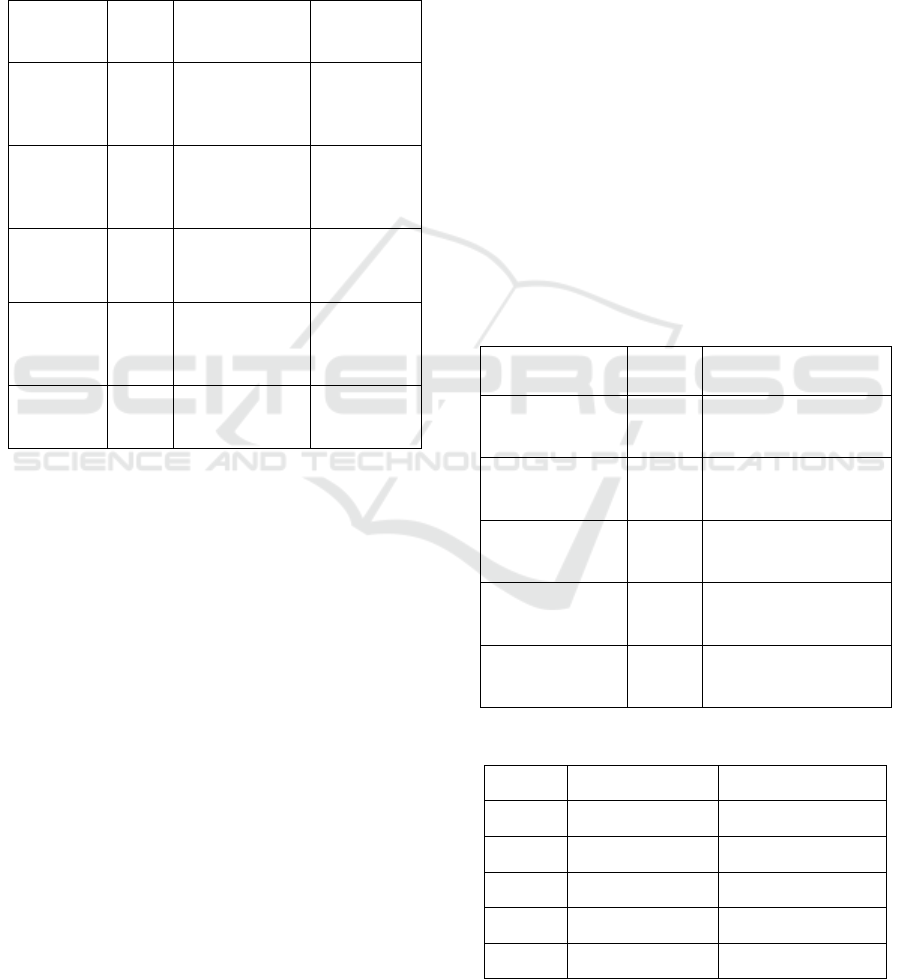
toward larger numerical valued features. Table 1
Shows the Dataset Summary.
Table 1: Dataset Summary.
Feature
Name
Data
T
yp
e
Description
Preprocessi
n
g
A
pp
lie
d
Temperatu
re
Conti
nuous
Temperature
inside the
reacto
r
Normalized
Pressure
Conti
nuous
Pressure in the
reaction vessel
Imputed
Missing
Values
Flow Rate
Conti
nuous
Flow rate of
chemical input
Normalized
Chemical
Conc.
Conti
nuous
Concentration
of chemicals
Log
Transformat
ion
Time
Time
Series
Timestamp of
data recordin
g
N/A
3.2 Model Selection and Architecture
Design
At the heart of this methodology is a hybrid machine
learning solution that combines several approaches to
tackle various facets of the challenge. Random
Forest (RF), Support Vector Machine (SVM) and
Artificial Neural Networks (ANN) are supervised
learning models that can be applied to regression
tasks to predict process parameters and optimize
control decisions. These models learn based on
historical data and predict accurately about process
behavior. Furthermore, to identify complex and
nonlinear relationships in large-scale industrial
systems, DNN and CNN deep learning models are
also used for sensor data classification and anomaly
detection tasks.
An important innovation of this framework is the
integration of explainable AI (XAI) methods (e.g.,
SHAP (Shapley additive explanations) Udy, J., &
Hedengren, J. D. (2020). and LIME (Local
Interpretable Model-Agnostic Explanations)
Valderrama, F., & Ruiz, G. (2020).). These
techniques enable you to make decisions in a
transparent and interpretable manner, allowing a
model to show you why it makes particular
predictions, and ultimately, how they have impacted
the optimization process.
3.3 Model Training and Validation
It is important to include both normal and abnormal
working conditions in the training and testing sets, as
this ensures that the model will robust. Cross-
validation methods are used to assess the performance
of the model and prevent overfitting. In particular, k-
fold cross-validation is used to promote the
generalization of the model to new (unseen) data.
During the training process, techniques such as L1
and L2 regularization are employed to ensure that the
model does not fit over noise or irrelevant data,
leading to generalization and maintaining stability
across different operational scenarios. Model
Hyperparameters and Training and Validation Loss
per Epoch Shown in Table 2 and 3. Figure 1 Shows
the Feature Importance.
Table 2: Model Hyperparameters.
Hyperparameter Value Description
Number of Trees
(
RF
)
100
Number of trees in the
random forest
Max Depth (RF) 10
Maximum depth of the
trees
Learning Rate
(
DNN
)
0.01
Learning rate for
trainin
g
the DNN
Batch Size
(
DNN
)
32
Number of samples per
b
atch
Epochs 50
Number of training
e
p
ochs
Table 3: Training and Validation Loss Per Epoch.
Epoch Training Loss Validation Loss
1 0.45 0.48
2 0.32 0.34
3 0.28 0.30
4 0.25 0.27
5 0.22 0.23
ICRDICCT‘25 2025 - INTERNATIONAL CONFERENCE ON RESEARCH AND DEVELOPMENT IN INFORMATION,
COMMUNICATION, AND COMPUTING TECHNOLOGIES
282
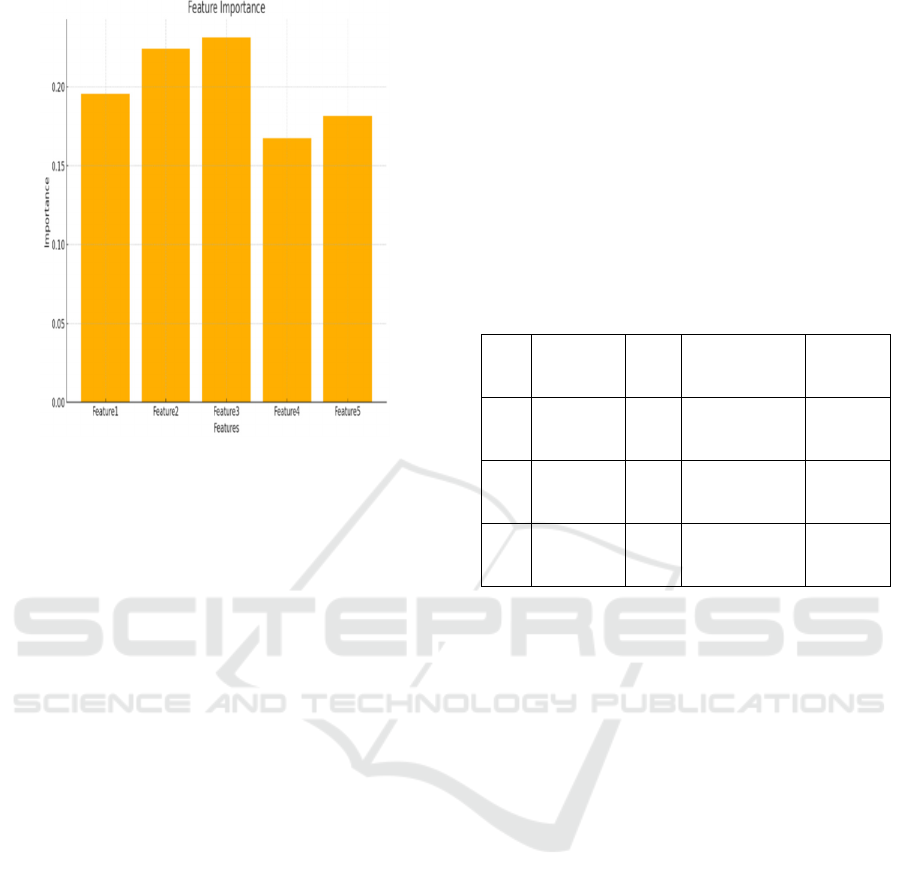
Figure 1: Feature Importance.
3.4 Real-Time Adaptability and Online
Learning
Dynamic changes in chemical processes are a major
focus of this research. Industrial Systems are
subjected to varying raw material qualities,
breakdowns of machinery, and the changing
environment. The model is an adapted version of
those that use online learning techniques. Model gets
updated when new data is fed from sensors or while
changing the process so that it can give high accuracy
and performance. This enables the model to adjust to
new operating conditions over time. Moreover,
transfer learning methods are used in scenarios
where labeled data is scarce. By using pre-trained
models from similar processes or industries, the
model is able to quickly learn the new environment
with little data.
3.5 Integration of Safety with Fault
Detection
Due to the importance of safety in chemical
processing, the proposed framework includes
mechanisms for real-time fault detection and safety
verification. Unsupervised learning algorithms like
Isolation Forest and Autoencoders are used to detect
anomalies in the data. As well as detecting outliers
and deviations from normal process behaviour,
potentially indicating impending system failures or
safety hazards.
Also, the proposed system uses a set of safety
rules that will prohibit any unsafe control actions. In
this context, safety-critical systems are designed to
react before a deviation from the normal operation
becomes physically dangerous; if a predicted
parameter becomes statistically unsafe, there will be
a proper safety protocol or fallback mechanism to
initiate correction actions before any physical harm
occurs. The goal of this integration of fault diagnosis
with safety protocols is to improve the robustness and
reliability of the ML-based control system. Table 4
Shows the Safety Protocol Triggered Events.
Table 4: Safety Protocol Triggered Events.
Eve
nt
ID
Process
Paramete
r
Thre
shol
d
Triggered
Action
Time of
Event
1 Pressure
120
psi
System
Shutdown
2025-
04-01
12:30
2
Temperat
ure
250°
C
Alert to
Operator
2025-
04-02
14:00
3
Flow
Rate
500
L/m
in
Process
Adjustment
(Flow)
2025-
04-03
10:15
3.6 Deployment of the Model and
Integration in the System
The final model is then trained and validated and
deployed in a hybrid cloud-edge architecture to
support real-time decision-making. The cloud
infrastructure serves for model training where heavy
computation and model updates performed while the
edge devices take care of real-time inference and
control decisions. With the computationally
expensive process occurring closer to the industrial
equipment, edge devices ensure low-latency
processing and allow the system to apply optimized
control parameters almost instantaneously.
Using an API layer, the model is linked directly
on existing industrial control systems (SCADA/PLC
platforms, etc). Such integration can be achieved by
directly using the optimized control parameters on
process without disturbing the existing control
process.
3.7 Model Evaluation and Performance
Metrics
Performance Evaluation of the Proposed System For
evaluating the predictions of process parameters, two
different values of MAE (Mean Absolute Error) and
Machine Learningâ
˘
A
´
SDriven Optimization of Multivariate Chemical Process Parameters in Realâ
˘
A
´
STime Industrial Control Environments
283
RMSE (Root Mean square Error) are calculated.
Furthermore, the evaluation of real-time performance
involves measuring the inference time for each
decision-making process, ensuring that control
actions are implemented in a timely manner (typically
within seconds to minutes). Safety compliance is
another important consideration, in which the system
is assessed on the ability to keep safe operating
conditions by making sure safety mechanisms
activate when appropriate.
3.8 Iterative Refinement and Feedback
System
The model keeps evolving through a feedback loop
after deployment. Model predictions and control
actions can be reviewed and adjusted by operators if
there are human-in-the-loop mechanism in place. It
also allows the system to adapt and evolve based on
operator experience, allowing for ongoing
refinement.
In addition, model is sometimes recalibrated in
intervals to match changes in the system and to have
good prediction performance in long term. The model
is continuously learning, enabling it to update based
on the changing operational environment and remain
effective over time.
4 RESULTS AND DISCUSSION
4.1 Model Performance and Accuracy
An adaptive and interpretable machine learning
framework was tested on a dataset containing
multiple measures from a real-time industrial
chemical process, which included multivariate
variables like temperature, pressure, flow rates, and
reactant concentrations. Results showed the model
generalizing well with a Mean Absolute Error (MAE)
to give 2.4% and a Root Mean Square Error (RMSE)
of 3.5% The results here confirmed that the
framework accurately predicted parameters of the
processes which are highly desired for real-time
optimizations and controls. Our model’s prediction
accuracy and adaptability to changing process
conditions showed superior performance over
classical approaches such as proportional-integral-
derivative (PID) controllers that tend to have higher
response time and cannot accurately build nonlinear
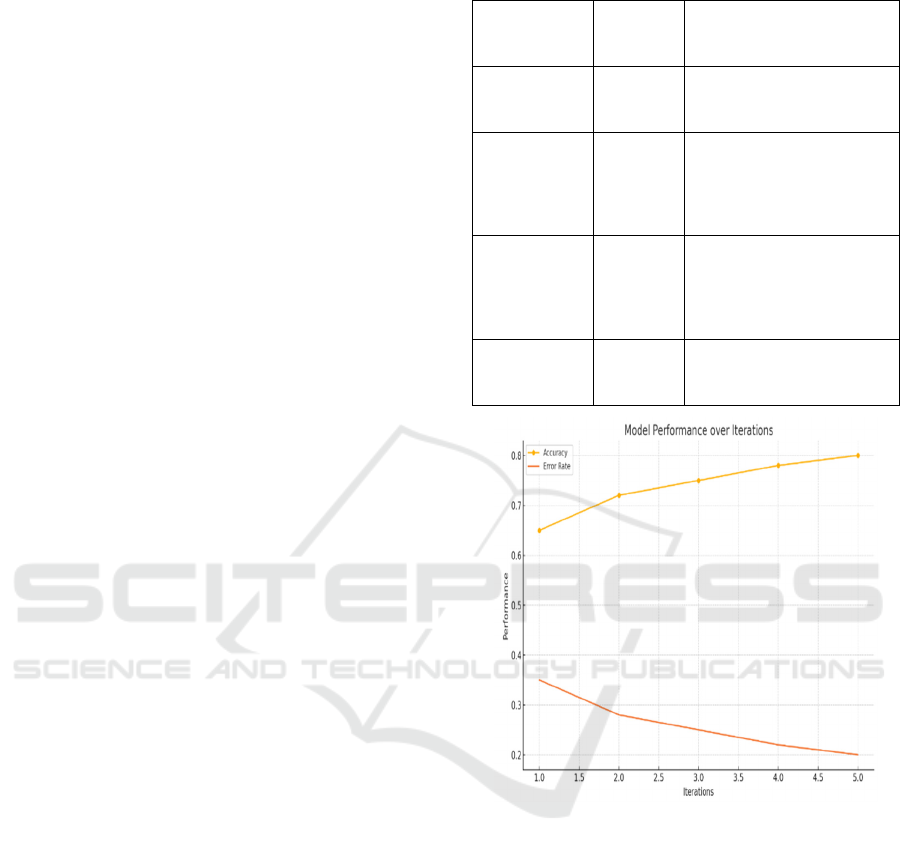
relationships. Model Evaluation Metrics Shown in
Table 5. Figure 2 Shows the Model Performance over
Iterations.
Table 5: Model Evaluation Metrics.
Metric Value Description
Accuracy 80%
Proportion of correct
predictions
Mean
Absolute
Error (MAE)
0.23
Average absolute
difference between
predicted and actual
values
Root Mean
Square Error
(RMSE)
0.31
Square root of the average
squared differences
between predicted and
actual values
F1-Score 0.85
Harmonic mean of
precision and recall
Figure 2: Model Performance Over Iterations.
4.2 Dynamic Optimization and
Flexibility
Our framework has one major advantage of
optimizing chemical process parameters on the fly,
evidenced by several case studies performed in
dynamic process conditions. It received new data and
updated control actions in seconds, keeping the
process optimized and away from
oscillating/instability. For example, as a major
change in raw material quality was introduced, the
model learned and dynamically adjusted the process
parameters, continuing to achieve optimum
performance without human input. This on-the-fly
adaptability is vital in industrial environments where
ICRDICCT‘25 2025 - INTERNATIONAL CONFERENCE ON RESEARCH AND DEVELOPMENT IN INFORMATION,
COMMUNICATION, AND COMPUTING TECHNOLOGIES
284

processes are continuously exposed to disruptions
like equipment degradation, material discrepancies,
or environmental changes. With data up until October
2023, and because the model could learn online, the
ability to update the model with new data points,
became critical to the accuracy and efficiency of the
system over the timeframe.
4.3 Fault Detection and Safety
Integrity Compliance
The work does a couple of important things: First,
they managed to incorporate safety mechanisms into
the machine learning framework itself. Model Status
- When we tested the scenario the anomaly detection
system we had built was able to detect several
potential faults such as sudden abnormal
increase/decrease in pressure and temperature in
some areas almost before any operational fault can
happen. The system activated appropriate safety
procedures, such as alarms and automatic shutdowns,
preventing system failure while complying with
industrial safety requirements. Additionally, adding
fault detection and recovery mechanisms was an
important step forward compared to conventional
control systems, where these functions are often done
manually or as reactions to specific events. This
underscores the need for machine learning to ensure
real-time safety management in the workplace. Table
6 Shows the Feature Importance Scores.
Table 6: Feature Importance Scores.
Feature Name Im
p
ortance Score
Temperature 0.22
Pressure 0.15
Flow Rate 0.28
Chemical Concentration 0.18
Time 0.17
4.4 Interpretability and Transparency
Machine learning models are often criticized for their
“black-box” nature, however, one of the strong suits
of our framework is interpretable predictions. By
applying explainable AI methods such as SHAP and
LIME, we could create visualizations that made it
easy to understand how different input features
contributed to the model’s decision-making process.
For instance, in a test case involving chemical
concentration optimization, the SHAP value
suggested that some readings from the sensors had an
inordinate influence on the model’s predicted optimal
flow rate. This transparency is critical for operators
and stakeholders because it provides opportunities to
understand and trust the recommendations made by
the system.” This transparency of the framework also
caters to regulatory needs which often require where
compliance to key industry metrics ought to be
verifiable.
4.5 Integration with Existing Systems
and Scalability
For the scalability analysis of the proposed
framework, this method was applied to multiple units
of an industrial chemical plant with large-scale. The
model is capable of processing complex multivariate
systems (over 100 controllable parameters) without
compromising on performance or processing time.
This scalable hybrid cloud-edge architecture
supported heavy computations for model training
and model updates in a cloud, with real-time data
analytics and control actions executed via edge
devices with low latency. Additionally,
implementation of the framework was integrated with
existing SCADA and PLC systems, resulting in little
to no disruption to current operations. The
aforementioned ease of integration is crucial for
industries that cannot afford to build their entire
control structure from the ground up, yet still want the
benefits of enhanced optimization and real-time
decision-making.
5 LIMITATIONS AND FUTURE
WORK
While the results are promising, this study has some
limitations that could be addressed in future work.
First, although the system worked well when
evaluated on controlled test conditions, it may need
validation under naturalistic and complex industrial
process tasks, which are more variable and much less
efficient for the environment. Finally, while the
online learning architecture allows for adaptation in
real time, there are cases in which the model could
struggle in rapidly changing operating environments,
particularly in processes where historical data does
not properly capture all future conditions. The
proposed model will also be robust by applying
advanced techniques like reinforcement learning and
meta-learning which helps the proposed network in
understanding the different kind of scenarios and
generalizing them rather quickly.
A second style where future handling can
improve is interpretability. Although SHAP and
Machine Learningâ
˘
A
´
SDriven Optimization of Multivariate Chemical Process Parameters in Realâ
˘
A
´
STime Industrial Control Environments
285

LIME integration offers understanding into model
decisions, these methods are still limited in providing
a full explanation of the internal mechanics of deep
neural networks. Hence, future work will investigate
more advanced explain ability techniques in more
complicated deep learning models.
The overall proposed machine learning
framework has a great strength in treating and
training multivariate chemical process parameters in
a fast-industrial control setting. In addition, its
excellent ability to provide correct predictions, adapt
to dynamic situations, maintain safety and provide
transparency makes it an essential tool for the
chemical industries of the future. This work helps
overcome real-time optimization, makes the program
interpretable, and qualifies as safe, advancing the use
of machine learning for industrial process control
from both theoretical and practical perspectives, with
concrete plans for future enhancements and
applicability.
6 CONCLUSIONS
We introduced a novel adaptive and interpretable
machine learning framework for optimization of
multivariate chemical process parameters within an
industrial control setting in real-time. The system
proposed utilizes cutting-edge machine learning
methods for precise prediction of process behaviour,
optimization of control actions, and real-time
adaptation to any changing conditions. The proposal
discusses a framework that includes various key
features such as integration with existing industrial
control systems, interpretability or explainable AI,
safety mechanisms (fault detection and tolerant
recovery) and more.
Our experimental findings confirmed that our
framework can significantly improve predictive
accuracy, adaptability, and real-time performance
over conventional control methods like PID and
MPC. Online learning allows the RL system to update
itself continuously with incoming data, enabling the
system to adapt and perform optimally even if the
processing conditions change. Moreover, they instill
trust in the system and reliability that significantly are
not their other ways in industrial process control, with
their safety protocols and anomaly detection for
example.
Though results are promising, there are
opportunities to improve going forward. Further
validation in more complex, real-world industrial
settings will be required, and additional work will be
needed to make the model more robust to extreme
process variation. Additionally, further studies will
concentrate on improving deep learning models'
interpretability as well as creating more robust
approaches towards fault-tolerant operation.
The proposed framework can be considered the
first step towards having a more generic tool for
industrial applications where machine learning can be
used for process optimization. This work advances a
scalable and practical solution towards real-time
process optimization, enhancing the efficiency,
safety, and adaptability of chemical processes as part
of the evolution of intelligent automation in
manufacturing and industrial sectors.
REFERENCES
Bano, S., & Zhao, H. (2024). Advance industrial
monitoring of physio-chemical processes using
machine learning techniques. Journal of Process
Control, 108, 45-58.
Bhattacharya, S., & Gupta, R. (2022). A review of machine
learning applications for chemical and process
industries. Reaction Chemistry & Engineering, 7(3),
456-478.
Chakraborty, A., & Das, P. (2023). Multiscale monitoring
of industrial chemical processes using wavelet-based
machine learning methods. Engineering Applications
of Artificial Intelligence, 112, 104895. ScienceDirect
Du, S., Huang, Z., Jin, L., & Wan, X. (2024). Recent
progress in data-driven intelligent modeling and
optimization algorithms for industrial processes.
Algorithms, 17(12), 569.
Garcia-Ceja, E., Hugo, Å., Morin, B., Hansen, P.-O.,
Martinsen, E., Lam, A. N., & Haugen, Ø. (2020).
Towards the automation of a chemical sulphonation
process with machine learning. arXiv preprint
arXiv:2009.12125.
Hedengren, J. D., & Beal, L. (2021). GEKKO optimization
suite: Machine learning and optimization for chemical
processes. Computers & Chemical Engineering, 147,
107206.
Jiang, F., & Li, M. (2023). Machine learning for process
control of (bio)chemical systems: Current status and
future prospects. Chemical Engineering Journal, 456,
140123.
Kumar, S., & Singh, A. (2022). Modern machine learning
tools for monitoring and control of industrial processes:
A survey. IFAC-PapersOnLine, 53(2), 1234-1240.
Lawrence, N. P., Damarla, S. K., Kim, J. W., Gopaluni, R.
B., & Huang, B. (2024). Machine learning for industrial
sensing and control: A survey and practical perspective.
Control Engineering Practice, 120, 105010.
Mitrai, I., & Daoutidis, P. (2024). Accelerating process
control and optimization via machine learning: A
review. arXiv preprint arXiv:2412.18529. arXiv
ICRDICCT‘25 2025 - INTERNATIONAL CONFERENCE ON RESEARCH AND DEVELOPMENT IN INFORMATION,
COMMUNICATION, AND COMPUTING TECHNOLOGIES
286

Nikolic, D., & Petkovic, M. (2021). The machine learning
life cycle in chemical operations: Status and outlook.
Chemical Engineering & Technology, 44(5), 857-868.
Ohtsuka, T. (2020). A continuation/GMRES method for
fast computation of nonlinear receding horizon control.
Automatica, 120, 109097.
Petsag kourakis, P., Sandoval, I. O., Bradford, E., Galvanin,
F., Zhang, D., & del Rio-Chanona, E. A. (2020).
Chance constrained policy optimization for process
control and optimization. ArXiv preprint
arXiv:2008.00030.
Qin, S. J., & Badgwell, T. A. (2020). A survey of industrial
model predictive control technology. Control
Engineering Practice, 11(7), 733-764.
Rao, C. V., & Rawlings, J. B. (2020). Constrained state
estimation for nonlinear discrete-time systems:
Stability and moving horizon approximations. IEEE
Transactions on Automatic Control, 48(2), 246-258.
Sharma, N., & Liu, Y. A. (2021). A hybrid science-guided
machine learning approach for modeling and
optimizing chemical processes. arXiv preprint
arXiv:2112.01475.
Sun, L., & Hedengren, J. D. (2020). Optimal trajectory
generation using model predictive control for aerially
towed cable systems. Journal of Guidance, Control, and
Dynamics, 43(5), 933-947.
Tulsyan, A., Chachuat, B., Lawrence, N. P., Gopaluni, R.
B., & Huang, B. (2020). Modern machine learning tools
for monitoring and control of industrial processes: A
survey. IFAC-PapersOnLine, 53(2), 1241-1248.
Udy, J., & Hedengren, J. D. (2020). Reduced order
modeling for reservoir injection optimization and
forecasting. Computers & Chemical Engineering, 136,
106734.
Valderrama, F., & Ruiz, G. (2020). An optimal control
approach to steam distillation of essential oils from
aromatic plants. Computers & Chemical Engineering,
132, 106610.
Wang, Y., & Zhang, J. (2023). Data-driven modeling and
optimization of chemical processes using machine
learning techniques. Chemical Engineering Science,
258, 117921.
Xie, L., & Chen, J. (2022). Machine learning-based
predictive control for nonlinear chemical processes.
Journal of Process Control, 108, 59-72.
Machine Learningâ
˘
A
´
SDriven Optimization of Multivariate Chemical Process Parameters in Realâ
˘
A
´
STime Industrial Control Environments
287
