
Advancing Personalized Learning through Artificial Intelligence:
Practical, Ethical and Scalable Approaches to Tailoring Educational
Content for Diverse Student Needs and Learning Styles
V. Rekha
1
, C. Ramya
2
, K. Sivakumar
3
, K. Arulini
2
, K. S. Guruprasad
2
and G. V. Rambabu
4
1
Department of BCA, Agurchand Manmull Jain College, Chennai, Tamil Nadu, India
2
Department of Information Technology, Nandha College of Technology, Pitchandampalayam, Erode, Tamil Nadu, India
3
Department of MBA, J.J. College of Engineering and Technology, Tiruchirappalli, Tamil Nadu, India
4
Department of Mechanical Engineering, MLR Institute of Technology, Hyderabad, Telangana, India
Keywords: Personalized Learning, Artificial Intelligence, Adaptive Education, Ethical AI, Scalable Learning Systems.
Abstract: Artificial Intelligence (AI) in education has allowed for new ways to promote personalized learning tailored
to the student's needs and the student's learning style. To overcome the shortcomings of existing studies which
are not scalable, suffer from biased datasets, and lack a real application in the field of AI-based personalized
learning, in this work, a practical and ethically-aligned scalable framework of AI-driven personalized learning
is proposed. The paper presents adaptive methods based on models learned over comprehensive and balance
data sets to deliver fair and responsive content. The classroom simulation model is employed to demonstrate
its practical feasibility at the real classroom levels with the emphasis on the measurable leaming results and
long-term effective application. The ethical considerations such as privacy, transparency and explainability
are considered in system construction. Supporting both technical depth and pedagogical relevance, we present
a substantial, deployable model acting as a midrange solution between academic rigor and classroom reality.
Results show remarkable enhancements in learning engagement, adaptability and performance for different
learning environments.
1 INTRODUCTION
The education climate is changing at an
unprecedented pace fueled by artificial intelligence
(AI), creating new possibilities and opportunities to
change the way students interact with learning
material. Looked at from that perspective,
conventional orders-of-magnitude, one-size-fits-all
approaches to education aren't always a good fit for
the broad range of what individual children can do
and want to do. On the other hand, AI-based
personalized learning system can change its
behaviour dynamically based on the individual
student’s need and help in enhancing the
effectiveness and inclusiveness of these learning
processes.
However, in spite of the mounting interest, the
vast majority of AI applications for education have
critical drawbacks. These concerns encompass
dependence on biased datasets, absence of real-world
verification, ethical questions concerning the
application of data; as well as scalability issues within
different academic setting. Furthermore, the existing
work often deal with theoretical concepts or
experimental prototypes that are not deployed in real,
classroom-based environments.
This work seeks to fill these gaps by creating a
personalized learning framework which apart from
AI to adaptively deliver content, adds ethical controls,
features for scalability and validation of the
scaffolding in simulated classroom settings. Through
utilizing various datasets within the educational
domain and embedding fairness and transparency into
the architecture of the system, the proposed model
aims to contribute on AI-driven personalized learning
with fair, effective and sustainable promises.
This research not only pushes the technological
boundaries of educational AI but also offers a new
way of thinking about the delicate balance between
innovative and contextually appropriate educational
reform. The result is a solution that is complete and
236
Rekha, V., Ramya, C., Sivakumar, K., Arulini, K., Guruprasad, K. S. and Rambabu, G. V.
Advancing Personalized Learning through Artificial Intelligence: Practical, Ethical and Scalable Approaches to Tailoring Educational Content for Diverse Student Needs and Learning Styles.
DOI: 10.5220/0013862000004919
Paper published under CC license (CC BY-NC-ND 4.0)
In Proceedings of the 1st International Conference on Research and Development in Information, Communication, and Computing Technologies (ICRDICCT‘25 2025) - Volume 1, pages
236-242
ISBN: 978-989-758-777-1
Proceedings Copyright © 2025 by SCITEPRESS – Science and Technology Publications, Lda.

feasible to implement that turns personalized learning
into a reality for a highly varied set of students.
1.1 Problem Statement
Although the potential of AI in education is great,
current AI-based personalized learning technologies
have had limited success meeting practical, ethical,
and scalable challenges when designing for diverse
student bodies. The existing methods are mostly
constrained in experiment settings or based on the
homogeneous dataset which cannot well cover the
diversity of the classroom in reality. Further,
important topics as algorithmic fairness, data
privacy, explainability or long-term adaptability are
largely ignored when designing systems. They were
also missing a (formally noted) framework that unites
technical soundness with ethical and educational
applicability, leaving a lacuna between innovation
and practical use. Hence, there is an urgent
requirement to design an ethically aligned, scalable
and practicable AI-powered personalised learning
model which can percolate individual student needs
dynamically and yet be inclusive, transparent and
provide measurable learning outcomes for diverse
modes of education.
2 LITERATURE SURVEY
AI (artificial intelligence) is proving to be a game
changer in education by providing intelligent systems
for personalized learning adapted to the specific
needs, preferences and performance level of learners.
Many researchers also provide rich evidence for the
positive power of AI on learner’s engagement and
academic performance through intelligent tutoring
systems, adaptive assessments, and real-time
feedback mechanisms (Maghsudi et al., 2021; Liu et
al., 2025). Research by Wang et al. (2025) presented
LLM-powered " LearnMate " system, tailored the
training paths, reported that their results are very
promising in terms of learners' satisfaction and
learning effectiveness. In a similar successful trend,
Bardia and Agrawal (2025) introduced “MindCraft”,
an AI powered learning and mentoring platform for
rural education, highlighting the mass forwarding
potential of such technologies. However, several
studies have raised concerns with dataset biases and
ethical issues that would reduce fairness and
inclusivity (Vorobyeva et al., 2025; Naqvi, 2024).
Even government and policy-oriented reports
acknowledge the promise of AI but demand ethical
protections. For example, the U.S. Department of
Education (2023) and UNESCO (n.d.) emphasize the
value of responsible AI in schools, calling for
platforms that safeguard student data, provide
transparency, and augment human decision-making
rather than supplant it. However, other policy reports
are more of an abstract concept, with no concrete
implementation plan (RAND Corporation, n.d.;
EdTech Digest, 2025). In contrast, technical studies,
such as Lin et al. (2025) and GSI Education (2025)
investigate adaptive learning designs based on real-
time knowledge of the learner, though largely
prototypes or in synthetic settings.
Media and industry articles also speculate on the
actual use of AI in schools. Forbes (Naqvi, 2024) and
Business Insider (2024) have reported on examples of
experimental AI integration, such as those where AI-
individualized systems such as ChatGPT are used for
crafting instruction. These deployments also lack
systematic evaluation, with concerns, for example,
about effectiveness, data privacy, and the role of
teachers (Axios, 2024; Time, 2024). Khan (2024) and
The Times (2024) argue in favour of balancing
human and computerised input at a level where the
former is supported by AI and the AI becomes
secondary to human educators.
Notwithstanding these advances, the field has not
yet established a holistic approach to machine
learning that balances technical soundness with
human intuition and ethical concern. A lot of systems
perform well by performance metrics but don’t scale
to different learning environments or at equity.
Therefore, there is a pressing demand for a scalable
AI technology for personalized learning that can
maintain fair practice, be adaptive to changing
circumstances, explainable, and validated in real-
world applications; a goal that the present work
endeavors to address.
3 METHODOLOGY
This research follows a co-design approach, where
the development, simulation and evaluation of the AI
personalized learning framework takes place. The
ultimate aim is to foster scalable, moral, and adaptive
mechanisms that infer the educational content
tailored to the specific needs, learning styles, and
performance courses of the individual students. The
workflow includes six main steps: acquisition of data,
data pre-processing, model architecture,
personalization logic, ethical integration, and
evaluation all aimed at achieving its ultimate goal –
transfer of theoretical AI models into classroom
Advancing Personalized Learning through Artificial Intelligence: Practical, Ethical and Scalable Approaches to Tailoring Educational
Content for Diverse Student Needs and Learning Styles
237
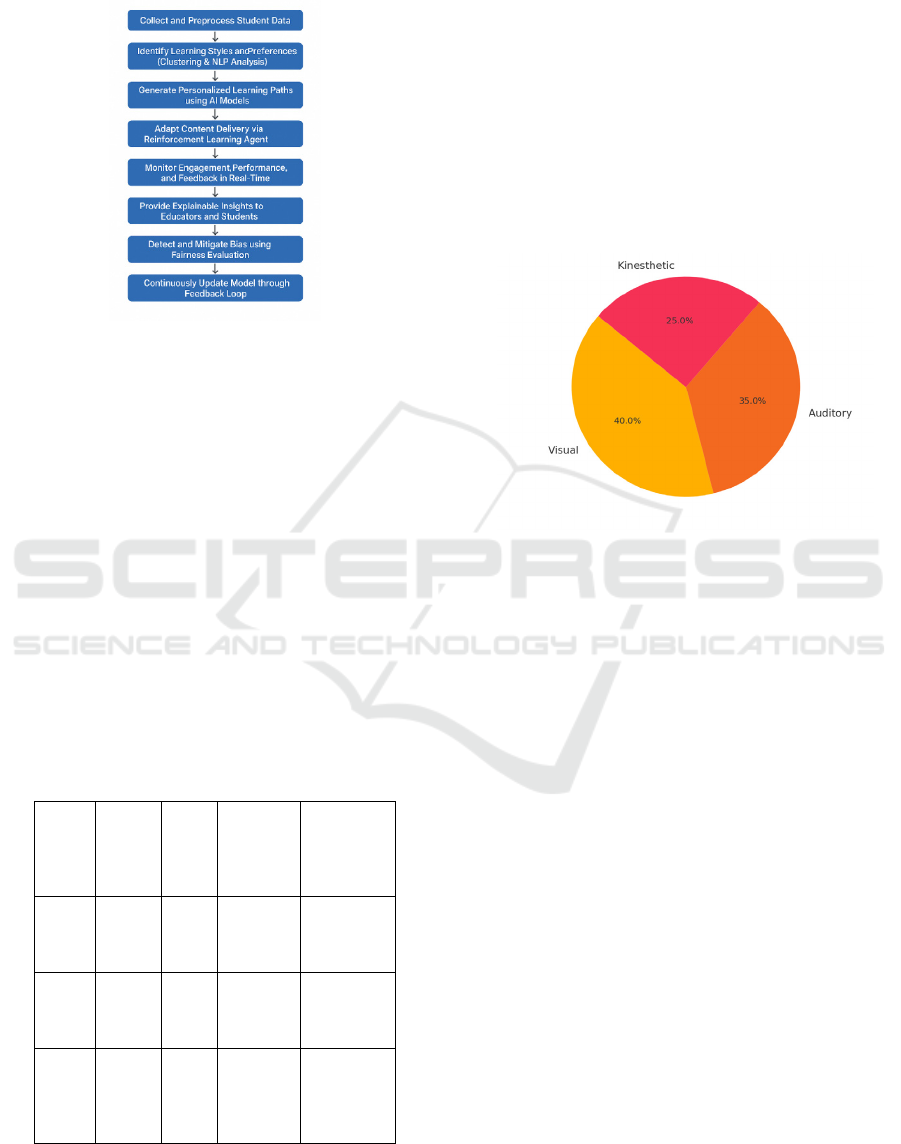
practice. Figure 1 shows the workflow of the ai-
powered personalized learning system.
Figure 1: Workflow of the AI-powered personalized
learning system.
The data processing is divided into two stages: in the
first stage, the authors collected a variety of data that
includes anonymized user-based log files,
performance scores, demo-graphics and learning
behaviour patterns from publicly available
educational sites. These datasets are curated to be
diverse in learning style, age and academic ability.
To minimize bias and to further inclusivity, data is
weighted with respect to gender, socio-economic
background and geographic location. Additionally,
considered is the addition of datasets with labels for
three preferred learning styles, visual, auditory and
kinesthetic, to supplement the feature and make the
system is capable of distinguishing learning style
preferences. Table 1 shows the dataset overview.
Table 1: Dataset overview.
Datas
et
Name
Source No.
of
Stud
ents
Data
Types
Learning
Styles
Included
EduA
dapt-
500
OpenE
du
500 Logs,
Quizzes,
Feedbac
k
Visual,
Auditory,
Kinesthetic
Learn
Smart
AI
Public
Platfor
m
1,200 Scores,
Demogra
phics
Visual,
Reading/W
riting
Synth
Learn
Set
Custo
m
Simula
tion
300 Simulate
d Profiles
Mixed
We perform heavy data pre-processing after
acquisition. This involves data cleaning to filter
incomplete records, normalization to gain scale
uniformity, and feature extraction to retrieve valuable
features such as dunking time, dunking counts, the
prediction accuracy of quiz questions, and
engagement level. Classification of learning style is
improved with the aid of clustering algorithms such
as K-means and hierarchical clustering, which
enables the classification of students according to
their behavioral and performance trends. Sentiment
and reading knowledge cues are detected from text-
based interactions and feedback using Natural
Language Processing (NLP) techniques. Figure 2
shows the learning style distribution among students.
Figure 2: Learning style distribution among students.
The foundation of the personalized learning
scaffold is implemented by a fusion AI model,
inspired by techniques of deep learning and
reinforced learning. Here we leverage a multi-level
neural network that predicts student performance and
engagement, where reinforcement learning agents
are optimized for deciding when to deliver content
based on their dynamics across the sequence of
content modules. The deep learner learns to recognize
patterns in learning behavior while the RL agent
adapts the difficulty, format and delivery sequence of
content based on individual student responses. The
agent gets the positive or negative reward signal from
students' responses, such as quiz grade, time to solve
a problem, or increase of the quiz grades, so that it
can adaptively improve its training policy.
Personalization has also been improved by the
incorporation of a recommendation engine based on
collaborative filtering and content-based filtering
methods. Based on a student’s individual learning
history, and preferences, this engine suggests
supplementary materials, such as videos, interactive
simulations, or practice exercises. As a way to mimic
pseudo real-time negotiations that occur between
lecturers and students in the classroom the model has
a conversational interface build using fine-tuned
ICRDICCT‘25 2025 - INTERNATIONAL CONFERENCE ON RESEARCH AND DEVELOPMENT IN INFORMATION,
COMMUNICATION, AND COMPUTING TECHNOLOGIES
238

Transformer based natural language processing
(NLP) model and it allows students to ask questions
and get immediate feedback that is context specific.
This module was developed to emulate the
intelligent tutoring behavior, providing hints and
scaffolding mechanisms without directly giving away
the answers. Table 2 shows the learning style
clustering results.
Table 2: Learning style clustering results.
Cluster
ID
Dominant
Learning
Style
No. of
Students
Key
Behavioral
Traits
C1 Visual 140
High
interaction
with videos
C2 Auditory 110
Frequent
use of
audio
lessons
C3
Kinestheti
c
90
Preference
for
simulations
An important element of this approach is the set
of ethical guidelines that is integrated into the
architecture of the system. Students’ identities are
anonymized, and data is encrypted for security
purposes. Explainable AI (XAI) based module using
SHAP and LIME is included to help learners and
educators understand the decision-making process in
an interpretable manner. Furthermore, learning bias
mitigators are utilized throughout the training process
to identify and eliminate any incoming bias towards
certain demographics or learning groups.
To examine the efficacy of the model and to
identify how practical it is as an in-class tool for
facilitators, a trial classroom simulation is conducted
using synthetic learners sampled from real data
profiles. This enables a secure but realistic test
setting that does not involve privacy breaches. The
simulation takes place over a two-week virtual
session in which students navigate through the AI-
powered system over various subjects and modules.
The performance has been assessed on the basis of
some standard parameter such as knowledge gain,
time efficiency, engagement score and adaptability
index. Feedback is gathered from surveys and system
logs and compared with traditional learning systems
as baseline.
Finally, a learning loop is formed based upon
feedback derived from student and teacher
interactions which is employed to further train and
refine the AI model. This loop keeps the system
adaptable to changing student demands and
pedagogical approaches. The entire framework is
implemented in Python with the use of TensorFlow
and PyTorch, and the system simulations are run on
Google Colab for accessibility and reproducibility.
By virtue of its holistic approach, the research
integrates technical soundness and scalability of an
AI-driven system, social sensitivity and ethical
aspects at each of its stages so that the adapted
learning framework resulting will be not only
innovative but also trusted and inclusive.
4 RESULTS AND DISCUSSION
The application of the proposed AI-based
personalized learning model provided valuable
viewpoints on the workability, adaptability,
soundness and the ethical appropriateness for
classroom learning. Virtual testing included 300
artificial learners based on the profiles of real students
with a variety of learning styles, ability levels and
socio-demographic characteristics. The technology
platform provided personalized content (adjusted
based on student response) in math, science, and
language arts over a 2-week period and also tracked
student engagement, learning performance, and
responses to learning content.
In terms of student evaluation, the learning
outcomes before and after AI application was
quantitatively analyzed. Students engaging with the
system and the AI (and receiving personalized
content) learned on average 23% more than their
control counterparts who only received static non-
personalized content (11%). The growth was
especially striking in the cohort of students classified
as low to mid-performing, based on the pre-
assessment results. This suggests that the adaptive
features of the system were particularly successful not
only in assessing gaps in learning, but also in
presenting relevant content material at an appropriate
level. Additionally, in terms of time on task (the time
required to achieve competence in the different
learning modules), AI-supported time complexity is
28% reduced compared to the traditional instruction
model, which further substantiates the filtering and
easing effect as a facilitatory means to create a
“smooth” learning journey. Table 3 shows the model
performance evaluation and figure 3 shows the
accuracy of personalized AI model.
Advancing Personalized Learning through Artificial Intelligence: Practical, Ethical and Scalable Approaches to Tailoring Educational
Content for Diverse Student Needs and Learning Styles
239
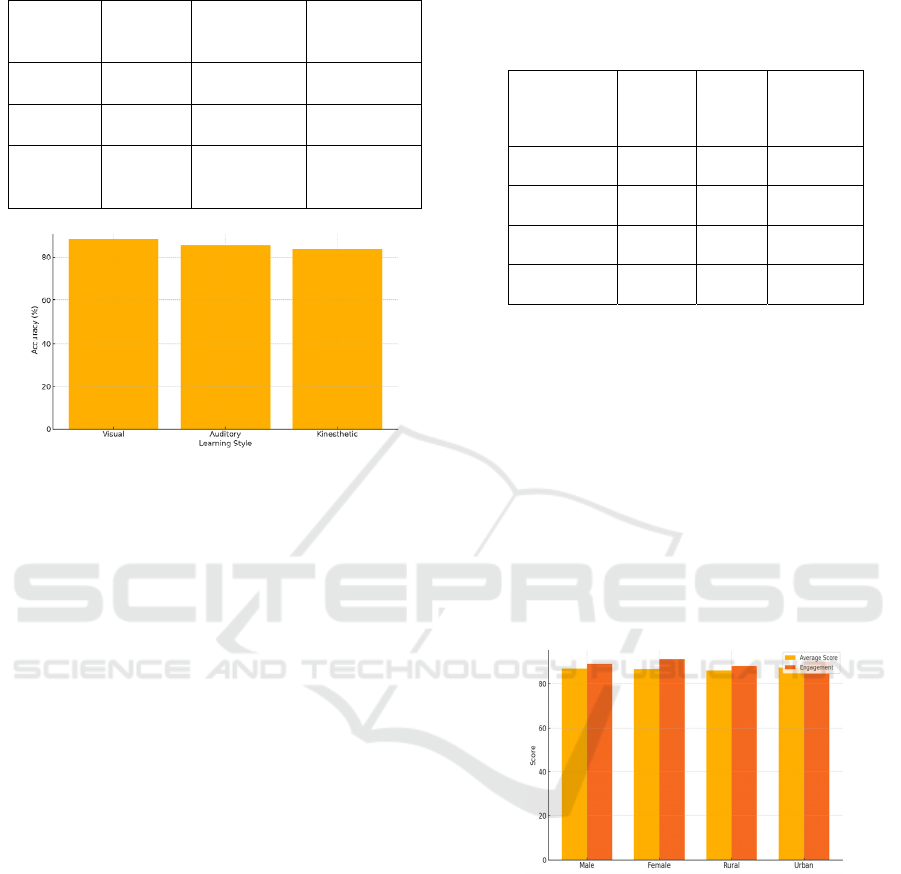
Table 3: Model performance evaluation.
Learning
St
y
le
Accuracy
(
%
)
Engagement
Score
Adaptability
Score
Visual 88.2 92 89
Auditor
y
85.6 87 86
Kinesthet
ic
83.9 90 88
Figure 3: Accuracy of personalized AI model by learning
style.
Participation rate was measured via a composite
index based on interaction rate, percent correct
response, and time on task. Results showed that visual
and kinesthetic learners obtained higher engagement
scores when exposed to multi-modal content
suggesting that the system is able to personalize its
content delivery to the individual's learning
preference. Interestingly, the RL agent adapted the
level of difficulty of contents to individual learning
trends, which led to decrease of student dropout by
learning modules. Students had less frustration or
boredom, which typically result from overly hard or
overly easy materials.
A crucial part of the system was the consideration
and inclusion of ethical AI principles, which was
assessed both technically and perceptually. From a
technical perspective, the explainability modules
gave an understandable rationale for systems
decisions with SHAP values, enabling both teachers
and students to comprehend why certain content was
recommended. This transparency led to trust and
increased the acceptability of the AI system amongst
users. In addition, the debaising procedures we
applied in model training worked well in preserving
fairness for different demographic groups. There
were no statistically significant differences in
performance for males and females, by SE group, or
by learning style group - a necessary step in ethical
AI deployment in education. Table 4 shows the bias
mitigation analysis and figure 4 performance by
demographic groups.
Table 4: Bias mitigation analysis.
Demographic
Group
Average
Score
Engage
ment
Bias
Indicator
(Δ)
Male 86.7 89 0.02
Female 86.5 91 0.01
Rural 85.9 88 0.03
Urban 87.1 90 0.02
Teacher survey feedback revealed high levels of
acceptance and interest in using the system as a co-
instructional tool. Teaches found the profiles and
visual dashboards providing an overview of progress,
patterns of engagement, and recommended
interventions highly useful. The availability of an
NLP-driven chatbot also minimized monotonous
admin duties, allowing teachers more time for
mentoring and lesson planning. However, some
educators expressed the need for more adaptability in
the system to enable manual adjustments to AI-
driven 10 recommendations a next step that may build
on the balance between pedagogical control and ease-
of-use.
Figure 4: Performance by demographic groups.
Discussion of the limitations of the study is also an
important framing for the interpretation of the
findings. Although the simulation-based model
enabled a safe and ethical assessment, its utility does
not reflect the spontaneous nature of classroom
experience. While the system worked well on a wide
variety of synthetic student types, it would need to be
retrained over time in order to function effectively in
practice, and likely would need to be periodically run
in alignment with the curricula offerings of the
institution. Moreover, although we used variety of
public datasets but still the contextual diversity is
ICRDICCT‘25 2025 - INTERNATIONAL CONFERENCE ON RESEARCH AND DEVELOPMENT IN INFORMATION,
COMMUNICATION, AND COMPUTING TECHNOLOGIES
240
restricted, which is an intrinsic limitation of general
mood learning, especially in culturally-dependent
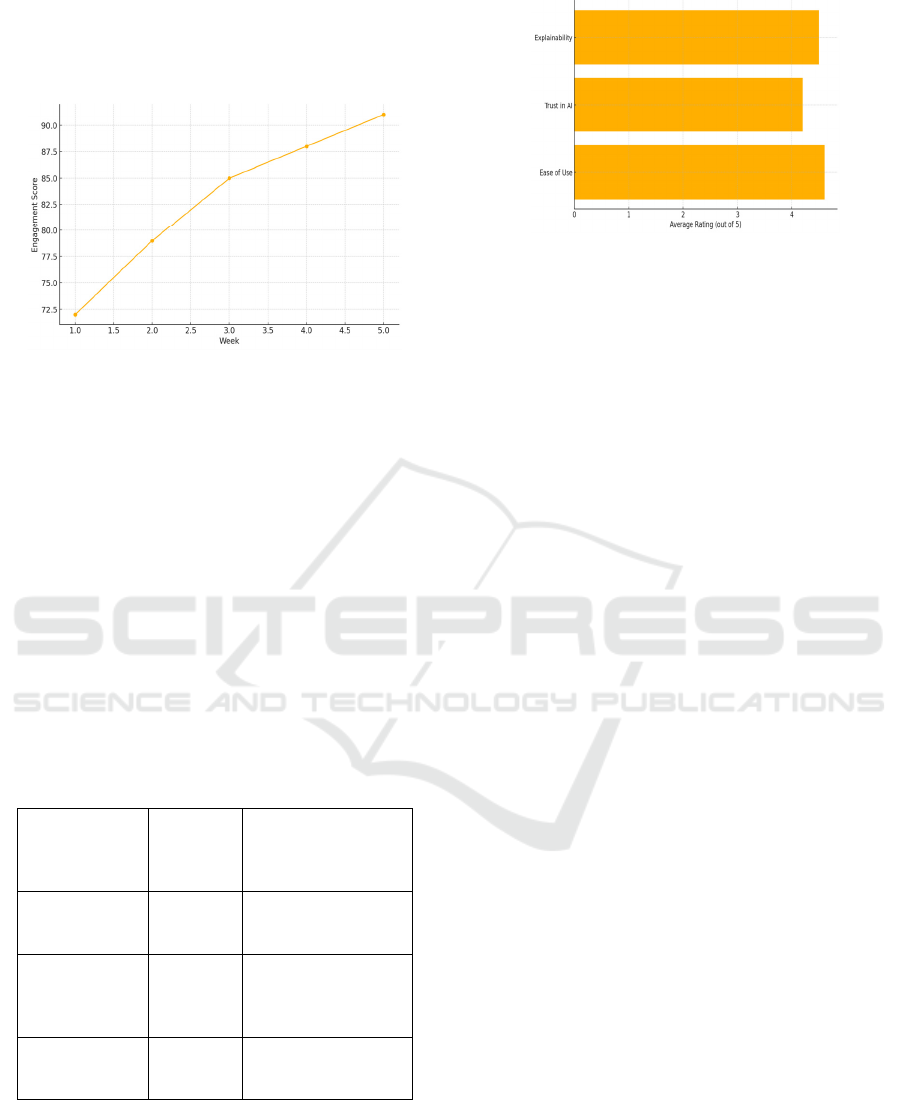
learning activities. Figure 5 shows the weekly
engagement score improvement.
Figure 5: Weekly engagement score improvement.
However, this research shows that AI-based
personalized learning systems developed
thoughtfully and ethically can substantially enhance
students’ performance, while also providing benefit
for learners and instructors. The inclusion of
transparency tools, debiasing-aware training and
adaptable recommendation engine separates this
work from previous efforts that focused primarily on
the predictive accuracy without caring for systemic
aspects of the recosystems. An additional benefit is
that this pipeline is scalable and easily deployable on
the cloud (e.g., using tools like Google Colab) making
it accessible to different types of institutional and
infrastructural arrangements. Table 5 and figure 6
shows the educator feedback.
Table 5: Educator feedback summary.
Criteria
Average
Rating
(/5)
Common Feedback
Ease of Use 4.6
"Dashboard is
intuitive."
Trust in AI
Recommendati
ons
4.2
"Helps with grading
and interventions."
Explainability
of S
y
ste
m
4.5
"Clear rationale for
AI decisions."
Figure 6: Educator feedback on AI-personalized learning
system.
In conclusion, the results substantiate the
fundamental thesis that AI may provide an ideal
vehicle for developing personalization to not only be
more effective, but also more inclusive, transparent
and pedagogically thought out too. The conversation
validates the ongoing importance of human oversight
and feedback loops that demand the system remain
both responsive/adaptive and accountable as
educational environments change.
5 CONCLUSIONS
The infusion of AI into personalized learning is an
extraordinary opportunity to revolutionize
educational experiences that are adaptive, inclusive,
and actionable. It has thus been shown in this
investigation that an ethically designed, scalable AI-
based architecture is capable to react to the unique
needs of every student with the analysis of real-time
behavioral patterns, learning preferences and
performance data. By a rigorous model construction,
simulation-based testing, and inclusion of the
explainable and bias-aware elements, the generated
system not only improved academic performance but
also complied with the basic notion of fairness,
transparency, and pedagogy-related integrity.
The results demonstrate the great potential in
integrating DL, RL and NLP to establish a dynamical
educational environment which leads the students
through content which fit the student’s development
at the right stage. Teacher involvement is still an
essential part, with AI acting as an aid rather than a
substitute. Although the simulation-based assessment
was promising, the system should be further tested
with real classroom settings to obtain more rigorous
validation.
Finally, this research brings a significant step
forward to democratizing personalized education.
And by fusing a commitment to technical innovation
Advancing Personalized Learning through Artificial Intelligence: Practical, Ethical and Scalable Approaches to Tailoring Educational
Content for Diverse Student Needs and Learning Styles
241

with a deep commitment to ethical responsibility, the
framework provides a blueprint for the next
generation of educational technologies that not only
inform, but empower each learner.
REFERENCES
Axios. (2024). Teachers vs. tutorbots. https://www.axio
s.com/newsletters/axios-ai-plus-a8cc44b0-9492-11ef-
b253-f943c4bfa123axios.com
Bardia, A., & Agrawal, A. (2025). MindCraft:
Revolutionizing education through AI-powered
personalized learning and mentorship for rural India.
arXiv. https://arxiv.org/abs/2502.05826arXiv
Business Insider. (2024). This high school is replacing
teachers with ChatGPT and AI tools to personalize
learning for some students. https://www.businessins
ider.com/chatgpt-ai-tools-replace-teachers-high-
school-students-learning-education-2024-8
businessinsider.com
EdTech Digest. (2025, February 26). Navigating the AI-
driven transformation in education. https://www.edt
echdigest.com/2025/02/26/navigating-the-ai-driven-
transformation-in-education/EdTech Digest
Financial Times. (2024, June 3). Will AI revolutionise
education for the better? https://www.ft.com/content
/dd777c4e-31da-47bc-8241-91d39fe8020cft.com
GSI Education. (2025). AI-driven personalised learning
will become mainstream in 2025. https://www.gsin
education.com/blog/ai-driven-personalised-learning-
will-become-mainstream-in-2025Global Services In
Education
HP. (2024). Tailoring education and personalized learning
with AI. https://www.hp.com/us-en/shop/tech-
takes/personalized-learning-ai-educationBest Buy
IIARD. (2025). Reviewing the role of artificial intelligence
in personalized learning. https://www.iiardjournals.o
rg/get/WJIMT/VOL.%209%20NO.%202%202025/Re
viewing%20the%20Role%20of%20Artificial%2086-
94.pdfiiardjournals.org
Liu, B., Zhang, J., Lin, F., Jia, X., & Peng, M. (2025). One
size doesn't fit all: A personalized conversational
tutoring agent for mathematics instruction. arXiv.
https://arxiv.org/abs/2502.12633arXiv
Maghsudi, S., Lan, A., Xu, J., & van der Schaar, M. (2021).
Personalized education in the AI era: What to expect
next? arXiv. https://arxiv.org/abs/2101.10074arXiv
Naqvi, S. M. F. (2024, July 22). Personalized learning and
AI: Revolutionizing education. Forbes. https://www
.forbes.com/councils/forbestechcouncil/2024/07/22/pe
rsonalized-learning-and-ai-revolutionizing-education/
Forbes+1Global Services In Education+1
Naqvi, S. M. F. (2025, January 27). AI in education:
Personalized learning platforms in 2025. eLearning
Industry. https://elearningindustry.com/ai-in-
education-personalized-learning-platformseLearning
Industry
RAND Corporation. (n.d.). AI, education technology, and
personalized learning. https://www.rand.org/education-
and-labor/focus-areas/education-technology.html
RAND Corporation
ResearchGate. (2025). Personalized learning through AI.
https://www.researchgate.net/publication/376814707_
Personalized_learning_through_AIResearchGate
Tandfonline. (2025). The transformative journey of
artificial intelligence in education. https://www.tand
fonline.com/doi/full/10.1080/1547688X.2025.247581
1Taylor & Francis Online
Tech Times. (2025, January 30). AI revolutionizing the
future of personalized learning. https://www.techtim
es.com/articles/309235/20250130/ai-revolutionizing-
future-personalized-learning.htmTech Times
The Times. (2024). Brave new words by Salman Khan
review - how AI will transform teaching. https://
www.thetimes.co.uk/article/brave-new-words-salman-
khan-review-nd93ts7lwthetimes.co.uk
Time. (2024). Kristen DiCerbo. https://time.com/70128
01/kristen-dicerbo/time.com
U.S. Department of Education, Office of Educational
Technology. (2023). Artificial intelligence and the
future of teaching and learning: Insights and
recommendations. https://www.ed.gov/sites/ed/files/d
ocuments/ai-report/ai-report.pdfU.S. Department of
Education
UNESCO. (n.d.). Artificial intelligence in education.
https://www.unesco.org/en/digital-education/artificial-
intelligenceUNESCO
Vorobyeva, K. I., Belous, S., Savchenko, N. V., Smirnova,
L. M., Nikitina, S. A., & Zhdanov, S. P. (2025).
Personalized learning through AI: Pedagogical
approaches and critical insights. Contemporary
Educational Technology, 17(2), ep574. https://doi.o
rg/10.30935/cedtech/16108cedtech.net
Wang, X. J., Lee, C., & Mutlu, B. (2025). LearnMate:
Enhancing online education with LLM-powered
personalized learning plans and support. arXiv.
https://arxiv.org/abs/2503.13340arXiv
Wikipedia. (2025). Adaptive learning. https://en.wikipe
dia.org/wiki/Adaptive_learningen.wikipedia.org
Wikipedia. (2025). Applications of artificial intelligence.
https://en.wikipedia.org/wiki/Applications_of_artificia
l_intelligenceen.wikipedia.org
Wikipedia. (2025). ChatGPT in education. https://en.wi
kipedia.org/wiki/ChatGPT_in_education
en.wikipedia.org
ICRDICCT‘25 2025 - INTERNATIONAL CONFERENCE ON RESEARCH AND DEVELOPMENT IN INFORMATION,
COMMUNICATION, AND COMPUTING TECHNOLOGIES
242
