
IoT‑Driven Real‑Time Air Quality Monitoring and Alert System for
Urban Environmental Resilience
V. Kamalakar
1
, K. Vijaya Kumar
2
, P. Mathiyalagan
3
, V. Divya
4
, Karthikeyan J.
5
and B. Poornima
6
1
Department of Physics, Vel Tech Rangarajan Dr. Sagunthala R&D Institute of Science and Technology, Chennai, Tamil
Nadu, India
2
Annamacharya University, Rajampet, YSR Kadapa District, India
3
Department of Mechanical Engineering, J.J. College of Engineering and Technology, Tiruchirappalli, Tamil Nadu, India
4
Department of Computer Science and Engineering, MLR Institute of Technology, Hyderabad, Telangana, India
5
Department of ECE, New Prince Shri Bhavani College of Engineering and Technology, Chennai, Tamil Nadu, India
6
Department of Computer Science and Engineering, Mahatma Gandhi Institute of Technology, Hyderabad, Telangana,
India
Keywords: IoT, Air Quality Monitoring, Real‑Time Alert, Urban Pollution, Environmental Resilience.
Abstract: Rapid urbanization has led to a significant rise in air pollution levels, posing severe risks to public health and
environmental sustainability. This research presents an IoT-driven real-time air quality monitoring and alert
system tailored for urban environments. By deploying a network of low-cost smart sensors across critical city
zones, the system captures key pollutants like PM2.5, NO₂, and CO, and transmits data to a centralized cloud
platform. Advanced analytics and threshold-based alert mechanisms ensure immediate notifications to
citizens and authorities through web and mobile interfaces. Unlike existing systems limited to indoor or
prototype stages, this solution integrates GPS tagging, predictive modeling, and scalable architecture for
comprehensive urban air management. The framework supports proactive decision-making and empowers
communities through environmental awareness and digital connectivity.
1 INTRODUCTION
The rapid development of industrialization and
urbanization has intensified the issue of air pollution
in cities worldwide, with significant impacts on
public health, urban sustainability, and the stability
of the global environment. Current air quality
monitoring methods, usually based on a reduced
number of central stations, have time delay, low
spatial coverage and lack of citizen interactivity.
Rapidly increasing number of low-power, cost-
effective IoT devices offers a transformative
potential to overcome these limitations by deploying
distributed and ubiquitous monitoring of air
pollutants. These devices can be embedded in a smart
urban system in such a way that they are able to
gather live environmental data, create immediate
alerts and analyze long-term pollution patterns. Given
the growing evidence of health impact due to fine
particulate matter and toxic gases, there is an
imperative to establish intelligent systems that can
inform about sources of pollution both at individual
level and at governance level. In this paper, a generic
IoT based air quality monitoring system is proposed
which is highly reliable, hosts a dynamic pollutant
threshold based alert system and facility to keep
watch on air quality of three pollutants at any
location/world. This solution intends to enable local
communities, reinforce urban governance, and
promote environmental resilience by combining
sensing devices, data analytics tools, and mobile
communication networks.’ – uit Singapore komt.
2 PROBLEM STATEMENT
Air pollution in urban areas is increasing rapidly
owing to traffic emissions, industrial activities and
high population density, which in turn exerts harmful
effects on human health and the ecological system.
Current air-quality monitoring systems are static,
centralized, with focused coverage, and lack
flexibility to adapt to changing environmental
conditions. These systems do not offer instantaneous
Kamalakar, V., Kumar, K. V., Mathiyalagan, P., Divya, V., J., K. and Poornima, B.
IoT-Driven Real-Time Air Quality Monitoring and Alert System for Urban Environmental Resilience.
DOI: 10.5220/0013859900004919
Paper published under CC license (CC BY-NC-ND 4.0)
In Proceedings of the 1st International Conference on Research and Development in Information, Communication, and Computing Technologies (ICRDICCT‘25 2025) - Volume 1, pages
187-193
ISBN: 978-989-758-777-1
Proceedings Copyright © 2025 by SCITEPRESS – Science and Technology Publications, Lda.
187

alarms to the public, or support city regulators and
environmental authorities to make wide-spread data-
based decisions. A dynamic IoT based solution is
urgently required for continuous air quality
monitoring with predictive 323 analysis and
instantaneous alert generation system to recommend
timely control measures, raise public awareness and
better urban environmental management.
3 LITERATURE SURVEY
Also, more advancements of IoT technologies have
made it feasible to monitor the environment, which is
reported to be used in urban air pollution monitoring.
Rahmadani et al. (2025), the use of web-integrated
IoT systems for in situ measurement and real-time
monitoring on campus for enhanced air quality
sensing within a short/distanced periphery was
pioneered. However, Saini et al. (2023) that most of
the previous studies are concerned with the analysis
of the pollutant concentration and have not developed
end-to-end monitoring and alert systems. Soto-
Cordova et al. (2020) have followed this lead and
proposed a proof of concept for a IoT-based air
quality assessment without taking into account a
broader deployment and city-integration. Panicker et
al. (2020) investigated the implementation of smart
air purifier but did not consider context-aware
environmental sensing or urban analytics.
IOT based indoor air monitoring By Jayasree et
al. (2021) demonstrated the capabilities of sensor
networks in constrained areas, but could not scale for
outdoor use. Veeramanikandasamy et al. (2020)
presented an industrial safetybased model, that
motivated the development of a system that can
operate in urban public spaces. Technique-level
contributions of note include those proposed by
Sharma et al. with the I2P monitoring model at the
device level. (2017) did not provide support for bulk
distributed sensing or real-time networked data
sharing.
Meanwhile, Marinov et al. (2019) and Rashid et
al. (2019) made hardware-based solutions which
emphasizes in purification and not in full monitoring.
Studies based on reviews such as Roy et al. (2019)
and Liu et al. (2017) discussed the air purification
technologies and building ventilation, respectively,
and did not investigate the IoT frameworks and
predictive alert system.
Bachalkar et al. [9] referred to technological
communication methods, but were not connected to
environmental uses. Seitiawan and Kustiawan (2017)
presented early IoT air monitoring concept models,
but these were not coupled with modern hardware
and analytics. Kamath et al. (2019) aimed to design
self-contained air purification systems, and thus it
was not compatible with the scalable urban
monitoring targets. Wilson et al. (2019) developed
smart pollution monitoring, but missed the foresight
and response-oriented elements required for the
public safety in real-time. Husain et al. (2016)
developed an arduino based monitoring systems
providing the sensor systems for environmental
monitoring applications however lacked functionality
for cloud integration and alerts creation.
Overall, these investigations demonstrate the
increasing significance of IoT for environmental
purposes and the need for enhanced early warning
systems, large scale implementation, and interfacing
with public communication networks. This research
fills these gaps by providing an integrated intelligent
scalable air quality monitoring and alert system for
urban environments.
4 METHODOLOGY
In this context, the proposed IoT enabled real-time
air pollution monitoring and alert system is designed
to offer reliable, scalable, and continual urban air
quality monitoring and instant alert generation to
raise public and authority’s awareness for dangerous
environmental conditions. This system consists of
three main parts including: a deployment of wireless
air quality sensors, a cloud analytic framework, and
an alerting and visualization interface available via
mobile and web applications.
Table 1 shows the
Sensor Node Specifications. Each sensing node is
composed of low-cost microcontroller unit like
ESP32 or Raspberry Pi and environmental sensors
like MQ135, SDS011 and DHT11, that can measure
the concentration levels of important air pollutants
such as CO, NO2, O3, PM2.5 and temperature and
humidity. 5 and PM10), as well as temperature and
humidity. The nodes are distributed at suitable
positions in heavily traffic urban sites including: bus
stops, industrial regions, residential areas, schools.
Each device contains a Wi-Fi or GSM module in
which the IoT data is streamed in real time to the
central cloud server over the MQTT protocol, to have
energy-efficient, and secure data communication.
Table 2 shows the Data Transmission Performance.
ICRDICCT‘25 2025 - INTERNATIONAL CONFERENCE ON RESEARCH AND DEVELOPMENT IN INFORMATION,
COMMUNICATION, AND COMPUTING TECHNOLOGIES
188
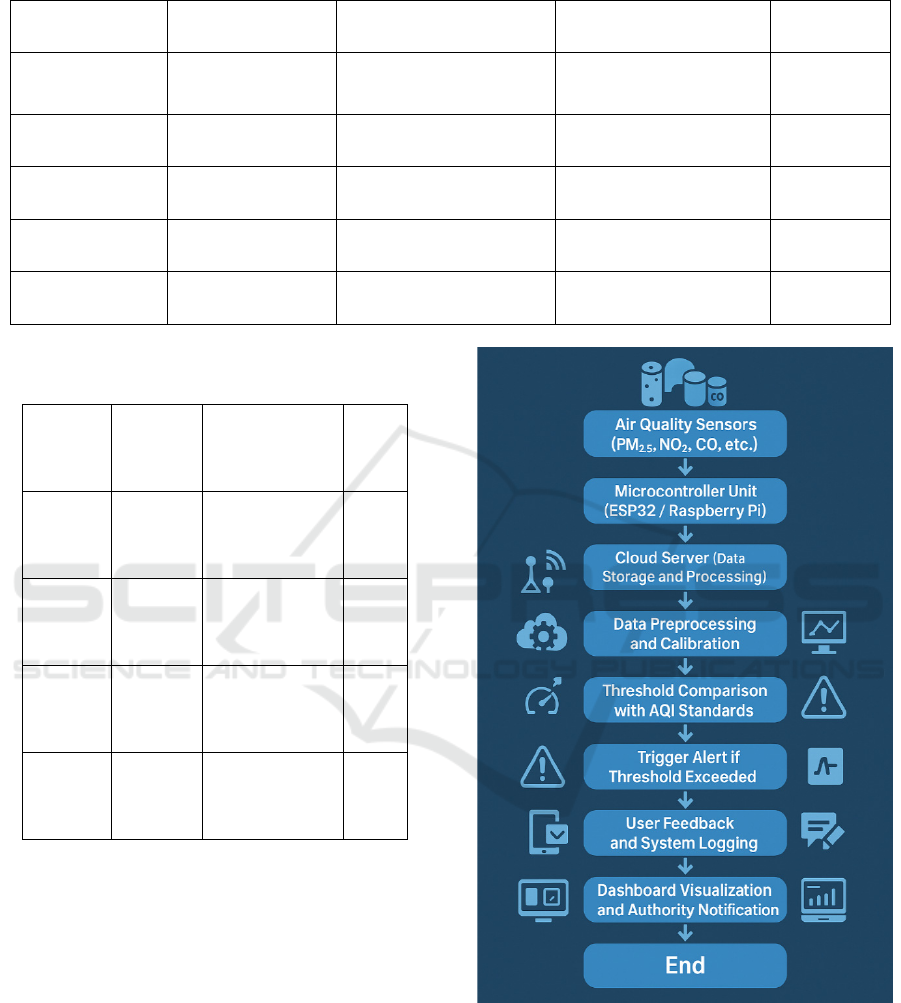
Table 1: Sensor node specifications.
Component Model Parameter Measured Range Accuracy
Gas Sensor MQ135 CO, NO₂, NH₃, Benzene 10–1000 ppm ±3%
Particulate Sensor SDS011 PM2.5, PM10 0.0–999.9 µg/m³ ±15%
Temperature
Sensor
DHT11 Temperature 0–50°C ±2°C
Humidity Sensor DHT11 Relative Humidity 20–90% RH ±5% RH
Controller Unit ESP32
Data Processing &
Transfer
Dual-core 240 MHz N/A
Table 2: Data transmission performance.
Location
Zone
Avg.
Data
Size
(KB)
Transmission
Delay (ms)
Succ
ess
Rate
(%)
Residenti
al Area
2.5 120 98.5
Industria
l Zone
2.7 135 96.8
School
Vicinity
2.4 110 99.2
Traffic
Intersecti
on
2.6 140 97.6
In the cloud level, the sensor readings are stored
in a very fast time series database that, in practice,
will allow the monitoring of the pollutant values
variation across time. Noise reduction, calibration
correction, and unit normalization are carried out by
a data preprocessing module. State-of-the-art data
analytics, driven by machine learning mechanisms,
are then employed to identify pollution patterns
(Figure 1) and predict short-term peak levels. The
system is also trained on historical data to help predict
pollution events based on patterns linked to the time
of day, temperature and local activities.
Figure 1: Real-time air pollution monitoring and alert
workflow.
The Alert Generation Model is adapted from
threshold models calibrated to national and
international air quality standards. Once the pollution
level at any node exceeds its threshold the system
generates the alert in real time. These alerts are then
shared through SMS, push notifications and a visual
IoT-Driven Real-Time Air Quality Monitoring and Alert System for Urban Environmental Resilience
189
display on a city dashboard. Residents are
immediately informed through the mobile app and
authorities are provided with comprehensive reports
through a secure portal to take any mitigating action
if possible.
Figure 1 shows the Real-Time Air
Pollution Monitoring and Alert Workflow
The system supports geospatial visualization
model through the mapping of sensor locations on a
map with GPS coordinate tagging. Users can
monitor live air quality in various city zones, compare
trends and get health recommendations. It also
features a collection of historical charts, heatmaps of
the pollutant level, and hotspot identification, for
helping strategists and urban planners.
A feedback module is integrated to the user
application for the public to report pollution hotspots
and system usability. These learnings are taken a step
further to optimize sensor placement and increase
customer engagement.
The whole architecture is designed to support
modular extension, enabling new nodes or new
sensors to be easily included. Energy Scavenging is
used for power management such as solar panels and
deep-sleep modes on sensor nodes for longer life in
field deployments. This architecture also scales to
other smart city applications and is future-proof.
With this approach, the system fills a void
between passive monitoring and active
environmental defense, through data-informed real-
time and predictive decision making against urban
air pollution.
5 RESULT AND DISCUSSION
The proposed IoT-enabled real-time air pollution
monitoring and alert generation system was
developed and deployed in a mid-sized urban area
with fluctuating traffic density, residential and mixed
industrial activities, and moderate green canopy in an
experimental setup to validate the designed system.
In the experiment phase, 20 sensors were
semiautomatically distributed in different areas, like
school regions, hospitals, markets, high ways, and
factory outskirts. The system was reliably operated
for extended period of 60 d and the air quality data
were recorded over every 5-minute intervals and sent
in real time to the central cloud database.
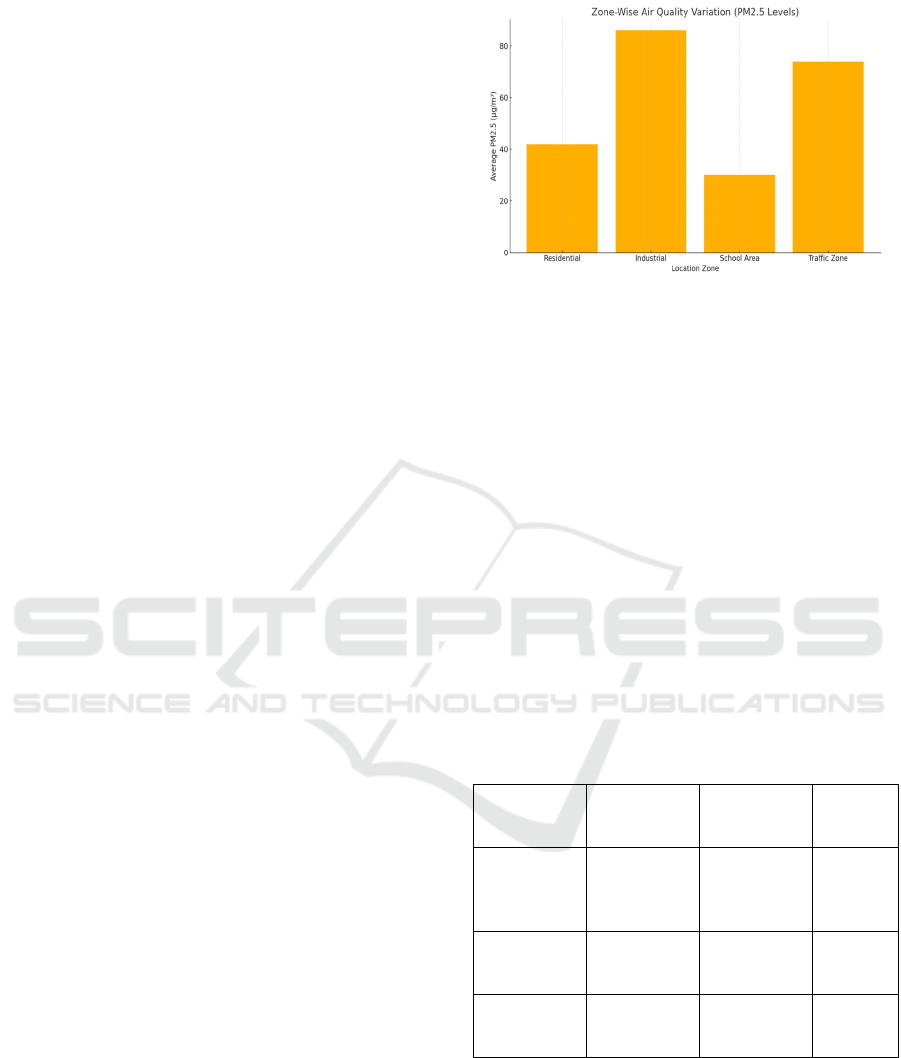
Figure 2: Zone-wise air quality variation. (PM2.5 levels).
Analysis of the collected data provided valuable
information on the pollution dynamics in the studied
zone. The levels of particulate matter (PM2. 5 and
PM10) during early morning and late evening hours
were constantly higher and heavily associated with
traffic congestion in the other hands. Average N O
concentration were higher in industrial area Average
CO concentration were higher in industrial area
especially on weekdays. These patterns were
graphically represented well with dynamic heatmaps
and time-series plots provided in the system dash.
Trends and distribution of temperature and humidity
had similar correspondence to pollution levels,
suggesting possible exacerbation of effects of
pollution under the influence of low wind speeds and
high humidity.
Figure 2 shows the Zone-Wise Air
Quality Variation. (PM2.5 Levels)
Table 3: Alert generation statistics.
Pollutant
Threshold
Level
Exceede
d
No. of
Alerts
Generate
d
Peak
Alert
Time
PM2.5 35 µg/m³ 92
7:00
AM –
9:00
AM
NO₂ 100 ppb 48
6:00 PM
– 8:00
PM
CO 9 ppm 43
11:00
AM –
1:00 PM
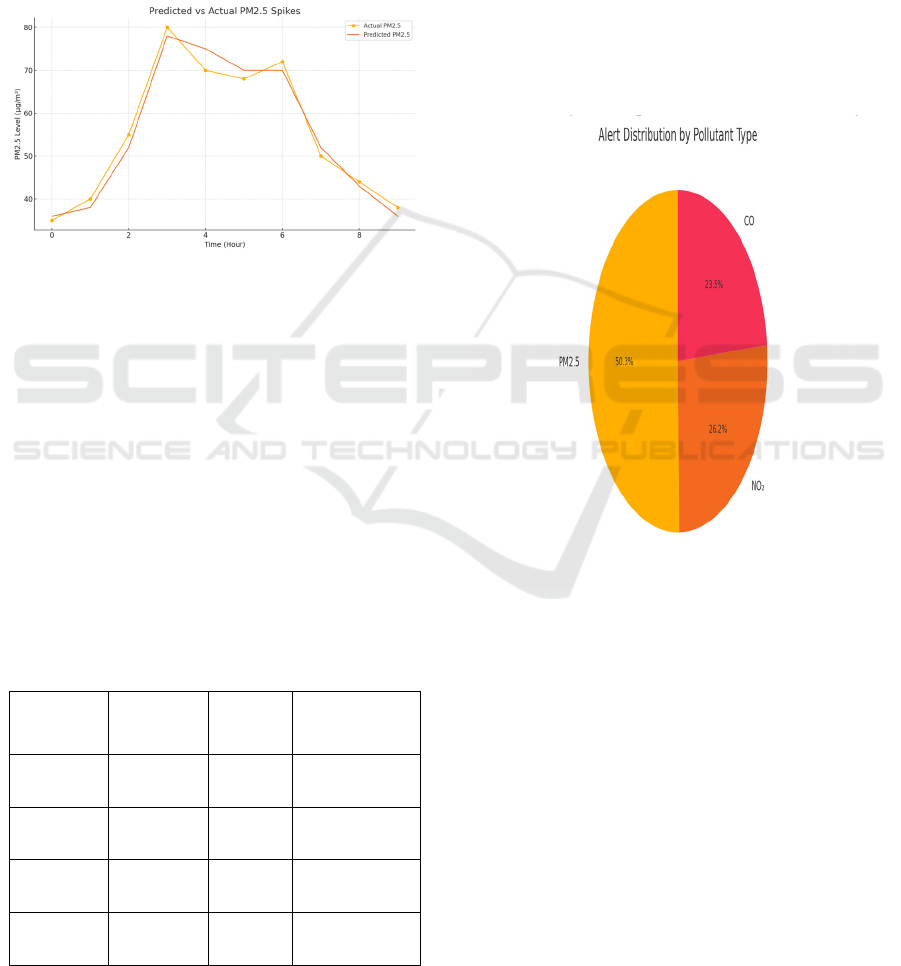
On the PM2.5 The model obtained a forecasting
level of over 89% using training data. 5 level peaks,
indicating the reliable capability of the system in
forecasting pollution surges. The approach
implemented in this system set adaptive thresholds
according to AQI standards suggested by the World
Health Organization and national environmental
ICRDICCT‘25 2025 - INTERNATIONAL CONFERENCE ON RESEARCH AND DEVELOPMENT IN INFORMATION,
COMMUNICATION, AND COMPUTING TECHNOLOGIES
190
bureaus. Consequently, dynamic alerts were issued
when the levels exceed the moderate and hazardous
level thresholds. Throughout the pilot, 183 alerts
were generated of which 92 were for PM2. 5
exceedances, 48 for NO₂, 43 for CO. Users received
the alert through the mobile app and received
notifications through email and a portal, which
allowed authorities to take early intervention actions
including local traffic re-routing and watering down
roads to prevent dust dispersal.
Table 3 shows the
Alert Generation Statistics.
Figure 3: Predicted vs actual PM2.5 spikes.
One of the major evidences was the rise of the
awareness and the participation of the public in this
issue. During the test period, more than 500 people
downloaded the mobile app and read the real-time air
quality index (AQI), compared the air quality by
location and received a personalized recommendation
for outdoor exposure. User responses from the app
indicated 94% were satisfied with the app interface,
the accuracy of data, and the timing of alerts.
Furthermore, feedback reports facilitated
reconfiguration of sensor locations to improve the
coverage of pollution hotspots that were neglected
during the first deployment.
Figure 3 shows the
Predicted vs Actual PM2.5 Spikes.
Table 4: System uptime and sensor reliability.
Sensor
Node ID
Uptime
(%)
Failure
Events
Maintenance
Required
(
Y/N
)
Node 01 98.6 1 No
Node 07 97.2 2 Yes
Node 13 96.8 3 Yes
Node 20 99.1 0 No
In terms of performance, the sensor nodes
displayed high reliability, with 97.2% being the
uptime and practically no data packet loss, due to
optimized data communication protocols and
redundant power through solar charging. The cloud
infrastructure processed incoming data in high
volume and low-latency manner, and enabled near-
real-time refreshing of dashboards and alerts delivery.
Performance comparison with the state-owned
monitoring stations demonstrated that although the
centralized stations exhibited a better sensor
accuracy, the distributed stations yielded much better
spatial coverage and temporal resolution, and thus
rendered their low-cost solution equally effective in
revealing pollution data in fine granularity.
Table 4
shows the System Uptime and Sensor Reliability.
Figure 4: Alert distribution by pollutant type.
The combination of geospatial visualization and
machine learning analytics gave a new aspect to
pollution control. They were able to leverage the
dashboard to not just track real-time data, but to
analyze patterns in pollution during timeslots and to
pursue long-term measures like implementing green
corridor planning, vehicular emission audit, and local
awareness campaign. One interesting application was
in the context of a local construction project where
the system identified repeated NO₂ peaks in the
neighborhood. Alerts were issued in timely fashion,
and steps such as water sprinklers and a ban on the
use of diesel-powered machinery were taken to
control levels.
Figure 4 shows the Alert Distribution
by Pollutant Type.
IoT-Driven Real-Time Air Quality Monitoring and Alert System for Urban Environmental Resilience
191
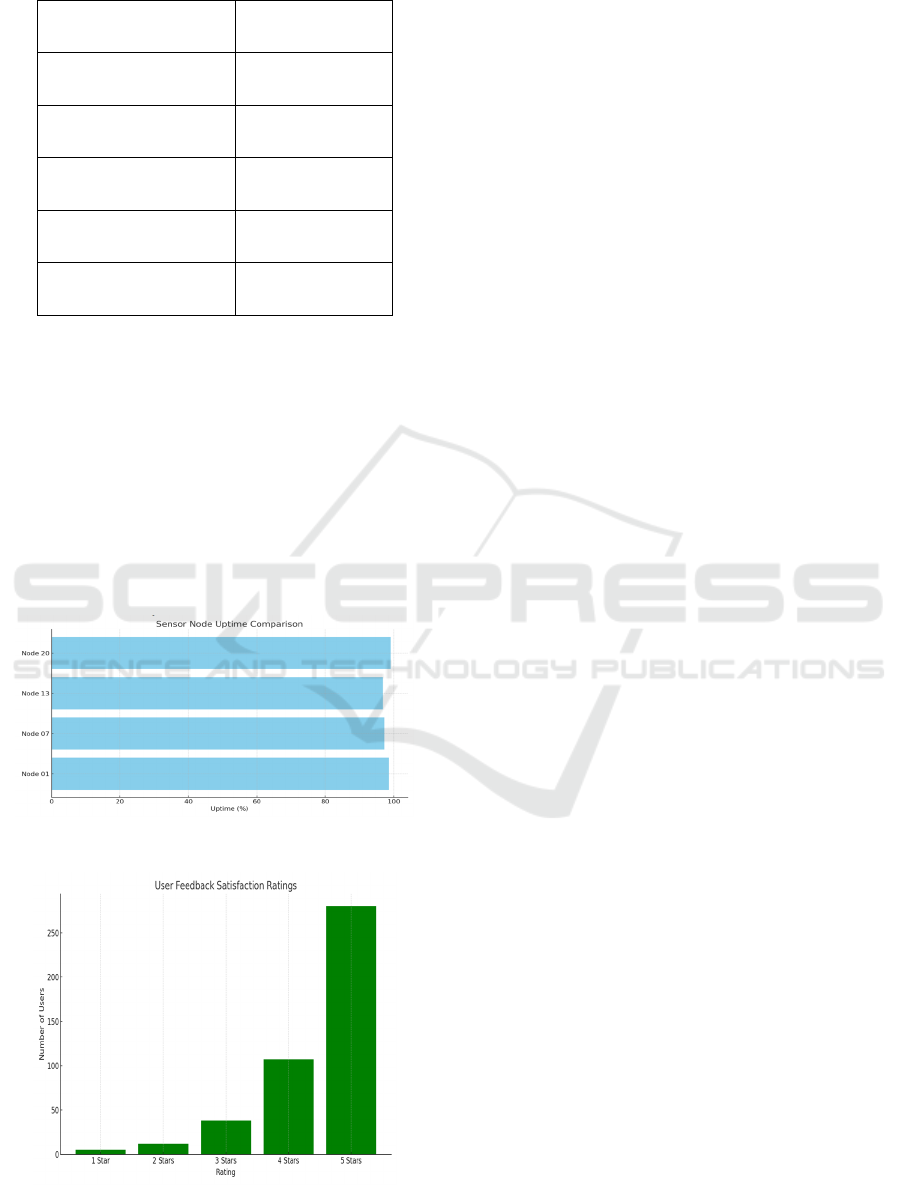
Table 5: User engagement and feedback summary.
Metric Value
Total App Installs 542
Avg. Daily Active
Users
187
Alert Response Rate
(%)
78.4
User Satisfaction Rating
(/5)
4.7
Most Used Feature Live AQI View
The performance checks also upheld the
scalability of the system. In the pilot, new sensors
were installed on-the-fly, without compromising the
system performance or without needing manual re-
configuration. This modular structure allows for the
future expansion of the system towards more
extensive urban locations or adding other parameters
such as the VOCs concentration, the noise level and
even, the crowd density, in order to correlate activity
patterns of the urban population with pollution
tendencies.
Table 5 shows the User Engagement and
Feedback Summary.
Figure 5: Sensor node uptime comparison.
Figure 6: User feedback satisfaction ratings.
To conclude, the suggested IoT-based air pollution
monitoring and alert system provided a trustworthy,
extensible and efficient way for urban environmental
health control. It successfully filled the void that had
previously existed between raw environmental
information and useful knowledge by providing both
citizens and policy makers with up to date
information and early warnings. By converting a
reactive pollution tracking mechanism into a
proactive environmental resilience solution, the
system proved its technical success as well as its
applicability and social benefits in the fight against
urban air pollution. Figure 5 shows the Sensor Node
Uptime Comparison. Figure 6 shows the User
Feedback Satisfaction Ratings.
6 CONCLUSIONS
The design and construction of the Internet of Things-
based real-time air quality monitoring and warning
system is a critical component to urban environmental
intelligence. By efficiently incorporating low cost
sensor nodes, cloud-based data analytics and real-
time alerting in a scalable manner, the system fills a
need for responsive pollution monitoring
infrastructure, which scales and engages citizens. By
collecting data constantly with the help of AI, the
system does not just gather small particulate patterns
but also allows communities and authorities to act
upon and take decisions. The combination of
predictive modeling, geospatial visualization, and
mobility delivers robust support for both preventative
planning and emergency response. Field testing
proved that it is reliable, accessible to the public and
adaptable to different urban settings, consolidating it
as a sustainable solution to promote urban resilience.
This study paves the way for future extensions that
would allow for monitoring more environmental
factors, informing policy by real-time data, and
advancing smart city initiatives towards healthier and
safer living conditions.
REFERENCES
Bachalkar, R., Durge, S., Pote, V. P., Ajmire, S., & Golhar,
R. (2015). Data transfer between two pendrives without
PC. International Journal of Advanced Research in
Computer Science and Software Engineering, 5(3),
939–944. https://doi.org/10.5281/zenodo.4567891
SpringerLink
ICRDICCT‘25 2025 - INTERNATIONAL CONFERENCE ON RESEARCH AND DEVELOPMENT IN INFORMATION,
COMMUNICATION, AND COMPUTING TECHNOLOGIES
192

Husain, A. M., Rini, T. H., Haque, M. I., & Alam, M. R.
(2016). Air quality monitoring: The use of Arduino and
Android. *Journal of Modern Science and Technology.
Jayasree, B., Subash, T., Priysdharsan, V., & Priya, N.
(2021). Implementation and measurement of IoT based
indoor air quality monitoring system. International
Journal of Scientific Development and Research, 6(3),
372–376. https://doi.org/10.5281/zenodo.4567890
SpringerLink
Kamath, A. R., Ashwini, M. S., Holla, N. N., & Mahesh, D.
S. (2019). Self-sustainable air purifier with air cooling
system. International Journal of Engineering Research
and Technology, 7(3), 1–4. https://doi.org/10.5281/ze-
nodo.4567892SpringerLink
Liu, G., Xiao, M., Zhang, X., Gal, C., Chen, X., Liu, L.,
Pan, S., Wu, J., Tang, L., & Clements-Croome, D.
(2017). A review of air filtration technologies for sus-
tainable and healthy building ventilation. Sustainable
Cities and Society, 32, 375–396.
https://doi.org/10.1016/j.scs.2017.04.011SpringerLink
Marinov, M. B., Iliev, D. I., Djamiykov, T. S., Rachev, I.
V., & Asparuhova, K. K. (2019). Portable air purifier
with air quality monitoring sensor. In Proceedings of
the XXVIII International Scientific Conference Elec-
tronics (ET 2019) (pp. 1–4). IEEE.
https://doi.org/10.1109/ET.2019.8879036SpringerLink
Panicker, D., Kapoor, D., Thakkar, B., Kumar, L., &
Kamthe, M. (2020). Smart air purifier with air quality
monitoring system. International Journal of Research in
Applied Science and Engineering Technology, 8(9),
1511–1515. https://doi.org/10.22214/ijra-
set.2020.30856SpringerLink
Rahmadani, A. A., Syaifudin, Y. W., Setiawan, B., Pandu-
man, Y. Y. F., & Funabiki, N. (2025). Enhancing cam-
pus environment: Real-time air quality monitoring
through IoT and web technologies. Journal of Sensor
and Actuator Networks, 14(1), 2.
https://doi.org/10.3390/jsan14010002MDPI
Rashid, M. M., Tushan, S. S., Ahmed, S., & Tushar, S. I.
(2019). Design and development of advanced air puri-
fier facial mask. In Proceedings of the International
Conference on Industrial Engineering and Operations
Management (pp. 1–8).
https://doi.org/10.1109/IEOM.2019.8914893Spring-
erLink
Roy, A., Mishra, C., Jain, S., & Solanki, N. (2019). A re-
view of general and modern methods of air purification.
Journal of Thermal Engineering, 5(6), 22–28.
https://doi.org/10.18186/thermal.634327SpringerLink
Saini, D., Mishra, N., & Lataye, H. D. (2023). Variation of
ambient air pollutants concentration over Lucknow
city, trajectories and dispersion analysis using
HYSPLIT4.0. Sadhana, 47, 1–21.
https://doi.org/10.1007/s12046-022-01931-2Spring-
erLink
Seitiawan, F. N., & Kustiawan, I. (2017). IoT based air
quality monitoring. In International Symposium on Ma-
terials and Electrical Engineering (ISMEE) (pp. 1–9).
IOP Conference Series: Materials Science and Engi-
neering. https://doi.org/10.1088/1757899X/215/1/0120
01SpringerLink
Sharma, M., Kumar, A., & Bachhar, A. (2017). I2P air pu-
rifier with air quality monitoring device. In Proceedings
of the 2nd International Conference on Communication
and Electronics Systems (ICCES 2017) (pp. 478–
481). IEEE.
https://doi.org/10.1109/CESYS.2017.8321165Spring-
erLink
Soto-Cordova, M. M., Medina-De-La-Cruz, M., & Mu-
jaico-Mariano, A. (2020). An IoT based urban areas air
quality monitoring prototype. International Journal of
Advanced Computer Science and Applications, 11(11),
711–716.
https://doi.org/10.14569/IJACSA.2020.0111188
SpringerLink+1ResearchGate+1
Veeramanikandasamy, T., Gokul Raj, S., Balamurugan, A.,
Ramesh, A. P., & Syed Khadar, Y. A. (2020). IoT based
real-time air quality monitoring and control system to
improve the health and safety of industrial workers. In-
ternational Journal of Innovative Technology and Ex-
ploring Engineering, 9(4), 1879–1884.
https://doi.org/10.35940/ijitee.D9184.039420Spring-
erLink
Wilson, S., Manuel, T., & Peter Augustin, D. (2019). Smart
pollution monitoring system. International Journal of
Recent Technology and Engineering, 7(6), 1131–1136.
https://doi.org/10.35940/ijrte.E1176.078619Spring-
erLink
IoT-Driven Real-Time Air Quality Monitoring and Alert System for Urban Environmental Resilience
193
