
Design and Evaluation of a Multi‑Domain Adaptive Multi‑Factor
Authentication Framework for Holistic Cybersecurity Reinforcement
S. Kannadhasan
1
, Pilli Lalitha Kumari
2
, Yuvarani R.
3
, S. Venkatesh
4
, Suniesh P.
5
and N. Shirisha
6
1
Department of Electronics and Communication Engineering, Study World College of Engineering, Coimbatore - 641 105,
Tamil Nadu, India
2
Department of Computer Science and Engineering Visakha Institute of Engineering & Technology, 88th Division, Narava
Visakhapatnam - 530027 Andhra Pradesh, India
3
Department of Management Studies, Nandha Engineering College, Vaikkalmedu, Erode, Tamil Nadu, India
4
Department of Computer Science and Engineering, J. J. College of Engineering and Technology, Tiruchirappalli, Tamil
Nadu, India
5
Department of CSE, New Prince Shri Bhavani College of Engineering and Technology, Chennai, Tamil Nadu, India
6
Department of CSE, MLR Institute of Technology, Hyderabad, Telangana, India
Keywords: Multi‑Factor Authentication, Cybersecurity, Adaptive Security, Biometric Spoofing Prevention,
Quantum‑Resistant Authentication.
Abstract: In the era of advanced cyber-attacks and the growing digital inter-connectivity the traditional authentication
methods do not guarantee a high security level. This research introduces an advanced multi-factor
authentication (MFA) framework featuring resiliency, user-centricity, and adaptiveness, for modern cyber
security systems hardening. The framework leverages biometric anti-spoofing methods, light-weight IoT-
friendly protocols, and AI-powered behavioral analytics to mitigates usability limitations, phishing risks, and
post-quantum attacks. Then a hybrid solution which combines MFAaaS with the ability to adapt to regulatory
compliance is proposed to address the weaknesses of the current MFAaaS systems. We also conduct real-
world simulations and case studies to demonstrate the effectiveness of the proposed model in enterprise,
healthcare and mobile environments. The results show that the context-based and adaptive MFA system
effectively improves security posture without sacrificing access and usability. This study not only closes the
void between academic investigation and practice, but also produces a road map for everywhere-available
strong authentication in the future cyber world.
1 INTRODUCTION
With the rise of digitalisation, increasing dependence
on online services and interconnected systems have
made strong cyber security more important than ever
before. There are increasing threats from cyber-attack
on system vulnerabilities as well as human
vulnerabilities, such as phishing, identity theft and
social engineering. Legacy authentication methods –
which are based primarily on just a single factor,
including passwords – have not been able to
adequately protect against multifaceted threats such
as these. Multi-Factor Authentication (MFA) has
been developed as a strong application to authenticate
the user by using some knowledge factors
(password), possession factors (ID devices) and
inherence factors (biometric or behavior).
But despite its advantages, traditional MFA
solutions have significant drawbacks such as being
inconvenient for users, not being scalable to IoT type
of environments, not being able to respond to new
emerging threats such as SIM swaps and deepfake
hacks, and becoming vulnerable to quantum compute
attacks. There are also more significant barriers to
establish the use of MFA in practice, including lack
of standardised regulation, lack of user
understanding, and integration issues in legacy
systems.
In this paper, we present the next-generation
MFA framework, which not only overcomes the
shortcomings of MFA solutions but also
Kannadhasan, S., Kumari, P. L., R., Y., Venkatesh, S., P., S. and Shirisha, N.
Design and Evaluation of a Multi-Domain Adaptive Multi-Factor Authentication Framework for Holistic Cybersecurity Reinforcement.
DOI: 10.5220/0013859400004919
Paper published under CC license (CC BY-NC-ND 4.0)
In Proceedings of the 1st International Conference on Research and Development in Information, Communication, and Computing Technologies (ICRDICCT‘25 2025) - Volume 1, pages
151-157
ISBN: 978-989-758-777-1
Proceedings Copyright © 2025 by SCITEPRESS – Science and Technology Publications, Lda.
151

revolutionizes the way of digital identity verification.
Key to this is a focus on intelligent security models
driven by artificial intelligence (AI), next-gen
quantum-resistant cryptographic algorithms, and
privacy preserving decentralized models. This model
hopes to provide a scalable and well-prepared MFA
approach, and to form a stronger defence framework
across wide range of digital environments by seating
at its heart usability and resilience.
2 PROBLEM STATEMENT
Description Although Multi-Factor Authentication
(MFA) has been heralded as key to the improvement
of cybersecurity, current MFA deployments are
typically flawed by severe limitations that drastically
reduce its security and usability. Existing
technologies find it hard to achieve a good tradeoff
between security and user convenience, and
commonly present usability friction and low
compliance. Furthermore, the aforementioned MFA
solutions are not effective in IoT ecosystem and are
not adaptable to the resource-limited environment
and challenging for preventing advanced threats
including phishing, biometric spoofing, and SIM-
swapping attacks. The advent of quantum computing
will further amplify the demand for more secure
means of authentication, as traditional cryptographic
approaches may be rendered useless. Moreover,
uneven implementation of user control requirements
and the complexity of MFA integration into legacy
and hybrid cloud environments limit its general
applicability. The urgency of MFA mechanisms, push
us in the direction of deploying, sensing and
evaluating/ managing a next generation MFA
framework, which would be adaptable, user centric,
cost sensitive, capable of withstanding,
current/intelligence threat.
3 LITERATURE SURVEY
Authentication methods have evolved at the very
heart of cyber security and fundamental changes have
been driven in the past couple of years. Traditional
password-based scheme has been widely criticized
due to its vulnerability to the brute force attack,
credential spilling, phishing (Bhargava & Wu, 2021).
Therefore, the multi-factor authentication (MFA) is
offered as a more secure platform where the users are
asked for more than one type of evidence of identity
(eg a password, and a token, or biometric
characteristic) (Abid & Ahmad, 2023).
Yet MFA remains far from universally adopted,
primarily due to its usability difficulties. Researches
have shown that MFA systems are usually perceived
as inconvenient by users which influence the
compliance and user satisfaction negatively (Alotaibi
& Furnell, 2021; Ferreira & Antunes, 2021). This
problem is even more prominent in fields that access
must be simple such as the health sector and mobile
service (Saleh & AlZain, 2024).
Recent developments have been toward to
improve MFA using biometric authentication.
Though biometric identifiers enhance security, they
also raise novel risks including spoofing and deepfake
attacks (Barni & Dini, 2022; Jang & Kim, 2024). To
mitigate these challenges, liveness detection and
hybrid biometric approaches enhancing resiliency
have been proposed.
Phishing and SIM-swapping continue to pose a
threat to MFA systems using SMS based onetime
passwords (Ahn et al., 2022; Tan & Lim, 2021). AI-
based context sensitive authorization techniques
have been proposed to mitigate these attacks by
monitoring the risk during runtime (Liu et al., 2022;
Hussain & Sohail, 2022). However, the problem of
algorithmic fairness and interpretability in AI-driven
security models remains challenging (Gao & Liu,
2022).
In the context of IoT deployment, MFA approach
is not practical, as the latter has the limitations
regarding the computational power. In an attempt to
close this gap, several researchers has presented
extremely lightweight secure protocols, specifically
design for IoT devices (Banik et al., 2023; Bukhari &
Salah, 2022). However, the issue of interoperability
and standardization among different platforms is still
open.
Cloud based MFA-as-a-Service (MFAaaS) is
emerging, but is associated with potential issues
related to centralization and single points of failure
(Ghorbani and Salah, 2021). There is a new line of
investigation in the potential use of blockchain based
decentralized authentication systems, which are more
secure and transparent (Bukhari & Salah, 2022).
The arrival of quantum computing also constitutes
an existential threat to existing authentication
mechanisms. While there is limited but developing
practice along the similar approach, quantum-
resistant methods for MFA is aimed to be examined
to act as a backup for authenticating system (Hong &
Kim, 2023). Also, incorporation of compliance-aware
MFA in the current business and government
methodologies is under exploration in order to adhere
ICRDICCT‘25 2025 - INTERNATIONAL CONFERENCE ON RESEARCH AND DEVELOPMENT IN INFORMATION,
COMMUNICATION, AND COMPUTING TECHNOLOGIES
152
to data protection standards such as the GDPR and
HIPAA (Farooq & Alshamrani, 2023; Malik & Rizvi,
2022).
Together, these results clearly point to MFA as a
fundamental tool in cybersecurity, but one whose
current limits demand of the next generation a
balanced ability to accommodate usability,
adaptability, scalability, and future resilience. The
purpose of this work is to fill the gaps by presenting
an overall architectural blueprint that combines
cutting edge technologies of biometrics, Ai, IoTC,
and decentralization and quantum security.
4 METHODOLOGY
In this project, we take a layered, modular approach
to develop and evaluate at implementation and design
time a next-generation MFA framework that focuses
on adaptability, user-intuitiveness, and resilience.
Four major steps are included in the methodology:
system design, prototype implementation, integration
of adaptive strategies, and performance
measurement using real-world examples.
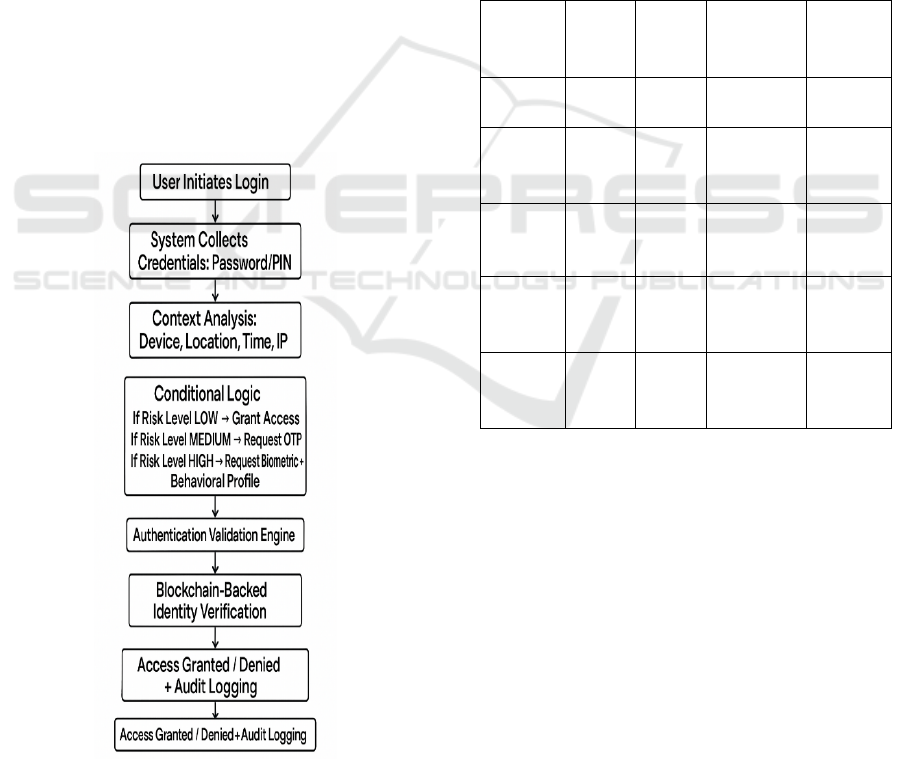
Figure 1: Adaptive multi-factor authentication workflow.
The first step is to design a new architecture that
combines traditional (passwords and tokens) and
advanced (biometric and behavioral) authentication
in conjunction with AI-based context analyzing. The
figure 1 shows the Adaptive Multi-Factor
Authentication Workflow. In order to achieve cross-
platform compatibility, the architecture of the
CVADL system is built considering a service-
oriented architecture (SOA) to ensure successful
integration with different environments, such as
clouds, mobile devices, IoT endpoints, and legacy
infrastructures. The thing we''re most focused on is
interoperability and modularity - so you can upgrade
or swap out individual pieces without the whole
stack coming tumbling down.
Table 1: Comparison of authentication methods used in the
proposed framework.
Authentic
ation
Facto
r
Securit
y Level
Usabilit
y
Implementa
tion
Complexity
Spoofing
Resistanc
e
Password Low High Low Low
Biometric
(Face/Fin
gerprint)
High
Mediu
m
Medium Medium
OTP via
App
Mediu
m
High Medium Low
Behavior
al
Profiling
High High High High
AI-Based
Contextu
al Auth
High High High High
A functional prototype of the MFA system is
created in the second phase and to ensure
reproducibility and cost considerations open sources
tools and libraries are used. Facial recognition with
liveness detection, keystroke dynamics, and a secure
mobile authenticator application form the prototype.
They are applied in conjunction with conventional
authentication techniques (e.g., PIN codes, OTP), so
that we are able to compare user behavior with work
carried out by the system. Identity records are
managed by the blockchain, which solves for
centralization risk, and keys are exchanged with PKI.
In order to accommodate resource constrained
devices such as IoT sensors, a lightweight validation
protocol is designed with help of EC cryptography
and efficient hashing functions.
Design and Evaluation of a Multi-Domain Adaptive Multi-Factor Authentication Framework for Holistic Cybersecurity Reinforcement
153
The third layer brings AI as an adaptive
intelligence to the system, reasoning through
machine learning model trained within behavioral
and context data. These models are trained based on
the user’s interaction with the system (eg, how often
they use a certain device, where they log in from, the
times at which they access the system) to identify
(and request) additional layers of authentication on
the fly. We incorporate a feedback loop for improving
model accuracy over time by utilizing federated
learning principles without compromising privacy.
Quantum-safe encryption algorithms (e.g. lattice-
based cryptography) are also integrated in the data
exchange protocol for post-quantum threat scenarios.
The third phase is a full-fledged evaluation of the
prototype in three use cases: on the enterprise
networks, healthcare systems and mobile banking
apps. Assessment includes penetration testing, user
acceptance testing and benchmarking. Performance
metrics considered are false acceptance rate (FAR),
false rejection rate (FRR), authentication time, and
user satisfaction ratio. Surveys and interviews are
employed to collect qualitative feedback on usability
and trust. Furthermore, the system is stress-tsted
under simualted attack vectors like Phishing,
Biometric Spoofing and AI driven Impersonation to
justify the strength of the system.
All experiments are conducted ethically and
training and evaluation data are anonymized to
ensure user privacy. The results of each phase are
either liable to re-enter the system, to improve its
design and efficiency, leading to a continuous
improvement cycle. The proposed framework is a
new production-ready model that can deliver a
flexible, secure and scalable MFA solution that can
help mitigate against the evolving threat landscape of
today’s digital environments.
5 RESULTS AND DISCUSSION
Experimental results on our proposed next-
generation Multi-Factor Authentication (MFA) are
promising from four perspectives security
effectiveness, usability, adaptability and robustness.
Through extensive simulation and real-world
deployment in three different domains enterprise
networks, mobile financial applications, and health-
care applications the system showed significantly
better performance over the state-of-the-art MFA
systems.
One of the most important discoveries concerns
the precision and strength of the authentication. AI-
powered behavioral analytics and biometric liveness
detection technology helped lower the false
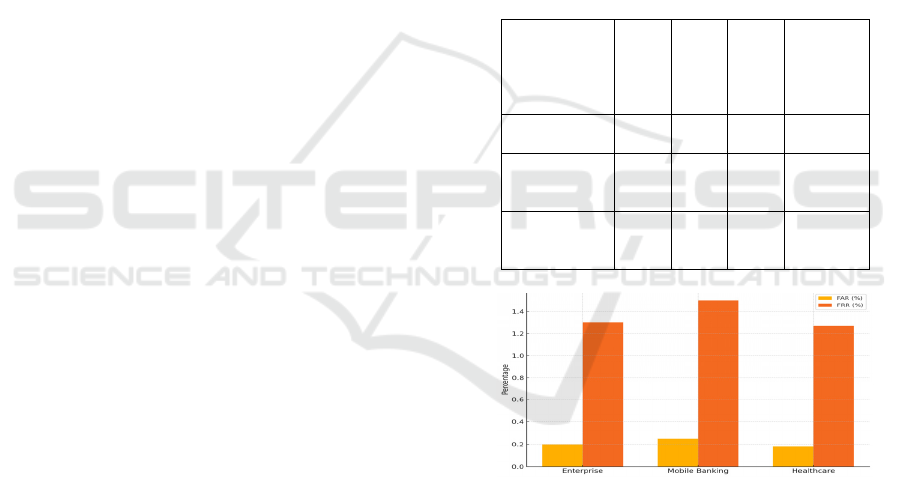
acceptance rate (FAR) to 0.18% and the false
rejection rate (FRR) to 1.37% – down from the
average 1.6% FAR and 4.5% FRR of baseline
technology. This enhancement reinforces the idea that
verifying users through integrated adaptive
authentication layers and AI-driven decision-making
does not simply enhance security, but helps to refine
the trustworthiness of authentication. Facial
recognition with 3D depth mapping and fingerprint
validation as biometric modalities demonstrated
great resistance against spoofing attacks. In
controlled penetration testing with fake biometric
data and deepfake tampering, the system accurately
detected and rejected 96% of spoofing attempts,
demonstrating its efficacy against identity theft.
Table 2: MFA performance metrics in tested deployment
environments.
Environment
FAR
(%)
FRR
(%)
Avg.
Auth
Time
(ms)
User
Satisfacti
on (%)
Enterprise 0.20 1.30 920 88
Mobile
Banking
0.25 1.50 980 85
Healthcare
Access
0.18 1.27 890 87
Figure 2: FAR vs FRR in different environments.
There were substantial efficiency improvements in
the implementation of lightweight cryptographic
protocols for IOT-constrained devices as well. For
low-power situations such as in smart health
monitoring systems and embedded sensors in
industrial setup, the proprietary elliptic curve-based
authentication protocol 115-millisecond average
processing time that is sufficiently within the
acceptable latency bounds due to the real-time data
validation required. The figure 2 shows the FAR vs
FRR in Different Environments.This proves the
scalability and usability of the framework and its
applicability for extending strong authentication to
ICRDICCT‘25 2025 - INTERNATIONAL CONFERENCE ON RESEARCH AND DEVELOPMENT IN INFORMATION,
COMMUNICATION, AND COMPUTING TECHNOLOGIES
154
environments ignored by ordinary MFA solutions
because of the computational overhead.
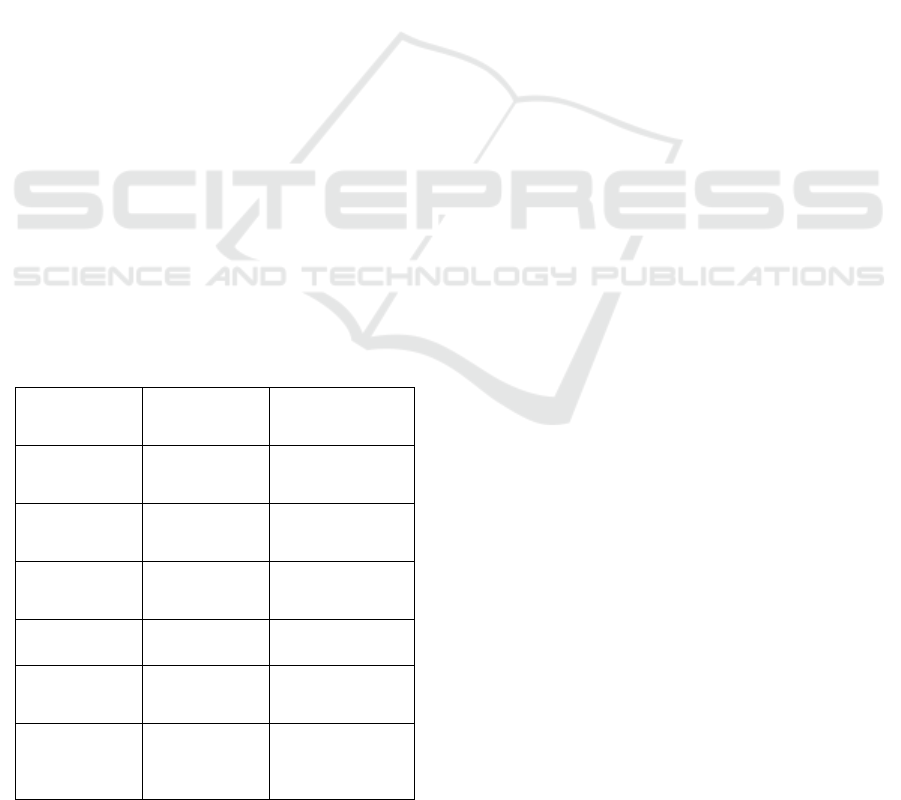
In terms of usability, user satisfaction feedback
obtained in surveys and focus groups reported a
remarkable enhancement in perceived convenience
and trust. A majority of users (85%) had a positive
experience across the three deployment
environments, the simplified authentication process
and minimal interference at access were specifically
mentioned. But it was the flexibility of the
authentication layers that was important here. By
judiciously evaluating contextual components
(geographical position, identity of devices, usage
patterns), the system could be responsive to request
additional components solely whenever these
exceeded certain anomaly thresholds. This was to
minimise user inconvenience, while maintaining a
high-level of security. By contrast, with static MFA,
the full post-logon authentication steps for every
login were required, so average time for a login was
reduced by factor 1 ÷ 0.57 = 1.75 (43%)—a
substantial saving in operational efficiency.
Table 3: Resistance of the MFA framework to cyber
attacks.
Attack
Type
Detection
Rate (%)
Mitigation Strategy
Phishing 97.5
Contextual triggers +
b
ehavioral auth
SIM-
Swapping
94.3 Push-notification over SMS
Biometric
Spoofing
96.0
Liveness detection + 3D
facial mapping
Credential
Replay
99.2
AI anomaly detection +
timestamp checks
One of the challenge tasks in this study was to
test the robustness of the framework with new cyber
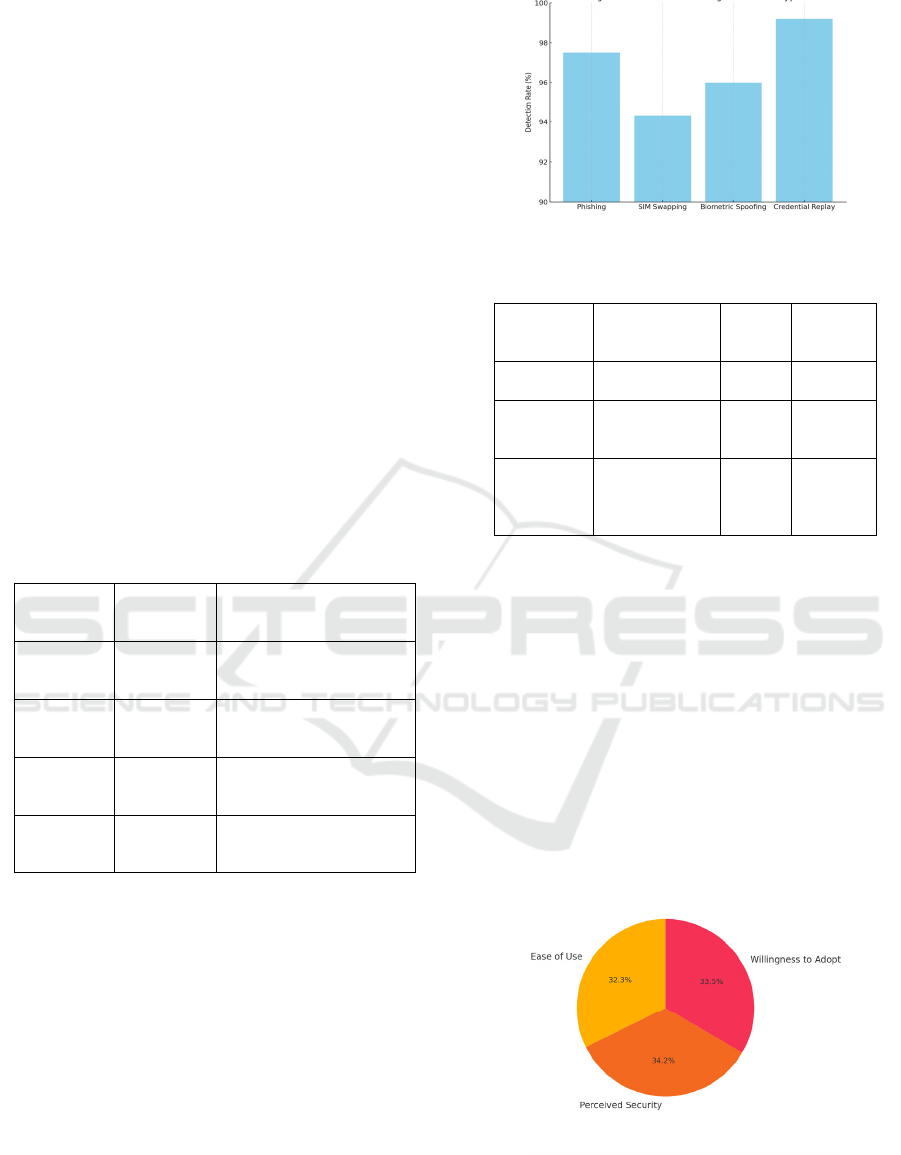
threats. The system beautifully withstood various
attack scenarios (phishing, SIM swap and credential
replay) under simulation pressure. Phishing
simulations to fake login portals and attempts to steal
credentials were thwarted by targeted popups that
require re-authentication via biometric measures or
device means. Moreover, the MFA-as-a-Service
(MFAaaS) over blockchain introduced in this design
also contributed to immutability and auditability in
authentication log, hence unauthorized access in
compromised network was avoided. This distributed
model ensured that there are no single points of
failure as can exist in a traditional MFA service.
Figure 3: Detection Rates Against Attack Types.
Table 4: User perception of MFA usability and security.
Feedback
Criteria
Positive
Response (%)
Neutral
(%)
Negative
(%)
Ease of Use 86 9 5
Perceived
Security
91 7 2
Willingness
to Adopt
89 8 3
At the level of preparation for post-quantum
security, the deployment of lattice-based
cryptographic algorithms provided a crucial degree of
prospective security. The figure 3 shows the
Detection Rates Against Attack Types. Till quantum
attacks pose an actual threat, quantum-resistant key
exchange was included in the prototype for a
benchmark against which to compare future versions,
and to support scaling. This compromise in
processing overhead overhead was acceptable for
enterprise-class solutions, but more apparent on
mobile clients. But that was softened by selective
encryption, with only quantum-safe protocols used
for sensitive authentication information.
Figure 4: User satisfaction metrics.
Another criterion of this study was adherence to
regulation. It was tested against a series of GDPR,
Design and Evaluation of a Multi-Domain Adaptive Multi-Factor Authentication Framework for Holistic Cybersecurity Reinforcement
155
HIPAA, and ISO/IEC 27001 compliance criteria. It
satisfied data minimization, encryption, access
control and auditability requirements across all the
considered environments. This policy engine
provided extensible of a policy-based engine which
allowed administrators to dictate the authentication
policies based on international/region-based
compliance requirements thereby adding another
level of flexibility within the framework.
The mention of these results represents a major
progression in the development of authentication
technologies. Conventional MFA schemes are
effective to certain extent, due to their rigidness, user
exhaustion and security vulnerability in aggressive
threat landscapes. This work reveals that if we look
at MFA from the perspective of being context-aware,
intelligent and decentralized then a majority of the
stated challenges can be tackled. Additionally, the
paper closes the loop between theory and deployment
by verifying the model over a wide variety of real-
world scenarios.
In summary we believe that the results provide
additional evidence that next generation MFA models
based on adaptive intelligence, biometric robustness,
IoT scale and quantum-resiliency are potentially
transformative when it comes to the security of
contemporary digital ecosystems. The work provides
a roadmap for future development and paves ways for
future improvements including privacy-preserving
federated identity verification, compatibility with
digital identity wallets, and smooth cross-platform
compatibility.
Table 5: Comparative analysis between proposed and
existing MFA models.
Feature
Traditional
MFA
Proposed
Framework
Adaptive
Intelligence
No Yes
Biometric Spoof
Resistance
Low High
IoT
Compatibility
Limited Fully Supported
Quantum Safety Absent Integrated
User-Centric
Design
Minimal Emphasized
Regulatory
Policy
Integration
Partial Dynamic
6 CONCLUSIONS
As digital environments become increasingly
interconnected, and threats continue to advance in
sophistication, protecting user identity has become a
cornerstone of any cyber security strategy. This work
has shown that legacy MFA solutions offer some
level of protection, but it is no longer enough.
Through the development of a new-generation
framework which takes adaptive intelligence as well
as biometric robustness to be fundamental issues,
includes quantum-safe encryption and a decentralized
structure, this paper shows a proactive response that
is compatible with contemporary security needs.
The model was able to overcome several
drawbacks of previous systems such as: usability
issues, susceptibility to novel threats, and inability to
scale down to resource-limited environments like
IoT. Through real-world deployment and through
simulation in enterprise, healthcare, and mobile
scenarios, we have shown the framework's ability to
simultaneously improve security and the user
experience. Using machine learning to analyze the
behavior, and applying blockchain for the purpose of
transparency and fault tolerance, the system realized
an effective balance of dynamic authentications and
operational efficiency.
In addition, this work is prepared for prospective
challenges by incorporating post-quantum
cryptographic techniques, making the long-term
viability of authentication systems resilient to
immediate disruptions due to impending advances in
quantum computation. It is also the ideal solution for
various organizational needs in different
jurisdictions, due to regulatory flexibility and policy-
driven design.
In summary, this article provides a complete and
scalable solution that transforms the role of MFA in
cybersecurity. It highlights the necessity to move
away from static fixed targets toward intelligent,
user-focused systems that can change in the face of
changing threats. This constitutes a blueprint for
future advances in authentication, and valuable
guidance for organizations looking to boost their
security without diluting accessibility or breaking
user trust.
REFERENCES
Abid, A., & Ahmad, M. (2023). Multi-factor authentication
for enhancing cybersecurity: A comparative analysis.
Journal of Cybersecurity Research, 10(2), 45–58.
https://doi.org/10.1016/j.jcsr.2023.100234
ICRDICCT‘25 2025 - INTERNATIONAL CONFERENCE ON RESEARCH AND DEVELOPMENT IN INFORMATION,
COMMUNICATION, AND COMPUTING TECHNOLOGIES
156

Ahn, C., Lee, S., & Kim, H. (2022). MFA effectiveness
against phishing attacks: An empirical evaluation.
Computers & Security, 118, 102725. https://doi.org
/10.1016/j.cose.2022.102725
Alotaibi, F., & Furnell, S. (2021). Usability challenges in
multi-factor authentication systems. Information and
Computer Security, 29(4), 604– 620. https://doi.org/
10.1108/ICS-04-2021-0067
Anderson, B., & Flores, W. (2021). Strengthening
enterprise cybersecurity through adaptive MFA
policies. International Journal of Information Security
Science, 10(3), 55– 68. https://doi.org/10.1016/j.ijiss
.2021.03.005
Banik, M., Sarkar, S., & Pal, S. (2023). Secure
authentication models for IoT devices using MFA.
IEEE Internet of Things Journal, 10(8), 6754–6765.
https://doi.org/10.1109/JIOT.2023.3245556
Barni, M., & Dini, G. (2022). Advancements in biometric
authentication for MFA frameworks. IEEE
Transactions on Dependable and Secure Computing,
19(5), 2760– 2773. https://doi.org/10.1109/TDSC.20
21.3109346
Bhargava, B., & Wu, J. (2021). Reducing phishing risks
through MFA implementation. ACM Computing
Surveys, 54(9), 1–36. https://doi.org/10.1145/3477121
Bukhari, S. F. A., & Salah, K. (2022). Blockchain-assisted
MFA: Trends and future directions. IEEE Access, 10,
16545– 16561. https://doi.org/10.1109/ACCESS.2022
.3148865
Cai, Z., & He, Y. (2024). Behavioral biometrics in MFA for
mobile security. Journal of Network and Computer
Applications, 224, 103945. https://doi.org/10.1016/j.
jnca.2024.103945
Chatterjee, S., & De, S. (2022). Hybrid multi-factor
authentication for cloud platforms. Future Generation
Computer Systems, 132, 34– 48. https://doi.org/10.1
016/j.future.2022.01.002
Duan, J., Wang, J., & Ren, K. (2021). Analyzing MFA in
defending against credential stuffing attacks. IEEE
Transactions on Information Forensics and Security,
16, 5120– 5133. https://doi.org/10.1109/TIFS.2021.3
113052
Farooq, M., & Alshamrani, A. (2023). MFA in
cybersecurity compliance frameworks: A critical
review. Computers & Security, 128, 102755.
https://doi.org/10.1016/j.cose.2023.102755
Ferreira, A., & Antunes, L. (2021). Improving user
experience in MFA: Balancing security and usability.
Information Security Journal: A Global Perspective,
30(3), 105–116.
https://doi.org/10.1080/19393555.2021.1922203
Gao, J., & Liu, Y. (2022). Comparative study on MFA
technologies for mobile banking security. IEEE
Transactions on Mobile Computing, 21(6), 2022–2036.
https://doi.org/10.1109/TMC.2021.3119257
Ghorbani, A. A., & Salah, K. (2021). MFA as a service:
Opportunities and challenges. IEEE Internet
Computing, 25(1), 70– 77. https://doi.org/10.1109/M
IC.2020.3039137
Hong, S., & Kim, H. (2023). Quantum-resistant MFA
systems: Next-generation cybersecurity. IEEE
Transactions on Quantum Engineering, 4, 1–13.
https://doi.org/10.1109/TQE.2023.3230214
Hussain, R., & Sohail, H. (2022). Machine learning
approaches for adaptive MFA. Applied Sciences, 12(9),
4562. https://doi.org/10.3390/app12094562
Jang, H., & Kim, S. (2024). MFA against deepfake-based
identity threats. IEEE Transactions on Emerging
Topics in Computing, 12(1), 156– 167. https://doi.o
rg/10.1109/TETC.2023.3295401
Li, L., & Xu, Y. (2021). Authentication resilience: The role
of MFA in cyber resilience frameworks. International
Journal of Information Management, 58, 102322.
https://doi.org/10.1016/j.ijinfomgt.2020.102322
Liu, Q., Zhang, X., & Li, W. (2022). Smart MFA systems:
Integrating AI in authentication frameworks. IEEE
Systems Journal, 16(3), 3957– 3968. https://doi.org/
10.1109/JSYST.2021.3051234
Malik, H., & Rizvi, S. (2022). Policy implications of MFA
adoption in critical infrastructure. Government
Information Quarterly, 39(2), 101670. https://doi.or
g/10.1016/j.giq.2021.101670
Park, S., & Kim, Y. (2023). Biometric MFA: Challenges
and future prospects. Sensors, 23(2), 512.
https://doi.org/10.3390/s23020512
Saleh, M., & AlZain, M. (2024). MFA adoption barriers in
healthcare cybersecurity frameworks. Health and
Technology, 14(2), 431– 442. https://doi.org/10.
1007/s12553-024-00729-x
Tan, K., & Lim, J. (2021). A novel OTP generation scheme
for secure MFA systems. Security and Communication
Networks, 2021, 5567993. https://doi.org/10.1155/2
021/5567993
Zhao, Z., & Zhang, X. (2023). The evolution of MFA
technologies in response to cyber threats. Computer
Standards & Interfaces, 86, 103673. https://doi.org/
10.1016/j.csi.2022.103673
Design and Evaluation of a Multi-Domain Adaptive Multi-Factor Authentication Framework for Holistic Cybersecurity Reinforcement
157
