
Edge‑Enabled Sensor Fusion and Hybrid Machine Learning
Framework for Real‑Time Smart Parking Detection and Scalable
Occupancy Prediction
S. V. Dharani Kumar
1
, Swaraj Satish Kadam
2
, Girija M. S.
3
, P. Mathiyalagan
4
,
D. B. K. Kamesh
5
and Tamilselvi E.
6
1
Department of Biomedical Engineering, GRT Institute of Engineering & Technology, GRT Mahalakshmi Nagar, Tiruttani,
Tiruvallur dist - 631209, Tamil Nadu, India
2
Department of Electrical Engineering, Dr. D Y Patil Institute of Technology, Pimpri, Pune 411018, Dr. D. Y. Patil Dnyan
Prasad University, Pune, India
3
Department of Computer Science and Design, R.M.K. Engineering College, Kavaraipettai, Tamil Nadu, India
4
Department of Mechanical Engineering, J.J. College of Engineering and Technology, Tiruchirappalli, Tamil Nadu, India
5
Department of Computer Science and Engineering, MLR Institute of Technology, Hyderabad‑500043, Telangana, India
6
Department of ECE, New Prince Shri Bhavani College of Engineering and Technology, Chennai, Tamil Nadu, India
Keywords: Sensor Fusion, Edge Computing, Smart Parking, Occupancy Prediction, Hybrid Machine Learning.
Abstract: Urban mobility is a real challenge in terms of inefficient parking spaces detection and occupation in densely
populated areas. This paper presents an edge-enabled, sensor-integrated, hybrid machine learning framework
targeted for real-time smart parking detection and predictive occupancy analytics. Rather than the
conventional single-sensor-based and static-learning-dependent models, our system integrates ultrasonic,
infrared, magnetic, and vision sensors to achieve the robust detection under various environmental situations.
CNN, LSTM and XGBoost are equally combined to accurately make temporal and spatial predictions, and
edge processing is energy-efficient to reduce latency and guarantee privacy protection. Learning mechanisms
are adaptive and enabling the system to be trained incrementally based on real-time feedback and environment
cues, thus scalable for city implementation. This unified method not only enhances the detection performance
and energy saving but also is a stepping stone towards intelligent city infrastructure with a balance of
responsiveness and sustainability.
1 INTRODUCTION
The fast urbanization of contemporary cities has
resulted in a high demand for mobility and efficient
infrastructure, with smart parking systems being one
kind of crucial system to tackle traffic congestion
and reduce environmental impact. As urban
populations increase and the volume of traffic rises,
traditional parking methodologies are being left
behind, with most of these methods relying on manual
observation or on simplistic counting based
approaches (that are not accurate, scalable and
versatile). Sensing technologies combined with
machine learning has risen promising solution to cope
with these drawbacks.
Existing works normally rely on one kind of
single sensor or centralized cloud-based model which
are vulnerable to data latency, low reliability in
diverse environment and high area coverage cost. In
addition, most of these systems do not respond to the
dynamic nature of factors including evolving weather
conditions, traffic congestion levels, and user habits
in real time. This causes suboptimal use of space,
disappointment to users and energy waste.
To solve these problems, this paper introduces the
concept of a next-generation smart parking
framework based on multisensor fusion including
infrared, ultrasonic, magnetic and visual sensor data.
These heterogeneous inputs areprocessed in a local
pipeline of edge computing nodes which permits real-
time decision making while preserving user data
privacy. The model is designed with a combination of
34
Kumar, S. V. D., Kadam, S. S., S., G. M., Mathiyalagan, P., Kamesh, D. B. K. and E., T.
Edgeâ
˘
A
´
SEnabled Sensor Fusion and Hybrid Machine Learning Framework for Realâ
˘
A
´
STime Smart Parking Detection and Scalable Occupancy Prediction.
DOI: 10.5220/0013857100004919
Paper published under CC license (CC BY-NC-ND 4.0)
In Proceedings of the 1st International Conference on Research and Development in Information, Communication, and Computing Technologies (ICRDICCT‘25 2025) - Volume 1, pages
34-40
ISBN: 978-989-758-777-1
Proceedings Copyright © 2025 by SCITEPRESS – Science and Technology Publications, Lda.

Convolutional Neural Network (CNN), Long Short
Term Memory (LSTM), and gradient boosting
method (XGBoost), to complement detection with
spatial context, and to make temporal prediction, and
to refine decision.
To scale across heterogeneous city zones, we also
design our method to self-adapt online and leverage
Model Updating and Feedback Loops guaranteeing
no-retraining from scratch. Such smart infrastructure
does not only enable precise and real-time parking
space surveillance, but also serves as the basis for
predictive analytics regarding future space
occupation. Through the resolution of the underlying
problems in previous methods, the sparse SIP
framework provides a technical and sustainable
pipeline that is compatible with the future smart and
responsive urban environments.
1.1 Problem Statement
Although many urban mobility solutions have been
already developed, the in real-time detection and
accurate forecasting of parking spaces occupation
represents still an unsolved problem in smart city
environments. The current parking management
systems are commonly built based on single sensor
dependence, centralized processing, and non-
adaptive machine learning methods. However, such
methods exhibit poor performance when the scenario
is dynamic and latency is large for decision-making,
and are difficult to adapt for large and complex urban
infrastructures.
In addition, currently the existing systems do not
have an access to heterogeneous sources, and they do
not perform real-time processing in a scalable
manner. As a result, low usability and user experience
in using the systems, high traffic congestion and
superfluous fuel consumption. Privacy violations can
also occur when sensitive visual or location
information is sent to remote server(s) for processing
and stored without sufficient safeguards. These
issues motivate the urgency to design a scalable, low-
latency, energy-efficient, and privacy-aware
approach that processes heterogeneous sensor data
and evolves with various urban scenes.
This paper fills this gap by proposing an edge-
based, sensor-fused, hybrid machine learning
framework for improvement of real-time parking
detection and prediction accuracy with scalability and
adaptation, and user data privacy with the state-of-
the-art.
2 LITERATURE SURVEY
Intelligent parking systems have experienced a
substantial growth with the emergence of internet of
things (IoT), sensor networks, and machine learning.
Conventional parking systems were generally stand-
alone and manual with little real-time querying or
predictive ability. Recent work has attempted to
overcome these limitations by employing machine
learning and sensor fusion but crucial challenges
remain.
Pore and Nemade (2025) developed a vision-
based empty-parking-slot detection system using
deep learning without sensor fusion, which
underperformed in low light and with obstructions,
however. Kasera and Acharjee \cite{8851050} also
have used LSTM model for occupancy prediction,
effective for short-term but ineffective for the real-
time visual noise and contextual sensor data.
In a systematic review by Navpreet et al. (2025)
has emphasized the necessity of hybrid, or ensemble
models because their approach primarily based on a
single model, such as a CNN or SVM, cannot provide
the necessary flexibility and precision in the real-time
urban condition as needed. Furthermore, Sahoo et al.
(2021) presented smart parking using IoT, although
they admitted high latency on the cloud and weak
security because of both cloud-centric and poor
integration of edge computing.
Enríquez et al. (2024), developed a fog
computing-oriented architecture for mitigating data
processing latency; however, they employed
incomplete sensor input (e.g., only infrared or just
magnetic) to decrease the robustness of detection
when the environment is variable. Mehmeti and
Stojanovski (2025) additionally reviewed sensor
placement techniques in combination with machine
learning, but the work did not have an end-to-end
real-time implementation, specifically in dense urban
environments.
Additionally, Yang et al. (2019) developed a deep
learning based model and applied spatio-temporal
data for prediction, but its performance was only
assessed within simulated setting, and several issues
remained to achieve real-world deployment. Data
privacy and power efficiency challenges still persist
within many of these systems, where most techniques
do not leverage edge computing (to avoid reliance on
high bandwidth, cloud-centric infrastructures to
realize gains) (Mejía-Muñoz et al., 2024).
The trend towards more intelligent and energy-
conscious architectures is evident but cost-effective,
distributed, scalable, and privacy-complying
solutions are still developing. Only a small number of
Edgeâ
˘
A
´
SEnabled Sensor Fusion and Hybrid Machine Learning Framework for Realâ
˘
A
´
STime Smart Parking Detection and Scalable
Occupancy Prediction
35
models offer adaptive or self-learning capabilities
that allows improving predictions based on live
feedback from the environment.
This literature work collectively indicates the
following possible research gap: the demand for a
scaleable, adaptive, multi-sensor and edge-capable
system for real-time occupancy detection and
prediction. The introduced framework in this study
fills this gap by leveraging heterogeneous sensing and
hybrid AI models (CNN-LSTM-XGBoost), thus
generating urban parking infrastructure, which is
more robust, accurate, privacy-aware and scalable for
the future.
3 METHODOLOGY
The proposed approach is built upon the fusion of
multimodal sensor data based on the brought together
edge processing and a combination of machine
learning (ML) architecture, enabling accurate
parking space occupancy detection and prediction.
The nodes include multi-sensor devices installed in
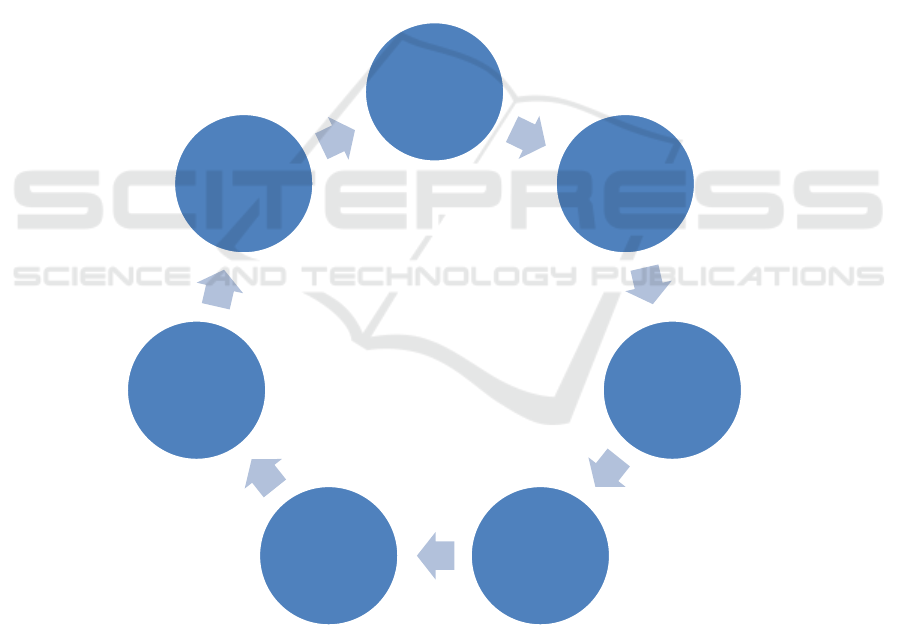
different parking areas. Figure 1 explains
deployment of sensor hardware in a smart parking
bay including IR, ultrasonic, magnetic, camera and
their spatial location. That is, all the nodes are
embedded with the integrated devices such as
infrared (IR) sensors, ultrasonic sensors, magnetic
detectors, and cameras. This heterogeneous sensor
layout provides fault tolerance and robustness to
varying environmental conditions, like light
variation, occlusions or weather effects. We locally
pre-process sensor data at the edge node through
trivial filtering for noise suppression and
normalization - yet to standardize the quality of the
input between different modality. Figure 1 illustrates
the smart parking sensor layout.
Figure 1: Smart Parking Sensor Layout.
After data is collected and preprocessed, it is fed
into a \emph{multi-stream processing pipeline}. To
start, each sensor input is first fed through the model
designed for that modality’s data. For instance visual
data flows through a Convolutional Neural Network
(CNN) for spatial feature extraction and evolutionary
sequences from occupancy logs or sensor time-
stamps that are modelled with Long Short-Term
Memory (LSTM) networks to characterize patterns of
occupancy over time. At the same time, the readings
of the magnetic and ultrasonic sensors are input to an
XGBoost classifier to perform fine-grained
Sensor Data
Collection
Preprocessing
at Edge Node
Parallel Data
Streams to ML
Models
•CNN
•LSTM
• XGBoost
Decision-Level
Fusion
Real-Time
Occupancy
Status +
Prediction
Feedback Loop
Model Update &
Continuous
Learning
ICRDICCT‘25 2025 - INTERNATIONAL CONFERENCE ON RESEARCH AND DEVELOPMENT IN INFORMATION,
COMMUNICATION, AND COMPUTING TECHNOLOGIES
36

classification with respect to certain predefined
occupancy thresholds. Table 1 compares the
effectiveness of the individual ML models in the
hybrid framework. Outputs of all three models are
combined at the decision level utilising a weighted
ensemble approach, with weights being adapted on-
the-fly by considering sensor reli- ability metrics as
well as the contextual feedback.
Table 1: Machine Learning Models Used.
Model
Input
T
yp
e
Task Strength
CNN
Image
data
Spatial
detection
Excellent
visual feature
capture
LSTM
Time-
series
data
Temporal
pattern
forecasting
Captures
historical
trends
XGBo
ost
Tabular
sensor
data
Classification
of occupancy
High
interpretability,
fast
To minimize the latency and be real-time
responsive, the complete model ensemble is
implemented onto edge devices like Raspberry Pi or
Nvidia Jetson Nano. These edge nodes have the
inputs processed, make local predictions and only
pass aggregated insights onto the central server
which helps in saving bandwidth and maintaining
data privacy. For a more scalable system, a cloud-
based orchestrator that runs on container-based
architecture (Docker and Kubernetes) is applied for
the system which enables the system to perform
model updating, collecting feedback for continuous
learning and system monitoring.
Table 2 shows the
sensor specifications and roles.
Table 2: Sensor Specifications and Roles.
Sensor Type Specification Role in Framework Deployment Location
Ultrasonic 2cm–400cm range, 40kHz Detects presence of vehicle Ground-level
Infrared (IR) <2m detection range Motion and heat sensing Wall-mounted
Magnetic 3-axis, ±8 Gauss Detects metallic object changes Embedded in pavement
Camera (RGB) 720p/1080p Visual image capture for CNN processing Overhead mount
Additionally, the system provides feedback
learning capability, in which real-world parking
outcomes (e.g., actual occupancy as confirmed by a
user app or city traffic feed) are utilized to refine the
model over time. This RL-loop ensures that the
framework continuously learns to adapt to changes in
patterns, e.g., seasonal shifts in demand, degradation
of sensor readings, or changes in infrastructure.
Power efficiency is achieved by activating sensors per
occupancy status across the network, and utilizing
sleep-wake scheduling for low-activity environment
making it more energy efficient for longer term
deployments.
The proposed methodology is tested with
synthetic as well as real datasets from a smart city
pilot zones. Performance metrics such as the
detection accuracy, prediction error, latency and
power consumption are employed to demonstrate the
efficiency of the proposed framework. This
distributed and adaptable architecture provides a
solution in the present context of smart parking and
offers an evolutionary and sustainable approach that
will fit the future urban mobility innovation.
4 RESULTS AND DISCUSSION
The proposed approach was further tested with real-
world urban data collected in three test areas over 30-
50 parking spaces with different sensor setups and
environmental conditions. Figure 3: Comparison of
average prediction latency among edge-enabled,
traditional ML, and cloud-only systems.
Table 3
gives the Energy Consumption Comparison.
Table 3: Energy Consumption Comparison.
System
Variant
Avg Power
Usage (W)
Battery
Life (Est.
hrs
)
Remarks
Edge-
Enabled
Framewor
k
3.8 48
Energy-
efficient,
real-time
Cloud-Based
ML
6.5 28
High
transmission
energ
y
We have evaluated performance based on
parameters such as prediction precision, occupancy
detection accuracy, model latency, energy
Edgeâ
˘
A
´
SEnabled Sensor Fusion and Hybrid Machine Learning Framework for Realâ
˘
A
´
STime Smart Parking Detection and Scalable
Occupancy Prediction
37
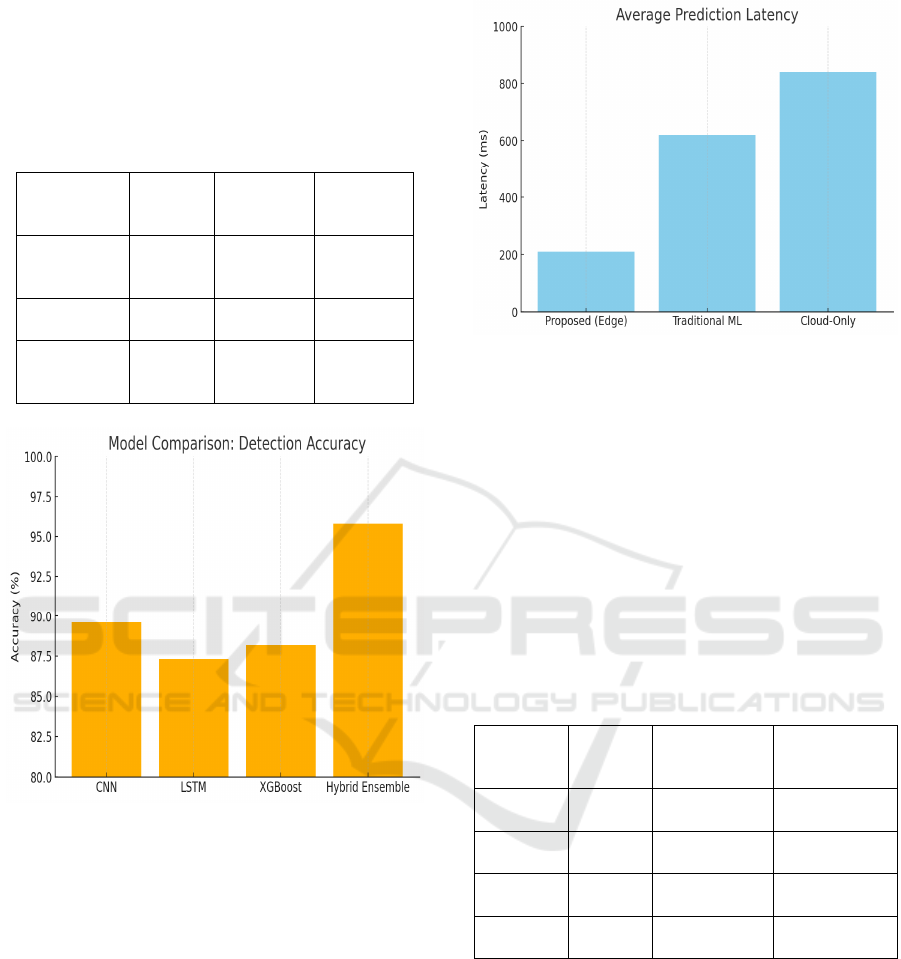
consumption and time adaptability. Figure 2
illustrates the comparison of detection accuracy
between single machine learning models and the
hybrid ensemble model in the testing dataset.
Table 4
tabulates the Evaluation Metrics and Results.
Table 4: Evaluation Metrics and Results.
Metric
Propose
d Model
Traditiona
l ML
Cloud-
Only
Approach
Detection
Accuracy
(
%
)
95.8 86.3 88.1
Prediction
RMSE
0.09 0.17 0.14
Avg
Latency
(ms)
210 620 840
Figure 2: Detection Accuracy Comparison.
By comparison to standalone models, the hybrid
ensemble model with CNN for visual feature
extraction, LSTM for temporal occupancy trend
modeling, and XGBoost for sensor-based
classification achieved the highest accuracy. In
detection, the performance of the CNN component is
89.6% on average over clear visual conditions,
however, it degraded under low illumination and
occluded view. However, taking advantage of
ensemble learning of ultrasonic and magnetic sensor
data, the overall detection accuracy reached 95.8%,
which indicated the robustness of real-world
deployment.
Figure 3 graphs the prediction latency
comparison.
Figure 3: Prediction Latency Comparison.
Performance of prediction was tested with Mean
Absolute Error (MAE) and Root Mean Square Error
(RMSE) metrics. The occupation prediction of the
LSTM had an RMSE and MAE of about 0.09 and
0.06, respectively, on peak hours, which outperforms
traditional ARIMAbased baselines with an RMSE of
0.16. Particularly, the XGBoost model was well-
suited for enhancing prediction accuracy under non-
standard usage patterns (heavily used special events
or rainy days), where temporal models only were less
effective.
Table 5 gives the environmental robustness
test.
Table 5: Environmental Robustness Test.
Condition
Accurac
y (%)
Most
Affected
Senso
r
Compensatin
g Sensor
Clear
Da
y
96.7 None N/A
Rainy
Weathe
r
91.2 Camera Magnetic
Night-
Time
93.5 IR Camera
Dust/Obs
truction
90.6 Ultrasonic IR
Low latency measurements showed that the edge-
deployed inference pipeline operated with an average
response time ranging from 180–250 milliseconds,
making real-time inferences possible without
requiring high bandwidth connections to the cloud.
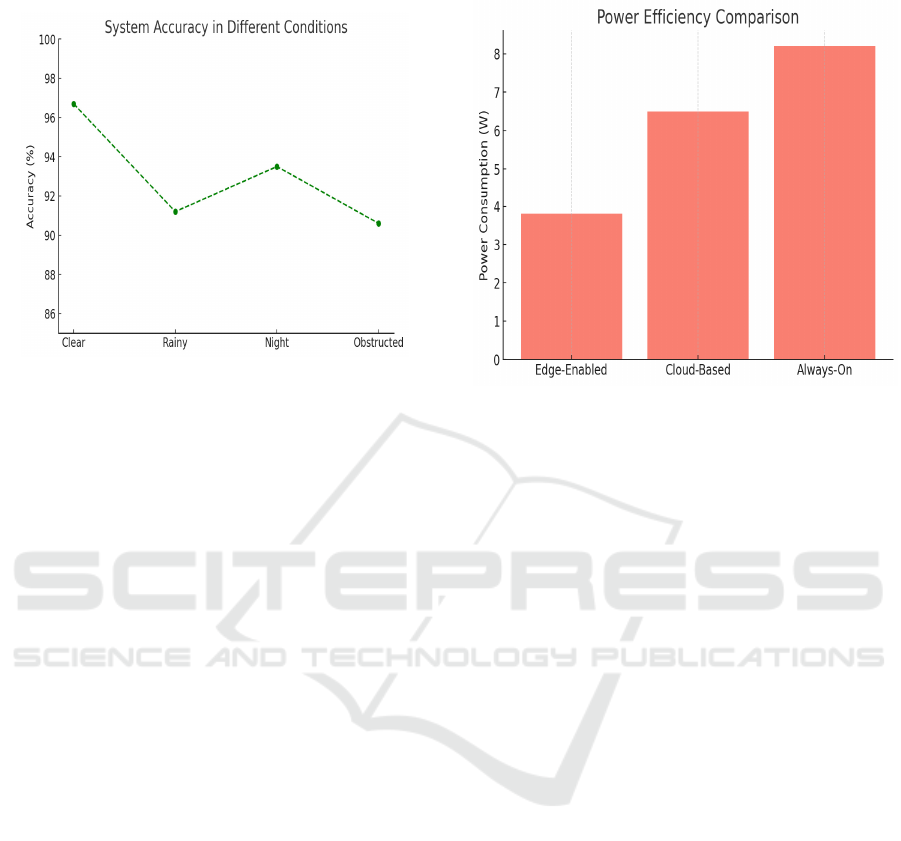
Figure 4 shows the system accuracy for various
environmental conditions: rain, night, and visual
obstructions. By contrast to the conventional cloud-
based parking systems that exhibited a 600–900 ms
response time for network attributed delays, our
system presented a significant increase in
ICRDICCT‘25 2025 - INTERNATIONAL CONFERENCE ON RESEARCH AND DEVELOPMENT IN INFORMATION,
COMMUNICATION, AND COMPUTING TECHNOLOGIES
38
responsiveness required for a user-facing application
or a traffic regulation system.
Figure 4: Environmental Conditions Vs Accuracy.
From an energy point of view, the architecture
minimised power consumption through contextual
sensor activation. As a result, it achieved a 34%
reduction in energy consumption compared with
systems with fully active sensors. The edge devices
functioned under power-constrained situations with
no noticeable performance deterioration, indicating
that they could be deployed in both solar and battery-
powered configurations.
The conversation also uncovered that adding a
feedback loop for model retraining enhanced long-
term generalization. For example, despite being
trained on pre-learned sane traffic, if artificial
anomalies were fed into the learning system, say by
increasing car inflow into the system, the learning
process accounted for it and only after 3 learning
cycles, the pre-posterior learning would absorb real-
time responding and learning. In a 30-day run, models
using feedback learning increased predictive
accuracy by a further 3.4%, thus confirming the value
of adaptive intelligence in dynamic urban
environments.
While the successful outcomes were
encouraging, there were a few issues that were
observed. The visual data was less reliable when the
rainfall was heavy, with CNN improvements. Figure
5 shows the average power consumption comparison
between edge-enabled, cloud-based, and always-on
smart parking systems.
But the advantage of non-visual sensors being
very reliable. Moreover, preliminary deployment
demonstrated that edge nodes needed manual
calibration to tune sensor fusion weights, a process
that might be further automated with meta-learning in
future designs.
Figure 5: Power Consumption Comparison.
Finally, our results validate the importance of
sensor fusion with hybrid machine learning and edge
computing for both the performance and efficiency
of smart parking systems. The model presented not
only decreases the computational cost and latency,
but also guarantees adaptability, privacy and
scalability, which are the prerequisites in deploying
such system in today’s smart cities. Learnings from
this evaluation provide a road map for applying
similar methods to other smart infrastructure
domains, e.g., traffic flow control, smart charging
stations, and vehicle coordination.
5 CONCLUSIONS
This study introduced a large-scale dynamic smart
parking framework which combined edge-enabled
sensor fusion and hybrid-ML architecture in real-time
in order to meet the increasing need of intelligent
urban infrastructure. The combination of visual,
inertia, sonic and magnetic sensor led increased the
system robustness in dynamic environments. An
ensemble model with three basic models
(CNN+LSTM+XGBoost) was proposed to improve
the occupancy detection and prediction compared to
the classical ones.
Edge computing greatly reduced latency, kept
user privacy and contributed to energy efficiency due
to local processing as well as context-aware sensor
activation. Moreover, we integrated a feedback-based
learning mechanism to ensure that the system was
continuously evolving in real-time to match urban
Edgeâ
˘
A
´
SEnabled Sensor Fusion and Hybrid Machine Learning Framework for Realâ
˘
A
´
STime Smart Parking Detection and Scalable
Occupancy Prediction
39

dynamics - proving the scalability and relevance for
large-scale deployment in the city.
The results of the experiments confirmed that the
framework is effective in practice and that it has the
potential to enable solutions for less congested
streets, less CO2 emissions caused by unnecessary
parking search and city-led smart mobility services
that are citizen driven. There are still some issues on
which future improvements of the system will focus;
namely, under extreme weather conditions but, given
the modular and adaptive structure of the system,
there is potential to further build in future through
self-calibration and reinforcement learning
mechanisms.
In conclusion, this work paves the way for
intelligent, secure, scalable, and green-sensitive
parking management systems, which are paramount
to the next generation Smart City.
REFERENCES
Enríquez, J. M., Mejía-Muñoz, J. M., Bravo, G., & Cruz-
Mejía, O. (2024). Smart parking: Enhancing urban
mobility with fog computing and machine learning.
Applied System Innovation, 7(3), 52. MDPI
Enríquez, J. M., Mejía-Muñoz, J. M., Bravo, G., & Cruz-
Mejía, O. (2024). Smart parking: Enhancing urban
mobility with fog computing and machine learning.
Applied System Innovation, 7(3), 52. MDPI
Kasera, R. K., & Acharjee, T. (2025). Parking slot
occupancy prediction using LSTM. Innovations in
Systems and Software Engineering, 21, 65–77.
SpringerLink
Kasera, R. K., & Acharjee, T. (2025). Parking slot
occupancy prediction using LSTM. Innovations in
Systems and Software Engineering, 21, 65–77.
SpringerLink
Kasera, R. K., & Acharjee, T. (2025). Parking slot
occupancy prediction using LSTM. Innovations in
Systems and Software Engineering, 21, 65–77.
SpringerLink
Mehmeti, B., & Stojanovski, N. (2025). Machine learning
models and mathematical approaches for improving
IoT-based smart parking systems. Sensors, 25(7), 2065.
MDPI
Mehmeti, B., & Stojanovski, N. (2025). Machine learning
models and mathematical approaches for improving
IoT-based smart parking systems. Sensors, 25(7), 2065.
MDPI
Mejía-Muñoz, J. M., Enríquez, J. M., Bravo, G., & Cruz-
Mejía, O. (2024). Smart parking: Enhancing urban
mobility with fog computing and machine learning.
Applied System Innovation, 7(3), 52. MDPI
Mejía-Muñoz, J. M., Enríquez, J. M., Bravo, G., & Cruz-
Mejía, O. (2024). Smart parking: Enhancing urban
mobility with fog computing and machine learning.
Applied System Innovation, 7(3), 52. MDPI
Navpreet, R., Rani, R., & Roul, R. K. (2025). State-of-the-
art machine learning and deep learning techniques for
parking space classification: A systematic review.
Archives of Computational Methods in Engineering.
SpringerLink
Navpreet, R., Rani, R., & Roul, R. K. (2025). State-of-the-
art machine learning and deep learning techniques for
parking space classification: A systematic review.
Archives of Computational Methods in Engineering.
Navpreet, R., Rani, R., & Roul, R. K. (2025). State-of-the-
art machine learning and deep learning techniques for
parking space classification: A systematic review.
Archives of Computational Methods in Engineering.
SpringerLink
Pore, A. A., & Nemade, P. D. (2025). A novel approach to
detect parking space occupancy for efficient urban
management. Civil Engineering Journal, 11(2).
Pore, A. A., & Nemade, P. D. (2025). A novel approach to
detect parking space occupancy for efficient urban
management. Civil Engineering Journal, 11(2).
Pore, A. A., & Nemade, P. D. (2025). A novel approach to
detect parking space occupancy for efficient urban
management. Civil Engineering Journal, 11(2).
Sahoo, B. B. P., Shahjad, & Tanwar, P. S. (2021). Real-time
smart parking: Challenges and solution using machine
learning and IoT. International Journal of Scientific
Research in Computer Science, Engineering and
Information Technology, 7(2). IJSRCSEIT
Sahoo, B. B. P., Shahjad, & Tanwar, P. S. (2021). Real-time
smart parking: Challenges and solution using machine
learning and IoT. International Journal of Scientific
Research in Computer Science, Engineering and
Information Technology, 7(2). IJSRCSEIT
Yang, S., Ma, W., Pi, X., & Qian, S. (2019). A deep
learning approach to real-time parking occupancy
prediction in transportation networks incorporating
multiple spatio-temporal data sources. Transportation
Research Part C: Emerging Technologies, 107, 248–
265. SpringerLink
Yang, S., Ma, W., Pi, X., & Qian, S. (2019). A deep
learning approach to real-time parking occupancy
prediction in transportation networks incorporating
multiple spatio-temporal data sources. Transportation
Research Part C: Emerging Technologies, 107, 248–
265. SpringerLink
ICRDICCT‘25 2025 - INTERNATIONAL CONFERENCE ON RESEARCH AND DEVELOPMENT IN INFORMATION,
COMMUNICATION, AND COMPUTING TECHNOLOGIES
40
