
OWL-S Grounding Parameters Matching by Means of LLM:
Preliminary Investigation
Domenico Redavid
1 a
, Eleonora Bernasconi
2 b
and Stefano Ferilli
2 c
1
Economics and Finance Department, University of Bari, Largo Abbazia S. Scolastica, Bari, 70124, Italy
2
Computer Science Department, University of Bari, Via E. Orabona 4, Bari, 70125, Italy
Keywords:
Semantic Web Service, OWL-S Composition, LLM.
Abstract:
SOA architecture was created to systematise issues relating to the interoperability of M2M services, focusing
on issues such as security and privacy. With the advent of generative AI, there is a different way to perform
the operations for which Semantic Web Services were created, in a much simpler way, but losing control over
the level of security and privacy. In this paper, we seek to propose a combined vision of the two approaches,
identifying how generative AI can be used to solve specific, rather than general, problems. To this end, we
attempt to analyse how an LLM could be used by a software agent to align different types of XML parameter
data in WSDL descriptions.
1 INTRODUCTION
Semantic Web Services (SWS) represent an evolu-
tion of traditional web services, enriched with seman-
tic capabilities that enhance their interoperability, dis-
covery, and automatic integration.
Unlike classic Web services (SOAP, REST),
which rely on syntactic descriptions (such as WSDL),
SWSs incorporate semantic metadata that enable:
• A deeper offered functionalities understanding
• precise matching between requests and services,
• An automatic composition of multiple services.
Key Components for the SWS concrete imple-
mentation are Semantic Web (SW) Ontologies (i.e.,
formal structures that describe concepts, relation-
ships, and logic in a specific domain), semantic
annotation languages (such as OWL for Services
(OWL-S) (Martin et al., 2005), Semantic Anno-
tations for WSDL and XML Schema (SAWSDL)
(Kopeck
´
y et al., 2007), Web Service Modeling Ontol-
ogy (WSMO) (Fensel et al., 2008)), and SW reason-
ing engines (Khamparia and Pandey, 2017) for infer-
ring relationships and compatibility between services.
The main advantages that these modes of repre-
sentation offer can be summarized as:
a
https://orcid.org/0000-0003-2196-7598
b
https://orcid.org/0000-0003-3142-3084
c
https://orcid.org/0000-0003-1118-0601
• Automatic discovery: Services can be found
based on their semantics, not just keywords;
• Enhanced interoperability: Shared understanding
of domains facilitates integration;
• Dynamic composition: Ability to create complex
workflows by combining services automatically;
• Adaptability: Greater resilience to changes in the
services ecosystem.
SWS represent an important step toward realiz-
ing the vision of the Semantic Web, where machines
can understand and use information on the Web. In
addition to the application of ML approaches (Ekie
et al., 2021), new scenarios and challenges have arisen
with the advent of generative AI for automating op-
erations, particularly composition, related to Web
services (Pesl et al., 2023; Aiello and Georgievski,
2023). Recent trends aim to simplify discovery and
composition operations by abandoning the Service
Oriented Architecture towards a simplified definition
of services, moving from structured to unstructured
descriptions (Pesl et al., 2025).
However, this vision does not take into account
the fact that Web services in the narrow sense were
created to enable automatic communication between
machines and were designed with a number of issues
related to security and monitoring of service level
agreements in mind. In this paper we ask whether
it is possible to use deep learning approaches to sim-
plify practical problems related to SWSs instead of
192
Redavid, D., Bernasconi, E. and Ferilli, S.
OWL-S Grounding Parameters Matching by Means of LLM: Preliminary Investigation.
DOI: 10.5220/0013854200004000
Paper published under CC license (CC BY-NC-ND 4.0)
In Proceedings of the 17th International Joint Conference on Knowledge Discovery, Knowledge Engineering and Knowledge Management (IC3K 2025) - Volume 2: KEOD and KMIS, pages
192-199
ISBN: 978-989-758-769-6; ISSN: 2184-3228
Proceedings Copyright © 2025 by SCITEPRESS – Science and Technology Publications, Lda.
replacing them. To do this we will use OWL-S as a
description language since it is natively related to the
web service syntactic description technologies.
2 BACKGROUND
2.1 Web Ontology Language for
Services (OWL-S)
Semantic Web Services(McIlraith et al., 2001) pro-
vide an ontological framework for describing ser-
vices, messages, and concepts in a machine-readable
format, enabling logical reasoning on service descrip-
tions. The Web Ontology Language for Services
(OWL-S) provides a Semantic Web Services frame-
work on which an abstract description of a service can
be formalised. It is an upper ontology described with
OWL
1
whose root class is Service, therefore, every
described service maps onto an instance of this con-
cept. The upper level Service class is associated with
three other classes:
• Service Profile. The service profile specifies the
functionality of a service. This concept is the
top-level starting point for the customizations of
the OWL-S model that supports the retrieval of
suitable services based on their semantic descrip-
tion. It describes the service by providing several
types of information, in particular: Human read-
able information, Functionalities, Service param-
eters, Service categories.
• Service Model. The service model exposes to
clients how to use the service, by detailing the se-
mantic content of requests, the conditions under
which particular outcomes will occur, and, where
necessary, the step by step processes leading to
those outcomes. In other words, it describes how
to ask for (invoke) the service and what happens
when the service is carried out.
• Service Grounding. A grounding is a mapping
from an abstract to a concrete specification of
those service description elements that are re-
quired for interacting with the service. In gen-
eral, a grounding indicates a communication pro-
tocol, a message format and other service-specific
details (e.g., port numbers, the serialization tech-
niques of inputs and outputs, etc.). From the
point of view of processes, a service grounding
1
OWL Web Ontology Language, W3C Recommen-
dation 10 February 2004 - http://www.w3.org/TR/owl-
features/
enables the transformation from inputs and out-
puts of an atomic process into a concrete atomic
process grounding constructs.
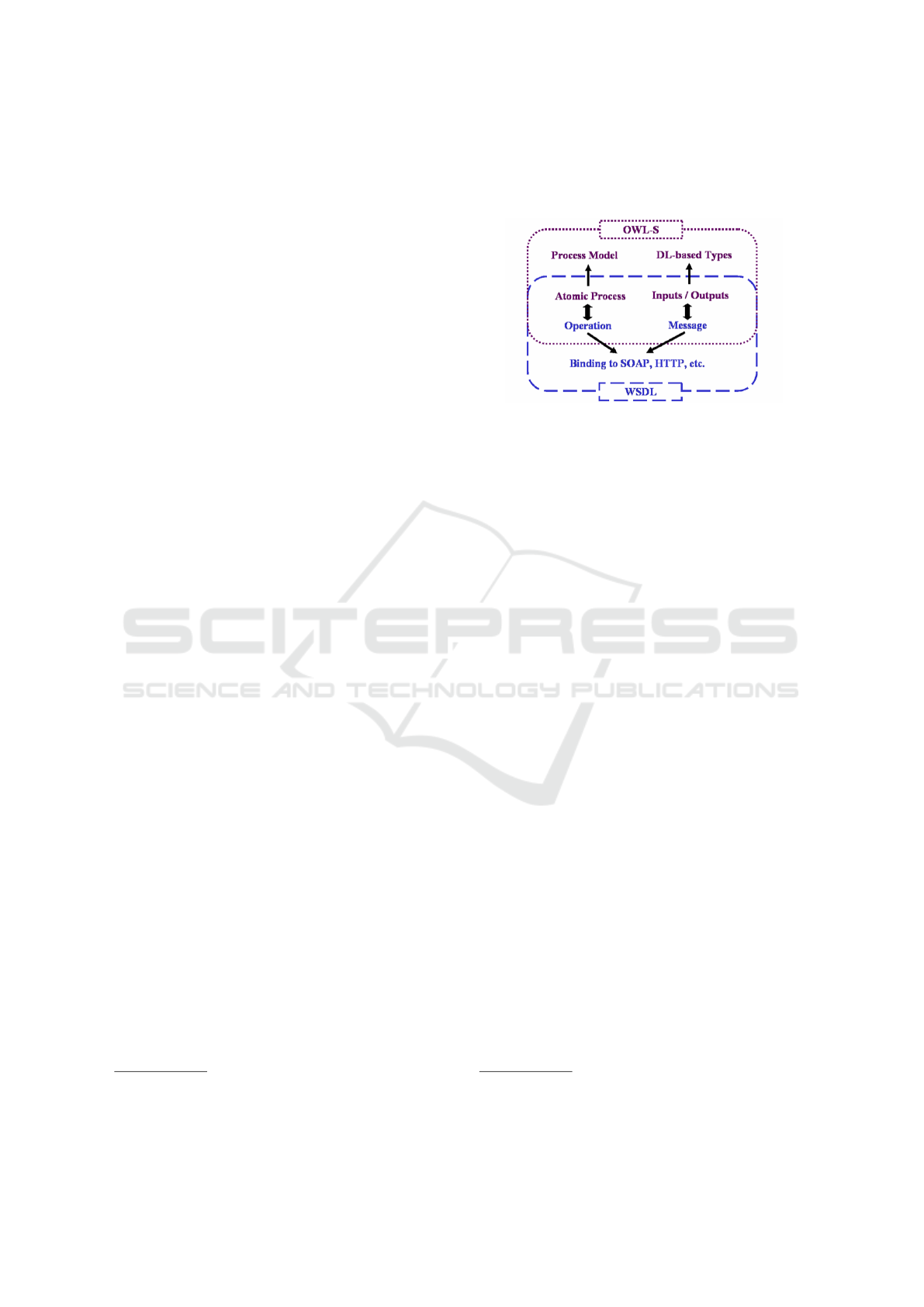
Figure 1: Schema Mapping WSDL-OWL-S.
As we can see from Figure 1, OWL-S grounding
map the semantic description of the service with the
corresponding Web Services Description Language
(WSDL)
2
, i.e., it maps directly with the description
allowing the concrete invocation of the service.
2.1.1 OWL-S Grounding
The service grounding specifies the details of how
to access the service by different kinds of informa-
tion: protocol and message formats, serialization,
transport, and addressing. The role of grounding
is mainly to bridge the gap between semantic de-
scription of web services and the existing service de-
scription models (i.e., syntactic). In general, service
grounding maps from the more abstract semantic no-
tions to the concrete elements that are necessary for
interacting with the service. The service profile and
service model present the abstract side of a service
description that doesn’t deal with the messages ex-
changed during service execution. The only part of
a message that is abstractly described is the content,
through the description of the input and output prop-
erties of the Process class in the Service Model on-
tology. The service grounding ontology is based on
and expands these primitive communication parame-
ters. The key role of a service grounding in OWL-S is
to realize process inputs and outputs as messages that
are sent and received.
OWL-S makes use of the Web Services De-
scription Language (WSDL) to describe a practical
grounding mechanism, but other mapping can be
used. To describe REST services, Web Application
Description Language (WADL) (Filho and Ferreira,
2009) has been proposed.
2
W3C Recommendation, Web Service Describe Lan-
guage (WSDL) Version 2.0 Part 1: Core Language, 2007,
http://www.w3.org/TR/wsdl
OWL-S Grounding Parameters Matching by Means of LLM: Preliminary Investigation
193

The work behind service grounding aims to ben-
efit from the advantages of both WSDL and OWL-S.
As described in previous sections, the OWL-S pro-
cess model is an expressive way of describing the in-
ner workings of a service and OWL’s typing mech-
anisms which are based on XML Schema provide
the developer with a set of design advantages. On
the other hand, the existing description mechanism
of WSDL and message declaration and software sup-
port of SOAP have been standardized and used exten-
sively, thus they constitute the best available option
for the declaration of message exchanges. In the Fig-
ure 1, the overlap between the two languages is illus-
trated. While WSDL defines abstract types specified
using XML Schema in order to characterize the inputs
and outputs of services, OWL-S allows for the defini-
tion of abstract types as OWL classes, based on de-
scription logic. Both languages, however, lack some-
thing. On the one hand, WSDL is unable to express
the semantics of an OWL class as it is not a semantic
language and lacks many required features. On the
other hand, OWL-S has no means, as currently de-
fined, to express the binding information that WSDL
captures. As a result, both languages are indispens-
able in a grounding declaration.
Once the high-level association has been estab-
lished
3
, it is possible to specify the concrete associ-
ation with the WSDL core elements which involves
operations, ports, and messages. Specifically, wsdl-
Operation is the URI of the WSDL operation corre-
sponding to the given atomic process. In turn, ws-
dlService is an optional property containing the URI
of the WSDL Service that offers the given operation.
If we are aware of the port that offers the service and
not the service itself, the equivalent wsdlPort prop-
erty can be used. Both wsdlService and wsdlPort are
optional since a wsdlOperation property sometimes
is enough to uniquely identify a specified operation.
However, if multiple ports and/or multiple services
offer the specified operation, then the wsdlPort and
wsdlService properties are used to uniquely identify
the operation.
2.2 WSDL Structure
WSDL is an XML standard developed by the W3C
to describe web services based on protocols such as
SOAP (Simple Object Access Protocol). It defines:
1) what a web service does (available operations), 2)
how to access it (protocols and message formats), and
3) where to find it (endpoint URL).
3
The complete OWL-S code is public available at:
https://www.daml.org/services/owl-s/1.1/Grounding.owl
A WSDL document is organized into the follow-
ing six main sections:
1. ⟨types⟩: Defines the data types used (using XML
Schema/XSD). The types defined by WSDL are
data structures, even complex ones, that are used
as basic elements to build the input and output
messages defined in the “messages” section.
2. ⟨message⟩: Describes the messages exchanged
(input/output). Messages are the elements that
constitute the inputs and outputs of services. Indi-
vidual messages can contain complex data types
defined in the “types” section, or simple primitive
data.
3. ⟨portType⟩: Defines the service operations (simi-
lar to an interface). The operations section defines
the operations provided by the web service.
4. ⟨binding⟩: Specifies the protocol (SOAP, HTTP
GET/POST) and message format. The binding
section maps the abstract service, defined in the
previous sections, to the concrete communication
protocol. The content of this section is highly de-
pendent on the protocol used and therefore on the
related WSDL extensions.
5. ⟨service⟩: Physical address (endpoint) of the ser-
vice. The last element of a WSDL file is the ser-
vice definition: this section allows all operations
to be collected under a single name. The service is
identified by a name and may have a description.
6. ⟨documentation⟩ (optional): For each element de-
scribed, it is possible to add an element indicat-
ing its functionality containing arbitrary human-
readable text. It is present at the operation level
(i.e., functionality) and at the service level (i.e.,
overall service).
For each operation, WSDL defines input and out-
put messages. The presence and order of these ele-
ments determines the type of service, which can be
one of four different types:
• One-way. This is a configuration where the end-
point simply receives the message sent by the
client (i.e., there is there is only one input ele-
ment).
• Request-response. The endpoint receives a re-
quest message, performs the necessary process-
ing, and returns a response message to the client.
• Solicit-response. This is the opposite of the pre-
vious one. The endpoint initiates communication
by sending a message to the client, which in turn
must respond accordingly.
• Notification. This is the opposite of the one-way
type. The endpoint sends a message to the client
KEOD 2025 - 17th International Conference on Knowledge Engineering and Ontology Development
194

without the client having to send a response. Only
the output message is present.
The interaction model to be used depends on the
nature of the service.
After providing a broad overview of the struc-
ture of a WSDL document, it is important to consider
other elements, even if not mandatory, that are useful
for describing Web Services. The use of WSDL can
also become very complex when connecting to proto-
cols other than SOAP and HTTP. For each protocol
and transport layer, it is necessary to define a spe-
cific WSDL extension and build WSDL documents
according to this grammar. The advantage of WSDL’s
great extensibility comes at the cost of complexity.
Another disadvantage of the WSDL standard is that
WSDL only provides a snapshot of the service, thus
giving a static view. What is missing is the dynamism
of the service, also known as behavior. Through be-
havior, it is possible to know how a service works and
what operations are allowed according to its internal
state.
2.3 OWL-S Composition Approach
In this section we briefly report the characteristics of
the considered OWL-S composer and some required
notions about OWL-S composite services. The work
presented in (Redavid et al., 2008) specify how to
encode an OWL-S atomic process as a SWRL rule
(Horrocks et al., 2005) (i.e., inCondition ∧ Precon-
dition is the body, output ∧ effect is the head). Af-
ter obtaining a set of SWRL rules, the following al-
gorithm was applied: it takes as input a knowledge
base containing SWRL rules set and a goal speci-
fied as a SWRL atom, and returns every possible path
built combining the available SWRL rules in order to
achieve such a goal. The set of paths can be con-
sidered as a SWRL rules plan representing all possi-
ble combinable OWL-S Atomic processes that lead to
the intended result (the goal). Subsequently, this con-
nected SWRL rule set is used to produce a composite
OWL-S service as described in (Redavid et al., 2011;
Redavid et al., 2013). One crucial feature of a com-
posite process is the specification of how its inputs are
accepted by particular sub-processes, and how its var-
ious outputs are produced by particular sub-processes.
Structures to specify the Data Flow and the Variable
Bindings are needed. When defining processes using
OWL-S, there are many places where the input to one
process component is obtained as one of the outputs
of a preceding step, short-circuiting the normal trans-
mission of data from service to client and back. For
every different type of Data Flow a particular Vari-
able Bindings is given. Formally, two complementary
conventions to specify Data Flow have been identi-
fied:consumer-pull (the source of a datum is speci-
fied at the point where it is used) and producer-push
(the source of a datum is managed by a pseudo-step
called Produce). Finally, we remark that a compos-
ite process can be considered as an atomic one using
the OWL-S Simple process declaration. This allows
to treat Composite services during the application of
the SWRL Composer.
Two different OWL-S atomic service parame-
ters identified from two different OWL Classes de-
clared equivalent with the axiom OWL:sameAs will
be treated as if they were the same meaning during the
composition process using Data Flow and Variable
Bindings to connect service at Process Model level.
But this is not sufficient for the invocation of the con-
crete WSDL services and therefore for the execution
of the obtained composite service.
2.4 Problem Specification
As reported in (Sycara and Vaculin, 2008), there can
be three different types of incompatibility that arise in
order to ensure interoperability between a (automatic
or non-automatic) requester and a service provider.
1. Data level mismatches:
(a) Syntactic / lexical mismatches: data are rep-
resented as different lexical elements (numbers,
dates format, local specifics, naming conflicts,
etc.).
(b) Ontology mismatches: the same information
is represented as different concepts in the same
ontology (subclass, superclass, siblings, no di-
rect relationship) or in different ontologies.
2. Service level mismatches:
(a) A requester’s service call is realized by sev-
eral providers’ services or a sequence of re-
quester’s calls is realized by one provider’s call.
(b) Requester’s request can be realized in differ-
ent ways which may or may not be equivalent
(e.g., different services can be used to to satisfy
requester’s requirements).
(c) Reuse of information: information provided
by the requester is used in different place in the
provider’s process model (similar to message
reordering).
(d) Missing information: some information re-
quired by the provider is not provided by the
requester.
(e) Redundant information: information pro-
vided by one party is not needed by the other
one.
OWL-S Grounding Parameters Matching by Means of LLM: Preliminary Investigation
195

3. Protocol / structural level mismatches: control
flow in the requester’s process model can be real-
ized in very different ways in the provider’s model
(e.g., sequence can be realized as an unordered list
of steps, etc.).
At the invocation level, it is necessary to resolve
issues related to Data level mismatches (1.(a)). In
the same paper (Sycara and Vaculin, 2008) this is
seen as a secondary issue, framing it as natively re-
solved by the fact that they can be handled directly in
the OWL-S grounding description through the defini-
tion of transformations between syntactic representa-
tion of web service messages and data structures. In
particular, it is possible to specify mechanisms (e.g.,
XSLT transformations) to map various syntactic and
lexical representations to the shared semantic repre-
sentation when the grounding is specified manually.
Although this is correct for maintaining the right level
of abstraction (i.e., syntactic and semantic) (Redavid
et al., 2014a; Redavid et al., 2014b), in order to apply
the automatic composition method described in sec-
tion 2.3, this aspect of grounding must also be handled
automatically. In practice, to invoke the execution of
a service, the types of the input parameters must be
those declared in the WSDL, i.e. if a parameter is de-
clared as type xsd:string, it is not possible to invoke
the service by passing a parameter of type xsd:int.
We therefore question whether it is possible to
use deep learning methods to automatically generate a
grounding specification that would make directly ex-
ecutable the composite service automatically created
using the methods described in the previous sections.
3 PROPOSED SOLUTION
To verify whether the idea of using AI approaches
to generate an OWL-S Grounding of the compos-
ite OWL-S service, including harmonisation between
the input and output parameter types of the various
atomic services that are part of the composition, we
used the LLM DeepSeek
4
. This allowed us to check
the results produced and refine the queries to improve
them. In general, the process can be summarised as
follows:
1. Application of OWL-S Composer to a set of
OWL-S atomic service descriptions that have ef-
fective grounding, i.e., WSDL exists (Redavid
et al., 2008).
2. Generation of composite OWL-S services (Re-
david et al., 2011; Redavid et al., 2013).
4
DeepSeek V3 - https://www.deepseek.com/en
3. For each composite OWL-S service, harmonisa-
tion of the binding through the insertion of a
Transformer capable of changing, where neces-
sary, the data types of the WSDL output of an
atomic service into the data types of the WSDL
input of the service invoked subsequently, follow-
ing the process model defined for the OWL-S ser-
vice in question.
In accordance with the initial vision of SWS
(McIlraith et al., 2001), it is a software agent that
governs operations related to composition and invoca-
tion, for which the agent itself may use LLM or Deep
Learning approaches. In the first case, the following
approaches may be used:
• Prompt Engineering for XML (Tam et al., 2024):
use LLMs with structured prompts and fine-tune
LLMs on XML-formatted datasets (e.g., DTD or
XSD-guided examples).
• XML as Text with Delimiters: Flatten XML into
a string format (e.g., ⟨tag⟩value⟨/tag⟩) and fine-
tune LLMs to predict sequences.
• Schema-Guided Generation (Zhang et al., 2023):
Use an XML schema (XSD/DTD) to constrain
LLM outputs via Constrained decoding (e.g.,
grammar-based sampling) or Post-processing val-
idation (e.g., XML validators like lxml
5
).
In the case of Deep Learning (Non-LLM), the follow-
ing other approaches currently exist:
• Sequence-to-Sequence (Seq2Seq) Models
(Vinyals et al., 2015; Aharoni and Goldberg,
2017): Train encoder-decoder models (e.g., T5,
BART (Setiyarini et al., 2024) to map XML
with text/JSON and use attention mechanisms to
handle nested tags.
• Graph Neural Networks (GNNs) (Bastings et al.,
2017): Model XML as a tree/graph and process
with GNNs (e.g., GAT, GraphSAGE).
• Hybrid Tokenization: Custom tokenizers (e.g.,
SpaCy
6
+ XML tags) for embeddings.
• XML-Specific Architectures (Tai et al., 2015):
Tree-LSTMs: Process XML trees recursively or
Transformer-XH: Extend transformers for hierar-
chical data.
3.0.1 Experiment
Given that the aim of this paper is to verify the
applicability of advanced AI approaches, we con-
5
lxml: Python XML parsing/validation -
https://github.com/lxml/lxml
6
SpaCy: Industrial-Strength Natural Language Process-
ing - https://spacy.io/
KEOD 2025 - 17th International Conference on Knowledge Engineering and Ontology Development
196

Listing 1: BookFinder WSDL.
<d e f i n i t i o n s name =” BookFinde r ”
t a r g e t N a m e s p a c e =” h t t p : / / ms / owlsmx / ws d l / b o o k f i n d e r ”
xml ns : t n s =” h t t p : / / ms / owlsmx / wsd l / b o o k f i n d e r ”
xml ns : xsd =” h t t p : / / www. w3 . o r g / 2 0 0 1 / XMLSchema ”
xml ns : s o a p =” h t t p : / / sche m a s . x m lsoa p . o rg / w s d l / s o a p / ”
xml ns =” h t t p : / / sche m a s . x m lsoa p . o rg / w s d l /”>
<s e r v i c e name =” B o o k F i n d e r S e r v i c e”>
<d o c u m e n t a t i o n>T h i s i s a book s e a r c h en g i n e .
</d o c u m e n t a t i o n>
<p o r t name =” B o o k F i n d e r P o r t ”
b i n d i n g =” t n s : B o o kF i n d e r S o a p Bi n d i n g”>
<soap : a d d r e s s
l o c a t i o n =” h t t p : / / ms / owlsmx / wsd l / b o o k f i n d e r ” />
</p o r t>
</ s e r v i c e >
<t y p e s>
<schema
t a r g e t N a m e s p a c e =” h t t p : / / ms / owlsmx / ws d l / b o o k f i n d e r ”
xml ns =” h t t p : / / www. w3 . org / 2 0 0 1 / XMLSchema”>
<compl exT ype name =” Requ e s t”>
<sequence>
<e l e m e n t name =” R e q u e s t I n f o ” t y p e =” x s d : s t r i n g ” />
</sequence>
</com pl exTyp e>
<compl exT ype name =” Book”>
<sequence>
<e l e m e n t name =”Name” t y p e =” xsd : s t r i n g ” />
<e l e m e n t name =”ISBN” ty p e =” xsd : s t r i n g ” />
</sequence>
< a t t r i b u t e name =” i d ” ty p e =” x sd : s h o r t ” />
</com pl exTyp e>
</sc hema>
</t y p e s>
<me s s age name =” B o o k F i n d e r I n p u t”>
<p a r t name =” bo dy ” t y p e =” t n s : R e q u e s t ” />
</m ess age>
<me s s age name =” Book F i n d e r O u t p u t”>
<p a r t name =” bo dy ” t y p e =” t n s : Book ” />
</m ess age>
. . .
</ d e f i n i t i o n s >
ducted a specific experiment on atomic OWL-S ser-
vices equipped with WSDL. The WSDLs considered
are those listed in 1, 2 and 3
7
.
Applying the OWL-S composer, we obtain the fol-
lowing possible combination of services:
BookFinderService → BookInfo2 → EBookOrder1
At this point, we tried to ask DeepSeek the follow-
ing query:
’Given the following WSDL files and supposing
that we have a PLAN A: BookFinderService, Book-
Info2, EBookOrder1, obtain two new Web services
that match WSDL outputs with WSDL inputs of subse-
quent service where the means of the parameter name
match’.
Considering that the mismatch problem concerned
the ISBN parameter, which in BookFinderService is
of type xsd:string, while in BookInfo2 it is of type
xsd:int, DeepSeek generated the WSDL shown in
listing 4, which takes the string-type ISBN as input
and returns the corresponding integer as output. This
demonstrates that the proposed approach is feasible.
7
ms means my site domain
Listing 2: BookInfo2 WSDL.
<d e f i n i t i o n s name =” Bo okI n fo2 ”
t a r g e t N a m e s p a c e =” h t t p : / / ms / owlsmx / w sdl / b o o k i n f o 2 ”
xm lns : t n s =” h t t p : / / ms / owlsmx / w sdl / b o o k i n f o 2 ”
xm lns : x s d =” h t t p : / / www. w3 . o r g / 2 0 0 1 / XMLSchema”
xm lns : s oap =” h t t p : / / s ch e mas . x mls o ap . o r g / w sdl / s o ap / ”
xm lns =” h t t p : / / s c he m as . x mls o ap . o r g / w sdl /”>
<s e r v i c e name=” B o o k I n f o S e r v i c e”>
<d o c u m e n t a t i o n>This i s a book i n f o r m a t i o n s e r v i c e
</d o c u m e n t a t i o n>
<p o r t name =” B o o k I n f o P o r t ”
b i n d i n g =” t n s : B o okInf o S o a p B i nding”>
<soa p : a d d r e s s
l o c a t i o n =” h t t p : / / ms / owlsmx / w sdl / b o o k i n f o 2 ” />
</po r t>
</ s e r v i c e>
<t y p e s>
<sc he ma t a r g e t N a m e s p a c e =” h t t p : / / ms / owlsmx / w sdl / b o o k i n f o 2 ”
xm lns =” h t t p : / / www. w3 . o r g / 2 0 0 1 / XMLSchema”>
<e l e m e n t name =” Re q u e s t”>
<co mp le xT yp e>
<seq u e n ce>
<e l e m e n t name =”Name” t y p e =” xs d : t o k e n ” />
<e l e m e n t name =” Au t hor ” t y p e =” x sd : t o k e n ” />
<e l e m e n t name =” ISBN ” t y p e =” xsd : i n t ” />
</s e q u ence>
</co mp le xT ype>
</e l e m e nt>
<e l e m e n t name =” I n f o”>
<co mp le xT yp e>
<seq u e n c e>
<e l e m e n t name =” P r i c e ” t y p e =” xs d : f l o a t ” />
<e l e m e n t name =” NumOfPages ” t y p e =” x sd : i n t ” />
<e l e m e n t name =” A v a i l a b i l i t y ” t y p e =” xsd : s t r i n g ” />
</s e q u ence>
<a t t r i b u t e use =” r e q u i r e d ” name =” ID ” t y p e =” xs d : i n t ” />
</co mp le xT ype>
</e l e m e nt>
</s chema>
</types>
<me ssa g e name =” B o okIn f o Inp u t M sg”>
<p a r t name =” body ” e l e m e n t =” t n s : R e q u e s t ” />
</messa ge>
<me ssa g e name =” B oo k Inf oOu tpu t Ms g”>
<p a r t name =” body ” e l e m e n t =” t n s : I n f o ” />
</messa ge>
. . .
</ d e f i n i t i o n s >
Listing 3: EBookOrderService WSDL.
<d e f i n i t i o n s name =” EBookOr de r1 ”
t a r g e t N a m e s p a c e =” h t t p : / / ms / owlsmx / ws d l / e b o o k o r d e r 1 ”
xml ns : t n s =” h t t p : / / ms / owlsmx / wsd l / e b o o k o r d e r 1 ”
xml ns : xsd =” h t t p : / / www. w3 . o r g / 2 0 0 1 / XMLSchema ”
xml ns : s o a p =” h t t p : / / sche m a s . x m lsoa p . o rg / w s d l / s o a p / ”
xml ns =” h t t p : / / sche m a s . x m lsoa p . o rg / w s d l /”>
<s e r v i c e name =” E B o o k O r d e r S e r vic e”>
<d o c u m e n t a t i o n>T h i s i s a e−book o r d e r s e r v i c e
</d o c u m e n t a t i o n>
<p o r t name =” EBookO r d e r P o rt ”
b i n d i n g =” t n s : E Book O r d erSo a p Bindi n g”>
<soap : a d d r e s s
l o c a t i o n =” h t t p : / / ms / owlsmx / wsd l / e b o o k o r d e r 1 ”/>
</p o r t>
</ s e r v i c e >
<t y p e s>
<schema
t a r g e t N a m e s p a c e =” h t t p : / / ms / owlsmx / ws d l / e b o o k o r d e r 1 ”
xml ns =” h t t p : / / www. w3 . org / 2 0 0 1 / XMLSchema”>
<e l e m e n t name =” R e q u e s t”>
<complexT ype>
<sequence>
<e l e m e n t name =”Name” t y p e =” xsd : t o k e n ” />
<e l e m e n t name =” A u t h o r ” t y p e =” xsd : t o k e n ” />
<e l e m e n t name =”ISBN” ty p e =” xsd : i n t ” />
</sequence>
</com pl exTyp e>
</element>
<e l e m e n t name =” A c coun t”>
<complexT ype>
<sequence>
<e l e m e n t name =” Usernam e ” ty p e =” x s d : t o k e n ” />
<e l e m e n t name =” P a s s w ord ” t y p e =” xs d : t o k e n ” />
</sequence>
</com pl exTyp e>
</element>
</sc hema>
</t y p e s>
<me s s age name =” E Book Orde rIn p utM sg”>
<p a r t name =” b o o k t i t l e ” e l e m e n t =” t n s : Re q u e s t ” />
<p a r t name =” ac c o u n t ” e l e m e n t =” t n s : A c coun t ” />
</m ess age>
<me s s age name =” E BookO rderO utput Msg”>
<p a r t name =” bo dy ” e l e m e n t =” x s d : s t r i n g ” />
</m ess age>
. . .
</ d e f i n i t i o n s >
OWL-S Grounding Parameters Matching by Means of LLM: Preliminary Investigation
197

Listing 4: BookFinderToBookInfo2 WSDL.
<d e f i n i t i o n s name =” Bo o kFi n d erTo B o okI n f o2 ”
t a r g e t N a m e s p a c e =” h t t p : / / ms / m e d i a t i o n / B o o kFi n d erTo B o okI n f o2 ”
xm lns : t n s =” h t t p : / / ms / m e d i a t i o n / B o okF i n derT o B ook I n fo2 ”
xm lns : b f =” h t t p : / / ms / owlsmx / w s dl / b o o k f i n d e r ”
xm lns : b i =” h t t p : / / ms / owlsmx / w s dl / b o o k i n f o 2 ”
xm lns : xsd =” h t t p : / / www. w3 . o r g / 2 0 0 1 / XMLSchema”
xm lns : s o ap =” h t t p : / / sch e mas . x m lso ap . o r g / w s dl / s o a p / ”
xm lns =” h t t p : / / s che m as . x m lso ap . o r g / w s dl/”>
<s e r v i c e name =” B oo k F i n d e r T o B o o k I n f o 2 S e r v i c e”>
<p o r t name=” B o o k F i n d e r T o B ookInfo2Port ”
b i n d i n g =” t n s : B o o k Find e r T o B ookIn f o 2 S o apBin d i n g”>
<so a p : a d d r e s s
l o c a t i o n =” h t t p : / / ms / m e d i a t i o n / B o okFi n d erT o B ookI n f o2”/>
</p o r t>
</s e r v i c e>
<ty p e s>
<sche ma t a r g e t N a m e s p a c e =
” h t t p : / / ms / m e d i a t i o n / B o okFi n d erT o B ookI n f o2 ”
xm lns =” h t t p : / / www. w3 . o r g / 2 0 0 1 / XMLSchema”>
<!−− I n p u t m atche s B o okF i nde r ’ s Book t y p e −−>
<e l e m e n t name =” M e d i a t i o n I n p u t ”>
<complexType>
<se q u e n ce>
<e l e m e n t name =”Name” t y p e =” x sd : s t r i n g ” />
<e l e m e n t name =”ISBN ” t y p e =” x sd : s t r i n g ” />
</s e quenc e>
<a t t r i b u t e name =” i d ” t y p e =” xs d : s h o r t ” />
</c om pl ex Ty pe>
</e l e ment>
<!−− O u tput m atches B o ok I nf o 2 ’ s R e q u e s t t y p e −−>
<e l e m e n t name =” M e d i a t i o n O u t p u t”>
<complexType>
<se q u e n ce>
<e l e m e n t name =”Name” t y p e =” x sd : t o k e n ” />
<e l e m e n t name =” A u thor ” t y p e =” x sd : t o k e n ” />
<e l e m e n t name =”ISBN ” t y p e =” x sd : i n t ” />
</s e quenc e>
</c om pl ex Ty pe>
</e l e ment>
</schema>
</t y p e s>
<mess a ge name =” MediationInputMs g”>
<p a r t name =” body ” e l e m e n t =” t n s : M e d i a t i o n I n p u t ” />
</m essag e>
<mess a ge name =” Me d i a tion O u t p utMs g”>
<p a r t name =” body ” e l e m e n t =” t n s : M e d i a t i o n O u t p u t ” />
</m essag e>
<por t T y p e name =” Bo o k F i nderT o B o o k I n fo2Po r t T y p e”>
<o p e r a t i o n name =” m e d i a t e B o o k I n f o R e q u e s t”>
<i n p u t m e ssa g e =” t n s : M e d i a t i o n I n p u t M s g ” />
<o u t p u t mes sag e =” t n s : M e diat i o n O utpu t M s g ” />
</o p e r a t i o n>
</p o rtTy p e>
. . .
</ d e f i n i t i o n s >
4 CONCLUSIONS
Generative artificial intelligence for automating web
service operations has given rise to new scenarios
and new challenges. Recent trends aim to simplify
discovery and composition operations by abandon-
ing service-oriented architecture in favour of a simpli-
fied definition of services, moving from structured de-
scriptions to unstructured descriptions. The composi-
tion of SOA web services through the application of
methods and techniques for SWS is still important, as
there are issues that require the correct identification
of responsibilities, especially in critical contexts. For
this reason, we sought to investigate the applicability
of these new methods to less complex but equally fun-
damental issues in the field of SWS. This paper repre-
sents only a starting point for further investigation of
the following aspects: 1) Can a software agent intelli-
gently use LLMs to find the best solution to syntactic
matching problems in services? 2) Can deep learning
methods also be used in combination with LLM meth-
ods for the problem examined? 3) Is it possible to
extend the approach to solve problems related to the
OWL-S Service Model? We are currently working on
implementing the proposed idea by leveraging the on-
tologies for describing cultural heritage, and specifi-
cally digital libraries and archives developed as part of
the CHANGES project. Trying to answer these ques-
tions is not easy, but it stimulates our interest.
ACKNOWLEDGEMENTS
This research was partially supported by project Cul-
tural Heritage Active innovation for Next-GEn Sus-
tainable society (CHANGES) (PE00000020), Spoke
3 (Digital Libraries, Archives and Philology), under
the NRRP MUR program funded by the NextGenera-
tionEU.
REFERENCES
Aharoni, R. and Goldberg, Y. (2017). Towards string-to-tree
neural machine translation. In Barzilay, R. and Kan,
M.-Y., editors, Proceedings of the 55th Annual Meet-
ing of the Association for Computational Linguistics
(Volume 2: Short Papers), pages 132–140, Vancouver,
Canada. Association for Computational Linguistics.
Aiello, M. and Georgievski, I. (2023). Service composi-
tion in the chatgpt era. Serv. Oriented Comput. Appl.,
17(4):233–238.
Bastings, J., Titov, I., Aziz, W., Marcheggiani, D., and
Sima’an, K. (2017). Graph convolutional encoders for
syntax-aware neural machine translation. In Palmer,
M., Hwa, R., and Riedel, S., editors, Proceedings of
the 2017 Conference on Empirical Methods in Natu-
ral Language Processing, pages 1957–1967, Copen-
hagen, Denmark. Association for Computational Lin-
guistics.
Ekie, Y. J., Gueye, B., Niang, I., and Ekie, A. M. T. (2021).
Web based composition using machine learning ap-
proaches: A literature review. In Ahmed, M. B.,
Boudhir, A. A., and Mazri, T., editors, NISS2021:
The 4th International Conference on Networking, In-
formation Systems & Security, KENITRA, Morocco,
April 1 - 2, 2021, pages 48:1–48:7. ACM.
Fensel, D., Kerrigan, M., and Zaremba, M., editors (2008).
WSMO and WSML, pages 43–65. Springer Berlin Hei-
delberg, Berlin, Heidelberg.
Filho, O. F. F. and Ferreira, M. A. G. V. (2009). Seman-
tic Web Services: A RESTful Approach. In IADIS
International Conference WWWInternet 2009, pages
169–180. IADIS.
Horrocks, I., Patel-Schneider, P. F., Bechhofer, S., and
Tsarkov, D. (2005). OWL rules: A proposal and pro-
totype implementation. J. of Web Semantics, 3(1):23–
40.
Khamparia, A. and Pandey, B. (2017). Comprehensive
analysis of semantic web reasoners and tools: a
survey. Education and Information Technologies,
22(6):3121–3145.
KEOD 2025 - 17th International Conference on Knowledge Engineering and Ontology Development
198

Kopeck
´
y, J., Vitvar, T., Bournez, C., and Farrell, J. (2007).
Sawsdl: Semantic annotations for wsdl and xml
schema. IEEE Internet Computing, 11(6):60–67.
Martin, D., Paolucci, M., McIlraith, S., Burstein, M., Mc-
Dermott, D., McGuinness, D., Parsia, B., Payne, T.,
Sabou, M., Solanki, M., Srinivasan, N., and Sycara,
K. (2005). Bringing semantics to web services: The
owl-s approach. In Cardoso, J. and Sheth, A., edi-
tors, Semantic Web Services and Web Process Com-
position, pages 26–42, Berlin, Heidelberg. Springer
Berlin Heidelberg.
McIlraith, S. A., Son, T. C., and Zeng, H. (2001). Semantic
Web Services. IEEE Intelligent Systems, 16(2):46–53.
Pesl, R. D., Mombrey, C., Klein, K., Zyberaj, D.,
Georgievski, I., Becker, S., Herzwurm, G., and Aiello,
M. (2025). Compositio prompto: An architecture
to employ large language models in automated ser-
vice computing. In Gaaloul, W., Sheng, M., Yu, Q.,
and Yangui, S., editors, Service-Oriented Computing,
pages 276–286, Singapore. Springer Nature Singa-
pore.
Pesl, R. D., St
¨
otzner, M., Georgievski, I., and Aiello, M.
(2023). Uncovering llms for service-composition:
Challenges and opportunities. In Monti, F., Plebani,
P., Moha, N., Paik, H., Barzen, J., Ramachandran,
G. S., Bianchini, D., Tamburri, D. A., and Mecella,
M., editors, Service-Oriented Computing - ICSOC
2023 Workshops - AI-PA, ASOCA, SAPD, SQS, SS-
COPE, WESOACS and Satellite Events, Rome, Italy,
November 28 - December 1, 2023, Revised Selected
Papers, volume 14518 of Lecture Notes in Computer
Science, pages 39–48. Springer.
Redavid, D., Ferilli, S., Carolis, B. D., and Esposito, F.
(2014a). Guidelines and tool for meaningful OWL-S
services annotations. In Filipe, J., Dietz, J. L. G., and
Aveiro, D., editors, KEOD 2014 - Proceedings of the
International Conference on Knowledge Engineering
and Ontology Development, Rome, Italy, 21-24 Octo-
ber, 2014, pages 130–137. SciTePress.
Redavid, D., Ferilli, S., Carolis, B. D., and Esposito, F.
(2014b). A tool for complete OWL-S services an-
notation by means of concept networks. In Fred, A.
L. N., Dietz, J. L. G., Aveiro, D., Liu, K., and Fil-
ipe, J., editors, Knowledge Discovery, Knowledge En-
gineering and Knowledge Management - 6th Interna-
tional Joint Conference, IC3K 2014, Rome, Italy, Oc-
tober 21-24, 2014, Revised Selected Papers, volume
553 of Communications in Computer and Information
Science, pages 405–420. Springer.
Redavid, D., Ferilli, S., and Esposito, F. (2011). SWRL
Rules Plan Encoding with OWL-S Composite Ser-
vices. In Kryszkiewicz, M., Rybinski, H., Skowron,
A., and Ras, Z. W., editors, ISMIS, volume 6804 of
Lecture Notes in Computer Science, pages 476–482.
Springer.
Redavid, D., Ferilli, S., and Esposito, F. (2013). To-
wards dynamic orchestration of semantic web ser-
vices. Trans. Comput. Collect. Intell., 10:16–30.
Redavid, D., Iannone, L., Payne, T. R., and Semeraro, G.
(2008). OWL-S Atomic Services Composition with
SWRL Rules. In An, A., Matwin, S., Ras, Z. W., and
Slezak, D., editors, ISMIS, volume 4994 of Lecture
Notes in Computer Science, pages 605–611. Springer.
Setiyarini, D., Adji, T. B., and Hidayah, I. (2024). Evaluat-
ing performance of transformer models for dialogue
summarization: A comparison of t5-base, t5-small,
and bart-base. In 2024 IEEE International Conference
on Communication, Networks and Satellite (COM-
NETSAT), pages 184–190.
Sycara, K. and Vaculin, R. (2008). Process mediation of
owl-s web services. In et al., T. S. D., editor, Advances
in Web Semantics I, pages 324 – 345. Springer.
Tai, K. S., Socher, R., and Manning, C. D. (2015). Im-
proved semantic representations from tree-structured
long short-term memory networks. In Proceedings
of the 53rd Annual Meeting of the Association for
Computational Linguistics and the 7th International
Joint Conference on Natural Language Processing of
the Asian Federation of Natural Language Processing,
ACL 2015, July 26-31, 2015, Beijing, China, Volume
1: Long Papers, pages 1556–1566. The Association
for Computer Linguistics.
Tam, Z. R., Wu, C., Tsai, Y., Lin, C., Lee, H., and Chen, Y.
(2024). Let me speak freely? A study on the impact
of format restrictions on large language model perfor-
mance. In Dernoncourt, F., Preotiuc-Pietro, D., and
Shimorina, A., editors, Proceedings of the 2024 Con-
ference on Empirical Methods in Natural Language
Processing: EMNLP 2024 - Industry Track, Miami,
Florida, USA, November 12-16, 2024, pages 1218–
1236. Association for Computational Linguistics.
Vinyals, O., Kaiser, L. u., Koo, T., Petrov, S., Sutskever,
I., and Hinton, G. (2015). Grammar as a foreign
language. In Cortes, C., Lawrence, N., Lee, D.,
Sugiyama, M., and Garnett, R., editors, Advances in
Neural Information Processing Systems, volume 28.
Curran Associates, Inc.
Zhang, Y., Floratou, A., Cahoon, J., Krishnan, S., M
¨
uller,
A. C., Banda, D., Psallidas, F., and Patel, J. M. (2023).
Schema matching using pre-trained language models.
In 2023 IEEE 39th International Conference on Data
Engineering (ICDE), pages 1558–1571.
OWL-S Grounding Parameters Matching by Means of LLM: Preliminary Investigation
199
