
Paper-Based Health Records: A Case Study on the Digitization of
Handwritten Clinical Records
Vincenza Carchiolo
a
, Michele Malgeri
b
and Lorenzo Spadaro Sapari
Dipartimento di Ingegneria Elettrica Elettronica e Informatica Universit
`
a di Catania, Catania, Italy
Keywords:
Health Management, OCR, Application.
Abstract:
This paper presents a case study focused on the application of handwriting recognition to digitize historical
clinical records containing significant handwritten content. The primary objective is to assess the feasibility
of using commercial OCR technologies—in particular, Microsoft Azure’s handwriting recognition API—for
processing health documents. The study aims to determine whether these tools can support the extraction
of meaningful clinical information, not only by recognizing individual characters but also by leveraging the
structural layout of documents, such as forms, to infer semantic content.
Our methodology includes empirical evaluation of OCR output on real-world patient records, alongside a
qualitative analysis of common recognition errors. In addition, we review relevant approaches from the liter-
ature, highlighting recent advances in deep learning for document understanding. The findings indicate that
general-purpose OCR systems are currently insufficient for reliable clinical data extraction in such contexts,
primarily due to the complexity and variability of handwritten medical records. However, the results also
suggest that structural cues present in form-based documents could be harnessed—through tailored AI-based
techniques—to significantly improve recognition and downstream information retrieval.
1 INTRODUCTION
In recent years, healthcare systems have undergone
an accelerated digital transformation, with the goal
of improving data accessibility, interoperability, and
analytical capabilities. However, despite the pro-
liferation of Electronic Health Record (EHR) sys-
tems, a significant portion of clinical information re-
mains trapped in non-digitized formats. These in-
clude scanned paper records, printed reports, hand-
written notes, and administrative forms. The pres-
ence of such unstructured data limits the potential
of modern healthcare information systems to pro-
vide timely and data-driven insights. The problem
is particularly severe in hospital settings, where doc-
umentation practices often vary across departments
and time periods. Clinical records are typically long
and detailed, encompassing a wide range of infor-
mation from patient demographics to complex di-
agnostic descriptions, therapeutic plans, and proce-
dural notes. These documents frequently include a
combination of printed and handwritten text, non-
a
https://orcid.org/0000-0002-1671-840X
b
https://orcid.org/0000-0002-9279-3129
standardized layouts, medical jargon, and institution-
specific abbreviations. The lack of uniformity not
only hinders human readability but also poses signifi-
cant challenges for automated processing. Within the
European Union, efforts are being made to harmo-
nize the healthcare data landscape. Initiatives such
as the European Health Data Space (EHDS), offi-
cially launched in 2025, promote secure cross-border
data exchange and aim to facilitate the secondary use
of health data for research and innovation. Stan-
dards such as HL7’s Clinical Document Architec-
ture (CDA) and Fast Healthcare Interoperability Re-
sources (FHIR) are increasingly adopted to enable in-
teroperability between systems. Nonetheless, a large
portion of legacy documents predates these standards
and exists only in paper or scanned format, making
them inaccessible to modern digital workflows.
To bridge this gap, Optical Character Recognition
(OCR) is still a foundational technology, also taking
into account the chance to integrate AI algorithms to
enhance the ability to recognize more contents. OCR
enables the automatic conversion of scanned images
or PDF documents into machine-readable text, allow-
ing historical and unstructured records to become ac-
cessible for further analysis. However, applying OCR
244
Carchiolo, V., Malgeri, M. and Sapari, L. S.
Paper-Based Health Records: A Case Study on the Digitization of Handwritten Clinical Records.
DOI: 10.5220/0013853900003985
Paper published under CC license (CC BY-NC-ND 4.0)
In Proceedings of the 21st International Conference on Web Information Systems and Technologies (WEBIST 2025), pages 244-251
ISBN: 978-989-758-772-6; ISSN: 2184-3252
Proceedings Copyright © 2025 by SCITEPRESS – Science and Technology Publications, Lda.

in the healthcare domain is far from trivial. Clinical
documents differ significantly from standard printed
text in terms of complexity, content density, and vari-
ability. Handwriting recognition remains particularly
difficult, especially when combined with poor scan
quality or domain-specific terminology. Additionally,
the presence of tables, multiple columns, and mixed
formatting adds another layer of complexity for OCR
systems to handle.
In this work, we present a case study focused on
the extraction of structured information from com-
plex clinical documents using a pipeline based on
Microsoft Azure Document Intelligence (Microsoft,
2025), part of the more general Microsoft Azure Cog-
nitive Services (Microsoft, na). The proposed so-
lution integrates multiple tools from the Microsoft
ecosystem, including the Read OCR API for text ex-
traction, the Layout API for document structure anal-
ysis, and custom modules for medical entity recogni-
tion and normalization. These tools are orchestrated
in a modular workflow designed to cope with hetero-
geneous document types, allowing for preprocessing,
layout-aware recognition, and post-OCR analysis.
The pipeline was applied to a dataset of anonymized
Italian clinical records collected from a hospital en-
vironment. These documents reflect the typical di-
versity of healthcare records: they include admis-
sion reports, discharge summaries, and intraopera-
tive notes—many of which contain mixed handwrit-
ten and typed sections. The evaluation focused both
on the quality of text recognition (e.g., character er-
ror rates, text segmentation) and on the ability to ex-
tract key information such as patient identifiers, di-
agnoses, and timestamps. Beyond digitization, a key
contribution of this work lies in positioning OCR as
a critical enabling step for advanced data analysis.
Once clinical text has been extracted, it can serve
as input for a wide range of artificial intelligence
(AI) applications, such as natural language process-
ing (NLP), named entity recognition (NER), tempo-
ral reasoning, and predictive modeling (Carchiolo and
Malgeri, 2025). In particular, the ability to transform
unstructured clinical narratives into structured data
opens the door to more sophisticated tools for clini-
cal decision support, cohort identification, risk strat-
ification, and automated report summarization. Al-
though OCR alone does not solve the full problem
of semantic understanding, it provides the essential
first layer of machine interpretability. The combina-
tion of OCR and AI-driven post-processing can help
unlock the latent value stored in years of handwritten
or non-standard documentation, contributing to the
broader goal of modernizing healthcare information
systems and improving data-driven patient care. In
summary, this study offers a realistic and scalable ap-
proach to document digitization in clinical contexts
using Microsoft-based OCR technologies. It illus-
trates both the current potential and the limitations
of applying these tools in real-world hospital settings,
and lays the groundwork for future integration with
AI-powered healthcare analytics pipelines.
The remainder of this paper is organized as fol-
lows: Section 2 describes the health records and the
related standards, if any. Section 3 details the OCR
pipeline, including the tools and methods adopted for
preprocessing, recognition, and post-processing. Sec-
tion 4 presents our proposal giving details about ar-
chitecture models and whatever has been studied and
section 5 discusses the findings. Finally, Section 6
concludes the paper and outlines directions for future
work.
2 ABOUT CLINICAL RECORDS
In the European Union, health records are central doc-
uments for both healthcare delivery and medico-legal
accountability. While there is no binding European
regulation that imposes a uniform structure or con-
tent for health records across all member states, mul-
tiple initiatives and technical standards have been in-
troduced to promote interoperability, data quality, and
security. The most significant initiative in this re-
gard is the European Health Data Space (EHDS),
proposed by the European Commission in 2022 and
officially entered into force in March 2025 (Euro-
pean Commission, 2025b). Its goal is to facilitate
the secure exchange and use of health data across
the EU, including electronic health records (EHRS),
while respecting patient privacy and national health-
care governance structures. Technical interoperabil-
ity efforts are also supported by the eHealth Net-
work, a voluntary collaboration between EU coun-
tries, which has produced common specifications for
cross-border health data exchange, particularly in the
form of “Patient Summaries” and “ePrescriptions”
(European Commission, 2025a). At the technical
level, several international standards developed by
Health Level Seven International (HL7) have been
increasingly adopted across Europe. These include
the Clinical Document Architecture (CDA), used to
define the structure of clinical documents such as dis-
charge summaries, and in a more recent version (HL7
FHIR) includes Fast Healthcare Interoperability Re-
sources (FHIR), the standard that facilitates the ex-
change of healthcare information across systems us-
ing modern web technologies (Bender and Sartipi,
2013). Among these, FHIR has emerged as the pre-
Paper-Based Health Records: A Case Study on the Digitization of Handwritten Clinical Records
245

ferred standard for modern EHR systems due to its
compatibility with RESTful APIs. The EHDS ini-
tiative aims to unify FHIR standards across member
states, targeting 80% adoption by 2026 (Willis, 2025).
This initiative underscores the EU’s commitment to
enhancing healthcare interoperability, improving pa-
tient care, and facilitating data-driven research and in-
novation.
Despite these harmonization efforts, each coun-
try retains significant autonomy in determining the
mandatory content and structure of health records. In
Italy, for example, the clinical record is recognized as
both a medical and legal document that accompanies
the entire hospitalization episode and documents the
diagnostic and therapeutic process in a traceable and
continuous manner. It is compiled and maintained
primarily by the attending physician, in compliance
with various legal, ethical, and procedural standards.
A legal foundation for the clinical record can be
found in a combination of sources. The Decree of
August 5, 1977 (Ministero della Sanit
`
a, 1977), re-
quires that private healthcare institutions compile a
medical record for each hospitalized patient, contain-
ing full personal data, initial and final diagnoses, fam-
ily and personal medical history, objective exami-
nations, laboratory and specialist tests, therapy, out-
comes, and post-treatment status. These records must
be signed by the treating physician and archived by
the healthcare facility. The Ministry of Health Guide-
lines of June 17, 1992, concerning the management of
hospital discharge forms (Scheda di Dimissione Os-
pedaliera), describe the clinical record as an individ-
ual information tool that documents all relevant de-
mographic and clinical data related to a single episode
of hospitalization, from admission to discharge, ef-
fectively representing the patient’s entire stay in the
hospital. Ethical obligations are further codified in
the 2014 Italian Code of Medical Ethics, where Ar-
ticle 26 specifies that the clinical record must be
compiled with completeness, clarity, diligence, and
in a timely manner (Federazione Nazionale Ordine
Medici Chirurghi ed Odontoiatri, 2014). It must
record both objective and subjective clinical data, de-
tails of diagnostic and therapeutic procedures, in-
formed consent or dissent—including for sensitive
data processing—and any advance care planning, par-
ticularly for patients with progressive illnesses. The
ethical code also mandates the traceability of all en-
tries and corrections, underscoring the importance of
documentation integrity. Italian jurisprudence rein-
forces this view by defining the clinical record as a
diagnostic-therapeutic diary in which all information
of medical and legal relevance must be accurately
recorded. This includes the patient’s personal and
medical history, diagnostic evaluations, treatments
administered, clinical evolution, outcomes, and any
lasting consequences of the illness.
Structurally, a typical Italian hospital-based health
record includes: Administrative and demographic in-
formation (such as patient ID, hospital unit, date
and mode of admission), admission diagnosis and
presenting complaints, medical and nursing notes (a
chronological log of observations, decisions, and care
delivered), diagnostic results (including laboratory
tests and imaging reports), specialist consultations
and interdisciplinary opinions, pharmacological and
therapeutic prescriptions, surgical and anesthesiol-
ogy documentation (when applicable), informed con-
sent forms and ethical disclosures, sheda di Dimis-
sione Ospedaliera (SDO)
1
, which uses the ICD-9-
CM (World Health Organization, 2025) standard for
coding health conditions, mainly in specification of
Chronic and/or relevant pathologies of the patient
and coded representation of all known pathologies in
progress at the time of filling out the document, and
discharge summary (final diagnosis, summary of care,
and follow-up recommendations).
The Fascicolo Sanitario Elettronico (FSE), Italy’s
national digital health record platform, has further
standardized the collection and availability of this in-
formation. As part of the European interoperability
effort, the FSE is being progressively integrated with
HL7 FHIR standards to support secure, structured,
and cross-provider data sharing, as reported in (Agen-
zia nazionale per i servizi sanitari regionali, 2023).
3 OCR AND INFORMATION
EXTRACTION
In the healthcare domain, legacy documents often
exist in scanned or handwritten formats, including
printed reports, PDF files, and clinical notes, often
handwritten. In (White-Dzuro et al., 2021) highlight
the practical difficulties faced during the COVID-19
pandemic, when large volumes of handwritten forms
and non-standardized clinical records had to be pro-
cessed rapidly. Their findings show that even modern
OCR systems struggle with the low quality of input
scans, domain-specific abbreviations, and the lack of
consistent formatting. In (Wang et al., 2023), the au-
thors examine various deep learning-based algorithms
for text detection and recognition, providing insights
into their methodologies and applications.
1
”Hospital Discharge Summary”: This form is an offi-
cial medical document issued by a hospital at the time of a
patient’s discharge.
WEBIST 2025 - 21st International Conference on Web Information Systems and Technologies
246

Given these challenges, modern OCR plat-
forms—such as Google Cloud Vision (Google Cloud
Platform, 2016), Amazon Textract (Amazon Web Ser-
vices, 2019), and Microsoft OCR’s Azure Cogni-
tive Services (Microsoft, na) have incorporated AI-
based modules to enhance the detection of text re-
gions, interpretation of complex layout structures, and
recognition accuracy across diverse document types.
Google Cloud Vision offers broad support for multi-
lingual OCR and layout detection; Amazon Textract
emphasizes structured data extraction, including ta-
bles and forms; while Azure OCR integrates seam-
lessly with other cognitive APIs for enhanced docu-
ment analysis. While these platforms mark a signif-
icant advancement in general-purpose OCR, they of-
ten struggle with domain-specific applications—such
as extracting clinically relevant content from elec-
tronic health records (EHRs), pathology reports, or
discharge summaries—where specialized tools tai-
lored to the medical domain can provide more ac-
curate and context-aware results. One example of
said specialized tools is the DEXTER system (Nand-
hinee et al., 2022) which presents a complete pipeline
for extracting tabular content from electronic medi-
cal records. By combining deep learning-based table
detection with conventional vision techniques for cell
segmentation it achieves great results on real-world
medical datasets. In a more recent study, the authors
of (Li et al., 2024) proposed a deep learning-based
OCR pipeline specifically designed for scanned labo-
ratory reports. Their system integrates advanced mod-
els such as Detection Transformer (DETR) R18 for
table detection and an encoder-dual-decoder (EDD)
architecture for table recognition. The study also em-
phasizes the challenges posed by document noise,
handwritten notes, and diverse table formats com-
monly found in medical records—issues that general-
purpose OCR tools often fail to address.
4 WHAT WE DID
Retrieving medical records is often a complex task
for patients due to fragmentation across systems
and inconsistent formats. This section presents the
core contribution of this work and it introduces
the architecture and implementation details of the
proposed system, which aims to extract structured
information from medical reports containing both
printed and handwritten text. The system leverages
a custom-trained OCR model and a large language
model(Carchiolo et al., 2026)to support accurate and
efficient retrieval of documents based on user in-
put, this enables patients to access their own medical
records with minimal effort.
4.1 System Architecture
The proposed system adopts an OCR-based pipeline
designed to process anonymized medical reports con-
taining both printed and handwritten text. The goal
is to extract structured information from these doc-
uments and enable retrieval through user interaction.
The OCR component is implemented using Microsoft
Azure Document Intelligence (Microsoft, 2025), a
cloud-based service that allows for custom model
training tailored to specific document layouts. The in-
formation gathered from the OCR component is then
leveraged by an LLM, namely Mixtral 8x7B (Jiang
et al., 2024), to guide the user in the retrieval of the
medical report he’s looking for. The interaction with
the user is carried out through a web-based conver-
sational interface, where the language model dynam-
ically adapts its queries based on the user’s previous
answers. If multiple reports match the provided crite-
ria, the model refines the search by asking additional,
targeted questions. The high-level workflow of the
system comprises the following steps:
(a) Medical reports are fetched from the relevant
medical database and processed by the custom
OCR model.
(b) Extracted key-value pairs are used to build a struc-
tured index for each report.
(c) The Mixtral 8x7B model interprets the user’s nat-
ural language requests via a brief conversational
exchange. This assists the user in filtering the
desired report(s) from potentially many available
documents.
(d) The system uses the criteria derived from the in-
terpreted user request to search the structured in-
dices and identify matching reports.
(e) Once some matches are found, the system pro-
vides direct links to the corresponding documents.
This process is designed to operate entirely in the
cloud. User login and authentication are handled
through SPID (Sistema Pubblico di Identit
`
a Digitale),
the Italian digital identity system (AgID, 2020). This
allows patients to securely access the system via au-
thorized medical platforms, such as the ones provided
by hospital companies. By leveraging SPID, the sys-
tem obtains the necessary personal information to per-
form a precise query on the medical database, retrieve
all the user’s reports for indexing, and subsequently
facilitate secure access.
Paper-Based Health Records: A Case Study on the Digitization of Handwritten Clinical Records
247
4.2 Model Training
Recognizing the need to handle specific structural nu-
ances present in the medical reports, a custom OCR
model was developed rather than relying solely on
a generic pre-trained solution. Although the reports
generally adhered to a common template regarding
the approximate placement of information, significant
variations existed between documents. For instance,
the same logical field (such as the hospital unit) might
appear as printed text in one report and as handwrit-
ten text in another, albeit typically within the same
region of the page. The resulting model is capable of
identifying key clinical data fields across the page, ef-
fectively processing regions containing both printed
and handwritten text, irrespective of these minor in-
consistencies.
To train and evaluate this custom OCR model, a
dedicated dataset was meticulously gathered and pre-
pared. A corpus of sixteen medical reports, was col-
lected from different units of the general hospital in
Catania. Crucially, prior to any processing, all docu-
ments underwent a rigorous anonymization procedure
to remove any patient’s personal information (such
as names, addresses, fiscal codes) and any other po-
tentially identifying information. This step was per-
formed in strict compliance with Europe’s General
Data Protection Regulation (GDPR) (Proton Tech-
nologies AG (GDPR.EU), 2018) requirements, en-
suring patient privacy was paramount. After having
anonymized the entire dataset, it was split into dis-
tinct sets for training and testing, a standard 60/40
split ratio was applied: 10 documents were allocated
for the training set and the 6 remaining for the test-
ing set. Then, a detailed annotation phase was un-
dertaken, using the Microsoft Document Intelligence
Studio UI, to label the regions of interest within each
document. This phase consisted of defining precise
bounding boxes around each target key field and nam-
ing such field.
From these documents, the following information
can be extracted:
• Name and City of the Hospital that produced the
report
• Patient’s residence
• Date of admission and discharge from the hospital
• Diagnosis of admission and discharge of the pa-
tient.
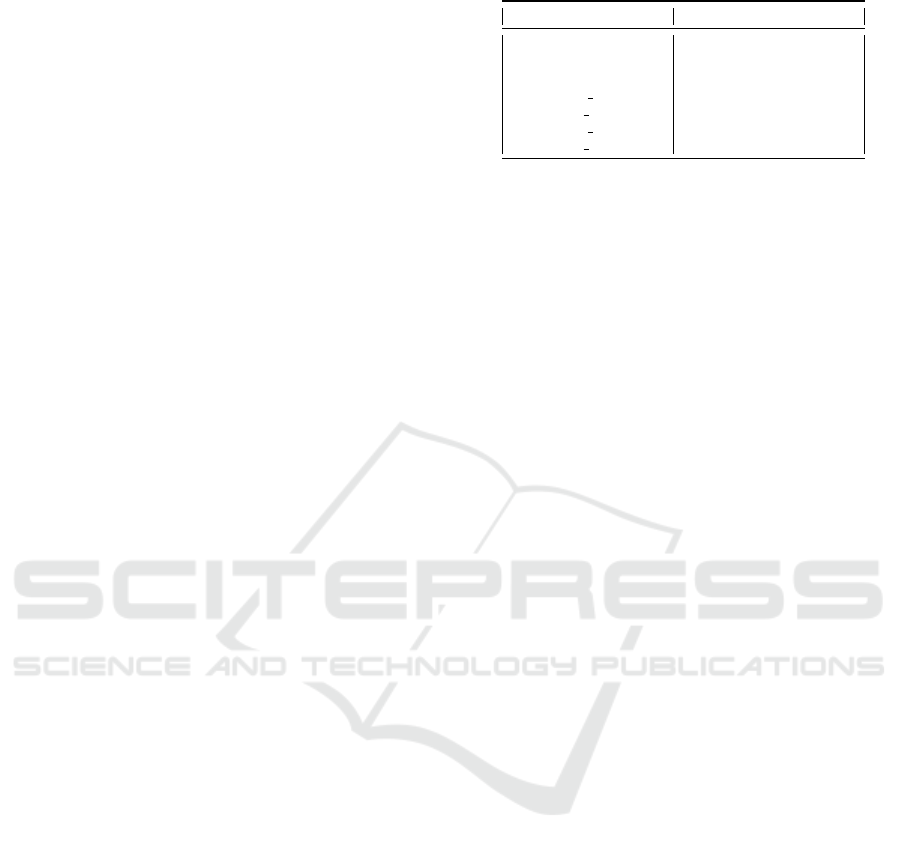
The OCR system returns information in the form
of key-value pairs, such as the ones represented in ta-
ble 1. The output of the OCR phase is a structured dic-
tionary that represents the essential metadata of each
medical report.
Table 1: Output sample.
Key Value
hospital Azienda Ospedaliera ...
city Catania
residence Palermo
admission date 01/01/2025
discharge date 01/01/2025
admission diagnosis Pneumonia
discharge diagnosis Pneumonia
Unlike other systems that rely on separate pars-
ing modules or NER (Named Entity Recognition)
pipelines to interpret and extract data from raw OCR
text such as the ones in (Rasmussen et al., 2012),(Tan
et al., 2022) and (Karthikeyan et al., 2022), the pro-
posed approach benefits from the native structured
output of the custom OCR model. Since key-value
data is extracted directly, no additional parsing or in-
formation extraction steps are required. This archi-
tecture reduces processing complexity and improves
response time. Moreover, the structured format facili-
tates accurate comparison with user input, improving
the overall effectiveness of the retrieval process.
4.3 Effect of OCR Limitations on the
System
While the proposed system demonstrates high per-
formance on documents following the trained layout,
several limitations and assumptions constrain its gen-
eralization capabilities. The custom OCR model was
trained on a set of medical reports with a fixed lay-
out, however due to the absence of standardized for-
matting among medical institutions, supporting addi-
tional report types would likely require dedicated re-
training.
The recognition of handwritten text remains
highly dependent on the legibility of the handwriting
itself. In favorable cases, the model achieved a Word
Error Rate (WER) of 0% and a Character Error Rate
(CER) as low as 2%. Importantly, no fields were con-
sistently more error-prone than others, indicating uni-
form performance across the page. In cases where a
field is missing or illegible, the system logs the corre-
sponding key in the structured index with the place-
holder value ”not found”. This mechanism ensures
that downstream processes, namely comparison and
retrieval, can proceed without exceptions or crashes
due to missing fields. Scalability of the solution was
not tested extensively due to resource constraints; the
experimental evaluation was limited to a dataset of 16
reports. While the approach is expected to scale lin-
early with the number of documents, further experi-
mentation on larger datasets is needed to validate this
assumption.
WEBIST 2025 - 21st International Conference on Web Information Systems and Technologies
248
Current latency for user interaction, including
OCR inference and response generation via the Mix-
tral 8x7B model, ranges from 5 to 15 seconds, which
is acceptable for interactive use. Finally, data pri-
vacy is a critical consideration, particularly in med-
ical applications. Microsoft Azure’s documentation
specifies that files processed through Document In-
telligence are temporarily stored on their servers for
up to seven days, presumably for caching and perfor-
mance optimization.
5 TESTING
The testing phase was designed to evaluate the per-
formance of the OCR component in extracting struc-
tured information from medical documents contain-
ing both printed and handwritten text. The source ma-
terial consisted of full medical records, each spanning
several hundred pages and originating from the same
healthcare institution, all anonymized to preserve pa-
tient confidentiality. For the purpose of both training
and evaluation, only the first page of each report was
used, as it consistently contains the key administra-
tive and clinical fields targeted by the system (e.g.,
hospital name, admission date, diagnosis, admission
unit). This approach allowed the creation of a rep-
resentative and manageable dataset without compro-
mising the diversity of layout and content necessary
for robust model evaluation. The OCR engine em-
ployed was a custom-trained model developed using
Microsoft Azure Document Intelligence. Its output is
a hashmap of key-value pairs representing the struc-
tured fields extracted from the page, eliminating the
need for additional post-processing.
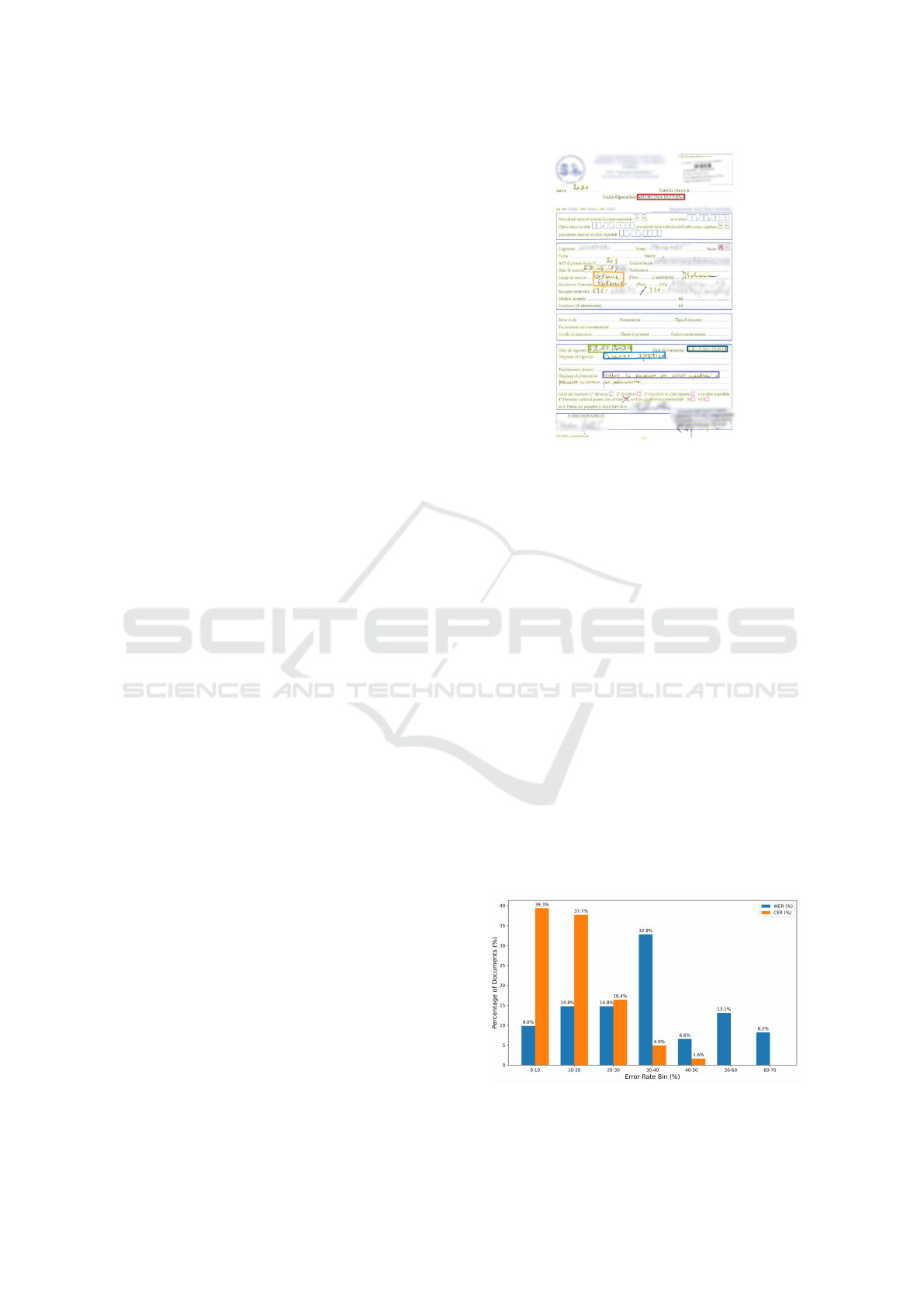
To complement the quantitative evaluation, Fig-
ure 1 presents a visual example of the OCR system’s
output on one of the test documents. The figure shows
the scanned page overlaid with bounding boxes corre-
sponding to the detected key-value pairs extracted by
the custom model. Each bounding box encloses ei-
ther a field label or its associated value, indicating the
model’s interpretation of the document structure.
The image illustrates the mixed nature of the con-
tent, which includes both machine-printed and hand-
written entries. Printed fields like the document
header are generally recognized with high accuracy.
Conversely, handwritten content, particularly in the
fields “Diagnosi di ingresso” (admission diagnosis)
and “Diagnosi di dimissione” (discharge diagnosis),
presents more variability due to inconsistent hand-
writing styles and legibility. These challenges are
manifested in the error rates discussed later in this
section.
Figure 1: OCR result with bounding boxes showing ex-
tracted fields from a test medical report.
Evaluation focused on the accuracy of text recog-
nition. Given the presence of both machine-printed
and handwritten content, two standard metrics were
adopted: Character Error Rate (CER) and Word Er-
ror Rate (WER). These were computed using the Ji-
Wer Python library for each test document and then
averaged. This allowed quantification of both fine-
grained errors (e.g., character-level substitutions) and
larger semantic discrepancies (e.g., missing or mis-
interpreted words). The test set comprised 51 rep-
resentative documents. Figure 2 illustrates the dis-
tribution of recognition errors across the document
set. Specifically, it presents the percentage of doc-
uments grouped by error rate intervals of 10%, using
both Character Error Rate (CER) and Word Error Rate
(WER) as evaluation metrics. This binning approach
enables a clearer understanding of how frequently dif-
ferent levels of error occur, highlighting the preva-
lence and severity of recognition issues within the
dataset. The results show a wide range in recognition
performance, primarily due to differences in hand-
writing legibility. In documents where printed text
Figure 2: WER and CER. The figure highlight the error
percentage vs the error classes.
Paper-Based Health Records: A Case Study on the Digitization of Handwritten Clinical Records
249
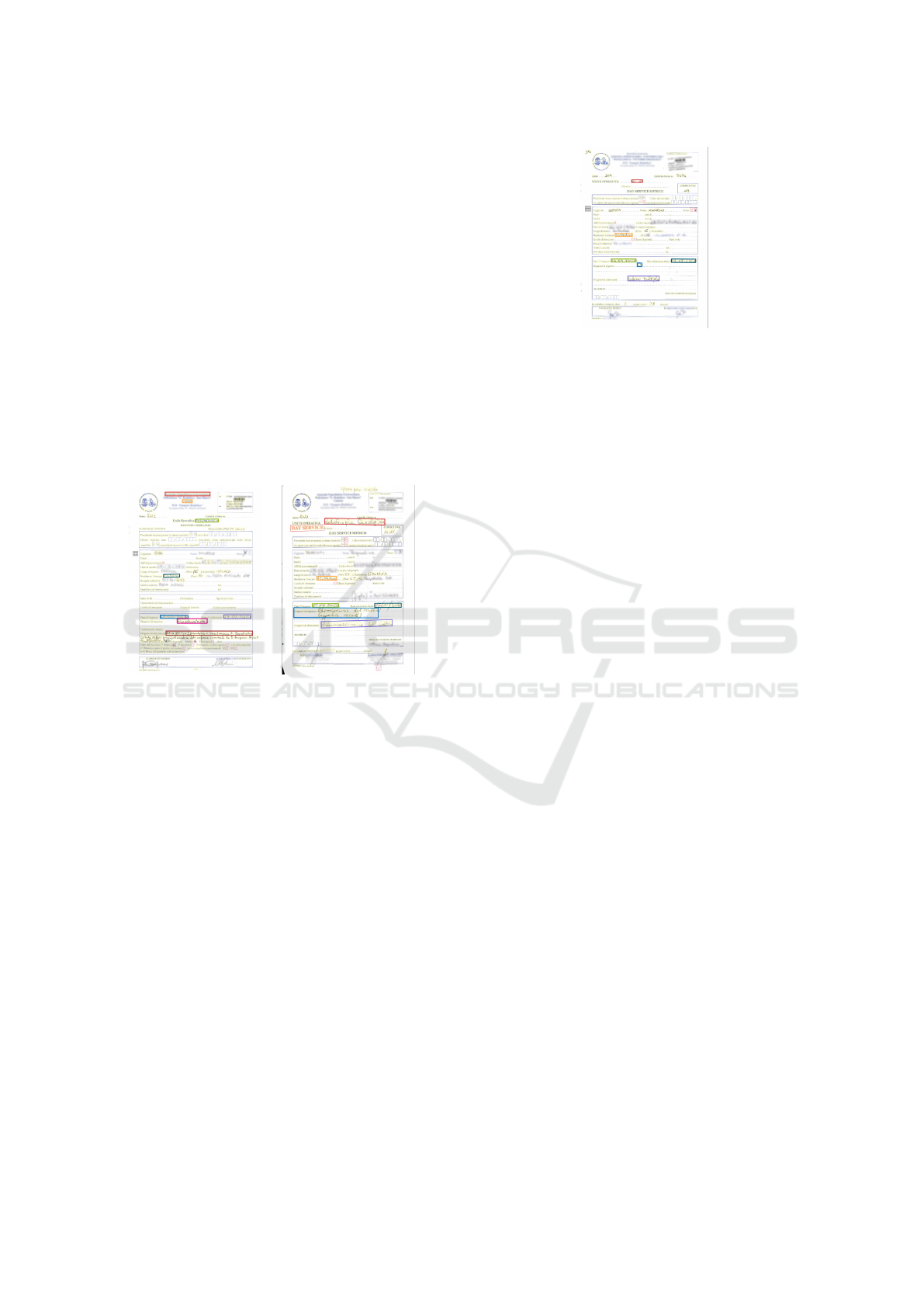
dominated error rates yielded a WER of 10.00% and a
CER 1.23%. Conversely, other documents saw WERs
exceeding 60%. Nevertheless, the average values of
WER, that is 37.43% and CER, 14.27%, reflect an
acceptable baseline for mixed-content recognition in
a real-world setting. Can be observed that the higher
error values are primarily attributable to the variabil-
ity in the handwriting of the document authors, which
introduces significant inconsistencies in the graphi-
cal representation of characters. Furthermore, a mi-
nor portion of the discrepancies could stem from dif-
ferences in document layout compared to those used
during the training phase, suggesting that model gen-
eralization to previously unseen document structures
remains an area for improvement.
This is exemplified in Figure 3a, which shows the
OCR results for the worst-performing case among the
51 documents tested. Figure 3b exemplifies the chal-
(a) (b)
Figure 3: OCR results for worst performing (left) and hand-
writing problems.
lenges posed by poor handwriting in document recog-
nition. In this case, the model failed to accurately
extract the dimission diagnosis field (highlighted by
the brown bounding box), resulting in a Word Error
Rate (WER) of 67.57% and a Character Error Rate
(CER) of 22.04%. Despite correctly locating all target
fields, the model still produced a WER of 66.67% and
a CER of 19.44%, underscoring the significant impact
of handwriting legibility on recognition performance.
Figure 4 shows the document that achieved the
best results, with a WER of 10.00% and a CER of
1.23%. The model successfully extracted all target
fields, and due to the clarity of both the document
and handwriting, only minor character-level misinter-
pretations were observed. Such calligraphic hetero-
geneity poses a substantial obstacle for automated text
recognition systems, reducing model accuracy even
with robust training.
In all test cases, the system successfully returned
structured output. On average, the processing time
for each document was under five seconds using the
Figure 4: OCR result of document #8.
Azure cloud infrastructure. While no local engine
was benchmarked for comparison, the cloud-based
setup enabled rapid iteration and ensured scalability.
Finally, end-to-end tests confirmed that the chatbot-
assisted retrieval system correctly identified the in-
tended medical record when the user input matched
the fields extracted by the OCR module. Final val-
idation was performed by the user through a binary
confirmation (“yes” or “no”), reinforcing the system’s
effectiveness under realistic usage conditions.
6 CONCLUSIONS
This study investigated the effectiveness of a com-
mercial OCR solution, specifically Microsoft Azure’s
handwriting recognition, in processing real-world
clinical records that include substantial handwritten
content. The goal was to evaluate whether exist-
ing general-purpose OCR technologies are suitable
for extracting meaningful and structured information
from historical patient documentation. The method-
ology combined both quantitative metrics and manual
inspection to assess recognition quality and semantic
coherence in the output.
The results indicate that current off-the-shelf OCR
systems, while offering basic recognition capabilities,
often fail to provide sufficient accuracy for down-
stream processing, particularly in highly domain-
specific and variable contexts like handwritten med-
ical forms. Issues such as fragmented recognition,
loss of document structure, and confusion in domain-
specific terminology were recurrent.
In parallel, the paper reviewed state-of-the-art ap-
proaches and recent research in form understanding
and handwriting recognition, which suggest that hy-
brid and AI-enhanced techniques—such as the inte-
gration of contextual models, semantic parsing, or
domain-specific post-processing—could offer signifi-
cant improvements over current commercial tools.
Ultimately, this case study underscores the need
for accurate and robust OCR technologies as a foun-
WEBIST 2025 - 21st International Conference on Web Information Systems and Technologies
250

dational component in any pipeline that aims to lever-
age artificial intelligence for clinical document anal-
ysis. Without reliable text extraction, the potential of
AI to derive insights from vast volumes of archived
handwritten data remains largely untapped. Future
work should explore the integration of domain-trained
models, active learning strategies, and multimodal
document representations to improve recognition ac-
curacy and usability in medical and archival settings.
REFERENCES
Agenzia nazionale per i servizi sanitari region-
ali (2023). Piattaforma di telemedicina e
FSE. https://www.agenas.gov.it/comunicazione/
primo-piano/2090-piattaforma-telemedicina-fse.
Accessed 8-May-2025].
AgID (2020). Sistema pubblico di identit
`
a digitale. https:
//www.spid.gov.it. Accessed 17-April-2025.
Amazon Web Services (2019). Amazon Textract – Fully
Managed ML for Text and Data Extraction. https:
//docs.aws.amazon.com/textract/. General Availabil-
ity announced November 28, 2018; service available
from May 2019, accessed on 2025-05-15.
Bender, D. and Sartipi, K. (2013). HL7 FHIR: An agile
and RESTful approach to healthcare information ex-
change. In Proceedings of the 26th IEEE Interna-
tional Symposium on Computer-Based Medical Sys-
tems, pages 326–331.
Carchiolo, V. and Malgeri, M. (2025). Trends, challenges,
and applications of large language models in health-
care: A bibliometric and scoping review. Future In-
ternet, 17(2).
Carchiolo, V., Malgeri, M., and Sapari, L. S. (2026). A con-
versational agent for handling health report inquiries.
Communications in Computer and Information Sci-
ence, 2518 CCIS:202 – 211.
European Commission (2025a). eHealth network. https:
//health.ec.europa.eu/ehealth-digital-health-and-care/
digital-health-and-care/eu-cooperation/
ehealth-network. Accessed 07-May-2025.
European Commission (2025b). European health
data space regulation (EHDS). https:
//health.ec.europa.eu/ehealth-digital-health-and-care/
european-health-data-space-regulation-ehds. Ac-
cessed: 2025-05-07.
Federazione Nazionale Ordine Medici Chirurghi ed Odon-
toiatri (2014). Nuovo codice di deontologia
medica. https://www.health-management.it/codice\
dentologico/cdm\ 03\ 25\ 26.htm.
Google Cloud Platform (2016). Google Cloud Vision API.
https://cloud.google.com/vision. Accessed: 2025-05-
15.
Jiang, A. Q., Sablayrolles, A., Roux, A., Mensch, A.,
Savary, B., Bamford, C., Chaplot, D. S., de las Casas,
D., Hanna, E. B., Bressand, F., Lengyel, G., Bour, G.,
Lample, G., Lavaud, L. R., Saulnier, L., Lachaux, M.-
A., Stock, P., Subramanian, S., Yang, S., Antoniak, S.,
Scao, T. L., Gervet, T., Lavril, T., Wang, T., Lacroix,
T., and Sayed, W. E. (2024). Mixtral of experts.
Karthikeyan, S., de Herrera, A. G. S., Doctor, F., and Mirza,
A. (2022). An OCR post-correction approach using
deep learning for processing medical reports. IEEE
Transactions on Circuits and Systems for Video Tech-
nology, 32(5):2574–2581.
Li, Y., Wei, Q., Chen, X., Li, J., Tao, C., and Xu, H. (2024).
Improving tabular data extraction in scanned labora-
tory reports using deep learning models. Journal of
Biomedical Informatics, 159:104735.
Microsoft (2025). What is azure AI document intelligence?
https://learn.microsoft.com/en-us/azure/ai-services/
document-intelligence/overview?view=doc-intel-4.0.
0”. Accessed 1-April-2025.
Microsoft (n.a.). Azure cognitive services —
computer vision ocr documentation. https:
//learn.microsoft.com/en-us/azure/cognitive-services/
computer-vision/concept-recognizing-text. Ac-
cessed: 2025-05-15.
Ministero della Sanit
`
a (1977). Determinazione dei requisiti
tecnici sulle case di cura private. http://architettura.it/
notes/ns\ nazionale/anno\ 70-79/D.M.5-8-77.html.
Nandhinee, P., Harinath, K., Koushik, S., Anil, G., and Su-
darsun, S. (2022). DEXTER: An end-to-end system to
extract table contents from electronic medical health
documents. arXiv preprint arXiv:2207.06823. Avail-
able at: https://arxiv.org/abs/2207.06823.
Proton Technologies AG (GDPR.EU) (2018). General data
protection regulation (GDPR). https://gdpr.eu/tag/
gdpr. Accessed 17-April-2025.
Rasmussen, L. V., Peissig, P. L., McCarty, C. A., and Star-
ren, J. (2012). Development of an optical character
recognition pipeline for handwritten form fields from
an electronic health record. Journal of the American
Medical Informatics Association, 19(e1):e90–e95.
Tan, Y. F., Connie, T., Goh, M. K. O., and Teoh, A. B. J.
(2022). A pipeline approach to context-aware hand-
written text recognition. Applied Sciences, 12(4).
Wang, X.-F., He, Z.-H., Wang, K., Wang, Y.-F., Zou, L.,
and Wu, Z.-Z. (2023). A survey of text detection and
recognition algorithms based on deep learning tech-
nology. Neurocomputing, 556:126702.
White-Dzuro, C. G., Schultz, J. D., Ye, C., Coco, J. R.,
Myers, J. M., Shackelford, C., Rosenbloom, S. T.,
and Fabbri, D. (2021). Extracting medical informa-
tion from paper COVID-19 assessment forms. Applied
Clinical Informatics, 12(1):170–178.
Willis, N. (2025). IFHIR adoption statistics in 2025: A
global overview. https://www.linuxactionshow.com/
fhir-adoption-statistics-in-2025-a-global-overview.
Accessed 8-May-2025].
World Health Organization (2025). International sta-
tistical classification of diseases and related health
problems (ICD). https://www.who.int/classifications/
classification-of-diseases. Accessed 8-May-2025.
Paper-Based Health Records: A Case Study on the Digitization of Handwritten Clinical Records
251
