
Linguistic Analogies in Word Embeddings: Where Are They?
Riccardo Contessi, Paolo Fosci
a
and Giuseppe Psaila
b
University of Bergamo, DIGIP, Viale Marconi 5, 24044 Dalmine (BG), Italy
Keywords:
Word Embeddings, Linguistic Analogies, Vector Semantics, Semantic Similarity, NLP.
Abstract:
Word Embedding has greatly improved Natural-Language Processing. In word-embedding models, words
are represented as vectors in a multi-dimensional space; these vectors are trained through neural networks, by
means of very large corpora of textual documents. Linguistic analogies are claimed to be encoded within word-
embedding models, in such a way that they can be dealt with through simple vector-offset operations. This
paper aims to give an answer to the following research question: given a word-embedding model, are linguistic
analogies really present? It seems rather unrealistic that complex semantic relationships are encoded within a
word-embedding model, which is trained to encode positional relationships between words. The investigation
methodology is presented, and the results are discussed. This leads to the following question: “Linguistic
analogies in Word Embeddings: where are they?”.
1 INTRODUCTION
Natural-Language Processing (NLP) has achieved
impressive results, which rely on “Neural Networks”:
a large corpus of textual documents is used to train the
inner model of a neural network, following the idea
that if a sequence of words (w
1
,...,w
n
) is submit-
ted to the network, it should output the most probable
next w
n+1
word. The internal representation learned
by a neural network trained in this way is a matrix:
rows correspond to single words, while columns de-
note a pool of weights that are used to identify the
most probable w
n+1
word. In such a vision, a word is
represented as a vector in a multi-dimensional space;
the overall pool of vectors (or matrix) is named Word
Embedding.
Modern Word Embedding was introduced by
(Mikolov et al., 2013a), where the above-mentioned
approach was presented. In particular, in the paper,
the authors presented an interesting and remarkable,
although unexpected, feature: the existence of seman-
tic relationships in the form of “linguistic analogies”.
The most famous linguistic analogy can be illustrated
as follows: King stands to Man as Queen stands to
Woman. This analogy gives rise to a very famous vec-
tor operation:
King - Man + Woman ≈ Queen
that could let people think that there is a hidden vector
a
https://orcid.org/0000-0001-9050-7873
b
https://orcid.org/0000-0002-9228-560X
(the one that results from King - Man) whose mean-
ing should be “supreme chief”.
As a consequence, many dissemination materials
graphically show such a hypothetic behavior lead-
ing researchers to strongly believe in it. However,
the authors of the present paper wanted to under-
stand Word Embedding, in particular why a word-
embedding model should be able to represent linguis-
tic analogies and semantic relations. Indeed, the exis-
tence of linguistic analogies within word-embedding
models seems quite strange, because an embedding
model is, by nature, a statistical, not semantic, model.
Indeed, many past research works pointed out criti-
cisms about this vision; moreover, it is still a widely
held opinion that linguistic analogies are encoded in
word-embedding models as vector-offset operations.
The goal of this paper is to address the following
research question: given a word-embedding model,
are linguistic analogies really present?
Unfortunately, (Mikolov et al., 2013a) used a dataset
that is no longer publicly available; furthermore, it
empirically showed linguistic analogies by exploit-
ing a vector operation named MostSimilar, which
was not formally defined; although this operation is
present in the Python library Gensim, which is consid-
ered the reference library for managing Word Embed-
dings, it is not clear if it was actually used in (Mikolov
et al., 2013a).
The contribution of the paper is the following:
(i) the concepts of Word Embedding and “linguistic
Contessi, R., Fosci, P. and Psaila, G.
Linguistic Analogies in Word Embeddings: Where Are They?.
DOI: 10.5220/0013830300003985
Paper published under CC license (CC BY-NC-ND 4.0)
In Proceedings of the 21st International Conference on Web Information Systems and Technologies (WEBIST 2025), pages 447-458
ISBN: 978-989-758-772-6; ISSN: 2184-3252
Proceedings Copyright © 2025 by SCITEPRESS – Science and Technology Publications, Lda.
447

analogies” are introduced; (ii) the operation Most-
Similar is formally defined, by interpreting the im-
plementation in the Gensim library, and an alternative
(more intuitive) operation named SimilarByVector
(provided by Gensim as well) is considered; (iii) an
investigation methodology is proposed and applied on
a publicly available word-embedding model; (iv) fi-
nally, the results of the experiments are discussed, ob-
taining the question in the title (Linguistic analogies
in Word Embeddings: where are they?).
The novelty of the contribution relies on a substan-
tial criticism to the approaches followed by previous
works: specifically, visual representations and evalua-
tions have never considered the representational space
actually used by word-embedding models.
The remainder of the paper is organized as fol-
lows. Section 2 briefly resumes the concepts of Word
Embedding and “linguistic analogy”, so as to further
report about related work on the research question of
this paper. Section 3 formally presents the various
vector operations that could be used for managing lin-
guistic analogies. Section 4 introduces the investiga-
tion methodology that was followed to answer the re-
search question, and Section 5 presents the results of
the experiments. Section 6 discusses the results of
the investigation. Finally, Section 7 draws the con-
clusions and highlights possible directions for future
works.
2 BACKGROUND AND RELATED
WORK
The goal of this section is to introduce the background
of the paper and, then, present the related work. Since
all considerations are built around the concepts of
Word Embedding and linguistic analogy, the first part
of this section presents these concepts. The second
part discusses the related work.
2.1 Word Embedding
Word Embedding is a technique for Natural-Language
Processing (NLP) that represents a (possibly-large)
vocabulary of words V = {w
1
,w
2
,...,w
n
} in a dis-
tributed way: each term w ∈ V is assigned to a vector
in a d-dimensional space, i.e., given a word w
i
∈ V
it is represented by a vector v
i
∈ R
d
. This con-
tinuous and dense representation should allow for a
more effective capture of relationships among words
in natural language; compared to previously devel-
oped techniques such as bag-of-words (Harris, 1954)
or TF-IDF (Salton et al., 1975), Word Embedding
has largely demonstrated its effectiveness. In recent
years, Word Embedding has led to significant ad-
vancements in NLP, due to its ability to geometrically
model similarities and relationships among words.
Formally speaking, given a set of words W =
{w
1
,w
2
,...,w
n
}, an embedding is a function f : W →
R
d
that maps each word w
i
to a vector v
i
∈ R
d
(Man-
delbaum and Shalev, 2016).
The vector representation is built in such a way
that vectors that represent words that frequently ap-
pear in similar contexts are located nearby in space.
This reflects the idea that the meaning of a word de-
pends on the context in which it is used. Indeed, the
idea is that the semantics of words is implicitly and in-
directly captured: words with similar meaning or that
are strongly correlated are represented by vectors that
point to the same region of space; this is usually true
for words that frequently occur in the same speech
context, such as the relationship between “doctor”
and “hospital”, and, to some extent, syntactic relation-
ships as well, such as the link between verbs and their
inflected forms.
Several models propose different strategies to
learn these vectors and they apply different tech-
niques. Word2vec (Mikolov et al., 2013a) leverages
the prediction of local contexts, and relies on a recur-
rent neural network to train the model (indeed, the
embedding is the weight matrix of the inner linear
layer). FastText (Bojanowski et al., 2017) enriches
the representation by exploiting word morphology
through character n-grams, but it still relies on a recur-
rent neural network. GloVe (Pennington et al., 2014)
exploits global co-occurrences within the corpus; dif-
ferently from Word2vec and FastText, the model is
computed as a co-occurrence matrix of words within
the training texts.
Apart from the specific technical approach, the
idea is as follows: given a sequence of n words
(s
1
,...,s
n
), through the word-embedding model it
should be possible to predict the s
n+1
word that is
most likely to follow the given n words.
Although the training process can produce vectors
of different length, models are usually normalized in
such a way that all vectors have length 1; the claimed
reason is to easily compute the cosine similarity be-
tween vectors. As a result, the actual representational
space of a word-embedding model is a d-dimensional
hyper-sphere with radius 1.
2.2 Linguistic Analogies
Linguistic analogies are relationships between pairs
of words, which are based on semantic relationships
between words. A typical example is: a king stands
to a man as a queen stands to a woman. The implicit
WEBIST 2025 - 21st International Conference on Web Information Systems and Technologies
448

semantic relationship is the concept of “person with
absolute power”. In a more formal way, the above
analogy could be stated as:
(king : man) = (queen : woman)
In the paper (Mikolov et al., 2013a), the authors
launch the idea that the difference between vectors
representing the words in the left and in the right side
of the previous analogy should be two more or less co-
incident vectors, i.e., the semantic relationship “per-
son with absolute power” or “supreme chief” should
be obtained by subtracting the vector “man” from the
vector “king”; similarly, the same vector should be
obtained by subtracting the vector “woman” from the
vector “queen”.
Consequently, given vectors that represent the
words “king”, “man”, and “woman”, the vector
“queen” should be approximately obtained by the
vector operation hereafter reported:
king - man + woman ≈ queen
This property has attracted considerable interest,
as it suggests that the vector space of Word Embed-
dings not only preserves some semantic similarity but
also encodes more complex conceptual relationships.
However, thinking that a representation of words,
which is built to capture co-occurrences of words in
the same speech contexts, is also able to encode se-
mantic relationships within the same representational
space raises several concerns. The purpose of this pa-
per is to investigate this aspect.
2.3 Related Work
The fact that word-embedding models actually en-
code linguistic analogies and semantic relationships
has been long debated. In particular, the fundamental
question is about the way vector operations are per-
formed. The reader can refer to Section 3.1, which
reports a formal definition of vector operations, as in-
tended by (Mikolov et al., 2013b), in which vectors
representing input words are excluded from the po-
tential result. In this respect, (Linzen, 2016) observed
that if this exclusion is not performed, the correctness
of vector operations drops very close to zero. On the
same line, (Levy and Goldberg, 2014) proposed to
consider the cosine similarity between offset vectors,
but this proposal has not been further followed.
The paper (Rogers et al., 2017) presented a
widespread analysis of critical issues about linguis-
tic analogies in Word Embeddings. However, while
(Rogers et al., 2017) focuses on the statistical per-
spective, the present paper continues on the same way,
by considering the complementary perspective of the
representational space.
In order to test the existence of linguistic analo-
gies in word-embedding models, several authors de-
fined corpora of categorized word pairs. The Google
set was introduced by (Mikolov et al., 2013b) (the
seminal paper about linguistic analogies); the “Bet-
ter Analogy Test Set” (BATS) was introduced by
(Gladkova et al., 2016), with the goal of enriching
the “Google set” with a large number of categories,
choosing a single category for each word (avoid-
ing repetition of words across categories); further-
more, the older corpus of semantic analogies, named
“SemEval-2012” (Jurgens et al., 2012), was used as
a reference of semantic relationships between words
to test analogies (Finley et al., 2017). However, these
data sets are made by humans and can be biased, as
far as the association of a word to a specific category
is concerned (in case of polysemous words).
Issues related to linguistic analogies emerge for
multi-lingual translations as well, typically managed
through cross-language embedding (Garneau et al.,
2021). Clearly, ways of saying complicate the task,
and simple embedding limited to words could be in-
sufficient.
3 OPERATIONS ON VECTORS
In the literature, a plethora of papers depict the above-
reported example of linguistic analogy with figures
that are very similar to Figure 1a. However, this repre-
sentation is not accurate and is misleading, for several
reasons.
(i) It does not take into account that the representa-
tional space is a d-dimensional hyper-sphere.
(ii) Points represent words, but words are represented
by vectors in the d-dimensional space, not by points
on a plane or in a 3-dimensional space.
(iii) Furthermore, how vector operations are actually
performed could significantly change the result and
affect reproducibility.
Figure 1b provides the correct representation, for
the simplified case of a 2-dimensional space. First of
all, the vectors that represent words are all rooted in
the origin of axes and reach the sphere (a circle in 2
dimensions) with radius 1; second, notice the effect of
computing a vector offset and later applying it to an-
other vector: the result is outside the representational
space of the 2-dimensional sphere; furthermore, it is
very far away from the expected resulting vector. In-
deed, this is not how vector-offset operations are ac-
tually defined/performed.
In this section, we consider different definitions,
as they were explored in the literature and beyond,
Linguistic Analogies in Word Embeddings: Where Are They?
449

king
man
woman
queen
(a) Vector operations as usually presented.
king
man
woman
queen
offset
offset
1
1
(b) Actual vector operations.
Figure 1: Representations of vector-offset operations.
always considering the actual representation space of
unit hyper-spheres.
3.1 Most Similar
The work (Mikolov et al., 2013a) explored various
vector arithmetic operations to compute linguistic
analogies. To evaluate these relationships, a method
known as MostSimilar, later implemented in the
Gensim library (
ˇ
Reh
˚
u
ˇ
rek and Sojka, 2010), was em-
ployed.
MostSimilar (GenSim Version). Given a set of posi-
tive words P = {w
1
,w
2
,...,w
m
} and a set of negative
words N = {w
m+1
,w
m+2
,...,w
m+n
}, each word w
i
is
represented by its embedding vector v
w
i
∈ R
d
.
• Step 1: Computing the query vector. The
“query vector” v
q
is computed as a weighted aver-
age of the word vectors from both sets, where each
word is associated with a weight α
i
∈ {+1,−1}.
Specifically, α
i
= +1 if w
i
∈ P, and α
i
= −1 if
w
i
∈ N. The formula below reflects the implemen-
tation of the MostSimilar method in the Gensim
library:
v
q
=
1
|P| + |N|
∑
w
i
∈P∪N
α
i
× v
w
i
(1)
This formulation ensures that all the vectors,
both positive and negative, contribute to a single
weighted mean rather than computing separate av-
erages.
• Step 2: Normalizing the query vector. The
query vector v
q
is named this way because it is
later used to query the vector space, so as to find
out the closest vector to v
q
. Since the vector space
is normalized to unit vectors, v
q
is normalized as
well. Thus, in the following, the normalized ver-
sion v
q
= norm(v
q
) is used.
• Step 3: Querying the vector space. Starting
from the normalized query vector v
q
, the top k
words whose representing vectors v
w
have the
highest cosine similarity with v
q
are selected, ex-
cluding the input words in P ∪ N:
MostSimilar(P,N) =
= argmax
w∈V|w /∈P∪N
cos(v
w
,v
q
) =
= argmax
w∈V|w /∈P∪N
v
w
·v
q
∥v
w
∥∥v
q
∥
(2)
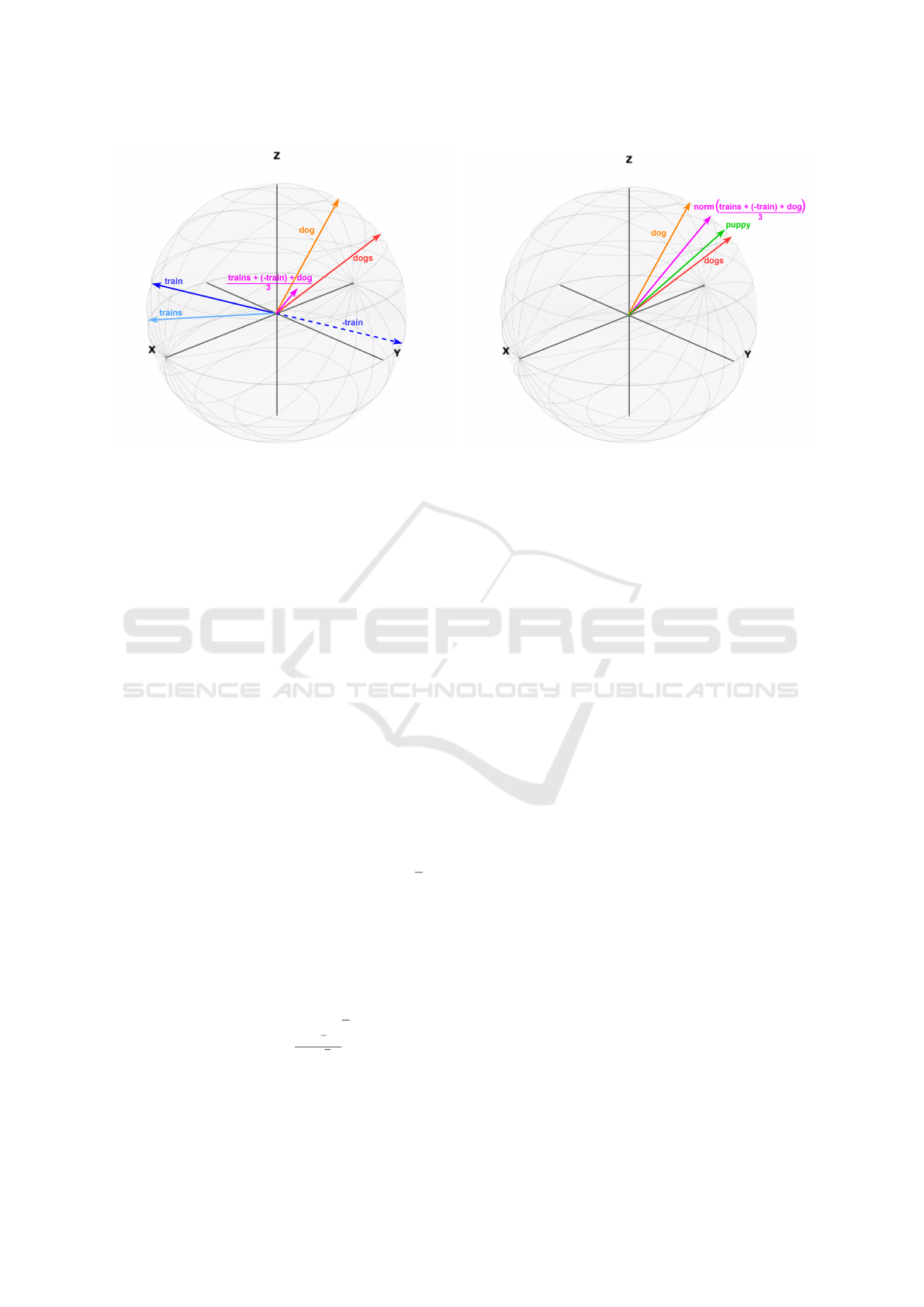
Example. To illustrate, consider a simplified model
in a 3-dimensional space (d = 3 is clearly insufficient
to obtain an effective model, however it is worth for
the sake of clarity), as illustrated in Figure 2. Specif-
ically, Figure 2a illustrates Step 1, while Figure 2b
illustrates Step 3.
The example of linguistic analogy is:
(trains : train) ≈ (dogs : dog)
consequently, the following vector operation is per-
formed:
trains - train + dog ≈ dogs
where the semantic relationship is “plural of”.
In Figure 2a, the vectors for “train” and “trains”
are the blue and light blue vectors, respectively; for
the sake of clarity, the dashed blue vector depicts “-
train”. Similarly, the vectors for “dog” and “dogs” are
the orange and red vectors, respectively. The resulting
query vector v
q
is the short fuchsia vector.
Figure 2b focuses on Step 3. For this reason, the nor-
malized query vector v
q
is depicted (fuchsia vector),
while the vectors for “trains”, “train” and “-train” are
not reported, for the sake of clarity. In addition, the
green vector that represents “puppy” is added. Notice
that in such a configuration, “dog” is still the closest
vector to v
q
: however, it is not returned because “dog”
is discarded, since it is an input word. Consequently,
usually “dogs” is returned.
MostSimilar (Mikolov Version). In the work
(Mikolov et al., 2013a), a slightly different version
of the vector operation was presented. The difference
concerns Step 1, in which the query vector is com-
puted based on the following equation:
v
q
=
∑
w
i
∈P∪N
α
i
× v
w
i
(3)
WEBIST 2025 - 21st International Conference on Web Information Systems and Technologies
450
(a) Computing the query vectors. (b) Searching for the most similar vector after normalization.
Figure 2: 3-D visual representation of MostSimilar.
The result is a longer vector compared to the previous
formulation. However, since Step 2 still normalizes
to unit the query vector, Step 3 obtains necessarily
identical results.
3.2 Similar by Vector
A second operation that is provided by Gensim is
named SimilarByVector: the idea is that, once a vec-
tor (that results from a classical vector operation) is
provided, the operation looks for the closest vector in
the model.
• Step 1: Computing the query vector. A simple
sum of vector is performed. However, since the
initial vector is rooted in the origin of the axes, the
resulting vector is also rooted in the origin of the
axes. As an effect, Equation 3 is used to compute
v
q
.
• Step 2: Normalizing the query vector. The
query vector is again normalized to unit, i.e., v
q
=
norm(v
q
) is used.
• Step 3: Querying the vector space. The nor-
malized query vector is used to query the vector
space for the closest vector. This time, all vectors
are considered.
SimilarByVector(P,N) =
= argmax
w∈V
cos(v
w
,v
q
) =
= argmax
w∈V
v
w
·v
q
∥v
w
∥∥v
q
∥
(4)
Equation 4 is very similar to Equation 2: the only
difference is that all the vectors are considered, while
in Equation 2 input vectors are discarded.
It is worth noting that, due to unit normalization it
could be possible to directly derive SimilarByVector
by simply relaxing the constraint that input vectors
must be excluded from the final results.
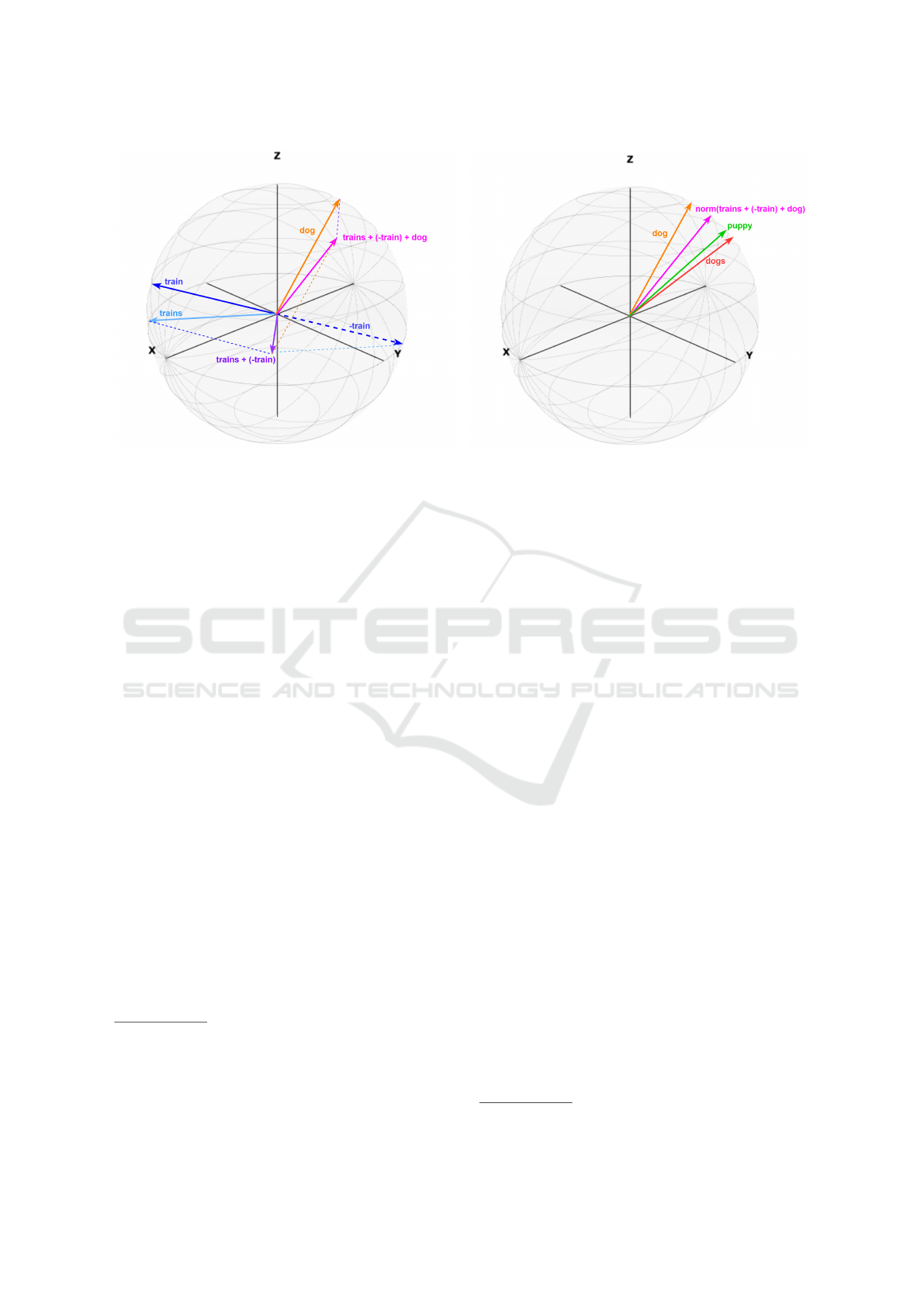
Example. By exploiting the same example analogy
that was illustrated in the example reported in Sec-
tion 3.1, Figure 3 illustrates the operation Similar-
ByVector.
Figure 3a depicts the computation of the query
vector. Notice that the resulting query vector (fuch-
sia vector) is now longer than the fuchsia vector in
Figure 2a, because each coordinate is now computed
as pure sum of the corresponding input coordinates.
The fuchsia vector in Figure 3b is the correspond-
ing normalized query vector, which is identical to the
normalized query vector depicted in Figure 2b: thus,
the nearby vectors are the same. However, this time
the vector “dog” is obtained because it is the closest
vector and is not discarded (as it is an input vector).
4 METHODOLOGY
This section presents the investigation methodology
that was carried out to address the research question
presented in Section 1.
4.1 Sources
Word Embedding based on the Skip-gram architecture
with Negative Sampling was introduced by (Mikolov
et al., 2013a), which demonstrated the effectiveness
of such models on large text corpora: the model was
Linguistic Analogies in Word Embeddings: Where Are They?
451
(a) Computing the query vectors. (b) Searching for the most similar vector after normalization.
Figure 3: 3-D visual representation of SimilarByVector.
trained through the Google News dataset
1
and on the
Wikipedia Text8 corpus
2
; a 300-dimensional space
was exploited for encoding words within the model.
The word-embedding model so far obtained was
used for the seminal work (Mikolov et al., 2013b), so
as to validate linguistic analogies; however, the word-
embedding model is no longer publicly available at
the link reported in the paper. Consequently, the
present study utilizes a pre-trained model that should
have similar characteristics (as far as training parame-
ters and the Wikipedia training corpus are concerned),
to remain as consistent as possible with (Mikolov
et al., 2013b).
Specifically, it is the pre-trained Word2vec model,
GoogleNews-vectors-negative300-SLIM.
This model constitutes an optimized and reduced-
vocabulary version of the original GoogleNews-
vectors-negative300 released by Google. The origi-
nal model was trained on approximately 100 billion
words from the English-language Google News cor-
pus, employing the Skip-gram architecture with Neg-
ative Sampling. The SLIM version restricts the vo-
cabulary to the approximately 300,000 most frequent
words and is not normalized to unit length by default
1
.
So as to pursue the investigation, the WordNet lex-
ical ontology (Miller, 1995) was downloaded
3
. In or-
der to query the lexical ontology, the Python library
1
https://code.google.com/archive/p/word2vec/,
accessed on 15/07/2025.
2
http://mattmahoney.net/dc/textdata.html,
accessed on 15/07/2025.
3
https://wordnet.princeton.edu/,
accessed on 15/07/2025.
NLTK was used
4
.
Only words confirmed as valid English lemmas
were kept, while very technical or ambiguous terms
were removed.
4.2 Generating Word Pairs
Generation of a significant number of word pairs for
a specific category of linguistic analogy is the neces-
sary starting point. Indeed, the idea is to couple all
the word pairs that share the same type of linguistic
analogy.
Types of Linguistic Analogies. A pool of categories
was considered to automatically build the corpus of
word pairs. This is the only human intervention, i.e.,
choosing the categories of interest; words and word
pairs were automatically built by querying the Word-
Net only, in a totally agnostic way. Hereafter, the con-
sidered categories are presented.
• Capital Cities (e.g., Norway:Oslo). This group
consists of 94 pairs composed of a country name
and its corresponding capital city, illustrating a se-
mantic relationship.
• Currency (e.g., Mexico:peso). Composed of 61
pairs, each formed by a country and its official
currency, representing a semantic relationship.
• Man-Woman (e.g., actor:actress). This set
includes 57 pairs reflecting gender-specific coun-
terparts in professions, roles, or familial relations.
Some pairs are identical due to the existence of
4
https://www.nltk.org/, accessed on 15/07/2025.
WEBIST 2025 - 21st International Conference on Web Information Systems and Technologies
452

gender-neutral terms in English (e.g., teacher).
This exemplifies a semantic relationship.
• Opposites (e.g., hot:cold). Containing 50 pairs
of antonyms, all adjectives, illustrating syntactic
opposition.
• Comparatives (e.g., tall:taller). This group
consists of 90 pairs of adjectives in their base and
comparative forms, demonstrating syntactic mor-
phological relationships.
• Verb Forms (e.g., work:works). Consisting of
65 pairs illustrating verb forms in the first-person
singular and third-person singular present tense,
exemplifying syntactic inflection (improperly re-
ferred to as “plural verbs” in (Mikolov et al.,
2013a)).
• Plural Nouns (e.g., chair:chairs). Containing
344 pairs of singular and plural forms of common
nouns. Note that some nouns share identical sin-
gular and plural forms, such as furniture and
species. This represents a syntactic morpholog-
ical relationship.
• Plural Animals (e.g., cat:cats). A subset
of plural nouns focusing exclusively on animal
names, containing 120 pairs. Some animal names
have identical singular and plural forms, such as
sheep and fish. This is a syntactic morphological
relationship.
• Plurals. The two previous groups “Plural Nouns”
and “Plural Animals” are fused together in a sin-
gle group.
During the experiments, each pair in a group was
compared with all other pairs in the same group. This
explains why three different groups about “plurals”
were considered: “Plural Nouns” were compared to
each other, “Plural Animals” were compared to each
other, and finally all plurals were compared to each
other (thus, comparing animals with nouns).
Generation Process. Previous corpora of linguistic
analogies (see Section 2) were not considered, in that
since they are mostly created by human beings, they
can be incomplete and can incorporate cognitive bias.
Clearly, semantic relationships that are not encoded
in WordNet were not considered; however, those en-
coded in WordNet are universally recognized and are
not subject to cognitive bias.
The goal was to automate, as much as possible, the
generation of word pairs for specific categories. Con-
sequently, once categories of interest were defined, a
pool of verified sets of words from which to start with
the gathering process was established; then, the gen-
eration of word pairs was performed automatically.
The WordNet lexical ontology was the basic
source. However, WordNet does not include factual
relations such as country–currency pairs and coun-
try–capital pairs; for this reason, supplementary re-
sources were needed
5
. A Python library as pycoun-
try
6
, actually acquired the factual word pairs.
Morphological and grammatical transformations, in-
cluding pluralization and verb conjugations, were ap-
plied using inflection libraries such as inflect
7
, which
handle both regular and irregular forms.
To keep the experimental runtime manageable,
not all possible word pairs were explored. However,
the selected pairs were chosen to be as unbiased and
domain-agnostic as possible.
4.3 Experimental Campaign
The investigation methodology encompassed an ex-
perimental campaign. It was structured as follows.
• For each category C
k
of word pairs, generated as
described in Section 4.2, each pair p
i
∈ C
k
was
coupled with another pair p
j
∈ C
k
(both p
i
and p
j
belonged to the same category); p
i
and p
j
could
coincide.
• Given two pairs p
i
= (x
i
,y
i
) and p
j
= (x
j
,y
j
), the
resulting vector v
R
was computed.
v
R
= v
y
j
− v
x
j
+ v
x
i
Vector operations were performed either by using
the operation MostSimilar or the operation Simi-
larByVector. The word R, represented by v
R
, was
the retrieved word from the operation.
• If the word R coincided with y
i
in the pair p
i
=
(x
i
,y
i
), than the retrieval succeeded, otherwise it
failed.
As anticipated, a first round of experiments
was done by performing vector operations through
MostSimilar, while a second round was performed
through SimilarByVector. These two rounds were
necessary to compare the effects of using one opera-
tion in place of the other.
5
https://en.wikipedia.org/wiki/List of circulating
currencies,
https://en.wikipedia.org/wiki/List of national capitals,
accessed on 15/07/2025.
6
https://pypi.org/project/pycountry/
7
https://pypi.org/project/inflect/,
accessed on 15/07/2025.
Linguistic Analogies in Word Embeddings: Where Are They?
453

Table 1: Correctness (in percentage) of linguistic analogy
detection using different vector operations (MS stands for
MostSimilar, while SBV stands for SimilarByVector).
Categories
Sample Word Pair
MS
SBV
Capital Cities
Norway
Oslo
78.78%
28.60%
Currency
Mexico
peso
0.75%
0.13%
Man-Woman
actor
actress
39.30%
10.40%
Opposites
hot
cold
12.08%
2.00%
Comparatives
tall
taller
81.35%
11.42%
Verb Forms
work
works
71.44%
13.06%
Plural Nouns
chair
chairs
67.80%
5.21%
Plural Animals
cat
cats
83.14%
9.44%
Plurals
box
boxes
59.38%
4.98%
5 RESULTS
This section presents the results of the experiments
conducted using the methodology described in Sec-
tion 4, comparing the performance of MostSimilar
and SimilarByVector.
5.1 General Overview
Table 1 shows the correctness, expressed as the per-
centage of correctly predicted target words over the
total number of evaluated queries, obtained by using
MostSimilar and SimilarByVector, considering in-
dividually each category defined in Section 4.2. The
table highlights that the two operations behave very
differently, with MostSimilar consistently produc-
ing higher scores than SimilarByVector. This differ-
ence can be attributed to the exclusion of input words
from the pool of potential results that is performed
by MostSimilar. In contrast, SimilarByVector con-
siders all vectors as candidate, without excluding the
input terms, leading to markedly-lower scores.
The performance of MostSimilar aligns with the
benchmarks reported by (Mikolov et al., 2013a). This
way, it is possible to claim that the experimental cam-
paign was performed in a way that is consistent with
the experiments presented in the seminal paper.
5.2 Visual Analysis
A visual analysis was conducted to perform an in-
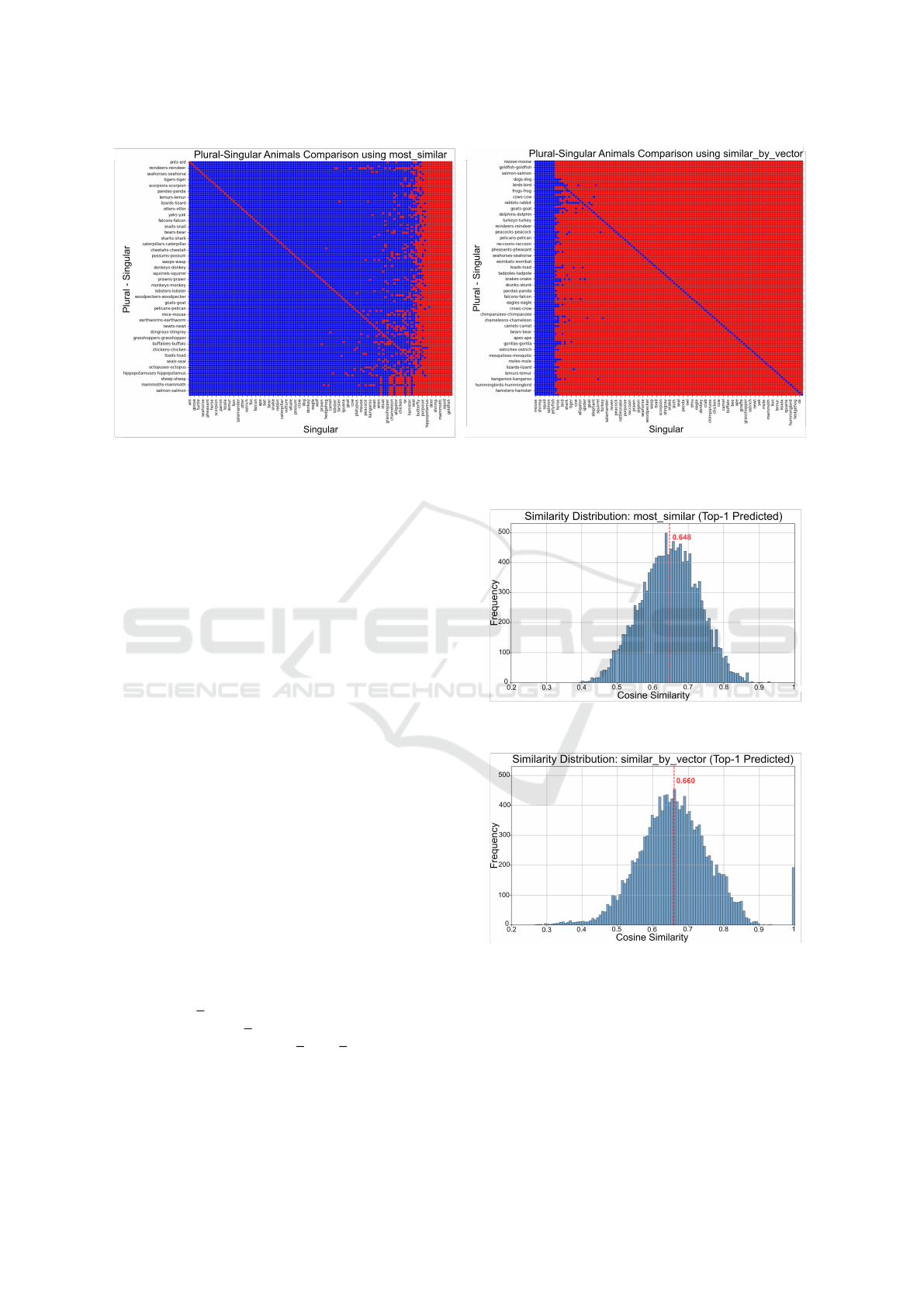
depth study of results. The heatmaps in Figure 4
presents the results of vector operations considering
word pairs of the category Plural Animals described
in Section 4.2: Figure 4a shows results for MostSim-
ilar; Figure 4b shows results for SimilarByVector.
Each heatmap must be read as follows.
• Vertical axis: Each point in the vertical axis cor-
responds to a word pair in the category; more pre-
cisely, it corresponds to a pair p
j
= (x
j
,y
j
); the
label on the axis is y
j
− x
j
.
• Horizontal axis: A point denotes a pair p
i
=
(x
i
,y
i
) in the same category, but the label is only
x
i
.
• Point (i, j). A point corresponds to the couple
of word pairs p
i
= (x
i
,y
i
) and p
j
= (x
j
,y
j
). The
point (or cell) denotes the operation
v
R
= v
y
j
− v
x
j
+ v
x
i
in such a way that the point is blue if R and y
i
coincides, otherwise the point is red.
As an example, given cats - cat on the vertical
axis and dog on the horizontal axis, the intersection
point denotes whether
cats - cat + dog
actually returned dogs (blue cell) or a different word
(red cell).
To improve interpretability, the columns are sorted
by retrieval success rate, and the rows are sorted ac-
cordingly. Thus, cells along the diagonal represents
vector operations such as
cats - cat + cat
Figure 4a shows results obtained using MostSimi-
lar. Notice that the heat map is mostly blue, due to the
high rate of correct results; indeed, this is a confirma-
tion of the retrieval rate of 83.14% reported in Table 1
for the analyzed category of “Plural Animals”.
Nonetheless, notice that the cells in the diagonal
are red: indeed, MostSimilar is not able to retrieve
the starting word when a pair is coupled with itself; it
should be
v
cats
− v
cat
+ v
cat
= v
cats
but MostSimilar does not return cats, because input
words are excluded from the potential results. This is
certainly an anomaly in the design of MostSimilar.
Similar issues arise with words like fish, whose sin-
gular and plural forms are identical. Since these tar-
gets match the input and are filtered out, their retrieval
is impossible with MostSimilar.
Figure 4b shows what happens when Similar-
ByVector is exploited. Recall that the main difference
is that input vectors are not excluded; consequently, it
is possible to expect that the cell on the diagonal are
blue. This can be observed in the heatmap.
However, it performs worse overall, as denoted by
the very large number of red cells. Indeed, this means
WEBIST 2025 - 21st International Conference on Web Information Systems and Technologies
454
(a) Heat map obtained using the operation MostSimilar. (b) Heat map obtained using the operation SimilarByVector.
Figure 4: Heat maps depicting the correctness obtained for the category “Plural Animals” of linguistic analogies.
that without excluding the input vectors, Similar-
ByVector returns the input vectors as results, mean-
ing that the input vectors are the closest to the query
vector (see Section 3).
Thus, it is possible to interpret the results as fol-
lows: the linguistic category “Plurals Animal” is
rather homogeneous, thus most vectors are in the
same region of space; in particular, vectors represent-
ing singular and plural of the same word are close
enough to each other, allowing MostSimilar to re-
trieve the correct one. However, they are not so close
to the query vector, which in most cases remains close
to the input vector(s), specifically v
x
j
. This is a clear
clue that vector-offset operations do not manage lin-
guistic analogies. The exclusion of input vectors per-
formed by MostSimilar is just an attempt to achieve
the desired result, not considering the intrinsic limi-
tation of the approach, i.e., vector offsets cannot rep-
resent something (linguistic analogies or semantic re-
lationships) that is outside the representational space
(i.e., words).
5.3 Distribution of Cosine Similarity
In order to further confirm the outcomes so far dis-
cussed, a third analysis was made. Specifically con-
sider both definitions of MostSimilar and Similar-
ByVector in Section 3. Step 2 obtains the normalized
query vector v
q
, which is later used in Step 3 to look
for the result vector v
R
. During all the experiments,
the cosine similarity between v
q
and v
R
was measured
and collected.
Figure 5 depicts the collected cosine similarities.
The charts were obtained as hereafter described.
(a) Cosine similarity distribution of the most similar pre-
dicted words using the MostSimilar method.
(b) Cosine similarity distribution of the most similar pre-
dicted words using the SimilarByVector method.
Figure 5: Target correctness matrices comparing singular
and plural animal terms.
• Similarity scores were grouped in intervals of
width 0.1.
• The horizontal axis reports the similarity scores.
Linguistic Analogies in Word Embeddings: Where Are They?
455

• The vertical axis reports the number of pairs
(v
q
,v
R
) whose similarity score falls in the inter-
val.
Figure 5a depicts the result for MostSimilar,
while Figure 5b depicts the results for SimilarByVec-
tor.
For the MostSimilar method, it can be observed
that the resulting vectors v
R
are not overly close to
the query vectors v
q
, as the average cosine similarity
is 0.646, and in rare cases it is close to 0.9. This corre-
sponds to an angle of about 49.8
◦
between v
q
and v
R
,
meaning that they are somehow far away each other,
they are not particularly close.
Figure 5b depicts the similarity scores for Simi-
larByVector. The reader can see that things do not
change so much: the shape is slightly translated to
the right, results in an average cosine similarity of
0.660. However, this still corresponds to an angle of
approximately 48.5
◦
, meaning that input vectors are
just slightly close to v
q
so as to be retrieved as results,
but they still remain distant. Furthermore, there are
195 similarity scores that are equal to 1, correspond-
ing to the points seen in the diagonal of Figure 4b plus
additional words whose singular and plural forms are
identical.
Therefore, the very high correctness obtained by
MostSimilar is apparent, in that it excludes the input
vectors that, in most cases, are the closest ones to the
query vector; consequently, it alters the search space
and often retrieves the desired word by chance.
In contrast, SimilarByVector, is mathematically
more adherent to the vector operations; as an effect, it
gets the vector that is actually the closest to the query
vector, which in most cases is not the wished one.
For the sake of space, the analysis is restricted
to the category of “Plural Animals” only. Nonethe-
less, similar results were obtained for the other cat-
egories reported in Table 1. In particular, it is pos-
sible to say that the above considerations are further
stressed when the correctness is lower. This confirms
that the representational space of Word Embedding is
not able to represent linguistic analogies and semantic
relationships in the form of vector-offset operations;
although the research tested only MostSimilar and
SimilarByVector, it can be expected that this is true
for any kind of vector-offset operation.
The fullresults of this experiment are available on
a GitHub repository
8
.
8
GitHub repository:
https://github.com/NLP-Studies-Group/NLP-Studies/
6 DISCUSSION
The results that were obtained by the investigation
methodology ask for a discussion.
Vector operations are not suitable. The results
show that linguistic analogies are not discovered by
the tested vector operations. Both MostSimilar and
SimilarByVector fail to obtain the expected results,
even from a statistical point of view. In fact, assum-
ing that they are somehow encoded within the word-
embedding model, an operation that is actually able
to deal with them should be very effective, with an
correctness that is very close to 1 (considering im-
precision in the training process). MostSimilar and
SimilarByVector certainly are not the wanted opera-
tion.
Lack of Soundness. The idea that linguistic analo-
gies and semantic relationships are encoded in the
word-embedding model is certainly fascinating, how-
ever, all examined previous studies lack formal
soundness. In other words, they move from the hy-
pothesis that linguistic analogies are encoded, thus try
to find out a way to let them emerge.
This approach is made evident by the exclusion of
input vectors in MostSimilar: vectors that represent
words that are somehow related to the same speech
context point to the same region of space; conse-
quently, since the difference between two very close
vectors is a small vector (e.g., trains - train), the
addition of a vector that points to a different region
(e.g., dog) obtains a resulting vector that is necessar-
ily very close to the last-added vector (e.g., dog); as
an effect, the last-added vector is very likely to be the
closest one to the normalized query vector.
In other words, it should not be expected that op-
erations that are able to actually deal with semantic
relationships (such as linguistic analogies) can be de-
fined (as vector-offset operations): the reason is that
there is no theoretical foundation that justifies the hy-
pothesis; consequently, it is not reasonable to expect
that they magically emerge.
Indeed, some research work tried to define a for-
mal framework for word-embedding models and re-
lated vector-offset operations for detecting linguis-
tic analogies, such as (Allen and Hospedales, 2019).
However, the result is a sufficient condition that is
likely not to be met; furthermore, all formulas are still
probabilistic and do not consider the actual definitions
of vector operations.
Universality of the relationships. Linguistic analo-
gies are “universal semantic relationships”: they ex-
press a concept that applies to all pairs of words for
which it makes sense, independently of the position
WEBIST 2025 - 21st International Conference on Web Information Systems and Technologies
456

of the vector pairs in the space. Differences of vectors
are not able to capture this universality, because vec-
tor pairs point to different regions of space. Consider,
for example, v
1
=trains - train and v
2
=dogs -
dog: v
1
and v
2
certainly point to two very different
directions, because the two pairs of input vectors cer-
tainly point to two different regions. However, both
v
1
and v
2
should represent the concept “plural of”, so
they are expected to be very very similar. The conclu-
sion is that it is not possible to expect that the univer-
sal concept of “plural of” could emerge by a vector
operator.
Outside the representational space. Definitely,
Word Embedding exploits a multi-dimensional space
to represent words in such a way that “positional re-
lationships” are encoded too, so as to be able to gen-
erate the n + 1 most likely word, given a sequence
of n words. Clearly, positional relationships de-
pends on syntactical relationships (that strongly de-
pends on the language); however, these syntactical
relationships are implicitly learned as positional re-
lationships. As an effect, if semantic relationships are
somehow within positional relationships it is because
words whose meanings are strongly related to a given
topic are often in the same speech context, i.e., they
often appear close by. As an effect, it is possible to
assume that words related to similar speech contexts
point to the same region.
Semantic relationships, such as linguistic analogies,
are something different. The analogy “person with
absolute power” does not correspond to any single
word in the vocabulary; thus, there is no vector that
represents it. It is true that words often represent con-
cepts, but it is also true that many concepts are not
represented by simple words.
Consequently, the concept “person with absolute
power” (as a representative of all complex concepts)
cannot be represented within the same representa-
tional space as a single word.
Effectiveness of Word Embedding. Nonetheless,
Word Embedding has been an incredible step towards
effective techniques for NLP. The reason is simple: it
effectively captures “positional relationships”, which
in turn are indirectly related to syntactical and seman-
tic relationships. This is actually the strength of Word
Embedding.
7 CONCLUSIONS
The motivation for this paper was the lasting belief
that word-embedding models actually encode linguis-
tic analogies and structured semantic relationships.
Consequently, the previous works that investi-
gated the existence of linguistic analogies within
word-embedding models were resumed, to reconsider
the problem from a novel perspective: the representa-
tional space and the way vector-offset operations are
defined are the focus of the contribution.
Indeed, after the discussion reported in Section 6,
it appears that vector-offset operations are not the
proper tool to manage structured semantic relation-
ships, because they work in the representational space
of words, i.e., they treat semantic relationships as
they were words; on the contrary, the training phase
considers only positional relationships and implicitly
encodes them within the representational space of a
word-embedding model, by construction.
Definitely, the results and the considerations that are
presented in this paper confirm what was suggested
by the work (Drozd et al., 2016):, which clearly states
that the essence of Word Embedding is as follows: “all
current distributional semantic approaches rely on the
same basic principle of using similarity between co-
occurrence frequency distributions as a way to infer
the strength of association between words”. Further-
more, the same work claims that “For many practical
purposes, such as information indexing and retrieval
and semantic clustering, these approaches work re-
markably well”. Indeed, since 2013, techniques for
Word Embedding have made possible an incredible
step forward for NLP.
As a future work, the experiments will be ex-
tended to models obtained with different and more
sophisticated techniques, such as BERT. Furthermore,
the authors plan to continue the investigation on the
theme. In particular, a good starting point could be to
move from considerations that were argued by (Etha-
yarajh, 2019), i.e., considering transformations in the
vector space, instead of vector-offset operations.
ACKNOWLEDGEMENTS
This study was funded by the European Union -
NextGenerationEU, in the framework of the GRINS -
Growing Resilient, INclusive and Sustainable project
(GRINS PE00000018 – CUP F83C22001720001).
The views and opinions expressed are solely those of
the authors and do not necessarily reflect those of the
European Union, nor can the European Union be held
responsible for them.
Linguistic Analogies in Word Embeddings: Where Are They?
457

REFERENCES
Allen, C. and Hospedales, T. (2019). Analogies explained:
Towards understanding word embeddings. In Interna-
tional Conference on Machine Learning, pages 223–
231. PMLR.
Bojanowski, P., Grave, E., Joulin, A., and Mikolov, T.
(2017). Enriching word vectors with subword infor-
mation. Transactions of the association for computa-
tional linguistics, 5:135–146.
Drozd, A., Gladkova, A., and Matsuoka, S. (2016). Word
embeddings, analogies, and machine learning: Be-
yond king-man+ woman= queen. In Proceedings
of coling 2016, the 26th international conference on
computational linguistics: Technical papers, pages
3519–3530.
Ethayarajh, K. (2019). Rotate king to get queen: Word rela-
tionships as orthogonal transformations in embedding
space. arXiv preprint arXiv:1909.00504.
Finley, G., Farmer, S., and Pakhomov, S. (2017). What
analogies reveal about word vectors and their com-
positionality. In Proceedings of the 6th joint confer-
ence on lexical and computational semantics (* SEM
2017), pages 1–11.
Garneau, N., Hartmann, M., Sandholm, A., Ruder, S.,
Vuli
´
c, I., and Søgaard, A. (2021). Analogy training
multilingual encoders. In Proceedings of the AAAI
conference on artificial intelligence, volume 35(14),
pages 12884–12892.
Gladkova, A., Drozd, A., and Matsuoka, S. (2016).
Analogy-based detection of morphological and se-
mantic relations with word embeddings: what works
and what doesn’t. In Proceedings of the NAACL Stu-
dent Research Workshop, pages 8–15.
Harris, Z. S. (1954). Distributional structure. WORD, 10(2-
3):146–162.
Jurgens, D., Mohammad, S., Turney, P., and Holyoak,
K. (2012). Semeval-2012 task 2: Measuring de-
grees of relational similarity. In * SEM 2012: The
First Joint Conference on Lexical and Computational
Semantics–Volume 1: Proceedings of the main confer-
ence and the shared task, and Volume 2: Proceedings
of the Sixth International Workshop on Semantic Eval-
uation (SemEval 2012), pages 356–364.
Levy, O. and Goldberg, Y. (2014). Linguistic regularities in
sparse and explicit word representations. In Proceed-
ings of the eighteenth conference on computational
natural language learning, pages 171–180.
Linzen, T. (2016). Issues in evaluating semantic spaces us-
ing word analogies. arXiv preprint arXiv:1606.07736.
Mandelbaum, A. and Shalev, A. (2016). Word embeddings
and their use in sentence classification tasks. arXiv
preprint arXiv:1610.08229.
Mikolov, T., Chen, K., Corrado, G., and Dean, J. (2013a).
Efficient estimation of word representations in vector
space. arXiv preprint arXiv:1301.3781.
Mikolov, T., Yih, W.-t., and Zweig, G. (2013b). Linguis-
tic regularities in continuous space word representa-
tions. In Vanderwende, L., Daum
´
e III, H., and Kirch-
hoff, K., editors, Proceedings of the 2013 Conference
of the North American Chapter of the Association for
Computational Linguistics: Human Language Tech-
nologies, pages 746–751, Atlanta, Georgia. Associa-
tion for Computational Linguistics.
Miller, G. A. (1995). Wordnet: a lexical database for en-
glish. Communications of the ACM, 38(11):39–41.
Pennington, J., Socher, R., and Manning, C. D. (2014).
Glove: Global vectors for word representation. In
Proceedings of the 2014 conference on empirical
methods in natural language processing (EMNLP),
pages 1532–1543.
ˇ
Reh
˚
u
ˇ
rek, R. and Sojka, P. (2010). Software Framework
for Topic Modelling with Large Corpora. In Proceed-
ings of the LREC 2010 Workshop on New Challenges
for NLP Frameworks, pages 45–50, Valletta, Malta.
ELRA. http://is.muni.cz/publication/884893/en.
Rogers, A., Drozd, A., and Li, B. (2017). The (too many)
problems of analogical reasoning with word vectors.
In Proceedings of the 6th joint conference on lexical
and computational semantics (* SEM 2017), pages
135–148.
Salton, G., Wong, A., and Yang, C. S. (1975). A vector
space model for automatic indexing. Communications
of the ACM, 18(11):613–620.
WEBIST 2025 - 21st International Conference on Web Information Systems and Technologies
458
