
Graph-Based Personalized Recommendation in Intelligent Educational
Platforms: A Case Study in Engineering Education
Sofia Merino Costa
1
, Rui Pinto
2 a
and Gil Gonc¸alves
2 b
1
Departamento Engenharia Inform
´
atica, Faculdade de Engenharia, Universidade do Porto, Porto, Portugal
2
SYSTEC-ARISE, Faculdade de Engenharia, Universidade do Porto, Porto, Portugal
Keywords:
Graph-Based Recommendation, Knowledge Management System, Education 5.0, Engineering Education.
Abstract:
The fragmentation of digital learning materials in engineering education makes it difficult for students to find
relevant content. This paper presents a graph-based recommender system integrated into an intelligent Knowl-
edge Management System (KMS) to support personalized learning. Using Neo4j, the system models users,
learning objects, and semantic relationships to generate contextualized recommendations across dashboard,
module, and Learning Path (LP) views. Its scoring mechanism combines semantic similarity, interaction his-
tory, and graph proximity to provide adaptive, explainable suggestions. A mixed-methods evaluation with
engineering students showed high alignment with user interests and positive perceptions of transparency and
personalization. The system effectively transitioned from fallback to tailored recommendations as user inter-
actions increased. Results highlight the potential of graph-based approaches to improve content relevance,
discovery, and learner engagement in web-based educational platforms, in line with Education 5.0 principles.
1 INTRODUCTION
Engineering students increasingly face the challenge
of navigating vast and complex digital learning
ecosystems. While abundant resources, such as lec-
ture notes, academic papers, and interactive tools, of-
fer rich learning opportunities, they also contribute
to information overload, making it difficult for learn-
ers to identify relevant, trustworthy, and pedagogi-
cally aligned content (Dalkir, 2017). Traditional plat-
forms often provide limited support for this discov-
ery process, relying on static listings, keyword-based
search, and non-personalized navigation (Kopeyev
et al., 2020).
To address this, there is growing interest in in-
tegrating intelligent features into web-based educa-
tional environments. Among these, recommender
systems offer promise by matching content to learn-
ers based on usage patterns, metadata, and learning
objectives (G. M. et al., 2024). However, their ap-
plication in education remains limited, particularly in
terms of explainability, semantic richness, and adapt-
ability to evolving learner needs (Sahu et al., 2024;
Liu et al., 2024a).
a
https://orcid.org/0000-0002-0345-1208
b
https://orcid.org/0000-0001-7757-7308
The main contributions of this paper are as fol-
lows:
• A graph-based recommendation approach for
an intelligent Knowledge Management System
(KMS), tailored for educational resource discov-
ery using Neo4j (Webber and Robinson, 2018) to
model learners, content, and pedagogical relation-
ships.
• Multi-context recommendation logic tailored to
user states (e.g., new, returning, active) and inter-
face views (dashboard, module, learning path).
• A mixed-methods evaluation combining precision
metrics and user feedback to assess recommenda-
tion quality and perceived usefulness.
• A discussion on how explainability and contextual
relevance foster learner trust and engagement in
alignment with Education 5.0.
The remainder of this paper is structured as fol-
lows: Section 2 reviews related work on educational
recommender systems and graph-based approaches.
Section 3 presents the system architecture and rec-
ommendation logic. Section 4 details the evaluation
methodology and results. Section 5 discusses the
findings, limitations, and implications. Finally, Sec-
tion 6 concludes the paper and outlines directions for
future work.
Costa, S. M., Pinto, R. and Gonçalves, G.
Graph-Based Personalized Recommendation in Intelligent Educational Platforms: A Case Study in Engineering Education.
DOI: 10.5220/0013830200003985
Paper published under CC license (CC BY-NC-ND 4.0)
In Proceedings of the 21st International Conference on Web Information Systems and Technologies (WEBIST 2025), pages 439-446
ISBN: 978-989-758-772-6; ISSN: 2184-3252
Proceedings Copyright © 2025 by SCITEPRESS – Science and Technology Publications, Lda.
439

2 RELATED WORK
Recommender systems are central to intelligent edu-
cational platforms, offering personalized content de-
livery and helping students navigate large volumes
of heterogeneous learning materials. In engineer-
ing education, this need is particularly acute, as stu-
dents must identify relevant resources across com-
plex, interdisciplinary domains, often without struc-
tured guidance (Urdaneta-Ponte et al., 2021).
Traditional recommendation techniques fall into
two main categories: collaborative filtering, which
identifies patterns based on user-item interactions,
and content-based filtering, which relies on seman-
tic features and metadata (Lops et al., 2011; Ricci
et al., 2011). While effective in domains such as
e-commerce, these approaches face limitations in
education due to sparse behavioral data, misalign-
ment with pedagogical goals, and the cold-start prob-
lem (Burke, 2002).
To address these challenges, hybrid systems have
emerged, combining collaborative and content-based
methods. A significant advancement is the use of
graph-based representations, where users, resources,
and educational concepts are modeled as intercon-
nected nodes. This structure enables semantic en-
richment, multi-hop reasoning, and explainable rec-
ommendations—essential features for transparency
and trust in learning environments (Markchom et al.,
2023).
Recent research reflects this shift toward graph-
enhanced educational recommenders. (Lu and Feng,
2024) combined graph convolutional networks with
user behavior modeling for dynamic adaptation. (Liu
et al., 2024b) used Neo4j to model user-resource rela-
tionships, integrating NLP to enhance semantic query
interpretation(Webber and Robinson, 2018). (Hu
et al., 2021) addressed information overload by fil-
tering resources based on rule-based matching and
user profiles. (Imamah et al., 2024) applied Ant
Colony Optimization to personalize Learning Paths
(LPs) based on difficulty and learner preferences.
Meanwhile, Skillify (Dhairya et al., 2024) integrated
generative AI features to recommend content based
on learner skill gaps.
These contributions highlight the pedagogical
value of recommender systems, particularly when en-
hanced by graph structures, semantic reasoning, and
adaptive logic. However, key limitations remain:
• Many systems struggle with cold-start scenarios
and sparse data.
• Few support multi-context recommendations
aligned with user state and platform usage.
• Explainability, though feasible via graph-based
logic, is underutilized.
• Alignment with Education 5.0 values—human-
centricity, personalization, and intelligent sup-
port—remains limited.
This work addresses these gaps by introducing a
modular graph-based recommender embedded in an
educational KMS for engineering students. The sys-
tem provides context-aware recommendations across
dashboard, module, and LP views, leveraging seman-
tic links for pedagogical relevance. Its graph-based
foundation also enables future enhancements in ex-
plainability, learner modeling, and adaptive reason-
ing, supporting Education 5.0 principles (Pinto et al.,
2023; Pinto et al., 2024).
3 SYSTEM DESIGN
The platform developed in this work serves as a pro-
totype for an intelligent KMS designed to enhance en-
gineering education. The system is composed of four
main components: I) a frontend interface for user in-
teraction; II) a backend server that handles applica-
tion logic, data management, and API communica-
tion; III) a data layer including a relational database
and a graph-based recommendation system; and IV)
external services such as a semantic search engine and
cloud storage. This modular architecture, as repre-
sented in Figure 1, ensures a seamless user experience
and provides scalability for future growth. Although
the system is not fully adaptive or self-learning, it in-
tegrates foundational intelligent features such as se-
mantic information retrieval and graph-based person-
alization, which represent an important step toward
creating more advanced, intelligent systems.
The recommendation system is a core compo-
nent of the broader intelligent knowledge manage-
ment platform tailored for engineering students. This
platform supports modular content organization, se-
mantic search, LPs, and personalized recommenda-
tions to guide students through relevant learning ma-
terials efficiently. To meet these objectives, the archi-
tecture adopts a hybrid multi-database backend, com-
bining PostgreSQL (Obe and Hsu, 2017) for relational
content and user management, Elasticsearch (Konda,
2024) for semantic retrieval, and Neo4j (Webber and
Robinson, 2018) (Community Edition) as a graph-
based recommendation engine. Unlike triple-store
Resource Description Frameworks (RDF), this ap-
proach was designed as a database model (rather than
a data exchange format), and easily handles multiple
relationships of the same type between the same two
nodes.
WEBIST 2025 - 21st International Conference on Web Information Systems and Technologies
440
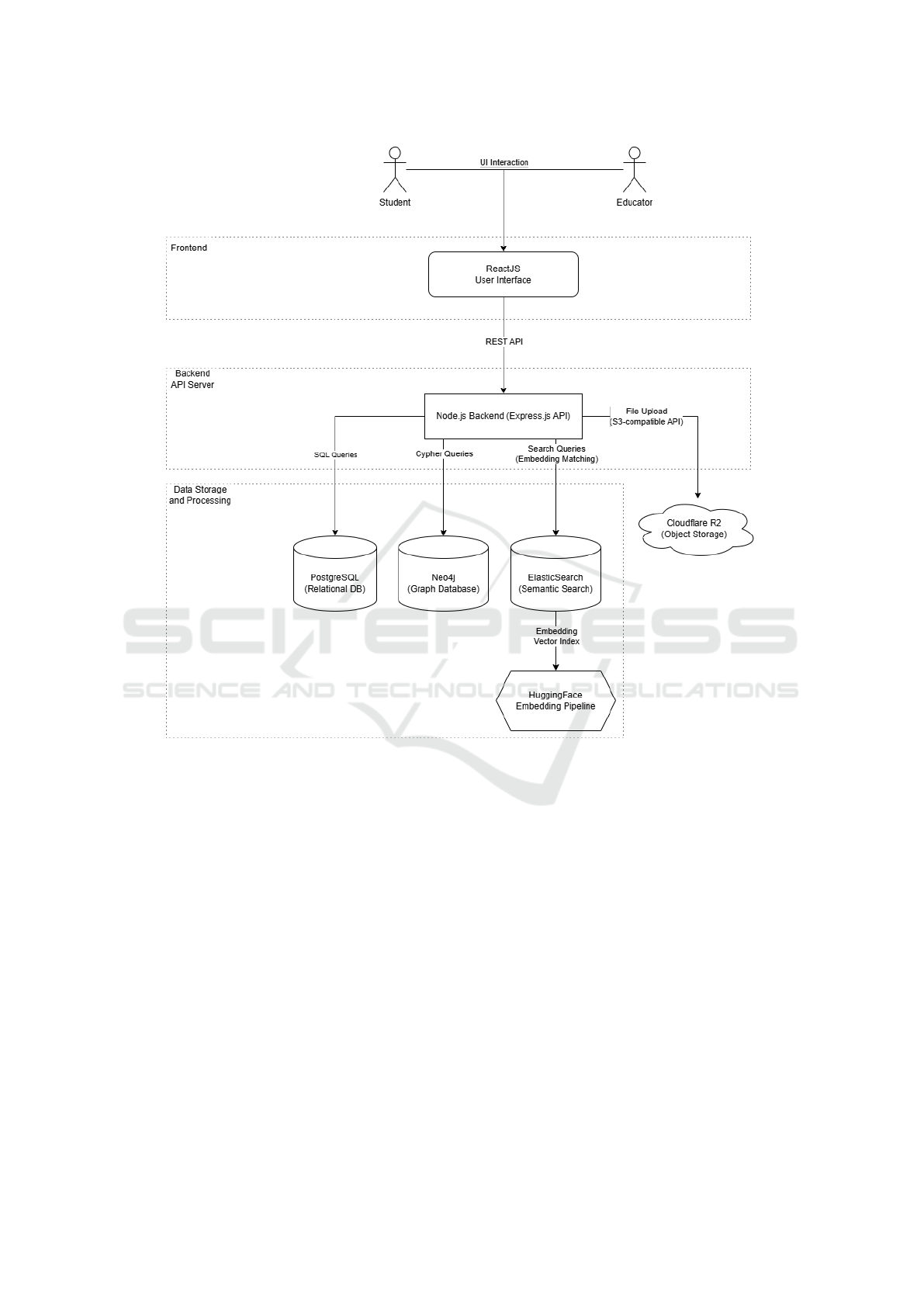
Figure 1: Component and Data Flow Diagram.
3.1 Data Model & Synchronization
The platform’s ability to support intelligent fea-
tures such as personalized recommendations, seman-
tic search, and adaptive LPs relies heavily on a ro-
bust and well-structured data model. The choice
to combine relational, search, and graph databases
stems from their complementary strengths. First,
PostgreSQL ensures reliable storage and transactional
consistency of structured data such as user profiles,
content metadata, and LP structures. Second, Elas-
ticsearch enables fast and flexible semantic search
across textual resource descriptions, supporting rich
query capabilities beyond keyword matching. Finally,
Neo4j, a property graph database, powers the rec-
ommendation engine by efficiently modeling com-
plex, evolving relationships between users, learning
resources, modules, and LPs, enabling context-aware
traversal queries that adapt to learner behaviors.
To integrate data from the relational backend into
the graph, a custom synchronization pipeline is im-
plemented via a Node.js script (Mardan et al., 2018).
This script extracts relevant entities and relationships
from PostgreSQL and incrementally populates the
Neo4j graph. It clears existing data and recreates
nodes for users, resources, modules, LPs, and clas-
sification nodes such as categories and tags, estab-
lishing their interconnections accordingly. User in-
teractions, such as resource views, module starts,
bookmarks, and completions, are stored relationally
and then represented as explicit Interaction nodes
in the graph, linked to the corresponding User and
Resource, Module, or LearningPath targets. This
design enables rich traversal patterns and weighted
personalization.
Graph-Based Personalized Recommendation in Intelligent Educational Platforms: A Case Study in Engineering Education
441
3.1.1 Neo4j Graph Schema
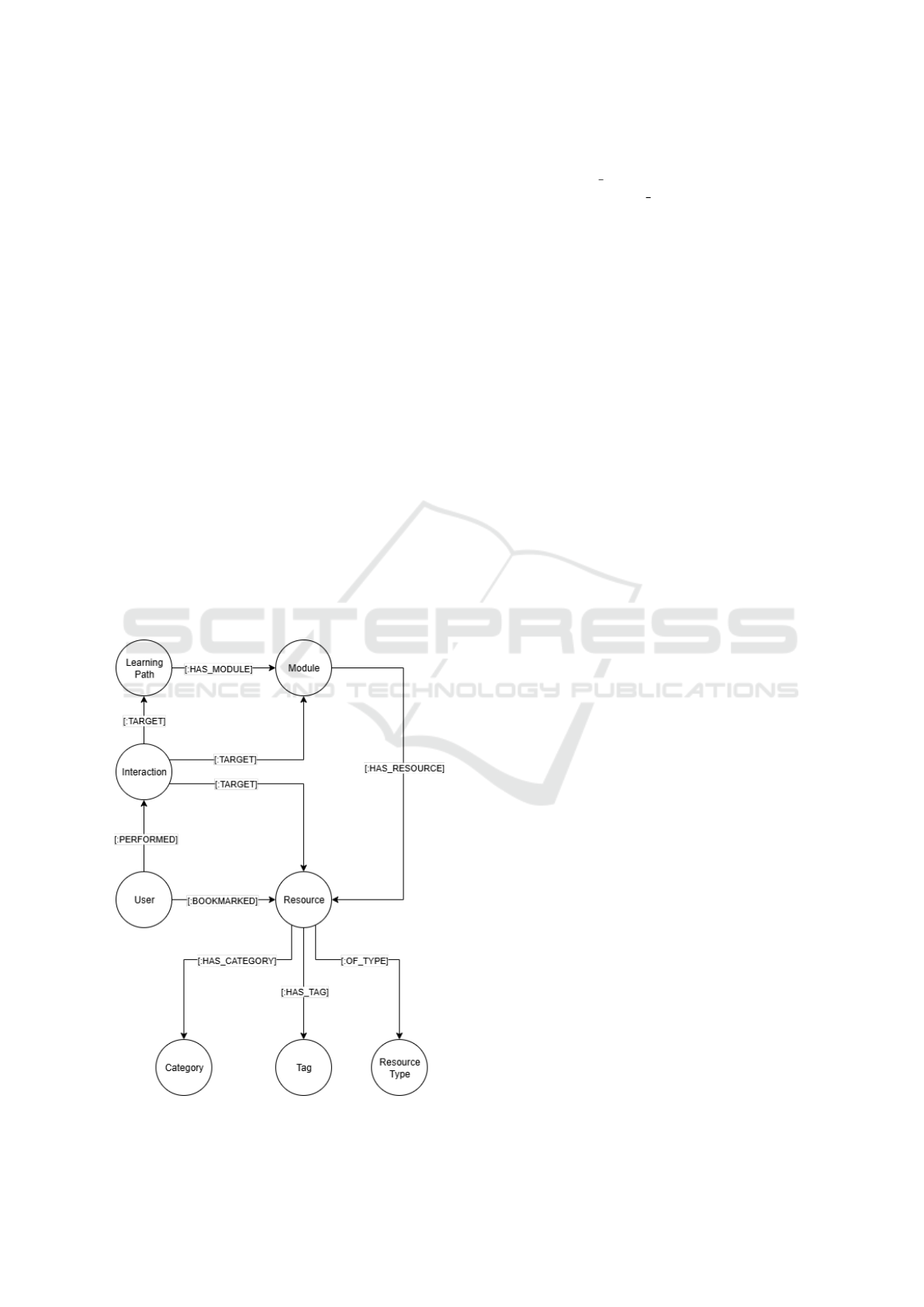
To support personalized recommendations, the plat-
form incorporates a graph-based model implemented
with Neo4j. This structure enables efficient traversal
of interconnected entities, including users, resources,
modules, and LPs, capturing complex relationships
not easily expressed in relational databases (Figure 2).
Key educational elements are modeled as nodes, such
as:
• User: Learners with profile attributes (e.g., ed-
ucation level, field of study, topic interests, pre-
ferred content types, language preferences).
• Resource: Learning materials enriched with
metadata such as categories, tags, type, title, and
description.
• Module: Groupings of related resources repre-
senting standalone instructional units.
• Learning Path: Ordered sequences of modules
guiding structured progression.
• Category, Tag, ResourceType: Classification
nodes supporting semantic connections.
• Interaction: User actions (e.g., view, start,
bookmark, complete) linked to targets, with
timestamps and weights.
Figure 2: Graph-based recommendation schema.
Relationships encode these connections, such as
(:Module)-[:HAS RESOURCE]->(:Resource) and
(:LearningPath)-[:HAS MODULE]->(:Module)
for content hierarchy, or
(:User)-[:PERFORMED]->(:Interaction)
and (:Interaction)-[:TARGET]->(:Resource)
for tracking user behavior. Each Interaction
node contains properties such as interaction type,
timestamp, and a computed weight.
The graph structure allows the system to per-
form personalized content recommendations based
on traversals of relationships such as shared tags,
co-interacted resources, or similar LPs. Cypher
queries (He et al., 2022) are used to retrieve relevant
content for each user based on both direct and indi-
rect connections, enabling a more contextualized and
intelligent experience.
3.2 Recommendation and Scoring Logic
The recommendation engine integrates three core
dimensions: Content Similarity (CS), Interaction
Weighting (IW), and Graph Proximity (GP). When a
learner interacts with a resource, module, or LP, the
system traverses the graph to identify candidate con-
tent and computes a final recommendation score using
a weighted sum, as represented in Equation 1:
Score = w
1
× CS +w
2
× IW +w
3
× GP (1)
The weights w
1
, w
2
, and w
3
are empirically tuned
to balance semantic, behavioral, and structural sig-
nals.
Content Similarity (CS) captures thematic close-
ness by comparing tags, categories, and meta-
data. The system employs the Sørensen–Dice coef-
ficient (Gragera and Suppakitpaisarn, 2016), imple-
mented via Neo4j’s Awesome Procedures on Cypher
(APOC) plugin (Shatnawi and Saquer, 2024), to com-
pute semantic similarity between resources.
Interaction Weighting (IW) reflects the pedagog-
ical significance and recency of user actions. Each
interaction type is assigned a base weight (w
base
), ad-
justed by a linear decay function that prioritizes recent
activity, as represented in Equation 2:
w
x
= w
base
× max(1, 10− DaysSinceInteraction) (2)
The interaction types and corresponding w
base
val-
ues are: 1 - Default (other interactions); 2 - Re-
source/module/LP views; 3 - Module/LP started; 4 -
Content bookmarked; 5 - Module completed; 6 - LP
completed.
This approach ensures that recent, pedagogically
meaningful actions have greater influence on recom-
mendations, while older actions still contribute with
diminished weight.
WEBIST 2025 - 21st International Conference on Web Information Systems and Technologies
442

Graph Proximity (GP) encodes the structural re-
lationship between users and content. Shorter path
lengths in the graph indicate stronger contextual rel-
evance, enabling the system to blend content-based
and collaborative filtering perspectives.
Together, these three dimensions enable the sys-
tem to deliver adaptive, context-aware, and explain-
able recommendations aligned with each learner’s
evolving profile and engagement history.
3.3 Recommendation Query
Formulation
The recommendation engine generates context-
specific suggestions using tailored Cypher queries ex-
ecuted on the underlying graph. These queries are
designed to balance personalization, semantic rele-
vance, and robustness to sparse data. Core elements
of the query formulation include:
• Interaction-Based Personalization: When
available, the engine prioritizes user interaction
history, excluding previously accessed content
and surfacing items aligned with past engagement
patterns and preferences.
• Profile-Driven Filtering: In the absence of in-
teraction data (e.g., cold-start), recommendations
are derived from explicit profile attributes such as
topic interests and preferred content formats.
• Semantic Matching: Queries incorporate tag
similarity, category alignment, and metadata com-
parisons to surface semantically related content
within the current context (e.g., a viewed module
or resource).
• Popularity Signals: Aggregate usage data across
the platform is used to highlight frequently ac-
cessed or highly rated content, improving diver-
sity and baseline relevance.
• Graph-Based Contextualization: The engine
exploits both direct and indirect relationships
within the graph—such as module-resource links
or shared attributes across LPs—to infer pedagog-
ical and thematic connections.
• Multi-Tier Fallbacks: A hierarchical fallback
strategy ensures continuity in recommendations,
progressing from personalized to profile-based
and finally to globally popular content as needed.
These dynamic query patterns leverage Neo4j’s
aggregation capabilities to compute ranked recom-
mendations across key platform views, including the
dashboard, resource detail pages, and LP modules.
3.4 Recommendation Contexts and
Pedagogical Impact
The recommendation engine operates across multiple
contexts within the platform, each aligned with a spe-
cific stage of the learner’s journey:
• Dashboard: Upon login, students receive person-
alized recommendations for resources, modules,
and LPs based on their profile, declared interests,
and recent interactions. This reduces the cogni-
tive load of content discovery and promotes re-
engagement.
• Resource View: When accessing a specific re-
source, the system suggests semantically related
materials, encouraging exploratory learning and
thematic deepening.
• Module View: Within a module, recommenda-
tions highlight complementary modules or LPs
that support conceptual progression and curricu-
lum continuity.
• Learning Path View: For learners navigating a
structured LP, the system offers reinforcing re-
sources and related modules to strengthen under-
standing and align with learning objectives.
Each context employs a tailored version of the
scoring logic, ensuring that recommendations are
both contextually relevant and pedagogically aligned.
4 EVALUATION
This section presents an evaluation of the intelligent
KMS developed in this work, with a focus on assess-
ing the performance of its personalized recommenda-
tions component. The evaluation was designed to re-
flect realistic usage within the context of engineering
education, by testing the system across all major con-
texts where recommendations appear within the plat-
form, as represented in Table 1.
Table 1: Recommendation contexts across the platform.
Context Description
Dashboard Personalized suggestions based
on profile and interaction data.
Resource Page Related resources and modules
extending the current topic.
Module Page Additional modules and LPs
supporting progression.
LP Page Resources that deepen knowl-
edge in active LPs.
Each context was tested under multiple user states,
namely: I) cold start, i.e., new user with no data
Graph-Based Personalized Recommendation in Intelligent Educational Platforms: A Case Study in Engineering Education
443
regarding preferences (content topics and type); II)
profile-based (static preferences selected by a new
or returning user); and III) personalized (interaction-
aware, after multiple interactions of a returning user),
to evaluate system behavior in both ideal and con-
strained conditions. These controlled conditions al-
lowed for consistent comparison of fallback and per-
sonalized recommendation strategies.
Ten participants, students from computer science
programs, completed a structured sequence of 3 tasks
designed to simulate the system’s intended use. Also,
the system wasn’t used in real courses. The tasks
are: I) Participants registered into the system, selected
their preferences, and configured their profiles. This
task was used to test the cold-start logic of the rec-
ommendation engine and capture profile-based per-
sonalization; II) The new users were asked to interact
with their personalized dashboard. They were encour-
aged to bookmark useful resources, interact with rec-
ommendations, and rate their relevance based on the
submitted preferences at sign-up. This task was used
to test the performance of the Neo4j-based graph rec-
ommendation system and assess the perceived qual-
ity of personalization; III) Participants selected one
of two LPs and completed its modules. Each module
included resources and an assessment to verify knowl-
edge gained.
The system was evaluated using the standard
quantitative metric Precision@k (P@k), which mea-
sures the proportion of relevant items among the top k
recommendations, calculated using Equation 3. This
metric was selected due to its widespread use and suit-
ability for top-k recommendation tasks. High preci-
sion indicates strong immediate relevance.
P@k =
# relevant items in top k
k
(3)
4.1 Results Summary
The following presents the system’s performance
across the different recommendation scenarios identi-
fied in Table 1. Metrics are reported for each context
to reflect how well the system adapts to different user
states and content configurations.
4.1.1 Dashboard
Table 2 shows the results for the dashboard context,
where user-level personalization is expected to be
most impactful. The system showed strong perfor-
mance in profile-based and personalized scenarios,
i.e., achieving a perfect P@k of 1.00. As expected, no
metrics are reported for cold start users, where fall-
back to popular items was applied instead of person-
alized ranking. These results demonstrate the value
of user modeling: when preferences or interaction
data are available, highly relevant recommendations
are consistently retrieved.
Table 2: Dashboard recommendation relevance by user
state.
State Fallback P@k
Cold Start Popular –
Profile-Based Preferences 1.00
Personalized N/A 1.00
4.1.2 Resource Page
Table 3 presents the results for module recommenda-
tions on resource pages.
Table 3: Resource page module recommendation results.
Resource Type P@k Fallback
With Module 1.00 No
Standalone 1.00 Yes
Even when fallback logic was needed (for stan-
dalone resources), the system maintained high rel-
evance, achieving perfect scores in both contexts.
These results suggest that the semantic similarity
logic and graph-based expansion strategies used for
recommending adjacent modules are effective even in
the absence of direct contextual anchors.
4.1.3 Module Page
Table 4 shows how well the system suggested LPs
when users viewed modules.
Table 4: Module page LP recommendation relevance.
Module Type P@k Fallback
With Path 1.00 No
Without Path 0.67 Yes
P@k dropped to 0.67 for standalone modules due
to fallback recommendations, highlighting some gaps
in topic alignment. These findings suggest a need for
improved fallback mechanisms in cases where mod-
ules are not yet connected to curated LPs.
4.1.4 Learning Path Page
Table 5 summarizes the relevance of resources rec-
ommended on LP pages. The three evaluated LPs
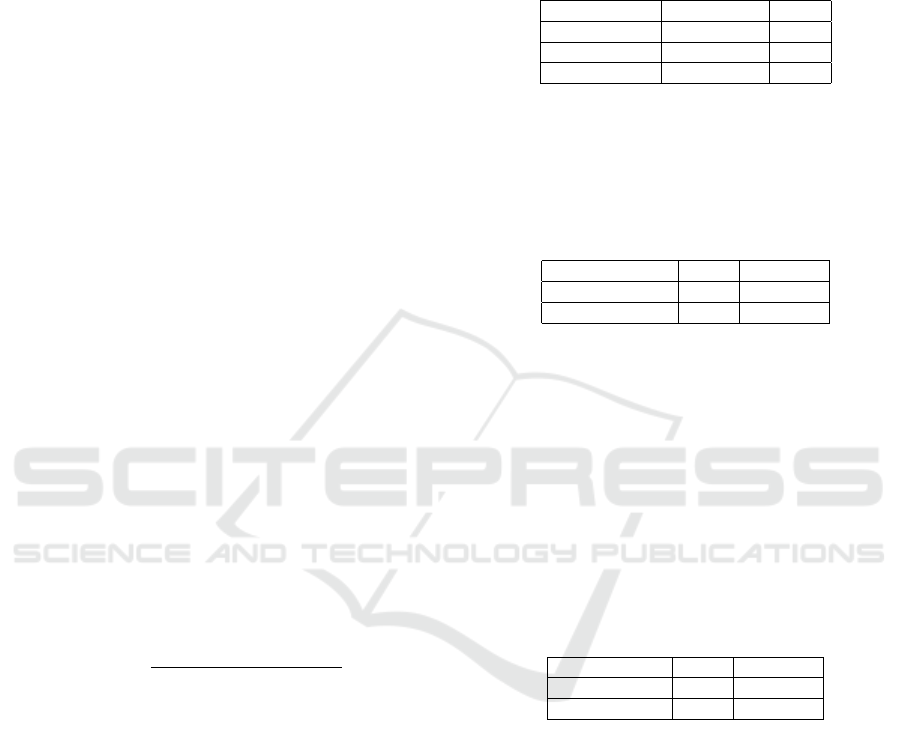
were: Introduction to Knowledge Management Sys-
tems (LP1), Getting Started with Arduino (LP2), and
Cyber-Physical Systems and Internet of Things (LP3).
While the system returned relevant items for all
LPs, performance varied considerably. Notably, LP1
and LP2 exhibited no unique recommendations, with
WEBIST 2025 - 21st International Conference on Web Information Systems and Technologies
444

Table 5: LP page resource recommendation results.
LP Items Unique Relevant P@k
LP1 6 0 3 0.50
LP2 6 0 2 0.33
LP3 6 2 4 0.67
multiple duplicate items across paths, resulting in
lower P@k scores of 0.50 and 0.33 respectively. In
contrast, LP3, which contained more distinct and
well-tagged content, achieved better diversity with
two unique recommendations and a higher P@k of
0.67. This variation indicates that while the system
can surface relevant content, there is room to improve
its ability to balance relevance and novelty, particu-
larly when multiple paths are thematically similar.
5 DISCUSSION
The evaluation highlighted both the strengths and
limitations of the recommendation system, showing
how performance is shaped by user context, interac-
tion history, and the structure of the underlying con-
tent graph. In personalized scenarios, particularly
the dashboard view, recommendations consistently
achieved perfect P@k scores when user profile data
and interaction history were available. This validates
the scoring strategy, which combines semantic sim-
ilarity, weighted user interactions, and graph prox-
imity to produce contextually relevant suggestions.
The graph-based design, together with scoring logic,
allowed dynamic adaptation to evolving user states,
transitioning smoothly from fallback suggestions to
personalized results. Users positively noted this pro-
gression, perceiving a clear improvement in recom-
mendation quality over the course of their session.
Despite these strengths, several limitations were
observed. In cold-start scenarios, fallback recommen-
dations relied on content popularity. While this en-
sured a baseline level of relevance, it often failed to
align with users’ specific interests. Additionally, in
the LP detail view, content overlap was observed be-
tween LPs that addressed different topics. This issue,
particularly between LP1 and LP2, with P@6 scores
of 0.50 and 0.33, reflected insufficient differentiation
in resource tagging and semantic descriptors. LP3,
featuring more distinctive and well-annotated content,
performed better (P@6 = 0.67), reinforcing the im-
portance of metadata richness.
These findings suggest that recommendation qual-
ity is not solely dependent on algorithmic logic, but
also on the breadth, granularity, and semantic qual-
ity of the content graph. Sparse metadata and limited
content variety constrain the system’s ability to gener-
ate diverse or specialized suggestions. Enhancing se-
mantic modeling—via knowledge graph embeddings
or NLP-based descriptors—could improve thematic
sensitivity and recommendation diversity. Moreover,
although the system’s graph structure inherently sup-
ports explainability, the lack of a user-facing explana-
tion layer limits its impact on trust and transparency,
which are critical in educational settings.
In summary, the system’s strong performance
in personalized contexts supports the validity of its
graph-based architecture and scoring logic. However,
the modest results under cold-start and semantically
sparse conditions point to areas for future work, in-
cluding improved metadata enrichment, integration of
explainable interfaces, and scalable strategies for ex-
panding and maintaining the content graph. These en-
hancements are key to deploying intelligent, learner-
centered recommendation systems in real-world edu-
cational environments.
6 CONCLUSION & FUTURE
WORK
This paper presented a graph-based recommender
system integrated into an intelligent KMS for en-
gineering education. Aligned with Education 5.0
principles, the system delivers personalized, context-
aware recommendations across multiple learning
views—including the dashboard, module pages, and
learning paths. Leveraging Neo4j to model users,
content, and semantic relationships, the system dy-
namically adapts to learner profiles and activity states,
using a hybrid scoring strategy to provide relevant
suggestions—even during early-stage interactions.
Evaluation results confirmed the system’s ef-
fectiveness in personalized contexts, validating the
multi-factor scoring logic that combines semantic
similarity, interaction history, and graph proximity.
Users experienced a clear progression from fallback
to personalized recommendations during sessions.
However, reduced performance in cold-start and se-
mantically sparse scenarios underscored the need for
richer metadata, broader content coverage, and en-
hanced similarity modeling.
This work contributes a practical, explainable,
and modular recommendation framework for educa-
tional platforms, balancing adaptability with integra-
tion flexibility. Future development will focus on ex-
panding the semantic layer, incorporating real-time
behavioral signals, and implementing visual explana-
tion features to enhance transparency, learner trust,
and long-term engagement in self-directed learning.
Graph-Based Personalized Recommendation in Intelligent Educational Platforms: A Case Study in Engineering Education
445

ACKNOWLEDGEMENTS
The authors gratefully acknowledge the support pro-
vided by the Foundation for Science and Technol-
ogy (FCT/MCTES) within the scope of the Associ-
ated Laboratory ARISE (LA/P/0112/2020), the R&D
Unit SYSTEC through Base (UIDB/00147/2020) and
Programmatic (UIDP/00147/2020) funds
REFERENCES
Burke, R. (2002). Hybrid recommender systems: Survey
and experiments. User modeling and user-adapted in-
teraction, 12(4):331–370.
Dalkir, K. (2017). Knowledge Management in Theory and
Practice. MIT Press, 3rd edition.
Dhairya, Hrishikesh, J., Sonu, G. P., Vaishnavi, D., Sana-
pala, S., and Pallavi, L. (2024). Skillify: En-
hanced Learning Management System Using Genera-
tive AI. In 2024 7th International Conference on Cir-
cuit Power and Computing Technologies (ICCPCT),
volume 1, pages 1527–1532.
G. M., D., Goudar, R. H., Kulkarni, A. A., Rathod, V. N.,
and Hukkeri, G. S. (2024). A digital recommendation
system for personalized learning to enhance online ed-
ucation: A review. IEEE Access, 12:34019–34041.
Gragera, A. and Suppakitpaisarn, V. (2016). Semimetric
properties of sørensen-dice and tversky indexes. In
Kaykobad, M. and Petreschi, R., editors, WALCOM:
Algorithms and Computation, pages 339–350, Cham.
Springer International Publishing.
He, Z., Yu, J., and Guo, B. (2022). Execution time predic-
tion for cypher queries in the neo4j database using a
learning approach. Symmetry, 14(1).
Hu, H., Ma, X., Pan, H., Zhang, H., and Gu, F. (2021). Re-
search on Intelligent Recommendation System Based
on Knowledge Management. In 2021 International
Conference on Intelligent Computing, Automation and
Applications (ICAA), pages 195–198.
Imamah, Laili Yuhana, U., Djunaidy, A., and Purnomo,
M. H. (2024). Development of Dynamic Personalized
Learning Paths Based on Knowledge Preferences and
the Ant Colony Algorithm. IEEE Access, 12:144193–
144207. Conference Name: IEEE Access.
Konda, M. (2024). Elasticsearch in action. Simon and
Schuster.
Kopeyev, Z., Mubarakov, A., Kultan, J., Aimicheva, G., and
Tuyakov, Y. (2020). Using a personalized learning
style and google classroom technology to bridge the
knowledge gap on computer science. International
Journal of Emerging Technologies in Learning (IJET),
15(2):218–229.
Liu, J., Luan, M., and Jiang, N. (2024a). Personalized aca-
demic communication recommendation system based
on knowledge graph. In 2024 5th International Con-
ference on Electronic Communication and Artificial
Intelligence (ICECAI), pages 610–614.
Liu, J., Luan, M., and Jiang, N. (2024b). Personalized
Academic Communication Recommendation System
Based on Knowledge Graph. In 2024 5th Interna-
tional Conference on Electronic Communication and
Artificial Intelligence (ICECAI), pages 610–614.
Lops, P., Gemmis, M. d., and Semeraro, G. (2011). Content-
based recommender systems: State of the art and
trends. In Recommender Systems Handbook, pages
73–105. Springer.
Lu, P. and Feng, X. (2024). Personalized Recommenda-
tion Algorithm in AI-Assisted Learning System. In
2024 6th International Conference on Communica-
tions, Information System and Computer Engineering
(CISCE), pages 1289–1294. ISSN: 2833-2423.
Mardan, A., Mardan, and Corrigan (2018). Practical Node.
js. Springer.
Markchom, T., Liang, H., and Ferryman, J. (2023). Re-
view of explainable graph-based recommender sys-
tems. ACM Computing Surveys.
Obe, R. O. and Hsu, L. S. (2017). PostgreSQL: up and run-
ning: a practical guide to the advanced open source
database. ” O’Reilly Media, Inc.”.
Pinto, R., Pinheiro, J., Gonc¸alves, G., and Ribeiro, A.
(2023). Towards industry 5.0: A capacitation ap-
proach for upskilling and technology transfer. In
Mehmood, R., Alves, V., Prac¸a, I., Wikarek, J., Parra-
Dom
´
ınguez, J., Loukanova, R., de Miguel, I., Pinto,
T., Nunes, R., and Ricca, M., editors, Distributed
Computing and Artificial Intelligence, Special Ses-
sions I, 20th International Conference, pages 342–
351, Cham. Springer Nature Switzerland.
Pinto, R.,
ˇ
Zilka, M., Zanoli, T., Kolesnikov, M. V., and
Gonc¸alves, G. (2024). Enabling professionals for in-
dustry 5.0: The self-made programme. In 5th Interna-
tional Conference on Industry 4.0 and Smart Manu-
facturing (ISM 2023), volume 232, pages 2911–2920.
Ricci, F., Rokach, L., and Shapira, B. (2011). Introduc-
tion to recommender systems handbook, pages 1–35.
Springer.
Sahu, S. S., Kumar, R., Sahoo, S., Kumar, B., and Mo-
hanta, P. (2024). Machine Learning-Enabled Inte-
grated Information Platform for Educational Univer-
sities, chapter 2, pages 29–47. John Wiley & Sons,
Ltd.
Shatnawi, H. and Saquer, J. (2024). Encoding feature mod-
els in neo4j graph database. In Proceedings of the
2024 ACM Southeast Conference, ACMSE ’24, page
157–166, New York, NY, USA. Association for Com-
puting Machinery.
Urdaneta-Ponte, M. C., Mendez-Zorrilla, A., and
Oleagordia-Ruiz, I. (2021). Recommendation
systems for education: Systematic review. Electron-
ics, 10(14).
Webber, J. and Robinson, I. (2018). A Programmatic Intro-
duction to Neo4j. Addison-Wesley Professional, 1st
edition.
WEBIST 2025 - 21st International Conference on Web Information Systems and Technologies
446
