Intelligent Knowledge Management for Enhancing Sustainable Food
Systems: The Case of Sweden
Azadeh Sarkheyli
a
School of Information Technology, Halmstad University, Halmstad, Sweden
Keywords: AI, Intelligent Knowledge Management, Sustainable Food System, Food Supply Chain,
Knowledge-Based Theory.
Abstract: Intelligent Knowledge Management (IKM) aims to establish intelligent integration of the food system to
capture, organize, analyze, and utilize information and knowledge that promotes sustainable food production.
With the growing importance of sustainable food systems, understanding consumer behavior, customer needs,
food preferences, producer demands, and local regulations is necessary. However, integration challenges
within the Swedish food system create significant obstacles. Inappropriate Knowledge Management systems,
system complexity, dynamic environments, inability to learn from and reuse data, information overload, and
insufficient data collection and analysis contribute to these challenges. This study uses a case study approach
and literature review to collect and analyze data. The proposed solution is an IKM conceptual model based
on the knowledge-based theory of the firm, leveraging AI-powered techniques to manage and analyze large
datasets from various stakeholders in the food supply chain. This model enhances forecasting and planning
capabilities, improving decision-making processes. Future research should further develop the IKM system
to achieve the potential results outlined in this paper.
1 INTRODUCTION
The modern food supply chain is complex and poses
significant challenges, particularly regarding
sustainability. It is essential to integrate and manage
knowledge within these systems to support
sustainable food production and consumption
(Touboulic & Walker, 2015; Mensah et al., 2024).
With the global population increasing and
environmental concerns becoming more prominent,
there is an urgent need for efficient and sustainable
food systems. This urgency is particularly evident in
Sweden, where sustainability is a top national
priority, and the food sector is essential to the
economy and society.
Intelligent Knowledge Management (IKM) seeks
to tackle these challenges by establishing a
comprehensive system that captures, organizes,
analyzes, and utilizes information and knowledge
throughout the food supply chain. By making use of
advanced technologies like Artificial Intelligence
(AI) and Machine Learning (ML), IKM systems can
offer actionable insights that improve decision-
a
https://orcid.org/0000-0002-5390-7509
making, streamline processes, and encourage
innovation (Mena et al., 2014; Jarrahi et al., 2023).
In Sweden, incorporating sustainable practices
into the food supply chain is met with significant
barriers, including the system's complexity,
constantly changing environments, information
overload, and inadequate data management (Garnett,
2013). These challenges underscore the need for a
robust IKM system to address these issues and
promote a more sustainable food system.
This paper suggests an IKM conceptual model
based on the Knowledge-Based Theory (KBT)
tailored to Sweden's sustainable food supply chain.
The model utilizes AI-powered techniques to manage
and analyze extensive datasets from various
stakeholders, thereby enhancing forecasting and
planning capabilities and improving decision-making
processes. Through a combination of a case study and
literature reviews, this research aims to demonstrate
the potential benefits of implementing such a system
and provide a roadmap for future sustainable food
system management developments.
514
Sarkheyli, A.
Intelligent Knowledge Management for Enhancing Sustainable Food Systems: The Case of Sweden.
DOI: 10.5220/0013817600004000
Paper published under CC license (CC BY-NC-ND 4.0)
In Proceedings of the 17th International Joint Conference on Knowledge Discovery, Knowledge Engineering and Knowledge Management (IC3K 2025) - Volume 2: KEOD and KMIS, pages
514-521
ISBN: 978-989-758-769-6; ISSN: 2184-3228
Proceedings Copyright © 2025 by SCITEPRESS – Science and Technology Publications, Lda.

The paper is structured as follows: Firstly, it
describes KBT and knowledge management for
sustainable food based on a thorough literature review
as the theoretical foundation. It then investigates the
description and analysis of sustainable food systems
in Sweden. Subsequently, it presents a goal and
conceptual models based on KBT and AI. Lastly, the
paper outlines future research and presents the
conclusion.
2 KNOWLEDGE-BASED
THEORY (KBT) OF THE FIRM
KBT posits that knowledge is the most strategically
significant resource of a firm. Unlike traditional
resources that can be easily replicated, knowledge's
unique, tacit, and complex nature provides a
sustainable competitive advantage (Grant, 1996).
This theory emphasizes the role of a firm's ability to
create, transfer, and utilize knowledge to achieve
superior performance.
According to KBT, firms exist because they are
better at integrating and coordinating knowledge than
markets (Kogut & Zander, 1992). Knowledge within
a firm is embedded in individuals and organizational
routines, processes, and cultures, making it difficult
for competitors to imitate (Nonaka & Takeuchi,
1995). This inimitability is a key source of
competitive advantage, as it allows firms to
differentiate themselves and protect their core
competencies.
The knowledge-based view also highlights the
importance of dynamic capabilities, which are the
firm's abilities to integrate, build, and reconfigure
internal and external competencies to address rapidly
changing environments (Teece et al., 1997). Firms
that continually innovate and adapt their knowledge
base are more likely to succeed in the long run.
Moreover, the theory suggests that firms should
invest in mechanisms to facilitate knowledge sharing
and creation. This includes fostering a collaborative
culture, implementing knowledge management
systems, and encouraging continuous learning and
development (Alavi & Leidner, 2001). Effective
knowledge management can improve decision-
making, innovation, and operational efficiency
(Heisig, 2024).
Critics of KBT argue that it may overemphasize
the role of knowledge and underappreciate other
critical resources, such as physical assets and
financial capital (Spender, 1996). Therefore, KBT has
been selected in this research, which has significantly
influenced strategic management literature and
practice, particularly in industries where knowledge
and innovation are paramount.
3 KNOWLEDGE MANAGEMENT
FOR SUSTAINABLE FOOD
SYSTEMS
Knowledge management is a strategic method that
systematically gathers, organizes, shares, and
analyzes knowledge within an organization (Heisig,
2024). It utilizes this knowledge to improve
performance, stimulate innovation, and accomplish
strategic objectives. Knowledge management can be
fundamental in sustainable food systems in tackling
the intricate challenges associated with sustainability,
efficiency, and resilience.
Knowledge management involves various
procedures and technologies crafted to tap into an
organization's expertise and information. These
procedures encompass knowledge generation,
storage, retrieval, and distribution. Efficient
knowledge management guarantees that valuable
information is accessible to the appropriate
individuals at the right time, facilitating informed
decision-making and continual improvement
(Nonaka & Takeuchi, 1995).
Knowledge management is essential for
integrating diverse data sources and stakeholder
viewpoints in sustainable food systems. This
integration is vital for comprehending and overseeing
food production, distribution, and consumption
dynamics. For example, knowledge management
systems can combine information from farmers,
suppliers, distributors, consumers, and regulators to
comprehensively view the food supply chain
(Garnett, 2013). Such a comprehensive perspective is
critical for pinpointing inefficiencies, minimizing
waste, and promoting sustainable practices.
Despite its potential benefits, implementing
knowledge management in sustainable food systems
presents several challenges. These include data silos,
resistance to change, absence of standardized
processes, and the necessity for cultural shifts
towards knowledge sharing (Davenport & Prusak,
1998). Overcoming these challenges necessitates a
strategic approach that involves strong leadership, a
clear knowledge management strategy, and ongoing
stakeholder training and support.
Incorporating advanced technologies like AI and
ML has significantly bolstered knowledge
management capabilities. These technologies enable
Intelligent Knowledge Management for Enhancing Sustainable Food Systems: The Case of Sweden
515

the analysis of large datasets, the identification of
patterns, and the generation of predictive insights. AI
and ML can automate the extraction of knowledge
from vast amounts of unstructured data, making it
easier to derive actionable insights (Becerra-
Fernandez & Sabherwal, 2014). For instance, AI-
powered knowledge management systems in the food
supply chain can forecast demand.
Knowledge management is a pivotal component
of sustainable food systems, offering tools and
frameworks to manage the complexity and dynamics
of the food supply chain. By leveraging advanced
technologies and fostering a culture of knowledge
sharing, knowledge management can substantially
contribute to sustainability goals. Future research and
practical applications should address implementation
challenges and further enhance knowledge
management capabilities to support the evolving
needs of sustainable food systems.
4 SUSTAINABLE FOOD
SYSTEMS IN SWEDEN
Sustainability is a top priority in Sweden's efforts to
promote environmental responsibility, economic
viability, and social well-being. In collaboration with
various stakeholders, the Swedish government has
introduced several initiatives to encourage
sustainability in the food industry. This part looks at
the main components, obstacles, and advancements in
sustainable food systems in Sweden.
Sweden has consistently prioritized sustainability,
as demonstrated by its national policies and
regulatory frameworks. The Swedish Food Strategy,
introduced in 2017, outlines the government's vision
for a sustainable food system that considers
ecological, economic, and social aspects. The strategy
emphasizes the importance of local food production,
reduced environmental impact, and improved food
security (Swedish Government, 2017).
In addition, Sweden's Environmental Objectives
system establishes specific targets for reducing
greenhouse gas emissions, enhancing biodiversity,
and minimizing the use of harmful chemicals in
agriculture. These goals are crucial for establishing a
sustainable food system that aligns with the
overarching objectives of the European Green Deal
(Naturvårdsverket, 2020).
Collaboration among various stakeholders,
including government agencies, farmers, food
producers, retailers, and consumers, is essential for
advancing sustainable food systems in Sweden.
Organizations such as the Swedish Board of
Agriculture (Jordbruksverket) and the Swedish
Environmental Protection Agency
(Naturvårdsverket) play pivotal roles in coordinating
efforts and supporting sustainable practices.
Furthermore, initiatives such as the "From Farm
to Fork" strategy underscore the significance of a
comprehensive approach involving all players in the
food supply chain. This strategy aims to establish a
more sustainable and resilient food system by
promoting sustainable farming practices, minimizing
food waste, and encouraging healthy and sustainable
diets (European Commission, 2020).
Technological innovation and research drive
sustainability in Sweden's food systems. Advances in
precision agriculture, biotechnology, and
digitalization have enabled more efficient and
sustainable farming practices. For example, using
drones and sensors for precision farming helps
optimize resource utilization, reduce environmental
impact, and enhance crop yields (Swedish University
of Agricultural Sciences, 2021).
Research institutions and universities in Sweden,
such as the Swedish University of Agricultural
Sciences (SLU), are actively involved in studying and
advocating for sustainable food production methods.
Their research contributes to developing new
technologies and practices that support sustainable
agriculture and food systems.
Despite significant progress, Sweden still faces
several challenges in establishing a sustainable food
system. These challenges include dealing with the
impact of climate change, finding the right balance
between productivity and sustainability, and ensuring
that everyone has fair access to sustainable food. The
integration challenges within Sweden's sustainable
food system have proven to be a significant obstacle.
One contributing factor to this challenge might be the
inappropriate Knowledge Management systems.
Other factors include the system's complexity and
large scale, dynamic environment, the inability to
learn from and reuse data, information overload, and
inadequate data collection and analysis. As a result, a
problem model (refer to Figure 1) has been developed
to illustrate the causes and effects of the identified
problems in Sweden's sustainable food system. These
identified problems also present opportunities for
innovation and enhancement. By continuing to invest
in research and development, fostering collaboration
among stakeholders, and implementing robust
policies, Sweden can further enhance the
sustainability of its food systems and serve as a model
for other countries.
KMIS 2025 - 17th International Conference on Knowledge Management and Information Systems
516
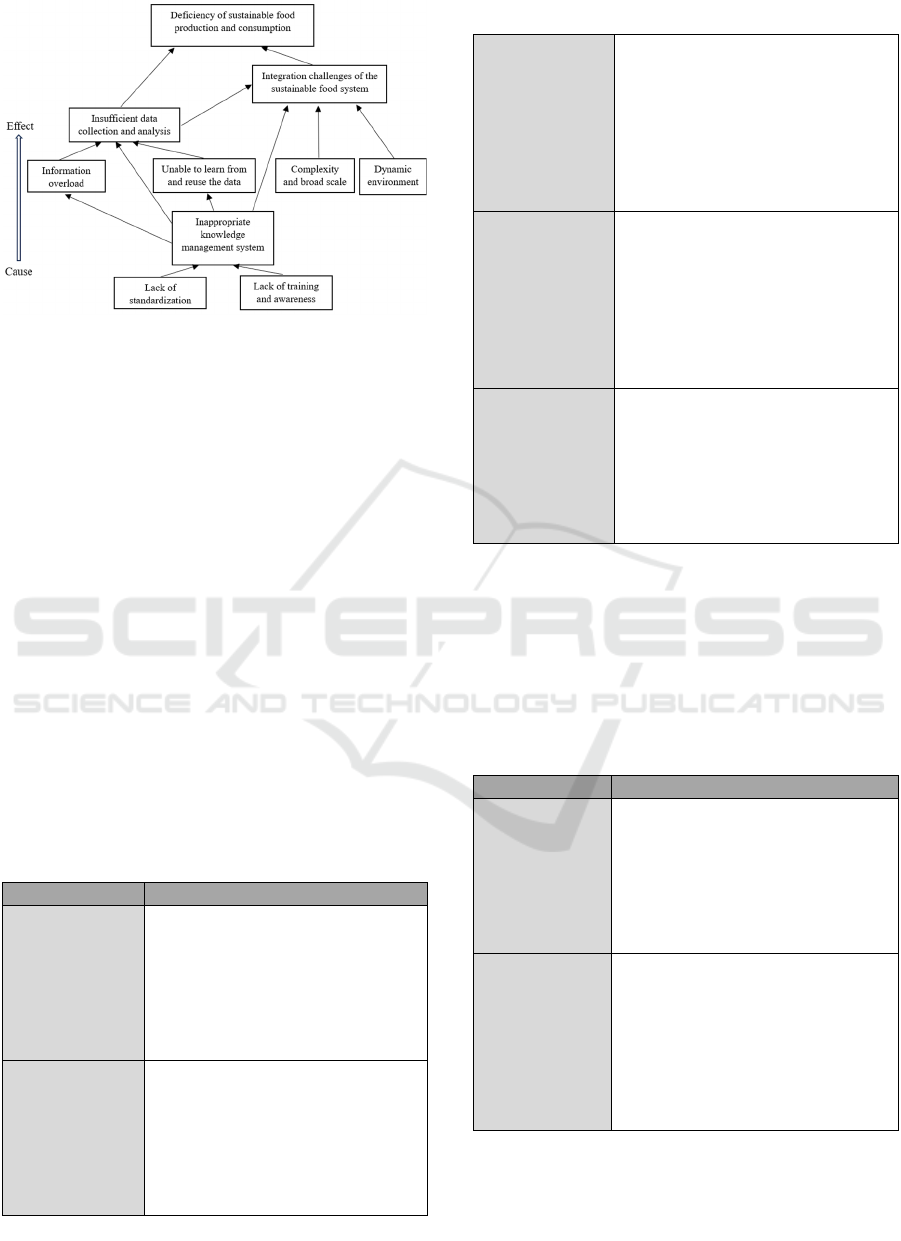
Figure 1: Problem model.
5 INTELLIGENT KNOWLEDGE
MANAGEMENT (IKM)
IKM represents a transformative approach to
managing the complex and dynamic information
flows within organizations and systems, particularly
in the context of sustainable food systems. IKM
integrates advanced technologies, such as AI, ML,
and big data analytics, to enhance the capabilities of
traditional knowledge management systems (Jarrahi
et al., 2023). This integration aims to improve
decision-making processes' efficiency, accuracy, and
effectiveness by leveraging vast amounts of data and
converting it into actionable insights. IKM builds on
the foundational principles of KM but significantly
extends its scope and capabilities through intelligent
technologies. The core components of IKM are
defined in Table 1.
Table 1: Key components of IKM.
KeyComponents Define
Data Collection
and Integration
IKM systems are designed to collect data
from various sources, including
databases, social media, sensors, and
transactional records. Integrating these
diverse data sources allows for a
comprehensive view of the system being
managed (Bhimani & Willcocks, 2014).
Data Analysis and
Interpretation
Advanced analytics and AI algorithms
are employed to analyze the collected
data. Machine learning techniques can
identify patterns, predict trends, and
provide insights that would be difficult or
impossible to detect using traditional
methods (Chen et al., 2012).
Table 1: Key components of IKM (cont.).
Knowledge
Creation and
Storage
The insights generated through data
analysis are transformed into knowledge
and then stored in a centralized
knowledge repository. This repository
ensures that knowledge is accessible to
all relevant stakeholders and can be
reused and updated as new data becomes
available (Nonaka & Takeuchi, 1995).
Knowledge
Sharing and
Utilization
IKM emphasizes the importance of
sharing knowledge across organizational
boundaries. Collaboration tools, digital
platforms, and communication channels
facilitate the dissemination of
knowledge, enabling stakeholders to
make informed decisions quickly and
effectively (Alavi & Leidner, 2001).
Continuous
Learning and
Adaptation
One of the key features of IKM is its
ability to learn from new data and adapt
to changing conditions continuously.
Feedback loops ensure that the system
evolves and improves over time,
enhancing its resilience and
responsiveness (Teece, 2007).
In the context of sustainable food systems, IKM
plays a crucial role in addressing the challenges
associated with food production, distribution, and
consumption. Applying IKM can lead to more
sustainable practices by optimizing resource use,
reducing waste, and improving supply chain
efficiency (refer to Table 2).
Table 2: Applications of IKM in Sustainable Food Systems.
Applications Define
Enhanced
Decision-Making
By providing real-time insights and
predictive analytics, IKM helps
stakeholders make better decisions
regarding crop selection, irrigation
scheduling, pest management, and supply
chain logistics (Kamilaris, Kartakoullis,
& Prenafeta-Boldú, 2017).
Sustainable
Practices
IKM supports adopting sustainable
practices by identifying areas where
resource use can be minimized and
environmental impacts can be reduced.
For example, AI-driven models can
optimize fertilizer application to reduce
runoff and improve soil health (Wolfert et
al., 2017).
Intelligent Knowledge Management for Enhancing Sustainable Food Systems: The Case of Sweden
517
T
able 2: Applications of IKM in Sustainable Food Systems
(cont.).
Improved
Collaboration
The knowledge-sharing capabilities of
IKM foster collaboration among farmers,
processors, distributors, and consumers.
This collaboration leads to more
integrated and efficient food systems that
respond better to market demands and
regulatory requirements (Verdouw,
Beulens, & Trienekens, 2013).
Consumer
Engagement
IKM enables better consumer
engagement by providing transparency
and traceability throughout the food
supply chain. Consumers can access
information about their food's origin,
quality, and sustainability, which can
influence their purchasing decisions and
promote sustainable consumption
(Kshetri, 2018).
IKM represents a significant advancement in how
organizations and systems manage information and
knowledge. By integrating advanced technologies
such as AI and ML, IKM enhances decision-making,
promotes sustainable practices, and fosters
collaboration across the food system. As
sustainability and resource management challenges
continue to grow, adopting IKM will be crucial in
creating resilient and efficient systems capable of
meeting the needs of a rapidly changing world.
6 IKM FOR SUSTAINABLE
FOOD SYSTEMS
According to the problem model of the previous
section, a goal model has been created to illustrate a
comprehensive framework aimed at achieving
improved sustainable food production and
consumption (refer to Figure 2). The model
integrates various components and processes,
highlighting the interplay between data collection,
ML, AI, and knowledge management. Below is a
detailed description of each component and its role
within the model.
- Improved Sustainable Food Production and
Consumption: This is the main goal of the model,
aiming to enhance the sustainability of food
production and consumption practices.
- Intelligent Integration of a Sustainable Food
System: This component focuses on creating a
cohesive and intelligent system that integrates
various sustainable practices across the food
production and consumption chain.
- Accurate Data Collection and Analysis: Accurate
and comprehensive data collection and analysis are
critical for informed decision-making. This
component ensures that all relevant data is gathered
and analyzed effectively to support sustainable
practices.
- Utilized Scenario Analysis and Knowledge
Management Using Adaptive AI-based Decision-
Making: This process involves using scenario
analysis and adaptive AI-based decision-making
tools to manage knowledge effectively. It ensures
that decision-making processes are adaptive and
informed by the latest data and scenarios.
- Utilized ML and Predictive Modeling: ML and
predictive modeling are employed to analyze
historical data and predict future trends and
outcomes. This helps in making proactive decisions
to enhance sustainability.
- Historical Data: Historical data provides a foundation
for analysis and modeling. It is utilized to understand
past trends and inform future strategies.
- Integration of AI: AI integration is critical for
automating processes and making intelligent
decisions. It supports various aspects of the model,
including data analysis, scenario planning, and
predictive modeling.
- Standardization: Standardization ensures that
processes and data are uniform across the system,
facilitating better integration and comparison.
- Training and Awareness: Continuous training and
awareness programs are necessary to ensure that all
stakeholders are informed about sustainable
practices and how to implement them effectively.
Furthermore, interconnections in the goal model
can be explained as follows:
- Data Collection and Analysis: Accurate data
collection and analysis feed into scenario analysis
and ML/predictive modeling.
- Scenario Analysis and ML: These processes use
historical data to create models and scenarios that
inform decision-making.
- Knowledge Management and AI Integration: AI-
based decision-making tools utilize scenario
analysis and ML insights to manage knowledge
dynamically.
- Standardization and Training: These support
systems ensure the framework operates smoothly
KMIS 2025 - 17th International Conference on Knowledge Management and Information Systems
518
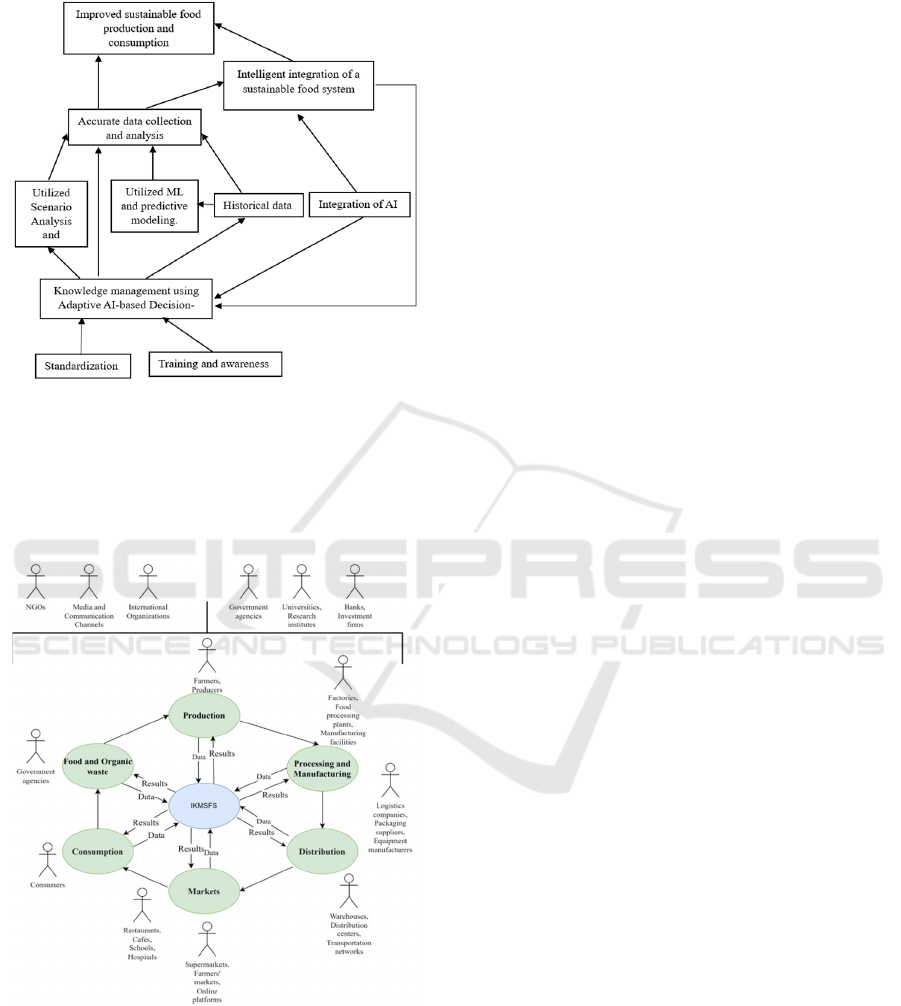
by maintaining consistency and enhancing
stakeholder capabilities.
Figure 2: Goal model.
Therefore, according to the problem and goal
model and KBT, a conceptual model has been
proposed (refer to Figure 3) to illustrate the
conceptual model of IKM for a sustainable food
system.
Figure 3: Conceptual model of IKM for the sustainable food
system.
The model demonstrates how IKM integrates
various sectors within the food system to enhance
sustainability. Below is a detailed description of the
key components and their interactions, as depicted in
Figure 3.
- IKM: It is the core of the model, which serves as the
central hub for the collection, analysis, and
dissemination of data, information, and knowledge
(DIK). IKM enables effective decision-making and
coordination across the entire food system.
- Production: This component includes farmers and
producers responsible for growing and supplying
raw agricultural products. IKM facilitates the flow
of DIK to and from the production sector, providing
insights and feedback (Results) that can improve
farming practices and sustainability.
- Processing and Manufacturing: This sector involves
factories, food processing plants, and
manufacturing facilities that transform raw
agricultural products into consumable goods. IKM
supports this sector by providing DIK that enhances
processing efficiency and product quality while
ensuring sustainability.
- Distribution: Distribution encompasses logistics
companies, packaging suppliers, and equipment
manufacturers responsible for moving goods from
production and processing facilities to markets.
Through IKM, distribution processes are optimized,
ensuring timely and efficient delivery of goods with
minimal environmental impact.
- Markets: This component includes supermarkets,
farmers' markets, and online platforms where
consumers can purchase food products. IKM helps
markets by providing DIK that informs supply
chain decisions, market trends, and consumer
preferences.
- Consumption: This sector comprises consumers
who purchase and consume food products. It also
includes institutions such as restaurants, cafes,
schools, and hospitals. IKM enables a better
understanding of consumption patterns and
promotes sustainable consumption practices by
disseminating relevant information and feedback.
- Food and Organic Waste: This component
addresses the management of food waste and
organic materials, involving recycling and waste
reduction efforts. IKM plays a crucial role in
managing waste by providing DIK with waste
reduction strategies, recycling processes, and the
circular economy.
Surrounding the central and primary components
are various external entities that interact with and
influence the sustainable food system:
- NGOs, Media, and Communication Channels: They
play a role in disseminating information, raising
awareness, and advocating for sustainable practices.
Intelligent Knowledge Management for Enhancing Sustainable Food Systems: The Case of Sweden
519

- International Organizations: These organizations
provide guidelines, support, and collaboration
opportunities for global sustainability efforts.
- Government Agencies: They regulate, support, and
implement policies that promote sustainability in
the food system.
- Universities and Research Institutes: These entities
contribute to the knowledge base by conducting
research and providing innovations.
- Banks and Investment Firms: Financial institutions
support sustainable practices through funding and
investments.
The bidirectional flow of DIK and Results marks
the interaction between IKM and each component.
This continuous exchange ensures that each sector
receives the necessary knowledge and feedback to
improve sustainability practices. The model
illustrates a holistic approach where all sectors and
external entities are interconnected, emphasizing the
importance of collaboration and knowledge sharing
in achieving a sustainable food system.
7 FURTHER RESEARCH
This research can present numerous avenues for
future research, particularly in Sweden. While this
study has laid the groundwork, several areas warrant
further investigation to deepen our understanding and
improve the implementation of IKM in sustainable
food systems, as described below.
Before designing the IKM system, conducting a
needs analysis based on the proposed models in this
paper is important. This should include examining the
problem, goal, and conceptual models. By doing so,
we can ensure that the system meets the requirements
of all stakeholders and explores various options. To
achieve better results, it may be beneficial to focus on
one or two counties in Sweden, such as Dalarna and
Halland, and then generalize the findings to the entire
country.
Future research should focus on longitudinal
studies that track the implementation of IKM in
Sweden's food system over extended periods. These
studies can provide valuable insights into the long-
term impacts of IKM on sustainability outcomes,
allowing researchers to identify trends, challenges,
and best practices that evolve. Longitudinal data will
critically assess the effectiveness and adaptability of
various IKM strategies to changing environmental
and economic conditions.
Comparative studies between Sweden and other
countries with similar or different food system
structures can yield significant findings. By
comparing the effectiveness of IKM in diverse
contexts, researchers can identify universal principles
and context-specific factors that influence the success
of IKM initiatives. This comparative approach can
help develop tailored strategies for cultural,
economic, and regulatory differences.
The rapid advancement of technologies such as
blockchain, the Internet of Things (IoT), and
advanced analytics offers new opportunities for
enhancing IKM. Future research should investigate
how these emerging technologies can be integrated
into IKM frameworks to improve data accuracy,
traceability, and decision-making processes. Pilot
projects and case studies exploring these technologies
can provide practical insights into their potential
benefits and limitations. Understanding the dynamics
of stakeholder engagement is necessary for
implementing IKM successfully.
Future studies should examine the roles and
perspectives of various stakeholders, including
farmers, processors, distributors, consumers, and
policymakers, in the IKM process. Research should
also explore effective collaboration models that foster
active participation and knowledge sharing among
stakeholders, leading to more inclusive and resilient
food systems. While environmental sustainability is a
primary focus, the economic and social impacts of
IKM on the food system should not be overlooked.
Future research should assess how IKM influences
the economic viability of food enterprises, job
creation, and social equity within the food system.
Understanding these impacts can help design policies
and interventions that promote holistic sustainability,
balancing ecological, economic, and social goals.
Research should focus on how policies affect the
adoption of IKM in food systems and identify ways
to improve them. Additionally, it should explore the
impact of knowledge dissemination on consumer
behavior and effective strategies to enhance
awareness of sustainable consumption.
8 CONCLUSIONS
IKM aims to integrate the food system intelligently to
promote sustainable food production. The Swedish
food system challenges include inappropriate
knowledge management systems, system complexity,
dynamic environments, and information overload.
The proposed IKM conceptual model, based on
KBT and leveraging AI-powered techniques, aims to
manage and analyze large datasets from various
stakeholders in the food supply chain. This model
KMIS 2025 - 17th International Conference on Knowledge Management and Information Systems
520

enhances forecasting, planning capabilities, and
decision-making processes, ultimately promoting
sustainable food production and consumption. The
model's holistic approach integrates intelligent
systems, AI, accurate data analysis, and continuous
learning to facilitate proactive decisions that enhance
sustainability. The model underscores the pivotal role
of IKM in integrating and optimizing various sectors
within the food system. Future research aims to
advance the understanding and application of
Intelligent Knowledge Management in enhancing
sustainable food systems. By addressing these areas,
researchers can contribute to developing adaptive and
inclusive food systems to meet the sustainability
challenges.
In conclusion, integrating IKM into the Swedish
food system has great potential for promoting
sustainability. With advanced technologies, the
proposed IKM model can facilitate informed
decision-making and efficient management across the
food supply chain.
REFERENCES
Alavi, M., & Leidner, D. E. (2001). Knowledge
management and knowledge management systems:
Conceptual foundations and research issues. MIS
Quarterly, 107-136.
Becerra-Fernandez, I., & Sabherwal, R. (2014). Knowledge
Management: Systems and Processes. Routledge.
Bhimani, A., & Willcocks, L. (2014). Digitisation, ‘Big
Data’ and the transformation of accounting
information. Accounting and Business Research, 44(4),
469-490.
Chen, H., Chiang, R. H., & Storey, V. C. (2012). Business
intelligence and analytics: From big data to big impact.
MIS Quarterly, 36(4), 1165-1188.
Davenport, T. H., & Prusak, L. (1998). Working
Knowledge: How Organizations Manage What They
Know. Harvard Business School Press.
European Commission. (2020). From Farm to Fork
Strategy.
Garnett, T. (2013). Food sustainability: problems,
perspectives and solutions. Proceedings of the nutrition
society, 72(1), 29-39.
Grant, R. M. (1996). Toward a knowledge-based theory of
the firm. Strategic Management Journal, 17(S2), 109-
122.
Heisig, P. (2024). Knowledge management. In Handbook
On Information Sciences (pp. 229-255). Edward Elgar
Publishing.
Jarrahi, M. H., Askay, D., Eshraghi, A., & Smith, P. (2023).
Artificial intelligence and knowledge management: A
partnership between human and AI. Business Horizons,
66(1), 87-99.
Kamilaris, A., Kartakoullis, A., & Prenafeta-Boldú, F. X.
(2017). A review on the practice of big data analysis in
agriculture. Computers and Electronics in Agriculture,
143, 23-37.
Kogut, B., & Zander, U. (1992). Knowledge of the firm,
combinative capabilities, and the replication of
technology. Organization Science, 3(3), 383-397.
Kshetri, N. (2018). 1 Blockchain’s roles in meeting key
supply chain management objectives. International
Journal of Information Management, 39, 80-89.
Mena, C., Terry, L. A., Williams, A., & Ellram, L. (2014).
Causes of waste across multi-tier supply networks:
Cases in the UK food sector. International Journal of
Production Economics, 152, 144-158.
Mensah, K., Wieck, C., & Rudloff, B. (2024). Sustainable
food consumption and Sustainable Development Goal
12: Conceptual challenges for monitoring and
implementation. Sustainable Development, 32(1),
1109-1119.
Naturvårdsverket. (2020). Sweden's Environmental
Objectives.
Nonaka, I., & Takeuchi, H. (1995). The Knowledge-
Creating Company: How Japanese Companies Create
the Dynamics of Innovation. Oxford University Press.
Spender, J. C. (1996). Making knowledge the basis of a
dynamic theory of the firm. Strategic Management
Journal, 17(S2), 45-62.
Swedish Government. (2017). The Swedish Food Strategy.
https://www.government.se/contentassets/16ef73aaa6f
74faab86ade5ef239b659/livsmedelsstrategin_kortversi
on_eng.pdf
Swedish University of Agricultural Sciences. (2021).
Research on Sustainable Food Systems.
Teece, D. J., Pisano, G., & Shuen, A. (1997). Dynamic
capabilities and strategic management. Strategic
Management Journal, 18(7), 509-533.
Teece, D. J. (2007). Explicating dynamic capabilities: The
nature and microfoundations of (sustainable) enterprise
performance. Strategic Management Journal, 28(13),
1319-1350.
Touboulic, A., & Walker, H. (2015). Theories in
sustainable supply chain management: a structured
literature review. International journal of physical
distribution & logistics management, 45(1/2), 16-42.
Verdouw, C. N., Beulens, A. J., & Trienekens, J. H. (2010).
Towards dynamic reference information models:
Readiness for ICT mass customisation. Computers in
Industry, 64(6), 525-538.
Wolfert, S., Ge, L., Verdouw, C., & Bogaardt, M. J. (2017).
Big data in smart farming–a review. Agricultural
Systems, 153, 69-80.
Intelligent Knowledge Management for Enhancing Sustainable Food Systems: The Case of Sweden
521
