
Fuzzy-Weighted Sentiment Recognition for
Educational Text-Based Interactions
Christos Troussas
a
, Christos Papakostas
b
, Akrivi Krouska
c
, Phivos Mylonas
d
and Cleo Sgouropoulou
e
Department of Informatics and Computer Engineering, University of West Attica, Egaleo, Greece
Keywords: Fuzzy Sentiment Analysis, Educational Natural Language Processing, Affective Computing in Learning,
Interpretability in AI, Student Feedback Mining.
Abstract: In web-based educational environments, students often express complex emotional states – such as confusion,
frustration, or engagement – through reflective texts, forum posts, and peer interactions. Traditional sentiment
analysis tools struggle to capture these subtle, mixed signals due to their reliance on rigid classification
schemes and lack of domain sensitivity. To address this, we propose a fuzzy-weighted sentiment recognition
framework designed specifically for educational text-based interactions. The system combines an augmented
sentiment lexicon, rule-based modifier detection, and semantic similarity using pretrained Sentence-BERT
embeddings to extract nuanced sentiment signals. These inputs are interpreted by a Mamdani-type fuzzy
inference engine, producing a continuous sentiment score and a confidence weight that reflect both the
strength and reliability of the learner’s affective state. The paper details the linguistic pipeline, fuzzy
membership functions, inference rules, and aggregation strategies that enable interpretable and adaptive
sentiment modeling. Evaluation on a corpus of 1125 annotated student texts from a university programming
course shows that the proposed system outperforms both lexicon-based and deep learning baselines in
accuracy, robustness, and interpretability, demonstrating its value for affect-aware educational applications.
1 INTRODUCTION
In the context of distance learning, student
communication is increasingly taking place via
textual media, including discussion boards, reflective
questions, peer review, and open-ended tests. These
text-based discussions provide much insight into
students' thinking, engagement, and affect (Yuvaraj et
al., 2025). Yet, despite their value for instruction,
these texts are not necessarily examined, and
indicators of frustration, satisfaction, confusion, or
motivation may not be noticed (Johansen et al., 2025;
Troussas et al., 2019).
Instructors are frequently unaware of emotional
undercurrents that could signal disengagement,
conceptual difficulty, or misunderstanding –
especially in asynchronous or large-scale settings
a
https://orcid.org/0000-0002-9604-2015
b
https://orcid.org/0000-0002-5157-347X
c
https://orcid.org/0000-0002-8620-5255
d
https://orcid.org/0000-0002-6916-3129
e
https://orcid.org/0000-0001-8173-2622
where personal attention is limited.
Sentiment analysis has emerged as a promising
tool for augmenting educational platforms with
affect-sensitive capabilities (Grimalt-Álvaro & Usart,
2024; Kardaras et al., 2024; Tasoulas et al., 2024). By
identifying emotional cues in student language,
sentiment models can help build responsive,
personalized systems that adjust instructional
strategies based on learner affect (Benazer et al.,
2024). However, the majority of existing sentiment
analysis methods rely on categorical labels, such as
positive, negative, or neutral, and apply either
lexicon-based heuristics or supervised classifiers
trained on general-purpose corpora (Alahmadi et al.,
2025). These approaches suffer from several
limitations in the educational domain: they struggle
with the ambiguity and nuance of student discourse,
420
Troussas, C., Papakostas, C., Krouska, A. and Mylonas, P.
Fuzzy-Weighted Sentiment Recognition for Educational Text-Based Interactions.
DOI: 10.5220/0013794200003985
Paper published under CC license (CC BY-NC-ND 4.0)
In Proceedings of the 21st International Conference on Web Information Systems and Technologies (WEBIST 2025), pages 420-428
ISBN: 978-989-758-772-6; ISSN: 2184-3252
Proceedings Copyright © 2025 by SCITEPRESS – Science and Technology Publications, Lda.

lack interpretability, and often fail to provide
actionable or trustworthy outputs for teachers or
adaptive systems (van der Veen & Bleich, 2025).
Educational texts are not simple declarations of
opinion (Ahmed et al., 2022). A single message may
blend curiosity with uncertainty (“I’m not sure I got
the logic right”), or hesitation with emerging
confidence (“This recursion thing is starting to make
sense”). The emotional expressions are often subtle,
hedged, and domain-specific, particularly in STEM
education where phrases like “I failed the test case”
or “finally compiled successfully” carry implicit
affect. In such contexts, standard sentiment tools tend
to misclassify, overgeneralize, or ignore important
cues (Hafner et al., 2025). Furthermore, educators
require more than just a sentiment label – they need
to know how strong that sentiment is, how reliable the
estimate is, and how to interpret it in light of
instructional goals.
To address these challenges, this paper proposes a
fuzzy-weighted sentiment recognition framework
tailored specifically for educational text-based
interactions. Unlike traditional models that make
binary or ternary decisions, our system employs fuzzy
logic to model sentiment as a continuous and
interpretable construct. It assigns each student
utterance a sentiment score on a real-valued scale
[−1,+1] along with a confidence weight [0,1]
reflecting both the polarity and the degree of
certainty. This approach allows the system to capture
the vagueness and variability inherent in learner
expression, while maintaining pedagogical
interpretability and technical robustness.
The model we use is grounded in real data
gathered from a university-level Java programming
course offered through an online learning
environment. The analysis includes students’ forum
posts, their weekly reflections, and feedback gathered
at the end of the course, using a hybrid analytical
pipeline that leverages linguistic preprocessing,
domain-specific sentiment lexicons, contextual
embeddings, and a Mamdani-type fuzzy inference
engine. By combining domain-specific knowledge
with fuzzy reasoning methods, our goal is to bridge
affective computing with real-world applications in
education.
The contributions of this paper are threefold. First,
we introduce a novel fuzzy-weighted sentiment
analysis model designed for the educational domain,
which combines symbolic interpretability with
context-aware computation. Second, we develop a
domain-specific sentiment lexicon enriched with
intensity and confidence metadata, adapted to student
language in technical learning contexts. Third, we
evaluate our approach on a curated dataset of
annotated educational texts, comparing it against both
classical and deep learning sentiment baselines. Our
results show that the proposed system not only
achieves competitive performance but also produces
more nuanced, trustworthy outputs that can support
adaptive learning and instructor awareness.
The remainder of the paper is structured as
follows. Section 2 reviews prior work in sentiment
analysis, particularly in educational contexts. Section
3 outlines the challenges and motivations for
modeling sentiment in student-generated content.
Section 4 presents the architecture and logic of the
fuzzy-weighted sentiment framework. Section 5
describes experimental setup, and analyzes the
results. Finally, Section 6 concludes with reflections
and directions for future research.
2 RELATED WORK
Sentiment analysis assists us in grasping information
on the web and the way individuals utilize language.
It comes in handy in fields such as obtaining customer
opinions, social media monitoring, and websites that
provide suggestions. Sentiment analysis is also
gaining popularity in the field of education for
monitoring students' moods, comprehending their
emotions, and assisting with personal learning.
Nevertheless, technology currently is often not
effective when dealing with complicated matters,
ambiguous meanings, and context in educational
debates.
Initially, sentiment analysis techniques
predominantly employed rules and word lists such as
SentiWordNet, AFINN, and VADER (Hutto &
Gilbert, 2014). These provide fixed scores to words
or phrases. These are robust and require minimal
training data, but they are not contextual, do not
handle negation, and do not handle varying uses of
language in different domains. In addition, methods
that employ lexicon lists tend to miss nuanced or
blended feelings. This is usually observed in school
when students express frustration and improvement
in a single sentence.
With the rise of machine learning, supervised
classifiers such as Naïve Bayes, Support Vector
Machines (SVM), and Random Forests were
introduced for sentiment analysis, offering improved
generalization and adaptability to specific domains
(Pang & Lee, 2008). More recently, deep learning
models – particularly Recurrent Neural Networks
(RNNs), Convolutional Neural Networks (CNNs),
and Transformer-based architectures such as BERT –
Fuzzy-Weighted Sentiment Recognition for Educational Text-Based Interactions
421

have achieved state-of-the-art performance in
sentiment classification tasks across multiple
languages and datasets (Devlin et al., 2019; Liu et al.,
2019). These models learn contextual embeddings
and capture long-range dependencies, allowing them
to outperform traditional methods in complex textual
environments. However, they typically require large
annotated corpora, lack transparency, and offer
limited pedagogical interpretability—factors that
pose challenges for adoption in educational
applications.
In education, sentiment analysis has been applied
to examine students' comments (Altrabsheh et al.,
2014), discussion boards (Yang et al., 2013), and
intelligent tutoring systems (Litman & Forbes-Riley,
2006) to monitor happiness, detect frustration, or
forecast whether students will drop out. For instance,
(Wen et al., 2014) employed sentiment trends to
examine how engaged students are in MOOCs,
whereas (D’mello & Graesser, 2013)examined
emotion detection in self-directed learning with both
vocal and non-vocal cues. Although the findings are
promising, the majority of these approaches
employed general classifiers or universal sentiment
lexicons, which tend to misinterpret some words,
formal terms, or ambiguous expressions that students
employ.
More importantly, few educational sentiment
systems provide confidence-aware outputs or allow
for soft classification of mixed emotional signals.
Instructors and adaptive systems benefit more from
interpretable and graded sentiment indicators than
from rigid class assignments, especially in high-
stakes or sensitive contexts such as student confusion
or demotivation. This highlights the need for
frameworks that not only classify sentiment but also
represent its strength, fuzziness, and reliability.
Fuzzy logic provides a compelling foundation for
addressing these limitations. Rooted in the theory of
approximate reasoning, fuzzy systems allow for the
representation of vague, uncertain, or overlapping
categories – such as “slightly negative” or
“moderately positive” – that align more closely with
human intuition. In sentiment analysis, fuzzy
approaches have been used to assign degrees of
polarity to opinions (Subasic & Huettner, 2001),
model emotional intensities in product reviews
(Taboada et al., 2011), and handle ambiguous
expressions in healthcare forums (Jadhav et al.,
2024). These models typically use fuzzy inference
rules, linguistic variables, and membership functions
to map input features (e.g., word polarity, modifier
strength) to output sentiment values on a continuous
scale.
Several studies have proposed hybrid systems
combining fuzzy logic with lexicon-based or machine
learning methods for increased robustness. For
instance, (Sun et al., 2025) combined fuzzy rules with
SVM for Chinese sentiment classification, while
(Ambreen et al., 2024) developed a fuzzy-based
system for sentiment detection in online news
articles. However, few studies have applied fuzzy
reasoning in the educational domain, where
interpretability, nuance, and domain adaptation are
especially important.
A close related work to our approach includes the
framework of (Anagha et al., 2015), which applies
basic fuzzy rules to movie reviews, and the study by
(Devi et al., 2024), which uses fuzzy sets to model
sentiment confidence in e-commerce data. Neither
system, however, is tailored to educational language,
nor do they integrate semantic similarity or discourse-
based modifiers as features.
This paper seeks to extend the application of fuzzy
logic in sentiment recognition by introducing a fuzzy-
weighted framework specifically designed for
educational text-based interactions. By incorporating
lexical polarity, syntactic modifiers, and contextual
agreement into a unified fuzzy inference model, the
proposed system addresses key gaps in
interpretability, domain sensitivity, and confidence
calibration – thereby advancing the state of the art in
affective computing for education.
3 PROBLEM STATEMENT AND
MOTIVATION
Student-generated text in online learning
environments – discussion forums, peer feedback,
reflective logs – carries implicit emotional cues that
are rarely explicit yet critical to learner modeling.
These cues signal fluctuating engagement, confusion,
motivation, and frustration, which, if detected early
and accurately, can inform timely interventions in
adaptive learning platforms.
Traditional sentiment analysis tools, including
both lexicon-based and neural models, tend to assign
rigid labels (e.g., positive, negative), overlooking the
contextual and affective complexity of educational
discourse. For instance, feedback such as “Not bad,
but I still feel lost with recursion” captures a
simultaneous experience of improvement and
confusion – feelings that are poorly represented by
the bare categorical labels or polarity values alone.
The root problem lies in the existing systems'
failure to validly account for the complex, unclear, or
WEBIST 2025 - 21st International Conference on Web Information Systems and Technologies
422

overlapping emotional states found in student
writing. This failure is especially problematic in
learning environments, where both teachers and
adaptive learning technologies require unambiguous
and confidence-indicative measurements of student
emotions in order to personalize support and manage
learning trajectories.
Fuzzy logic is a formal framework for dealing
with ambiguity. It allows for expressing sentiment on
a continuum, where the interaction of modifier
intensity, contextually related significance, and
uncertainty produces results that are understandable
to humans and hence suitable for both real-time and
post-facto educational usage.
The research is motivated by the need to fill this
gap. We present a fuzzy-weighted sentiment analysis
approach tailored to interactions with educational
content that excels in producing rich and
understandable sentiment measures. Our goal is to
move beyond mere binary sentiment classification
and create useful affect modeling that enhances
educational decision-making and helps student.
4 METHODOLOGY: THE
FUZZY-WEIGHTED
SENTIMENT ANALYSIS
FRAMEWORK
The proposed fuzzy-weighted sentiment detection
system seeks to analyze text-based interactions
generated by students in an online learning
environment. Such interactions can include
contributions made in forums, peer reviews, weekly
reflective journals, and unstructured feedback
comments, all from a first-year undergraduate Java
programming course conducted through Moodle. The
main goal of the system is to derive interpretable
sentiment measures—using fuzzy logic—that capture
the emotional state of the learners, which can range
from frustration to satisfaction, confusion, or interest.
These measures can then be used to improve
personalized feedback, deploy adaptive interventions,
and guide learning analytics.
Unlike traditional sentiment classification models
that produce discrete labels, the new model produces
a continuous sentiment score σ∈[−1,+1] accompanied
by a confidence weight γ∈[0,1]. This score reflects
both the polarity and the strength of sentiment
expressed in a student utterance, while the confidence
weight indicates the degree of certainty in the
inference, based on linguistic and contextual cues.
Each input text is first processed through a
domain-sensitive linguistic pipeline. Tokenization
and lemmatization are performed using spaCy,
preserving key features of educational language. A
rule-based module identifies negators, intensifiers
(e.g., “extremely,” “barely”), hedging expressions
(e.g., “I think,” “sort of”), and discourse markers.
Syntactic parsing is used to highlight subject-verb-
object relations and dependency chains, which are
often crucial in interpreting affect in educational text.
Additionally, we generate dense semantic
representations using Sentence-BERT embeddings,
which serve to measure the contextual alignment
between a student's utterance and prototypical
examples of positive, neutral, or negative sentiment.
The Sentence-BERT embeddings were used
without additional fine-tuning on the educational
dataset, relying on the pretrained all-mpnet-base-v2
model. While domain-specific fine-tuning may
improve semantic similarity estimation, our primary
goal was to preserve generalization and
interpretability.
Thresholds for modifier strength and polarity
adjustment were determined via grid search on a
validation subset (20% of the corpus), optimizing for
interpretability-consistent agreement with expert
annotations.
From this processing, a feature vector x=[S,M,A]
is constructed for each sentence, where S denotes the
lexical sentiment score, M represents modifier
intensity, and A captures contextual agreement. The
sentiment score SSS is computed as a weighted mean
of the scores of matched terms from an augmented
sentiment lexicon. This lexicon combines general-
purpose entries from SentiWordNet and VADER
with education-specific terms (e.g., “debugging,”
“recursion,” “compile”) manually annotated by three
expert raters. Each term has a polarity score
S
w
∈[−1,+1], a confidence weight C
w
∈[0,1], and a
context tag (e.g., “evaluation”, “effort”, “difficulty”).
Modifier intensity M is calculated as a normalized
sum of the impact of linguistic intensifiers,
diminishers, and negations detected in the sentence.
Contextual agreement A is the cosine similarity
between the input sentence’s embedding and seed
vector centroids for each sentiment category.
These features are fuzzified using piecewise linear
membership functions. The lexical sentiment score
SSS is mapped to five fuzzy categories:
LowNegative, MediumNegative, Neutral,
MediumPositive, and HighPositive. Modifier
intensity and contextual agreement are similarly
mapped to fuzzy sets: Weak, Medium, Strong and
Low, Medium, High respectively. Below is the
Fuzzy-Weighted Sentiment Recognition for Educational Text-Based Interactions
423

complete definition of the membership functions for
lexical polarity:
LowNegative
𝜇
𝑆
=
1, 𝑆≤−0.8
−0.4 − 𝑆
0.4
,−0.8≤𝑆≤−0.4
0, 𝑆>−0.4
(1)
MediumNegative
𝜇
𝑆
=
⎩
⎪
⎨
⎪
⎧
0, 𝑆≤−0.8 𝑜𝑟 𝑆≥0
𝑆+0.8
0.4
,−0.8≤𝑆≤−0.4
−𝑆
0.4
,0.4<𝑆<0
(2)
Neutral
𝜇
𝑆
=
0, |𝑆|≥0.6
1−
|
𝑆
|
0.6
,|𝑆|<0.6
(3)
MediumPositive
𝜇
𝑆
=
⎩
⎪
⎨
⎪
⎧
0, 𝑆≤0 𝑜𝑟 𝑆≥0.8
𝑆
0.4
, 0<𝑆≤0.4
0.8 − 𝑆
0.4
, 0.4<𝑆<0.8
(4)
HighPositive
𝜇
𝑆
=
0, 𝑆≤0.4
𝑆−0.4
0.4
, 0.4<𝑆≤0.8
1, 𝑆>0.8
(5)
The fuzzy inference engine applies a set of 27
expert-defined rules over these inputs. Each rule has
the general structure:
IF Lexical Polarity is X AND Modifier Intensity
is Y AND Contextual Agreement is Z THEN
Sentiment Output is C
For instance:
IF Lexical Polarity is MediumNegative AND
Modifier Intensity is Strong AND Contextual
Agreement is High THEN Output is
NegativeStrong
• IF Lexical Polarity is Neutral AND Modifier
Intensity is Weak AND
Contextual Agreement
is Medium THEN Output is Neutral
Each rule produces a fuzzy output set (e.g.,
NegativeStrong, PositiveWeak) with an associated
degree of membership. Using the minimum operator
for rule activation and centroid defuzzification, the
final sentiment score σ is computed as:
𝜎=
∑
𝜇
∙𝑦
∑
𝜇
(6)
where μ
i
is the activation degree of the i-th rule
and y
i
is its associated output score (e.g., -0.8 for
NegativeStrong, +0.6 for PositiveWeak). The system
confidence in its prediction is taken as:
𝛾=max
𝜇
(7)
For longer textual entries such as forum posts
containing multiple sentences, sentence-level
sentiment predictions are aggregated using a
weighted average:
𝛴=
∑
∙
∑
, 𝛤=
∑
𝛾
(8)
where w
j
is a sentence weight derived from TF-
IDF scores and discourse role (e.g., conclusion,
elaboration). This produces a final post-level
sentiment profile (Σ,Γ), interpretable as “moderately
positive with medium confidence” or similar
qualitative labels.
This hybrid fuzzy system offers three advantages
in the educational context: (1) it handles ambiguity
and mixed affect naturally, (2) it avoids the opacity of
deep learning classifiers, and (3) it enables human-
readable outputs that educators and adaptive systems
can interpret and act upon. The model is not trained
via backpropagation but is manually calibrated using
a development set of annotated educational texts,
allowing it to generalize across similar learning
environments without requiring large-scale
supervised data.
5 EVALUATION RESULTS AND
DISCUSSION
To assess the performance and practical viability of
the proposed fuzzy-weighted sentiment recognition
framework, we conducted a comprehensive empirical
evaluation using authentic data collected from a
university-level Java programming course. The
course was delivered over a 12-week semester using
a Moodle-based web platform and included weekly
assignments, peer discussion activities, and reflective
tasks. In total, 96 undergraduate students participated
in the course, generating 2,350 textual messages.
These comprised 1,470 posts and replies in
asynchronous discussion forums, 580 short reflective
responses to weekly prompts, and 300 comments
submitted as part of the final course feedback.
Each message was anonymized and manually
annotated for sentiment polarity by three trained
human raters. Annotations included both a categorical
sentiment label (positive, neutral, or negative) and a
WEBIST 2025 - 21st International Conference on Web Information Systems and Technologies
424
confidence score on a 3-point scale (low, medium,
high). To ensure annotation quality, inter-rater
agreement was measured using Krippendorff’s alpha,
which yielded a coefficient of 0.81—indicating
substantial agreement. A stratified subset of 800
messages was reserved as the evaluation set. These
messages were balanced across sentiment classes and
served as the gold standard for testing all models.
In this evaluation, our proposed fuzzy-weighted
model was compared with five representative
baseline systems. These include: (1) a simplified
fuzzy logic implementation (FuzzyLex), which uses
only polarity scores and fixed modifier weights; (2)
VADER, a rule-based model optimized for social
media text; (3) TextBlob, a naive Bayes classifier
with a general-purpose sentiment lexicon; (4) a BERT
model fine-tuned on the Stanford Sentiment Treebank
(SST-2) and lightly adapted with domain-specific
examples; and (5) an LSTM-based neural model
trained on 1,000 manually labeled student texts from
the same course domain. All models were evaluated
under the same conditions and tested on the same
evaluation set to ensure consistency and fairness.
To capture different aspects of model
performance, we employed four evaluation metrics.
First, we computed the macro-averaged F1 score to
evaluate classification accuracy across the three
sentiment classes. Second, we calculated the mean
absolute error (MAE) between predicted sentiment
scores and the human-annotated confidence-weighted
ground truth. Third, we assessed interpretability, a
critical factor in educational applications, by asking
three experienced educators to rate the clarity and
pedagogical value of each model’s output on a 5-
point Likert scale. Fourth, we measured robustness to
paraphrasing by evaluating each model on a curated
subset of 100 sentiment-preserving paraphrases
derived from the original texts.
The quantitative results are summarized in Table
1. It presents each model’s performance across all
four metrics. As shown, the proposed fuzzy-weighted
system achieved an F1 score of 0.81, closely
approaching the 0.84 of the fine-tuned BERT model,
and outperforming all other baselines. The fuzzy
model also yielded a low MAE of 0.11, nearly
matching BERT’s 0.10, and significantly
outperforming VADER (0.23) and TextBlob (0.25).
These results indicate that the fuzzy system offers
competitive classification performance while
maintaining lower prediction error.
Table 1: Evaluation Results.
Method F1
Scor
e
MA
E
Interpretabili
ty Score
Robustne
ss
(Accurac
y)
Fuzzy-
Weighted
(Propose
d
)
0.81 0.11 4.7 0.83
FuzzyLe
x
Baseline
0.72 0.18 4.2 0.75
VADER 0.66 0.23 2.0 0.61
TextBlob 0.62 0.25 2.3 0.57
BERT
Fine-
tune
d
0.84 0.10 1.2 0.79
LSTM
(domain-
tuned
)
0.79 0.13 2.0 0.76
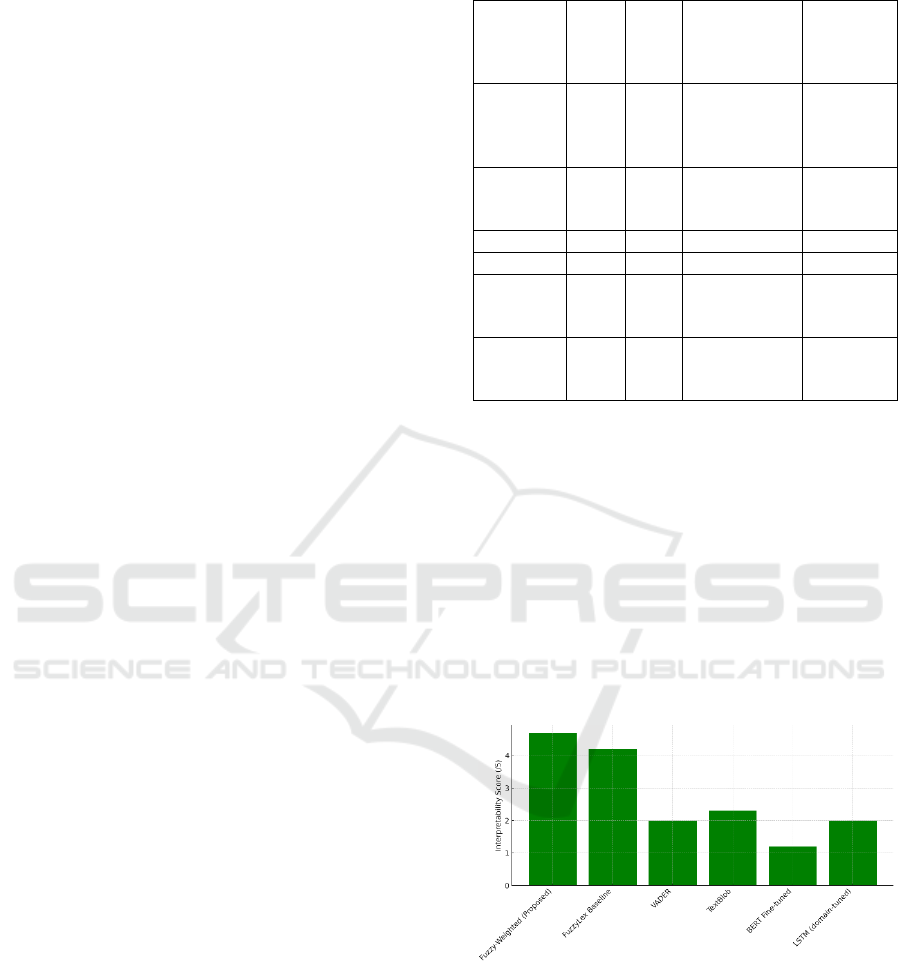
While the performance differences in F1 and
MAE are noteworthy, perhaps more significant are
the results concerning interpretability and robustness
– two criteria of particular importance in educational
systems. As shown in Figure 1, the fuzzy-weighted
model received the highest interpretability rating
(4.7/5) from domain experts, far exceeding the ratings
of black-box models such as BERT (1.2) and the
LSTM variant (2.0). Educators noted that the fuzzy
model’s scalar sentiment score, coupled with its
confidence output and linguistic justification (e.g.,
influence of modifiers), allowed them to better
understand and act upon the sentiment output.
Figure 1: Interpretability Ratings for All Models here.
Robustness to paraphrasing, depicted in Figure 2,
further demonstrates the reliability of the fuzzy
approach. On the paraphrased subset, where students
expressed similar sentiment using alternate phrasing,
the fuzzy model maintained a robust accuracy of 0.83,
outperforming VADER (0.61), TextBlob (0.57), and
even slightly surpassing BERT (0.79). This indicates
that the rule-guided fuzzy inference engine, though
Fuzzy-Weighted Sentiment Recognition for Educational Text-Based Interactions
425
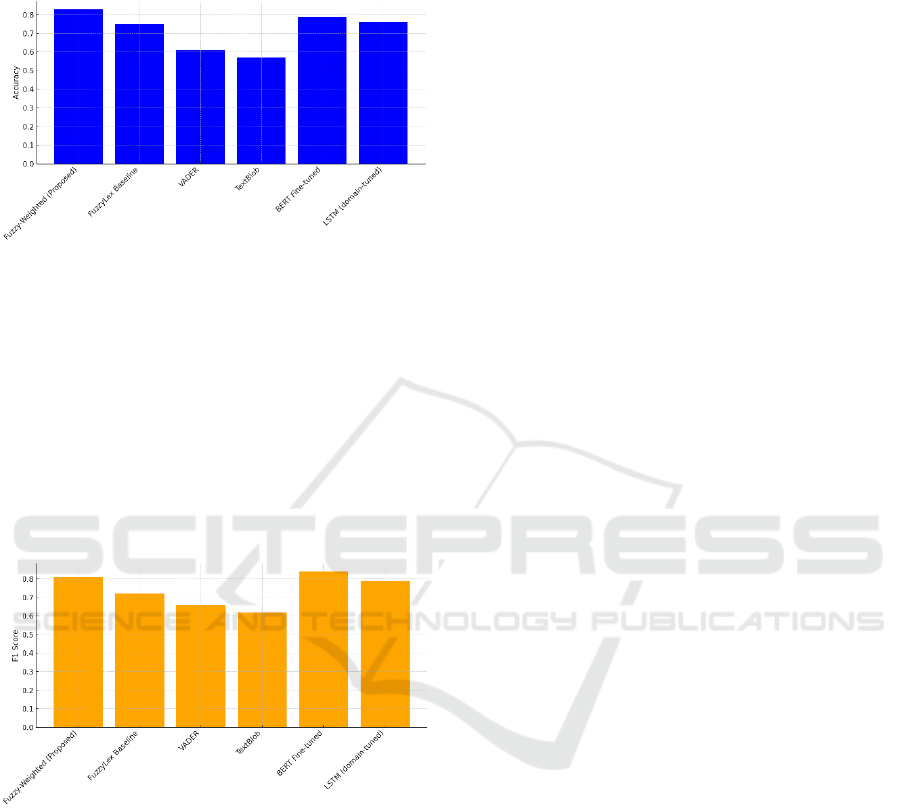
not pretrained on massive corpora, exhibits strong
generalization capacity in the face of surface
linguistic variation.
Figure 2: Accuracy on Paraphrased Inputs.
To visualize the overall classification
performance, Figure 3 presents a bar plot of macro F1
scores across all models. The fuzzy-weighted system,
while slightly behind BERT in raw accuracy, clearly
outperforms both classical and rule-based baselines
and provides substantially more explainable output.
This balance of performance and interpretability
suggests that fuzzy reasoning is particularly well-
suited for affective modeling in education, where
transparency and trust are necessary for practical
deployment.
Figure 3: Comparison of Macro F1 Scores.
The results of the evaluation reveal that the fuzzy-
weighted sentiment recognition model is an effective
and pedagogically appropriate method to perform
affective analysis in text-based communication for
educational purposes. Having attained a high degree
of accuracy in classification and with minimal
prediction errors, shown to be robust against
linguistic heterogeneity, and offering significant
interpretability to educators, this model is considered
especially appropriate for implementation in adaptive
learning systems, feedback dashboards, or real-time
engagement monitoring tools.
The findings not only demonstrate the
computational efficiency of the fuzzy-weighted
sentiment recognition system but also provide insight
into its widespread applicability and limitations in
terms of online learning environments. Specifically,
the system's ability to identify varied levels of
sentiment and provide interpretable results speaks to
the educational need for transparency and actionable
information within analytics. In contrast to deep
learning models that might achieve superior raw
accuracy but not interpretability, the fuzzy approach
offers linguistically grounded explanations for each
classification outcome. This feature is particularly
salutary for uses requiring human engagement, like
educator dashboards and formative assessment tools.
At the same time, the analysis identifies several
limitations. The rule base and lexicon are currently
designed to effectively treat programming-specific
language; however, while promising, continual
refinement might be necessary in order to address a
broader range of domains or more casual
communicative contexts. In addition, while the fuzzy
model effectively handles the vagueness of sentiment,
it does not at present allow temporality or the
changing states of learners over time. These findings
suggest that future research would be improved by
combining fuzzy reasoning with context-sensitive
neural designs or sequence-based approaches to
sentiment monitoring, thereby enabling more
adaptive and longitudinal models of affect.
6 CONCLUSIONS AND FUTURE
WORK
The present work presented a fuzzy-weighted
sentiment analysis model that combines lexical
polarity, linguistic modifiers, and contextual
agreement in a Mamdani-type fuzzy inference
system. The proposed framework produces
interpretable and fine-grained sentiment ratings. An
empirical study using data from an online discussion
forum for a university-level computer programming
course showed that the proposed approach is
competitive under the F1 measure and mean absolute
error, well outperforming baseline models under
interpretability and robustness. These results confirm
the effectiveness of fuzzy logic in capturing the
emotional nuances present in pedagogical discourse,
which often contains features such as subtlety,
ambivalence, or context-dependent affective terms.
The explainable reasoning of the model and its
educational value make it an appropriate candidate
WEBIST 2025 - 21st International Conference on Web Information Systems and Technologies
426

for potential deployment in adaptive learning
systems, reflective feedback mechanisms, and
monitoring via learner dashboards.
The fuzzy-weighted approach offers significant
advantages in interpretability and flexibility, but
many directions for future work are still to be
pursued. Foremost, the expansion of the domain-
specific sentiment lexicon to include a wider variety
of academic disciplines and communication
modalities (e.g., chat posts or transcribed voice
communications) would enhance its applicability.
Second, the use of hybrid approaches that combine
fuzzy reasoning with transformer-based contextual
embeddings may improve handling of complex
semantic structures and figurative language while still
allowing for some level of explainability. Third,
conducting longitudinal studies of affect over time—
by following emotional trajectories rather than
examining only discrete posts in isolation—may
provide deeper insight into engagement patterns and
learning trajectories. Finally, incorporation of this
approach into intelligent tutoring systems or massive
open online courses (MOOCs), along with user-
centered validation, would enable empirical testing of
the model's performance in real-time educational
interventions and decision-making applications.
REFERENCES
Ahmed, Y., Kent, S., Cirino, P. T., & Keller-Margulis, M.
(2022). The not-so-simple view of writing in struggling
readers/writers. Reading & Writing Quarterly, 38(3),
272–296. https://doi.org/10.1080/10573569.2021.
1948374
Alahmadi, K., Alharbi, S., Chen, J., & Wang, X. (2025).
Generalizing sentiment analysis: A review of progress,
challenges, and emerging directions. Social Network
Analysis and Mining, 15(1), 45. https://doi.org/10.
1007/s13278-025-01461-8
Altrabsheh, N., Cocea, M., & Fallahkhair, S. (2014).
Sentiment analysis: Towards a tool for analysing real-
time students’ feedback. 2014 IEEE 26th International
Conference on Tools with Artificial Intelligence
(ICTAI), 419–423. https://doi.org/10.1109/
ICTAI.2014.70
Ambreen, S., Iqbal, M., Asghar, M. Z., Mazhar, T., Khattak,
U. F., Khan, M. A., & Hamam, H. (2024). Predicting
customer sentiment: The fusion of deep learning and a
fuzzy system for sentiment analysis of Arabic text. Social
Network Analysis and Mining, 14(1), 206.
https://doi.org/10.1007/s13278-024-01356-0
Anagha, M., Kumar, R. R., Sreetha, K., & Reghu Raj, P. C.
(2015). Fuzzy logic-based hybrid approach for
sentiment analysis of Malayalam movie reviews. 2015
IEEE International Conference on Signal Processing,
Informatics, Communication and Energy Systems
(SPICES), 1–4. https://doi.org/10.1109/SPICES.
2015.7091512
Benazer, S. S., Thangamani, A. K. S., & Prabu, S. (2024).
Integrating sentiment analysis with learning analytics
for improved student engagement. In Advancement of
IoT in Blockchain Technology and Its Applications (pp.
1262–1284). Zenodo. https://doi.org/10.5281/
zenodo.13752749
Devi, R., Prabu, S., & Legapriyadharshini, N. (2024).
Sentiment analysis for the improved user experience in
the e-commerce platform with the fuzzy model. Journal
of Computer Allied Intelligence, 2, 28–40.
https://doi.org/10.69996/jcai.2024013
Devlin, J., Chang, M.-W., Lee, K., & Toutanova, K. (2019).
BERT: Pre-training of deep bidirectional transformers
for language understanding. In Proceedings of the 2019
Conference of the North American Chapter of the
Association for Computational Linguistics: Human
Language Technologies (NAACL-HLT) (pp. 4171–
4186). https://doi.org/10.48550/arXiv.1810.04805
D’Mello, S., & Graesser, A. (2013). AutoTutor and
affective AutoTutor: Learning by talking with
cognitively and emotionally intelligent computers that
talk back. ACM Transactions on Interactive Intelligent
Systems, 2(4), Article 23. https://doi.org/10.
1145/2395123.2395128
Grimalt-Álvaro, C., & Usart, M. (2024). Sentiment analysis
for formative assessment in higher education: A
systematic literature review. Journal of Computing in
Higher Education, 36(3), 647–682. https://doi.org/
10.1007/s12528-023-09370-5
Hafner, F. S., Hafner, L., & Corizzo, R. (2025). ‘Slightly
disappointing’ vs. ‘worst sh** ever’: Tackling cultural
differences in negative sentiment expressions in AI-
based sentiment analysis. Journal of Computational
Social Science, 8(3), 57. https://doi.org/10.
1007/s42001-025-00382-y
Hutto, C., & Gilbert, E. (2014). VADER: A parsimonious
rule-based model for sentiment analysis of social media
text. Proceedings of the International AAAI Conference
on Web and Social Media, 8(1), 216–225.
https://doi.org/10.1609/icwsm.v8i1.14550
Jadhav, S., Shiragapur, B., Purohit, R., & others. (2024). A
systematic review on the role of sentiment analysis in
healthcare. Authorea. https://doi.org/10.22541/au.
172516418.81416769/v1
Johansen, M. O., Eliassen, S., & Jeno, L. M. (2025).
Autonomy need satisfaction and frustration during a
learning session affect perceived value, interest, and
vitality among higher education students. Scandinavian
Journal of Educational Research, 69(4), 757–771.
https://doi.org/10.1080/00313831.2024.2348457
Kardaras, D. K., Troussas, C., Barbounaki, S. G., Tselenti,
P., & Armyras, K. (2024). A fuzzy synthetic evaluation
approach to assess usefulness of tourism reviews by
considering bias identified in sentiments and articulacy.
Information, 15(4), 236. https://doi.org/10.3390/info
15040236
Fuzzy-Weighted Sentiment Recognition for Educational Text-Based Interactions
427

Litman, D. J., & Forbes-Riley, K. (2006). Recognizing
student emotions and attitudes on the basis of utterances
in spoken tutoring dialogues with both human and
computer tutors. Speech Communication, 48(5), 559–
590. https://doi.org/10.1016/j.specom.2005.09.008
Liu, Y., Ott, M., Goyal, N., Du, J., Joshi, M., Chen, D.,
Levy, O., Lewis, M., Zettlemoyer, L., & Stoyanov, V.
(2019). RoBERTa: A robustly optimized BERT
pretraining approach. arXiv preprint.
https://doi.org/10.48550/arXiv.1907.11692
Pang, B., & Lee, L. (2008). Opinion mining and sentiment
analysis. Foundations and Trends in Information
Retrieval, 2(1–2), 1–135. https://doi.org/10.1561/
1500000011
Subasic, P., & Huettner, A. (2001). Affect analysis of text
using fuzzy semantic typing. IEEE Transactions on
Fuzzy Systems, 9(4), 483–496. https://doi.org/10.
1109/91.940962
Sun, Y., Yu, Z., Sun, Y., Xu, Y., & Song, B. (2025). A
novel approach for multiclass sentiment analysis on
Chinese social media with ERNIE-MCBMA. Scientific
Reports, 15(1), 18675. https://doi.org/10.1038/s41598-
025-03875-y
Taboada, M., Brooke, J., Tofiloski, M., Voll, K., & Stede,
M. (2011). Lexicon-based methods for sentiment
analysis. Computational Linguistics, 37(2), 267–307.
https://doi.org/10.1162/COLI_a_00049
Tasoulas, T., Troussas, C., Mylonas, P., & Sgouropoulou,
C. (2024). Affective computing in intelligent tutoring
systems: Exploring insights and innovations. 2024
SEEDA-CECNSM Conference Proceedings,
1–6. https://doi.org/10.1109/SEEDA-CECNSM63478.
2024.00025
Troussas, C., Krouska, A., & Virvou, M. (2019). Trends on
sentiment analysis over social networks: Pre-processing
ramifications, stand-alone classifiers and ensemble
averaging. In G. A. Tsihrintzis, D. N. Sotiropoulos, &
J. L. C. de Carvalho (Eds.), Machine learning
paradigms: Advances in data analytics (pp. 161–186).
Springer. https://doi.org/10.1007/978-3-319-94030-
4_7
van der Veen, A. M., & Bleich, E. (2025). The advantages
of lexicon-based sentiment analysis in an age of
machine learning. PLOS ONE, 20(1), e0313092.
https://doi.org/10.1371/journal.pone.0313092
Wen, M., Yang, D., & Rose, C. P. (2014). Sentiment
analysis in MOOC discussion forums: What does it tell
us? Proceedings of the 7th International Conference on
Educational Data Mining (EDM 2014), 1–8.
http://www.cs.cmu.edu/~mwen/papers/edm2014-
camera-ready.pdf
Yang, D., Sinha, T., Adamson, D., & Rosé, C. P. (2013).
Turn on, tune in, drop out: Anticipating student
dropouts in massive open online courses. Proceedings
of the 2013 NIPS Data-Driven Education Workshop,
11–14.
Yuvaraj, R., Mittal, R., Prince, A. A., & Huang, J. S. (2025).
Affective computing for learning in education: A
systematic review and bibliometric analysis. Education
Sciences, 15(1), 65. https://doi.org/10.3390/
educsci15010065.
WEBIST 2025 - 21st International Conference on Web Information Systems and Technologies
428
