
Bias-Mitigating News Search with BiasRank
Tim Menzner
1 a
and Jochen L. Leidner
1,2 b
1
Information Access Research Group, Center for Responsible Artificial Intelligence Research (CRAI),
Coburg University of Applied Sciences, Coburg, Germany
2
Department of Computer Science, University of Sheffield, Sheffield, U.K.
Keywords:
News Bias Detection, Information Retrieval, Bias-Aware Ranking, Large Language Models, News
Recommendation Systems, Search Result Fairness, Re-Ranking.
Abstract:
As geopolitical adversaries as well as internal commercial and political actors target democracies with dis-
information campaigns, it is increasingly necessary to filter out biased reporting. Some automatic success
has recently been achieved in this task. For further progress, web search engines need to implement news
bias resistance mechanisms for ranking news stories. To this end, we present BiasRank, a new approach that
demotes articles exhibiting news media bias by combining a large neural language model for news bias classi-
fication with a heuristic re-ranker. Our experiments, based on artificially polluting a (mostly neutral) standard
news corpus with various degrees of biased news stories (biased to varying extents), inspired by earlier work
on answer injection, demonstrate the effectiveness of the approach. Our evaluation shows that the method
radically reduces news bias at a negligible cost in terms of relevance. In turn, we also provide new metrics
for the evaluation of similar systems that aim to balance two variables (like relevancy and bias in our case).
Additionally, we release our test collection on git to support further research on de-biasing news search.
1 INTRODUCTION
Web search engines, such as Google, Baidu, Qwant,
Yandex, DuckDuckGo and others, as well as news
recommender engines, such as Google News, are
powerful tools for seeking specific information as
well as for getting news stories. However, it has been
shown that these systems suffer from various types
of bias (Gharahighehi et al., 2021; Wendelin et al.,
2017), and given the pervasiveness of Web search in
our lives, there is a looming threat of manipulating
online audiences for political or monetary gain. To
help counter this issue, in this paper we explore ap-
proaches for reducing media bias in the ranking of
news stories. Specifically, we address the following
research question:
Research Question (RQ): How can we achieve less
biased rankings in a news search or news recommen-
dation context?
The main contributions of this work are as fol-
lows:
a
https://orcid.org/0009-0005-9753-9364
b
https://orcid.org/0000-0002-1219-4696
• We describe BiasRank, a new hybrid method for
ranking news stories, promoting objective news
reports and demoting individual stories and web-
sites that suffer from media bias;
• We propose a dynamic method to update the in-
dex with LLM-generated information only when
a document is requested, minimizing the need for
frequent and costly LLM calls;
• We outline a set of metrics to measure bias in
query results and its (or any other metric’s) trade-
off with result relevance;
• We present an empirical evaluation that demon-
strates the efficacy of BiasRank on a news corpus;
• We release a demo of our system, as well as our
test collection, to the public in order to foster more
discussion and encourage future work;
To analyze ranking relevance and bias together, and
to explore the trade-offs doing so, we need five in-
gredients: 1. a data collection (we combine a news
corpus with injected known-bias stories), 2. a set
of queries (we created a set), 3. a set of relevance
judgments (QRELs, we created judgments for two re-
trieval methods for the top-40 for our topics), 4. a set
of bias assignments for retrieved documents (we use
436
Menzner, T. and Leidner, J. L.
Bias-Mitigating News Search with BiasRank.
DOI: 10.5220/0013755200004000
Paper published under CC license (CC BY-NC-ND 4.0)
In Proceedings of the 17th International Joint Conference on Knowledge Discovery, Knowledge Engineering and Knowledge Management (IC3K 2025) - Volume 1: KDIR, pages 436-447
Proceedings Copyright © 2025 by SCITEPRESS – Science and Technology Publications, Lda.

both a lexicon-based baseline and a state-of-the-art,
custom-fine tuned, 27-class news bias neural trans-
former model) and 5. an evaluation metric that com-
bines relevance and bias (a new one is proposed be-
low).
Note that we address a different problem from
(Joachims, 2002) or (Craswell et al., 2008), who both
address positional bias irrespective of the content of
documents at particular positions, whereaswe address
news bias, i.e. the neutrality (pr not) of documents
together with their ranks. We are not aware of any
prior work on true news bias re-ranking, but (Ye and
Skiena, 2019), who approximate news bias analysis
with sentiment analysis, comes closest among prior
approaches.
Figure 1: Search results for a query in BiasRank before
(top) and after (bottom left and bottom right) re-ranking
based on two different settings.
2 RELATED WORK
Bias, propaganda and disinformation in media have
been widely studied (Herman and Chomsky, 1988;
Lippmann, 1922). Building on this foundational
work, recent studies have empirically established the
presence of bias in both Web search and social media
(Bakshy et al., 2015; Gezici et al., 2021). In the
following sections, we review work on various bias
types and related fields relevant to news search.
2.1 Media Content Bias
Some biases may stem directly from the agenda of an
owner or other decision makers, others might be ar-
tifacts of the way systems have been built and how
models have been trained. Increasingly there is also
“customer orientation” or “bias by demand”, i.e. jour-
nalists write about things news consumers care about
and click on based on their biases, which is its own se-
lection bias, or even clickbait (Wendelin et al., 2017).
Lauw, Lim and Wang (Lauw et al., 2006) argue
that bias and controversy are connected, and should
therefore be analysed together: the same degree of
bias observation at the surface may count for more if
observed for a less controversial topic.
Fine-grained models and systems for the detection
of propaganda (Da San Martino et al., 2019) and me-
dia bias (Menzner and Leidner, 2024b; Menzner and
Leidner, 2024c) have been proposed, based on ma-
chine learning methods, where propaganda denotes
voluntary influencing for political gain whereas me-
dia bias is a broader concept that includes propaganda
and also involuntary distortions. These fine-rained de-
tection methods inspire our choice of a neural classi-
fier in BiasRank, as they open up the way for a reli-
able, automated detection of document bias based on
its actual content.
2.2 Gender Bias in Text & Search
Gender bias in text and in search has received sub-
stantial attention in its own right (e.g., (Costa-Jussà,
2019)). This line of work is partly motivated by gen-
der stereotypes that emerge through machine learning
when translating between languages. In some lan-
guages, the grammatical gender reflects the biologi-
cal sex of the person holding a profession, whereas
in others it does not. For example, nurse in English
is gender-neutral, while Krankenschwester in Ger-
man refers only to female nurses. Ratz, Schedl and
Kopeinik (Ratz et al., 2024) look at gender bias and
evaluate their on bias metric for it against past work
on a recent collection of bias-sensitive topics and doc-
uments from MS MARCO data.
2.3 Political Bias on the Web & Social
Media
(Kulshrestha et al., 2019) propose a framework to
quantify political bias in social media search re-
sults by disentangling bias introduced by input data
from that introduced by the ranking system, and,
through empirical analysis of Twitter queries during
the 2016 US presidential primaries, they find that both
Bias-Mitigating News Search with BiasRank
437

sources significantly shape the political bias observed
in search results.
A study by Epstein and Robertson (Epstein and
Robertson, 2015) investigated what they called "the
search engine manipulation effect", finding that bi-
ased search rankings can indeed shift the voting pref-
erences of undecided voters.
2.4 Bias in Rankings
(Gharahighehi et al., 2021) address the problem of
popularity bias (“rich get richer”) in rankings.
(Ovaisi et al., 2020) consider position bias and
selection bias in rankings in recommender engines
that uses learning to rank. The authors adapt a bias
correction method from the older statistical literature
to the recommendation ranking scenario and demon-
strate superior accuracy compared to unbiased rank-
ings. Crucially, their method does not inspect the ac-
tual documents at each rank.
1
Fairness using protected Attribute Labels has been
the topic of the Fair Ranking Track shared task at
US NIST’s Text REtrieval Conferences (TREC) (Ek-
strand et al., 2022), which targeted fair exposure
of individual attributes or groups of them, based
on Wikipedia documents. Raj and Ekstrand com-
pared different evaluation metrics for fair ranking and
found the Attention-Weighted Rank Fairness (AWRF)
(Sapiezynski et al., 2019; Raj and Ekstrand, 2022) to
be the most generally useful metric for single rank-
ings with its adaptability to different models, target
distributions, and difference functions (Raj and Ek-
strand, 2022).
In the FAIR Ranking Track, the product of AWRF
and nDCG (Järvelin and Kekäläinen, 2002) is formed
to give relevance and fairness the same weight in the
evaluation of sub-task 1 at that shared task. citeDai-
etal:2024:KDD provide a survey of the various chal-
lenges around bias in IR. Note that the extensive body
of work on statistical distortions in search results (bi-
ased rankings) is different from the topic of this paper
(biased-language news rankings).
2.5 Previous Attempted Remedies
(Jaenich et al., 2024) describe adaptive re-ranking
methods aimed to increase the visibility of relevant
but underrepresented groups in the re-ranking phase
1
Re-ordering the items in a ranking because item posi-
tions may have incurred a bias as per their position alone
is different from inspecting the textual content of each item
and estimating a content bias score, which is what we pro-
pose here.
of a two-stage retrieval process comprising document
ranking and re-ranking.
. In the context of news recommendation, the
technical report (Wu et al., 2022) describe a fairness-
aware ranking approach that models users’ interest
via user embeddings, obtained via adversarial learn-
ing also from click data.
In contrast to these models, our heuristic approach
is not only simpler, it can also be implemented in set-
tings where click data is unavailable.
(Park et al., 2012) present NewsCube, an aspect-
oriented news browser prototype; by presenting mul-
tiple aspects of each news story they aim to mitigate
news bias.
2
The advantage of this approach is that
it avoids automatic censorship, intentional or other-
wise. But the approach implies that users are actually
interested in investigating a broad range of alternative
viewpoints.
(Hu et al., 2019) study political partisanship bias
in the snippets of the Google Web search’s SERP us-
ing a lexicon approach.
Different design choices for bias-aware web
searches were investigated by (Paramita et al., 2022).
Even though their prototype was a mock-up that did
not actually assess document bias, their findings con-
firm the utility of a re-ranking approach for such sys-
tems.
Perhaps closest in spirit to our approach is the
work of Ye and Skiena (Ye and Skiena, 2019), who
describe MediaRank, a method and Website that ranks
>50,000 media Websites based on the factors peer
reputation (where number of citations is taken to be
a proxy for reputation), reporting bias/breadth (where
sentiment differences of a large set of left-wing and
right-wing individuals towards them is used as a
proxy), bottom-line financial pressure (using bot and
ad activity as a proxy) and popularity (using Alexa
rank as a proxy). Unlike these statistical corrections
, we directly analyze content to detect linguistic bias
in news items; our system also focuses on news bias,
which is estimated directly by a custom model rather
than by using a proxy.
3 METHOD
Our goal is to take into account the content bias of
all individual documents in a collection, but in a way
that only minimally impacts the typical IR indexing
and retrieval pipeline. We also aim to facilitate im-
plementation of our method as part of existing legacy
2
At the time of writing, the system is no longer available
on the Internet.
KDIR 2025 - 17th International Conference on Knowledge Discovery and Information Retrieval
438
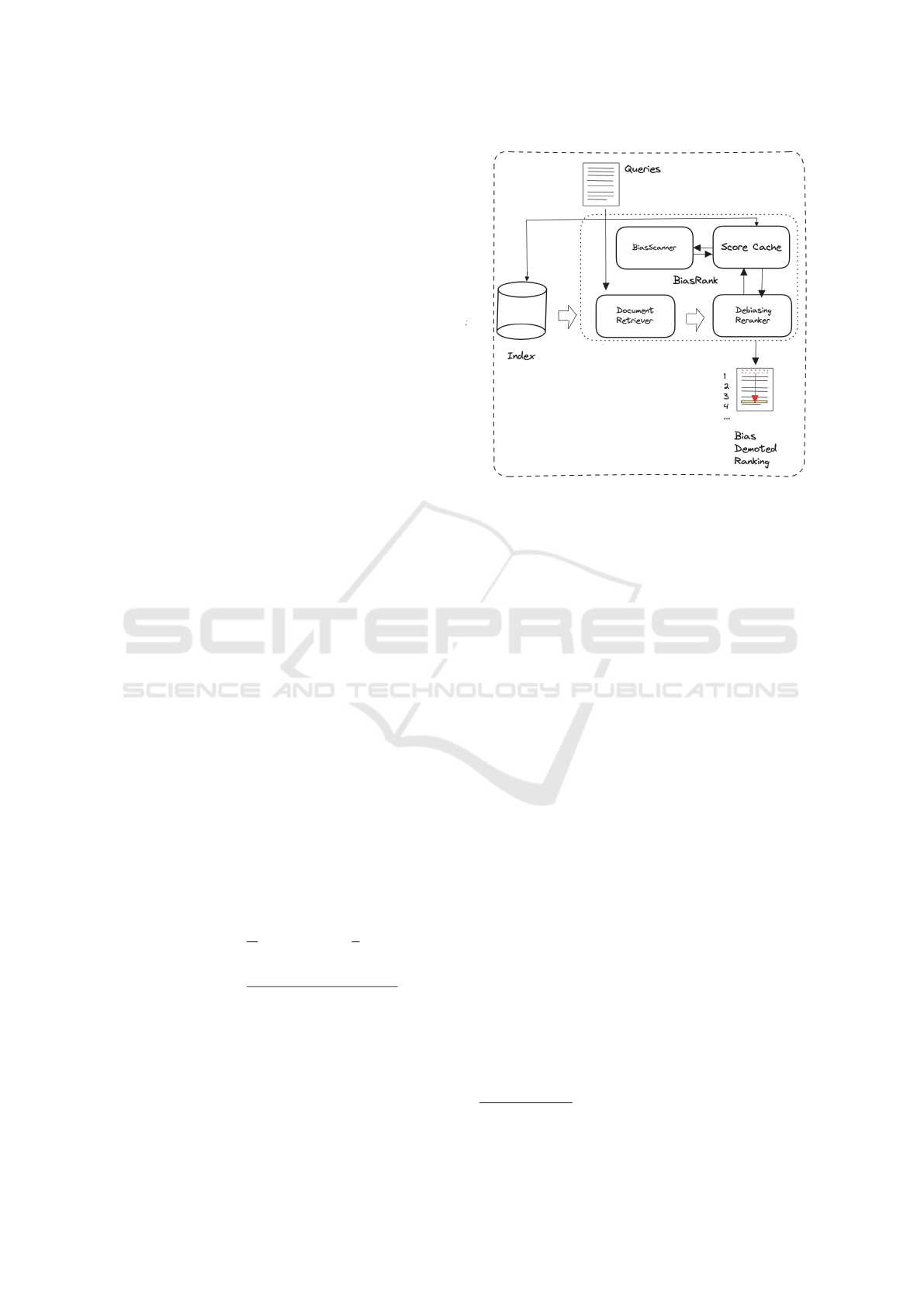
indexing and retrieval pipelines that may be hard to
change, but which we wish to enrich with our method
for adding resilience in the face of news bias (Figure
2).
We propose a heuristic search function that com-
bines a relevance model and an anti-bias model to cal-
culate a ranking score for a document d and a query
q, based on a score rel
relevance
indicating the relevance
for q, as well as a score bias
document
indicating how
biased the content of a document is, through simple
linear interpolation as follows:
BiasRank(q, d) =(1 − λ)· rel
document
(q, d)
+ λ · (1 − bias
document
(d))
(1)
where the linear interpolation weight λ controls
the degree of the influence of the bias score in the
overall score. 0 ≤ λ ≤ 1, where λ = 0 means that the
bias-based re-ranking will be switched off, and Bias-
Rank behaves like a pure relevance ranker, whereas
λ = 1 means that the relevance ranking term disap-
pears, so BiasRank decays to perform a search for the
least biased documents, not taking any relevance into
account at all.
To assess a document’s bias, we use BiasScan-
ner (Menzner and Leidner, 2025; Menzner and Lei-
dner, 2024a; Menzner and Leidner, 2024c), a large
custom language model (LLM) fine-tuned with train-
ing data comprising biased sentences from news arti-
cles, annotated with bias type and intensity, to iden-
tify all biased sentences and determine the intensity
(bias strength on a scale of 0 to 1) of the bias in each
individual, biased sentence. For this experiment, we
opted for the GPT-3.5 variant of BiasScanner. Let a
document have N sentences in total, of which n are
classified as biased with a respective intensity b. We
can then use this information to calculate the over-
all bias of a document: pervasiveness as the pro-
portion of biased sentences and strength as the mean
bias intensity of these sentences. By combining these
two measures, we obtain a single overall bias score
bias
document
, which reflects both the extent and inten-
sity of bias within the document:
pervasiveness =
n
N
, strength =
1
n
n
∑
i=1
b
i
bias
document
=
pervasiveness + strength
2
(2)
4 IMPLEMENTATION
We implemented our score as a re-ranking procedure
on top of length-normalized TFIDF and BM25 scores
Figure 2: BiasRank Architectural Overview.
as provided by Apache Lucene search library (An-
drzej Białecki, 2012), to compare performance across
standard relevance models. Our system is based on
the PyLucene (9.7.0)
3
wrapper. The architecture of
the system is shown in 2.
1. When a query retrieves a document from the in-
dex, the de-biasing ranker first checks whether
the document already includes the field we use to
specify its bias information.
2. If this field is absent, the ranker then determines if
the document’s bias has already been cached in a
Redis(Sanfilippo, 2009) database.
3. If the bias is not cached, the document is for-
warded to a component that evaluates its bias. By
default, we employ the BiasScanner model for
this assessment, though it can be easily replaced
with any comparable method, as long as it returns
a score between 0 and 1 for each document.
4. Once the bias score is generated, it is stored in the
cache, and the bias field is added to the document
in the index.
By only rating documents that actually appear in our
queries and storing the results, we optimize our sys-
tem’s efficiency and reduce unnecessary computation
as well as cost and energy consumption, ensuring
that subsequent queries can retrieve bias information
quickly and accurately without redundant processing.
We re-scale all Lucene relevance scores to [0;1]
using the minimum and maximum returned lucene
3
https://lucene.apache.org/pylucene/
Bias-Mitigating News Search with BiasRank
439

score for all n results of the query with a linear nor-
malization; our bias score assigned to a document is
always between 0 and 1 by definition (In practice,
the lower bound of 0 can occur somewhat frequently.
However, the upper bound of 1 is rarely reached be-
cause it would require a document made up entirely of
biased sentences, without any generic filler text, and
each sentence would need to be extremely biased.).
5 EVALUATION
5.1 Retrieval Setup
Our evaluation protocol is inspired by answer injec-
tion (Leidner and Callison-Burch, 2003), a method
to evaluate question answering systems by planting
known answers in large background corpora in a way
so as to remember where (in which document ID)
the correct answer to any one particular question was
to be found. Following this protocol, we first create
an artificially polluted corpus from a assumed-neutral
background corpus by planting news stories known to
us to be biased inside the background corpus of news,
which can be expected to be mostly unbiased; we call
this enriched corpus the “polluted corpus”.
5.2 Collection
We utilize the Reuters TRC2 English sub-corpus as
our background corpus: for our experiments, we as-
sume the great majority of Reuters stories to be un-
biased
4
and “pollute” it with news stories known to
be biased. While the notion of a completely unbiased
news agency is likely an unattainable standard, not
least because individual definitions of bias may vary
depending on perspective, Reuters is often considered
one of the news agencies that come closest to achiev-
ing this goal (Ad Fontes Media (eds.), 2024; Budak
et al., 2016).
The TRC2 collection is a collection of news re-
ports from the Reuters news agency (owned by the
Thomson Reuters Corporation and distributed by US
NIST for research purposes) for English. TRC2 was
designed originally to be time-aligned with another
corpus covering blogs (BLOG09), so it contains news
from 14 months starting with the year 2009.
The biased news stories injected in the corpus
were manually collected by searching for biased ar-
ticles on the Fox News website that addressed topics
reported in TRC2 during the given time period. Fox
4
We counted 645 opinion pieces in the TRC2 dataset
among 1,312,775 documents (< 0.05%).
News was selected as a source due to its convenient
search function, which allows for easy access to arti-
cles from the relevant time-frame and keywords. Ad-
ditionally, its well-documented right-wing bias (Mar-
tin and Yurukoglu, 2017; Bernhardt et al., 2020) fa-
cilitates the identification of articles that exhibit bias
while covering pertinent topics.
The limitation of gathering biased articles from
only one side of the bias spectrum does not impede
our experiment, as the bias score calculation we rely
on is agnostic to the direction of bias, whether right-
wing, left-wing, or otherwise. As long as a document
is biased, it is likely to yield a high bias score.
Besides time-frame, the specific topics where also
chosen based on the likely contentiousness of the
event, because we want to have a realistic likelihood
that biased (as well as unbiased) stories about these
topics are retrieved; so if the topic is not somewhat
controversial, there may be not enough data in the in-
tersection set between relevant and biased stories.
Overall, 85 biased articles covering 17 differ-
ent topics including “same-sex marriage”, the “auto
bailout” and “Obama’s presidential campaign and
victory” were picked and injected.
5.3 Queries
We constructed set of 40 queries (often called “top-
ics” in IR) based on the 17 different topics identified
for Section 5.2. We ensured that the queries them-
selves were not inherently biased, avoiding, the ex-
plicit request for a Fox News article or the use of
loaded terms. Instead, we formulated queries that one
might use when genuinely seeking information about
a topic without pre-existing bias (e.g., “obama stim-
ulus package” rather than “obama socialist stimulus
fox news”).
5.4 Relevance Judgments
The two co-authors annotated a set of documents
for relevance with respect to the 40 queries. Given
top-k retrieval with k = 40, there are less than 40 ×
40×IR methods=2 = 3, 200 QRELs to produce, how-
ever in practice there is substantial overlap between
documents retrieved by the vector space model with
TFIDF weighting and the binary probabilistic model
with BM25 weighting. We divided the data in three
groups, one per annotator for single annotation and
a smaller partition with N = 100 doubly annotated
records to be able to determine inter-annotator agree-
ment. We annotated the JSON representation of the
QREL tuples that included the question and the title
as well as the first 512 characters of the document
KDIR 2025 - 17th International Conference on Knowledge Discovery and Information Retrieval
440

directly in a text editor. Each document was cate-
gorized as either “relevant” or “not relevant”. For a
N = 8 query sample and k = 40 top-k retrieval results,
we constructed QRELs with two raters; the resulting
inter-annotator agreement observed was 95.55% (raw
overlap) and 0.91 (in terms of Cohen κ), which can
be described as nearly perfect agreement, bolstering
confidence in the quality of annotations.
5.5 Baseline
To enable the assessment of the impact of the news
bias model, we also implemented a simple lexicon
baseline method that works as follows: a small set
of terms are looked up from a hashtable and each sen-
tence with at least one match encountered while going
through a news story increases a counter. The overall
bias score of an article is then calculated by divid-
ing this counter with the total number of sentences.
Biaslex-baseline-IPM21 uses the list of 76 En-
glish bias indicator terms from Spinde et al. (Spinde
et al., 2021) whereas Biaslex-baseline-KDIR2025
uses our own list of 48 bias terms made up from intro-
spection and browsing the Web for resources explain-
ing for human readers how to identify news biases, as
well as term obtained by prompting ChatGPT-4o to
output the 50 terms most strongly indicative of news
bias.
5
5.6 Evaluation Metrics
We evaluate several retrieval methods against our rel-
evance judgments before and after re-ranking with
our method. To assess the overall bias in a set of
n search results for a given query, we calculate the
sum of the bias scores assigned to each document, ap-
plying a logarithmic weighting based on its position
in the ranking. This approach gives greater weight
to higher-ranking documents, ensuring they have a
larger influence on the overall bias, as we consider
the top results to be the most significant in shaping
the overall perception of the query.
bias
results
=
n
∑
i=1
bias
document
log
2
(i + 1)
(3)
To measure relevance of a set, we decided to use
Normalized Discounted Cumulative Gain (NDCG)
provided by trec_eval (Järvelin and Kekäläinen,
2002) because it accounts for document position in
5
both lexica as well as the URLs of the
injected articles and all queries with the cor-
responding qrels can be found here online
(https://github.com/Timperator2/BiasRankReproducibility)
a manner similar to our bias calculation, thereby en-
hancing comparability. Since NDCG also relies on
normalization with the maximum possible DCG, we
normalized bias
results
using the maximum possible
bias of the given set (bias
results
when sorted in de-
scending order of bias). However, our overarching
interest is whether bias is reduced in a way that does
not, or not substantially, affect relevancy in a negative
way. To this end, we can define a combined metric,
the Linear Re-ranking Impact Score (LRIS), based on
the delta of bias
results
and relevancy
results
in percent
before and after the re-reanking:
LRIS = −1 × ∆bias
results
+ ∆relevance
results
(4)
When the decrease in bias after re-ranking is
larger than the decrease in relevancy, the RIS will be
positive. If relevancy decreases larger than bias, it will
be negative. Besides this linear trade-off metric, we
also calculate the delta in an Adapted Harmonic Mean
(AHM) between bias and relevancy of the set before
and after re-ranking (similar like a F-score combines
Precision and Recall). This Non-Linear Re-ranking
Impact Score (NRIS) is more sensitive to small (ab-
solute) improvements when relevance or bias values
are low.
We conducted a second evaluation focusing solely
on the top-k results out of our n, without applying
position-based weighting within this window. In this
case, relevance and bias scores for the k out of n re-
sults may change due to back-filling, as documents
in the top-k can be replaced by others with different
relevance or bias levels trough the re-ranking. To re-
move position-based weighting, we replaced NDCG
with Precision for calculating relevance
top-k
. To en-
sure comparability, bias
top-k
was also calculated in a
precision-like manner in this round, representing the
proportion of documents in the top − k with a bias
score greater than zero. We chose a k of 10, as this is
also the standard number of results you would get on
the first page of many search engines.
LRIS and NRIS rely on effective bias-scoring
methods. A system that assigns high bias scores to
unbiased documents may still perform well by demot-
ing these misclassified documents, while failing to ad-
dress any true bias it cannot measure. To address this,
we use a second version of LRIS, the Injection-based
Linear Re-ranking Impact Score (ILRIS). Under our
premise that the injected documents are biased and
the TRC2 documents are neutral, we assign bias val-
ues of 0 and 1 accordingly. We then calculate the IL-
RIS like we would LRIS to assess the effects of the
re-ranking, which is still done using the scores of the
Bias-Mitigating News Search with BiasRank
441

respective bias-scoring method.
AHM =
2 · relevance
results
· (1 − bias
results
)
relevance
results
+ (1 − bias
results
)
NRIS = ∆AHM
(5)
5.7 Results
5.7.1 Bias-Scoring Methods
Table 1 compares the BiasScanner method for deter-
mining the bias of news articles with the two base-
lines described in Section 5.5 and a third baseline in
which bias values are assigned randomly as numbers
between 0 and 1. For each retrieval method (BM25
and TFIDF), the same 40 queries with 40 hits were
used, resulting in 1257 unique documents for BM25
and 1229 unique documents for TFIDF, respectively.
To make the scores assigned by each method more
comparable with one another, bias scores are normal-
ized using the lowest and highest assigned scores for
each individual query as bounds.
All methods except for the random baseline assign
significantly higher bias values to the injected docu-
ments compared to the TRC2 documents. This in-
dicates that the methods align with our premise that
TRC2 documents can generally be considered un-
biased by default, while injected documents are bi-
ased.The same applies when examining the average
ranking of TRC2 and injected documents among the
top-40 retrieved documents for each query, after sort-
ing them in descending order by bias.
Across all methods except the random baseline,
the injected documents consistently rank higher (in-
dicating greater bias) than the TRC2 documents, with
this difference being greatest with BiasScanner. Bi-
asScanner also performed best in terms of F1. Be-
cause a simple threshold approach, in which a docu-
ment’s bias score had to exceed a certain value, was
not feasible due to differences in scoring methods
across the compared approaches, the confusion ma-
trix for calculating the F1-score was derived using an
alternative approach to ensure comparability: based
on our premise, for a query with n injected documents
in its results, the n strongest-biased documents should
be the injected ones. Therefore, true positives are in-
jected documents among the n most biased, false pos-
itives are TRC2 documents in the n most biased, true
negatives are TRC2 documents not in the n most bi-
ased, and false negatives are injected documents not
in the n most biased.
Even-though all methods perform way better than
random on this metric, overall F1 is still rather low
(between 0.237 for Biaslex-baseline-KDIR2025 and
0.339 for BiasScanner) due to a relatively high num-
ber of false positives. This has two reasons.
First of all, while our premise generally holds
true, it is, of course, an oversimplification. Even if
most Reuters articles are unbiased, the sheer over-
representation of these articles in the dataset (for all
unique documents retrieved with BM25, 1,177 are
from TRC2, while only 52 belong to the injected ones,
with similar proportions for TFIDF) ensures that a
low percentage of biased articles can lead to a high
number of false positives in our setup.
Secondly, the systems themselves are imperfect,
as evidenced by examples where relatively high bias
scores were assigned to neutral-looking Reuters arti-
cles. In addition to formatting issues such as some
news reports missing proper punctuation (which can
disrupt the calculation of the overall bias score, partly
based on the percentage of biased sentences), quotes
containing biased content are also an important as-
pect that can lead to bias being detected in otherwise
neutral articles. These phenomena and their impact is
discussed in more detail in Section 7.
Interestingly, even though IPM21 mainly contains
words associated with topics that are often associated
with bias rather than words that directly indicate bi-
ased language, it still performs relatively well. Over-
all, BiasScanner generally achieves the best perfor-
mance in detecting bias for all tested methods, its
good performance is consistent with other, indepen-
dent evaluation on datasets specifically constructed
for bias detection (Menzner and Leidner, 2024c).
5.7.2 Re-Ranking
Table 2 provides a comparison of the averages of rel-
evance and bias metrics after re-ranking using BiasS-
canner with varying bias weightings (λ) for full set
(n = 40) and top − k = 10 retrieval across 40 queries
using BM25 and TFIDF.
As expected, increasing bias weight reduces bias
post re-ranking but also decreases relevancy. The ta-
ble shows that optimal balance is generally achieved
with higher weightings, though peak LRIS, NRIS and
ILRIS values typically occur between 0.5 and 0.75.
The highest LRIS for n is 0.181 (TFIDF, λ = 0.62)
and 0.658 (BM25, λ = 0.74) for top-k. The NRIS
peaks at 0.162 (BM25, λ = 0.72) for n and 0.147
(BM25, λ = 0.59) for top-k. IRLIS is at its highest
for n at 0.228 (BM25, λ = 0.68) and 0.399 (BM25,
λ = 0.70).
LRIS scores are way higher for top − k than for
n, while NRIS differences are less pronounced and
peak earlier for top−k. LRIS uses relative percentage
changes, weighting small bias reductions similarly to
larger relevance reductions.
KDIR 2025 - 17th International Conference on Knowledge Discovery and Information Retrieval
442

Table 1: Evaluation of different bias-scoring methods including the average assigned bias score and the average place when
ranked by bias for TRC2 with injected documents (normalized for better comparability). The results confirm the suitability
of BiasScanner as a method for assessing document bias in this scenario.
Method TRC INJ TRC-Rank INJ-Rank F1-Score
Random baseline 0.504 0.512 20.48 20.13 0.048
Biaslex-baseline-IPM21 0.063 0.138 20.94 12.86 0.310
Biaslex-baseline-KDIR2025 0.056 0.188 21.08 10.79 0.237
BiasScanner 0.296 0.772 21.21 7.10 0.339
Table 2: Comparison of averages of relevance and bias metrics after re-ranking with varying bias weightings (λ) for full set
(n = 40) and top − k = 10 retrieval across 40 queries using BM25 and TFIDF. The table includes changes in relevance (∆R),
bias as rated by BiasScanner (∆B) and bias measured via injected documents (∆B
I
), LRIS, NRIS and ILRIS metrics (all as
defined in 5.6), as well as the percentage of queries with an improvement in LRIS and NRIS. ∆T RC and ∆INJ show the
average change in ranking of TRC2 and injected documents, with top-k only looking at the top-10. The results show that
the general principle works, providing an overview of which parameters correspond to the expected trade-off between loss of
relevancy and gain in neutrality, and indicate that the sweet spot lies somewhere between a bias weighting of 0.5 and 0.75.
Setup ∆R ∆B LRIS NRIS ↑ LRIS ↑ NRIS ∆T RC ∆INJ ∆B
I
ILRIS
BM25
n
λ = 0.25 -2.5% -9.5% 0.070 0.069 90.0% 97.5% 0.2 -4.1 -10.2% 0.077
λ = 0.5 -6.7% -20.3% 0.136 0.138 92.5% 97.5% 0.6 -10.3 -24.8% 0.182
λ = 0.75 -16.2% -29.8% 0.136 0.160 82.5% 95.0% 1.0 -17.8 -38.3% 0.221
BM25
k
λ = 0.25 -3.59% -29.35% 0.258 0.078 70.0% 67.5% -0.7 -3.2 -11.7% 0.081
λ = 0.5 -13.3% -65.6% 0.523 0.141 87.5% 75.0% -3.2 -12.0 -41.3% 0.280
λ = 0.75 -34.4% -100.0% 0.656 0.100 82.5% 65.0% -7.1 -23.7 -72.5% 0.381
TFIDF
n
λ = 0.25 -0.7% -10.2% 0.095 0.066 100% 92.5% 0.2 -4.4 -7.2% 0.066
λ = 0.5 -5.9% -21.7% 0.158 0.119 92.5% 90.0% 0.6 -10.9 -24.2 % 0.182
λ = 0.75 -12.9% -30.6% 0.177 0.138 87.5% 87.5% 0.9 -17.8 -33.8% 0.209
TFIDF
k
λ = 0.25 -9.4% -28.3% 0.189 0.039 60.0% 52.5% -0.8 -3.1 -6.3% -0.032
λ = 0.5 -16.1% -63.5% 0.474 0.070 87.5% 72.5% -3.0 -11.8 -37.5% 0.213
λ = 0.75 -29.6% -94.4% 0.648 0.043 82.5% 57.5% -6.8 -26.1 -65.0% 0.354
In contrast, NRIS focuses on absolute values,
which makes it less affected by high percentage
changes in small values, despite small values hav-
ing a greater effect on the Adapted Harmonic Mean.
Thus, in cases with low bias where relevance is cru-
cial, NRIS may be a better metric for overall perfor-
mance evaluation.
Although LRIS and NRIS improved for most
queries across all parameters, there was at least one
query in all but one case where the relevancy-bias ra-
tio either did not improve or worsened. While ILRIS
also shows improvement in most cases, there is one
setup where re-ranking actually results in a slightly
worse trade-off between bias and relevance, accord-
ing to this metric.
Overall, the ILRIS scores confirm that the re-
ranking indeed operates in line with our initial
premise when using BiasScanner, as they strongly
correlate with the LRIS scores according to Pearson
correlation coefficient, r(10) = .768, p = .0035. The
correlation between bias reduction in percent using
BiasScanner values (∆B) and bias reduction in percent
based on the demotion of injected documents (∆B
I
) is
even stronger, r(10) = 0.907, p < 0.0001.
Interestingly, the weightings that show the highest
percentage of improvements in LRIS and NRIS are
often not the same as those associated with the high-
est average scores in these metrics. This suggests a
trade-off: one can opt for smaller yet more consistent
improvements or pursue the potential for larger gains,
which also carries the risk of negative outcomes.
Generally speaking, a medium-high value of λ
tends to be optimal. For the or the top − k selec-
tion, where the differences a especially high, lower
Bias-Mitigating News Search with BiasRank
443

values may fail to adequately filter out biased docu-
ments, while excessively high values can lead to di-
minishing returns in bias reduction for many queries
(while the improvement on others is still high enough
to drive up the total average).
As an additional insight, de-biasing can occasion-
ally even improve relevancy by allowing more rele-
vant, unbiased documents to replace non-relevant, bi-
ased ones. This occurs for at least 5% of queries
(top − k TFIDF with λ = 0.25) and up to 30% (n
TFIDF with λ = 0.5), averaging around 16%. Con-
sequently, this drives up LRIS and NRIS scores, as
de-biasing consistently reduces bias.
5.7.3 Re-Ranking with Different Bias-Scoring
Methods
Table 3 shows differences in system performance
when employing different bias-scoring methods apart
from BiasScanner. The system with BiasScanner out-
performs the other variants in all metrics and shows
the clearest correlation between between bias reduc-
tion using the automatically assigned values and bias
reduction based on the demotion of the injected doc-
uments. As described in 5.6, the meaningfulness of
LRIS depends in part on the effectiveness of the bias-
scoring methods in accurately identifying bias. (In
line with our premise, a higher value of r(∆B, ∆BI) in-
dicates greater meaningfulness). Consequently, LRIS
may be more effective for comparisons within a single
method rather than between different methods. Still,
even for ILRIS, IPM21 and KDIR2025 scores remain
relatively low.
6 DEMO
As we believe that actually interacting with a
system makes it easier to understand what it is
about than mere walls of text and tables, we
also implemented a live demo accessible under
https://biasscanner.org/BiasRankWebDemo
A screenshot from the demo is shown in 1
For performance reasons, the web version of our
demo prototype currently does not support actual live
search. Instead, we have pre-cached the search re-
sults for the 40 queries (see 5.3) using the BM25 al-
gorithm in Lucene. When a query is entered, the sys-
tem retrieves the results of the most similar cached
query, with similarity determined by a combination
of semantic matching using word2vec(Mikolov et al.,
2013) embeddings and cosine similarity, in combi-
nation with exact string matching done via Leven-
shtein distance. Users can adjust the search ranking
by using a slider going from 0 to 1 in steps of 0.01,
which allows them to control the extent to which bias
influences the ranking. This interactive demo illus-
trates how the trade-offs between bias and relevance,
as quantified in our evaluation, manifest in a practical
setting.
7 LIMITATIONS
Obviously, the quality of our re-ranking approach is
highly dependent on the accuracy of the system used
to assess document bias in the first place (as demon-
strated by comparisons with the baseline word lexica
in 5.7.1 and 5.7.3). Additionally, the performance of
the ranking algorithm used for determining relevance,
is just as crucial.
That said, we like to emphasize that our main con-
tribution lies not in the specific bias assessment sys-
tem, but in providing a general framework that can be
applied across such systems.
We are aware that the number of biased docu-
ments is relatively low, at least compared to other
works. However, we believe that this number is suf-
ficient to demonstrate the applicability of our method
as the observed effects were strong and the correla-
tions described in 5.7statistically significant. Over-
all, comprehensive bias analysis of every document is
an expensive operation, more so than other typical IR
text analysis task (e.g. spam filtering, topic classifi-
cation). Content bias analysis must be carried out in
full, as processing just the beginning of a document
could lead to gaming the method.
One question is whether a “mostly neutral stories
retrieved” setup is actually desirable at all: it could
be that a more diverse, but balanced mix of neutral
news stories as well as news stories with various bi-
ases is more helpful, depending on the motivation
of the news search. We content that search engines
should make such choices transparent to the end user,
although it is known that most users never modify de-
faults.
The influence of quotes on the bias of an article is
a topic worthy of its own debate. Currently, our sys-
tem does not differentiate between quotes and non-
quotes. One could argue that simply reproducing a
biased statement made by someone as part of an oth-
erwise impartial report should not increase the arti-
cle’s bias score. However, when a publication selec-
tively chooses whom and what to quote to advance a
particular narrative, quotes can become tools of media
bias. Ultimately, the impact of a quote depends on its
overall context and the role it plays within the article.
Finally, from an ethics perspective, the decision
KDIR 2025 - 17th International Conference on Knowledge Discovery and Information Retrieval
444

Table 3: Comparison of system performance using different bias-scoring methods for the full set (n = 40) and top − k = 10
retrieval across 40 queries. LRIS and ILRIS values are averages of both BM25 and TFIDF for bias weightings λ = 0.25,
λ = 0.5, and λ = 0.75. Pearson correlation is between bias reduction using the bias values returned by the method and bias
reduction based on the demotion of injected documents. The results show the clearest correlation between between bias
reduction using the automatically assigned values and bias reduction based on the demotion of the injected documents when
using BiasScanner.
Method LRIS
n
LRIS
k
ILRIS
n
ILRIS
k
r(∆B, ∆BI)
Random baseline 0.0825 -0.097 -0.005 0.039 -0.361
Biaslex-baseline-IPM21 0.058 0.067 0.001 -0.017 0.740
Biaslex-baseline-KDIR2025 0.085 0.148 0.014 0.022 0.876
BiasScanner 0.129 0.458 0.156 0.213 0.907
which sentences are biased is a sensitive one; users
may argue it should not be up to a technology provider
to decide what is biased; however, we consider this
question is not much different from leaving the rele-
vancy ranking to a third party. What might be pre-
sented as relevant to a user might already be the result
of bias in the process of relevancy calculation, espe-
cially when the algorithm considers a personal profile
for making its selection. We mitigate user acceptance
risk by selecting a bias model that generates textual
explanations for each sentence classified as biased.
8 SUMMARY, CONCLUSION AND
FUTURE WORK
We presented BiasRank, the first heuristic re-ranking
method that is informed by bias as well as relevance:
With “bias” refering to a full news content bias analy-
sis carried out on the sentence-level for each indexed
document (content bias profiling). Our method can
equally be used for recommendation and search as
step added on top of the initial ranking. We further
provide appropriate metrics to evaluate how well a re-
ranking method achieves a trade-off between bias (or
any other secondary metric) and the relevancy of in-
dividual documents.
We described an evaluation using injection of
“polluted” (known biased) documents into a stan-
dard news corpus. Our comprehensive evaluation
compares various methods for automatically assess-
ing document bias and highlights the effectiveness
of BiasRank, particularly when employing BiasScan-
ner, across two information retrieval models with dis-
tinct weighting schemes by employing novel and tra-
ditional metrics.
In future work, we plan to extend the evaluation
setup in order to explore languages other than En-
glish. We also would like to collect aggregate bias
statistics for entire news outlets in ways similar to Ye
and Skiena (Ye and Skiena, 2019), but using our full
sentence-level bias analysis (rather than a set of weak
proxies like sentiment, as they did); such statistics
could then be used as priors to build more compre-
hensive Web-scale Bayesian models of bias in com-
munication. An integration with fact-checking sys-
tems could also be explored. This way, re-ranking
could consider not only the bias of a document, as as-
sessable by its linguistic features, but also the factual
accuracy of its content.
REFERENCES
Ad Fontes Media (eds.) (2024). Reuters bias and reliability.
(accessed 2024-10-15).
Andrzej Białecki, Robert Muir, G. I. (2012). Apache
Lucene 4. In Proceedings of the SIGIR 2012 Work-
shop on Open Source Information Retrieval Held in
Portland, OR, USA, 16th August 2012, pages 17–24.
Bakshy, E., Messing, S., and Adamic, L. A. (2015). Ex-
posure to ideologically diverse news and opinion on
facebook. Science, 348(6239):1130–1132.
Bernhardt, L., Dewenter, R., and Thomas, T. (2020). Watch-
dog or loyal servant? political media bias in us news-
casts.
Budak, C., Goel, S., and Rao, J. M. (2016). Fair and
balanced? quantifying media bias through crowd-
sourced content analysis. Public Opinion Quarterly,
80(Suppl. 1):250–271.
Costa-Jussà, M. (2019). An analysis of gender bias stud-
ies in natural language processing. Nature Machine
Intelligence, 1:495–496.
Craswell, N., Zoeter, O., Taylor, M., and Ramsey,
B. (2008). An experimental comparison of click
position-bias models. In Proceedings of the 2008
International Conference on Web Search and Data
Mining, WSDM ’08, pages 87—-94, New York, NY,
USA. Association for Computing Machinery.
Da San Martino, G., Yu, S., Barrón-Cedeño, A., Petrov, R.,
and Nakov, P. (2019). Fine-grained analysis of propa-
ganda in news article. In Proceedings of the 2019 Con-
ference on Empirical Methods in Natural Language
Processing and the 9th International Joint Conference
on Natural Language Processing (EMNLP-IJCNLP),
Bias-Mitigating News Search with BiasRank
445

pages 5636–5646, Hong Kong, China. Association for
Computational Linguistics.
Ekstrand, M. D., Das, A., Burke, R., and Diaz, F. (2022).
Fairness in information access systems. Found. Trends
Inf. Retr., 16(1-2):1—-177.
Epstein, R. and Robertson, R. E. (2015). The search engine
manipulation effect (seme) and its possible impact on
the outcomes of elections. Proceedings of the Na-
tional Academy of Sciences, 112(33):E4512–E4521.
Gezici, G., Lipani, A., Saygın, Y., and Yilmaz, E. (2021).
Evaluation metrics for measuring bias in search en-
gine results. Information Retrieval Journal, 24(2):85–
113.
Gharahighehi, A., Vens, C., and Pliakos, K. (2021). Fair
multi-stakeholder news recommender system with hy-
pergraph ranking. Information Processing & Manage-
ment, 58(5):102663.
Herman, E. S. and Chomsky, N. (1988). Manufacturing
Consent: The Political Economy of the Mass Media.
Pantheon Books, New York, NY, USA, 1st edition.
Hu, D., Jiang, S., E. Robertson, R., and Wilson, C. (2019).
Auditing the partisanship of google search snippets. In
The World Wide Web Conference, WWW ’19, pages
693–704, New York, NY, USA. ACM.
Jaenich, T., McDonald, G., and Ounis, I. (2024). Fairness-
aware exposure allocation via adaptive reranking. In
Proceedings of the 47th International ACM SIGIR
Conference on Research and Development in Informa-
tion Retrieval, SIGIR 2024, pages 1504–1513, New
York, NY, USA. ACM.
Järvelin, K. and Kekäläinen, J. (2002). Cumulated gain-
based evaluation of IR techniques. ACM Trans. Inf.
Syst., 20(4):422–446.
Joachims, T. (2002). Optimizing search engines using
clickthrough data. In Proceedings of the Eighth
ACM SIGKDD International Conference on Knowl-
edge Discovery and Data Mining, July 23-26, 2002,
Edmonton, Alberta, Canada, pages 133–142. ACM.
Kulshrestha, J., Eslami, M., Messias, J., Zafar, M. B.,
Ghosh, S., Gummadi, K. P., and Karahalios, K.
(2019). Search bias quantification: investigating polit-
ical bias in social media and web search. Information
Retrieval Journal, 22(1–2):188–227.
Lauw, H. W., Lim, E.-P., and Wang, K. (2006). Bias
and controversy: beyond the statistical deviation. In
Proceedings of the 12th ACM SIGKDD International
Conference on Knowledge Discovery and Data Min-
ing, KDD 2006, pages 625–630, New York, NY, USA.
ACM.
Leidner, J. L. and Callison-Burch, C. (2003). Evaluating
question answering systems using FAQ answer injec-
tion. In Proceedings of the 6th Annual CLUK Re-
search Colloquium, CLUK.
Lippmann, W. (1922). Public Opinion. Harcourt, Brace &
Co., New York. First edition.
Martin, G. J. and Yurukoglu, A. (2017). Bias in cable news:
Persuasion and polarization. The American Economic
Review, 107(9):2565–2599.
Menzner, T. and Leidner, J. L. (2024a). Biasscanner: Au-
tomatic detection and classification of news bias to
strengthen democracy. Cornell University ArXiv pre-
print server (accessed 2024-07-30).
Menzner, T. and Leidner, J. L. (2024b). Experiments in
news bias detection with pre-trained neural transform-
ers. In Proceedings of the 46th European Confer-
ence in Information Retrieval (ECIR 2024), Glasgow,
UK, March 24-28, 2024, volume IV of Lecture Notes
in Computer Science (LNCS 14611), pages 270–284,
Cham, Switzerland. Springer Nature.
Menzner, T. and Leidner, J. L. (2024c). Improved mod-
els for media bias detection and subcategorization. In
Natural Language Processing and Information Sys-
tems:Proceedings of the 29th International Confer-
ence on Applications of Natural Language to Infor-
mation Systems, NLDB 2024 Turin, Italy, June 25–27,
2024, Proceedings, Part I, volume 14762 of Lecture
Notes in Computer Science, LNCS, pages 181–196.
Menzner, T. and Leidner, J. L. (2025). Automatic news bias
classification for strengthening democracy. In Pro-
ceedings of the 47th European Conference on Infor-
mation Retrieval (ECIR). Accepted for publication.
Mikolov, T., Chen, K., Corrado, G., and Dean, J. (2013).
Efficient estimation of word representations in vector
space.
Ovaisi, Z., Ahsan, R., Zhang, Y., Vasilaky, K., and Zheleva,
E. (2020). Correcting for selection bias in learning-to-
rank systems. In Proceedings of The Web Conference
2020, WWW 2020, pages 1863–1873, New York, NY,
USA. ACM.
Paramita, M. L., Kasinidou, M., and Hopfgartner, F. (2022).
Base: a bias-aware news search engine for improving
user awareness (prototype). In Biennial Conference
on Design of Experimental Search & Information Re-
trieval Systems.
Park, S., Kang, S., Chung, S., and Song, J. (2012). A com-
putational framework for media bias mitigation. ACM
Trans. Interact. Intell. Syst., 2(2):1–32.
Raj, A. and Ekstrand, M. D. (2022). Measuring fairness in
ranked results: An analytical and empirical compar-
ison. In Proceedings of the 45th International ACM
SIGIR Conference on Research and Development in
Information Retrieval, SIGIR ’22, pages 726—-736,
New York, NY, USA. ACM.
Ratz, L., Schedl, M., Kopeinik, S., and Rekabsaz, N.
(2024). Measuring bias in search results through re-
trieval list comparison. In Proceedings of the 46th
European Conference on Information Retrieval (ECIR
2024), Glasgow, UK, March 24–28, 2024, Proceed-
ings, Part V, pages 20–34, Heidelberg, Germany.
Springer-Verlag.
Sanfilippo, S. (2009). Redis in-memory data structure
server. (accessed 2024-11-04).
Sapiezynski, P., Zeng, W., Robertson, R. E., Mislove, A.,
and Wilson, C. (2019). Quantifying the impact of user
attentionon fair group representation in ranked lists.
In Companion of The 2019 World Wide Web Confer-
ence, WWW 2019, San Francisco, CA, USA, May 13-
17, 2019, pages 553–562. Association for Computing
Machinery (ACM).
Spinde, T., Rudnitckaia, L., Mitrovi
´
c, J., Hamborg, F.,
Granitzer, M., Gipp, B., and Donnay, K. (2021).
KDIR 2025 - 17th International Conference on Knowledge Discovery and Information Retrieval
446

Automated identification of bias inducing words in
news articles using linguistic and context-oriented
features. Information Processing & Management,
58(3):102505.
Wendelin, M., Engelmann, I., and Neubarth, J. (2017).
User rankings and journalistic news selection: com-
paring news values and topics. Journalism Studies,
18(2):135–153.
Wu, C., Wu, F., Qi, T., and Huang, Y. (2022). FairRank:
Fairness-aware single-tower ranking framework for
news recommendation. Cornell University ArXiv pre-
Print Server (accessed 2024-07-08).
Ye, J. and Skiena, S. (2019). Mediarank: Computational
ranking of online news sources. In Proceedings of
the 25th ACM SIGKDD International Conference on
Knowledge Discovery & Data Mining, KDD 2019,
pages 2469–2477, New York, NY, USA. ACM.
Bias-Mitigating News Search with BiasRank
447
