
Design and Implementation of a Real-Time Web Infrastructure for
Student Monitoring: A Kafka-Based Plugin for Moodle
Rima Kilany Chamoun
1
a
, Wadad Wazen
2
and Mario Gharib
2
1
Saint-Jospeh University, Faculty of Engineering, Beirut, Lebanon
2
Saint-Jospeh University, CINIA, Beirut, Lebanon
Keywords: Learning Management Systems, Moodle, Apache Kafka, Real-Time Streaming, Event-Driven Architecture,
Educational Analytics, Web Infrastructure.
Abstract: Modern Learning Management Systems (LMS) require increasingly responsive and scalable infrastructures
to support real-time learning analytics. This paper presents the design and implementation of robust technical
architecture that integrates Moodle, an open-source LMS, with Apache Kafka, a distributed streaming
platform, to enable real-time student performance monitoring. The proposed solution captures high-velocity
event data from Moodle (e.g., assignment submissions, quiz attempts, forum activity) and routes it through
dynamically generated Kafka topics into a scalable pipeline, where it is processed in real time and stored in
MongoDB for downstream analysis. This infrastructure supports immediate visualization of engagement data,
threshold-triggered alerts, and seamless extensibility toward predictive analytics using Kafka Streams and
machine learning models. The system demonstrates how architectural innovations in event-driven web
applications can be applied to education, enabling data-driven interventions and advancing the capabilities of
LMS platforms beyond traditional batch-based reporting.
1 INTRODUCTION
1.1 Background and Motivation
The evolution of Learning Management Systems
(LMS) has significantly transformed digital
education, but many platforms still rely on batch-
based data processing models. Such models delay
insight generation and hinder timely responses to
students’ evolving needs. The growing demand for
responsive, web-scale educational systems highlights
the need for infrastructure capable of supporting real-
time data collection, processing, and visualization.
Event-driven architectures and stream-processing
pipelines—standard in modern web applications—
are underutilized in educational platforms.
1.2 Objective and Scope of the Study
This paper presents a technical infrastructure that
integrates Moodle (Moodle, n.d.) with Apache Kafka
to enable real-time educational data streaming.
Designed to address performance, scalability, and
a
https://orcid.org/0000-0002-5710-6901
extensibility challenges common in LMS
environments, the system applies architectural
patterns from modern web infrastructure—such as
decoupled messaging, real-time stream processing,
and scalable storage—to enhance the responsiveness
and effectiveness of educational platforms. The goal
is to transform Moodle from a traditional, batch-
oriented LMS into a dynamic platform for real-time
analytics that empowers educators with timely,
actionable insights.
At the core of the system, Moodle serves as the
primary source of educational data, generating events
based on student activities such as logins, quiz
submissions, and assignment completions. These
events are captured and streamed into a real-time data
pipeline, where they are categorized for further
processing and analysis. This design enables timely
monitoring of student engagement and supports
flexible analytic strategies, including both real-time
and batch-based insights.
To ensure optimal throughput and fault tolerance,
Kafka topic configurations—such as the number of
partitions and replication factors—are tuned based on
Chamoun, R. K., Wazen, W. and Gharib, M.
Design and Implementation of a Real-Time Web Infrastructure for Student Monitoring: A Kafka-Based Plugin for Moodle.
DOI: 10.5220/0013753200003985
Paper published under CC license (CC BY-NC-ND 4.0)
In Proceedings of the 21st International Conference on Web Information Systems and Technologies (WEBIST 2025), pages 205-212
ISBN: 978-989-758-772-6; ISSN: 2184-3252
Proceedings Copyright © 2025 by SCITEPRESS – Science and Technology Publications, Lda.
205

the nature and frequency of events. General
guidelines suggest assigning more partitions to high-
frequency events (e.g., attendance or quiz
submissions) to enable parallel consumption and
faster processing, while lower-frequency or high-
impact events (e.g., late assignments or failed
quizzes) can benefit from increased replication for
reliability.
After processing, the data are stored in MongoDB
and visualized using external analytics tools.
Although both Grafana and Kibana offer robust
visualization capabilities, Grafana was selected due to
its native support for MongoDB via official and
community plugins, its flexibility in building real-
time educational dashboards, and its ease of
integration without requiring data migration to
Elasticsearch. This setup enables dynamic
dashboards and in-depth analysis of student activity.
The system also implements role-based access
controls, providing tailored analytics views for
instructors and managers, as detailed in Section 4.4.
This integration facilitates timely tracking of
engagement and performance metrics, supports
threshold-based alerts for proactive intervention, and
lays the foundation for future integration with
predictive machine learning models.
This study explores the end-to-end
communication architecture, demonstrating how real-
time data can be captured, processed, stored, and
visualized in a seamless, modular pipeline. By
combining Kafka’s distributed streaming capabilities
with Moodle’s LMS environment, the infrastructure
enables timely educational interventions and
contributes to the development of more personalized
and engaging learning experiences. Ultimately, this
work aims to provide a replicable model for real-time
learning analytics that supports improved student
outcomes across diverse educational contexts.
2 LITERATURE REVIEW
Extensive research has been conducted on the
integration of Learning Management Systems (LMS)
like Moodle with various data processing
technologies to enhance the monitoring and
assessment of student performance. Recent studies
emphasize the benefits of integrating Moodle LMS
with real-time data streaming platforms like Apache
Kafka to enhance student engagement. One proposed
architecture uses Apache Flume to capture student
activity logs in real time, which are then transmitted
via Kafka and processed using Apache Spark for
immediate analysis and responsive feedback
mechanisms (Chaffai, 2023). This setup enables
institutions to monitor engagement patterns and
intervene when students show signs of
disengagement. In addition to technical integration,
Moodle’s native collaborative features—such as
discussion forums and group assignments—have
been shown to increase student participation and
satisfaction, particularly in STEM education contexts
(Gamage et al., 2022), (Martin et al., 2021).
Furthermore, the use of Moodle’s learning analytics
tools allows educators to track learner progress,
detect at-risk students, and tailor interventions
accordingly (Martin et al., 2021). Recent
developments also explore the incorporation of
artificial intelligence within Moodle to personalize
learning. For instance, an AI-powered system has
been developed that uses Natural Language
Processing (NLP) to send personalized feedback and
support messages based on student behavior and
performance data (Aammou et al., 2024).
Collectively, these approaches highlight how the
synergy of real-time analytics, collaborative tools,
and AI-driven personalization within Moodle
ecosystems can significantly enhance learner
engagement and educational outcomes. On the other
hand, traditional educational methods, which often
rely on periodic assessments, do not sufficiently
capture the continuous progress or struggles of
students. By incorporating real-time data processing
systems such as Apache Kafka, these systems can
provide more dynamic and responsive educational
experiences. This approach allows for the ongoing
assessment of student engagement and
understanding, facilitating immediate academic
support where necessary. The literature reveals a
significant trend towards leveraging technology to
transform educational environments, making them
more adaptable and attuned to the needs of both
students and educators.
2.1 What are the Key Benefits of
Integrating Apache Kafka with
Moodle?
Integrating Apache Kafka with a Learning
Management System (LMS) like Moodle can
significantly enhance real-time monitoring and data
analysis in educational institutions. Kafka's robust
event streaming capabilities allow for reliable, high-
volume data exchange, which is crucial for
processing educational logs and analytics in real time
(Theofanis, Raptis, Cicconetti, & Passarella, 2024).
By optimizing Kafka's configuration, such as the
number of partitions and brokers, institutions can
WEBIST 2025 - 21st International Conference on Web Information Systems and Technologies
206

tailor the system to meet specific application
requirements, improving performance and resource
utilization (Theofanis, Raptis, Cicconetti, &
Passarella, 2024)(Han, Shang, & Wolter, 2020).
Moreover, local analytics tools, such as the JavaScript
library developed for Moodle, enable institutions to
analyze educational logs without transferring
sensitive data to third parties, thus addressing privacy
concerns (Amo, Cea, Jimenez, Gomez, & Fonseca,
2021). This local-first approach not only mitigates
risks associated with data exposure but also facilitates
the use of advanced analytics techniques, such as
clustering and visualization, to monitor student
engagement and identify at-risk students effectively
(Sáiz-Manzanares, Rodríguez-Díez, Díez-Pastor,
Rodríguez-Arribas, Marticorena-Sánchez, & Ji,
2021). Overall, the integration of Kafka with Moodle
fosters a more responsive and secure educational
environment, enhancing both data-driven decision-
making and student support.
2.2 How Does Apache Kafka Enhance
Real-Time Monitoring
Real-time analytics are pivotal in modern educational
systems, providing a framework through which data
can be utilized immediately as it is generated. The
role of these analytics is to enable educators to make
informed decisions swiftly, which is crucial for
intervening effectively in students' academic paths.
This process involves the continuous monitoring of
data points like assignment submissions, quiz
performances, and overall engagement levels within
an LMS. The integration of real-time analytics into
educational practices not only supports personalized
learning paths but also fosters an educational
environment that can adapt to the pace and style of
each student. By facilitating a more granular view of
student performance, real-time analytics help
educational institutions to maximize their resources
and enhance educational outcomes. Apache Kafka
offers several benefits for real-time monitoring and
data analysis in education-based Learning
Management Systems (LMS) like Moodle. Firstly,
Kafka's distributed and fault-tolerant architecture
ensures high reliability and scalability, which is
crucial for handling the large volumes of data
generated by user interactions in an LMS (Theofanis,
Raptis, Cicconetti, & Passarella, 2024)(Santos,
2023). This capability allows for efficient data
streaming and processing, enabling timely insights
into student engagement and performance. Moreover,
Kafka facilitates seamless integration with various
applications, enhancing the ability to analyze data in
real time and make informed decisions quickly
(Sanjana, Sinchana, Prabhu, & Sandhya, 2023). Its
support for high-throughput message processing
ensures that data can be collected and analyzed
without significant delays, which is essential for
maintaining an effective learning environment (Zhou,
Zhou, & Chen, 2024). Additionally, Kafka's ability to
trigger alerts based on specific conditions can help
educators respond promptly to student needs, thereby
improving overall educational outcomes (Santos,
2023). Overall, the implementation of Apache Kafka
in an LMS like Moodle can significantly enhance
operational efficiency and decision-making
processes.
2.3 How Does Apache Kafka Enhance
Scalability in Moodle LMS?
Implementing Apache Kafka's event-driven
architecture (EDA) can significantly enhance the
scalability and reliability of a Moodle-based Learning
Management System (LMS) for real-time monitoring
and data analysis in educational institutions. Research
indicates that EDA improves performance and
scalability in microservices by facilitating
asynchronous communication, which can lead to a
19.18% increase in response time and a 34.40%
reduction in error rates compared to traditional API-
driven architectures (Alam, Nugraha, Rohmat, &
Darmawan, 2022). Furthermore, Kafka's ability to
handle high-volume data streams with low latency
makes it suitable for real-time applications, as
demonstrated in a cloud-based architecture that
processed up to 8000 messages per second reliably
(Khriji, Benbelgacem, Cheour, El Houssaini, &
Kanoun, 2021). Additionally, optimizing database
performance through distributed systems has shown
substantial improvements in Moodle's efficiency,
with performance gains of up to 384% in course read
operations (Johan, Prakasa, Hanani, Rohman, &
Utama, 2024). Thus, integrating Kafka with Moodle
can address performance bottlenecks and enhance the
system's capacity to manage concurrent users
effectively, ensuring a robust educational
environment.
2.4 What Role Does Event-Driven
Architecture Play in Modern LMS
Infrastructures?
Event-driven architecture (EDA) has become a
pivotal model for designing scalable, responsive
Learning Management Systems (LMS) by enabling
asynchronous, decoupled processing of student-
Design and Implementation of a Real-Time Web Infrastructure for Student Monitoring: A Kafka-Based Plugin for Moodle
207
generated events such as quiz submissions, logins, or
forum activity. In contrast to monolithic or polling-
based designs, EDA allows system components to
operate independently, processing high-throughput
data streams in real time without introducing
performance bottlenecks (Kiran, 2021).
In LMS environments like Moodle, EDA
improves scalability during peak usage (e.g., exams
or course registration) and supports responsiveness
through asynchronous event handling (Kommera,
2020). Its modular design also facilitates integration
with modern technologies—including real-time data
pipelines and machine learning—without disrupting
existing services (Malviya, Mandala, Lekkala, &
Reddy, 2025). Frameworks based on platforms such
as Apache Kafka and Flink add fault tolerance and
allow real-time analytics and alerts (Kiran, 2021),
(Kommera, 2020).
While EDA introduces complexity in event
orchestration and consistency management, these
challenges are outweighed by its adaptability, fault
resilience, and support for personalized interventions.
Our proposed architecture builds on these principles,
implementing a Kafka-based event streaming system
tailored to the evolving needs of scalable, analytics-
driven LMS infrastructures.
3 PROPOSED FRAMEWORK
3.1 Overview of the Proposed System
The proposed system is designed to harness the robust
capabilities of Apache Kafka integrated with Moodle
to facilitate a real-time student performance
monitoring framework. This system transforms the
traditional reactive educational model into a
proactive, data-driven approach. By leveraging
Kafka's efficient data ingestion and processing
capabilities alongside Moodle's widespread
educational platform, the system can provide
immediate insights into student performance and
engagement. This integration allows for the
continuous evaluation of students' activities and
academic progress, enabling educators to intervene
promptly and effectively.
3.2 Real-Time Data Pipeline: From
Kafka Ingestion to MongoDB
Storage
In our SMART plugin architecture, Apache Kafka
serves as the backbone for ingesting real-time
educational events from Moodle, such as quiz
submissions and forum posts, using the PHP-rdkafka
client (GitHub, n.d.). These events are categorized
into course-specific Kafka topics for modular
processing and fault-tolerant distribution. Once
captured, the events are stored in MongoDB, chosen
for its document-oriented structure that aligns with
Moodle’s hierarchical data. MongoDB enables fine-
grained querying and longitudinal tracking by storing
metadata like timestamps, user IDs, and activity
types. This integration supports both real-time
responsiveness and historical analysis, empowering
educators with timely insights and facilitating role-
based access to dashboards via tools like Grafana.
3.3 The Potential Integration of Kafka
Streams in the System
The current system uses Apache Kafka to collect real-
time student data, which is stored in MongoDB.
Integrating Kafka Streams would enable advanced,
real-time analytics directly on the data streams before
storage. This includes operations like windowed
aggregations, stream joins, and real-time scoring.
Such enhancements would allow the system to
generate immediate insights—including detailed
engagement trends, participation levels, and early
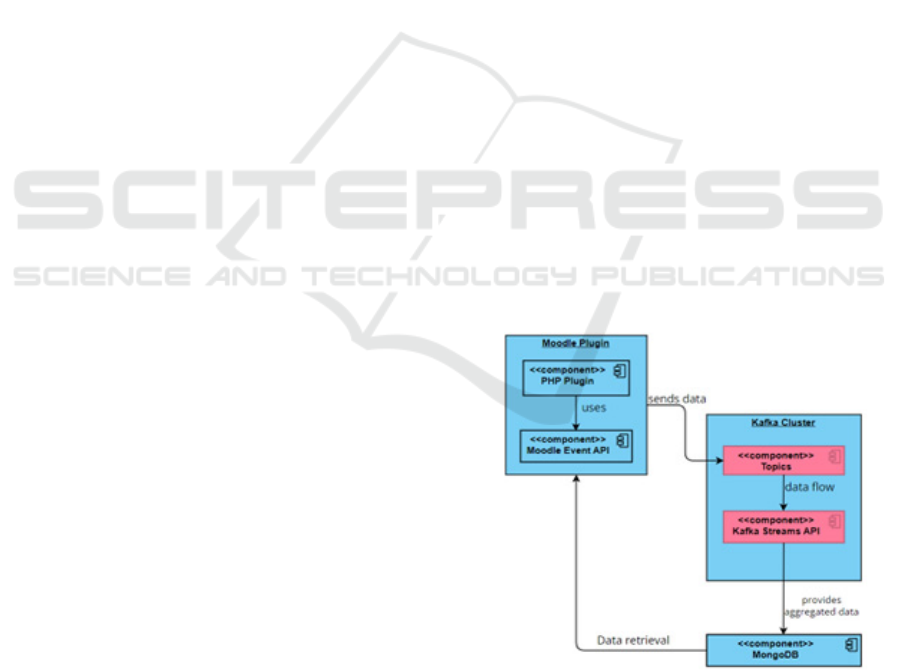
warning signs for at-risk students (see Figure 1). The
enriched data would then be stored in MongoDB for
deeper analysis, supporting timely and informed
educational interventions.
Figure 1: UML Component diagram of our SMART Plugin
integrating Moodle with Apache Kafka and MongoDB for
real-time data processing.
WEBIST 2025 - 21st International Conference on Web Information Systems and Technologies
208
4 IMPLEMENTATION
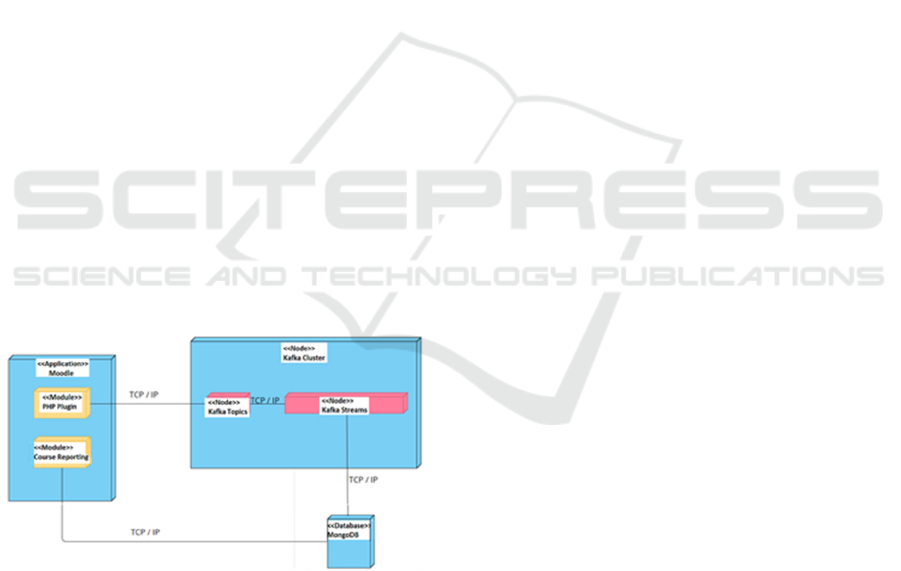
In this section we will detail the implementation of
the proposed architecture, as shown in the UML
deployment diagram in Figure 2. The resources used
were as follows:
- Moodle: Our smart plugin is being developed
with the latest stable version of Moodle (4.3.2+).
- Apache Kafka: Kafka cluster that includes the
Kafka Streams API (Kafka version 3.6.1).
- MongoDB: The latest stable release of MongoDB
for data storage (7.0).
- MongoDB Java Driver: Library for interacting
with MongoDB from the Kafka Streams
application
- MongoDB PHP Library for reading data from
MongoDB.
- Java Standard Library, which includes the
java.util.regex.Pattern package. This package
allows the application to subscribe to topics based
on a certain pattern, including those
corresponding to courses that have not yet been
created with their specific topics.
- Rdkafka library: php library for
producing/consuming messages.
- Security Protocols: Software to manage secure
communications, like SSL/TLS for HTTPS
connections.
- Programming Languages and Frameworks: PHP
(version 8.1) for Moodle plugin development,
Java for Kafka Streams, and any other languages
necessary for custom development.
Figure 2: UML Deployment Diagram of the Moodle-Kafka
Architecture.
4.1 Data Ingestion from Moodle
Data ingestion is handled by custom event handlers
within the SMART plugin, defined in observer.php
and registered via Moodle’s Events API. These
handlers respond to key student activities—such as
quiz submissions, forum posts, attendance logging,
and assignment uploads—by extracting relevant
metadata (e.g., user ID, course ID, timestamps) using
$event->get_data(), parsing the payload via
parse_event_data(), and serializing the result into
JSON using json_encode(). The structured message is
then streamed to Apache Kafka using the php-rdkafka
client (GitHub, n.d.). Each event is routed to a
designated Kafka Topic based on its type (e.g.,
quiz_submissions, forum_posts, assignments_
submitted). When a new course is created, the plugin
initializes corresponding topics (e.g., quizzes,
absences) to prepare for incoming events. For time-
sensitive activities like quizzes and assignments,
Moodle’s task manager schedules ad hoc checks for
non-submissions post-deadline.
Performance tuning identified that using three
Kafka partitions with a replication factor of two
ensured optimal throughput and low latency for high-
volume topics like quiz failures and attendance, while
single-partition topics sufficed for lower-frequency
events like late assignment tracking. These settings
were validated through simulated testing with up to
200 concurrent Moodle users during peak activity.
To ensure compliance with educational data
regulations, the system incorporates anonymization
protocols and adheres to GDPR and FERPA
standards (European Union, 2016), safeguarding
student privacy while supporting real-time
monitoring.
4.2 Data Storage with MongoDB
After real-time processing (or directly from the Kafka
producer in the current implementation), the data is
ingested into MongoDB, which serves as the central
repository for storing all processed student data. Each
document represents an event or processed data point,
including fields like student ID, activity type,
timestamp, and relevant metrics. Collections are
organized by activity type (e.g., quiz_results,
forum_interactions) to align with Kafka topics.
Indexes on key fields optimize query performance for
generating reports and alerts. MongoDB is deployed
as a replica set with configurations prioritizing
availability and partition tolerance—using
writeConcern: {w: "majority", j: true, wtimeout:
5000}, readPreference: "secondaryPreferred", and
readConcern: "available". This setup ensures
responsive dashboards while accepting eventual
consistency for non-critical analytics. For critical
operations, stronger consistency is enforced using
readConcern: "majority" and readPreference:
"primary", balancing performance with data integrity
(MongoDB Inc., 2024).
Design and Implementation of a Real-Time Web Infrastructure for Student Monitoring: A Kafka-Based Plugin for Moodle
209
4.3 Implementation of Event Handlers
and a Kafka Producer Within the
Moodle Plugin
The core of the real-time data ingestion process lies
in the custom Moodle plugin, which integrates event
handlers and a Kafka producer using PHP-rdkafka.
Each event handler is designed to listen to specific
Moodle events, using the Moodle Events API
(Moodle Docs, n.d.), such as when a student submits
an assignment, completes a quiz, or posts in a forum.
Upon capturing an event, the handler extracts relevant
information (e.g., student ID, activity details,
timestamps) and formats it into a JSON message.
This message is then passed to the Kafka
producer, which is configured to connect to the Kafka
cluster. The producer serializes the JSON message
using the librdkafka library, ensuring that the data is
compact and efficiently transmitted over the network.
The message is then published to the appropriate
Kafka topic, where it becomes available for real-time
processing or direct storage in MongoDB.
The plugin’s architecture is designed to handle
high throughput, ensuring that even during peak
usage times, all student interactions are captured and
processed without delay. This is achieved through
careful optimization of the event handlers and the
Kafka producer’s configuration, including tuning
parameters such as batch sizes, linger time, and
compression settings to balance performance and
resource utilization.
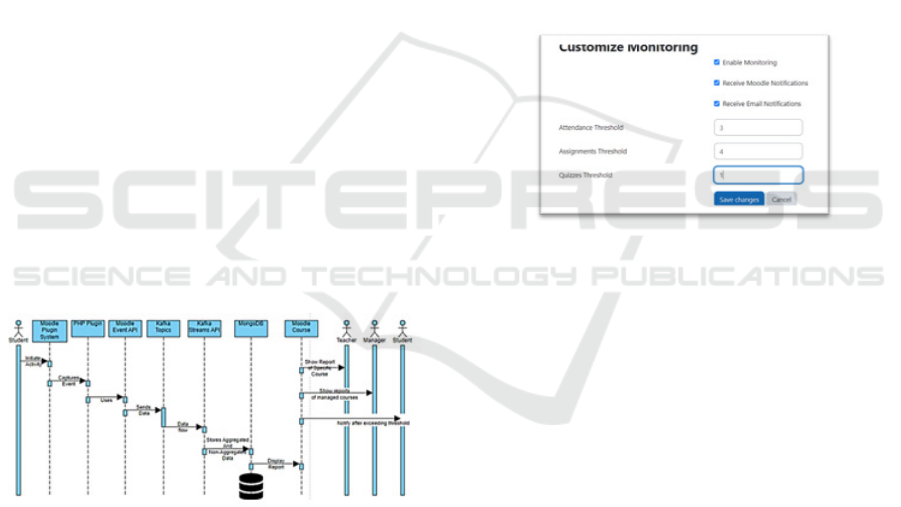
Figure 3: UML Sequence Diagram of the Moodle-Kafka
Architecture.
4.4 User Interaction
The system provides educators with role-based, user-
friendly interfaces for real-time access to student
performance data. Instructors interact with
customized Moodle dashboards enhanced by the
SMART plugin, which retrieves course-specific
data—such as attendance, quiz scores, and
participation—from MongoDB. These dashboards
support configurable alerts, allowing educators to
define threshold-based triggers for significant events,
such as missed assignments or low engagement.
Figure 4 shows the SMART plugin interface used to
set monitoring parameters and alert conditions
tailored to specific course contexts.
At the institutional level, managers access broader
analytics via Grafana dashboards, which visualize
aggregated data across multiple courses and
departments. Data flow from Moodle’s event system
through Apache Kafka to MongoDB is illustrated in
Figure 3, showcasing the real-time pipeline
architecture. The reporting interface combines data
from Moodle (student names, identifiers) and
MongoDB (engagement metrics), presenting it in
sortable HTML tables for intuitive exploration. This
dual-interface design ensures that both instructors and
administrators have timely access to actionable
insights, aligned with their respective roles and
responsibilities.
Figure 4: SMART Plugin Configuration panel.
5 RESULTS AND DISCUSSION
The proposed system demonstrates robust real-time
monitoring capabilities by integrating Apache Kafka
and MongoDB to capture, process, and visualize
student engagement data as it occurs. In a simulated
deployment reflecting a university with 1,200
students and approximately 3,600 hourly interactions,
the SMART plugin streamed events via php-rdkafka
to Kafka and stored them in MongoDB. The Kafka
cluster—configured with 3 partitions and a
replication factor of 2—maintained stable throughput
with average end-to-end latency below 80
milliseconds and no data loss, validating its suitability
for small-to-medium-scale institutions and its
scalability in line with Kafka’s capacity to handle tens
of thousands of events per second (Theofanis, Raptis,
Cicconetti, & Passarella, 2024)(Han, Shang, &
Wolter, 2020). The system facilitates timely
pedagogical interventions by alerting instructors
when students fall behind, and its real-time
dashboards—illustrated in Table 1—enable
WEBIST 2025 - 21st International Conference on Web Information Systems and Technologies
210

personalized learning by presenting metrics such as
missed assignments, absences, and quiz failures.
These analytics empower educators to provide
tailored support based on student-specific activity
patterns, thereby enhancing engagement and
improving learning outcomes. Moreover, the
infrastructure supports institutional decision-making
through the continuous analysis of performance
trends, informing curriculum adjustments, resource
allocation, and the design of targeted academic
programs. Technical integration challenges—such as
configuring Kafka for reliable message streaming,
designing scalable MongoDB schemas, and resolving
compatibility between Moodle (PHP) and Kafka
(Java)—were mitigated through Docker-based
containerization and fine-tuned Kafka connector
settings. While the system is fully functional in
controlled test environments, future work will involve
benchmarking its performance with live student
cohorts at institutional scale.
Table 1: Sample Monitoring Output Report from Moodle.
ID Name
Total
Assignme
nts Misse
d
Total
Quizzes
Misse
d
Total
Abse
nces
Total
Quizzes
Fails
10 John Doe 8 2 8 0
11 Jane Roe 1 0 1 0
6 CONCLUSIONS AND FUTURE
WORK
The SMART plugin shows how integrating Apache
Kafka with Moodle enables real-time monitoring and
improved student performance assessment within
LMS environments. This scalable and responsive
infrastructure facilitates timely educational
interventions and supports personalized learning.
Additionally, the modular framework is designed for
extensibility, paving the way for future integration of
tools like Kafka Streams and predictive machine
learning models.
The following table compares our smart Moodle-
Kafka plugin to native Moodle reporting tools.
Table 2: Moodle Kafka Plugin features vs Native Moodle
Reporting.
Feature
Moodle Native
Reports
SMART Kafka Plugin
Real-Time Monitoring
✗ ✔
Dynamic Event Topic
Creation
✗ ✔
Stream Processing Pipeline
✗ ✔ (Kafka-compatible)
Custom Threshold-Based
Alerts
✗
✔
Extensible for Future ML
Models
✗
✔
Scalable with High User
Volume
Limited
✔
(Kafka partitioned topics)
Immediate Intervention
Support
✗
✔
6.1 Implications and Contributions
This work tackles the broader challenge of integrating
real-time analytics into Learning Management
Systems (LMS) to support timely, data-driven
educational interventions. It demonstrates how
technologies like Apache Kafka and MongoDB can
be adapted to educational contexts through modular,
event-driven architectures. Key contributions
include:
A scalable infrastructure connecting Moodle
with Kafka for real-time ingestion, dynamic topic
management, and low-latency streaming, with future
support for Kafka Streams and machine learning.
The SMART plugin, which extends Moodle with
real-time dashboards and alerting features, enabling
educators to respond proactively to live student data.
A roadmap for predictive modeling, using
historical and streaming data to identify academic
risks and support personalized learning.
A bridge between educational practice and
scalable web infrastructure, showing how modern
data engineering can be embedded into open-source
LMS platforms with minimal disruption.
Beyond the technical proof-of-concept, the
architecture is generalizable to other platforms,
promoting broader adoption of responsive, analytics-
driven instruction. Future empirical studies will
assess the impact of real-time alerts and predictive
models on learning outcomes across diverse
academic settings.
6.2 Future Work
Future work will include empirical evaluation of the
system’s usability and its effect on educational
outcomes, focusing on how real-time feedback
influences both student engagement and instructor
decision-making. The next development phase
involves integrating Kafka Streams and machine
learning to transition from monitoring to predictive
analytics. Historical data from MongoDB will be
used for training models, with features engineered to
capture student behavior patterns. Algorithms such as
decision trees and neural networks will be applied to
predict dropout risk and academic performance.
These models will be embedded into the Kafka
Streams pipeline for real-time inference, generating
alerts for at-risk students. The system will support
Design and Implementation of a Real-Time Web Infrastructure for Student Monitoring: A Kafka-Based Plugin for Moodle
211

continuous learning through periodic model
retraining. Predictions and alerts will be stored in
MongoDB and visualized through real-time
dashboards in Moodle.
ACKNOWLEDGEMENTS
The authors would like to thank Karim Issa and Omar
Metlej for their major contribution to the project. The
authors also acknowledge the use of OpenAI
ChatGPT, for assistance with summarizing content
and refining the language during the preparation of
this paper.
REFERENCES
Aammou et al., “Smart agent-based educational system
using NLP for personalized feedback in Moodle LMS,”
*Br. J. Educ. Technol. Syst.*, vol. 12, no. 1, 2024.
[Online]. Available: https://www.brajets.com/index
.php/brajets/article/view/1723
Alam, R., F. Nugraha, G. Rohmat, and I. Darmawan,
“Event-driven architecture to improve performance and
scalability in microservices-based systems,” in *Proc.
IEEE ICADEIS*, 2022, doi: 10.1109/ICADEIS
56544.2022.10037390.
Amo, D., S. Cea, N. M. Jimenez, P. Gomez, and D.
Fonseca, “A privacy-oriented local web learning
analytics JavaScript library with a configurable schema
to analyze any edtech log: Moodle’s case study,”
Sustainability, vol.13, no.9, 2021, doi:10.3390/su1309
5085.
Chaffai, A.; “Real-time analysis of students’ activities on
an e-learning platform based on Apache Spark,”
*Academia.edu*, 2023. [Online]. Available:
https://www.academia.edu/109325203
European Union, “Regulation (EU) 2016/679 (General
Data Protection Regulation),” *Off. J. Eur. Union*,
2016. [Online]. Available: https://eur-lex.europa.eu/
legal-content/EN/TXT/?uri=celex:32016R0679
Gamage et al., “The impact of Moodle LMS integration on
group discussions to support collaborative learning,”
*ResearchGate*, 2022. [Online]. Available: https://
www.researchgate.net/publication/382848020
GitHub, “php-rdkafka.” [Online]. Available: https://github.
com/arnaud-lb/php-rdkafka
Han, W., Z. Shang, and K. Wolter, “Learning to reliably
deliver streaming data with Apache Kafka,” in *Proc.
IEEE/IFIP DSN*, 2020, doi:10.1109/DSN48063.2020.
00068.
Johan, E., W. Prakasa, A. Hanani, F. Rohman, and S. N.
Utama, “Improving Moodle performance using
HAProxy and MariaDB Galera Cluster,” *Appl. Inf.
Syst. Manag*, vol. 7, no. 1, 2024, doi: 10.15408/
aism.v7i1.34871.
Khriji, S., Y. Benbelgacem, R. Cheour, D. El Houssaini,
and O. Kanoun, “Design and implementation of a
cloud-based event-driven architecture for real-time data
processing in wireless sensor networks,” *J. Super
comput*, 2021, doi: 10.1007/s11227-021-03955-6.
Kiran, V. N. S., “Event-Driven architecture: Building res-
ponsive and scalable systems,” *Int. J. Sci. Res.*, vol.
10, no. 7, 2021, doi: 10.21275/sr24716231109.
Kommera, A. R., “The power of event-driven architecture:
Enabling real-time systems and scalable solutions,”
*Turk. J. Comput. Math. Educ.*, vol. 11, no. 1, 2020,
doi: 10.61841/turcomat.v11i1.14928.
Malviya, R. K., V. Mandala, S. Lekkala, and M. S. Reddy,
“Event-riven integration in multi-cloud and hybrid
architectures: Ensuring data consistency and
performance,” *SSRN*, 2025, doi:10.2139/ssrn.508
0809.
Martin et al., T. K. “Learning analytics in STEM education:
The role of Moodle tools for monitoring engagement,”
*Int. J. STEM Educ.*, vol. 8, no. 12, 2021. [Online].
Available: https://link.springer.com/article/10.1186/
s40 594-021-00323-x
Moodle, “Moodle Learning Platform.” [Online]. Available:
https://docs.moodle.org/
Moodle Docs, “Events API.” [Online]. Available:
https://docs.moodle.org/dev/Events_API
MongoDB Inc., “Read and Write Concerns,” MongoDB
Manual, 2024. [Online]. Available: https://www.
mongodb.com/docs/manual/core/replica-set-read-write
-concerns
Sáiz-Manzanares, M. C., J. J. Rodríguez-Díez, J. F. Díez-
Pastor, S. Rodríguez-Arribas, R. Marticorena-Sánchez,
and Y. P. Ji, “Monitoring of student learning in learning
management systems: An application of educational
data mining techniques,” *Appl. Sci.*, 2021, doi:
10.3390/app11062677.
Sanjana, N., R. Sinchana, V. Prabhu, and S. Sandhya,
“Real-time event streaming for financial enterprise
systems with Kafka,” in *Proc. IEEE AsianCon*, 2023,
doi: 10.1109/ASIANCON58793.2023.10270532.
Santos, J. L., “Streamlining enterprise data processing,
reporting and real-time alerting using Apache Kafka,”
in *Proc. IEEE ISDFS*, 2023, doi: 10.1109
/ISDFS58141.2023.10131800.
Theofanis, P., C. Raptis, C. Cicconetti, and A. Passarella,
“Efficient topic partitioning of Apache Kafka for high-
reliability real-time data streaming applications,”
*Future Gener. Comput. Syst.*, 2024, doi:
10.1016/j.future.2023.12.028.
Zhou, Z., L. Zhou, and Z. Chen, “A distributed real-time
monitoring scheme for air pressure stream data based
on Kafka,” *Appl. Sci.*, vol. 14, no. 12, 2024, doi:
10.3390/app14124967.
WEBIST 2025 - 21st International Conference on Web Information Systems and Technologies
212
