
A Job Finder Chatbot-Based Web Platform: A Use Case for Software
Engineers
Panagiotis Fotiadis, Georgia M. Kapitsaki
a
and Maria Papoutsoglou
b
Department of Computer Science, University of Cyprus, Aglantzia, Cyprus
Keywords:
Job Adverts, Chatbot, Hard Skills, Soft Skills, Software Engineering Positions, GitHub.
Abstract:
Finding a job requires browsing through a vast number of position openings, usually at various online sites.
This process becomes more complicated for users when they are considering different potential job locations.
Even though existing tools that automate the process exist (e.g. sonara.ai, dream.jobs), they lack the element
of interactivity with the user and the integration of external resources that contain information on the skills of
the user. With the aim to bridge the gap between job seekers and potential employers by matching resumes
and job listings more efficiently and effectively, in this work we are introducing an AI-driven chatbot-based
web platform to assist job seeking. In the initial implementation, we are considering the job seeking needs of
software engineers but more disciplines can be easily added. We have integrated the developer’s CV and the
user’s GitHub account, and are describing the design and implementation process of the web platform, while a
small scale user evaluation has also been performed. We argue that the chatbot can be used as a starting point
for similar job seeking assistants.
1 INTRODUCTION
There is a noticeable disconnect in the current job
market, where employers struggle to find candidates
with the right mix of skills and competences, while
job seekers often find it challenging to locate op-
portunities that match their specific skill set, experi-
ence and career aspirations (Aluas et al., 2024). The
essence of personalized job recommendations lies
in their ability to significantly increase employment
chances and simplify the job seeking process. By
delivering tailored job suggestions that align closely
with an individual’s skills, experience, and career
aspirations, these systems transform the task of job
hunting into a more manageable and targeted en-
deavor. The utilization of Artificial Intelligence (AI)
and machine learning technologies presents an op-
portunity to significantly improve the accuracy and
relevance of job recommendations (Le Barbanchon
et al., 2023). Even though existing commercial tools
that offer such recommendations exist (e.g. sonara.ai,
dream.jobs), they lack the element of interactivity
with the user and the integration of external resources
relevant to the user skills, which are useful for spe-
a
https://orcid.org/0000-0003-3742-7123
b
https://orcid.org/0000-0003-0658-5065
cific disciplines, such as the development activity of
the user for software engineering positions.
In this work, we aim to create a chatbot-based web
platform that efficiently matches job seekers with rel-
evant opportunities based on a detailed analysis of
their skills (hard and soft skills) and preferences. The
chatbot aims to gather user information in a conver-
sational manner, making the process of adding prefer-
ences and skills more engaging. The main contribu-
tion of the work lies in enhancing the efficiency of the
job search and recruitment process by demonstrating
how AI-driven chatbots can be utilized to personal-
ize job seeking. By analyzing a large number of job
listing from online sites, as well as developers’ CVs
and GitHub activities, the platform offers at the cur-
rent state of implementation personalized job recom-
mendations to software engineers, thereby increasing
the chances of successful employment. Nevertheless,
more disciplines will be added in the future. The job
listings are collected from ergodotisi.com for Cyprus
and glassdor.com for United States. The matching of
CV and job listings is based on the user’s previous
years of experience, soft skills, hard skills, education,
and other personal preferences, such as location and
company. We have evaluated the chatbot via a small-
scale user study focusing on assessing its usability
and effectiveness in matching jobs and resumes, and
Fotiadis, P., Kapitsaki, G. M. and Papoutsoglou, M.
A Job Finder Chatbot-Based Web Platform: A Use Case for Software Engineers.
DOI: 10.5220/0013749000003985
Paper published under CC license (CC BY-NC-ND 4.0)
In Proceedings of the 21st International Conference on Web Information Systems and Technologies (WEBIST 2025), pages 197-204
ISBN: 978-989-758-772-6; ISSN: 2184-3252
Proceedings Copyright © 2025 by SCITEPRESS – Science and Technology Publications, Lda.
197

the overall user satisfaction (Chowdhary and Chowd-
hary, 2020).
Chatbot Source Code Availability. The job
finder chatbot is available for replication purposes on-
line in a GitHub repository: https://github.com/
CS-UCY-SEIT-lab/Job-Finder-Chatbot.
The remainder of the text is structured as follows.
Section 2 presents relevant related work, while Sec-
tion 3 describes the design choices and the implemen-
tation tools of the chatbot, including use demonstra-
tion. The user evaluation is presented in section 4,
while section 5 discusses the main findings. Finally,
section 6 concludes the work.
2 RELATED WORK
Chatbots. Chatbots function effectively across var-
ious fields, from customer support to personal assis-
tance, making them a crucial asset in numerous ap-
plications (Nagarhalli et al., 2020). In customer ser-
vice, they can offer 24/7 assistance, handling inquiries
and resolving issues promptly (e.g. chatbot.com).
In e-commerce, chatbots enhance the shopping ex-
perience by offering personalized recommendations
and support (e.g. maisieai.com). In healthcare, they
can triage symptoms and provide health-related in-
formation (Shinde et al., 2021), whereas they have
also been used for career counseling purposes (Suresh
et al., 2021). In software engineering, they have been
used to assist in understanding and using Open Source
Software licenses (Shittas et al., 2025).
Skills, Job Matching and Recommendations.
Prior works have focused on extracting skills from
job advertisements, using both automatic and man-
ual techniques. A pre-trained LinearSVC model was
used for identifying skills in advertisements in Ger-
man (Grüger and Schneider, 2019), while manual
analysis was used for finding soft skills in job ad-
vertisements for software positions in Cyprus (Kapit-
saki et al., 2024). Earlier research has also focused
on gathering software developers’ prior experience
from different sites in one location, in order to assist
employers (Greene and Fischer, 2016; Kapitsaki and
Foutros, 2017).
In job matching, an algorithm considering
seeker’s preferences has been introduced by Zhou
et al. (Zhou et al., 2019). Zero-Shot Learning and
specific pretrained models (e.g. all-MiniLM-L12-
v2) were used in order to align job descriptions with
candidate profiles (Kurek et al., 2024). Job adver-
tisements from Avenga were employed for this pur-
pose, while the used dataset contains also previous
mappings manually created by recruiters. When it
Table 1: Comparison of current work with online job seek-
ing systems.
Features sonara.ai simplify.jobs careerflow.ai dream.jobs Our work
Chatbot
function-
ality
✓ ✓
Analyze
re-
sume/CV
✓ ✓ ✓ ✓
Large
variety of
jobs in
database
✓ ✓
Considers
hard skills
✓ ✓ ✓ ✓ ✓
Considers
soft skills
✓ ✓
Use of
GitHub
✓
comes to personalized job recommendations, using
the largest online job board in Sweden, it was found
that recommending a vacancy to a job seeker in-
creases the seeker’s possibility to work at that specific
place (Le Barbanchon et al., 2023).
Concerning online tools, the recent escalation in
the development of AI made it possible to create tools
that help, personalize, and boost the process of find-
ing the best-fitting jobs for the seekers. Sonara,
1
Sim-
plify,
2
Careerflow
3
and Dream.jobs
4
are main such
tools that offer different subscription plans. Sonara
and Careerflow work by analyzing user’s CV for
years of experience and hard skills and based on that
information filters the job listings that are posted on
the side of the employer. Simplify uses a chatbot
to collect information such as hard skills, location,
salary, and preferred company. This system has a lot
of companies uploading their job listings directly to
them. Dream.jobs also has a small number of job list-
ings, but the system’s CV analyzer takes into consid-
eration hard skills and soft skills. Table 1 provides a
comparison of the features of the above systems and
the current work.
3 DESIGN AND
IMPLEMENTATION
3.1 Platform Overview
The implemented job finder chatbot-based web plat-
form aims to match the abilities of a software engi-
neer based on their CV and their GitHub activity with
available job advertisements in online sites. The plat-
1
https://www.sonara.ai/
2
https://simplify.jobs/
3
https://www.careerflow.ai/
4
https://dream.jobs/
WEBIST 2025 - 21st International Conference on Web Information Systems and Technologies
198

form initially analyzes users’ CV and GitHub profile
in order to extract hard skills and soft skills. GitHub
was chosen, as it summarizes well developer’s prior
experience in OSS projects and has been used also in
prior works for this purpose, functioning as an up-to-
date CV for developers (Greene and Fischer, 2016;
Kapitsaki and Foutros, 2017). Then, with the use of
the chatbot, the users provide information on the de-
sired job location, company, type of employment (full
or part time), their years of experience and any ad-
ditional hard skills and soft skills they want to add.
Finally, using the collected information the platform
filters the available job listings that are collected and
analyzed from glassdoor.com and ergodotisi.com, in
order to provide to users best matches.
3.2 Sources of Job Listings
The selection of glassdoor.com and ergodotisi.com as
primary sources for the data collection was influenced
by their structural similarities and extensive job list-
ings. Both platforms present job advertisements in a
concise list format, with each listing linked to a sep-
arate URL detailing the full job description. Glass-
door.com, being one of the leading job advertisement
websites in the United States, and ergodotisi.com,
holding a similar standing in a European country
(Cyprus), were good candidates for compiling a com-
prehensive and inclusive dataset of job posts. This
way two geographical areas were added in the plat-
form, whereas additional sources for other locations
can be added. Data are collected at regular intervals
to ensure the platform considers recent job posts.
Before settling for those two sources, other plat-
forms, such as LinkedIn and Monster were considered
and examined. However, they were both excluded for
the following reasons. LinkedIn features a sophisti-
cated search engine and complex website structure,
but extracting information is not allowed. Monster
was found to have a limited number of listings for
software engineering positions that were targeted for
the initial implementation of the chatbot-based web
platform.
3.3 Data Collection and Extraction
Concerning the data collection process, Selenium
5
was used to automate the browsing process to collect
job listing data from the online platforms. Beautiful-
Soup4
6
was used alongside Selenium to extract spe-
cific content from web pages after they were loaded
5
https://www.selenium.dev/
6
https://pypi.org/project/beautifulsoup4/
and interacted with by Selenium, taking into consid-
eration the job listing structure from the sites. Light-
cast
7
offers a taxonomy in hard and soft skills con-
sisting of more than 33,000 skills accessible via the
Lightcast’s Open Skills API. This service was pre-
ferred over creating a skills taxonomy from scratch or
employing other Machine Learning or Natural Lan-
guage Processing (NLP) techniques to extract skills,
as Lightcast updates these data constantly, ensuring
that any new hard skill or technology that emerges
is added in the database. The Lightcast API is then
used to return the relevant soft and hard skills found
within each job post description (using as input the
job post text), so that these can be subsequently
matched against the user’s skills. The final structure
of the data collected from job posts are stored in JSON
(JavaScript Object Notation) format so that they can
subsequently be matched against the developer profile
and preferences (note however, that job postings from
ergodotisi.com are used only for matching purposes
and are not further stored).
From the side of the developer, data are collected:
1) from the user (via the interaction with the chatbot),
2) the uploaded CV and 3) the user’s GitHub pro-
file. Uploading a CV generally allows a job match-
ing system to analyze comprehensive details about
a user’s educational background, skills, and accom-
plishments, and is the traditional approach used also
in the online systems (e.g. sonara). Integrating
GitHub data enables the system to assess in addi-
tion the user’s coding projects, contributions to pub-
lic repositories, and technical skills, which are often
not fully captured in a traditional CV. The system can
thus, identify not only the programming languages
that the user knows but also their recent activity and
expertise level in using those languages in real-world
projects. The information collected from the user via
the chatbot are specifically: location(s) of desired job
positions, job type, preferred company, years of ex-
perience, education information, hard skills, and soft
skills. These data are also stored in a JSON schema
as job listings data.
The data retrieved and used for the job listings
and the user are all listed in Table 2. Concerning the
user, fields beginning with info are provided by the
user (via the chatbot), while the rest are retrieved from
the developer’s CV and GitHub profile (programming
languages captured in hard skills and user’s location
are extracted from GitHub, while hard skills and soft
skills are retrieved from the user’s CV). For the em-
ployment type, we are using the following options: 1)
full or part time, 2) hybrid, remote or flexible, 3) per-
manent or temporary.
7
https://lightcast.io/
A Job Finder Chatbot-Based Web Platform: A Use Case for Software Engineers
199

Table 2: Data used for the job listing and the user.
Name Data type
Job listings data (J)
URL string
location string
company name string
employment type string array
years of experience string
hard skills string array
soft skills string array
User data (U)
ID string
username string
info_location string array
info_job type string array
info_company string array
info_years of experience string array
info_education level string array
info_education type string array
info_hard skills string array
info_soft skills string array
cv_hard skills string array
cv_soft skills string array
github_hard skills string array
github_location string
3.4 Skills Matching
When all data from the job adverts and the user are
available, skill matching is performed using the two
sets of data: one set comprises of the hard or soft
skills of the user (U) and the second set contains the
respective hard or soft skills from the job adverts (J).
We decided to perform a match on skills on keywords
level, as the extended taxonomy of Lightcast covers a
very large number of skills. For this purpose, we are
relying on Jaccard similarity:
J(J, U) =
| J ∩U |
| J ∪U |
(1)
The two sets are considered relevant for the user,
and hence the respective job advert, if there is a value
of 0.2 or higher for either the hard skills or the soft
skills matching. We have opted for this threshold af-
ter experimentation with the matching process in the
sources of job adverts, but the threshold can be up-
dated (e.g. if more sources are added).
3.5 Implementation Tools and Chatbot
Flow
The Rasa
8
framework was used at the core of the
implementation as it was adopted as the chatbot im-
plementation framework. It was chosen due to its
popularity and since it has an Open Source edi-
tion. Rasa uses a number of steps for understanding
user’s intent and performing the appropriate action.
It combines tokenization, feature extraction, and so-
phisticated classification and decision-making mech-
anisms, to empower the application to handle user in-
teractions effectively, recognizing intents and extract-
ing entities, with the above features:
1. User input: The job finder chatbot collects de-
tailed user inputs across several categories criti-
cal to job matching, including geographic loca-
tion, job type preference (e.g. full time), years
of experience, educational background, soft skills
and hard skills, as detailed in subsection 3.3. It
engages users in a comprehensive dialogue, en-
suring that all relevant information is gathered to
support personalized job recommendations.
2. NLP analysis: The job finder chatbot successfully
interprets and processes user responses, such as
interpreting "Alabama" as a location and recog-
nizing "5 years" as the level of experience. The
NLP component of Rasa has been tuned in the
framework of the current work with relevant con-
figuration files offered to understand and extract
meaningful information from user inputs.
3. User feedback mechanism: Each stage of the in-
teraction with the chatbot allows for user confir-
mation or correction, which is crucial for main-
taining the accuracy of user data.
4. Data integration: The job finder chatbot-based
web platform is an integrated platform that takes
user data (e.g. skills and experience) from various
sources (chatbot, CV, GitHub) and maps them to
the available job postings (then shows to the user
links to job listings tailored to the user’s profile).
The backend of the web platform is leveraging the
collected data to fetch relevant job opportunities
from external job sites.
For the chatbot functionality, Rasa relies on a
number of key configuration files, including do-
main.yml, nlu.yml, and stories.yml. Understanding
user’s intent is vital for the above process, and specif-
ically items 2 and 3. The nlu.yml file contains lookup
tables with expected words that the user can give and
variations of answers that the user might give using
8
https://rasa.com/
WEBIST 2025 - 21st International Conference on Web Information Systems and Technologies
200
the lookup tables’ words. This file is used to cre-
ate the natural language model which the chatbot is
based on, recognizing the user’s answers and decid-
ing on the chatbot’s story flow. A subset of the possi-
ble user intents when collecting soft skills is presented
below, with the text in square brackets ([]) referring
to the parameter from the user provided text and the
text in parenthesis (()) referring to the entity’s name,
i.e. (soft_skills) in the example intent:
− i n t e n t : c o l l e c t _ s o f t _ s k i l l s
e x am pl e s : |
− I am good a t [ teamwork ] ( s o f t _ s k i l l s )
− [ l e a d e r s h i p ] ( s o f t _ s k i l l s )
− [ f a s t l e a r n e r ] ( s o f t _ s k i l l s ) and
[ l e a d e r s h i p ] ( s o f t _ s k i l l s )
− [ f a s t l e a r n e r ] ( s o f t _ s k i l l s ) , [ l e a d e r s h i p ]
( s o f t _ s k i l l s ) and [ teamwork ] ( s o f t _ s k i l l s )
− I e x c e l i n [ com mu n ic at i on ] ( s o f t _ s k i l l s )
and [ t e a m b u i l d i n g ] ( s o f t _ s k i l l s ) .
− My s t r e n g t h s i n c l u d e [ c r i t i c a l t h i n k i n g ]
( s o f t _ s k i l l s ) and [ pr obl em s o l v i n g ] ( s o f t _
s k i l l s ) .
− I p o s s e s s s t r o n g [ a n a l y t i c a l s k i l l s ]
( s o f t _ s k i l l s ) and [ i n n o v a t i o n ] ( s o f t _ s k i l l s )
c a p a b i l i t i e s .
− [ S e l f − mo t i v a t i o n ] ( s o f t _ s k i l l s ) i s one o f
my c o r e q u a l i t i e s .
− I have e x p e r i e n c e w it h [ v i r t u a l t ea m s ]
( s o f t _ s k i l l s ) and [ kn o wled ge t r a n s f e r ]
( s o f t _ s k i l l s ) .
− [ C o n s u l t i n g ] ( s o f t _ s k i l l s ) ,
[ r e p o r t w r i t i n g ] ( s o f t _ s k i l l s ) , and
[ b u d ge t i ng ] ( s o f t _ s k i l l s ) a r e my e x p e r t i s e
a r e a s .
− I am known f o r my [ r e l i a b i l i t y ]
( s o f t _ s k i l l s ) and [ a b i l i t y t o mee t
d e a d l i n e s ] ( s o f t _ s k i l l s ) .
− P r o f i c i e n t i n [ q u a l i t y a s s u r a n c e ]
( s o f t _ s k i l l s ) and [ p r o g r e s s r e p o r t i n g ]
( s o f t _ s k i l l s ) .
[ . . . ]
The domain.yml file contains intents and entities
names that can be extracted from user’s input. In our
case, the entities correspond to the user data that can
be collected from the chatbot as presented in Table 2
(starting with info). Stories.yml file defines a diagram
of the chat flow and how the chatbot must proceed af-
ter each question is answered and what information it
should expect from the user to provide. We are rely-
ing on a main story flow, which contains a large num-
ber of actions and intents, in order to collect all re-
quired user data sequentially. All configuration files
are available on the GitHub repository of the platform.
For the main implementation of the platform,
MongoDB was also used for data storage, Docker was
used for making the chatbot deployment easier, and
Flask was used for the server-side logic and database
interactions. We also employed JSON Web Tokens
(JWT) that are defined by the open standard RFC
7519 for securely transferring information, while we
relied on React JS for frontend development pur-
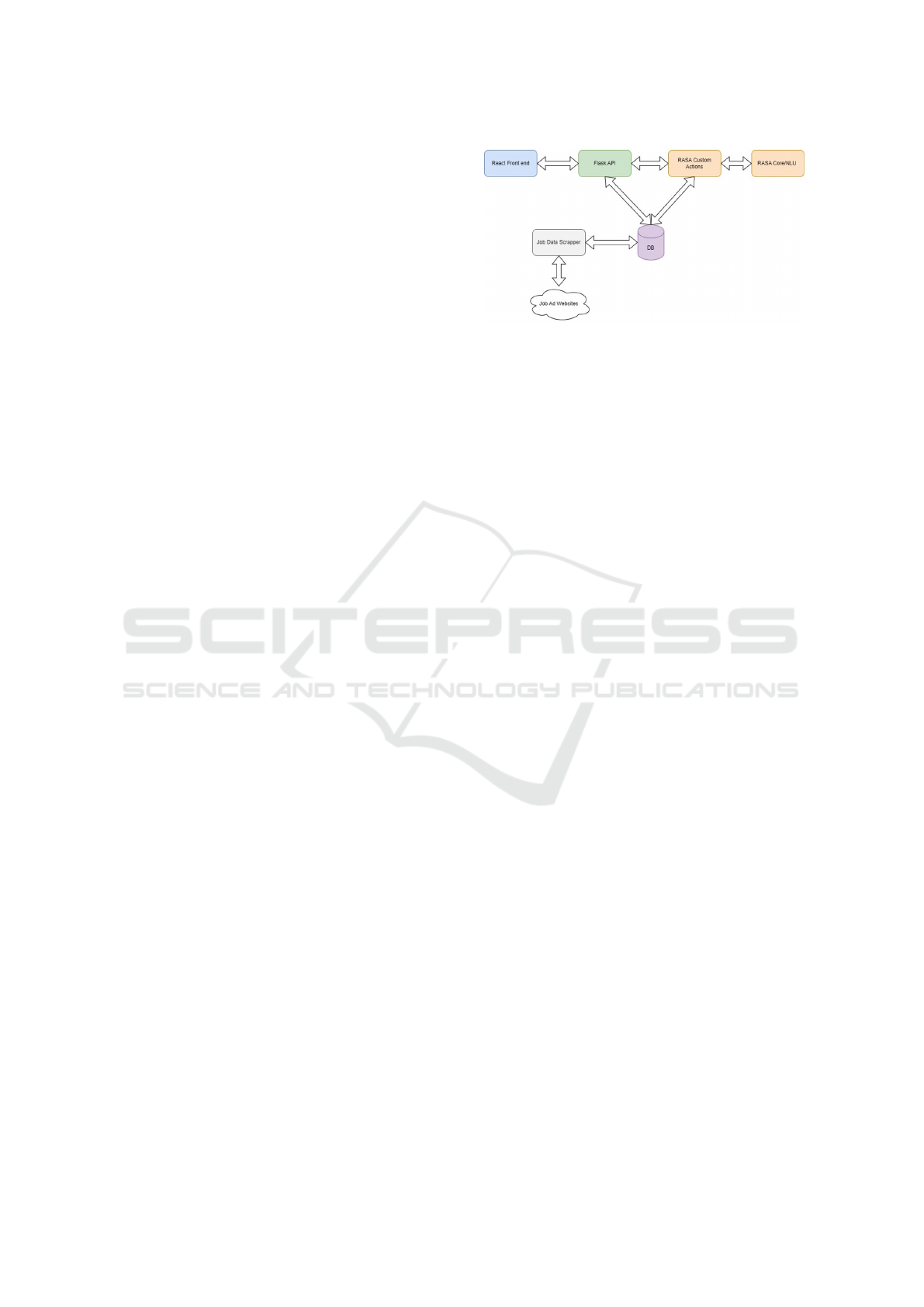
poses.The interconnection between the main tools is
depicted in Figure 1.
Figure 1: Interaction of implementation tools.
3.6 Use Demonstration
Basic interactions with the chatbot-based web plat-
form are depicted in Figure 2 and Figure 3. When the
user is logged in the system, the available page layout
allows the user to refresh the current chat (by clicking
“Refresh Chat”), create a new chat (by clicking “New
Chat”), upload his/her CV (using “Resume/CV De-
tails”), trigger the GitHub analysis (by giving his/her
GitHub username) and navigate to old chats. An ex-
ample of the respective analysis results after the user
has uploaded his/her CV and has triggered the GitHub
analysis is shown in Figure 2. When the user adds
his/her GitHub username, the backend uses GitHub’s
API to detect all programming languages that are in
the repositories the user has contributed to, and to also
expert the user’s location if this information is avail-
able in the user profile on GitHub. The text of the CV
is also analyzed to detect hard and soft skills (rely-
ing as aforementioned on the taxonomy provided by
Lightcast). Those data are used along with the data
collected through the chatbot conversation in order to
find the most fitting job adverts for the user.
Concerning the chatbot, user’s temporary data that
are stored during a chatbot use are deleted every time
the user logs in or clicks on “Refresh Chat” option.
An example interaction flow with a user is depicted
in Figure 3. The user is interested in job posts in Al-
abama, whereas Larnaca is detected as user’s location
from GitHub, so both locations are used for the job
listings recommendations. The user is interested in
full type employment, has 5 years of experience and
is not interested in specific companies. The user then
provides information on his/her education level, hard
and soft skills, and at the end the chatbot recommends
a specific job post to the user.
4 USER EVALUATION
Survey Creation. The chatbot-based web platform
for job recommendations has been evaluated with the
A Job Finder Chatbot-Based Web Platform: A Use Case for Software Engineers
201
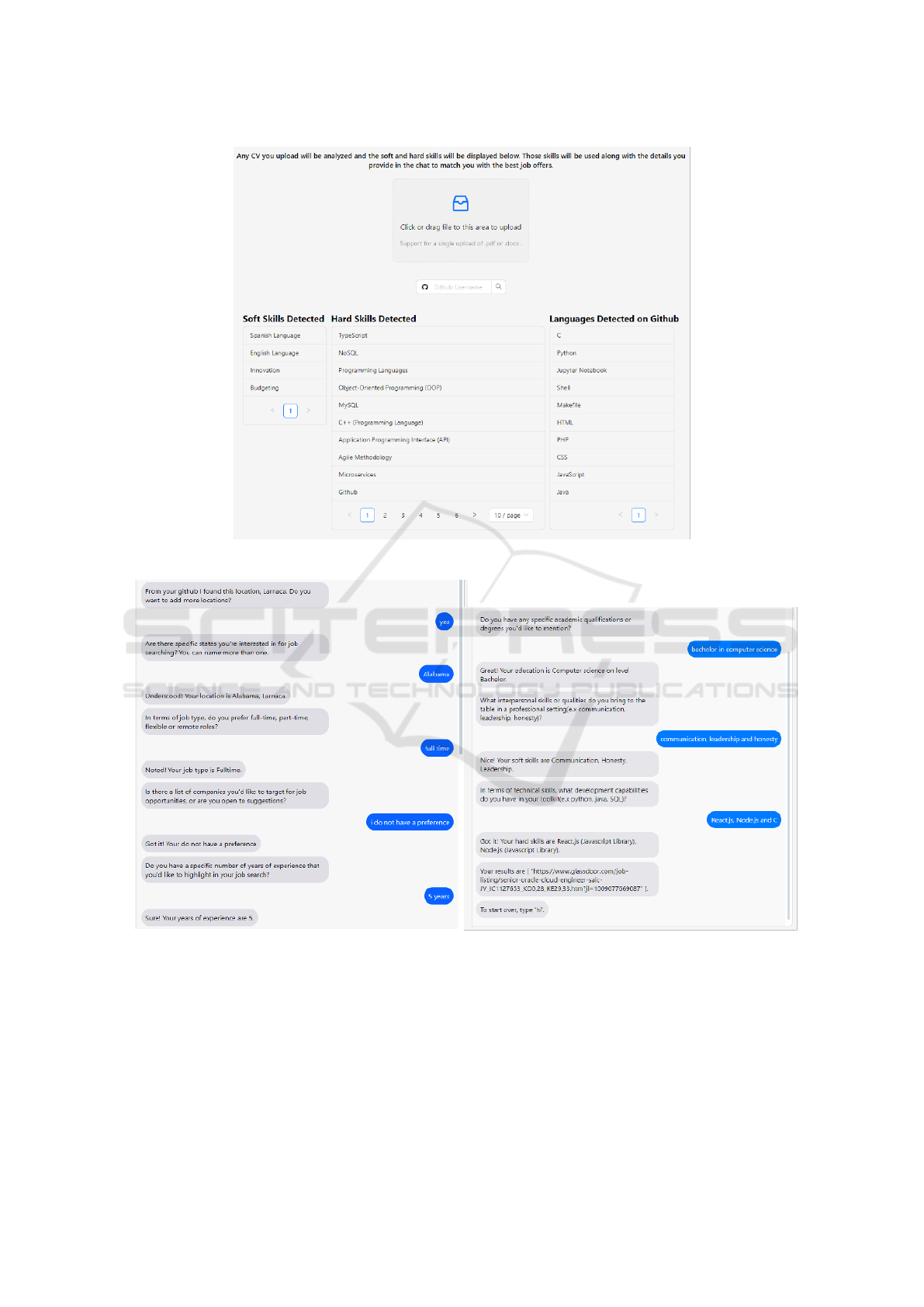
Figure 2: CV analysis in job finder chatbot.
Figure 3: Interaction example with the job finder chatbot.
participation of users from the University of Cyprus.
The user evaluation aimed to gather feedback on the
usability, effectiveness, and overall user experience
with the web platform. The questionnaire consisted
of 15 questions that cover the main parts presented
in Table 3, including prior experience with job search
and the feedback from the interaction with the imple-
mented platform. Questions used are mainly multi-
ple choice, 5-Likert case and open ended questions.
Potential participants within the Computer Science
Department of University of Cyprus were contacted
via email communication. Participants were informed
that no personal data would be collected in the survey,
that their replies would be used solely for research
purposes and would not trace back to the participant
in any way. In order to answer the questionnaire, par-
WEBIST 2025 - 21st International Conference on Web Information Systems and Technologies
202
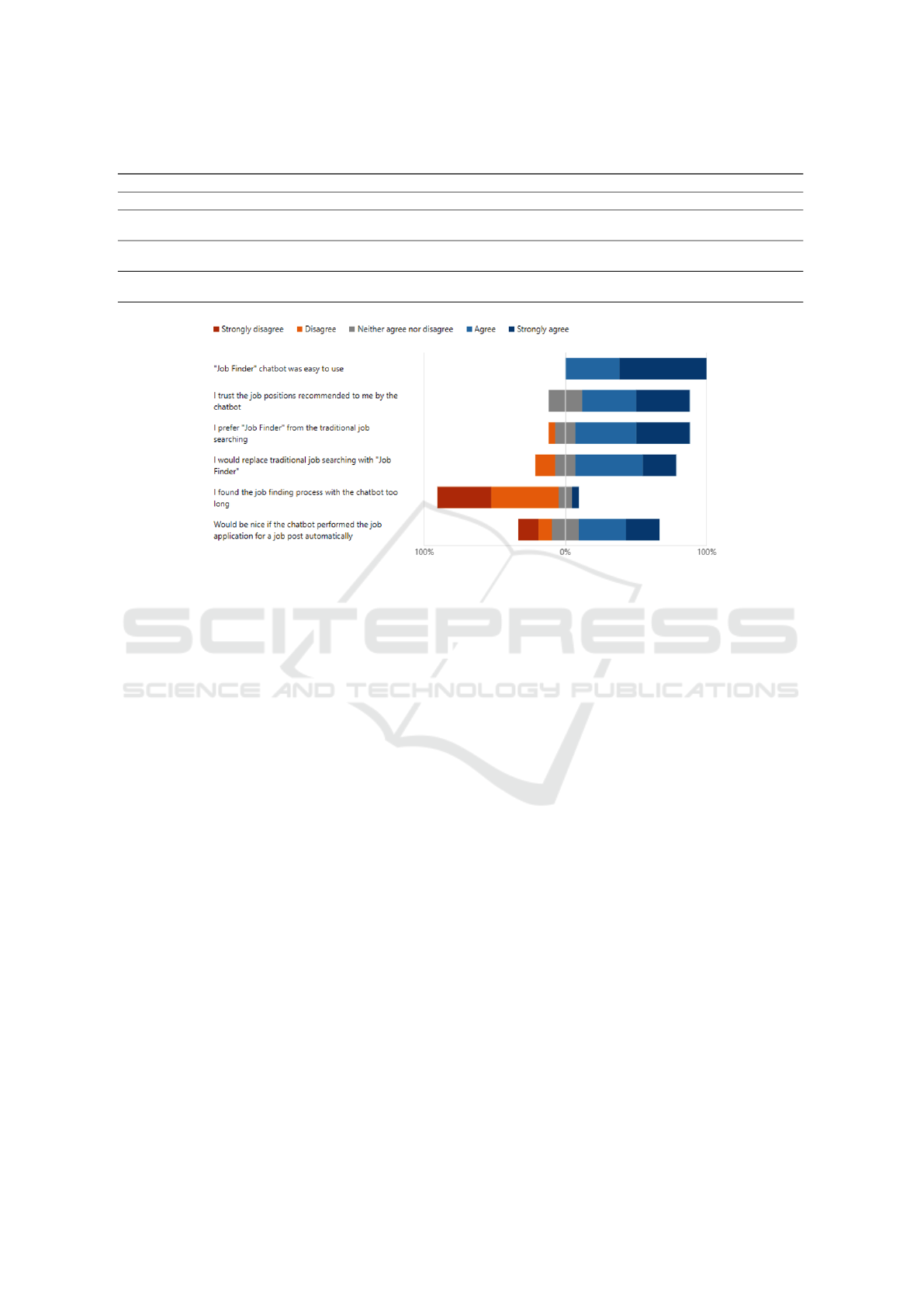
Table 3: Main parts of user evaluation questionnaire.
Section # questions Question examples
Background, job search behavior and preferences 4 What is your current employment status? (multiple choice)
Previous experience with job finder tools 4 In which industry/field are you seeking employment? (open)
How many days per week do you dedicate to looking for job opportunities? (open)
Willingness to use AI-driven job finder tools 2 Would you use an AI chatbot that finds you personalized job listings based on the details
given on the chatbot, GitHub and CV that you provide? (multiple choice)
Feedback on chatbot usage 5 JobFinder chatbot was easy to use. (5-Likert scale)
(after interacting with the chatbot) I trust the job positions recommended to me by the chatbot. (5-Likert scale)
Figure 4: Users’ replies to main questions of evaluation.
ticipants gave their consent to the above.
Results. 21 users participated in the evaluation
in total. 13 (61.9%) of them were employed, while
3 (14.3%) were seeking employment and 5 (23.8%)
were students. Data concerning the hours users spent
on job search were collected (second section of the
questionnaire), with an average value of 5.4 hours per
week indicated by the users (standard deviation: 3.56
hours) and with some participants spending even 10
hours on this task weekly.
Concerning the experience with using the chatbot-
based web platform, most participants found it easy
to use: 13 (61.9%) participants agreed strongly and 8
(38.1%) agreed. Replies’ distribution to some of the
main questions on the chatbot interaction are shown
in Figure 4. The chatbot was generally well-received,
particularly in terms of usability, trustworthiness in
job recommendations and the length of the job search
process. An important question was whether users
would prefer this chatbot-based approach over the tra-
ditional job search and most of the users indicated a
preference for the chatbot: 15 (71.4%) participants
agreed or agreed strongly. Adding more features,
such as automatic job application by the chatbot on
behalf of the user, were also considered useful. Such
features were among the participants suggestions for
improving the chatbot.
5 DISCUSSION
We have gathered overall positive feedback from the
users, which allows also to transfer the current imple-
mentation to other disciplines beyond software engi-
neering. This would require considering potentially
also other sources of information for skills acquisi-
tion besides GitHub that is tailored to software de-
velopment. The main matching performed based on
the chatbot interaction with the user does not require
any adaptations for this transfer. Concerning the data
sources used, the accuracy of the recommendations
provided by the chatbot depends heavily on the com-
prehensiveness and reliability of the information it re-
ceives from the users. However, we argue that it is
vital to use more than one sources of information. If
the chatbot relies solely on conversational data pro-
vided during interactions with the user and does not
have access to additional detailed sources like CVs,
the matching might not be as accurate.
Limitations. In terms of data collection for job
adverts, we are limited by the terms of service and the
structure of respective sites, and for this reason it is
not feasible to use any site for job adverts collection.
Concerning the software development activity, we are
relying on GitHub to gather relevant data but this may
not reflect the user’s activity on all skills level, as it
refers mainly to programming language skills. More-
A Job Finder Chatbot-Based Web Platform: A Use Case for Software Engineers
203

over, the evaluation has been limited to the population
of University of Cyprus, so main results might differ
if a wider population of software engineers employed
in the industry had tested the chatbot.
6 CONCLUSIONS
In this work, we have presented a job finder chatbot-
based web platform, that assists users to get personal-
ized recommendations for their software development
job search, considering their preference and skills,
and using different data sources (CV and GitHub pro-
file). The chatbot can be used as a starting point
for the development of similar interactive job seek-
ing systems, and its initial small-scale user evaluation
is promising in this respect. Future work will expand
the chatbot’s algorithms and databases to support a
broader range of job categories beyond software en-
gineering, while new sources of job adverts covering
more countries will be added. Moreover, participants
from the software industry will also be recruited for
evaluation purposes. An extended evaluation will al-
low to draw more conclusions on its comparison with
traditional job searching techniques.
REFERENCES
Aluas, M., Angelis, L., Arapakis, I., Arvanitou, E., Geor-
giou, K., Gogos, A., Jahn, M., Kehagias, D., Kordoni,
V., Macaluso, S., et al. (2024). Skillab: Skills matter.
In 2024 50th Euromicro Conference on Software En-
gineering and Advanced Applications (SEAA), pages
491–498. IEEE.
Chowdhary, K. and Chowdhary, K. (2020). Natural lan-
guage processing. Fundamentals of artificial intelli-
gence, pages 603–649.
Greene, G. J. and Fischer, B. (2016). Cvexplorer: Identi-
fying candidate developers by mining and exploring
their open source contributions. In Proceedings of
the 31st IEEE/ACM international conference on au-
tomated software engineering, pages 804–809.
Grüger, J. and Schneider, G. J. (2019). Automated analysis
of job requirements for computer scientists in online
job advertisements. In WEBIST, pages 226–233.
Kapitsaki, G., Chatzivasili, L., Papoutsoglou, M., and
Galster, M. (2024). An exploratory study on soft
skills present in software positions in cyprus: a
quasi-replication study. In Proceedings of the 18th
ACM/IEEE International Symposium on Empirical
Software Engineering and Measurement, pages 200–
211.
Kapitsaki, G. M. and Foutros, P. (2017). Dear developers,
your expertise in one place. In 2017 43rd Euromicro
Conference on Software Engineering and Advanced
Applications (SEAA), pages 371–374. IEEE.
Kurek, J., Latkowski, T., Bukowski, M.,
´
Swiderski, B.,
Ł˛epicki, M., Baranik, G., Nowak, B., Zakowicz, R.,
and Dobrakowski, Ł. (2024). Zero-shot recommenda-
tion ai models for efficient job–candidate matching in
recruitment process. Applied Sciences, 14(6):2601.
Le Barbanchon, T., Hensvik, L., and Rathelot, R. (2023).
How can ai improve search and matching? evidence
from 59 million personalized job recommendations.
Evidence from, 59.
Nagarhalli, T. P., Vaze, V., and Rana, N. (2020). A re-
view of current trends in the development of chat-
bot systems. In 2020 6th International conference
on advanced computing and communication systems
(ICACCS), pages 706–710. IEEE.
Shinde, N. V., Akhade, A., Bagad, P., Bhavsar, H., Wagh,
S., and Kamble, A. (2021). Healthcare chatbot system
using artificial intelligence. In 2021 5th International
Conference on Trends in Electronics and Informatics
(ICOEI), pages 1–8. IEEE.
Shittas, G., Kapitsaki, G. M., and Papoutsoglou, M. (2025).
Licy: A chatbot assistant to better understand and se-
lect open source software licenses. In Mannion, M.,
Männistö, T., and Maciaszek, L. A., editors, Proceed-
ings of the 20th International Conference on Evalu-
ation of Novel Approaches to Software Engineering,
ENASE 2025, Porto, Portugal, April 4-6, 2025, pages
573–581. SCITEPRESS.
Suresh, N., Mukabe, N., Hashiyana, V., Limbo, A., and
Hauwanga, A. (2021). Career counseling chatbot on
facebook messenger using ai. In Proceedings of the
International Conference on Data Science, Machine
Learning and Artificial Intelligence, pages 65–73.
Zhou, Q., Liao, F., Chen, C., and Ge, L. (2019). Job rec-
ommendation algorithm for graduates based on per-
sonalized preference. CCF Transactions on Pervasive
Computing and Interaction, 1:260–274.
WEBIST 2025 - 21st International Conference on Web Information Systems and Technologies
204
