
Smart Optimized Scheduling Under Constraints in Industry 5.0
Through Intelligent Computational Methods
Cherifa Nakkach
1
, Wiem Abbes
1
and Yvan Picaud
2
1
Orange Innovation Tunisia, Sofrecom Tunisia, Tunis, Tunisia
2
Orange Innovation, Lannion, France
Keywords: Industry 5.0, Metaheuristic, Smart Scheduling, Raw Material Optimization, Production Planning, Additive
Manufacturing.
Abstract: Production scheduling has become an integral component of next-generation industrial systems during the era
of Industry 5.0, which emphasizes collaboration between humans and machines, sustainability, and hyper-
personalization. To address complex scheduling challenges, this paper presents a smart scheduling framework
based on metaheuristic optimization tailored for manufacturing environments incorporating 3D printing
technologies. The proposed framework addresses several key objectives, including the optimization of energy
consumption, efficient utilization of raw materials, and minimization of total production time. By
incorporating metaheuristic algorithms such as Genetic Algorithms, Particle Swarm Optimization, and Ant
Colony Optimization, the system demonstrates adaptability to multiple constraints and competing priorities.
Experimental evaluations confirm the framework’s effectiveness in enhancing operational efficiency,
flexibility, and sustainability, in alignment with the core principles of Industry 5.0.
1 INTRODUCTION
With Industry 5.0, manufacturing has entered a new
era, where humans-centric design, sustainability, and
resilience are now equally important. Instead of
focusing solely on smart automation, cyber-physical
systems, and IoT integration, Industry 5.0 promotes a
symbiotic collaboration between humans and
machines. A flexible, adaptive, and intelligent
production system is essential in this dynamic
environment to meet demand for personalization,
real-time responsiveness, environmental
responsibility, and flexibility (Ghoujdam,2024).
An important enabling technology of Industry 5.0
is 3D printing, also known as additive manufacturing
(AM) (Dehghan,2025). In addition to its ability to
allow complex geometries, material efficiency, and
minimal tooling, it also supports decentralized, on-
demand, and sustainable manufacturing. Integration
of 3D printing into broader industrial production
workflows, however, presents complex scheduling
challenges. There are numerous factors to consider,
including variable job geometry, multiple material
requirements, fluctuating energy availability, and the
need to coordinate dynamically with other production
units, including robotic arms, inspection systems, and
finishing processes. The traditional deterministic
scheduling algorithms are often inadequate in this
context since they are poorly suited to cope with
multi-objective, combinatorial, and dynamic
production in Industry 5.0 (Chen,2024).
Consequently, meta-heuristic optimization
algorithms such as Genetic Algorithms (GA), Particle
Swarm Optimization (PSO), and Ant Colony
Optimization (ACO) are often considered effective
alternatives. In NP-hard problems, these algorithms
offer near-optimal solutions within a reasonable
amount of time even if the data is incomplete or
changing. We propose an intelligent production
scheduling framework that uses metaheuristics and
artificial intelligence algorithms to intelligently
schedule 3D printer jobs in a cyber-physical
production environment. It supports the following
features:
• Optimization with multiple objectives,
including energy efficiency, material use,
and production delays.
• Interaction with operators, which allows
them to intervene or guide scheduling
decisions.
Nakkach, C., Abbes, W. and Picaud, Y.
Smart Optimized Scheduling Under Constraints in Industry 5.0 Through Intelligent Computational Methods.
DOI: 10.5220/0013748500003982
Paper published under CC license (CC BY-NC-ND 4.0)
In Proceedings of the 22nd International Conference on Informatics in Control, Automation and Robotics (ICINCO 2025) - Volume 2, pages 511-517
ISBN: 978-989-758-770-2; ISSN: 2184-2809
Proceedings Copyright © 2025 by SCITEPRESS – Science and Technology Publications, Lda.
511

2 RELATED WORKS
In manufacturing research, particularly in Industry
4.0, the issue of production scheduling has received
considerable attention. For scheduling in static
environments, linear programming, constraint-based
optimization, and heuristic rules have long been used.
The growing complexity of modern factories,
especially those that use additive manufacturing
(AM) often makes these methods unsuitable for real-
time, multi-objective optimization. As a powerful
tool for solving complex scheduling problems,
metaheuristic algorithms have gained a lot of
attention in recent years. In industrial scheduling
problems, Genetic Algorithms (GA), Particle Swarm
Optimization (PSO), Simulated Annealing (SA), and
Ant Colony Optimization (ACO) have been used
because they are capable of escaping local optima.
Accordingly, [Zhao et al., 2021] applied PSO for
optimizing job-shop scheduling under energy
constraints, whereas [Li and Wang, 2020] used GA in
cloud-based smart factories for dynamic scheduling.
3 PROBLEM DEFINITION AND
OBJECTIVES
3.1 Problem Definition
Since 3D printers are becoming increasingly
integrated into production workflows, task
scheduling has become increasingly difficult.
Because 3D printing involves layer-by-layer
geometry, extended production times, and high
resource sensitivity - particularly filament availability
- it presents unique challenges. In addition to static
job allocation, scheduling must take into account
fluctuating material stocks, tight delivery deadlines,
and energy limitations, as well as the continuous
influx of customer orders in real-time. The majority
of existing research has focused on optimizing
makespan and minimizing resource usage in
controlled environments, often overlooking the
dynamic nature of additive manufacturing. In most
models, energy and material consumption are
assumed to be constant, disregarding geometry
complexity and machine state for their variability. It
is also rare for conventional scheduling approaches to
accommodate the need to reprioritize tasks in
response to incoming orders or real-time disruptions.
A novel scheduling framework for 3D printing
environments is presented in this paper that takes into
account raw material availability, energy constraints,
delivery deadlines, and handling of orders in real-
time. Using intelligent computational methods, we
aim to ensure both operational efficiency and
responsiveness in resilient, human-centric
manufacturing systems.
3.2 Objectives
Scheduling tasks for 3D printing is aimed at
optimizing efficiency, reliability, and quality in the
production process. In order to minimize production
times (makespan), print jobs must be ordered and
allocated effectively across available printers. To
accomplish this, machines, materials, and energy
must be utilized most efficiently, while idle time and
waste must be minimized. Moreover, meeting
deadlines and prioritizing urgent tasks are essential to
timely delivery. As well as reducing energy
consumption and optimizing material usage,
sustainability is also dependent on minimizing carbon
emissions. A scheduling system must also guarantee
a balanced workload among printers, adapt
dynamically to unexpected changes such as machine
failures or urgent jobs, and minimize setup and
transition times. Furthermore, smart scheduling
strategies contribute to a robust and efficient
workflow for 3D printing by maintaining high
product quality (Kantaros,2025).
3.3 Proposed Smart Scheduling
Solution
3.3.1 Smart Scheduling Framework
Specifically, the Smart Scheduling Framework aims
to optimize task allocation in Industry 5.0
environments through intelligent, modular systems.
Dynamically generated task schedules are generated
utilizing computational intelligence approaches such
as Ant Colony Optimization, Artificial Bee Colony,
or Discrete Particle Optimization.
Essentially, the framework consists of four
components:
Input Layer: This layer collects information about
printing jobs, materials, deadlines, machine
availability, and filament types.
Optimisation Engine: Explores scheduling solution
space using metaheuristic algorithms. In each
algorithm, delays are minimized and filament
changes are minimized.
Evaluation Module: This module provides a multi-
criteria evaluation system for assessing the quality of
ICINCO 2025 - 22nd International Conference on Informatics in Control, Automation and Robotics
512
the generated schedules (e.g., number of delays, total
delay, filament changes, execution time). As a result,
operational efficiency and real-time manufacturing
goals are aligned.
Decision & Execution Interface: It provides a
schedule for 3D printing, which can be re-evaluated
or re-optimized in response to unexpected events.
3.3.2 3d Printing Task Scheduler Functional
Diagram
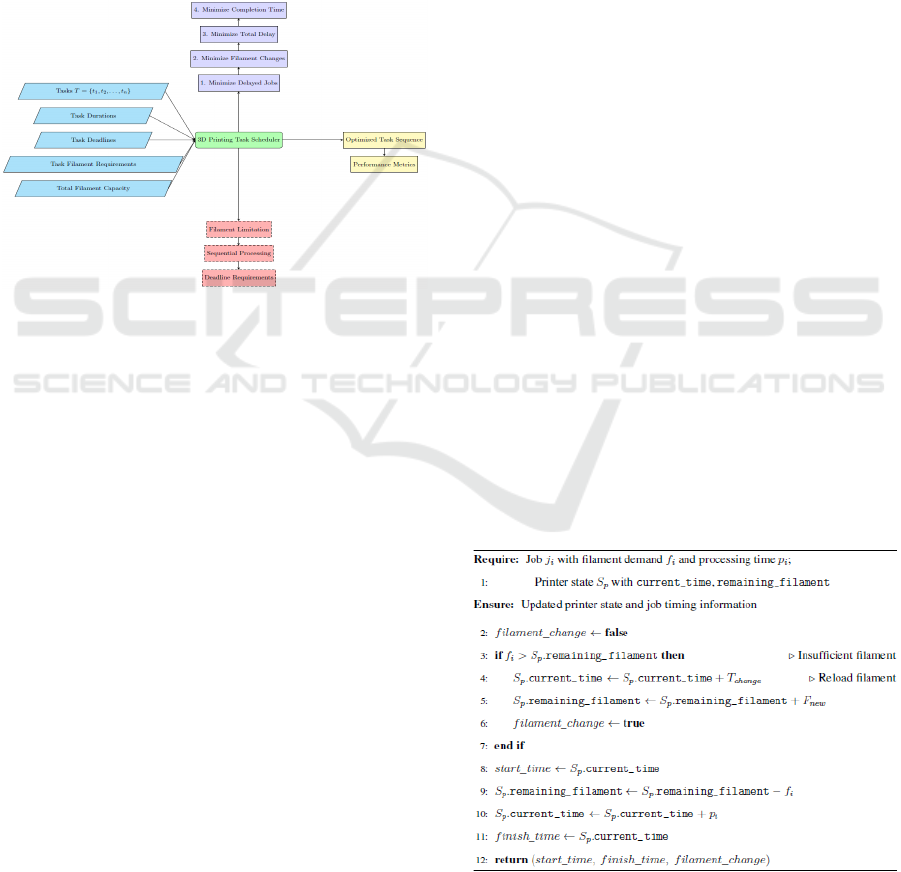
The description of 3D Printing Task Scheduler
Functional Diagram is provided in figure.1.
Figure 1: 3D Printing Task Scheduler Functional Diagram.
The diagram illustrates a multi-objective
optimization system that balances competing
priorities (speed, material efficiency, and deadline
compliance) while staying within physical and
resource constraints. In additive manufacturing, the
arrows illustrate the flow of information from inputs
through processing to final outputs.
Inputs:
Tasks T = {t₁, t₂, ..., tₙ}: Set of printing tasks to be
scheduled Task Durations: Estimated time required
for each printing task.
Task Deadlines: Delivery deadlines for each task
Task Filament Requirements: Amount of filament
material needed per task
Total Filament Capacity: Total available filament
stock/capacity
Central Processing Unit: The 3D Printing Task
Scheduler serves as the core optimization engine that
processes all input data to generate an optimal
printing schedule.
Optimization Objectives: The proposed system is
designed to simultaneously optimize four key
performance criteria that reflect both efficiency and
sustainability in modern manufacturing. First, it seeks
to minimize the overall completion time (makespan)
in order to accelerate project delivery and improve
throughput. Second, it aims to minimize the total
delay, thereby reducing cumulative lateness across all
scheduled tasks and ensuring smoother operations.
Third, the system focuses on minimizing the number
of filament changes, which not only shortens material
changeover time but also decreases material waste
and energy consumption. Finally, it strives to
minimize the number of delayed jobs, ensuring that
tasks are completed within their respective deadlines
to enhance reliability and customer satisfaction.
System Constraints:
The scheduler operates under strict limitations:
Filament Limitations:
Material availability constraints
Sequential Processing: Tasks must be processed one
at a time per printer
Deadline Requirements: Hard deadlines that must be
respected
Outputs The system generates:
Optimized Task Sequence: The optimal order for
executing printing tasks
Performance Metrics: Key performance indicators
measuring schedule effectiveness
To ensure consistency and enable fair comparisons,
all developed algorithms use a unified
implementation framework. As a result of this
standardization, all algorithms operate under the same
conditions and can be evaluated equally (Figure 2).
__________________________________________
Algorithm 1: Unified Job Processing Method.
Figure 2: Algorithm to process a job on a printer, updating
its timing and filament state.
Smart Optimized Scheduling Under Constraints in Industry 5.0 Through Intelligent Computational Methods
513

4 METAHEURISTIC
ALGORITHMS USED
4.1 Ant Colony Optimization (ACO)
An Ant Colony Optimization (ACO) algorithm is a
powerful metaheuristic algorithm that can be used to
assign print jobs to available printers with the best or
near-optimal sequence while satisfying a variety of
constraints such as time, material availability, and
energy consumption in the context of 3D printing task
scheduling. The ACO model is based on the foraging
behaviour of ants, where each node represents a
specific task or decision point (e.g., assigning a job to
a printer at a certain time). Pheromone trails (which
encode past schedule quality) and heuristic
information (such as estimate printing time) are used
to allow artificial "ants" to explore different
scheduling combinations. Pheromone levels are
updated after solutions are constructed to reinforce
the paths that lead to better performance - like
reduced total production time, balanced printer loads,
or lower energy consumption - while allowing less
effective paths to fade over time (Sarder,2023).
4.2 Particle Swarm Optimizer (PSO)
For solving optimization problems, PSO uses a
nature-inspired, population-based metaheuristic
algorithm. Using this method, animal groups such as
bird flocks or fish schools can be simulated
(Gad,2022). In PSO, each possible solution is
modeled as a moving "particle" guided by both its
own best position and the best known position found
by the swarm. Through these interactions, particles
are able to converge towards optimal or near-optimal
solutions over time. Each particle's position and
velocity are determined by equations that take into
account inertia, cognitive properties, and social
factors.
4.3 Greedy Algorithm
In Greedy Algorithm, we select the locally optimal
choice at each decision point as we build a solution
step by step (Zhao, 2021). 3D printing task
scheduling algorithms that prioritize immediate
gains, such as minimizing machine idle time or start
time, utilize greedy algorithms to assign tasks to the
earliest available slot and printer. Despite being
computationally efficient and able to produce
acceptable schedules in very short periods of time,
this method ignores the global structure of the
problem, resulting in suboptimal long-term results. It
may, for example, result in many delays or excessive
filament changes due to short-sighted decisions.
4.4 Migratory Bird Optimisation
(MBO)
Using the Migratory Bird Optimization algorithm, we
can simulate the migration behavior of migratory
birds in V-formations using a population-based
metaheuristic. This algorithm represents each
solution as a "bird" in a formation, with the best
performing solution taking the lead. To avoid
stagnation, birds periodically change positions based
on local and global neighborhood evaluations
(Wei,2023). Using MBO, scheduling problems can be
balanced between exploration and exploitation, with
the aim of finding globally efficient task sequences.
Although it avoids extremes, MBO rarely achieves
optimal performance in any single metric: in practice,
it tends to yield average results across all metrics.
4.5 Discrete Particle Optimisation
(DPO)
Particle Swarm Optimization (PSO) is adapted for
discrete and combinatorial problems, such as task
scheduling, by Discrete Particle Optimization (DPO)
(Franzoi,2022). Each particle represents a possible
sequence or configuration of scheduled tasks, with
the particle's movement determined by discrete
operators (e.g., swap, insertion) instead of continuous
velocity updates. Using both personal (personal best)
and collective (global best) experiences, DPO guides
the search for optimal outcomes. While DPO has an
intelligent search mechanism, it may suffer from
premature convergence or reduced diversity in
discrete spaces, reducing its effectiveness when
scheduling scenarios are highly constrained. We
found that DPO generated a relatively high number of
delayed tasks and a high total delay in our
experiments, showing that it had difficulty optimizing
task sequences under practical constraints.
5 RESULTS AND DISCUSSION
As part of this study, we utilized the Raise3D Pro2
(figure 3), a high-performance Fused Deposition
Modeling (FDM) 3D printer that was well-suited for
industrial-grade applications. Dual extrusions allow
the printer to print multi-materials or colors, which
introduces an additional level of complexity in
ICINCO 2025 - 22nd International Conference on Informatics in Control, Automation and Robotics
514
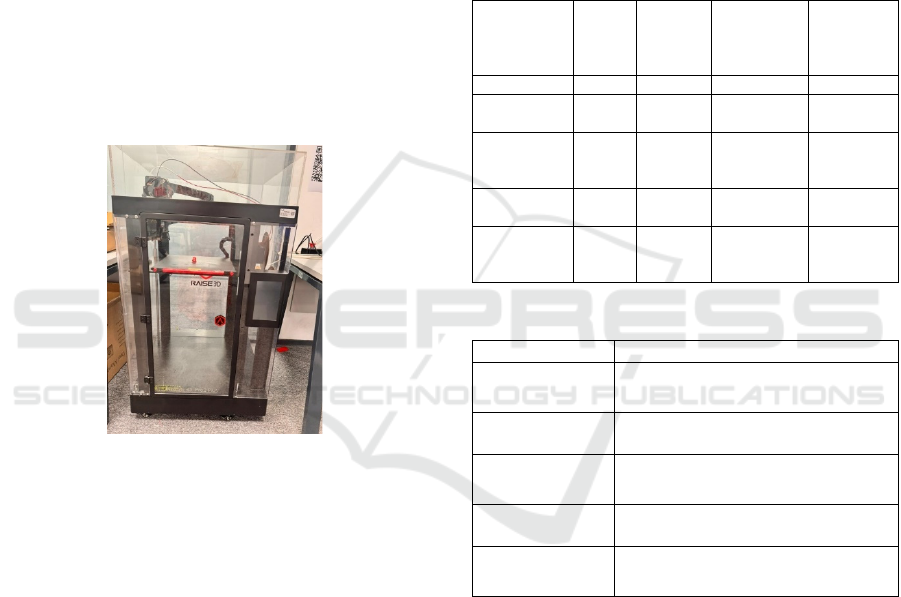
scheduling tasks. A 305 mm x 305 mm x 300 mm
build volume allows for the printing of medium to
large-sized parts that often require lengthy print
times. In addition to standard 0.4 mm nozzles, a range
of diameters can be selected based on the throughput
required. A wide range of filament types can be used
with Raise3D Pro2, including PLA, ABS, PETG,
TPU, and Nylon, each of which has its own thermal
and handling parameters. It also features a filament
run-out detection system and power loss recovery,
which enhance the reliability and resilience of the
production workflow. A heated bed and enclosed
build chamber ensure better print stability, but they
also add energy consumption constraints. The
printer's integrated touchscreen interface, remote
monitoring capabilities, and network and cloud
connectivity enable it to communicate with centrally
managed or artificially intelligent scheduling
systems.
Figure 3: Raise3D Pro2 printer.
5.1 Evaluation of Metaheuristics for 3D
Printing Task Scheduling
As part of the evaluation of metaheuristic algorithms
for 3D printing task scheduling, a number of key
performance metrics were considered to assess both
the quality and applicability of the solutions. The key
metrics for our framework are filament changes, total
delay, and execution time. Delays indicate the
system's ability to respect timing constraints, an
essential factor in high-speed production.
Furthermore, the total delay provides a deeper
understanding of the extent of disruptions, even when
the number of delays remains low. Material
efficiency and machine downtime are also affected by
the number of filament changes, which lead to higher
operational costs and reduced printer availability. As
a final consideration, the algorithm's execution time
determines its suitability for real-time or near-real-
time scheduling, particularly in Industry 5.0
environments. We gain a comprehensive view of each
algorithm’s performance by analyzing these metrics
together: some methods reduce total delay but
produce excessive filament changes or compute too
slowly, while others balance speed, precision, and
resource efficiency better. Through table 1 and table
2, we ensure that both technical constraints and
industrial objectives are aligned with the scheduling
strategy chosen.
Table 1: Evaluation of metaheuristics for 3d printing task
scheduling.
Algorithm No. of
Delays
Number
of
Filament
Changes
Total Delay
(s)
Execution
Time (s)
Greedy 142 38 184,579.709 13,846.793
Artificial
Bee Colony
60 37 307,032.071 13,816.793
Migratory
Bird
Optimisation
67 38 434,737.523 13,846.793
Ant Colony
Algorithm
49 38 249,998.075 13,846.793
Discrete
Particle
Optimisation
89 37 467,556.575 13,816.793
Table 2: Summary Analysis.
Al
g
orith
m
Summar
y
Anal
y
sis
Greedy Lowest total delay, but too many
individual delays
Artificial Bee
Colon
y
Good trade-off: fast, few delays
Migratory Bird
Optimisation
Average performance, not optimal in
any specific criterion
Ant Colony
Al
g
orith
m
Best overall compromise
Discrete Particle
Optimisation
Globally inefficient despite good
execution time
5.2 Discussion
Based on the comparability of the five algorithms,
distinct performance characteristics can be identified
in terms of scheduling efficiency, resource
optimization, and execution time. It is clear from the
Greedy algorithm's results (184,579.709) that it
successfully prioritizes task allocation in the short
run. Despite this, it exhibits a very high number of
individual delays (142), indicating poor robustness in
situations with tight deadlines. Compared to other
algorithms, the Artificial Bee Colony (ABC) has
relatively few delays (60) and the shortest execution
time (13,816.793), making it an ideal choice for real-
Smart Optimized Scheduling Under Constraints in Industry 5.0 Through Intelligent Computational Methods
515
time or near-real-time scheduling in Industry 5.0. The
slightly higher total delay (307,032.071) can be
attributed to the algorithm's efficiency. There is no
clear advantage in any of the metrics in the Migratory
Bird Optimization (MBO) algorithm. There is a
possibility that its lack of specialization could limit its
applicability in situations where specific performance
objectives are important (e.g., minimizing delays or
changing resource allocations). In terms of global
efficiency, the Ant Colony Algorithm (ACO) stands
out as the most balanced approach. Providing the best
overall balance between delay minimization and
stability, it has the least number of delays (49) and a
moderate total delay (249,998.075).
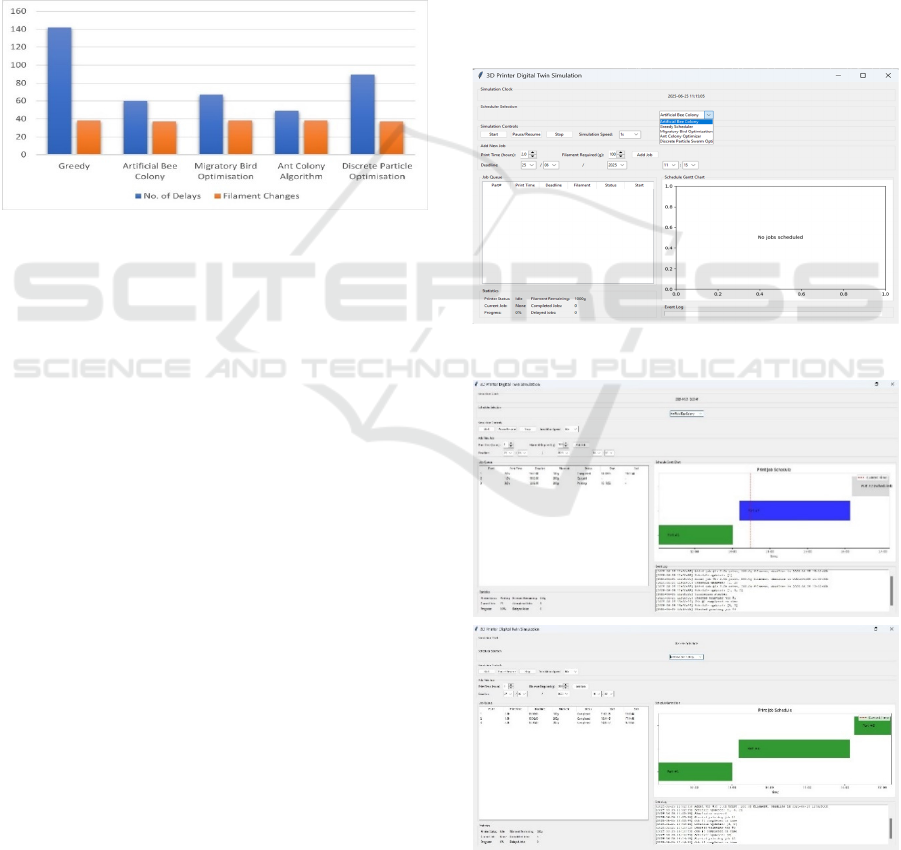
Figure 4: Results of metaheuristic Algorithms.
Thus, it is a good candidate for scheduling systems
that are adaptive and dynamic in smart
manufacturing. As a result, Discrete Particle
Optimization (DPSO), though slightly faster in
execution, exhibits a relatively high number of delays
(89) and a higher total delay (467,556.575). Despite
its speed, it cannot optimize task sequencing
effectively, making it less practical for industrial
applications requiring quality and timeliness. As a
result, the Ant Colony Algorithm is the most robust
and consistent approach, followed by the Artificial
Bee Colony algorithm, which offers good speed-to-
effectiveness tradeoffs. In general, the Greedy and
DPSO methods are unreliable. Figure 4 shows these
results.
5.3 Results
An overview of the 3D printing job schedule is
provided by a Gantt chart, which makes it easy to see
which jobs are running, waiting, or finished, and how
resources are allocated. The use of this type of
visualization helps production managers optimize
printer utilization, minimize idle time, and meet
deadlines by adjusting job sequences accordingly. A
gantt chart in 3D printing scheduling offers several
key features that enhance management and planning.
Their timelines provide a clear picture of when each
job begins and ends. Additionally, they help to
understand task relationships and potential conflicts
by displaying work dependencies and overlaps. In
addition to highlighting current progress and resource
usage, Gantt charts facilitate effective monitoring of
ongoing jobs. Using this visualization, planners can
identify bottlenecks or scheduling conflicts quickly
and make interactive adjustments, making it easier to
improve efficiency and meet deadlines. Each green
bar represents a print job in a horizontal Gantt chart
labeled "Print Job Schedule." Each bar corresponds to
the job's start and end times on the timeline below,
visually identifying when each job begins and ends
(Figure 5 and figure 6). Using the chart, you can see
how jobs overlap or are sequenced, providing a clear
view of the schedule. Users can also track progress in
real time by using a "Current Time" marker.
Figure 5: Scheduling interface for 3D printing tasks.
Figure 6: Gantt chart-based scheduling interface for 3D
printing tasks.
ICINCO 2025 - 22nd International Conference on Informatics in Control, Automation and Robotics
516

6 CONCLUSIONS
This study evaluated and compared several
metaheuristic algorithms (greedy, artificial bee
colony, migratory bird optimization, ant colony
algorithm, and discrete particle optimization) for the
complex task of scheduling 3D printing operations.
Our evaluation relied on four critical performance
metrics: number of delays, filament changes, total
delay, and execution time. The results demonstrate
that no single algorithm excels in all aspects,
highlighting the trade-offs between speed, accuracy,
and operational efficiency.
Overall, these findings emphasize the importance
of multi-criteria evaluation when selecting a
scheduling strategy for industry 5.0 systems, where
real-time responsiveness, material efficiency, and
reliability are key. Future work may explore hybrid
metaheuristics, reinforcement learning, or adaptive
scheduling frameworks that can dynamically respond
to changing constraints and workload priorities in
cyber-physical environments. As a perspective for
this work, Artificial Intelligence (AI) will play a
strong role in enhancing our system. AI techniques
can be integrated to model and optimize energy
consumption (Nakkach, 2023), (Nakkach, 2024)
enabling more sustainable and efficient production
planning. Moreover, predictive maintenance based on
computer vision and deep learning (Nakkach, 2022)
can be employed to detect early signs of wear,
anomalies, or defects in machines and 3D-printed
parts. Such capabilities will help anticipate failures,
minimize downtime, and improve overall system
reliability. Together, these AI-driven approaches will
reinforce the adaptability, efficiency, and
sustainability of cyber-physical production
environments in line with the vision of Industry 5.0.
REFERENCES
Chen, Shu-Chuan, et al. "Multi-Objective Optimization in
Industry 5.0: Human-Centric AI Integration for
Sustainable and Intelligent Manufacturing." Processes
12.12 (2024): 2723.
Dehghan, Shayan, et al. "The Integration of Additive
Manufacturing into Industry 4.0 and Industry 5.0: A
Bibliometric Analysis (Trends, Opportunities, and
Challenges)." Machines, 13.1 (2025): 62.
Franzoi, Robert E., and Brenno C. Menezes. "Large-Scale
Discrete-Time Scheduling Optimization: Industrial-
Size Applications." IFAC-PapersOnLine, 55.10
(2022): 2581-2586.
Gad, Ahmed G. "Particle swarm optimization algorithm
and its applications: a systematic review." Archives of
computational methods in engineering 29.5 (2022):
2531-2561.
Ghoujdam, Mousaab El Khair, et al. "Exploring the
Technologies of Industry 5.0, Benefits and
Applications: A Systematic Review." Industry 5.0 and
Emerging Technologies: Transformation Through
Technology and Innovations (2024): 23-37.
Kantaros, Antreas, et al. "The Role of 3D Printing in
Advancing Automated Manufacturing Systems:
Opportunities and Challenges." Automation 6.2 (2025):
21.
Kim, Kyeongho, Soonjo Kwon, and Minjoo Choi.
"Optimization of Production Scheduling for the
Additive Manufacturing of Ship Models Using a
Hybrid Method." Journal of Marine Science and
Engineering 12.11 (2024): 1961.
Nakkach, Cherifa, Amira Zrelli, and Tahar Ezzdine. "An
efficient approach of vehicle detection based on deep
learning algorithms and wireless sensors networks."
International Journal of Software Innovation (IJSI) 10.1
(2022): 1-16.
Nakkach, Cherifa, Amira Zrelli, and Tahar Ezzedine.
"Long-Term Energy Forecasting System Based on
LSTM and Deep Extreme Machine Learning."
Intelligent Automation & Soft Computing 37.1 (2023).
Nakkach, Cherifa, and Yvan Picaud. "AI-Driven Smart Air
Conditioning System for a Sustainable and Energy-
Efficient Industrial Future." International Conference
on Innovative Intelligent Industrial Production and
Logistics. Cham: Springer Nature Switzerland, 2024.
Sardar, Abdullah, et al. "Optimization of daily operations in
the marine industry using ant colony optimization
(ACO)-An artificial intelligence (AI) approach."
TransNav, International Journal on Marine Navigation
and Safety of Sea Transportation, 17.2 (2023): 289-
295.
Wei, Lixin, et al. "A multi-objective migrating birds
optimization algorithm based on game theory for
dynamic flexible job shop scheduling problem." Expert
Systems with Applications, 227 (2023): 120268.
Zhao, ZiYan, MengChu Zhou, and ShiXin Liu. "Iterated
greedy algorithms for flow-shop scheduling problems:
A tutorial." IEEE Transactions on Automation Science
and Engineering 19.3 (2021): 1941-1959.
Smart Optimized Scheduling Under Constraints in Industry 5.0 Through Intelligent Computational Methods
517
