
Performance Evaluation of REST and GraphQL API Models in
Microservices Software Development Domain
Mohamed S. M. Elghazal
1
, Adel Aneiba
2 a
and Essa Q. Shahra
2 b
1
Faculty of Information Technology Department of Computer Networks & Communications Department, University of
Benghazi, Benghazi, Libya
2
Faculty of Computing, Engineering and Built Environment, Birmingham City University, Birmingham B4 7RQ, U.K.
Keywords:
REST API, GraphQL AP, Microservice, Software Development.
Abstract:
This study presents a comprehensive comparative analysis of REST and GraphQL API models within the
context of microservices development, offering empirical insights into the strengths and limitations of each
approach. The research explores the effectiveness and efficiency of GraphQL versus REST, focusing on their
impact on critical software quality metrics and user experience. Using a controlled experimental setup, the
study evaluates key performance indicators, including response time, data transfer efficiency, and error rates.
The findings reveal that REST APIs demonstrate superior memory efficiency and faster response times, partic-
ularly under high-load conditions, making them a reliable choice for performance-critical microservices. On
the other hand, GraphQL excels in offering greater flexibility for data retrieval, but exhibits higher response
times and higher error rates when handling complex queries. This research provides a nuanced understand-
ing of the trade-offs between the REST and GraphQL API interaction models, offering actionable guidance
to developers and researchers in selecting the optimal API model for microservice-based applications. The
insights are particularly valuable for balancing considerations such as performance, flexibility, and reliability
in real-world implementations.
1 INTRODUCTION
In distributed systems, an application programming
interface (API) allows distributed devices or services
to exchange data regardless of operating system type
(Efuntade et al., 2023). For example, an API allows
any system to exchange the data and functionality
of its services with other systems, devices, or even
other applications within an organisation. As a result,
organisations are increasingly sharing data, services,
and sophisticated resources. This communication can
take place locally, with external partners, or with the
public. APIs are commonly used for the exchange of
text, media, and more (Simon, 2024). Massive and
complicated software products are groups of loosely
linked services in a microservice architecture. Every
service can be hosted separately from the others and is
focused only on achieving one goal, excelling at that
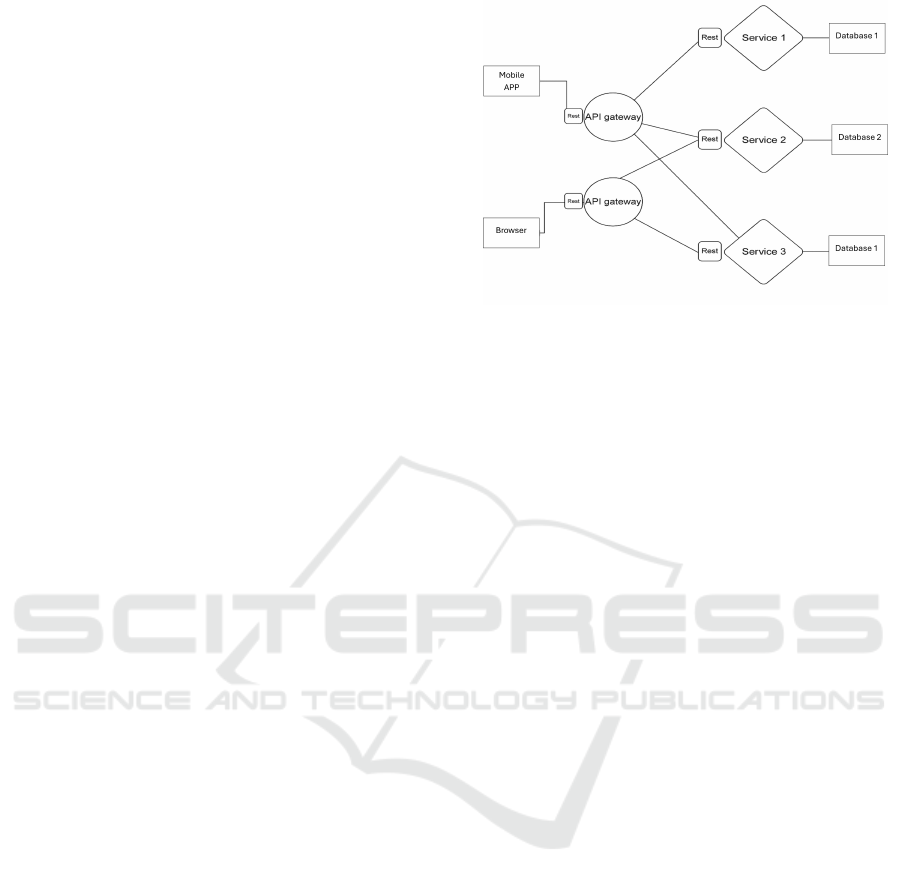
task (Wells, 2024). Figure 1 shows that a microser-
vice architecture is a collection of loosely linked ser-
vices that can be deployed independently, each fo-
a
https://orcid.org/0000-0002-8021-445X
b
https://orcid.org/0000-0002-3668-6230
cused on achieving specific business goals. The mi-
croservice architectural style is defined as a method of
designing software as a collection of discrete services,
each of which is executed in its own process and com-
municates through minimal means, most commonly
an API for HTTP resources (S
¨
oylemez et al., 2024).
These services are aligned with business characteris-
tics and can be deployed independently using fully au-
tomated release tools. Various approaches have been
proposed to increase the efficiency of data processing,
some focusing on the forms of requests and responses,
while others optimize the number of queries made
over the network. A recent development is the use
of a declarative data query approach, where client ap-
plications specify the data they need, improving com-
munication with the server to retrieve data more effi-
ciently (Acharya, 2024). Service providers and most
software engineers have embraced the REST archi-
tectural style, largely due to its ease of use compared
to previous web performance standards such as SOAP
and RPC. Moreover, the success of REST can be at-
tributed to the constraints imposed on how service
components are built, potentially benefiting the over-
Elghazal, M. S. M., Aneiba, A. and Shahra, E. Q.
Performance Evaluation of REST and GraphQL API Models in Microservices Software Development Domain.
DOI: 10.5220/0013729900003985
Paper published under CC license (CC BY-NC-ND 4.0)
In Proceedings of the 21st International Conference on Web Information Systems and Technologies (WEBIST 2025), pages 83-91
ISBN: 978-989-758-772-6; ISSN: 2184-3252
Proceedings Copyright © 2025 by SCITEPRESS – Science and Technology Publications, Lda.
83
all system when such constraints are applied (Singh
et al., 2024).
gRPC is a high-performance framework that en-
ables applications built using different technologies
to communicate seamlessly. It is based on the con-
cept of defining a service and the methods that can
be called remotely, along with their input parameters
and output formats. It originated from Google’s in-
ternal project, called Stubby, which was designed for
fast and efficient inter-service communication. gRPC
builds on these principles, bringing them to the wider
developer community as an open source solution.
(Levandoski et al., 2024). In 2012, Facebook recog-
nized the need to rebuild its native mobile apps, which
were initially thin wrappers around mobile website
views. A REST server existed, but performance was
poor, and the apps frequently crashed. Developers
sought to transform how data was delivered to client
apps. Lee Byron, Nick Schrock, and Dan Schafer
led the development of GraphQL, a query language
that allows client/server applications to specify the ca-
pabilities and requirements of data models (Sheltami
et al., 2018). GraphQL aims to improve the way con-
sumers interact with remote systems by addressing
several limitations faced by developers working with
REST APIs. For instance, GraphQL allows clients
to request only the data they need, whereas REST
clients often have to make multiple requests to gather
the necessary data (Vadlamani et al., 2021).
GraphQL is a distinct and entirely new method
for interacting with APIs. It is an API query and in-
formation retrieval approach that is open-source. It
provides a customizable, query-based language for
interacting with APIs, offering flexibility and a sin-
gle endpoint. Software components using GraphQL
communicate with the server only to retrieve the spe-
cific data they request, with queries designed to inter-
act with the web for exactly what is needed—nothing
more. GraphQL was publicly released in 2015 as an
alternative to existing REST services. On November
7, 2018, Facebook handed over the development of
GraphQL to the newly established GraphQL Foun-
dation, which is managed by the non-profit Linux
Foundation. As seen, the tech sector is continuously
evolving, prompting developers to find solutions that
balance flexibility and functionality. While REST
APIs offer simplicity and familiarity, their rigid struc-
ture can become problematic. In REST, the API
provider dictates what data is sent, often leading to
over-fetching or under-fetching (Leng et al., 2024).
This model worked in the past, but the rise of com-
plex, client-driven applications necessitates a differ-
ent approach.
GraphQL addresses the shortcomings of REST by
Figure 1: Cloud computing services model.
empowering clients with control over data retrieval.
Clients can specify exactly what data they need in a
single query, which is crucial in dynamic tech envi-
ronments. This flexibility can improve application
performance, streamline development, and enhance
API self-documentation. However, it is important to
recognize the added complexity of GraphQL, poten-
tial security risks, and the need for custom caching
solutions.
The aim of this study is to conduct a comprehen-
sive comparative analysis of REST and GraphQL API
models within the context of microservices develop-
ment, providing empirical insights into the strengths
and limitations of each approach.
This paper is organized as follows: Section 2 re-
views the related work. Section 3 introduces the pro-
posed system model. Section 4 discuss the implemen-
tation and presents the results. Finally, Section 5 con-
cludes the paper.
2 RELATED WORK
GraphQL is a modern class of web-based data access
interfaces that offers an alternative to REST-based in-
terfaces. Due to its advantages over REST, GraphQL
has gained significant attention and has been adopted
by a growing number of users since its official launch
(Hartig and P
´
erez, 2017). Some research studies
have evaluated the performance of both REST and
GraphQL, but many of these studies rely on sim-
ple software development implementations, result-
ing in either ambiguous outcomes or basic network
service functions being tested, such as reading, in-
serting, modifying, and removing data (Mikuła and
Dzie
´
nkowski, 2020). The results demonstrated that
both services performed equally well in adding, mod-
ifying, and removing data. However, under high
load, performance variations were observed for dis-
WEBIST 2025 - 21st International Conference on Web Information Systems and Technologies
84

play functions. While GraphQL may not consis-
tently outperform REST in scenarios involving over-
fetching, it demonstrates comparable performance for
single requests, positioning it as a viable alternative
to REST. Furthermore, in cases of under-fetching,
GraphQL proves to be more efficient than REST, as
it allows clients to retrieve precisely the data they
need in a single query. In environments where under-
fetching occurs frequently, GraphQL emerges as a
more practical and efficient API architecture com-
pared to REST (Vadlamani et al., 2021).
Authors in (Lawi et al., 2021) found that REST
was 51% faster than GraphQL when evaluating the
performance of the two systems in a monolithic archi-
tectural application . However, this result is specific
to monolithic architectures. C. Pautass et al. in (Pau-
tasso et al., 2008) attempted to compare GraphQL and
REST but did not consider the microservices domain.
When microservices are not fully considered, conclu-
sions about REST can be questionable, as an architec-
ture style is defined by the combination of constraints,
not just individual ones. Metrics are implementation-
dependent and, thus, not always suitable for judging
performance across different domains. In (Brito and
Valente, 2020), they involved 22 graduate and under-
graduate students, aimed to compare the effort and
time required to develop queries for a web service us-
ing REST and GraphQL. The experiment took place
in a controlled setting, with participants randomly as-
signed to either the REST or GraphQL group. The
results indicated that implementing remote service
queries using REST required significantly more ef-
fort than with GraphQL, particularly for complex end-
points and multiple inputs, leading to increased devel-
opment time and effort.
Interestingly, the experiment also showed that
even participants with no prior knowledge of
GraphQL could easily implement queries, suggest-
ing that GraphQL has a lower learning curve com-
pared to REST, making it more accessible to devel-
opers (Amareen et al., 2024). However, one limita-
tion of the experiment was the lack of consideration
for microservices as a constraint. Brito argues that
this limitation is not significant since most developers
work with monolithic architectures. Nevertheless, the
results could differ if microservices were taken into
account. In (Erlandsson and Remes, 2020) Brito’s
experiment provides valuable insights into the rela-
tive merits of REST and GraphQL, suggesting that
GraphQL is a more efficient and easier-to-use option
for developing remote service queries. However, it is
important to note that these findings may not be gen-
eralizable to all development contexts. Despite these
limitations, the experiment provides valuable insights
into the relative merits of REST and GraphQL. The
results suggest that GraphQL is a more efficient and
easier-to-use option for developing remote service
queries. The asynchronous JavaScript and XML apps
designed by Mesbah and van Deursen are also rele-
vant here. Their work connects to Single Page Appli-
cations (SPAs) (Mesbah and Van Deursen, 2007), the
successors to what they referred to as ”AJAX applica-
tions,” which often utilize GraphQL. They precisely
define factors to consider when developing such apps
using the REST method, such as delta communica-
tion. However, rather than viewing these systems as
variations of existing models, they propose a new ar-
chitectural style that addresses multiple factors previ-
ously covered by older models. Systems using SPAs
can be seen as composites, for example, employing
the Model-View-Controller (MVC) style for the front
end and REST for the backend. Shaw et al. (Shaw and
Clements, 1997) Presents a classification of architec-
tural styles based on their fundamental elements, in-
cluding components and connectors, as well as their
handling of control mechanisms, data management,
and the interplay between control and data aspects.
However, this classification is disconnected from the
specific requirements of applications, focusing only
on technical features like the layout or structure of
the final system. This makes it difficult for a designer
to choose an architecture, and thus, their classifica-
tion methodology is not appropriate for comparing
GraphQL and REST models, as it does not offer guid-
ance on when to use each for creating an API. Vohra
and Manuaba This research aims to fill this gap by
conducting a quantitative comparison of REST and
GraphQL in a scalable microservices environment.
It will explore performance under real-world condi-
tions, including complex queries and varying levels
of concurrency, providing developers with the empir-
ical data necessary to make informed decisions about
API models in microservices.
Authors in (Vohra and Manuaba, 2022) ex-
plored performance comparisons between REST and
GraphQL within a microservices architecture frame-
work, using a freelance marketplace as their testbed.
They employed Ocelot for REST and HotChocolate
for GraphQL as gateways, using ”JMeter” to simu-
late various user scenarios (Niswar et al., 2024). Per-
formance parameters like average response time and
throughput were analyzed to highlight differences be-
tween REST and GraphQL under diverse scenarios.
While they found similar performance for POST and
PUT queries, significant discrepancies arose in GET
queries that retrieved data from multiple services. De-
spite the valuable insights from Vohra and Manuaba’s
study, several limitations must be considered. Firstly,
Performance Evaluation of REST and GraphQL API Models in Microservices Software Development Domain
85
the study was conducted in a local system rather
than a cloud-based environment, which could restrict
scalability and real-world applicability. Secondly,
the simplified freelance marketplace scenario might
not fully capture the complexity of real-world mi-
croservices architectures, where interconnected ser-
vices of varying complexities could affect REST and
GraphQL APIs differently. Lastly, the reliance on a
limited number of predefined test cases might con-
strain the comprehensiveness of the findings, poten-
tially missing a full range of scenarios encountered in
real-world applications. Despite significant theoreti-
cal comparisons between REST and GraphQL, empir-
ical research on their performance within microser-
vices architectures remains limited. Existing stud-
ies often focus on monolithic architecture and sim-
ulated environments, which do not accurately reflect
the complexities of real-world distributed systems.
3 PROPOSED SYSTEM MODEL
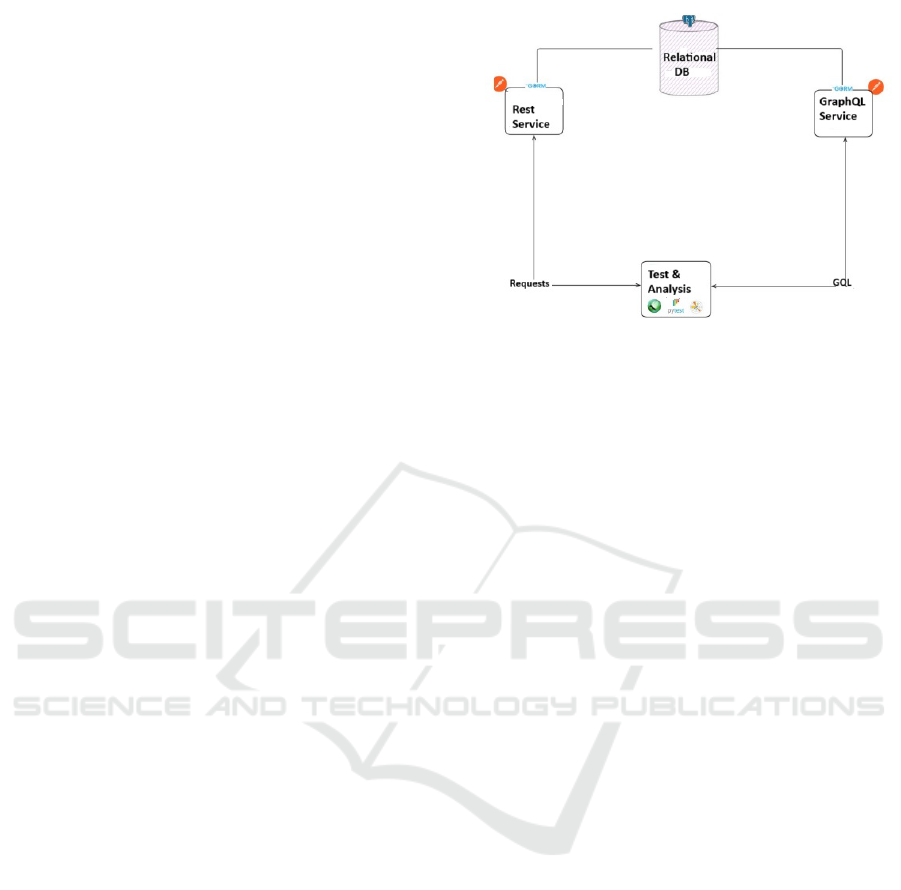
The system architecture is built to compare the per-
formance of REST and GraphQL APIs model in
a microservices environment. Both the REST and
GraphQL services are developed using Go (Golang)
and utilize the GORM library to interact with a cen-
tralized PostgreSQL database. The architecture con-
sists of three key layers:
1. REST Service Layer: It interacts with the Post-
greSQL database using GORM to perform vari-
ous database operations. The REST API exposes
multiple endpoints that allow clients to request re-
sources or perform operations on data.
2. GraphQL Service Layer: Like the REST service,
it communicates with the PostgreSQL database
using GORM, but provides more flexibility in
terms of data fetching, allowing clients to define
complex queries and mutations.
3. Data Layer: A PostgreSQL database serves as the
shared data layer for both REST and GraphQL
services. This setup ensures consistency in data
management and allows for a fair comparison of
the two services’ performance when interacting
with the same data source.
The proposed system model is Illustrated in Figure
2, which outlines the flow of communication between
different system components. The system is tested
using various tools such as K6 for load testing and
Postman for manual testing. A Python script is em-
ployed for analysis, generating insights into perfor-
mance metrics like response time, memory consump-
tion, and error rates under different testing scenarios.
Figure 2: Proposed system model.
The results are analyzed to compare the efficiency and
scalability of both API models within the same mi-
croservices architecture.
4 EXPERIMENT SETUP AND
ANALYSIS PROCEDURES
4.1 Experiment Setup
1. Microservices Development: Two microservices
were implemented, each employing a distinct ar-
chitectural style—one based on REST and the
other on GraphQL. Both services were devel-
oped in Golang, leveraging its performance and
efficiency for backend development, and inte-
grated with PostgreSQL to provide robust and
scalable data management across both implemen-
tations. The microservices and databases were
deployed on separate virtual machines running
Ubuntu 22.04 LTS, each provisioned with 4 vC-
PUs, 8 GB RAM, and 50 GB SSD storage. These
machines were connected over a dedicated giga-
bit Ethernet network to minimize latency and en-
sure consistent throughput during testing. This
deployment approach addressed limitations iden-
tified in earlier work that relied solely on local,
single-machine tests, allowing for a more realistic
evaluation of distributed system performance.
2. Performance Testing Framework: Testing was
conducted using the Grafana K6 framework,
which enabled the simulation of real-world usage
scenarios to evaluate system performance. The
tests scaled up to 1,000 Virtual Users (VUs), ef-
fectively simulating varying levels of user load to
ensure the microservices could handle diverse op-
erational demands.
WEBIST 2025 - 21st International Conference on Web Information Systems and Technologies
86
3. Test Scenarios: The performance evaluation was
designed to assess the system under varied op-
erational loads while accounting for differences
in data-retrieval behavior between REST and
GraphQL. Notably, REST often required multi-
ple requests to retrieve the same data due to un-
derfetching. For example, in the Heavy Con-
sumer Scenario, a REST client typically made two
sequential requests of 150bytes each, whereas
GraphQL could retrieve the equivalent dataset in
a single 300-byte query. In some cases, REST
responses also included unused fields (overfetch-
ing), leading to slightly larger payload sizes than
strictly necessary. These distinctions are impor-
tant when comparing network utilization, latency,
and backend workload.
• The Light Consumer Scenario focused on read-
intensive operations, simulating data fetching
with up to 1,000 Virtual Users (VUs) ramping
up in one minute, holding steady for 30 sec-
onds, and then gradually ramping down. This
scenario aimed to assess API efficiency in man-
aging concurrent read requests.
• Concentrated on write-intensive operations,
starting two minutes into the test and follow-
ing the same ramping profile as the Light Con-
sumer Scenario. It measured latency and error
rates during peak insertion loads. Network pay-
load sizes were comparable between REST and
GraphQL for writes, as these operations typi-
cally involved a single structured request.
• Emphasized complex data-retrieval involving
nested or relational queries. Beginning at the
four-minute mark, this scenario highlighted a
key difference: REST often required multi-
ple endpoint calls (e.g., two × 150-byte re-
quests) to assemble the complete dataset, while
GraphQL could perform the same retrieval in a
single composite query ( 300bytes). This al-
lowed direct analysis of query efficiency and
backend processing costs.
• Focused on frequent modifications to existing
data, starting six minutes into the test with the
same ramping structure. While both REST and
GraphQL updates were typically single-request
operations, REST payloads tended to contain
some redundant data fields due to overfetching
in update responses. This scenario evaluated
efficiency, consistency, and error management
under high update loads.
4.2 Analysis Procedures
1. Key Metrics Evaluated
Table 1: REST API vs. GraphQL API results comparison.
Metric REST API GraphQL API
Average
Request
Duration
247.17 ms 915.14 ms
Error Rate
6.86%
15,462
failed out
of
225,262
requests
5.85%
8,613
failed out
of
138,492
requests
Requests
Completed
225, 262
471 requests
/second
147,327
312 request
/second
Request
Sending
Duration
1.23 ms (avg),
24.86 second
(max)
477.14 Mic
sec(avg),
1.74 seconds
(max)
Request
Receiving
Duration
44.46 ms(avg),
1 minute,
3 seconds
1.64 ms (avg),
3.96 seconds
(max)
Total VUs
1,000 max
VUs
1,000 max VUs
Test Duraion 8 minutes 8 minutes
• Response Time: Measures efficiency in deliv-
ering prompt results under varying loads.
• Memory Consumption: Tracks resource usage
to evaluate scalability under high-demand con-
ditions.
• Error Rate: Monitors system reliability, stabil-
ity, and ability to handle complex queries with-
out failure.
2. Performance Assessment Goals
• Provide a comprehensive evaluation of the sys-
tem’s using the key metrics evaluation men-
tioned above. .
• Identify the suitability of the microservices for
high-demand environments.
5 RESULTS
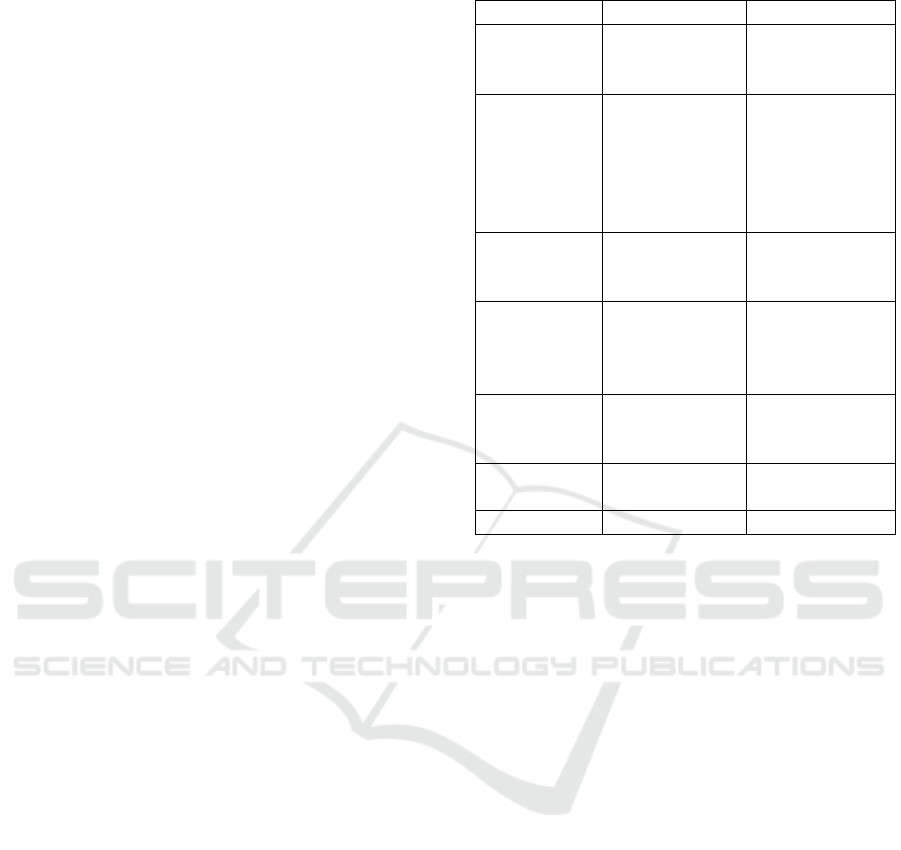
Table 1 provides a side-by-side comparison of the
REST and GraphQL APIs outputs aspects:
5.1 Individual Metric
The Average Request Duration is another critical met-
ric that highlights the efficiency of both API mod-
els. As shown in Figure 3, the average request du-
ration for GraphQL is significantly higher than that of
Performance Evaluation of REST and GraphQL API Models in Microservices Software Development Domain
87
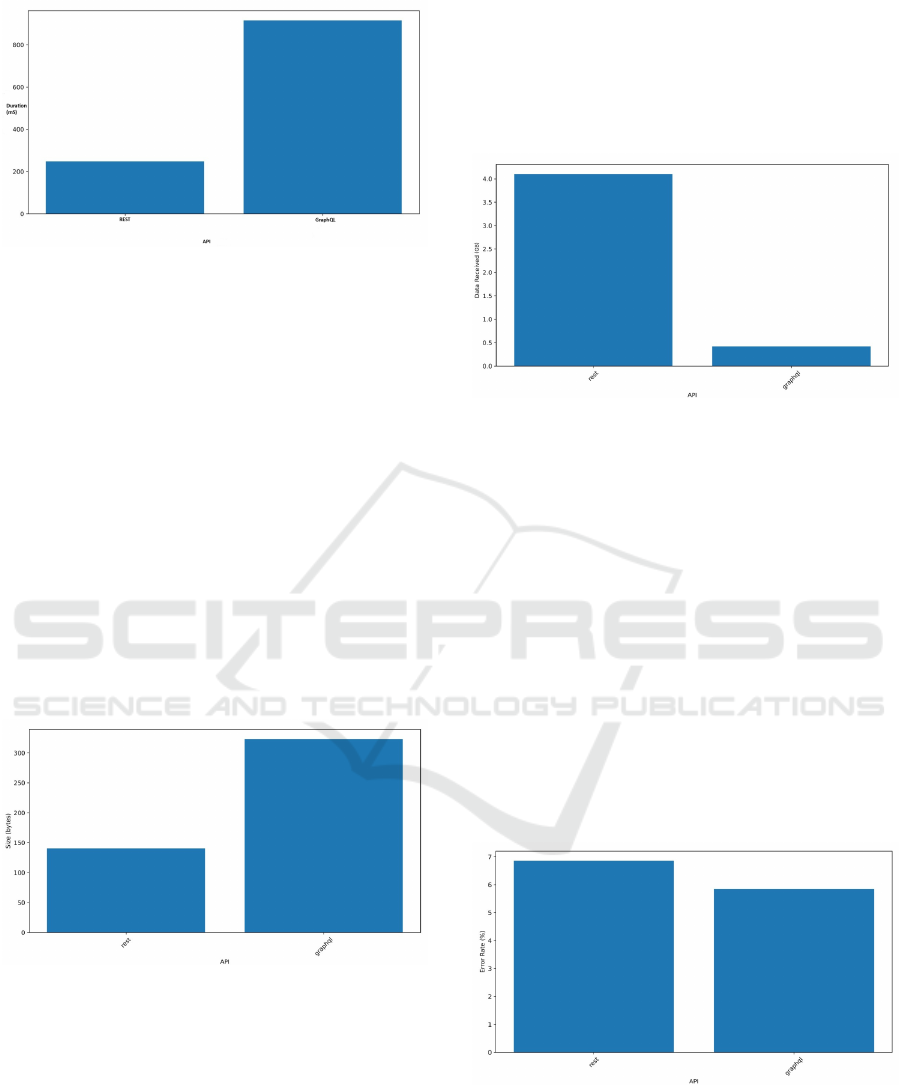
Figure 3: Average request duration by API model.
REST, with GraphQL averaging around 850 ms com-
pared to REST’s average of approximately 250 ms.
This substantial difference can be attributed to the in-
creased complexity of GraphQL queries, which often
involve fetching nested and specific data structures
that require more server-side processing time. REST,
by contrast, operates with predefined endpoints that
are optimized for quicker data retrieval, leading to
lower request duration. The longer request duration
in GraphQL demonstrates a trade-off between flexi-
bility and performance. While GraphQL offers more
detailed and precise data querying capabilities, this
comes at the cost of increased server-side process-
ing time, especially when handling complex queries.
REST, with its simpler and more straightforward data
fetching mechanism, is able to provide faster response
times, making it more suitable for applications where
low-latency interactions are critical.
Figure 4: Average Request Size of Rest and GraphQL Mod-
els.
Figure 4, shows a significant difference in Average
Request Size between REST and GraphQL. REST re-
quests were smaller on average, with sizes typically
around 150 bytes. In contrast, GraphQL requests
were more than twice as large, averaging over 300
bytes. This increase in size for GraphQL is due to its
ability to allow clients to request complex and nested
data in a single query. While REST requests are gen-
erally simpler and more streamlined due to the fixed
structure of endpoints, GraphQL’s flexibility comes
at the cost of larger payloads. This finding suggests
that while GraphQL offers greater query flexibility,
it may introduce inefficiencies in terms of network
bandwidth when dealing with large or frequent re-
quests.
Figure 5: Data received comparison between the two mod-
els.
Figure 5, illustrated Total Data Received by the
client from the server also varied significantly be-
tween REST and GraphQL. REST APIs received
far more data, with the total data received near-
ing 4 GB, while GraphQL received significantly less
data—close to a few hundred MB. This disparity is
primarily due to the over-fetching inherent in REST,
where endpoints return a fixed set of data regardless
of how much is actually needed by the client. In con-
trast, GraphQL’s ability to request only the data that
is required leads to smaller data transfers, particu-
larly in complex queries where only a subset of fields
is needed. This result highlights the efficiency of
GraphQL in reducing unnecessary data transmission,
making it more suitable in bandwidth-constrained en-
vironments.
Figure 6: Error rate comparison between the two API mod-
els.
Figure 6, presents the Error Rate comparison be-
tween REST and GraphQL. REST showed a slightly
higher error rate, around 7%, while GraphQL’s error
rate was slightly lower, approximately 6%. This dif-
WEBIST 2025 - 21st International Conference on Web Information Systems and Technologies
88
ference suggests that REST experiences more chal-
lenges when handling high traffic or more complex
operations. GraphQL’s ability to handle more specific
queries might reduce the likelihood of errors, as it al-
lows clients to retrieve exactly what they need, reduc-
ing the complexity of server-side operations. How-
ever, it is important to note that this difference is rela-
tively small, and both API models performed reliably
under typical load conditions.
5.2 Time Series Analysis for REST and
GraphQL API Models
Figure 7: Comparison of Data Received (REST vs.
GraphQL).
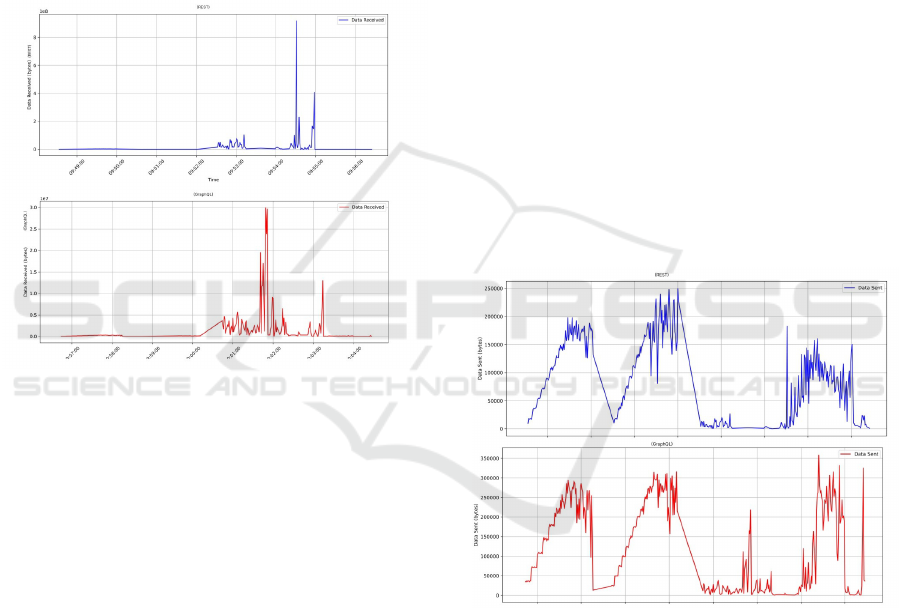
The data received by the REST and GraphQL APIs
during the performance tests demonstrates the differ-
ent approaches each API takes in handling data re-
trieval. As shown in Figure 7, the REST API con-
sistently processes larger volumes of data compared
to GraphQL. This is a direct result of REST’s static
nature, where predefined endpoints often return all
available data fields, regardless of whether the client
requires them. In contrast, GraphQL’s flexibility al-
lows clients to specify exactly what data they need,
reducing the amount of unnecessary data transferred.
This observation highlights the efficiency of
GraphQL in minimising data transfer, which is par-
ticularly advantageous in bandwidth-constrained en-
vironments or applications where only partial data is
frequently needed. However, REST’s approach can
be beneficial in scenarios where full data responses
are consistently required, as it simplifies server-side
implementation and reduces client-side logic.The vol-
ume of data handled by each API model during the
performance tests, highlighting the more efficient data
transfer exhibited by GraphQL in complex querying
scenarios.
The comparison of data sent between the REST
and GraphQL APIs reveals similar trends to the data
received metrics. The REST API tends to send more
data, as it returns complete responses based on pre-
defined structures. GraphQL, on the other hand, ex-
hibits more efficient data transfer by sending only the
data explicitly requested by theclient. This leads to a
smaller data footprint in GraphQL, especially in com-
plex scenarios where clients can avoid fetching un-
necessary fields.
This characteristic of GraphQL presents a clear
advantage in applications where precise data fetch-
ing is required, such as mobile apps or environments
with limited resources. However, the simplicity of
REST’s data transmission model makes it more pre-
dictable and easier to manage in scenarios where uni-
form data payloads are necessary. As shown in Fig-
ure 8, the amount of data sent through the REST and
GraphQL APIs demonstrates a significant contrast,
particularly when handling requests involving mul-
tiple nested data structures. The Figure emphasizes
GraphQL’s capability to send precise data based on
client requirements, unlike REST, which often results
in over-fetchin.
Figure 8: Comparison of Data Sent (REST vs. GraphQL).
The error rates observed during testing indicate
that GraphQL encounters more frequent errors per
second compared to REST, particularly under heavy
load and when resolving complex, nested queries.
This is largely due to the additional computational
overhead required by GraphQL to dynamically re-
solve requests and gather data from multiple sources.
In contrast, REST’s simpler, more linear request-
response model results in fewer errors, making it
more reliable under high-stress conditions.The fre-
quency of errors encountered per second by each API
model is visualized in Figure 9. The results demon-
Performance Evaluation of REST and GraphQL API Models in Microservices Software Development Domain
89
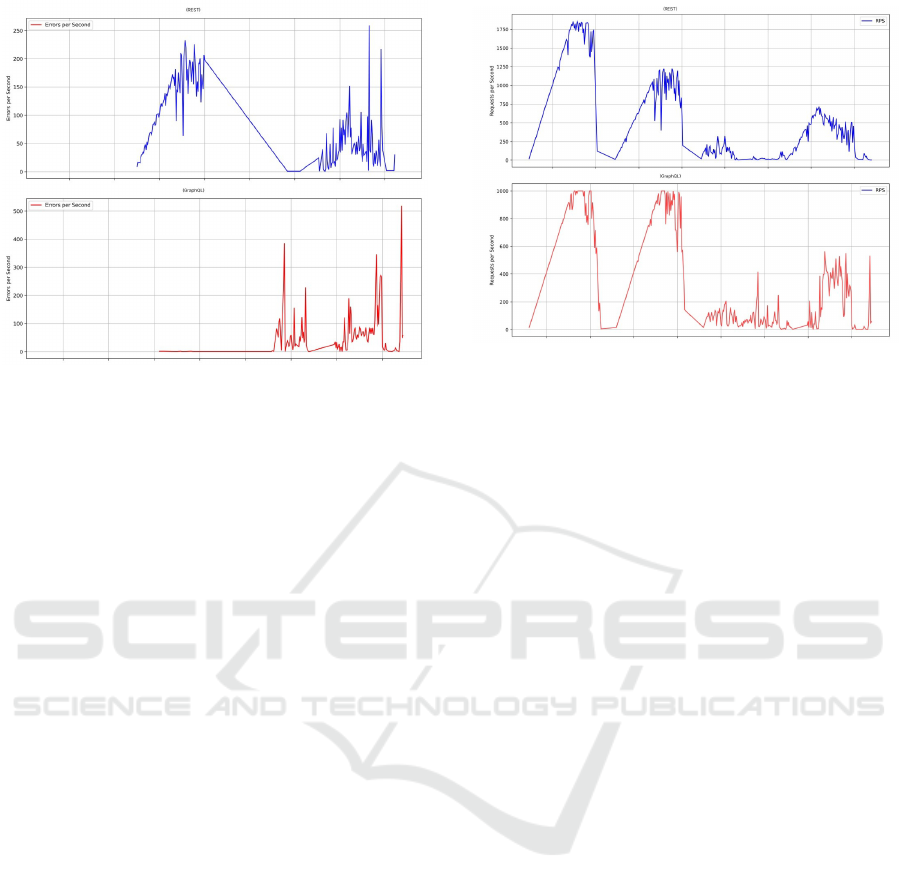
Figure 9: Comparison of errors per second (REST vs.
GraphQL)).
strates that GraphQL, though more flexible, tends
to generate more errors under higher loads, espe-
cially when dealing with intricate data queries. This
difference underscores the importance of optimizing
GraphQL resolvers and schema design to mitigate er-
ror rates in production environments. While GraphQL
offers flexibility, it requires careful management to
avoid performance bottlenecks and error spikes dur-
ing peak usage. REST, with its more robust error
handling under load, is better suited for applications
where reliability is prioritized over flexibility. The re-
quests per second (RPS) metric provides insight into
the throughput capabilities of each API. The REST
API consistently handles a higher number of requests
per second compared to GraphQL. This is expected,
given REST’s simpler request-response model, where
requests are statically defined and require less com-
putational overhead to fulfill. In contrast, GraphQL’s
dynamic nature, where the client defines the shape of
the response, introduces additional processing time,
reducing its overall memory.
This observation suggests that REST is better
suited for high-throughput scenarios where perfor-
mance and scalability are critical. GraphQL, while
capable of handling complex queries, may struggle
to maintain high RPS in applications with intense
traffic unless optimizations are made to streamline
query resolution. For developers, this highlights the
trade-off between flexibility and performance in API
design, with REST being the preferred option for
performance-critical applications.
The comparative analysis shows that REST han-
dles a higher volume of requests per second more ef-
ficiently, while GraphQL’s performance fluctuates de-
pending on the complexity of the queries being pro-
cessed, as illustrated in Figure 10.
Figure 10: Comparison of requests per second (REST vs.
GraphQL).
6 CONCLUSION
This study presented a comprehensive and empiri-
cal evaluation of REST and GraphQL API models
within the dynamic landscape of microservices de-
velopment. The primary objective was to provide a
detailed comparison of these two paradigms based
on critical performance metrics, including response
time, memory consumption, and error rates. Through
a series of meticulously designed experiments that
leveraged real-world scenarios in a social media sys-
tem, this research effectively highlighted the unique
strengths and limitations of each API model in man-
aging complex data interactions. The experimental
results revealed that REST consistently demonstrated
superior performance in terms of average request du-
ration and error rates, especially under high-load con-
ditions, underscoring its suitability for performance-
critical applications. Conversely, GraphQL excelled
in offering a significantly higher degree of flexibility
in data fetching, allowing for more granular and pre-
cise data retrieval. This capability reduces issues such
as over-fetching or under-fetching, enhancing the de-
veloper experience in applications where precise data
control is a priority. The findings of this study of-
fer valuable practical insights for both developers and
researchers. By presenting robust performance data
and clearly articulating the trade-offs between REST
and GraphQL, the research provides actionable guid-
ance on selecting the most appropriate API model for
microservices-based systems. This work enriches the
growing body of knowledge on API technologies and
empowers the development community to make in-
formed decisions tailored to real-world performance
demands and specific system requirements.
WEBIST 2025 - 21st International Conference on Web Information Systems and Technologies
90

REFERENCES
Acharya, K. (2024). Chat application through client
server management system project. Authorea.
July 29, 2024. DOI: https://doi. org/10.22541/au.
172228527.74316529/v1.
Amareen, S., Dector, O. S., Dado, A., and Bosu, A. (2024).
Graphql adoption and challenges: Community-driven
insights from stackoverflow discussions. arXiv
preprint arXiv:2408.08363.
Brito, G. and Valente, M. T. (2020). Rest vs graphql: A con-
trolled experiment. In 2020 IEEE international con-
ference on software architecture (ICSA), pages 81–91.
IEEE.
Efuntade, O. O., Efuntade, A. O., and FCIB, F. (2023).
Application programming interface (api) and man-
agement of web-based accounting information system
(ais): Security of transaction processing system, gen-
eral ledger and financial reporting system. Journal of
Accounting and Financial Management, 9(6):1–18.
Erlandsson, P. and Remes, J. (2020). Performance compar-
ison: Between graphql, rest & soap.
Hartig, O. and P
´
erez, J. (2017). An initial analysis of face-
book’s graphql language.
Lawi, A., Panggabean, B., and Yoshida, T. (2021). Eval-
uating graphql and rest api services performance in a
massive and intensive accessible information system.
computers 2021, 10, 138.
Leng, J., Guo, J., Xie, J., Zhou, X., Liu, A., Gu, X.,
Mourtzis, D., Qi, Q., Liu, Q., Shen, W., et al. (2024).
Review of manufacturing system design in the inter-
play of industry 4.0 and industry 5.0 (part i): Design
thinking and modeling methods. Journal of Manufac-
turing Systems, 76:158–187.
Levandoski, J., Casto, G., Deng, M., Desai, R., Edara, P.,
Hottelier, T., Hormati, A., Johnson, A., Johnson, J.,
Kurzyniec, D., et al. (2024). Biglake: Bigquery’s evo-
lution toward a multi-cloud lakehouse. In Companion
of the 2024 International Conference on Management
of Data, pages 334–346.
Mesbah, A. and Van Deursen, A. (2007). An architectural
style for ajax. In 2007 Working IEEE/IFIP Confer-
ence on Software Architecture (WICSA’07), pages 9–
9. IEEE.
Mikuła, M. and Dzie
´
nkowski, M. (2020). Comparison of
rest and graphql web technology performance. Jour-
nal of Computer Sciences Institute, 16:309–316.
Niswar, M., Safruddin, R. A., Bustamin, A., and Aswad,
I. (2024). Performance evaluation of microservices
communication with rest, graphql, and grpc. Interna-
tional Journal of Electronics and Telecommunication,
70(2):429–436.
Pautasso, C., Zimmermann, O., and Leymann, F. (2008).
Restful web services vs.” big”’web services: mak-
ing the right architectural decision. In Proceedings of
the 17th international conference on World Wide Web,
pages 805–814.
Shaw, M. and Clements, P. (1997). A field guide to boxol-
ogy: Preliminary classification of architectural styles
for software systems. In Proceedings Twenty-First An-
nual International Computer Software and Applica-
tions Conference (COMPSAC’97), pages 6–13. IEEE.
Sheltami, T. R., Shahra, E. Q., and Shakshuki, E. M. (2018).
Fog computing: Data streaming services for mobile
end-users. Procedia computer science, 134:289–296.
Simon, F. M. (2024). Escape me if you can: How ai re-
shapes news organisations’ dependency on platform
companies. Digital Journalism, 12(2):149–170.
Singh, S. P., Mehta, A., and Vasudev, H. (2024). Applica-
tion of sensitivity analysis for multiple attribute deci-
sion making in lean production system. Engineering
Management Journal, pages 1–24.
S
¨
oylemez, M., Tekinerdogan, B., and Tarhan, A. K. (2024).
Microservice reference architecture design: A multi-
case study. Software: Practice and Experience,
54(1):58–84.
Vadlamani, S. L., Emdon, B., Arts, J., and Baysal, O.
(2021). Can graphql replace rest? a study of their
efficiency and viability. In 2021 IEEE/ACM 8th In-
ternational Workshop on Software Engineering Re-
search and Industrial Practice (SER&IP), pages 10–
17. IEEE.
Vohra, N. and Manuaba, I. B. K. (2022). Implementation
of rest api vs graphql in microservice architecture. In
2022 International Conference on Information Man-
agement and Technology (ICIMTech), pages 45–50.
IEEE.
Wells, S. (2024). Enabling microservice success: managing
technical, organizational, and cultural challenges. ”
O’Reilly Media, Inc.”.
Performance Evaluation of REST and GraphQL API Models in Microservices Software Development Domain
91
