
LLM-Assisted Augmented Intelligence for Context-Aware Decision
Support: Current Trends and Integrated Approach
Alexander Smirnov
a
, Andrew Ponomarev
b
, Nikolay Shilov
c
and Tatiana Levashova
d
St. Petersburg Federal Research Center of the Russian Academy of Sciences (SPC RAS),
St. Petersburg, Russian Federation
Keywords: Decision Support, Augmented Intelligence, Large Language Models, Generative AI, Conversational AI,
Dialogue-Based DSS, Evaluative AI.
Abstract: The growing complexity of technical, social, and business systems created and managed by humans determine
the need for effective decision support. Recent advancements in AI push the boundary of what can be
accomplished using AI tools and what are possible modes of human-AI interaction, bringing a concept of
augmented intelligence, extending intellectual capabilities of human by variety of AI-based tools, while
leaving final decision-making (as well as some other operations, e.g., goal-setting, coordination, control) to a
human. This paper explores possibilities of using augmented intelligence for decision support. Starting with
a general structure of decision-making process, it highlights and reviews current trends in several branches of
AI, that are most important for decision support. Then, it proposes an integrated approach combining
conversational, generative, and evaluative AI. Distinguishing features of the proposed approach are
integration and mutual enrichment of data- and model-based techniques, as well as using modern LLMs as a
basis for human-AI interaction during decision-making.
1 INTRODUCTION
The growing complexity and number of tasks solved
by humans determine the need for the design of
effective decision support systems (DSSs). Over the
last few decades, a variety of techniques and
approaches powering DSSs have been proposed and
explored (Megawaty and Ulfa 2020). Recently, the
development of machine learning methods, and in
particular, large language models (LLMs), has led to
their introduction into various human activity
processes, including decision-making processes.
However, this trend is also associated with a number
of problems, such as the complexity of interaction
with such models, the low level of trust in them, the
unpredictability of the results they generate. This
highlights the relevance and global nature of the tasks
considered in the paper.
Among the approaches aimed at addressing these
issues, one can highlight the development of
a
https://orcid.org/0000-0001-8364-073X
b
https://orcid.org/0000-0002-9380-5064
c
https://orcid.org/0000-0002-9264-9127
d
https://orcid.org/0000-0002-1962-7044
dialogue-based DSSs, which involve both the
argumentation of alternative solutions presented to
the user and their evaluation alongside the assessment
of user-proposed solutions, ultimately aiding the user
in reaching a final decision through step-by-step
recommendations. Therefore, there is urge in the
development of new methods that would allow both
to synthesize new generation of DSSs and to use
them, supplementing human intelligence with
artificial intelligence to improve the effectiveness of
decision-making processes by preserving the leading
role of humans in the decision-making process and
organizing constructive dialogue between the
decision maker (DM) and AI.
Context awareness is critical for effectiveness of
decision support, as decisions inherently depend on
situational factors, user constraints, and domain-
specific knowledge. Without proper context
integration, even technically optimal solutions may
Smirnov, A., Ponomarev, A., Shilov, N. and Levashova, T.
LLM-Assisted Augmented Intelligence for Context-Aware Decision Support: Current Trends and Integrated Approach.
DOI: 10.5220/0013714300004000
Paper published under CC license (CC BY-NC-ND 4.0)
In Proceedings of the 17th International Joint Conference on Knowledge Discovery, Knowledge Engineering and Knowledge Management (IC3K 2025) - Volume 2: KEOD and KMIS, pages
409-416
ISBN: 978-989-758-769-6; ISSN: 2184-3228
Proceedings Copyright © 2025 by SCITEPRESS – Science and Technology Publications, Lda.
409
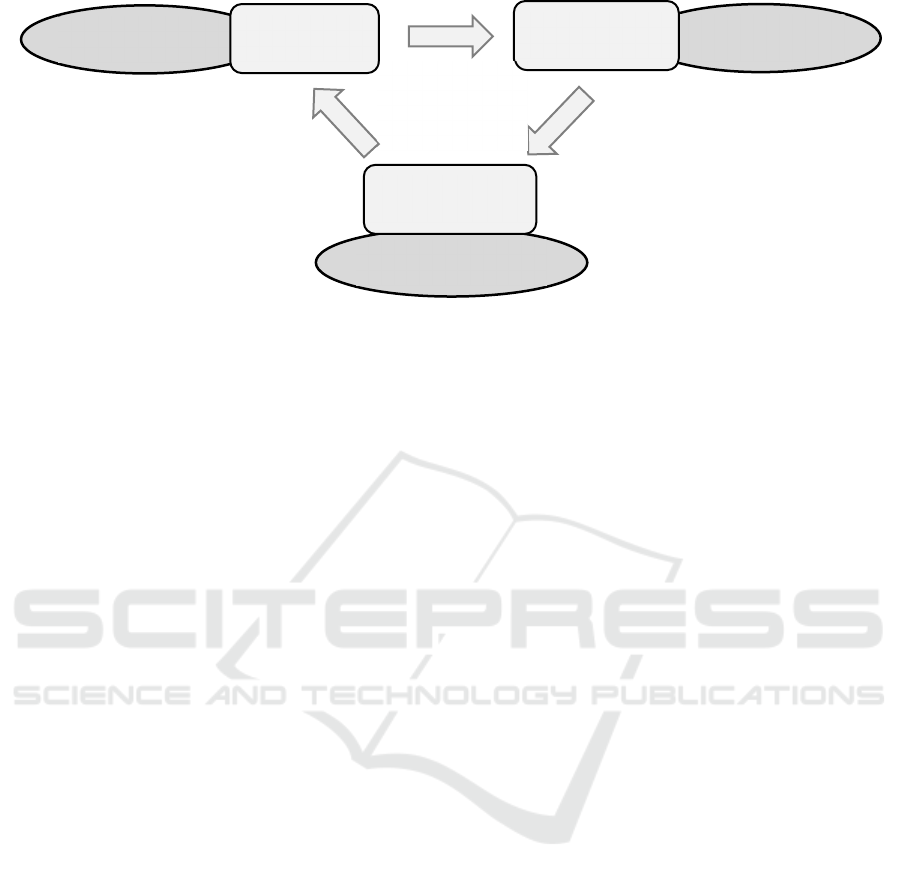
Figure 1: Decision-making cycle and relevant areas of AI.
prove impractical. Thus, context awareness serves not
as an enhancement but as a core requirement for DSS
in complex, real-world environments. Context-
dependent decision support focuses on formulating
solutions based on context (the task status, the
situation of the DM, as well as her/his preferences),
and a DSS implementing this approach should
include the following stages: (1) clarifying the current
task's formulation, (2) generating solutions feasible
within the current context, (3) evaluating these
solutions, including explanations, and providing the
DM with recommendations for making the final
decision.
Integrating the DM's intelligence with AI models
and methods can significantly improve the
effectiveness of context-dependent decision support.
Such integration, including the development of AI
models designed to support and enhance human
capabilities (as opposed to autonomous AI decision-
making), is referred to as augmented intelligence.
Implementation of the aforementioned stages of
context-dependent decision support requires:
(1) dialogue with the DM to clarify the task (since the
user's preferences and task conditions are rarely fully
known initially), (2) generation of possible solutions
(alternatives), and (3) their evaluation while ensuring
trust between the DM and the decision-supporting AI.
This trust is achieved, in particular, through
explainable reasoning. To meet these requirements, it
is advisable to use methods from conversational,
generative, and evaluative AI, respectively (Fig. 1).
This can be viewed as a natural elaboration of existing
trends in human-AI collaborative decision support
and (Smirnov, Shilov, and Ponomarev 2022).
Thus, the approach proposed in the paper focuses
on the three aforementioned types of AI
(conversational, generative, and evaluative) in terms
of developing models and methods necessary for their
effective use by DMs within the framework of
augmented intelligence. Application of LLMs
appears promising for implementing these.
The rest of the paper is organized as follows.
Section 2 provides a brief review of existing research
in areas, relevant to the proposed approach. Based on
this review, Section 3 summarizes key principles of
the approach, which is presented in more detail in
Section 4.
2 RELATED WORK
This section is structured according to the four main
research directions indicated above, namely: LLM-
based decision support, conversational, generative,
and evaluative AI.
2.1 LLM-Based Decision Support
In recent years, with the rapid advancement of LLMs,
a variety of general (and sufficiently universal)
approaches have been proposed to support decision-
making through natural language interaction with
users.
There are several approaches trying to integrate
different types of AI. For example, the integrated
methodology proposed in (Ramaul, Ritala, and
Ruokonen 2024) emphasizes the combined use of
generative and conversational AI in chatbots like
ChatGPT. The methodology is based on cyclic
bidirectional interactions between these two AI types:
the human initiates the generative AI, which then
engages the conversational AI for further dialogue.
This allows users to maintain continuous
conversation with the system, initiating new queries,
receiving responses, requesting clarifications or
refinements, and obtaining updated answers. Similar
Conversational
AI
Generative
AI
Evaluative
AI
Problem
clarification
Identification
of alternatives
Evaluation of
the alternatives
LLM
+
problem
model
KMIS 2025 - 17th International Conference on Knowledge Management and Information Systems
410

methodologies, integrating several types of AI are
Ask Grapho (Gutierrez de Esteban 2023), DeLLMa
(Liu et al. 2024) and mPulse methodology (Danzer
2024).
From the technical perspective, using LLM for
decision support is typically done by enriching LLM
with additional modules and tools (sometimes, this is
referred to as LLM-based agents). For example,
RAGADA architecture (Pitkäranta and Pitkäranta
2024) integrates a library of specialized methods and
algorithms with the generative capabilities of LLMs,
enhanced by Retrieval-Augmented Generation
(RAG) technology, providing means to select
appropriate problem-specific algorithms and present
their outputs in natural language.
Beyond general-purpose DSS architectures
employing LLMs for user interaction (among other
functions), there are also specialized frameworks for
particular DSS categories, e.g., recommender
systems, and conversational recommender systems
(Feng et al. 2023).
A distinctive feature of the approach proposed in
this paper is bidirectional integration of LLMs and
conceptual modeling – leveraging conceptual models
to enhance decision support quality while
simultaneously employing LLMs for conceptual
model construction during DSS development. Initial
attempts to apply LLMs for building domain
conceptual models have already emerged. For
instance, (Kommineni, König-Ries, and Samuel
2024) presents an automated approach to knowledge
graph construction using LLMs. Similar efforts
appear in (Caufield et al. 2023; Babaei Giglou,
D’Souza, and Auer 2023; Lam et al. 2024).
While LLMs may compete with ontologies in
certain applications, their combined use shows
significant potential. Moreover, complete automation
of high-quality ontology development through LLMs
remains unachievable (Neuhaus 2023), necessitating
human-AI collaboration (through dialogue and DM
involvement).
2.2 Generative AI
Generative Adversarial Networks (GANs) (Kusiak
2025; Chakraborty et al. 2024) represent one of the
most powerful deep learning methods for artifact
generation. Contemporary generative models are
capable of producing diverse artifacts including text,
images, videos, tabular data, and parameterized
graphs (Fan and Huang 2019; Fan, Tech, and Huang
2019; Zhou et al. 2019; Jia et al. 2023). These models
can be enhanced through conditional architectures
that incorporate additional input parameters
(conditional GAN), e.g, (Fan, Tech, and Huang
2019), and specialized modules that optimize training
efficiency for domain-specific constraints (De Cao
and Kipf 2018). Such capabilities make them
potentially suitable for generating feasible solutions
in DSSs, where outputs must satisfy both explicit
requirements and implicit patterns learned from
training data.
Notably, generative AI extends beyond neural
network implementations. Alternative approaches
include knowledge-based systems employing
symbolic knowledge representations (dynamic
modeling, metaheuristics, constraint satisfaction) and
evolutionary algorithms (genetic, swarm intelligence,
cellular automata) (Liao et al. 2024; Jiang et al. 2024).
Hybrid methodologies also show promise, such as the
integrated approach combining metaheuristics with
question generation to create educationally balanced
assignments with comprehensive topic coverage
(Láng and Dömsödi 2024).
2.3 Conversational AI for Decision
Support
Within the domain of conversational AI for context-
aware DSS, two key challenges merit particular
attention: model-oriented dialogue management
using LLMs for situation modeling and requirement
refinement, and LLM adaptation for domain-specific
dialogues.
The refinement of user requirements through
dialogue represents a critical application of LLMs in
DSS. Here, the primary function of LLMs involves
interpreting user inputs and mapping them to
elements of the task model, including their potential
values (Lawless et al. 2024; Han et al. 2023).
However, in most implementations, the task model is
predefined, with LLM integration designed
accordingly. Extending these approaches to work
with generalized structural models could significantly
streamline DSS development.
Domain adaptation of LLMs aims to enhance
response accuracy and reduce hallucinations. Widely
applied adaptation methods fall into two broad
categories: parametric and non-parametric.
Parametric adaptation involves fine-tuning model
parameters using domain-specific training samples.
This process not only improves the model's grasp of
specialized terminology and conceptual relationships
but also optimizes dialogue performance for specific
tasks (Tu et al. 2025). The complexity of parametric
adaptation, coupled with the inherent optimization of
many LLMs for general dialogue and instruction-
following, has led to widespread adoption of non-
LLM-Assisted Augmented Intelligence for Context-Aware Decision Support: Current Trends and Integrated Approach
411

parametric methods. These techniques, collectively
termed “prompt engineering”, augment queries with
relevant information unavailable during initial
training (e.g., post-training updates or proprietary
knowledge). Dozens of prompt engineering
techniques now exist, serving not only for domain
adaptation but also for generating step-by-step
reasoning, reducing hallucinations and other tasks
(Sahoo et al. 2024). Such methods have proven
particularly effective in medical DSS prototypes,
where they incorporate clinical guidelines
(unavailable during model training) into physician
recommendations (Zhao, Wang, and Peng 2024).
2.4 Evaluative AI
The role of evaluative AI within the proposed
approach lies in assessing both human-proposed and
AI-generated solutions, subsequently presenting
these evaluations to DMs alongside explanatory
rationale to facilitate more informed final decisions.
The evaluative AI embodies a paradigm shift
from recommendation-driven to hypothesis-driven
(Le, Miller, Zhang, et al. 2024; Miller 2023), where
the AI system enhances rather than dictates decision-
making processes. Specifically, it aims to strengthen
decision-maker autonomy (Le, Miller, Sonenberg, et
al. 2024), contextual awareness (Le 2023; Le, Miller,
Sonenberg, et al. 2024), and DM’s procedural control
through her/his hypothesis incorporation. While
implementation approaches vary significantly, a
defining characteristic of such evaluative AI systems
is their capacity to present balanced arguments
supporting and opposing each alternative.
Application of evaluative AI in DSS is a
promising research direction, necessitating further
work in three key areas: task model specification,
solution evaluation, and their presentation to DMs.
2.5 Summary
1. The development of augmented intelligence-
based DSS necessitates a comprehensive
methodology that combines: natural language
contextual interaction with users, generation of
appropriate responses or solutions aligned with
user requests, and justification & evaluation of
proposed solutions preserving the final decision
authority with human DMs. The most promising
AI components for such methodology appear to
be generative AI, conversational AI, and
evaluative AI. Currently, no existing
methodology integrates all three AI types for
augmented decision support. While some
approaches combine generative and
conversational AI - where generative AI utilizes
LLMs to formulate responses derived from
logical inference or computational problem-
solving, and conversational AI manages user
interaction through LLMs and NLP techniques.
The proposed in this paper approach aims to
incorporate all three AI types to implement
Simon's decision-making model (Simon 1979).
2. General-purpose LLMs, which form the
foundation of conversational AI implementations,
exhibit several inherent limitations. These
limitations can be effectively addressed by
employing LLMs as components within
integrated solutions supplemented by decision-
making methodologies and specialized reasoning
tools.
3. Current research notably underrepresents the
integration of conceptual modeling with LLMs,
making this an exceptionally promising direction
for advancing conversational AI techniques.
4. The predominant specialization of existing
artifact generation methods (generative AI)
similarly suggests the value of developing more
universal solutions grounded in domain
conceptual models, which would enable broader
applicability with minimal adaptation.
5. The incorporation of evaluative AI into DSS
represents another promising research avenue
demanding development of task model
specification methods, solution evaluation
frameworks, and presentation models for DMs.
3 FOUNDATIONAL PRINCIPLES
This section summarizes key principles that shape the
integrated approach, proposed in the paper. These
principles are based on the literature review, in
particular, on the identification of open issues and
their potential solutions. The principles are structured
along three dimensions: 1) the role of the prospective
DSSs in management activities, their scope and
functionality, 2) mode of interaction with the user
(decision-maker), 3) problem representation and
processing. These dimensions capture both “external”
image of the DSS in its location among other tools
available to the decision-maker, and its “internal”
organization.
KMIS 2025 - 17th International Conference on Knowledge Management and Information Systems
412

Scope and Role
1. DSS is aimed at helping decision-maker to
understand situation in detail, it may propose
solutions, help to evaluate solutions (proposed
either by decision-maker, or by itself), but the
final decision is made by human and human is
responsible for it. Hence, it is an exemplar of
augmented intelligence, when decision-makers
competency and understanding of the problem
situation is extended by external information and
reasoning capabilities of AI.
2. DSS memorizes the scenarios, results of their
executions, and decisions made and can use this
knowledge to make recommendations in the
future.
Interaction with the User
1. DSS interprets problems presented in natural
language. This interface can be supplemented
with other suitable forms of information
presentation and input (depending on the problem
domain of the DSS), but interface in natural
language is obligatory. Despite the ambiguity
immanent to natural language, the support of it as
a main communication media obviates the need
for creating problem-specific user interfaces and
simplifies the adoption of the DSS.
2. DSS interacts with human, when necessary, e.g.,
to refine the query, to agree on the problem model,
etc. In particular, it can help to resolve ambiguities
unavoidable when using natural language
communication. But moreover, problem is rarely
clearly specified in advance, often even decision-
maker a priori doesn’t know all the details and
preferences.
3. AI provides explanations of recommendations
(proposed decisions) and evaluations (of the
decisions proposed by itself or by decision-
maker), giving a traceable critique, allowing to
check whether these results can be trusted.
4. AI infers, manages, and takes into account
decision-makers’ preferences (explicit and
implicit).
Problem Representation and Processing
1. DSS is context-aware, it infers and takes into
account environment of the problem, decision-
makers perspective and other transient
information related to the problem.
2. DSS builds a model of the problem (or several
semantically interoperable models). Specifics of
these models may vary depending on the problem
domain and problem itself, however, model
building on the one hand, allows clarifying
intricacies of the problem at hand and its relations
to other elements of the domain, on the other
hand, it sometimes allows employing efficient and
explainable techniques, fulfilling the
explainability principle. This is one of the most
important principles and in severely influences
several other.
3. DSS decomposes complex problems into simpler
ones. Such decomposition is often made based on
the model of the problem and on some process-
based representation of similar problems.
4. Multi-aspect semantically consistent
representation of the proposed solution. A
potential solution sometimes has to address the
requirements of several stakeholders, who may
deal with the problem on different levels of
abstraction or from different perspectives.
Solution representation should allow such
multiple views, ensuring that they are consistent.
5. Utilization of existing knowledge. Such
utilization can take two forms: on a meta-level,
domain models can be viewed as a refined
representation of domain knowledge. On the
factual level, domain knowledge is represented in
variety of structured and unstructured resources
that can be interpreted and leveraged.
4 THE PROPOSED APPROACH
The article primarily examines support in solving
complex tasks that cannot be fully delegated to AI.
Accordingly, the main operational scenarios of the
decision support system (DSS) are those in which AI
generates recommendations, provides the necessary
information for decision-making (including
explanations), and evaluates possible solutions, while
humans use the AI's outputs to form their own
decisions and select the final solution.
The central element of the proposed approach (see
Fig. 2) for developing context-dependent decision
support systems is the process of model specification
using conceptual modeling techniques, as well as
information extraction and generalization methods to
systematize knowledge about the problem domain.
Thus, according to the proposed methodology,
during the DSS development phase, two closely
interconnected parallel processes are carried out in a
dialog mode: (a) the analysis of unstructured (textual)
and structured (database) information sources about
the problem domain; (b) the construction and
LLM-Assisted Augmented Intelligence for Context-Aware Decision Support: Current Trends and Integrated Approach
413
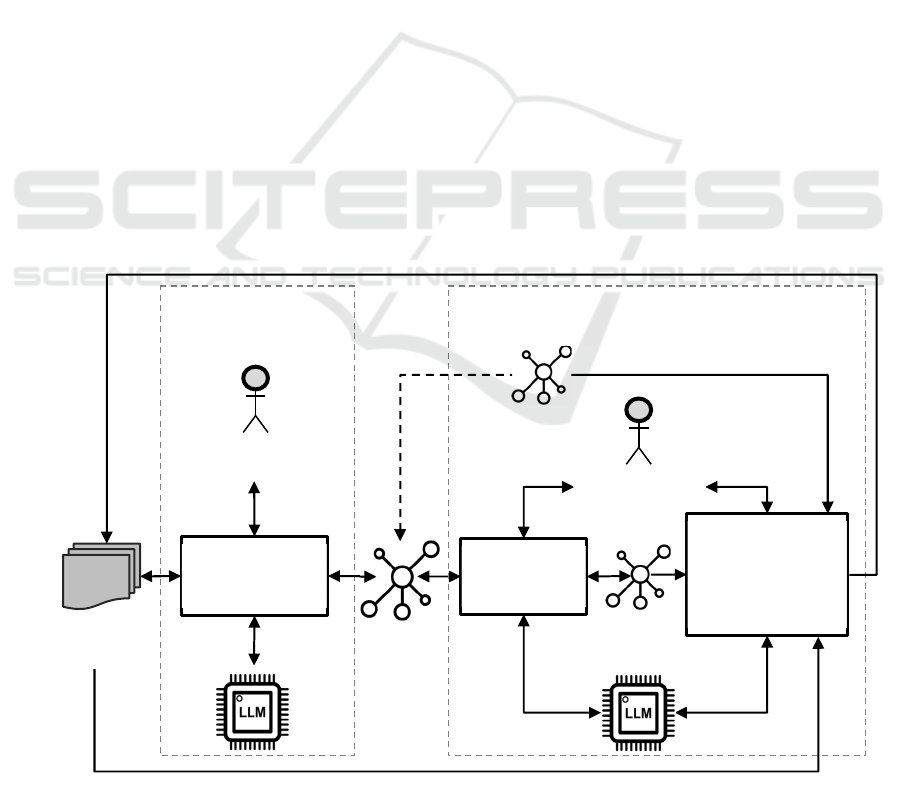
refinement of a conceptual model of the problem
domain, which includes the main object classes, their
relationships, the decision-maker's (DM) task models,
their possible decomposition into subtasks, and the
anticipated solution scenarios.
During the DSS operation phase, the DM's goal is
identified, and the model of the current task is
specified (populated with concrete attributes). This
refined task model is then used to generate and
evaluate solutions using developed generative and
evaluative AI methods, respectively.
As it was already noted, the proposed concept
amalgamates several branches (or, flavors) of AI,
here, the roles of different types of AI in the proposed
framework are summarized:
1. Generative AI. Within the proposed approach,
the objective of generative AI methods is to construct
solutions aligned with the decision-maker's (DM)
task. A common feature of the generative AI methods
considered here is that they take as input a task model
constructed through user interaction using an LLM
(Large Language Model), along with elements of the
problem domain model. Two key directions in
generative AI are deemed relevant: a) optimization-
based approaches (potentially constraint-aware),
primarily relying on metaheuristics; b) generative
neural network models. To select appropriate
solution-generation methods, it is necessary to
develop a method for determining dependencies
between problem domain models and the
corresponding solution-generation techniques. When
considering solution generation directly via LLMs,
attention should be given to investigating their
analogy with crowd computing. In both cases,
solutions are obtained through unreliable agents, and
crowd computing has developed various techniques to
process such results and enhance their reliability.
2. Conversational AI. The role of conversational
AI methods in the proposed approach is to construct
and refine the problem domain model (during DSS
development) and the specific task model (during DSS
operation) through natural language dialogue with the
user. The proposed approach centers conversational
AI around LLMs, which currently represent the most
promising tool for natural language interaction.
Specifically, LLMs are used for: a) acquiring domain
knowledge, context, and user preferences through
dialogue; b) providing the user with information (e.g.,
solution evaluations) in natural language. However,
generic LLMs are not always suitable for decision
support in specific domains. Therefore, one of two
kinds of adaptation of LLM to the domain can be used:
- parametric adaptation, which involves fine-
tuning the LLM to optimize dialogue behavior for the
given task. The most demanded here are resource-
efficient techniques allowing to reduce computational
complexity of the LLM fine-tuning (e.g., Quantized
Low-Rank Adaptation – QLoRA).
Figure 2: General scheme of the approach.
Data sources
(DBs, text, etc.)
DSS
develope
r
Domain model
building
DSS development
Abstract
domain
model
Task model
building
Selection and
application of
the specialized
decision support
method
Knowledge on
methods of task
solving
Decision-make
r
DSS operation
Usin
g
decisions to im
p
rove models, reasonin
g
and further decisions
Personalization and
context
RAG variants
KMIS 2025 - 17th International Conference on Knowledge Management and Information Systems
414

- non-parametric adaptation, which encompasses
solutions implemented via LLM extensions (often
termed LLM agents), including: prompt
engineering methods for structured, goal-oriented
dialogue; retrieval-Augmented Generation (RAG) to
enhance responses with external knowledge, reducing
hallucinations and improving answer quality and
some other techniques.
3. Evaluative AI. The role of evaluative AI
methods in the proposed approach is to assess
solutions—whether proposed by the DM or generated
by AI—and present these evaluations to the DM
along with explanations to support more informed
final decisions. Evaluations are performed using the
task model and problem domain model,
supplemented with pros and cons for each assessed
solution.
5 CONCLUSIONS
The growing complexity of modern business and
technical systems demands advanced decision-
support methodologies that augment human
intelligence rather than replace it. This paper has
explored how conversational, generative, and
evaluative AI—integrated into a unified
framework—can enhance decision-making while
preserving human agency in critical functions like
goal setting and validation. By combining data-driven
and model-based techniques with LLM-mediated
interaction, the proposed approach enables adaptive,
context-aware support that evolves alongside
dynamic real-world challenges.
Key advantages include the system’s ability to:
(1) leverage structured and unstructured knowledge
through hybrid AI methods, (2) provide explainable,
auditable reasoning via evaluative components, and
(3) maintain natural human oversight through
conversational interfaces. Future work should address
computational efficiency and domain-specific
customization while maintaining ethical alignment.
As AI capabilities progress, such augmented
intelligence systems will become indispensable for
balancing automation with human judgment in high-
stakes decision environments.
ACKNOWLEDGEMENTS
The research is funded by the Russian Science
Foundation (grant number 25-11-00127,
https://rscf.ru/project/25-11-00127/).
REFERENCES
Alvarez-Melis, David, Harmanpreet Kaur, Hal Daumé,
Hanna Wallach, and Jennifer Wortman Vaughan. 2021.
“From Human Explanation to Model Interpretability: A
Framework Based on Weight of Evidence.” In 9th AAAI
Conf. on Human Computation and Crowdsourcing
(HCOMP 2021). https://arxiv.org/abs/2104.13299.
Babaei Giglou, Hamed, Jennifer D’Souza, and Sören Auer.
2023. “LLMs4OL: Large Language Models for
Ontology Learning.” In The Semantic Web – ISWC
2023, 408–27. https://doi.org/10.1007/978-3-031-
47240-4_22.
Cao, Nicola De, and Thomas Kipf. 2018. “MolGAN: An
Implicit Generative Model for Small Molecular
Graphs.” In ICML 2018 Workshop on Theoretical
Foundations and Applications of Deep Generative
Models. https://doi.org/10.48550/arXiv.1805.11973.
Castelnovo, Alessandro, Riccardo Crupi, Nicolò Mombelli,
Gabriele Nanino, and Daniele Regoli. 2024.
“Evaluative Item-Contrastive Explanations in
Rankings.” Cognitive Computation, July. https://doi.
org/10.1007/s12559-024-10311-2.
Caufield, J. Harry, Harshad Hegde, Vincent Emonet, Nomi
L. Harris, Marcin P. Joachimiak, Nicolas Matentzoglu,
HyeongSik Kim, et al. 2023. “Structured Prompt
Interrogation and Recursive Extraction of Semantics
(SPIRES): A Method for Populating Knowledge Bases
Using Zero-Shot Learning,” April. http://arxiv.org
/abs/2304.02711.
Chakraborty, Tanujit, Ujjwal Reddy K S, Shraddha M Naik,
Madhurima Panja, and Bayapureddy Manvitha. 2024.
“Ten Years of Generative Adversarial Nets (GANs): A
Survey of the State-of-the-Art.” Machine Learning:
Science and Technology 5 (1): 011001. https://doi.
org/10.1088/2632-2153/ad1f77.
Danzer, Alex. 2024. “Generative AI, Conversational AI,
Predictive Analytics – What Works Best for Preventive
Healthcare.” MPulse Blogs. mPulse Official Web Site.
2024.
Fan, Shuangfei, and Bert Huang. 2019. “Labeled Graph
Generative Adversarial Networks.” https://arxiv.org/
abs/1906.03220.
Fan, Shuangfei, Virginia Tech, and Bert Huang. 2019.
“Deep Generative Models for Labelled Graphs.” ICLR
Workshop DeepGenStruct, 1–10.
Feng, Yue, Shuchang Liu, Zhenghai Xue, Qingpeng Cai,
Lantao Hu, Peng Jiang, Kun Gai, and Fei Sun. 2023. “A
Large Language Model Enhanced Conversational Re-
commender System.” https://arxiv.org/abs/2308.06212
Gutierrez de Esteban, Nicolas. 2023. “Revolutionizing
Decision-Making with Generative AI: Our Experience
with Ask Grapho.” Intellico Blog. intellico.ai. 2023.
Han, Qiushi, Haitong Chen, Haoxiang Fan, and Zhenhui
Peng. 2023. “ReDBot: Exploring Conversational
Recommendation for Decision-Making Support in
Group Chats.” In Proceedings of the Eleventh
International Symposium of Chinese CHI, 73–80. New
York, USA: ACM. https://doi.org/10.1145/3629606.
3629615.
LLM-Assisted Augmented Intelligence for Context-Aware Decision Support: Current Trends and Integrated Approach
415

Jia, Nan, Xiaolin Tian, Wenxing Gao, and Licheng Jiao.
2023. “Deep Graph-Convolutional Generative
Adversarial Network for Semi-Supervised Learning on
Graphs.” Remote Sensing 15 (12): 3172. https://doi.
org/10.3390/rs15123172.
Jiang, Feifeng, Jun Ma, Christopher John Webster, Alain
J.F. Chiaradia, Yulun Zhou, Zhan Zhao, and Xiaohu
Zhang. 2024. “Generative Urban Design: A Systematic
Review on Problem Formulation, Design Generation,
and Decision-Making.” Progress in Planning 180
(February): 100795. https://doi.org/10.1016/j.progress.
2023.100795.
Kommineni, Vamsi Krishna, Birgitta König-Ries, and
Sheeba Samuel. 2024. “From Human Experts to
Machines: An LLM Supported Approach to Ontology
and Knowledge Graph Construction,” March.
http://arxiv.org/abs/2403.08345.
Kusiak, Andrew. 2025. “Generative Artificial Intelligence
in Smart Manufacturing.” Journal of Intelligent
Manufacturing 36 (August): 1–3. https://doi.org/
10.1007/s10845-024-02480-6.
Lam, Michelle S., Janice Teoh, James A. Landay, Jeffrey
Heer, and Michael S. Bernstein. 2024. “Concept
Induction: Analyzing Unstructured Text with High-
Level Concepts Using LLooM.” In Proceedings of the
CHI Conference on Human Factors in Computing
Systems, 1–28. New York, NY, USA: ACM.
https://doi.org/10.1145/3613904.3642830.
Láng, B., and B. Dömsödi. 2024. “Integration of AI and
Metaheuristics in Educational Software: A Hybrid
Approach to Exercise Generation.” International
Journal of Emerging Technologies in Learning 19 (6):
38–51.
Lawless, Connor, Jakob Schoeffer, Lindy Le, Kael Rowan,
Shilad Sen, Cristina St. Hill, Jina Suh, and Bahareh
Sarrafzadeh. 2024. “‘I Want It That Way’: Enabling
Interactive Decision Support Using Large Language
Models and Constraint Programming.” ACM Transac-
tions on Interactive Intelligent Systems 14 (3): 1–33.
https://doi.org/10.1145/3685053.
Le, Thao. 2023. “Explaining the Uncertainty in AI-Assisted
Decision Making.” Proceedings of the AAAI
Conference on Artificial Intelligence 37 (13): 16119–
20. https://doi.org/10.1609/aaai.v37i13.26920.
Le, Thao, Tim Miller, Liz Sonenberg, and Ronal Singh.
2024. “Towards the New XAI: A Hypothesis-Driven
Approach to Decision Support Using Evidence.”
https://arxiv.org/abs/2402.01292.
Le, Thao, Tim Miller, Ruihan Zhang, Liz Sonenberg, and
Ronal Singh. 2024. “Visual Evaluative AI: A
Hypothesis-Driven Tool with Concept-Based
Explanations and Weight of Evidence.” https://arxiv.
org/abs/2402.01292.
Liao, Wenjie, Xinzheng Lu, Yifan Fei, Yi Gu, and Yuli
Huang. 2024. “Generative AI Design for Building
Structures.” Automation in Construction 157: 105187.
https://doi.org/10.1016/j.autcon.2023.105187.
Lipton, Peter. 1990. “Contrastive Explanation.” Royal
Institute of Philosophy Supplement 27 (March): 247–
66. https://doi.org/10.1017/S1358246100005130.
Liu, Ollie, Deqing Fu, Dani Yogatama, and Willie
Neiswanger. 2024. “DeLLMa: Decision Making Under
Uncertainty with Large Language Models,” February.
http://arxiv.org/abs/2402.02392.
Megawaty, Megawaty, and Maria Ulfa. 2020. “Decision
Support System Methods: A Review.” Journal of
Information Systems and Informatics 2 (1): 192–201.
https://doi.org/10.33557/journalisi.v2i1.63.
Miller, Tim. 2023. “Explainable AI Is Dead, Long Live
Explainable AI!” In
2023 ACM Conf. on Fairness,
Accountability, and Transparency, 333–42. New York,
USA: ACM. https://doi.org/10.1145/3593013.3594001
Neuhaus, Fabian. 2023. “Ontologies in the Era of Large
Language Models – a Perspective.” Applied Ontology
18 (4): 399–407. https://doi.org/10.3233/AO-230072.
Pitkäranta, Tapio, and Leena Pitkäranta. 2024. “Bridging
Human and AI Decision-Making with LLMs: The
RAGADA Approach.” In Proceedings of the 26th
International Conference on Enterprise Information
Systems, 812–19. SCITEPRESS - Science and
Technology Publications. https://doi.org/10.5220/
0012705000003690.
Ramaul, Laavanya, Paavo Ritala, and Mika Ruokonen.
2024. “Creational and Conversational AI Affordances:
How the New Breed of Chatbots Is Revolutionizing
Knowledge Industries.” Business Horizons 67 (5): 615–
27. https://doi.org/10.1016/j.bushor.2024.05.006.
Sahoo, Pranab, Ayush Kumar Singh, Sriparna Saha, Vinija
Jain, Samrat Mondal, and Aman Chadha. 2024. “A
Systematic Survey of Prompt Engineering in Large
Language Models: Techniques and Applications.”
https://arxiv.org/abs/2402.07927.
Simon, Herbert. 1979. “Rational Decision Making in
Business Organizations.” American Economic
Association 69 (4): 493–513.
Smirnov, Alexander, Nikolay Shilov, and Andrew
Ponomarev. 2022. “Context-Aware Knowledge
Management as an Enabler for Human-Machine
Collective Intelligence.” In Knowledge Discovery,
Knowledge Engineering and Knowledge Management.
IC3K 2020. Communications in Computer and
Information Science, Vol 1608, 94–116. Springer,
Cham. https://doi.org/10.1007/978-3-031-14602-2_5.
Tu, Tao, Mike Schaekermann, Anil Palepu, Khaled Saab,
Jan Freyberg, Ryutaro Tanno, Amy Wang, et al. 2025.
“Towards Conversational Diagnostic Artificial
Intelligence.” Nature 642 (8067): 442–50.
https://doi.org/10.1038/s41586-025-08866-7.
Zhao, Xiutian, Ke Wang, and Wei Peng. 2024. “An
Electoral Approach to Diversify LLM-Based Multi-
Agent Collective Decision-Making.” In Proceedings of
the 2024 Conference on Empirical Methods in Natural
Language Processing, 2712–27. Stroudsburg, PA,
USA: Association for Computational Linguistics.
https://doi.org/10.18653/v1/2024.emnlp-main.158.
Zhou, Dawei, Lecheng Zheng, Jiejun Xu, and Jingrui He.
2019. “Misc-GAN: A Multi-Scale Generative Model
for Graphs.” Frontiers in Big Data 2 (April).
https://doi.org/10.3389/fdata.2019.00003.
KMIS 2025 - 17th International Conference on Knowledge Management and Information Systems
416
