
Systematic Literature Review (SLR): Knowledge Management (KM)
Processes and Artificial Intelligence (AI)
Nada S. AlMuzaini, Boyka Simeonova and Mat Hughes
a
School of Business, University of Leicester, University Rd, Leicester LE1 7RH, U.K.
Keywords: Knowledge Management (KM), Artificial Intelligence (AI), Knowledge Management (KM) Process,
Knowledge Creation, Knowledge Sharing and Knowledge Utilisation.
Abstract: The purpose of this systematic literature review is to identify the gaps and limitations within Knowledge
Management (KM) processes through the lens of Artificial Intelligence (AI). Using a systematic literature
review methodology, 42 academic articles were identified and analysed through content analysis to examine
how KM processes are addressed within AI-related research. The studies were thematically coded and
categorised to uncover prevailing patterns and insights. The review finds that the integration of AI into KM
is still in its nascent stages, with fragmented and evolving research. Five core themes emerged from the
analysis: (1) AI and human collaboration, (2) Trust and ethics, (3) Ingenuity, (4) Organisational performance
and (5) Information security. Each theme highlights both opportunities and challenges of AI within KM
processes. In addition, the review identifies limitations within each theme and offers suggestions for future
research. This paper provides a comprehensive overview of how AI intersects with KM processes and
demonstrates the value of applying a systematic literature review to organise and explore this emerging area
of research.
1 INTRODUCTION
Knowledge is recognised as a key organisational
resource, with organisations actively orchestrating
knowledge assets and processes to create, share and
apply knowledge effectively (Olan et al., 2022, Alavi
et al., 2024). Individuals exchange both tacit and
explicit knowledge through experiences, skills,
documentation and formal communication (Nonaka
and Takeuchi, 1995). The role of Knowledge
Management (KM) is to manage these knowledge
resources efficiently (Jarrahi et al., 2023) and to
facilitate the KM processes, namely knowledge
creation, sharing and utilisation, which are essential
for achieving a competitive advantage in today’s
complex environments (Heisig, 2009).
KM includes various processes, which involve a
set of systematic functions designed to manage an
organisation's knowledge effectively and enhance its
performance (Sabherwal and Becerra‐Fernandez,
2003). These KM processes include knowledge
creation, acquisition, assimilation and sharing across
the organisation, enabling informed decision-making
a
https://orcid.org/0000-0001-6859-558X
and intelligent action (Heisig, 2009). To meet KM
objectives, these processes help establish a
framework that supports the effective creation,
sharing and utilisation of knowledge by both the
organisation and its members (Dalkir, 2023). Heisig
(2009) emphasised that the success of KM depends
on the interplay between KM processes and
contextual factors such as organisational culture,
technology and leadership. For KM to be effective,
these processes must work together in harmony.
Heisig (2009) also identified the most common KM
processes as knowledge creation, sharing, utilisation,
identification and acquisition. These processes
interact in a continuous cycle, influencing one
another in an emergent rather than hierarchical
manner (Alavi and Leidner, 2001).
Knowledge creation refers to the generation of
new knowledge from both explicit and tacit sources
(Nonaka, 1994). Knowledge sharing involves the
exchange of information, ideas and experiences
among individuals, teams and employees (Jarrahi et
al., 2023). Knowledge utilisation is the application of
knowledge after it has been created and shared,
AlMuzaini, N. S., Simeonova, B. and Hughes, M.
Systematic Literature Review (SLR): Knowledge Management (KM) Processes and Artificial Intelligence (AI).
DOI: 10.5220/0013685000004000
Paper published under CC license (CC BY-NC-ND 4.0)
In Proceedings of the 17th International Joint Conference on Knowledge Discovery, Knowledge Engineering and Knowledge Management (IC3K 2025) - Volume 2: KEOD and KMIS, pages
237-246
ISBN: 978-989-758-769-6; ISSN: 2184-3228
Proceedings Copyright © 2025 by SCITEPRESS – Science and Technology Publications, Lda.
237

transforming it into action and value creation. (Wiig,
1993). Knowledge identity refers to a data analyst’s
self-perception of their knowledge, shaped by past
experiences, current practices and future aspirations.
This identity influences their ability to apply analytics
for problem-solving effectively (Intezari et al., 2022).
Knowledge acquisition is the process of identifying
knowledge from internal and external sources and
transforming it into a format that can be internalised
or used effectively within the organisation (Gaines,
2004).
A Knowledge Management (KM) model outlines
how knowledge is processed across departments
within an organisation. This process facilitates
knowledge flow and provides a framework for
enhancing collaboration, teamwork and
organisational learning (Heisig, 2009).The following
section presents two KM models.
Nonaka’s model of knowledge creation (Nonaka,
1994; Nonaka and Takeuchi, 1995) highlights the
dynamic interaction between tacit and explicit
knowledge within individuals and organisations. It
consists of four modes: socialisation (tacit to tacit),
combination (explicit to explicit) , externalisation
(tacit to explicit), and internalisation (explicit to tacit
knowledge) (Nonaka and Takeuchi, 1995). The four
modes of knowledge creation can be utilised to
enhance an organisation's KM strategies, drive
innovation, and foster learning with individuals and
groups (Nonaka, 1994).
To manage organisational learning through KM
processes, Alavi and Leidner (2001) created a model
emphasising the role of KM processes. Their model
included knowledge creation, storage/retrieval,
transfer and application. Knowledge creation
encompasses the internal and external development
of new knowledge for the organisation. Knowledge
storage and retrieval involve storing knowledge
within an organisation to be effectively retrieved for
future use. Knowledge transfer includes sharing
knowledge within the organisation through formal
meeting documentation and databases. Knowledge
application is applying the knowledge to achieve
organisational goals effectively in decision-making
processes.
KM models illustrate how knowledge is managed
and utilised at various stages within an organisation.
The use of core KM processes such as knowledge
creation, sharing and utilisation is fundamental for
understanding how knowledge is effectively
exercised in organisational settings (McAdam and
McCreedy, 1999). These processes also support
organisations in creating, sharing and applying
knowledge to enable better decision-making and
more informed strategic choices in competitive
environments (Rollett, 2012).
Technology such as artificial intelligence (AI) has
transformed organisational contexts by offering new
opportunities to enhance knowledge management
(Jarrahi et al., 2023). For instance, AI impacts KM
processes by generating new insights from explicit
knowledge and assisting with problem-solving
(Alavi et al., 2024). It can also extract, analyse and
share knowledge from various data sources, thereby
leveraging an organisation’s knowledge assets and
enhancing decision-making by converting data into
actionable insights (Benbya et al., 2021, Rezaei et al.,
2024). This encourages employees at all levels to
collaborate, share and utilise information and insights
produced by A(Sumbal et al., 2024). For example, AI
tools such as generative AI (GenAI) can act as co-
creators alongside humans to support task execution,
creativity and innovation (Benbya et al., 2021).
This provides a deeper understanding of how
knowledge flows through the organisation and how it
is embedded in both individual cognition and
collective practices (Alavi et al., 2024, Alavi and
Leidner, 2001). However, it is also disrupting
traditional KM processes by analysing large datasets
to generate knowledge more rapidly than
conventional methods (Peters et al., 2024, Anthony et
al., 2023). Despite these benefits, AI also presents
risks, including algorithmic bias, ethical concerns and
the potential erosion of tacit knowledge (Benbya et
al., 2024, Alavi et al., 2024, Anthony et al., 2023).
These risks underscore the importance of retaining
expert insights within KM frameworks. (Alavi et al.,
2024, Alavi and Leidner, 2001)
Although AI is increasingly integrated into
business functions, its role within KM remains
empirically underdeveloped. There is limited
research exploring how AI influences the core KM
processes of knowledge creation, sharing and
utilisation (Anthony et al., 2023, Peters et al., 2024).
Given the limited availability of existing studies, this
research adopts a systematic literature review (SLR)
to examine and understand the current state of the
literature on AI within KM processes, with a specific
focus on knowledge creation, sharing, and utilisation.
The central research question guiding this study
is: What is the current state of the literature on AI
within KM processes, particularly in relation to
knowledge creation, sharing, and utilisation?
Through the systematic analysis of 42 academic
articles published in high-quality journals, this study
aims to identify key themes, highlight research gaps,
and propose future directions for both theory and
practice.
KMIS 2025 - 17th International Conference on Knowledge Management and Information Systems
238
The following section presents a systematic
literature review to understand the gaps in KM and AI
and includes a research theme that emerged from the
literature review.
2 METHODOLOGY
To identify and understand research gaps in AI within
the field of KM as it relates to organisational aspects,
this systematic literature review (SLR) aims to
explore both known and unknown areas of KM
processes and AI. The SLR was conducted following
the methodological framework suggested by
Tranfield et al. (2003), as themes were created to
identify, code and analyse the articles.
The search strategy encompassed a thorough
examination of a primary database using only the
Web of Science, as this database provided the
necessary journals for this search. The search was
conducted using the following keywords:
“knowledge management”, “artificial intelligence”,
“knowledge transfer”, “knowledge sharing”,
“knowledge creation”, “knowledge utilisation”, or
"knowledge utilization” and “knowledge application”
(presented in appendix) Within the research, only
journals were selected for ranking in the ABS list with
greater than or equal to two stars with selected fields,
including Information Management, Innovation,
General Management (Ethics, Gender and Social
responsibility), Organisation Studies, and
Entrepreneurship.
Articles were excluded that particularly on
domains such as R&D, construction knowledge, audit
technology, profit performance, gender, medical
logistics, marketing analytics, grant prediction,
scientific mobility, virtual teams, and invention
growth were excluded.
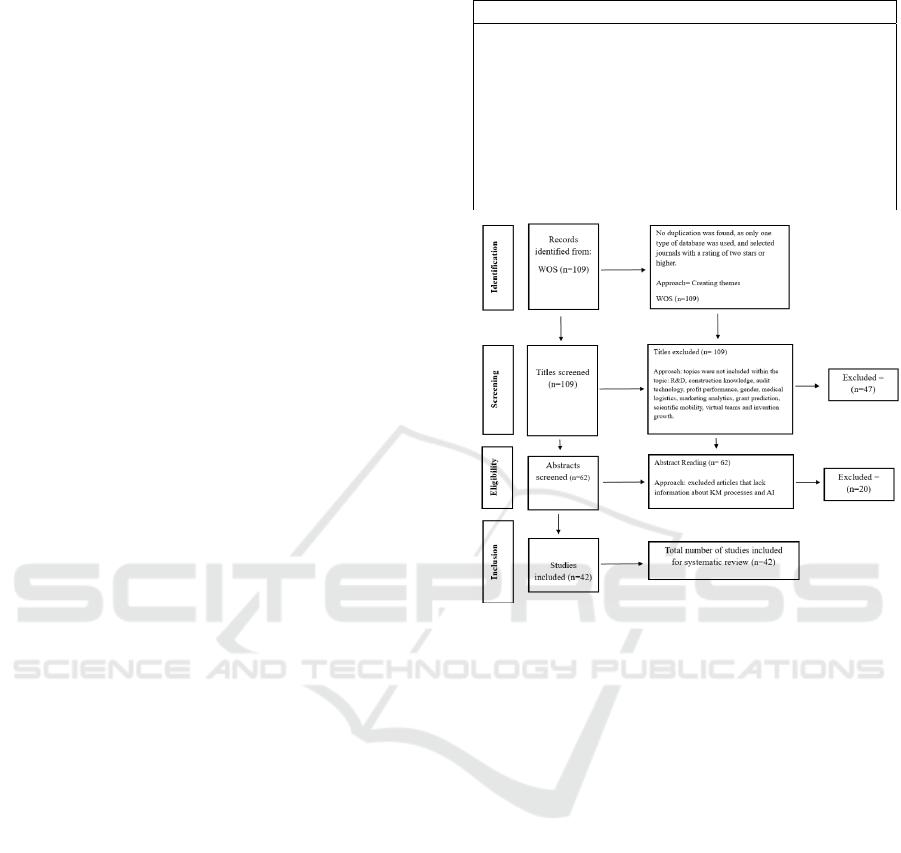
The search initially identified 109 articles. After
carefully evaluating each article's title, this number
was reduced to 62. After reviewing the abstracts to
assess their alignment with the research objectives,
only 42 articles were considered relevant (shown in
appendix).
The following section reviews five themes of SLR
to provide a deeper understanding of the gaps in the
interdisciplinary field of KM and AI, as well as the
connection between them.
Table 1: Keywords assembly structure.
Keywords Search
1. “artificial intelligence” and “knowledge
management”
2. “artificial intelligence” and “knowledge transfer”
3. “artificial intelligence” and “knowledge sharing”
4. “artificial intelligence” and “knowledge creation”
5. “artificial intelligence” and “knowledge
utilisation” or “knowledge utilization"”
6. “artificial intelligence” and “knowledge
a
pp
lication”
Figure 1: Flowchart of the sample selection process, as per
(Kahale et al., 2021, Mengist et al., 2020).
2.1 Findings: Current State of the
Knowledge in the Discipline of AI
in KM Processes
The analysis utilised the classifications that emerged
from the citation analysis. All 42 papers were
classified independently according to 5 themes; each
theme's details are explained below.
The results show a need for more empirical
studies within the KM and AI disciplines. Of the 42
articles reviewed, the majority were quantitative
studies (11) focusing on statistical analysis, followed
by qualitative studies (8) providing deeper insights
into experiences. Additionally, three mixed-method
studies provided a clearer understanding of KM and
AI. The review also included conceptual frameworks
(3 articles) and literature reviews (17 articles), which
were primarily based on editorial literature reviews (4
articles), literature reviews (3 articles), or systematic
literature reviews (10 articles), identifying existing
knowledge and highlighting future research gaps in
KM and AI.
Systematic Literature Review (SLR): Knowledge Management (KM) Processes and Artificial Intelligence (AI)
239

The articles used the following theories:
knowledge-based view, resource-based view,
dynamic capability theory, relationship marketing
theory, systems theory and emerging theories related
to knowledge augmentation and knowledge hiding.
Table 2: Summary of themes and sub-themes.
Themes
Sub-
themes
Description
No.
Article
s
1) AI-
individual
collaboration
KM
Models
and
organis
ational
knowle
dge.
Articles view AI as
a co-creator
working alongside
the individual and
consider AI to have
numerous
cognitive skills
necessary to
improve
productivity and
create new
knowledge for
organisations
p
rocesses.
16
2
) Trust and Ethics
Articles raise
concerns about AI
in relation to trust
and ethic.
10
3
) Ingenuity
Innovati
on
solution
s and
creativit
y
Article views
ingenuity within
organisational
contexts as
creativity and
innovative thinking
in problem-
solving, providing
new opportunities
to improve
organisational
p
erformance.
10
4) Performance
Articles view ways
to improve the
organisation's
p
erformance.
10
5) Information Security
Articles mention
information
security within AI
systems to prevent
knowledge from
leakage.
2
Theme 1: AI–Individual Collaboration (16 articles)
These articles view AI as a co-creator working
alongside the individual and consider AI to have
numerous cognitive skills necessary to improve
productivity and create new knowledge for
organisational processes. The sub-themes are the KM
model and organisational knowledge.
AI integration into the KM model, articles discussing the
KM model with the integration of AI (6 articles).
Articles mentioning the KM model include KM
processes using AI. The literature reviewed by Jarrahi et al.
(2023) and Benbya et al. (2024) used the KM model for
knowledge creation, sharing, storage/retrial and application.
Jarrahi et al. (2023) recommended utilising AI to
support KM processes. The article underscores the
collaboration between AI and humans in organisational
settings, emphasising that AI should enhance employees'
skills rather than replace them. The article's main argument
is that AI will enhance employees' expertise, provide a large
amount of data and improve the efficiency of KM processes.
On the other hand, Benbya et al. (2024) explained the role
of GenAI and its implications for knowledge and creative
work in fields such as design, writing, and innovation.
GenAI is helpful for creativity and knowledge creation.
Additionally, GenAI can work alongside employees to
answer their enquiries, provide feedback, enable them to
share knowledge, foster learning experiences, and aid the
organisation's knowledge in decision-making and strategic
planning.
GenAI is integrated within the KM model, particularly
in the view of Alavi et al. (2024), who
recommended
using the KM processes of knowledge creation,
transfer, utilisation, storage, retrieval and articulation
of explicit implementation. GenAI helps to facilitate
more comprehensive knowledge, and organisations
must carefully manage technology integration with
human insight to ensure ethical and accurate KM
practices.
Nonaka's model of knowledge creation integrated
human intelligence into AI processes to enhance
learning and adaptability while augmenting
organisational knowledge, thereby creating a
"recursive theory of knowledge augmentation”
(Harfouche et al. (2023). The theory extends the
traditional models of organisational knowledge
creation with the integration of AI; with the
knowledge creation model, the author used five new
models of knowledge augmentation: Alimentation,
Aggregation, Amplification, Reflection, and Fusion.
This mode explains the collaboration of humans and
AI reclusively to feed AI with human knowledge,
learn from AI outputs, and interact between humans
and AI to ensure that knowledge is explained and
refined within the organisation.
AI is transforming organisational knowledge.
Ardito et al. (2022) used absorptive capacity theory in
a systematic review to explore how AI transforms
KM in organisations, focusing on how knowledge is
acquired, assimilated, transformed, and exploited
across stages. Zhang et al. (2025), in their systematic
review, explain how AI is influencing each dimension
of the SECI model of knowledge creation (presented
by Nonaka and Takeuchi (1996)), highlighting how
AI accelerates the conversion of tacit to explicit
KMIS 2025 - 17th International Conference on Knowledge Management and Information Systems
240

knowledge, enriches knowledge integration, and
ultimately enhances innovation, decision-making,
and organisational performance.
Organisational Knowledge: articles discussing
how AI changes organisational knowledge (10
articles).
AI, particularly ML systems reduce the need for
human interaction and organisations must understand
the learning capabilities of the systems to align them
with their strategies (Sturm et al., 2021). For example,
ML has the potential to provide information for sales
personnel to help with sales decisions, market
knowledge, and assist with visual and written content
(Paschen et al., 2020). Intelligent bots in KM have
numerous important functions in collaborating with
other stakeholders and supporting employees in their
daily tasks. For example, mobile messaging apps
implement bots to monitor conversations and provide
recommendation services (Kane, 2017). Chin et al.
(2024) explains in a conceptual paper, helps to
recognise how organisational knowledge is shaped by
the interaction between AI and human intelligence in
managing cross-cultural knowledge. It aims to
understand how humans and AI collaborate, conflict,
and co-create knowledge in the context of
humanitarian logistics.
Two studies (Shollo et al., 2022, Olan et al., 2022)
showed the importance of RBV in investigating how
businesses can create value and achieve a competitive
advantage by leveraging AI. From a qualitative
perspective, a study by Shollo et al. (2022) achieved
an understanding of the business's capabilities using
AI, as it helps the organisation to create new
knowledge for the firm, make better decisions, and
add value to the business strategies. This highlights
how AI can orchestrate AI capabilities to create and
sustain value within the organisation's strategies.
From a quantitative perspective, Liu et al. (2024)
explored the influence of AI on the speed of
internationalisation for firms from emerging markets,
focusing on Chinese firms. The results show that AI
has a positive impact on organisations' processes,
improving their competitive advantage by global
standards. However, research also noted that firms
based in their home country, where reliance on
market knowledge and practices may hinder the use
of AI for international growth, may also benefit from
AI. This provides a new perspective on how AI can
help firms’ KM emerge in new global markets, create
a competitive advantage, and provide valuable
insights by learning from the feedback.
There are numerous methods for investigating
feedback loops in AI. One approach is to explore the
role of knowledge brokers, who translate tacit
knowledge into explicit knowledge by coding the
individuals' insights and experience, leading to new
knowledge within the AI system to facilitate decision-
making processes (Waardenburg et al., 2022).
Fowler (2000) discusses how integrating human
intelligence with AI can enhance problem-solving
and user acceptance. Additionally, the research
examines how AI systems codify tacit knowledge into
actionable steps by finding, filtering, formatting,
forwarding, and providing feedback knowledge to the
Human-in-the-Loop AI, thereby supporting human
decision-making. Kumar (2025) demonstrates the
development of a dual-loop framework that
influences the use of AI within KM to support better
decision-making and continuous feedback. This
framework encourages human–AI collaboration in
the practice of automated, augmented, and supported
decisions.
Limitations: While the existing literature
provides insight into how AI affects organisational
knowledge, there is still a need for broader research
to understand its overall impact on knowledge-related
practices. Further studies are needed to explore the
evolving relationship between AI and human roles,
including its influence on workplace dynamics,
information flow, and the reliability of knowledge
within organisations.
Theme 2: Trust and Ethics (10 articles): These
articles discuss AI in relation to trust and ethics.
Creating tacit dimensions for AI is challenging.
Sanzogni et al. (2017) highlighted four aspects that
would have implications for research, which other
researchers have since explored.
Firstly, there are ethical challenges to the
knowledge of AI (Sanzogni et al., 2017). Benbya et
al. (2024) discuss several ethical and practical
concerns related to copyright infringement when
GenAI creates text and other content, potentially
using copyrighted material without permission.
Additionally, GenAI can produce misinformation,
which may lead to employees becoming overly reliant
on AI. Issues of accountability and ownership are also
raised, particularly regarding who holds rights to AI-
generated content. Research by Rezaei et al. (2024)
studied the ethical challenges in decision-making
processes within AI in knowledge sharing, which
helps to validate ethical challenges in the e-retail
landscape. The author noted that privacy and data
protection challenges, bias and fairness, and
transparency and explainability are particularly
significant in influencing decision-making processes.
Systematic Literature Review (SLR): Knowledge Management (KM) Processes and Artificial Intelligence (AI)
241

Secondly, knowledge sharing in KM is
challenging to measure with AI (Sanzogni et al.,
2017). However, AI technology helps to facilitate
explicit knowledge sharing rather than employees
hiding the knowledge (Abubakar et al., 2019). Recent
research has used AI to help capture explicit
knowledge related to knowledge hiding. For example,
managers could use AI to assess fairness among
employees, allowing them to address issues quickly
before they escalate (Abubakar et al., 2019). In this
instance, AI has a positive impact by increasing the
transparency of knowledge. Additionally, Di Vaio et
al. (2020) discussed the role of AI in advancing
sustainable business models through KM systems,
noting that AI has the potential to support knowledge
sharing across different countries. However, AI raises
concerns about privacy and transparency, and policy
support is needed to address these issues.
Thirdly, reliance on AI may reduce some social
interactions, as AI-driven work activities will
influence employees’ social relationships by shifting
interaction dynamics (Sanzogni et al., 2017). Jarrahi
et al. (2023) and Benbya et al. (2024) while AI can
assist in KM processes, it will reduce the social
interactions and aspect of knowledge exchange
knowledge between individuals. Evenly, AI supports
collaborative roles like decision-making, and
organisations need to have concerns about ethics,
safety, and accuracy (Chanda, 2024).
Lastly, the relationship between AI and KM will
affect the power relations in society, understanding
the design of AI systems in terms of who designs and
manages the knowledge sharing (Sanzogni et al.,
2017). Trust in AI and knowledge sharing can be
hindered when users lack an understanding of the AI
systems. Transparency is essential to build user trust
and facilitate effective knowledge sharing (Rezaei et
al., 2024). The Trust Paradox highlights that a lack of
transparency and public understanding of AI systems
can hinder AI adoption. Addressing trust issues
through factors such as reliability, transparency,
association, reciprocity, and accountability can help
balance knowledge and power, enabling broader trust
in AI-generated knowledge (Nylund et al., 2023).
Additionally, Chowdhury et al. (2022) examined the
organisational dynamics of employee AI-
collaboration in knowledge sharing, showing a
positive relationship between employees’ trust in AI
systems and improved business performance.
Limitations: The existing studies acknowledge
that tacit knowledge remains challenging to capture
and integrate within AI systems. However, many of
these studies are limited in scope, often focusing on
specific industries or relying primarily on quantitative
methods. There is also a noticeable gap in the
literature concerning ethical considerations related to
AI in KM. Broader and more in-depth qualitative
research is needed to gain a deeper understanding of
these ethical challenges and their implications for AI-
driven knowledge processes.
Theme 3: Ingenuity (10 articles): The articles view
ingenuity within an organisational context as the
innovation and creativity to solve problems and
create new opportunities that impact organisational
performance. The sub-themes include innovative
solutions and creativity.
Innovative solutions: Articles view innovative
thinking in creating new problem-solutions to
improve organisational performance (7 articles).
AI offers new opportunities for enabling
knowledge sharing among businesses that foster open
innovation. Broekhuizen et al. (2023) investigate the
challenges and opportunities of using AI in managing
open innovation to enhance creativity, collaboration,
and innovation between organisations. Hence, by
creating new knowledge, AI helps the innovation
strategy of firms by implementing shared knowledge
to construct the creative process within open
innovation. Additionally, AI can be viewed as a tool
comprising a set of techniques that benefit both
customers and firms. The article emphasises the need
for further research to understand how AI tools can
support the development of more innovative KM
practices within organisations (Marvi et al., 2024).
AI can help with knowledge sharing, innovative
communication, and facilitating knowledge-hiding
on why employees are hiding knowledge in the
organisations (Abubakar et al., 2019). Implementing
AI can improve KM practices by facilitating
communication processes within the organisation, as
currently, there is no empirical research on
understanding how communication practices between
AI and the organisation’s KM (Iaia et al., 2024).
AI acts as a tool to improve the KM of the
organisation, as AI allows the acquisition, storage and
utilisation of the data and knowledge within the
organisation to help the employees with decision-
making and take the required training to improve the
employees’ skills and knowledge on how to use AI
effectively, as noted by Oppioli et al. (2023).
Additionally, AI supports firms in achieving
competitive advantages, which impacts the financial
and non-financial performance (Bahoo et al., 2023).
AI such as ChatGPT can reshape KM: Sumbal et
al. (2024) conducted a case study focusing on
academics in Hong Kong to study how ChatGPT is
KMIS 2025 - 17th International Conference on Knowledge Management and Information Systems
242

reshaping the KM paradigm. The research
highlighted how ChatGPT is useful for checking
knowledge bases, specifically explicit knowledge.
Additionally, the article demonstrates how data and
information help to improve decision-making and
promote collaboration within different levels of the
organisation. Tacit knowledge can be supported by
knowledge sharing through ChatGPT, as it serves as
a knowledge base for creating and disseminating
knowledge.
Creativity: Articles view AI creativity
as providing new opportunities for organisation (3
articles).
AI provides many creative solutions for managing
knowledge. These include changing the dynamics of
knowledge sharing on social media platforms, as AI
offers innovative solutions by enabling quick
responses and reducing wait times (e.g., through
chatbots) (Ghouri et al., 2022). Similarly, Saviano et
al. (2023) explained that integrating AI with customer
service would influence the customer's handling
of emotional and complex customer needs.
Additionally, Botega and Silva (2020) studied AI to
support KM in selecting creativity and innovation
techniques during new product development, and
noted that AI systems can improve creativity and
innovation by providing more creative knowledge to
the employees.
Limitations: While AI shows promise in
enhancing innovation and creativity, the current
literature provides limited insight into its broader
impact on organisational knowledge culture and
leadership practices. There is also a gap in
understanding how AI influences human factors
across different roles, organisational contexts and
sectors. Further research is needed to investigate
these areas in greater depth and better understand the
broader implications of AI within organisational
settings.
Theme 4: Performance (10 articles): These articles
view ways to improve the organisation's
performance.
One benefit of AI is that it solves complex
problems and supports knowledge sharing for
organisational performance. A recent study by Olan
et al. (2022) investigated the role of AI and
knowledge sharing on organisational performance.
Results showed a positive relationship between AI
knowledge sharing on organisational performance
and organisational innovation, which can help
employees make decisions and provide new
opportunities. AI has the potential to improve team
knowledge through sharing the mong among
employees and (Zhang et al., 2024) and supporting
smarter, more efficient, and sustainable practices for
organisations that invest in knowledge sharing
systems (Al Halbusi et al., 2025). Similarly, Rodgers
et al. (2023) found suggest that AI algorithms
strengthen the transfer of knowledge and influence
decision-making within the organisation. Armenia et
al. (2024) demonstrate that AI helps companies
gather, store, and utilise knowledge more effectively,
which improves decision-making and maintains
competitive advantage.
AI can be integrated in various ways, such as by
incorporating it into human-computer technology.
Additionally, it can be used to assess employee job
satisfaction and performance, as noted Li et al.
(2022), demonstrating positive impacts in these areas.
Also, AI can be integrated into banking systems to
encourage efficient knowledge to support decision-
making, as explained by Mohapatra (2021). The
integration of AI can improve services by automating
repetitive tasks, allowing employees to do other tasks
(Mohapatra, 2021), thereby saving time and
improving labour efficiency and fairness (Li et al.,
2022). Knowledge sharing allows the employees to
interact with the AI system using verbal instructions,
and allows AI to learn and update its feedback loop
based on the data (Li et al., 2022).
AI is integrated into KM systems. Kumar (2025)
explains that AI technologies integrated into KM
systems within the healthcare sector may enhance
clinical performance and patient satisfaction by
improving diagnostic accuracy, supporting informed
decision-making, and enabling healthcare providers
to better understand and tailor services to patients’
needs, thereby strengthening their value proposition.
Lastly, AI can be integrated into the clothing business
system, as mentioned in the article by Liu and Li
(2022), An AI algorithm optimises production
processes, enabling the clothing line to operate more
efficiently and fostering a positive relationship
between customer trust and the system.
Theme 5: Information Security (2 articles): This
theme discusses the articles on information security
in AI systems to prevent knowledge from leakage.
Creating knowledge from AI requires the content
to be protected. Samtani et al. (2023) found the
importance of investing in AI security systems to
protect sensitive knowledge and data from potential
cyber threats. Similarly, Sahay et al. (2021) highlight
the importance of securing KM systems in AI to
protect sensitive information from leaking and
unauthorised access. Securing AI systems is essential
from cyber-attack, and all organisations need to have
Systematic Literature Review (SLR): Knowledge Management (KM) Processes and Artificial Intelligence (AI)
243

a security strategy to protect the AI systems from
attack to ensure the privacy and integrity of the data;
this strategy will help to create trust between the
organisation and their stakeholders’ confidence in
transparency and explainability.
Limitations: The reviewed studies highlight the
potential of AI to enhance organisational
performance and strengthen security within
knowledge management systems. However, there is
still limited understanding of the risks and challenges
associated with AI implementation. Further research
is needed to explore how organisations are addressing
these concerns, particularly in terms of safeguarding
data and ensuring secure AI integration.
3 CONCLUSIONS
This systematic literature review explores the gaps at
the intersection of AI and KM processes, with a focus
on knowledge creation, sharing (both tacit and
explicit), and utilisation within organisations. A
thematic analysis of 42 academic articles helped
identify key gaps in the literature, leading to the
emergence of five core themes: AI–individual
collaboration, trust and ethics, ingenuity,
organisational performance, and information
security. While AI has the potential to enhance KM
processes (Alavi et al., 2024), it also presents
significant challenges, including algorithmic bias and
ethical concerns (Alavi et al., 2024; Anthony et al.,
2023; Benbya et al., 2024).
The findings present both opportunities and
challenges that AI introduces within KM processes.
Opportunities include improving employees’ daily
tasks (Paschen et al., 2020), and enhancing
knowledge sharing between organisations and
customers by improving the overall customer
experience (Kane, 2017). AI also enables the creation
of new knowledge and opportunities for organisations
(Olan et al., 2022; Shollo et al., 2022), thereby
helping them gain a competitive advantage within
their industries (Liu et al., 2024) and fostering open
innovation (Broekhuizen et al., 2023).
However, AI also raises concerns such as ethical
transparency (Jarrahi et al., 2023), trust (Sanzogni et
al., 2017), and the risk of providing misinformation
to customers (Alavi et al., 2024). Additionally, the
literature remains limited in empirical research and
shows a degree of industry-specific bias, revealing
clear gaps in current knowledge.
This review underscores the importance of
understanding the existing body of literature within
the interdisciplinary field of AI and KM frameworks,
and the need to adopt novel research approaches.
Future research should adopt both quantitative
and qualitative methods to better examine the
complexities of AI–human collaboration across
industries and to address the ethical challenges in AI-
driven knowledge management processes. By doing
so, scholars and practitioners can foster a more
intelligent and ethical knowledge culture that
leverages AI effectively for both short- and long-term
organisational learning and innovation.
REFERENCES
Abubakar, A. M., Behravesh, E., Rezapouraghdam, H. &
Yildiz, S. B. 2019. Applying Artificial Intelligence
Technique To Predict Knowledge Hiding Behavior.
International Journal Of Information Management, 49,
45-57.
Al Halbusi, H., Al-Sulaiti, K. I., Alalwan, A. A. & Al-
Busaidi, A. S. 2025. Ai Capability And Green
Innovation Impact On Sustainable Performance:
Moderating Role Of Big Data And Knowledge
Management. Technological Forecasting And Social
Change, 210, 123897.
Alavi, M. & Leidner, D. E. 2001. Review: Knowledge
Management And Knowledge Management Systems:
Conceptual Foundations And Research Issues. Mis
Quarterly, 25, 107.
Alavi, M., Leidner, D. E. & Mousavi, R. 2024. A
Knowledge Management Perspective Of Generative
Artificial Intelligence. Journal Of The Association For
Information Systems, 25, 1-12.
Anthony, C., Bechky, B. A. & Fayard, A. L. 2023.
"Collaborating" With Ai: Taking A System View To
Explore The Future Of Work. Organization Science, 34,
1672-1694.
Armenia, S., Franco, E., Iandolo, F., Maielli, G. & Vito, P.
2024. Zooming In And Out The Landscape: Artificial
Intelligence And System Dynamics In Business And
Management. Technological Forecasting And Social
Change, 200, 20.
Bahoo, S., Cucculelli, M. & Qamar, D. 2023. Artificial
Intelligence And Corporate Innovation: A Review And
Research Agenda. Technological Forecasting And
Social Change, 188, 32.
Benbya, H., Pachidi, S. & Jarvenpaa, S. L. 2021. Special
Issue Editorial: Artificial Intelligence In Organizations:
Implications For Information Systems Research.
Journal Of The Association For Information Systems,
22, 281-303.
Benbya, H., Strich, F. & Tamm, T. 2024. Navigating
Generative Artificial Intelligence Promises And Perils
For Knowledge And Creative Work. Journal Of The
Association For Information Systems, 25, 15.
Botega, L. F. D. & Silva, J. C. 2020. An Artificial
Intelligence Approach To Support Knowledge
KMIS 2025 - 17th International Conference on Knowledge Management and Information Systems
244

Management On The Selection Of Creativity And
Innovation Techniques. Journal Of Knowledge
Management, 24, 1107-1130.
Broekhuizen, T., Dekker, H., De Faria, P., Firk, S., Nguyen,
D. K. & Sofka, W. 2023. Ai For Managing Open
Innovation: Opportunities, Challenges, And A Research
Agenda. Journal Of Business Research, 167, 14.
Chanda, A. K. 2024. Human Judgment In Artificial
Intelligence For Business Decision-Making: An
Empirical Study. International Journal Of Innovation
Management, 28, 29.
Chin, T., Cheng, T. C. E., Wang, C. H. & Huang, L. 2024.
Combining Artificial And Human Intelligence To
Manage Cross-Cultural Knowledge In Humanitarian
Logistics: A Yin-Yang Dialectic Systems View Of
Knowledge Creation. Journal Of Knowledge
Management, 28, 1963-1977.
Chowdhury, S., Budhwar, P., Dey, P. K., Joel-Edgar, S. &
Abadie, A. 2022. Ai-Employee Collaboration And
Business Performance: Integrating Knowledge-Based
View, Socio-Technical Systems And Organisational
Socialisation Framework. Journal Of Business
Research, 144, 31-49.
Dalkir, K. 2023. Knowledge Management In Theory And
Practice, Mit Press.
Di Vaio, A., Palladino, R., Hassan, R. & Escobar, O. 2020.
Artificial Intelligence And Business Models In The
Sustainable Development Goals Perspective: A
Systematic Literature Review. Journal Of Business
Research, 121, 283-314.
Fowler, A. 2000. The Role Of Ai-Based Technology In
Support Of The Knowledge Management Value
Activity Cycle. Journal Of Strategic Information
Systems, 9, 107-128.
Gaines, B. R. 2004. Organizational Knowledge
Acquisition. Handbook On Knowledge Management 1:
Knowledge Matters, 317-347.
Ghouri, A. M., Mani, V., Ul Haq, M. A. & Kamble, S. S.
2022. The Micro Foundations Of Social Media Use:
Artificial Intelligence Integrated Routine Model.
Journal Of Business Research, 144, 80-92.
Heisig, P. 2009. Harmonisation of Knowledge Management
– Comparing 160 Km Frameworks Around The Globe.
Journal of Knowledge Management, 13, 4-31.
Iaia, L., Nespoli, C., Vicentini, F., Pironti, M. & Genovino,
C. 2024. Supporting The Implementation of AI In
Business Communication: The Role of Knowledge
Management. Journal Of Knowledge Management, 28,
85-95.
Intezari, A., Namvar, M. & Taghinejad, R. 2022.
Knowledge Identity (Ki): A Determining Factor In The
Effective Use Of Analytics.
Knowledge Management
Research & Practice, 20, 14-33.
Jarrahi, M. H., Askay, D., Eshraghi, A. & Smith, P. 2023.
Artificial Intelligence And Knowledge Management: A
Partnership Between Human And Ai. Business
Horizons, 66, 87-99.
Kahale, L. A., Elkhoury, R., El Mikati, I., Pardo-Hernandez,
H., Khamis, A. M., Schünemann, H. J., Haddaway, N.
R. & Akl, E. A. 2021. Tailored Prisma 2020 Flow
Diagrams For Living Systematic Reviews: A
Methodological Survey and A Proposal.
F1000research, 10.
Kane, G. C. 2017. The Evolutionary Implications Of Social
Media For Organizational Knowledge Management.
Information And Organization, 27, 37-46.
Kumar, P. 2025. Artificial Intelligence (AI)-Augmented
Knowledge Management Capability And Clinical
Performance: Implications For Marketing Strategies In
Health-Care Sector. Journal of Knowledge
Management, 29, 415-441.
Li, M. Y., Shang, X. F., Liu, N., Pan, X. C. & Han, F. S.
2022. Knowledge Management In Relationship Among
Abusive Management, Self-Efficacy, And Corporate
Performance Under Artificial Intelligence. Journal Of
Global Information Management, 30, 26.
Liu, Q. & Li, J. Y. 2022. The Progress Of Business
Analytics And Knowledge Management For Enterprise
Performance Using Artificial Intelligence And Man-
Machine Coordination. Journal Of Global Information
Management, 30, 21.
Liu, Y., Ying, Z. Z., Ying, Y., Wang, D. & Chen, J. 2024.
Artificial Intelligence Orientation and Internatio-
nalization Speed: A Knowledge Management
Perspective. Technological Forecasting and Social
Change, 205, 11.
Marvi, R., Foroudi, P. & Cuomo, M. T. 2024. Past, Present
and Future of AI In Marketing And Knowledge
Management. Journal of Knowledge Management, 29,
1-31.
Mcadam, R. & Mccreedy, S. 1999. A Critical Review Of
Knowledge Management Models. The Learning
Organization, 6, 91-101.
Mengist, W., Soromessa, T. & Legese, G. 2020. Method For
Conducting Systematic Literature Review And Meta-
Analysis for Environmental Science Research.
Methodsx, 7, 100777.
Mohapatra, S. 2021. Human And Computer Interaction In
Information System Design For Managing Business.
Information Systems and E-Business Management, 19,
1-11.
Nonaka, I. 1994. A Dynamic Theory Of Organizational
Knowledge Creation. Organization Science,
5, 14-37.
Nonaka, I. & Takeuchi, H. 1995. The Knowledge-Creating
Company, Oup Usa.
Nylund, P. A., Ferras-Hernandez, X. & Brem, A. 2023. A
Trust Paradox May Limit The Application Of Al-
Generated Knowledge. Research-Technology
Management, 66, 44-52.
Olan, F., Arakpogun, E. O., Suklan, J., Nakpodia, F., Damij,
N. & Jayawickrama, U. 2022. Artificial Intelligence
And Knowledge Sharing: Contributing Factors To
Organizational Performance. Journal Of Business
Research, 145, 605-615.
Oppioli, M., Sousa, M. J., Sousa, M. & De Nuccio, E. 2023.
The Role of Artificial Intelligence for Management
Decision: A Structured Literature Review. Management
Decision, 19.
Paschen, J., Wilson, M. & Ferreira, J. J. 2020. Collaborative
Intelligence: How Human And Artificial Intelligence
Systematic Literature Review (SLR): Knowledge Management (KM) Processes and Artificial Intelligence (AI)
245

Create Value Along The B2b Sales Funnel. Business
Horizons, 63, 403-414.
Peters, M. A., Jandrić, P. & Green, B. J. 2024. The Dikw
Model In The Age Of Artificial Intelligence. Postdigital
Science And Education, 1-10.
Rezaei, M., Pironti, M. & Quaglia, R. 2024. Ai In
Knowledge Sharing, Which Ethical Challenges are
Raised In Decision-Making Processes for
Organisations? Management Decision, 20.
Rodgers, W., Cardenas, J. A., Gemoets, L. A. & Sarfi, R. J.
2023. A Smart Grids Knowledge Transfer Paradigm
Supported By Experts' Throughput Modeling Artificial
Intelligence Algorithmic Processes. Technological
Forecasting And Social Change, 190, 16.
Rollett, H. 2012. Knowledge Management: Processes And
Technologies, Springer Science & Business Media.
Sabherwal, R. & Becerra‐Fernandez, I. 2003. An Empirical
Study of The Effect of Knowledge Management
Processes At Individual, Group, And Organizational
Levels. Decision Sciences, 34, 225-260.
Sahay, S. K., Goel, N., Jadliwala, M. & Upadhyaya, S.
2021. Advances In Secure Knowledge Management In
The Artificial Intelligence Era. Information Systems
Frontiers, 23, 807-810.
Samtani, S., Zhao, Z. M. & Krishnan, R. 2023. Secure
Knowledge Management And Cybersecurity In The Era
of Artificial Intelligence. Information Systems
Frontiers, 25, 425-429.
Sanzogni, L., Guzman, G. & Busch, P. 2017. Artificial
Intelligence and Knowledge Management: Questioning
The Tacit Dimension. Prometheus, 35, 37-56.
Saviano, M., Del Prete, M., Mueller, J. & Caputo, F. 2023.
The Challenging Meet Between Human and Artificial
Knowledge. A Systems-Based View of Its Influences on
Firms-Customers Interaction. Journal of Knowledge
Management, 27, 101-111.
Shollo, A., Hopf, K., Thiess, T. & Mueller, O. 2022.
Shifting Ml Value Creation Mechanisms: A Process
Model Of Ml Value Creation. Journal Of Strategic
Information Systems, 31, 20.
Sturm, T., Gerlach, J. P., Pumplun, L., Mesbah, N., Peters,
F., Tauchert, C., Nan, N. & Buxmannb, P. 2021.
Coordinating Human and Machine Learning For
Effective Organizational Learning. Mis Quarterly, 45,
1581-1602.
Sumbal, M. S., Amber, Q., Tariq, A., Raziq, M. M. & Tsui,
E. 2024. Wind Of Change: How Chatgpt And Big Data
Can Reshape The Knowledge Management Paradigm?
Industrial Management & Data Systems, 124, 2736-
2757.
Tranfield, D., Denyer, D. & Smart, P. 2003. Towards A
Methodology for Developing Evidenceinformed
Management Knowledge By Means of Systematic
Review. British Journal Of Management, 14, 207-222.
Waardenburg, L., Huysman, M. & Sergeeva, A. V. 2022. In
The Land Of The Blind, The One-Eyed Man Is King:
Knowledge Brokerage In The Age of Learning
Algorithms. Organization Science, 33, 59-82.
Wiig, K. M. 1993. Knowledge Management Foundations :
Thinking About Thinking: How People and
Organizations Create, Represent And Use Knowledge/
K.M. Wiig.
Zhang, X., Xu, T. X., Wei, X., Tang, J. X. & De Pablos, P.
O. 2024. The Establishment Of Transactive Memory
System In Distributed Agile Teams Engaged In Ai-
Related Knowledge Work. Journal Of Knowledge
Management, 28, 381-408.
KMIS 2025 - 17th International Conference on Knowledge Management and Information Systems
246
