
Digital Transformation and Automation: Application and
Effectiveness of Chatbots in Bulgarian Entrepreneurship
Ana Todorova
a
and Irina Kostadinova
b
University of Ruse “Angel Kanchev”, 8 Studentska Street, Ruse, Bulgaria
Keywords: Chatbots, Efficiency, Bulgarian Entrepreneurs, Chatbot Solutions, Artificial Intelligence.
Abstract: In view of the growing importance of digitalisation, this study examines the adoption and use of chatbot
solutions based on artificial intelligence among Bulgarian entrepreneurs. The aim is to identify the main
reasons for their implementation, the perceived benefits and challenges encountered, and the main areas of
application. A survey was conducted among 401 business owners in Bulgaria. The results show that 38%
(154) of the surveyed entrepreneurs use chatbots and the analysis focuses on their data. The main factors
driving implementation are increased efficiency, improved customer service and reduced costs. Improved
operational efficiency and customer satisfaction were identified as the leading benefits. However,
entrepreneurs face significant challenges, mainly related to the ability of chatbots to handle complex queries,
the need for staff training and customer acceptance. Chatbots are most often used in marketing and sales, but
they also have applications in customer service, internal processes and data analysis. In conclusion, despite
the still relatively low adoption rate among all respondents, Bulgarian entrepreneurs with experience using
chatbots see clear benefits related to efficiency and customer service. Successful expansion of this technology
requires addressing current challenges, especially in terms of functionality and the human factor.
1 INTRODUCTION
The advancements in artificial intelligence (AI) and
the global proliferation of chatbots (CBs) have led to
their significant rise across various industries,
highlighting their potential to improve customer
service (CS), streamline operations, and drive
business growth. CBs offer 24/7 availability, efficient
processing of routine tasks, cost-effective solutions,
and fast response times (McClune, 2024). In addition,
modern AI CBs can continuously learn from
interactions, provide personalised experiences, and
automate multiple processes (SAP, 2024).
In a broad sense, CBs can be defined as software
that accepts natural language as input and generates
natural language as output by engaging in a
conversation. Another definition emphasises their
attempt to resemble a human-like character and
defines them as interactive virtual characters whose
mission is to assist people in high-profile
environments. In addition to engaging in written
conversations (text-based CBs), CBs can also imitate
a
https://orcid.org/0009-0007-2993-077X
b
https://orcid.org/0000-0001-8845-7598
human speech (voice-based CBs) to improve the user
experience and cultivate customer loyalty. CBs can
be found on websites, social media, or instant
messaging applications. They can be deployed within
an organisation to support various services and
processes, such as internal support systems, IT
service management, training, or human resource
management (Miklosik et al., 2021). According to
one of the most established developers of
technological innovations, integrating AI CBs into
business processes can lead to a 45% increase in
customer trust and loyalty through transparent and
responsible AI practices (ESG with AI, n.d.).
At the same time, the Bulgarian entrepreneurial
environment is characterised by a significant role of
small and medium-sized enterprises (SMEs) as key
drivers of economic growth (Ministry of Transport,
2020). The country’s digital transformation efforts
and the growing importance of technology adoption
for competitiveness are evident (Digital Watch
Observatory, 2020). However, a number of analyses
highlight the relatively lower levels of digital skills
Todorova, A. and Kostadinova, I.
Digital Transformation and Automation: Application and Effectiveness of Chatbots in Bulgarian Entrepreneurship.
DOI: 10.5220/0013684600004000
Paper published under CC license (CC BY-NC-ND 4.0)
In Proceedings of the 17th International Joint Conference on Knowledge Discovery, Knowledge Engineering and Knowledge Management (IC3K 2025) - Volume 2: KEOD and KMIS, pages
225-236
ISBN: 978-989-758-769-6; ISSN: 2184-3228
Proceedings Copyright © 2025 by SCITEPRESS – Science and Technology Publications, Lda.
225

and technological adoption in Bulgarian SMEs
compared to the European Union (EU) average and
identify them as both challenges and opportunities
(Ministry of Transport, 2020). While CBs adoption is
growing, the level of sophistication and degree of
integration can vary significantly among Bulgarian
SMEs. The emergence of local CBs platforms and
language-specific AI models indicates an adapted
approach to the Bulgarian market. This creates an
opportunity to explore the specifics of CBs adoption
and effectiveness in this context.
This study focuses on the need to understand the
extent and effectiveness of CBs implementation
among Bulgarian entrepreneurs. The main objectives
include collecting data from business owners and
managers through a questionnaire to assess their
perspective on the use of CBs and their effect on
various aspects of their business. The report is
structured by first analysing the status and benefits of
CBs implementation, as well as analysing sample
indicators to measure their effectiveness. The
research methodology and the design of a
questionnaire that examines the benefits and
challenges of and against the implementation of CBs
in the Bulgarian context are presented.
2 THEORETICAL
BACKGROUND
AI-powered systems have many potential
applications in decision support, manufacturing
automation, learning, communication, etc.
Communication between online users and
organisations is shifting towards interactions with AI-
powered systems. CBs are just such an example of a
technology being used in computer-mediated
communication, where AI agents are increasingly
taking on roles that humans once performed. The
advantage of deploying AI-powered CBs is that they
create the impression of intelligence as they become
smarter with increased data and user interactions
(Miklosik et al., 2021).
CBs powered by AI are used in a variety of
business areas, such as customer communication,
marketing activities and sales processes, which leads
to the optimisation of time and resources. In a study
conducted by CBInsights and analysing the 12 most
significant CS technologies, AI CBs are identified as
a top priority for businesses. Since the challenges and
current trends observed internationally are
comparable to those in the Bulgarian business
environment, local companies are expected to invest
in this technology. The goal is to improve customer
interaction and other operational aspects. Estimates
show that most AI CBs can independently process
between 60% and 70% of incoming inquiries (Umni,
n.d).
Azmi et al. (2023) also define a chatbot as an AI
application designed to simulate human conversation
through text or voice interactions. It is typically used
to provide automated customer support, answer
frequently asked questions, assist with tasks, and
engage in conversation with users naturally and
conversationally. According to the authors, CBs can
operate in two main types: rule-based and AI-driven.
Rule-based CBs follow predefined rules and patterns
to respond to user inputs; however, AI-driven CBs
use machine learning algorithms to better understand
and generate responses based on vast amounts of
training data. CBs can complement business
intelligence systems in several ways. In essence, CBs
provide a natural language interface that allows users
to interact with the business intelligence system using
natural language. They can help users formulate
queries, select appropriate visualisations, and
interpret results, allowing users to extract information
on their own.
This makes it easier for non-technical users to
access and analyse data about the company or
organisation. CBs can offer contextual information
and suggestions during conversations or decision-
making processes. Therefore, CBs could provide
personalised analysis and recommendations
according to user preferences, patterns, and
behaviour. Routine tasks in a business intelligence
system, such as generating reports, scheduling data
refreshes, or monitoring key performance indicators
(KPIs), can be easily automated by CBs, which allow
for continuous learning from user interactions and
improving responses using machine learning
techniques (Interoperable Europe, 2024; Microsoft,
2025).
The pandemic has stimulated the adoption of
digital services among Bulgarian businesses, which
had not widely adopted CBs until then. This has
become a necessity due to challenges such as the lack
of employees and the demand for self-service options
by customers. In the context of the EU digital agenda,
digitalisation is becoming a top priority for Bulgaria
and its business sector (Interoperable Europe, 2024).
A survey shows that a significant part of companies
(47%) intend to invest more in digital technologies
than in the past year. About a third will maintain the
same volume of investments, and a tiny percentage
(2%) foresee a decrease. These data clearly
KMIS 2025 - 17th International Conference on Knowledge Management and Information Systems
226

demonstrate increasing digital activity in the majority
of industries (Umni, n.d.).
Available information shows a growing interest
and adoption of CBs among Bulgarian enterprises,
especially SMEs, driven by the need to optimise
customer communication and improve business
processes. There are concrete examples of Bulgarian
companies using CBs in various sectors such as
tourism, beauty services and e-commerce (Umni,
n.d). In addition, the development of Bulgarian-
specific AI CBs such as BgGPT shows a growing
local capacity and focus (AI4Green, 2024). Also, the
cost reduction and labour savings are significant
motivators for the adoption of CBs among Bulgarian
entrepreneurs. The need for 24/7 customer support
and improved response times plays an equally
important role (Umni, n.d). The automation of routine
tasks and the release of human resources for more
complex issues are other key factors. At the same
time, the desire to improve customer engagement and
provide personalised experiences is also driving the
adoption of CBs (Maderis, 2024).
Many sources point to a growing adoption of CBs
in Bulgaria (Ministry of Transport, 2020; SAP, 2024;
AI4Green, 2024), including basic, rule-based CBs for
handling frequently asked questions and simple
queries. Alongside these, AI-based CBs with natural
language processing are being implemented to
facilitate more complex interactions. These CBs are
finding applications in CS, sales, marketing and
internal communication in Bulgarian SMEs (SAP,
2024).
However, the study shows that there is a gap
between the global trend of CBs use and the specific
context of Bulgarian SMEs, suggesting a potentially
lower level of understanding. The global increase in
CBs adoption is undoubtedly due to their numerous
benefits (McClune, 2024), but lower digital skills in
Bulgaria (Ministry of Transport, 2020) may affect the
ease of CBs adoption and perceptions of their
effectiveness.
The effectiveness of CBs in a business context can
be assessed using several key dimensions. One of
them is efficiency, which includes aspects such as
response time, problem resolution rate, and capacity
to handle a large number of queries. Another critical
dimension is cost reduction, which can manifest itself
as savings in CS and reduced employee workload.
Customer satisfaction is also essential and can be
measured through metrics such as user satisfaction
and positive feedback. CBs can also influence
employee efficiency through the automation of
routine tasks and the ability to focus on more complex
issues. Finally, the percentage of completed goals,
such as customer inquiries successfully handled,
leads generated, or sales made, is an essential
indicator of CBs effectiveness.
There are specific quantitative KPIs that can be
used to quantify the performance of CBs. These
include the total number of interactions, the average
chat duration, and the percentage of goals completed.
Other important metrics include the number of
misunderstood lines and the rate of escalation to a
human (Behl, 2024). Conversion rate, retention rate,
error rate, and return on investment (ROI) are also
critical metrics. In addition, metrics such as bot
experience score, bot automation score, and
automated conversation cost can be tracked.
Interaction volume, bounce rate, conversation length,
and handling time also provide valuable information
(Calabrio, n.d.).
3 METHODOLOGY
The research methodology is based on a survey
conducted between April 20 and May 10, 2025, and
aimed at owners of micro, small and medium-sized
enterprises, as well as large companies with over 250
employees. The study sample is formed based on the
number of owners of Bulgarian companies.
According to data from the National Statistical
Institute of Bulgaria (NSI, 2024), the total number of
non-financial enterprises in Bulgaria for 2023 is
462,752. Therefore, the minimum recommended size
of the study is 383 respondents, with a confidence
level of 95% and a margin of error of 5%. It is
important to emphasise that the minimum sample size
does not guarantee a number of respondents that fully
meet the scope of the study, such as companies that
have implemented CBs solutions. At the moment, the
latter is impossible to achieve, since there is no data
on how many enterprises in Bulgaria have
implemented CBs solutions.
The questionnaire was developed based on the
main challenges, benefits and indicators for
measuring the effects of implementing CBs identified
in the theoretical background. This also determines
the content of the main statements in the
questionnaire, including the following topics: reasons
for implementation, implementation process,
perceived benefits and challenges, impact on business
goals, and satisfaction with the work of the CBs.
Respondents are invited to respond to the formulated
statements on a scale from 1 to 5, where 1 is the
lowest and 5 is the highest possible score.
Regarding the question exploring the areas of
application of CBs – "Where exactly in your company
Digital Transformation and Automation: Application and Effectiveness of Chatbots in Bulgarian Entrepreneurship
227
have you implemented CBs solutions?", the following
options are included, with the possibility of selecting
more than one:
• Customer Service / Support:
On the company website (to answer frequently
asked questions, direct customers, collect information
for requests); On social networks (e.g. Facebook
Messenger, Instagram DMs – to answer inquiries,
provide information); On a mobile application (if
available – for support and navigation); For initial
processing of customer requests before handing them
over to an employee;
• Sales / Lead Generation:
On the website to qualify visitors and collect
contacts; To recommend products/services based on
customer needs; To schedule demonstrations or
consultations; To process orders or reservations (less
common for complex processes, but possible for
standard ones);
• Marketing:
To engage website visitors (e.g. through
interactive quizzes, collecting opinions); To promote
new products/services or special offers; To segment
the audience and personalise messages; To conduct
surveys and collect feedback;
• Internal processes / Employee support:
IT support (to answer common technical
questions, collect information about problems);
Human Resources (HR) (to answer questions about
leave, benefits, internal procedures; to onboard new
employees); To access internal information and
databases (e.g. to check availability, project statuses);
• Data collection and analytics:
For automated collection of opinions and
feedback from customers; For analysis of the most
common queries and problems;
• Other (please specify):
This option is very important to capture specific
or innovative applications that you did not foresee;
• We have not implemented chatbot solutions.
The survey was distributed through email
newsletters from various professional networks,
social networks, communication channels, and
personal contacts of the study authors. The main
research questions (RQ) that the study seeks to
answer are:
RQ1: What are the main reasons for
implementing chatbot solutions?
RQ2: What benefits and challenges do Bulgarian
entrepreneurs identify?
4 RESULTS
The survey included 401 respondents. According to
the size of the organisation, 122 (30.4%) represent
companies with less than 10 employees, 187 (46.6%)
– with between 11 and 50 employees, 69 (17.2%) –
with between 51 and 250 employees, and 23 (5.7%) –
with over 250 employees. Therefore, the main profile
of the survey participants is that of representatives of
micro and SMEs in Bulgaria.
The organisations that have not yet implemented
CBs solutions are mainly representatives of micro-
companies – 82 (33%), small organisations – 97
(39%), medium-sized enterprises – 49 (20%), and 19
large companies (8%). Probably the micro and small
enterprises cannot secure access, underestimate or at
the highest level ignore CBs solutions as
opportunities for improved performance. It is also
possible that, according to the specifics of their
activities, as well as the current level of success
achieved, these organisations do not currently need
CBs solutions in their activities.
Of those who have implemented CBs solutions,
40 (26%) are representatives of micro companies, 90
(58%) are representatives of small organisations, 20
(13%) are medium-sized enterprises, and 4 (3%) fall
within the definition of large companies.
No respondent chose the opportunity to indicate
an option other than those already suggested for the
question "Where exactly in your company have you
implemented CBs solutions?". Of the total number of
respondents, 247 (62%) stated that they have not yet
implemented CBs solutions in their activities. With
the possibility of selecting more than one answer, the
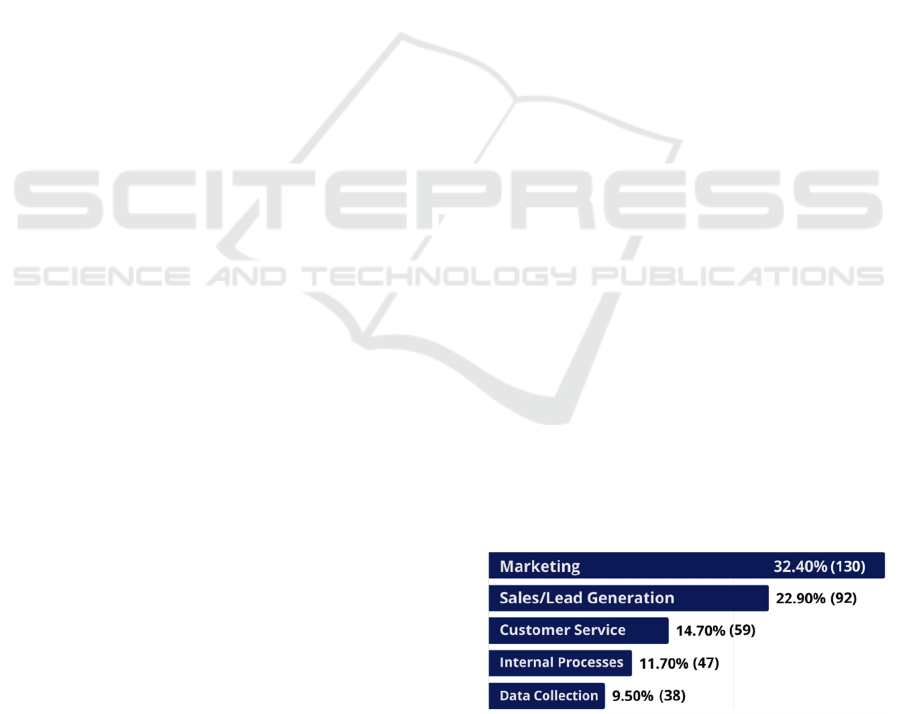
remaining 154 (38%) respondents indicated different
areas of application (Figure 1). The data shows that
Bulgarian entrepreneurs perceive CBs primarily as
tools for improving external communication and
operations, with marketing and lead generation being
the leading application areas. While CS remains an
important aspect, it is not the dominant function.
Figure 1: Areas of application of
CBs
according to
Bulgarian entrepreneurs. Source: Own development.
KMIS 2025 - 17th International Conference on Knowledge Management and Information Systems
228

Table 1: Descriptive statistical analysis of the data generated in the study. Source: Own development.
Descriptive statistical analysis
–
number of responses* (N), minimum value (Min), maximum value (Max), average value (Mean), standard deviation (Std. Deviation)
N Min Max Mean Std. Deviation
To what extent did the following factors influence your decision to implement a CBs?
Cost Reduction
154 2 5 3,98 ,718
Improving CS
153 2 5 4,09 ,729
Increasing Efficiency
154 2 5 4,10 ,697
Task Automation
154 2 5 4,12 ,660
Competitive Pressure
154 1 5 3,96 ,740
To what extent do you agree with the following statements about the benefits of implementing a CBs?
Reduce CS costs
154 1 5 3,56 ,758
Increase the efficiency of business operations
154 2 5 3,75 ,811
Automate routine tasks efficiently
154 2 5 3,63 ,741
Improve customer satisfaction
153 2 5 3,69 ,719
To what extent do you agree with the following statements about the challenges of implementing a CBs?
We encountered difficulties integrating it with existing systems
154 1 5 3,44 ,870
The CBs struggled with complex queries
154 1 5 3,80 ,820
Maintaining the CBs’ knowledge base required significant effort
154 1 5 3,54 ,864
Our employees needed significant training to use and manage the CBs
154 1 5 3,63 ,885
Customer adoption of the CBs was lower than expected
154 1 5 3,61 ,843
To what extent did the CBs contribute to achieving the following business goals?
Increased Sales
154 1 5 3,32 ,830
Improved Lead Generation
154 1 5 3,55 ,768
Improved Customer Retention
153 1 5 3,46 ,835
Reduced Operating Costs
153 1 5 3,48 ,828
Improved Employee Productivity
153 1 5 3,43 ,809
Please answer to what extent...:
…are you satisfied with the level of integration of the CBs with your existing systems?
152 1 5 3,31 ,893
…were the available resources (e.g. budget, technical expertise) sufficient for the
implementation of the CB?
154 1 5 3,50 ,865
…was the process of implementing the CB in your organisation easy?
154 1 5 3,37 ,893
…are you satisfied with the overall performance of the CB?
152 1 5 3,42 ,917
…are you satisfied with the ability of the CB to understand and accurately respond to
customer inquiries in Bulgarian?
154 1 5 3,46 ,894
…are you satisfied with the information and data provided by the CB 's analytics?
153 1 5 3,38 ,874
*The number of responses (N) in Table 1 may differ from the actual number of respondents (N=154), as respondents were given the option to answer or
not to the relevant question/statement, according to their business environment.
The use of CBs applications for internal processes
and analytics is still in its infancy, suggesting
potential for future growth and diversification in the
Bulgarian business environment. This distribution
reflects the general trends in global CBs adoption,
where the initial focus is often on marketing and sales
funnel automation.
The descriptive analysis of the survey data,
presented in Table 1, shows that Bulgarian
entrepreneurs are implementing CBs primarily to
improve task automation, increase efficiency, and
improve CS. Competitive pressure and the desire to
reduce costs are also strong drivers, but there is also
greater diversity in the responses of Bulgarian
entrepreneurs.
Although there is even more dispersion in the
answers, the next section of statements/questions
supports this data to some extent. Respondents do not
clearly identify one of the benefits mentioned. With
the lowest support, but still close to the others, is the
reduction of costs. The fluctuations here may be the
result of the fact that technological innovations,
which in themselves require significant investment,
are unlikely to lead to cost reductions generally. Or at
least not as quickly as, for example, improving the
efficiency of business operations, which stands out
with the highest degree of support. Based on the data
generated by the study, it is possible to search for and
discover interesting correlations (Table 2) that could
reveal important insights into the impact and
outcomes of CBs' implementation.
Digital Transformation and Automation: Application and Effectiveness of Chatbots in Bulgarian Entrepreneurship
229

Table 2: Relationship between reasons for implementation and achieved business goals. Source: Own development.
Improved Customer
Retention
Improved Lead
Generation
Increased
Sales
Improve customer
satisfaction
Improving CS
Pearson
Correlation
,805** ,768** ,850** ,770**
Sig. (2-tailed) ,000 ,000 ,000 ,000
N 153 153 153 153
** Correlation is significant at the 0.01 level (2-tailed).
Reduce CS
costs
Increase the
efficiency of
business operations
Automate
routine tasks
efficiently
Increased
Sales
Improved
Employee
Productivity
Task
Automation
Pearson
Correlation
,762** ,802** ,749** ,846** ,788**
Sig. (2-tailed) ,000 ,000 ,000 ,000 ,000
N 154 154 154 154 153
** Correlation is significant at the 0.01 level (2-tailed).
Table 3: Regression Model Summary: Impact of Achieved Business Goals on Chatbot Integration Satisfaction. Source: Own
development.
Model Summary
b
Model R R Square Adjusted R Square Std. Error of the Estimate Durbin-Watson
1 ,940
a
,883 ,879 ,310 ,570
a. Predictors: (Constant), [Improved Employee Productivity], [Improved Lead Generation], [Increased Sales], [Improved Customer
Retention], [Reduced Operating Costs]
b. Dependent Variable: [To what extent are you satisfied with the level of integration of the CBs with your existing systems?]
Table 4: Analysis of variance (ANOVA) of the regression model: Impact of achieved business goals on satisfaction with
chatbot integration. Source: Own development.
ANOVA
a
Model
Sum of Squares df Mean Square F Sig.
1 Regression 106,392 5 21,278 220,724 ,000
b
Residual 14,075 146 ,096
Total 120,467 151
a. Dependent Variable: [To what extent are you satisfied with the level of integration of the CBs with your existing systems?]
b. Predictors: (Constant), [Improved Employee Productivity], [Improved Lead Generation], [Increased Sales], [Improved Customer
Retention], [Reduced Operating Costs]
The correlation analysis presented in Table 2
examines the relationships between two main reasons
for implementing CBs – "Improving CS" and "Task
automation" – and various achieved business goals.
For the analysis, Pearson correlation coefficients (r)
were calculated, with the statistical significance of all
correlations assessed at the p<.01 level (two-tailed).
The results reveal that the drive to improve CS is
strongly and statistically significantly associated with
multiple positive business outcomes. A robust
positive correlation was found between "Improving
CS" and "Increased sales" (r=.850, N=153, p<.001),
suggesting that efforts in this direction contribute
significantly to growth in commercial activity.
Similarly, substantial positive relationships were
reported with "Improved Customer Retention"
(r=.805, N=153, p<.001), "Improved Lead
Generation" (r=.768, N=153, p<.001), and "Improved
Customer Satisfaction" (r=.770, N=153, p < .001).
These findings underscore the pivotal role of focusing
on customer experience in implementing CBs to
achieve a broad range of desired business objectives
directly related to the customer base.
In parallel, the analysis demonstrates that task
automation, as a motive for implementing CBs, is
also strongly and statistically significantly associated
with achieving key operational and financial goals. A
robust positive correlation was found between "Task
Automation" and "Increase in the efficiency of
business operations" (r=.802, N=154, p<.001), which
is a direct reflection of the expected benefits of
automation. Significant positive relationships were
also found with "Reduce CS costs" (r=.762, N=154,
p<.001), "Effective automation of routine tasks"
(r=.749, N=154, p<.001), and "Improved employee
productivity" (r=.788, N=153, p<.001). It is also
KMIS 2025 - 17th International Conference on Knowledge Management and Information Systems
230

noteworthy to observe the strong positive correlation
with "Increased sales" (r=.846, N=154, p<.001),
which suggests that optimising internal processes
through automation indirectly contributes to revenue
growth.
To examine the impact of achieved business goals
on satisfaction with the level of chatbot integration, a
multiple linear regression analysis was conducted. In
this model, the dependent variable is " To what extent
are you satisfied with the level of integration of the
CBs with your existing systems?". Five achieved
business goals were included as independent
variables (predictors): [Improved Employee
Productivity], [Improved Lead Generation],
[Increased Sales], [Improved Customer Retention],
and [Reduced Operating Costs].
The results of the model summary are presented
in Table 3. The model demonstrates a strong multiple
correlation between the predictors and the dependent
variable, with a correlation coefficient of R=.940. The
most important indicator, the coefficient of
determination (R
2
), is .883. This value indicates that
approximately 88.3% of the total variance in
satisfaction with the level of chatbot integration is
explained by the five achieved business goals
included in the model. The adjusted coefficient of
determination (Adjusted R
2
) is .879, which is a more
conservative estimate and confirms the high
explanatory power of the model. The standard error
of the forecast (Std. Error of the Estimate) is .310,
which indicates the average magnitude of the error in
the model's predictions. The value of the Durbin-
Watson statistic is 0.570, which may indicate the
presence of positive autocorrelation in the residuals,
an aspect that warrants further study.
To assess the overall statistical significance of the
regression model, an analysis of variance (ANOVA)
was conducted, the results of which are presented in
Table 4. The observed F-statistic is 220.724 at 5 and
146 degrees of freedom (F(5,146)=220.724). The
corresponding significance level is p<.001. Since this
p-value is significantly less than the accepted
significance threshold of α=0.05, the null hypothesis
that all regression coefficients (except the constant)
are equal to zero is rejected.
This conclusion confirms that the regression
model as a whole is statistically significant.
Collectively, the achieved business goals included in
the model make a statistically significant contribution
to explaining the variance in satisfaction with the
level of integration of the chatbot with existing
systems. The high explanatory power of the model
(R²=.883) combined with its overall statistical
significance (p<.001) strongly suggests that
achieving these business goals is a powerful predictor
of higher satisfaction with the integration aspects of
chatbot solutions.
In summary, the results of the correlation analysis
between the variables in Table 2 strongly indicate that
both the orientation towards improving CS and
towards task automation in implementing CBs are
associated with significant achievement of the
respective business goals. All the correlations
examined are strong, with coefficients ranging from
.749 to .850, and are highly statistically significant. It
is essential to note that although these correlations
suggest strong associations between the variables,
they do not establish causal relationships, but rather
indicate that these phenomena are observed
simultaneously and in a similar direction within the
studied population.
5 DISCUSSION
Bulgarian entrepreneurs identify the ability of CBs to
process complex queries as the biggest challenge.
This is particularly important in the context of the
Bulgarian language, as satisfaction with the ability of
CBs to understand and respond in Bulgarian has until
recently been rated as relatively low. Other
significant challenges include maintaining the
chatbot’s knowledge base, staff training, and
customer acceptance. Integration with existing
systems is a challenge, but less pronounced than the
others, which indirectly indicates that CBs
development most likely follows relatively universal
and easily applicable implementation principles.
Of interest here is the identified problem with user
acceptance of CBs. The answers vary significantly,
and the predominant rating is between 3 and 4. This
reported non-acceptance by users may be due to high
expectations on the part of entrepreneurs, problems
with the language capabilities of the respective
chatbot, or overly complex requests (queries) from
customers. In all three cases, entrepreneurs should
improve the information security of their digital
platforms. For example, suppose users are forced to
send overly complex queries through chatbot
systems. In that case, the corresponding online
application (website, social network, etc.) does not
offer the necessary quantity and quality of
information to satisfy the needs of users without the
need for automated queries. In any case, it is essential
to identify not only the rejection itself (which is
obviously already done by some respondents), but
also the reasons that led to the rejection.
Digital Transformation and Automation: Application and Effectiveness of Chatbots in Bulgarian Entrepreneurship
231

The overall satisfaction with CBs is moderate to
high in terms of their contribution to business goals
(lead generation, customer retention, sales, costs,
productivity). The diversity in the answers is also
understandable, given that each business unit pursues
different business goals. The majority report
improved customer acquisition and retention, which
is the primary mission of chatbot solutions. Cost
reduction and improved employee efficiency are also
reported as significant results of the implementation
of CBs solutions. Accordingly, the lowest support is
for increased sales, and the reasons for this can again
be sought in various directions. It is possible that the
company in question does not have a correct sales
tracking system in place or, by default (or due to
insufficient understanding), the capabilities of CBs
are limited solely to a communication tool.
On the other hand, satisfaction here with regard to
sales can be defined as low and even unsatisfactory,
given that Bulgarian entrepreneurs indicate that the
main area of application is precisely sales, not only
attracting potential customers (Figure 1). Therefore,
although chatbot solutions generally perform the
functions expected of them, there is a discrepancy
between the goals set and achieved with the help of
CBs.
The "Please answer to what extent..." section
contains more general questions related to the
experience with CBs. In terms of satisfaction with the
level of integration of the chatbot with the existing
systems, an average value of 3.31 is reported. This
indicates moderate satisfaction, especially
considering that the integration itself is shown as not
that challenging. Satisfaction with the information
and data provided by the chatbot's analytics and with
the chatbot's ability to understand and accurately
respond to customer inquiries in Bulgarian are also
rated with average values. Satisfaction with the
analytical data is moderate. The assessment of
language capabilities confirms that there are
significant problems with understanding and
responding in Bulgarian, especially with complex
inquiries, as reported in the previous questions.
An interesting fact is that only satisfaction (with
an average score of 3.5 / Table 1) that the available
resources were sufficient for the implementation of a
chatbot solution, theoretically exceeded the average
values and tends to a good rating. Despite significant
variance in respondents' answers, this response shows
that entrepreneurs approach the implementation of
technological solutions relatively well-off
financially.
The study also shows that the implementation of
CB solutions in the modern business landscape is
motivated by a wide range of strategic goals aimed at
optimising processes, improving customer
experience and achieving competitive advantages.
Respondents from Bulgaria identify "Cost
Reduction", "Improving CS", "Increasing Efficiency"
and "Task Automation" as the leading motives for
implementing CBs. These data correspond to general
global trends, where the automation of routine
processes and cost optimisations in the field of CS are
often the primary drivers for investments in AI and
chatbot technologies. These findings also reveal
significant similarities with global trend results,
providing valuable context for understanding
regional trends.
According to Umni (n.d.), a leading developer of
chatbot solutions for the Bulgarian market, as of
2020, only 30% of companies worldwide consider
themselves to be lagging in implementing innovative
technologies. Notably, this percentage was even
lower for Bulgaria, with only 25% of companies
feeling the need to invest in digital tools. The
company concludes that this relative digital
conservatism is one of the reasons for the accelerated
rise of AI CBS outside Bulgaria. They also emphasise
that, against the backdrop of general market
conservatism and still limited knowledge of the
technology in the country, the use of AI CBs provides
a significant opportunity for Bulgarian companies to
differentiate themselves from their competitors.
Supporting this growing trend, the current study finds
that 38% of respondents have already implemented
chatbot solutions. These solutions are mainly used in
the field of marketing and sales, but they also play a
significant role in CS, internal processes, and data
collection and analysis.
Research suggests that CBs can bring significant
benefits to companies, especially in the area of CS.
According to a Gartner study, approximately 30% of
the companies surveyed have already implemented or
have plans to use CBs. A report by CapGemini also
confirms this trend, indicating that almost half of the
top hundred companies in the banking and insurance
sectors have already implemented CBs. In Norway,
where this study is conducted, several large
corporations and government organisations have
implemented CBs in recent years as part of their
digitalisation strategies. As a result of this process,
there has also been an increase in the number of local
chatbot platform providers in the country (Zhang et
al., 2021).
In the Romanian context, academic studies
(Anton et al., 2024; Clim, 2025) also emphasise the
leading role of efficiency and optimisation in
customer interactions as key motivators for the
KMIS 2025 - 17th International Conference on Knowledge Management and Information Systems
232

adoption of chatbot solutions. Research in the
Romanian banking sector shows that banks are
adopting CBs "to improve CS by offering fast and
accurate answers to their queries", aiming for a
"positive impact… on customer satisfaction". This
goal has been successfully achieved, demonstrating
that improving CS is a leading motive and a notable
result in Romania. Furthermore, the implementation
of CBs "increases the efficiency of operations" by
"automating routine tasks" and "reducing waiting
times and personnel costs". More broadly, a survey of
Romanian SMEs confirms that "increasing the
efficiency of business operations" and "reducing
costs" are the primary drivers for implementing AI
technologies, including CBs, which also contribute to
enhancing "customer interactions" and "customer
satisfaction". These results demonstrate a strong
correlation between the strategic motives for
implementing CBs in Bulgaria and Romania,
explicitly focusing on operational efficiency, cost
reduction, and customer experience optimisation.
The use of chatbots in Croatia is expanding
dynamically in both the public and private sectors.
During the COVID-19 pandemic, the healthcare
chatbot “Andrija” was used by over 30,000 citizens,
with over 75% expressing satisfaction (Petričević &
Mustić, 2022). In the corporate sector, 65% of
Croatian companies implement chatbots for customer
service, automating around half of queries (EOS
Group, 2021). Students at the University of North
actively use AI chatbots such as ChatGPT and
Copilot for training, while a survey of employees in
IT companies showed that 95.7% have used
ChatGPT, and over 30% use it regularly
(Szombathelyi et al., 2023; Horvat et al., 2025).
Despite the lack of nationally representative data,
these studies point to a growing use of and trust in
chatbots in Croatia, in line with global trends in AI.
Users appreciate their speed, efficiency, and
accessibility, although concerns about security and
data privacy remain.
At the same time, the businesses in Croatia are
also actively researching and investing in AI and
chatbot solutions. One notable example is the
Croatian startup Splix.ai, which successfully raised
almost €2 million in a pre-seed funding round. This
company is developing a chatbot security platform
based on AI, which highlights the growing emphasis
on security and trust challenges in implementing
these technologies (Kostanic, 2024). This
demonstrates not only the adoption of CBs but also
the development of the ecosystem to support their
secure and efficient operation in the country.
In the context of user engagement, Croatian
research highlights that the primary reasons users
choose to use CBs are their convenience, speed, and
24/7 availability. The use of CBs can lead to higher
user satisfaction. These results suggest that
companies implementing CBs are likely seeking to
enhance CS and reduce costs by automating routine
tasks, aligning with trends observed in other countries
in the region (Dobrinić et al., 2021; Horvat et al.,
2025).
A comparative analysis of results between
Bulgaria and other Balkan countries, such as
Romania and Croatia, is essential due to the shared
economic and socio-cultural context in the region.
This commonality of factors ensures higher relevance
of comparisons to markets with different maturity and
stages of digital transformation, such as those in
Western Europe.
Such cross-country comparisons enable the
identification of specific regional trends in the
adoption of technologies, such as CBs. They can be
used to establish whether the motivations for
implementation and the achieved results are universal
for the Balkans or whether there are unique factors
influencing the success of chatbot solutions in
specific countries.
Furthermore, such a comparison provides
valuable benchmarking for businesses in the region,
enabling them to compare their achievements with
those of competitors or similar markets. This can
contribute to better strategic positioning and
adaptation of chatbot solutions to local needs and
challenges. Finally, given the often limited
specialised scientific literature for smaller markets in
the region, comparative analysis helps to build a more
comprehensive picture and compensate for this lack
of local data.
The analysis performed allows answering the
formulated research questions. Regarding the first
RQ1: What are the main reasons for implementing
chatbot solutions? the study shows that the main
reasons for implementing chatbot solutions by
Bulgarian entrepreneurs are related to operational
optimisation (efficiency, automation, cost reduction)
and improving market position (improving CS,
competitive advantage), with risk management also
appearing to play a significant role. Bulgarian
entrepreneurs identify key benefits such as increased
operational efficiency, improved customer
satisfaction and automation of routine tasks. At the
same time, they face significant challenges, mostly
related to the processing of complex queries by the
chatbot, the need for staff training, customer
acceptance and maintaining the knowledge base. This
Digital Transformation and Automation: Application and Effectiveness of Chatbots in Bulgarian Entrepreneurship
233

also provides a satisfactory answer to the second
research question – RQ2: What benefits and
challenges do Bulgarian entrepreneurs identify?
Based on this data, the authors conclude that the
Bulgarian entrepreneurs and CBs developers should
focus on:
• Improve the understanding and processing of
complex queries, primarily in Bulgarian. This may
include investments in more advanced AI models
specifically trained for Bulgarian, or hybrid systems
that route complex queries to human operators;
• Optimise the processes for maintaining the
chatbot knowledge base to reduce the effort required
to update it.
• Develop more effective employee training
programs on the use and management of CBs.
• Strategies to improve customer acceptance of
CBs by emphasising the benefits and convenience
they offer and ensuring a seamless user experience.
Limitations of the study
This study has certain limitations that should be taken
into account when interpreting the results. First, the
lack of detailed information about the field of activity
of the surveyed companies and the specifics of their
operation (e.g., predominantly online or offline
presence, geographical location – city/rural) limits the
possibility of a more nuanced analysis of the factors
influencing the adoption and effectiveness of CBs
solutions in different business contexts. Similarly, the
study does not collect data on the specific type of CBs
used (e.g., rule-based, AI, hybrid) and the duration of
their implementation, which could affect the reported
effectiveness.
Secondly, a limitation arising from the method of
distribution of the questionnaire survey should be
noted. The approach used does not guarantee
complete coverage of the entire population of
Bulgarian entrepreneurs using CBs technologies,
which may introduce a certain degree of selective
under-exhaustion and affect the representativeness of
the sample. Therefore, the results should be
considered indicative of the surveyed group, and
generalisations for the entire entrepreneurial
community in the country should be made with due
caution.
Additionally, during the statistical analysis, a
variation in the number of respondents included (N)
was observed across the different correlation
calculations. In the majority of the analyses, the
number of cases was N = 154, but in specific
correlation pairs, it decreased to N = 153. This
difference is a result of applying a method for
handling missing data known as pairwise deletion.
The pairwise deletion method assumes that each
correlation coefficient is calculated by including only
those respondents who have valid data for both
specific variables involved in the given calculation.
Unlike "listwise deletion", which excludes the entire
respondent if they are missing even one response in
the whole set of variables, pairwise deletion allows
the use of a larger amount of available information.
In this case, the variation of one respondent (154 vs.
153) indicates that one respondent provided a
response for one of the variables but omitted a
reaction for the other variable included in the
correlation. Adopting pairwise deletion has its
advantages, as it maximises the use of available data,
especially when the number of missing values is
small and scattered. However, it is essential to note
that, although insignificant in this case, it can
potentially lead to the calculation of correlations
based on slightly different samples, which requires
caution in interpretation, especially if the number of
missing data points is larger or not random. In the
present study, given the minimal difference in N and
the high statistical significance of the correlations,
this approach is not expected to affect the validity and
reliability of the conclusions drawn significantly.
Applicability
The present study contributes to expanding the
scientific knowledge on digital transformation in the
Bulgarian entrepreneurial sector by providing initial
empirical data on the level of adoption and
subjectively assessed effectiveness of chatbot (CBs)
technologies. It identifies the main areas of
application of these tools and, despite its
methodological limitations, lays the foundation for
future, more in-depth research on the factors
determining the successful integration and return on
investment in automated communication solutions in
the specific national context.
In practical terms, the study's results offer
valuable guidance for Bulgarian entrepreneurs. These
data can help them make informed decisions about
investments in chatbot technologies, focusing on the
proven benefits that arise from improved CS, task
automation, and increased efficiency. The identified
implementation challenges, such as integration
difficulties and the need for knowledge base
maintenance, allow entrepreneurs to anticipate
potential obstacles and proactively plan resources and
strategies to overcome them. Understanding user
expectations and perceptions of CBs, including
factors that drive their satisfaction, can help create
more effective and user-centric solutions, ensuring a
higher level of adoption.
KMIS 2025 - 17th International Conference on Knowledge Management and Information Systems
234

For chatbot solution providers, the study provides
clear guidance on the specific needs and areas of
interest in the Bulgarian market. The high correlation
between addressing challenges and overall chatbot
satisfaction highlights that developing solutions that
are easy to integrate, effective in handling complex
queries, and supported by an intuitive knowledge
base is key to market success.
Providers can use these results to adapt their
products and services, offering more targeted
functionalities, improved implementation services,
and tailored training that meets the current needs of
Bulgarian companies. This will enable them to
establish stronger partnerships and drive broader
chatbot adoption.
For policymakers, this report provides an
empirical basis for understanding the dynamics of
digital transformation in the Bulgarian
entrepreneurial sector. The findings can inform the
development of government strategies and programs
to support businesses in implementing innovative
technologies. Policies can be aimed at stimulating
investments in automated communication solutions,
ensuring access to training programs to address
technical challenges, and increasing digital literacy.
Supporting the research and development of solutions
tailored to the local context and language-specificities
(such as the Bulgarian language) can also be a priority
to ensure the maximum applicability and benefit of
chatbot technologies for the Bulgarian economy.
Furthermore, the study highlights the need for
further research into good practices and challenges in
the effective use of CBs, which is beneficial for
consultants and training organisations.
6 CONCLUSION
The growing global importance of CBs contrasts with
the slower adoption rate and potentially lower level
of understanding in the Bulgarian context, which is
influenced by factors such as digital skills and
specific market conditions. However, there are clear
signs of growing interest and adoption of this
technology among Bulgarian enterprises, driven by
the potential to reduce costs, improve customer
service and increase efficiency.
The proposed questionnaire aims to collect
valuable data to understand the reasons for
implementation, the process, perceived benefits and
challenges, as well as the impact on business
objectives and daily work. The analysis of the
benefits and challenges of implementing CBs in
Bulgaria reveals that despite significant potential
advantages, there are also country-specific barriers
related to technical expertise, language and cultural
characteristics. The consideration of the human factor
underscores the importance of adopting CBs by both
employees and customers. Ensuring adequate
employee training and effective customer
communications is crucial for the success of these
technologies.
Statistical analysis further supports these findings,
demonstrating strong and significant correlations
between successfully overcoming challenges and
high satisfaction with various aspects of chatbot
solutions. It was found that companies that coped
better with integration difficulties, managed complex
queries, and maintained a knowledge base
experienced greater satisfaction with the chatbot's
implementation and overall performance. Regression
analysis revealed that achieved business goals, such
as improved employee productivity and reduced
operating costs, collectively explain a significant
portion of the variance in satisfaction with chatbot
integration, highlighting the direct relationship
between achieved results and a positive perception of
the technology.
In conclusion, CBs represent an essential tool for
the digital transformation of Bulgarian entrepreneurs.
To realise their full potential, careful consideration of
the specific conditions of the Bulgarian market is
necessary, along with continuous monitoring and
evaluation of their effectiveness.
Future research should focus on gaining a deeper
understanding of the specific needs and impact of
CBs in various sectors of the Bulgarian economy, as
well as on conducting longitudinal studies to track the
long-term effectiveness and return on investment.
The proposed recommendations and overcoming the
study's limitations will enable, on the one hand, more
in-depth analyses of the topic, and on the other hand,
informed business decisions in this rapidly evolving
field.
ACKNOWLEDGMENTS
This study was funded by the Scientific Research
Fund of the University of Ruse "Angel Kanchev",
Bulgaria.
REFERENCES
AI4Green. (2024). BgGPT: Bulgaria's AI chatbot benefits
business, education, and government. Retrieved May 6,
2025, from https://ai4greensme.eu/news/bulgarian-ai-
Digital Transformation and Automation: Application and Effectiveness of Chatbots in Bulgarian Entrepreneurship
235

chatbot-bggpt-bulgarias-ai-chatbot-benefits-business-
education-and-government/
Anton, C. E., Ciobanu, E., Brătucu, G., & Bucs, L. (2024).
Using Chatbots to Enhance Integrated Reporting:
Insights from Accounting and Consultancy Companies
from Romania. Electronics, 13(23), 4801. DOI:
10.3390/electronics13234801
Azmi, M., Mansour, A., & Azmi, C. (2023). A context-
aware empowering business with AI: Case of chatbots
in business intelligence systems. Procedia Computer
Science, 224, 479–484. DOI:
10.1016/j.procs.2023.09.068
Behl, A. (2024). Unleashing Success: 7 Key Metrics to
Monitor for a Chatbot Implementation. Mastech
InfoTrellis. Retrieved May 6, 2025, from
https://mastechinfotrellis.com/blogs/key-metrics-to-
look-out-for-while-implementing-chatbot
Calabrio. (n.d.). The chatbot performance metrics every
team should be measuring. Retrieved May 6, 2025,
from https://www.calabrio.com/wfo/contact-center-
ai/key-chatbot-performance-metrics/
Clim (Moga), L. M. (2025). The Role of Chatbots in the
Growth of Virtual Businesses in Romania: Implications
for Integrated Reporting. EuroEconomica, 44(1), 7–16.
Retrieved from https://dj.univ-danubius.ro/index.php/
EE/article/view/3328
Digital Watch Observatory. (2020). Bulgaria's AI
development concept (2020-2030). Retrieved May 6,
2025, from https://dig.watch/resource/bulgarias-ai-
development-concept-20202030
Dobrinić, D., Gregurec, I., & Dobrinić, D. (2021). Attitudes
of Croatian consumers about mobile messenger
chatbots. Journal of Information and Organizational
Sciences, 45(2), 579–599. DOI: 10.31341/jios.45.2.13.
EOS Group. (2021). Chatbot survey 2021: Two-thirds of
European companies already use chatbots. EOS
Solutions. https://eos-solutions.com/en/newsroom/pr
essreleases/20211117
ESG with AI. (n.d.). Home page. Retrieved May 6, 2025,
from https://esg-with-ai.com/
Horvat, T., Havaš, L., Valdec, D., & Crčić, D. (2025). The
use of AI chatbots in stem education: a study on
University north students in Croatia. Proceeding of the
17th International Conference on Education and New
Learning Technologies. pp. 3190-3197, ISBN: 978-84-
09-74218-9. DOI: 10.21125/edulearn.2025.0848
Interoperable Europe. (2024). Open-source AI for
Bulgaria: INSAIT's BgGPT can foster public and
private sector innovation. Retrieved May 6, 2025, from
https://interoperable-europe.ec.europa.eu/collection/pu
blic-sector-tech-watch/open-source-ai-bulgaria-insaits-
bggpt-can-foster-public-and-private-sector-innovation
Kostanic, A. M. (2024). Croatia’s SplxAI raises €1.8M to
enhance AI chatbot security amid growing cyber
threats. The Recursive. Retrieved May 6, 2025, from
https://therecursive.com/croatia-splxai-2m-pre-seed-
round-chatbot-security-ai/
Maderis, G. (2024). Top 22 benefits of chatbots for
businesses and customers. Zendesk. Retrieved May 6,
2025, from https://www.zendesk.com/au/blog/5-
benefits-using-ai-bots-customer-service/
McClune, S. (2024). Customer chatbots: The good, the bad,
and the ugly. Beyond Encryption. Retrieved May 6,
2025, from https://www.beyondencryption.com
/blog/customer-chatbots-good-bad-ugly
Microsoft. (2025). Empowering Bulgaria's future: AI
transformation and Microsoft's vision. CEE Multi-
Country News Center. Retrieved May 6, 2025, from
https://news.microsoft.com/en-cee/2025/02/04/empow
ering-bulgarias-future-ai-transformation-and-microso
fts-vision/
Miklosik, A., Evans, N., & Qureshi, A. M. A. (2021). The
use of chatbots in digital business transformation: A
systematic literature review. IEEE Access, 9, 106530–
106539. DOI: 10.1109/ACCESS.2021.3100885
Ministry of Transport. (2020). Kontseptsiya za razvitieto na
izkustveniya intelekt v Balgariya do 2030 g. [Concept
for the development of artificial intelligence in Bulgaria
until 2030]. Retrieved from https://www.mtitc.gov
ernment.bg/sites/default/files/koncepciyazarazvitienaii
vbulgariyado2030.pdf
NSI. (2024). Broy na predpriyatiyata [Number of
enterprises]. Natsionalen statisticheski institute.
Retrieved May 6, 2025, from https://bit.ly/3H4wYNO
Petričević, S., & Mustić, D. (2022). Communicating a
global pandemic with WhatsApp and Healthbot in
Croatia. In Proceedings of the International Conference
“Grid Technologies & Applications” (GRID 2022).
Novi Sad, Serbia: University of Novi Sad, Faculty of
Technical Sciences, Department of Graphic
Engineering and Design
SAP. (2024). What is a chatbot. Retrieved May 6, 2025,
from https://www.sap.com/bulgaria/resources/what-is-
a-chatbot
Szombathelyi, D., Jakopec, T., & Selthofer, J. (2023,
September). The impact of using ChatGPT on
employees of Croatian IT companies. In Proceedings of
the 34th Central European Conference on Information
and Intelligent Systems (CECIIS 2023) (pp. 473–480).
Dubrovnik, Croatia: Faculty of Organization and
Informatics, University of Zagreb.
Umni. (n.d.). The unlimited potential of AI chatbots in
Bulgaria. Retrieved May 6, 2025, from https://
umni.bg/en/blog/the-unlimited-potential-of-ai-chatbot
s-in-bulgaria/
Zhang, J. J. Y., Følstad, A., & Bjørkli, C. A. (2021).
Organizational factors affecting successful
implementation of chatbots for customer service.
Journal of Internet Commerce, 22(1), 122–156. DOI:
10.1080/15332861.2021.1966723
KMIS 2025 - 17th International Conference on Knowledge Management and Information Systems
236
