
Redefining Prerequisites Through Text Embeddings: Identifying
Practical Course Dependencies
S¸
¨
ukr
¨
u Kaan Tetik, Emirhan Toprak, Senem Kumova Metin
a
and Hande Aka Uymaz
b
˙
Izmir University of Economics, Department of Software Engineering,
˙
Izmir, Turkey
Keywords:
Software Engineering Education, Course Prerequisites, Embedding Models, Machine Learning, SHAP.
Abstract:
This study proposes a framework to support undergraduate students in course selection by identifying implicit
prerequisites and predicting performance in elective courses. Unlike traditional prerequisite rules that rely
solely on curriculum design, our approach integrates students’ academic history and course-level semantic in-
formation. We define two core tasks: (T1) identifying practical prerequisites that significantly impact success
in a target course, and (T2) predicting student success in elective courses based on academic profiles. For T1,
we analyze prior course performance and learning outcomes using SHAP (SHapley Additive exPlanations) to
determine the most influential courses. For T2, we build student representations using course descriptions and
learning outcomes, then apply embedding models (Sentence-BERT, Doc2Vec, Universal Sentence Encoder)
combined with classification algorithms to predict course success. Experiments demonstrate that embedding-
based models, especially those using Sentence-BERT, can effectively predict course outcomes. The results
suggest that incorporating semantic representations enhances curriculum design, course advisement, and pre-
requisite refinement.
1 INTRODUCTION
In university education, selecting the right courses at
the right time is a critical decision stage that may have
several effects on the student’s academic journey,
which requires careful consideration. Although stu-
dents are required to take certain compulsory courses
within their department programs, they also have the
opportunity to take elective courses that allow them
to either diversify their competencies or specialize
in particular areas. For instance, in the departments
such as computer and software engineering, the prac-
tical skills together with the theoretical skills affect
the success of the further courses. These course se-
lection decisions can significantly influence not only
students’ academic performance and future course
choices but also the competencies they will have ac-
quired by the time of graduation. Typically, univer-
sities define course enrollment rules based on factors
such as a student’s current academic level, whether a
prerequisite course has been successfully completed,
or credit thresholds. However, student success is not
solely determined by these explicit institutional rules;
a
https://orcid.org/0000-0002-9606-3625
b
https://orcid.org/0000-0002-3535-3696
it also depends on personal knowledge, skills, compe-
tencies, and prior performance in specific courses or
course groups. Making course selections based solely
on general academic criteria may negatively impact
students’ academic performance, reduce their GPA,
or misguide their long-term academic planning.
In the literature, the problem of guiding students
in course selection has often been approached through
the adaptation of recommendation system techniques,
machine learning methods, and hybrid frameworks
(Atalla et al., 2023; Zhu and Wang, 2022; Esteban
et al., 2020). These systems typically rely on either
students’ historical course data or patterns identified
from similar student profiles.
This study aims to improve course performance
among undergraduate students in the field of software
engineering by providing practical prerequisites for
achieving success in a given course and presenting the
competencies that a student should possess before en-
rolling in a course. In line with this primary objective,
two specific tasks (T) were defined to facilitate the de-
velopment of solutions through different approaches.
T1. To identify the implicit or practical prerequisites,
beyond the formally defined institutional require-
ments, that contribute to student success in a
given course.
Tetik, ¸S. K., Toprak, E., Kumova Metin, S. and Aka Uymaz, H.
Redefining Prerequisites Through Text Embeddings: Identifying Practical Course Dependencies.
DOI: 10.5220/0013682800004000
Paper published under CC license (CC BY-NC-ND 4.0)
In Proceedings of the 17th International Joint Conference on Knowledge Discovery, Knowledge Engineering and Knowledge Management (IC3K 2025) - Volume 1: KDIR, pages 49-59
Proceedings Copyright © 2025 by SCITEPRESS – Science and Technology Publications, Lda.
49

For each course offered by an educational insti-
tution, a set of prerequisites, such as success in
a specific course or group of courses and atten-
dance requirements, is defined within the frame-
work of the existing curriculum. A student who
meets these prerequisites is allowed to enroll in
the corresponding course. This first task aims
to investigate how these prerequisites are formed
and applied in practice. The outcome of the task
may be used to update/extend the prerequisites,
considering the practical results of the current
system.
T2. To evaluate the extent to which a student’s suc-
cess in an elective course can be predicted based
on their existing academic profile. This task fo-
cuses on predicting whether a student will suc-
ceed, or to what extent they will succeed, in a
course they plan to take, based on their existing
competencies. The proposed prediction system
has the potential to assist students in evaluating
whether they meet the course requirements and
to support more informed and confident course
enrollment decisions.
To address the tasks defined in this study, we pro-
posed the following methodology. First, to identify
implicit prerequisites that contribute to student suc-
cess (T1), we developed two modeling approaches:
one based on students’ past course performances and
another based on the learning outcomes of the com-
pleted courses. In both cases, we represented student
profiles using vector-based representations and ap-
plied SHAP (SHapley Additive exPlanations) (Lund-
berg and Lee, 2017) to interpret which prior courses
or learning outcomes had the greatest impact on suc-
cess in a target course. Second, to evaluate and
predict student success in elective courses (T2), we
constructed student profiles using course descriptions
and learning outcomes, combined with students’ let-
ter grades. We employed several embedding models,
including Doc2Vec (Le and Mikolov, 2014), SBERT
(Reimers and Gurevych, 2019), and the Universal
Sentence Encoder to transform this textual data into
feature vectors, which were then used to train classi-
fication models. The classification performance was
evaluated using cross-validation and F1 scores across
multiple algorithms.
The remainder of this paper is structured as fol-
lows: Section 2 provides a review of the relevant
literature and background. Section 3 describes the
dataset utilized in this study. Section 4 presents the
proposed methodology for identifying practical pre-
requisites and constructing predictive student profiles.
Section 5 details the experimental setup and discusses
the results obtained. Finally, Section 6 concludes the
paper.
2 LITERATURE REVIEW
In this section, we review relevant literature and back-
ground concepts related to our approach. First, we
present essential academic terms that are frequently
referenced in this context. Then, we examine re-
lated work in the domain of course recommendation
systems and prerequisite discovery, focusing on tech-
niques such as semantic similarity, and the application
of large language models (LLMs).
2.1 Background
This subsection introduces several terms frequently
used both in this paper and in related literature re-
views, such as syllabus, transcript, and grade point
average. A syllabus is a document prepared by in-
structors that outlines the goals of a course, weekly
topics, required materials, learning outcomes, grading
policies, and credit information. It acts like a roadmap
for both instructors and students during the semester.
In general, learning outcomes are presented in the syl-
labus, which explains in simple and clear terms what
a student should be able to do, understand, or apply
after they complete the course. A transcript is an of-
ficial academic record that lists all courses a student
has taken, with the corresponding letter grades and
credit information. It is a comprehensive document
summarizing a student’s academic performance over
semesters. The Grade Point Average (GPA), which
also appears on the transcript, is a numerical measure
of the general academic performance of a student. It
is calculated by taking the average of grade points cor-
responding to letter grades, weighted by course cred-
its. GPA is widely used to assess a student’s academic
standing and to make decisions about graduation or
honors.
2.2 Related Work
In the literature, one of the course recommenda-
tion systems was proposed by Atalla et.al, which
presents a data-driven framework for guiding students
in course selection (Atalla et al., 2023). The au-
thors propose a system that combines curriculum de-
pendency analysis with student performance model-
ing to assist academic advising. Their methodology
involves constructing a Course Dependency Graph
(CDG) to capture prerequisite relationships and cur-
riculum flow, and then applying matrix factorization
techniques to model students’ performance patterns
based on historical grade data. This combination al-
lows the system to recommend courses that are both
pedagogically appropriate and aligned with a stu-
KDIR 2025 - 17th International Conference on Knowledge Discovery and Information Retrieval
50

dent’s academic profile.
Anh et. al. proposed a course recommendation
model that emphasizes the use of learning outcomes
as the core representation of both student profiles and
course content (Anh et al., 2021). In their approach,
each course is described by a set of learning out-
comes, and student profiles are built based on the
learning outcomes of previously completed courses.
To quantify the similarity between a student and a
potential future course, the authors employ seman-
tic similarity measures, comparing the student’s ac-
quired learning outcomes with those required by up-
coming courses. This allows the system to recom-
mend courses that align well with a student’s cur-
rent competencies. Their model demonstrates that
learning outcome-based representations can offer a
more meaningful and educationally relevant basis for
course recommendation than relying solely on course
names or historical grades.
Van Deventer et al present a novel course recom-
mendation system that leverages LLMs to interpret
students’ natural language queries (Deventer et al.,
2024). By employing a Retrieval-Augmented Gen-
eration (RAG) framework, the system generates a
course description based on the user’s input. Then
they embedded this description into a vector space
and compared it with existing course descriptions to
identify the most semantically similar courses. The
study demonstrates the potential of LLMs in captur-
ing nuanced student interests and providing personal-
ized course recommendations.
Aytekin and Saygın propose a novel approach for
detecting prerequisite relations between educational
concepts using fine-tuned large LLMs which are GPT-
3 (Brown et al., 2020) and LLAMA2 (Touvron et al.,
2023) (Aytekin and and, 2025). Their method for-
mulates the task as a binary classification problem
and trains LLMs with custom prompts and comple-
tion strings that include both the classification and an
explanatory justification. According to their results,
the fine-tuned models not only achieve state-of-the-art
performance across several benchmark datasets but
also generate human-comparable explanations.
3 DATASET
In this study, two main datasets were utilized to de-
velop and evaluate the proposed models: one com-
prising course-related textual content and the other
consisting of anonymized academic records of stu-
dents. These datasets are essential in capturing
both the structural and semantic aspects of university
courses as well as students’ historical academic per-
formance. By combining these two data sources, we
aimed to build a comprehensive foundation for mod-
eling student profiles and understanding the implicit
dynamics influencing course success. The subsec-
tions below describe the datasets and preprocessing
steps in further detail.
3.1 Course Information Dataset
To obtain the course descriptions and learning out-
comes for the transcript dataset, relevant informa-
tion was collected from the official departmental web
pages of
˙
Izmir University of Economics. A total of
1,654 course entries were gathered.
3.2 Transcript Dataset
The transcript dataset is constructed from the aca-
demic records of graduates of
˙
Izmir University of
Economics (IUE). The raw transcript data required
preprocessing, as it included records spanning the
past 20 years. This meant that some courses were
no longer offered and had no accessible information
available. Additionally, course selection rules and re-
strictions have changed over time.
The dataset originally included 1,313 unique stu-
dents, 1,017 distinct courses, and 10 unique grade
scores.
As a first step, outlier data, such as students who
had taken courses from the Food Engineering depart-
ment, were removed. Then, using the course in-
formation collected from department websites, out-
dated or currently unavailable courses were identified
and matched with their updated versions, if available.
Courses that are too old or irrelevant to the current
curriculum were eliminated. The cleaned and refined
dataset was then used for all subsequent processes.
In the transcript dataset, students’ performance in
each course is represented by a letter grade. Table 1
shows these letter grades together with corresponding
point intervals, coefficients, and academic status indi-
cators. Accordingly, a profile is maintained for each
student, consisting of course–letter grade pairs.
The dataset contains 1,307 different graduated stu-
dents’ anonymised transcript information from 2003
to 2025, obtained from software and computer en-
gineering students of IUE. To visualize student per-
formance, the average grade for each year is calcu-
lated. As shown in Figures 1 and 2, the overall aver-
age grade value is approximately 2.5.
The dataset includes both the elective and the
mandatory courses. There are 912 distinct elec-
tive courses, which are grouped into five categories:
game, software, artificial intelligence and machine
Redefining Prerequisites Through Text Embeddings: Identifying Practical Course Dependencies
51

Figure 1: Number of students over the years.
Figure 2: Average GPA over the years.
Table 1: Grading Scale with Corresponding Letter Grades,
Grade Point Coefficients, and Academic Status in IUE.
Points Letter Grades Coefficient Status
90-100 AA 4,00 Successful
85-89 BA 3,50 Successful
80-84 BB 3,00 Successful
75-79 CB 2,50 Successful
70-74 CC 2,00 Successful
65-69 DC 1,50 Successful
60-64 DD 1,00 Successful
50-59 FD 0,50 Unsuccessful
≤ 49 FF 0,00 Unsuccessful
-
EX
(course transferred
from external
transcript)
- Successful
-
S
(Satisfactory)
- Successful
- P (Pass) - Successful
learning, web, and mobile development. The total
number of students enrolled in each category was cal-
culated. The results show that 3,347 students en-
rolled in software courses, 1,474 in game program-
ming courses, 1,276 in web courses, 753 in artifi-
cial intelligence courses, and 551 in mobile devel-
opment courses. Average grade scores were also
computed for each group. Game programming re-
lated courses had the highest average grade at 2.98,
followed by mobile development courses at 2.93.
Software courses averaged 2.52, artificial intelligence
courses 2.47, and web courses had the lowest average
at 2.40.
Furthermore, the top ten most-enrolled elective
courses are selected to examine and visualize the dis-
tribution of students across the course categories, as
shown in Figure 3.
KDIR 2025 - 17th International Conference on Knowledge Discovery and Information Retrieval
52
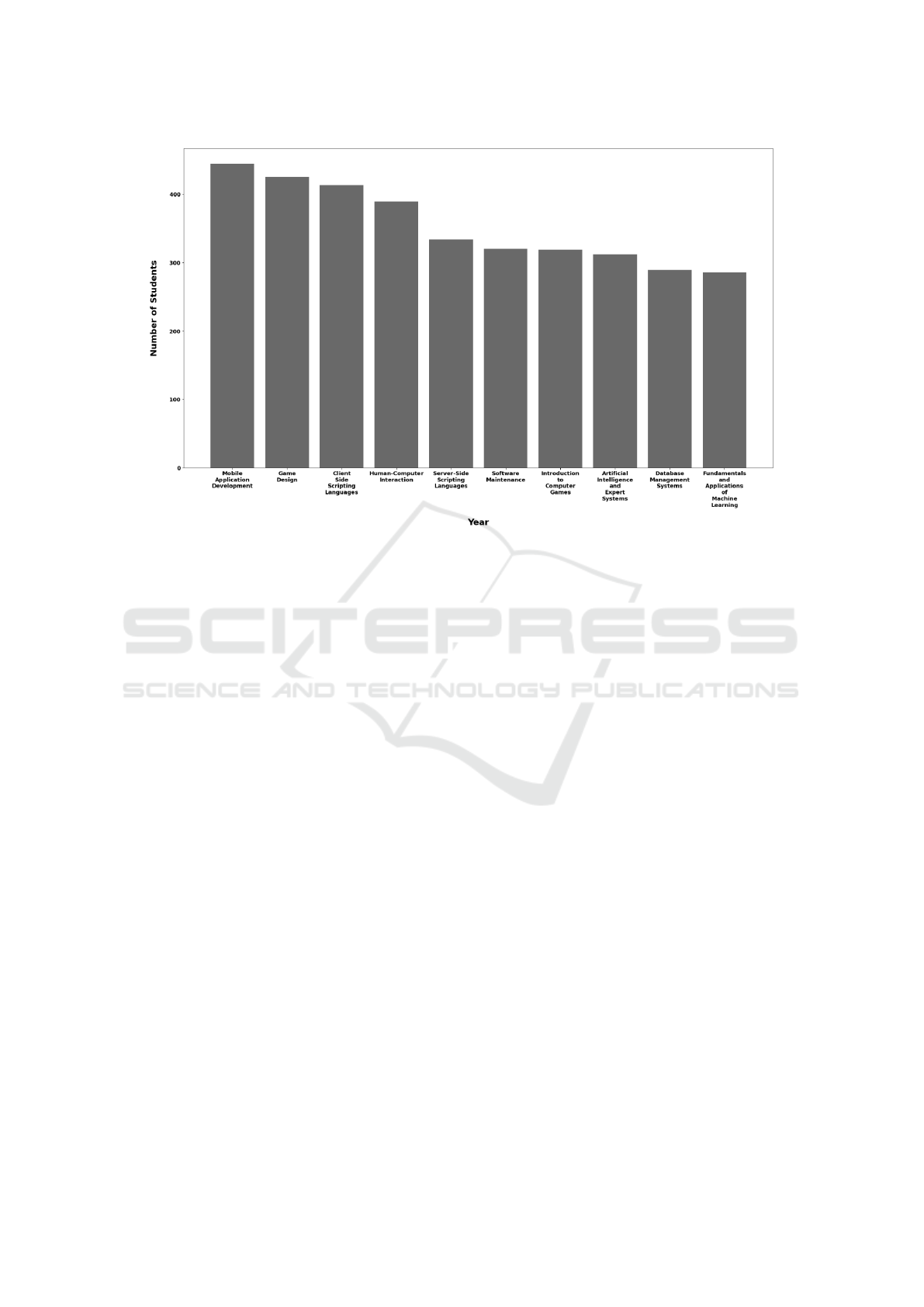
Figure 3: Distribution of the top ten most enrolled elective courses across course categories.
In addition, elective courses categorized as POOL
courses are included. These are: POOL 3 (Eco-
nomics), POOL 4 (Humanities), POOL 5 (Art and
Communication), POOL 6 (Ethics and Public Aware-
ness). These courses aim to broaden students’ per-
spectives by fostering critical thinking, social aware-
ness, and interdisciplinary connections. The average
grade scores for POOL 3, POOL 4, POOL 5, and
POOL 6 are 3.03, 3.00, 3.15, and 3.00, respectively.
The second part of the dataset consists of 735
mandatory courses, whose average grades are also
taken into account. These courses are categorized
as Software Engineering Department courses, Com-
puter Engineering Department courses, and Mathe-
matics and Science courses. Course grade averages
are calculated for the first three years of the curricu-
lum, as there are no mandatory courses from these
departments in the senior (fourth) year. The average
grade scores for Software Engineering Department
courses are 2.61 in the first year, 2.71 in the second
year, and 2.14 in the third year. Mandatory Com-
puter Engineering courses are offered in the second
and third years, with average scores of 2.10 and 2.50,
respectively. For Mathematics and Science courses,
the average scores are 2.32, 2.19, and 2.33 for the first,
second, and third years, respectively.
4 METHODOLOGY
This section outlines the methodology designed for
the two main tasks addressed in this study.
T1. To identify the implicit or practical prereq-
uisites, beyond the formally defined institutional re-
quirements, that contribute to student success in a
given course.
Within the scope of this task, two different ap-
proaches were employed to seek a solution.
1. Identifying the courses that most significantly in-
fluence success in a specific target course.
To achieve this, each student’s previously com-
pleted courses and their corresponding letter
grades were used to construct a profile, namely,
a representation vector.
2. Examining the contribution of course learning
outcomes (LOs).
Here, student profiles were represented based
on the learning outcomes of the courses they
had completed. Given that some learning out-
comes may be semantically similar, Sentence-
BERT (SBERT) (Reimers and Gurevych, 2019)
embeddings were utilised to represent LOs in the
vector space, and cosine similarity was calculated
between them. Learning outcomes with a cosine
similarity greater than 0.85 were merged to reduce
redundancy and ensure conceptual consistency in
the representation.
Redefining Prerequisites Through Text Embeddings: Identifying Practical Course Dependencies
53

To identify the top n courses that most signif-
icantly influenced the predicted performance in the
target course, the SHAP method (Lundberg and Lee,
2017) was applied to the learned representation vec-
tors. SHAP offers a consistent approach to model
interpretability by assigning an importance value to
each input feature based on its contribution to the
model’s output. This method operates by evaluating
the impact of each feature on the prediction, analyz-
ing how the model’s output changes when the feature
is included or excluded across various combinations.
T2. To evaluate the extent to which a student’s
success in an elective course can be predicted based
on their existing academic profile.
To predict the extent to which a student will suc-
ceed in a given course, it is possible to utilise data col-
lected from various sources that reflect the student’s
background and competencies. Within the scope of
this task, the student’s transcript, considered a more
reliable source, was used to construct student repre-
sentations, or in other words, profiles.
For this task, two different types of profiles were
constructed for each student. The first profile (con-
tent description profile (CDP)) was based on the con-
tent descriptions of the courses the student had com-
pleted, while the second (learning outcome profile
(LOP)) utilised the learning outcomes associated with
those courses. In both approaches, the grade the stu-
dent received in each course was incorporated into the
profile without disrupting the textual integrity of the
content. For example, in the first type of profiles,
the descriptions of courses taken by the student are
first updated with an expression based on the suc-
cess status of the student in the relevant course, and
then appended to each other depending on the order
in the SHAP results, and a single profile text is cre-
ated. This text is then converted to a profile vector em-
ploying the embedding model. In this study, we em-
ployed Doc2Vec (Le and Mikolov, 2014), which gen-
erates vector representations for variable-length doc-
uments, enabling document-level similarity and clas-
sification tasks; Sentence-BERT (SBERT) (Reimers
and Gurevych, 2019), a modification of the BERT ar-
chitecture designed for efficient sentence similarity
tasks; and Universal Sentence Encoder (Cer et al.,
2018), which generates fixed-dimensional embed-
dings for sentences. A similar procedure is followed
to build learning outcome profiles. In Table 3, sample
profile texts are provided for a student who completed
3 courses (C1, C2 and C3) with grades AA, CC, and
DD, respectively.
The profile embeddings are employed to train a
number of classification (CL) models. The main aim
of the CL process is to predict the level of success on
the given course. The letter grades are categorized to
success levels as given in Table 2 where the expres-
sion regarding the success level that is employed to
build CDP and LOP text is also given in rightmost col-
umn. The performance of CL models together with
alternative embeddings are measured by the average
F1 measure. The F1 score is the harmonic mean of
precision and recall where a high value refers to a
successful classification performance. In the classi-
fication process, 5 fold cross validation is applied to
avoid overfitting, and the CL models that are evalu-
ated in this study are Decision Tree (DT), Multi-Layer
Perceptron (MLP), Gaussian Naive Bayes (GNB), K-
Nearest Neighbour (KNN), Support Vector Classifier
(SVC), and Logistic Regression (LR), Random forest
classifier (RFC) which are selected due to their dis-
tinct methodological approaches.
Table 2: Categorization of letter grades to success levels.
Letter
Grades
Coefficient Description
Success
Level
AA 4.00 Very good Excellent
BA 3.50 Good-Very good Excellent
BB 3.00 Good Excellent
CB 2.50 Average-Good Pass
CC 2.00 Average Pass
DC 1.50 Average-Weak Pass
DD 1.00 Weak Fail
FD 0.50 Very Weak-Fail Fail
FF 0.00 Fail Fail
EX -
Pass (course
transferred from
external transcript)
Pass
S - Satistfactory Pass
P - Pass Pass
5 EXPERIMENTAL SETUP AND
RESULTS
In this section, we describe the experimental steps
undertaken to address the two main tasks of this
study. The first part focuses on Task 1 (T1), where
we utilize students’ past course performances and
learning outcomes to identify implicit prerequisites
that contribute to success in target courses. This
is achieved through SHAP-based interpretability
applied on predictive models trained with course
description-based and learning outcome-based repre-
sentations. The latter part of the experiments relates
to Task 2 (T2), where we construct embedding-based
student profiles using course content and learning
outcomes, and employ various classification models
to predict student success in elective courses. The
KDIR 2025 - 17th International Conference on Knowledge Discovery and Information Retrieval
54

Table 3: Sample profile texts.
Course Grade
Course Content
Description
Course Learning
Outcomes
CDP Text LOP Text
C1 AA
This course introduces
the students to the
fundamental concepts of
programming using Java
programming language.
1- will be able to define
the fundamental concepts
in programming
2- will be able to write,
compile and debug
programs in Java
language
3- will be able to use
control structures
4- will be able to design
functions in Java codes
Excellent at: This
course introduces
the students to the
fundamental concepts
of programming using
Java programming
language
Excellent at: will be able
to define the fundamental
concepts in programming
Excellent at: will be able
to write, compile and
debug programs in Java
language
Excellent at: will be able
to use control structures
Excellent at: will be able
to design functions
in Java codes
C2 CC
This course covers
the fundamental
concepts of
object-oriented
programming
using Java
programming language.
1- will be able to define
classes in Java
programming language.
2- will be able to define
the features of
object-oriented
programming languages.
3- will be able to develop
programs in Java
programming
language using objects.
4- will be able to use
inheritance technique in
class designs with
Java programming
language.
5- will be able to
implement the
polymorphism concept
in Java programming
language.
Pass at: This course
covers the fundamental
concepts of
object-oriented
programming
using Java
programming
language.
Pass at: will be able to
define classes
in Java programming
language.
Pass at: will be able to
define the features
of object-oriented
programming languages.
Pass at: will be able to
develop programs in
Java programming
language using objects.
Pass at: will be able to
use inheritance technique
in class designs with Java
programming language.
Pass at: will be able to
implement the
polymorphism concept in
Java programming language.
C3 DD
The course provides
the fundamental
concepts of software
engineering discipline
and gives concepts of
abstraction, problem solving
and systematic view.
1- explain engineering,
software, computer and
system engineering
2- define software
processes
3- gather the software
requirements
4- design using UML
5 - explain software
verification and
validation
Fail at: The course
provides
the fundamental
concepts of software
engineering discipline
and gives concepts of
abstraction, problem
solving and systematic
view.
Fail at: explain engineering,
software, computer
and system engineering
Fail at: define software
processes
Fail at: gather the software
requirements
Fail at: design using UML
Fail at: explain software
verification and validation
results from these embedding-driven models are
evaluated to assess their effectiveness in supporting
informed course enrollment decisions. The first
four steps focus on Task 1 (T1), aiming to identify
practical prerequisites through SHAP analysis, while
steps five and six correspond to Task 2 (T2), involving
embedding-based profile construction and predictive
modeling for student success. The details about the
steps can be seen as follows:
1. Target Course Selection and Training Dataset
Construction:
Firstly, in the experimental phase of the study,
four mandatory third-year software engineer-
ing courses (coded as SE1, SE2, SE3, and
SE4) were selected, along with four popular
elective courses from the areas of game de-
velopment (GD), web technologies (WT), ar-
tificial intelligence (AI), and mobile program-
ming (MP), serving as the target courses. The
selection process prioritized courses with high
student enrollment to ensure both broad rep-
resentativeness and practical relevance. Addi-
tionally, efforts were made to include courses
that span a variety of subfields within the dis-
cipline, enabling a more in-depth exploration
of curriculum design and teaching methods.
A summary of the selected target courses and
Redefining Prerequisites Through Text Embeddings: Identifying Practical Course Dependencies
55

Table 4: The list of target compulsory (C) and elective (E) courses and their titles and descriptions.
Course
Code
Course
Type
Course
Descriptive
Title
Description
SE1 C
Software
Architecture
This course covers the principals behind the software design patterns and their application in
constructing software components.
SE2 C
Concepts of
Programming
Languages
The following topics will be included in the course: lexical and syntax analysis, names, bindings,
type checking, scopes, data types, expressions, assignment statements, subprograms, implementing
subprograms, abstract data types and encapsulation constructs, support for object-oriented
programming, exception handling, event handling.
SE3 C
Systems
Programming
To acquaint students with basic knowledge to develop systems programs that involves multi-threading
and computer networks. It provides an introduction to multi-threading, socket programming and information security.
SE4 C
Software
Specification
and Design
In this course, students learn the theoretical and practical aspects of specification and design stages of software engineering.
More, this course enables students to realize software specification and design phases of sample projects with real clients.
GD E
Game
Development
In this course, students learn about the process of game development and use this information to develop their own games.
WT E
Web
Technologies
This course introduces the students to the fundamental concepts of web programming using HTML, CSS, JavaScript,
jQuery and JSON.
AI E
Artificial
Intelligence
This course provides an introduction to Artificial Intelligence (AI). In this course we will study a number of theories,
mathematical formalisms, and algorithms, that capture some of the core elements of computational intelligence.
We will cover some of the following topics: search, logical representations and reasoning, automated planning,
representing and reasoning with uncertainty, decision making under uncertainty, and learning.
MP E
Mobile
Programming
Mobile devices, mobile applications and their requirements, developing mobile applications, using web services
and databases in mobile applications.
their brief descriptions is provided in Table 4.
Then, we created eight separate training
datasets, one for each of the eight courses. For
example, in the training dataset for the course
SE1, the first column contains the student ID,
and the remaining columns correspond to all
courses that were taken by at least one student
before SE1. Since each student had taken a
different set of prior courses, not all columns
are filled for every student. If a student did not
take a particular course, the corresponding en-
try is marked as N/A. Otherwise, we recorded
the letter grade they received in that course
(e.g., AA, BA, etc.). In this way, we con-
structed eight training datasets, each tailored
to one of the eight target courses.
In addition to this grade-based representation,
we also constructed an alternative represen-
tation based on the learning outcomes (LOs)
of the courses students had previously com-
pleted. SBERT embeddings were used to rep-
resent each LO in a vector space, and cosine
similarity was calculated to merge semanti-
cally similar LOs (similarity 0.85), ensuring
a more consistent and conceptually meaning-
ful feature space. These LO-based represen-
tations enabled us to model students not only
based on their academic performance, but also
based on the underlying competencies they
acquired.
2. Course Filtering:
Secondly, we applied filtering to courses and
LOs presented in the training dataset in or-
der to decrease the size of each representation.
Two filters are applied to reduce the number
of courses and eliminate certain compulsory
courses included in the academic curriculum
in accordance with the regulations established
by the Council of Higher Education (Y
¨
OK).
The first filter removes courses that appear in
less than %25 of the samples in the dataset.
The second filter excludes science courses and
other unrelated courses that have high levels
of student preference.
For filtering LOs, firstly, the LOs related with
courses that are not presented in one of the
courses of a software engineering student’s
curriculum were eliminated. Secondly, LOs of
English courses were also removed from the
dataset.
3. Training Model Descriptions:
After filtering some of the courses (features)
in the eight training datasets, each of them
was then used to train seven different classi-
fication models: Decision Tree, Multi-layer
Perceptron (MLP), Gaussian Naive Bayes,
K-Nearest Neighbors (KNN), Support Vec-
tor Classifier (SVC), Logistic Regression and
Random Forest.
In total, this resulted in 112 model training
runs, corresponding to 7 models trained on
each of the 8 datasets using 2 different rep-
resentation vectors. For each combination, we
applied 5-fold cross-validation and evaluated
performance using the F1-score. The model
with the highest average F1-score was se-
lected as the best-performing model for each
dataset.
KDIR 2025 - 17th International Conference on Knowledge Discovery and Information Retrieval
56

4. SHAP-Based Identification of Impactful Prior
Courses:
In this step, we aimed to identify which prior
courses had the most significant impact on
students’ performance in target courses. To
achieve this, we employed SHAP (Lundberg
and Lee, 2017) on each of the eight best-
performing models (determined in the pre-
vious step), using their respective training
datasets.
This analysis allowed us to quantify the influ-
ence of each input feature (i.e., prior courses)
on the grade prediction for a specific target
course. For each of the eight target courses,
we selected the top two most influential prior
courses based on their SHAP values. For ex-
ample, in the case of the target course SE1,
the most impactful prior courses were identi-
fied as SE1 A and SE1 B.
5. Constructing Embedding Datasets Based on In-
fluential Prior Courses:
Following the SHAP analysis, we constructed
two new embedding datasets for each of the
eight target courses, using the selected influ-
ential prior courses. The datasets are as fol-
lows:
• Content Description Profile (CDP) based
dataset: For each student, we retrieved the
CDP texts as represented in Table 3 corre-
sponding to the two selected prior courses
and concatenated them.
• Learning Outcome Profile (LOP) based
dataset: Similarly, we retrieved the LOP
texts for the same two prior courses and
concatenated them.
Each of these text representations for each stu-
dents was then fed into three different em-
bedding models (Doc2Vec, SBERT, and the
Universal Sentence Encoder (USE)) to ob-
tain vector representations of students. For
SBERT, “all-mpnet-base-v2” with 768-length
embeddings and for USE, “Dimitre/universal-
sentence-encoder”
1
having vector size 512,
models are utilized.
6. Predictive Modeling with Embeddings:
The embeddings obtained from the CDP and
LOP datasets were used as input features for
predictive modeling. We trained models us-
ing the same seven classifiers employed in
1
https://huggingface.co/Dimitre/universal-sentence-
encoder
the previous phase (e.g., Logistic Regression,
Random Forest, etc.) and evaluated their per-
formance using 5-fold cross-validation. The
goal was to determine whether representations
based on influential prior courses could effec-
tively predict student performance in the tar-
get courses.
The classification F1 scores of all configu-
rations show slight variations, ranging from
0.50 to 0.65. The best performance, with an
F1 score of 0.65, was achieved using course
grades as the best representation combined
with course content description profiles as
embeddings, where the Sentence-BERT em-
bedding method was employed. Addition-
ally, prediction performance was generally
higher for elective target courses compared to
mandatory courses.
Additionally, the outcomes of the most influential
courses identified for our eight target courses can be
interpreted as follows:
SE1 – Software Architecture
• An introductory-level course on programming
was identified as the most influential course based
on both course descriptions and learning out-
comes. As a foundational programming course, it
equips students with essential skills in logic, con-
trol structures, and basic problem-solving, which
directly support their ability to recognize and ap-
ply software design patterns in SE1.
• Based on course descriptions, discrete mathemat-
ics emerged as a practical prerequisite. The logi-
cal reasoning and formal structures covered in this
course—such as sets, relations, and graphs—are
closely related to the abstraction and structure-
oriented thinking required in SE1.
• According to learning outcomes, the course on
database management systems was also identified
as an influential course. Understanding databases
and system components may enhance students’
ability to make architectural software decisions,
thereby indirectly supporting the design-oriented
learning objectives in SE1.
SE2 – Concepts of Programming Languages
• Based on both course content and LOs two pro-
gramming courses given to first year students
were determined. First course lays the ground-
work for understanding language syntax and se-
mantics, which is deepened in SE2. Second intro-
duces object-oriented programming, which is es-
sential in understanding language paradigms, en-
capsulation, and inheritance that are the core top-
ics in SE2.
Redefining Prerequisites Through Text Embeddings: Identifying Practical Course Dependencies
57

SE3 – System Programming
• Experimental results based on both course con-
tent and learning outcomes indicate that database
management systems course has a significant im-
pact on success in SE3. This may be because the
course provides experience in system-level data
manipulation, which complements the networked
and multithreaded programming concepts covered
in SE3.
• Course content-based experimental results high-
light the introduction to programming as an influ-
ential course, as it establishes the problem-solving
and logical reasoning skills necessary for writing
programs in SE3.
• Experiments based on learning outcomes suggest
that SE1 has a significant effect, since understand-
ing system architecture and modularity helps stu-
dents develop robust and concurrent systems in
SE3
SE4 – Software Specification and Design
• The results based on course content and learning
outcomes suggest that Calculus II given in first
year is an influential course. This may be be-
cause the course enhances analytical thinking and
formal modeling skills, both of which are essen-
tial for managing complex software project design
and specification in SE4.
• Another influential course identified is the course
on object-oriented analysis and design, as it pro-
vides fundamental methods and modeling tools,
such as UML diagrams, that students directly ap-
ply in SE4 while developing real-world software
projects.
GD – Game Development
• According to course content-based analysis, SE2
was identified as an influential course, as under-
standing functional, object-oriented, and imper-
ative paradigms helps students implement logic
and scripting more effectively within game en-
gines.
• Secondly, both course content and learning
outcome-based experiments highlight SE1 as in-
fluential, since it enables students to design
scalable, maintainable, and efficient architec-
tures—an essential skill for developing complex
game systems.
• Additionally, learning outcome-based analysis
suggests the course on probability and statistics as
a contributing course. This may be because proba-
bility and statistics skills enhance game logic, par-
ticularly in areas such as randomness, AI behav-
ior, and physics simulations.
WT – Web Technologies
• According to course content-based analysis,
Human-Computer Interaction course was identi-
fied as an influential course, as it provides essen-
tial insights into user experience and interface de-
sign principles, which are critical for front-end
web development.
• Database management systems course was also
determined to be impactful based on both of the
experiments, as it equips students with the neces-
sary skills to design and implement backend sys-
tems—an essential component of full-stack web
applications.
• According to learning outcome-based analysis,
the course on history of civilization was found to
be influential.
MP – Mobile Programming
• According to both of experiments, database man-
agement systems course was identified as an in-
fluential course, as many mobile applications rely
on local or remote databases.
• The introductory-level course on programming
was also found to be impactful, as it develops
core programming skills such as logic, control
flow, and event handling—fundamental compe-
tencies required in mobile application interfaces
and frameworks.
• Additionally, SE1 was identified as influential ac-
cording to LO-based experiments, as the ability to
design modular and maintainable systems is es-
sential for building scalable and robust mobile ap-
plications.
AI – Artificial Intelligence
• According to course content-based analysis, SE3
was identified as an influential course, as it pro-
vides students with essential knowledge in mem-
ory management, concurrency, and low-level opti-
mization—all of which are critical for developing
efficient artificial intelligence implementations.
• The introductory-level course on programming
was also found to be impactful, as it lays the
groundwork for algorithmic thinking and control
structures, which are fundamental for implement-
ing AI algorithms effectively.
• According to learning outcome-based analysis,
the courses on programming were highlighted as
relevant, as they emphasize object-oriented logic
and class structure design, supporting the devel-
opment of AI agents and rule-based systems.
• Additionally, Physics was determined to be influ-
ential.
KDIR 2025 - 17th International Conference on Knowledge Discovery and Information Retrieval
58

6 CONCLUSIONS
In this study, we proposed a framework for supporting
undergraduate students in the course selection process
by identifying implicit prerequisites and predicting
success in elective courses. By utilizing anonymized
transcript data and course-level textual information,
we constructed student profiles based on both aca-
demic performance in courses and learning outcomes.
These profiles were transformed into embedding rep-
resentations using various natural language process-
ing models.
Two main tasks were addressed: (1) discovering
the practical prerequisites that significantly contribute
to course success, and (2) evaluating the extent to
which a student’s success in an elective course can
be predicted based on their existing academic back-
ground. Through SHAP-based analysis, we identi-
fied prior courses with the highest impact on perfor-
mance, while embedding-based classification mod-
els achieved promising F1 scores—particularly when
Sentence-BERT was used with course content pro-
files.
Our results demonstrate that combining structured
academic records with semantic representations of
course content can lead to a more informed and
personalized course selection process and especially
identification and potential revision of course prereq-
uisites based on the analysis of existing student per-
formance data.
ACKNOWLEDGEMENTS
The anonymized transcript data used in this study
were kindly provided by
˙
Izmir University of Eco-
nomics. All personal data were anonymized prior to
analysis and securely stored, with access restricted to
the research team.
REFERENCES
Anh, N., Nguyen, H. H., Nguyen, D.-L., and Le, M.-D.
(2021). A course recommendation model for students
based on learning outcome. Education and Informa-
tion Technologies, 26.
Atalla, S., Daradkeh, M., Gawanmeh, A., Khalil, H., Man-
soor, W., Miniaoui, S., and Himeur, Y. (2023). An in-
telligent recommendation system for automating aca-
demic advising based on curriculum analysis and per-
formance modeling. Mathematics, 11:1098.
Aytekin, M. C. and and, Y. S. (2025). Discovering prerequi-
site relations using large language models. Interactive
Learning Environments, 33(2):1670–1688.
Brown, T., Mann, B., Ryder, N., Subbiah, M., Kaplan, J. D.,
Dhariwal, P., Neelakantan, A., Shyam, P., Sastry, G.,
Askell, A., et al. (2020). Language models are few-
shot learners. arXiv preprint arXiv:2005.14165.
Cer, D., Yang, Y., yi Kong, S., Hua, N., Limtiaco, N., John,
R. S., Constant, N., Guajardo-Cespedes, M., Yuan,
S., Tar, C., Sung, Y.-H., Strope, B., and Kurzweil, R.
(2018). Universal sentence encoder.
Deventer, H. V., Mills, M., and Evrard, A. (2024). From
interests to insights: An llm approach to course rec-
ommendations using natural language queries. ArXiv,
abs/2412.19312.
Esteban, A., Zafra, A., and Romero, C. (2020). Help-
ing university students to choose elective courses by
using a hybrid multi-criteria recommendation system
with genetic optimization. Knowledge-Based Systems,
194:105385.
Le, Q. V. and Mikolov, T. (2014). Distributed representa-
tions of sentences and documents.
Lundberg, S. M. and Lee, S.-I. (2017). A unified approach
to interpreting model predictions. In Advances in Neu-
ral Information Processing Systems, volume 30.
Reimers, N. and Gurevych, I. (2019). Sentence-BERT: Sen-
tence embeddings using Siamese BERT-networks. In
Inui, K., Jiang, J., Ng, V., and Wan, X., editors, Pro-
ceedings of the 2019 Conference on Empirical Meth-
ods in Natural Language Processing and the 9th Inter-
national Joint Conference on Natural Language Pro-
cessing (EMNLP-IJCNLP), pages 3982–3992, Hong
Kong, China. Association for Computational Linguis-
tics.
Touvron, H., Martin, L., Stone, K., Almahairi, A., Babaei,
Y., Bashlykov, S., Batra, S., Baumgartner, T., Bhosale,
S., et al. (2023). Llama 2: Open foundation and fine-
tuned chat models. arXiv preprint arXiv:2307.09288.
Zhu, L. and Wang, B. (2022). Course Selection Recommen-
dation Based on Hybrid Recommendation Algorithms,
pages 476–482.
Redefining Prerequisites Through Text Embeddings: Identifying Practical Course Dependencies
59
