
Objective-Oriented Transformer for Abstractive Document
Summarization
Parma Nand
a
, CangeGe Zhang and Manju Vallayil
b
School of Engineering, Computer and Mathematical Sciences, Auckland University of Technology, Auckland, New Zealand
Keywords:
Deep Learning, Language Modelling, Pre-Trained Transformer, Document Summarization, Generative
Modelling.
Abstract:
The effectiveness of transformer language models has been extensively used in a variety of language under-
standing and production tasks. Adaptation of these models for the specific purpose of text summarization has
not been explored as much. In this work, we present the adaptation of a pre-trained Transformer model for
the specific task of text summarization. A common way to train a language model is to randomly mask tokens
from text and train the model to predict the masked words. The learner does this by paying attention to other
neighbouring words in order to predict the masked words. Instead of training a single learner to learn ran-
dom words, we trained three separate learners to focus only on specific types of words and generate separate
summaries from multiple summary viewpoints. Then we used these focused learners to generate composite
summaries corresponding to the type of words on which they were trained. We hypothesize that if we combine
these different summaries, then it should result in a richer, more accurate summary covering multiple perspec-
tives. We used already trained masked language models, BERT and RoBERTa, to extend the pretraining on
the composite tasks of predicting just the nouns, the verbs or the rest of the words, as 3 separate pretraining
objectives. We then trained the composite models for the downstream task of corresponding composite sum-
marization. The evaluation was carried out by combining the three composite summaries with two benchmark
data sets, Food Review and CNN/Daily Mail. The proposed composite pre-trained model and the composite
summary generation algorithm produced a higher precision score based on ROUGE-1 and ROUGE-3 but a
slightly lower score on ROUGE-2 compared to the state-of-the-art. The results showed that generating mul-
tiple summaries from different perspectives and then merging them has the potential to produce a richer and
better summary compared to a one-shot strategy.
1 INTRODUCTION
During the pre-training phase of a Transformer
(Vaswani et al., 2017), a Deep Learning Neural Net-
work is presented with input/output sequence pairs
and the target is to predict the output sequence, gen-
erated a word at a time, hence the name, generative
model. The two sequences of texts can emulate the
semantics between “The sky is cloudy and “It is go-
ing to rain. In this case, the Transformer will be em-
ulating that cloudy sky results in rain, without explic-
itly specifying this semantic relation. Similarly, we
can also train a Transformer to emulate the semantics
among the words in the same sequence by presenting
the same sequence with some of the words masked
and forcing the Transformer to predict the masked
a
https://orcid.org/0000-0001-6853-017X
b
https://orcid.org/0000-0003-1962-8837
words. This technique of training a transformer is
referred to as a mask language model (MLM), (De-
vlin et al., 2018) and is self-supervised, as no human
annotation effort is needed. This technique of train-
ing a transformer with huge amount of training data
embeds generic text semantics within the neural net-
work (NN) weights and hence can be used for a vari-
ety of text modelling tasks. However, we cannot ex-
pect the model to perform well on specific sequence-
to-sequence (seq2seq) tasks, as it is trained only on
very generic seq2seq data. For instance, it will not
do well in generating answers from question texts as
it has not seen these semantic relations in the train-
ing data. Hence, these types of generic models need
to be further fine-tuned for specific tasks, known as
downstream tasks, and all of the prior training there-
fore is referred to as pretraining. However, all these
BERT-like models are designed for NLP tasks such
240
Nand, P., Zhang, C. and Vallayil, M.
Objective-Oriented Transformer for Abstractive Document Summarization.
DOI: 10.5220/0013682600004000
Paper published under CC license (CC BY-NC-ND 4.0)
In Proceedings of the 17th International Joint Conference on Knowledge Discovery, Knowledge Engineering and Knowledge Management (IC3K 2025) - Volume 1: KDIR, pages 240-247
Proceedings Copyright © 2025 by SCITEPRESS – Science and Technology Publications, Lda.

Table 1: Examples of composite summaries corresponding
to the same source text.
Source Text: The first photographs have emerged
of a stricken fishing vessel that has run aground on
rocks and is spilling oil near an endangered pen-
guin colony. The vessels owner says an investiga-
tion will need to uncover the “mistake that led to
the accident.
The 25m Austro Carina, owned and operated by
Lyttelton-based Pegasus Fishing Ltd, ran aground
near picturesque Shell Bay on the southeastern side
of the Banks Peninsula on Sunday night.
A helicopter recovered the skipper and three crew
of the vessel, which was carrying 10,000L of diesel
and 400L of hydraulic oil.
Regional council Environment Canterbury (ECan)
says initial aerial observations show oil from the
vessel was headed towards Shell Bay and the
neighbouring bays.
Summary 1: A fishing vessel, operated by
Lyttelton-based Pegasus Fishing Ltd, has run
aground near a penguin colony.
Summary 2: The 25m fishing vessel, Austro Ca-
rina ran aground spilling oil near Shell Bay.
Summary 3: A helicopter recovered the skip-
per and three crew from Austro Carina which ran
aground.
Summary 4: A 25m fishing vessel has run aground
and is spilling oil near endangered penguin colony.
Summary 5: A mistake has led to Austro Carina
to run aground spilling oil which is drifting towards
Shell and neighbouring bays.
as document classification, translation, text genera-
tion, and text understanding. To our knowledge, only
one research group PEGASUS (Zhang et al., 2020)
proposed a pre-training objective tailored solely for
document summarization. The authors of this work
proposed a self-supervised objective for pretraining
a large Transformer-based encoder-decoder model on
large text corpora. The aim of this task was to take
out significant sentences from an input document and
combine them into a single output sequence, sim-
ilar to an extractive summary. It was discovered
that masking entire sentences from a text and cre-
ating these gap sentences from the remainder of the
document is an effective pre-training goal for down-
stream summarization tasks. The pre-trained model
was tested on 12 different summarization tasks, in-
cluding news, science, stories, instructions, emails,
patents, and legislative bills. The results of the ex-
periments showed that PEGASUS achieved the best
performance in all 12 datasets, measured by ROUGE
scores (Lin, 2004).
Working towards the aim of this multi-shot sum-
mary generation objective, we present three compos-
ite pre-training objectives for summarization and test
the pre-trained model on the task of abstractive sum-
marization task. The idea is inspired by the language
learning pedagogy in which students are given an arti-
cle to read together with a summary, with some of the
key words blanked out. The learners are then asked
to generate the summary by filling in the blanked
words. To apply this concept to summarization, a
semi-supervised dataset is used with variants of MLM
by masking only nouns (MSLM-NOUN), masking
only verbs (MSLM-VERB), and masking the rest of
the words (MSLMREST). A further motivation for
this strategy is based on the hypothesis that splitting
attention to different syntactical elements will gener-
ate summaries on different perspectives. Instead of
forcing a single learner to learn all aspects of the in-
put, we split the task into three separate but related
tasks to force them to learn each task better. A source
text can give rise to multiple different summaries and
all of them would have some degree of relevance as
shown in Table 1. The summaries would all have dif-
ferent perspectives of the source text, depending on
the intent of the reader, which could be more or less
relevant. Forcing the learner to pick up critical nouns,
verbs, or other tokens by paying attention to the ap-
propriate tokens in the source text would generate the
different summaries, focusing on entities (nouns), ac-
tions (verbs), and properties (adjectives, adverbs, and
conjunctions). By splitting the tasks into specific ob-
jectives, we can better train individual learners to fo-
cus on critical parts of the source by paying extra at-
tention to them. In this paper, we explore if forcing
an already pre-trained learner to focus on different
syntactical elements of the source text would gener-
ate summaries focused on the corresponding aspects
of the source text, hence conflating the summaries at
the end would give us a more “wholesome summary.
In summary, we propose a novel objective-
oriented and pre-trained Transformer model for sum-
marization based on the MSLM objective. We then
evaluate the performance of this multi-shot model
with the state-of-the-art one-shot models for summa-
rization. We report that the F1 Rogue scores were
higher for the multi-shot model compared to the state-
of-the-art single-shot models.
Objective-Oriented Transformer for Abstractive Document Summarization
241

2 RELATED WORK
2.1 Language Modelling
Language modelling (Wang and Cho, 2015) under-
pins tasks such as question answering, summariza-
tion, and translation. Most state-of-the-art models fol-
low the seq2seq paradigm and are pre-trained on var-
ied input-output sequences. Dai and Le (2015) intro-
duced an RNN-based model trained with unlabelled
data to learn next-word and sequence reconstruction,
laying the foundation for downstream tasks like sum-
marization.
Transformer-based models have since become
dominant, using pre-training on large corpora and
task-specific fine-tuning. For instance, MASS (Song
et al., 2019) masks sentence fragments for recon-
struction, while UniLM (Dong et al., 2019) com-
bines masking, unidirectional, and seq2seq objec-
tives. GPT-2 (Radford et al., 2019) focuses on next-
token prediction, and BART (Lewis et al., 2019)
corrupts and reconstructs input via shuffled seg-
ments, using [MASK] tokens for span annotations.
Transformer-XL (Dai et al., 2019) improves context
handling by encoding relative positional information,
enabling longer, coherent generations.
While most abstractive summarization models
rely on encoder-decoder architectures, Narayan et al.
(2018) explored ConvNets for single-sentence sum-
maries, an approach less evaluated in this con-
text. Extensive studies, such as Rothe et al. (2020),
have benchmarked transformer checkpoints for down-
stream tasks, finding that randomly initialized models
may outperform BERTGPT2 combinations in some
settings.
2.2 Transformer Pre-Training for
Document Summarization
Document summarization (Yao et al., 2017) aims
to produce concise versions of source texts. Early
extractive methods treated it as a sentence ranking
problem (Kupiec et al., 1995; Conroy and OLeary,
2001), selecting top-ranked sentences for the sum-
mary. SUMMARUNNER (Nallapati et al., 2017) was
among the first to apply CNNs for this task. Recent
advances such as PEGASUS (Zhang et al., 2020) and
RoBERTa (Liu et al., 2019) established new state-of-
the-art results using pre-trained transformers.
BottomUp (Gehrmann et al., 2018) blends word
selection and abstractive generation, using a bidirec-
tional LSTM for word salience prediction, incorpo-
rated into a transformer decoder. Generic models like
BERT (Devlin et al., 2018) are also integrated into
seq2seq summarization. TED (Yang et al., 2020), an
unsupervised model leveraging the journalistic lead
bias, was pretrained on 21.4M news articles using au-
tomatic filtering and denoising autoencoding. It out-
performed other unsupervised baselines across three
datasets.
2.3 Enhancing Summary Faithfulness
Pasunuru and Bansal (2018) improve abstractive sum-
marization coherence via multitask reinforcement
learning, combining entailment and summary gener-
ation tasks in a shared seq2seq model (Luong et al.,
2015). Both tasks use a two-layer LSTM-RNN, with
Gigaword (Graff and Cieri, 2007) as the summariza-
tion corpus and SNLI (Bowman et al., 2015) for en-
tailment pairs. ROUGE evaluations show improved
summary quality.
Cao et al. (2018) enhance factual accuracy by ex-
tracting open information tuples (Banko and Etzioni,
2007) from source sentences, converting them into
fact descriptions. These are concatenated with the
source text before summary generation. A depen-
dency parser merges incomplete tuples to improve
coverage. Generated summaries show a 40% higher
usage of fact description terms.
We adopt ROUGE-N and ROUGE-L (Lin, 2004)
to evaluate n-gram and longest common subsequence
overlap between generated and reference summaries.
2.4 Masked Language Model (MLM)
The primary goal of RoBERTa pretraining is MLM,
which is implemented in the same way as BERT but
with slight variations. The model treats each sentence
as an input and uniformly selects 15% of tokens from
each sentence for replacement. From the tokens se-
lected to replace, they randomly select 80% of the to-
kens to replace by using the special symbol [MASK],
10% original tokens are retained, and another 10%
is replaced by randomly selected other “noise tokens.
The target is to identify the original words that have
been replaced. The goal of MLM is to predict the
masked tokens by utilizing cross-entropy loss. In our
project, we keep the token masking task similar to that
of BERT and RoBERTa. A special symbol, [MASK],
represented by the value 25,652 was added to the dic-
tionary and 15% of the tokens were replaced with the
mask symbol.
KDIR 2025 - 17th International Conference on Knowledge Discovery and Information Retrieval
242

3 METHODOLOGY
3.1 Mask Summary Language Model
(MSLM)
We introduce a new pre-training objective, named
(MSLM), which is an extension of MLM designed to
be better adapted for the downstream summary gener-
ation task. The MLM model is a generic model which
uses a self-supervised objective, since it only needs
the source text for masking and pretraining. The pro-
posed MSLM, on the other hand, is specifically de-
signed for downstream document summary tasks and
therefore requires source and summary pairs as train-
ing data set. The pre-training phase aligns the gold
standard summary text in addition to the source text
with the target output. To do this, we kept the source
text as original, but masked certain linguistic cate-
gories of words in the summary text. We then con-
catenated the masked summary to the source text to
be used as input. The models objective is to predict
the masked words in the summary, using only the un-
masked words within the summary.
We designed three variants of MSLM based on
three linguistic categories. MSLM-Noun, keeps all
nouns as original and masks all other words; MSLM-
Verb, keeps all verbs as original and masks all other
words; MSLM-Rest, keeps all other words and masks
all nouns and verbs. Note that the input sequence con-
sists of the unmasked source text concatenated with
the summary with either the nouns, verbs, or rest
of the tokens masked. This resulted in three sepa-
rate models focused on the three separate aspects of a
summary.
3.2 Diverse Aspects Document
Understanding (DADU)
DADU design is based on the common fine-tuning of
a seq2seq model which makes use of the source text as
the input and the summary text as the target; however,
our target is not the whole original summary text. In-
stead, the target in our model is only certain types of
words in the summary, while all the other words are
masked. For example, in our experiment, we designed
DADU-Noun, which means we only kept nouns as
original in summary, using - instead of all verbs and
using = instead of all the other words. The other two
composite training models are illustrated in Figure 1.
The Python Spacy library was used to identify nouns
and verbs (POS types NOUN and VERB), while the
remaining words were those that were not classified
as NOUN or VERB.
The summaries generated for each of the three
variations of the target represent three different per-
spectives of the source text, emphasizing the fact that
different humans would also generate slightly differ-
ent summaries for the same text, emphasizing differ-
ent aspects of the information contained in the text.
To obtain a complete summary, we then used a merge
function (described in the next section) to obtain a
complete summary of the input text.
3.3 Merge Function
The merge function will merge the output summary
words into DADU-Noun summary by merging their
corresponding symbols and the same order of the
nouns, verbs, and rest of the words in the sequence.
For example, the first symbol in DADU Noun is “=,
which indicates that this position should be a word
that has been classified in Rest sub-task. The first
word in the DADU-Rest word list is This, therefore,
the merge function will merge This into the = mask.
In the case of a mismatch of the number of words gen-
erated versus the number of masks in the summary,
the rest of the words or the remaining symbols were
discarded. Similarly, the DADU- Verb is used to com-
plete the noun summary. The same procedure was fol-
lowed to complete the summaries of DADU-Verb and
DADU-Rest, illustrated in Figures 2 and 3.
4 RESULTS AND ANALYSIS
4.1 Datasets
We used two publicly available datasets: Amazon
Food Reviews and CNN/Daily-mail datasets, briefly
described below. The Amazon Food Reviews dataset
consists of food reviews from Amazon. It spans a
period of more than 10 years (October 1999 - Oc-
tober 2012), consisting of a total of 568,454 data-
points. The reviews include product and user infor-
mation, ratings, and a plain text review per datapoint.
There is also a summary of the reviews which can be
used as the gold standard for abstractive summary.
The CNN/Daily Mail dataset contains 93k CNN ar-
ticles and 220k Daily Mail stories, and their corre-
sponding human-generated abstractive summaries as
bullets. In total, the corpus has 286,817 training pairs,
13,368 validation pairs, and 11,487 test pairs, as de-
fined by their scripts. We split the data into two equal
parts, one for pretraining and another for fine-tuning,
each part containing almost the same number of data
points.
Objective-Oriented Transformer for Abstractive Document Summarization
243
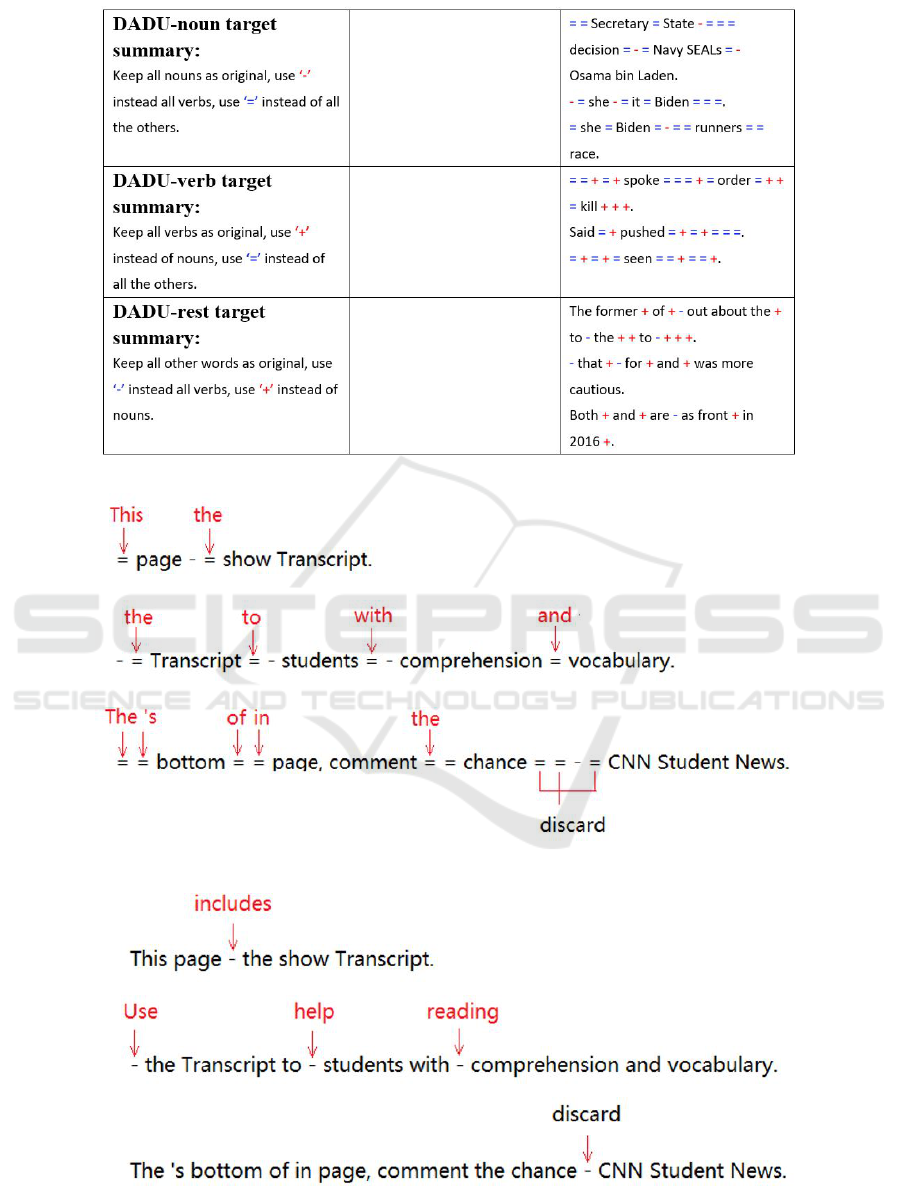
Figure 1: DADU input and target for the three sub-tasks.
Figure 2: Merge Rest into DADU-Noun summary.
Figure 3: Merge Verb into DADU-Noun summary.
KDIR 2025 - 17th International Conference on Knowledge Discovery and Information Retrieval
244

Table 2: The details of model comparisons.
Model Objective Dataset Trained Epochs
BERT MLM + NSP Wikipedia 40 epochs
RoBERTa MLM Wikipedia 40+ epochs
RoBERTa-CNN20epochs MLM CNN/Daily-mail 20 epochs
BQ MLM + MSLM CNN/Daily-mail 20 epochs
BQ-partial-Noun MLM + MSLM-Noun CNN/Daily-mail 20 epochs
BQ-partial-Verb MLM + MSLM-Verb CNN/Daily-mail 20 epochs
BQ-partial-Rest MLM + MSLM-Rest CNN/Daily-mail 20 epochs
4.2 Data Pre-Processing
Since we used RoBERTa as our benchmark com-
parison, we filter text larger than 500 tokens, since
RoBRTa has a limit of 512 tokens. We used the
Food Review dataset only for the downstream Ab-
stractive document summarization task and used the
CNN/Dail-Mail dataset for both pretraining and sum-
marization tasks.
4.3 Model Training
All our experiments were trained on Google Colab;
however, the computing resource provided by Colab
is limited and sometimes unstable, thus, we restricted
our pretraining tasks to 20 epochs, and finetuning
tasks to 10 epochs for each experiment. Since the
training time for our experiments has been restricted
compared to some of the state-of-the-art works (e.g.,
RoBERTa was trained for over 40 epochs), the final
evaluation values reflect this. Hence, to compare the
results on the same dataset and training time, we pre-
trained RoBERTa on the same CNN/Dail-Mail dataset
(the original was trained on Wikipedia). We named
this version RoBRTTa as RoBERTa-CNN-20 epochs.
Table 2 outlines the various names and the training
epochs for BERT, RoBERTa, and BQ (our model,
abbreviated for “Blank Quiz” which forms the mo-
tivation for composite task oriented approach) mod-
els. Note that, as a comparison, we also trained our
BQ model with random masking of words, as is the
case with standard masked language modelling. The
base used for all BQ variants in our modelling was the
RoBERTa model.
4.4 Results for Search of the Best
BQ-Partial Variants
As described earlier, we first pre-trained each BQ-
partial variant on CNN/Daily-mail dataset for 20
epochs. Then, we fine-tuned them for summary gen-
eration on the Food Review and CNN/Daily- mail
datasets for 10 epochs each, respectively. The fine-
tuning was tested by using each of the variants to
generate the complete summary for the two datasets.
The results shown in Table 3 show that the best per-
former among the variants was the BQ-partial-noun.
Table 3: Comparison of the various BQ variants.
BQ-partialnoun BQ-partial-verb BQ-partialrest
Food Review-fine-tune
Rouge-1 18.22 15.17 14.79
Rouge-2 5.28 4.11 3.83
Rouge-L 18.02 14.99 14.65
CNN/Daily-mail-finetune
Rouge-1 24.95 5.64 3.27
Rouge-2 0.77 0.21 0.12
Rouge-L 23.63 5.31 3.07
Table 4: Comparison of BQ and RoBERTa trained for 20
epochs.
Model Rouge-1 Rouge-2 Rouge-L
RoBERTa-CNN20epochs 27.53 8.41 19.68
BQ 30.18 9.67 21.35
BERT 42.13 19.60 39.18
RoBERTa-base 42.30 19.29 39.54
RoBERTa-large 43.06 19.70 40.16
This reaffirms the intuition that nouns are the highest
carriers of information among the various linguistic
components of a language. Since the BQpartial-noun
was trained on the MSLM-noun objective and deliv-
ered the best results, we chose to concatenate MLM
and MSLM-noun to train our final BQ model. This is
intuitive, as nouns usually have high information con-
tent that indicates the entities in the text. The verbs
and all the rest of the words, such as conjunctions and
adjectives, usually indicate the relationships between
the entities. The findings demonstrate that nouns in
texts are essential components for building models for
common language tasks.
4.5 RoBERTa-CNN-20epochs vs BQ
To directly compare the effectiveness of the partial
variants (Noun), we trained the BQ model with the
MLM + MSLM noun objective for 20 epochs and
compared it with RoBERTa-cnn-20 epochs on the
MLM objective. The results are tabulated in Ta-
ble 4. We have also included the numbers for the
stateof-the-art models trained for a higher number of
epochs in the bottom three rows for relative compar-
ison. From the first two rows, BQ has consistently
performed better compared to the equally trained
RoBERTa version, RoBERTa-CNN-20epochs, which
was the base for our BQ model. This is a promis-
ing result that indicates that with enough training, the
model has the potential to perform better than the cur-
rent state of the model, as the performance of the BQ
model is approximately 75% of the state-of-the-art
with less than half the training.
4.6 Summarization Comparison
In order to gauge the effectiveness of the proposed
DADU model we trained the RoBERTa-based model
on CNN/Daily-mail dataset for ten epochs, then we
Objective-Oriented Transformer for Abstractive Document Summarization
245

Table 5: Results for DADU with one-shot summary gener-
ation.
Precision Recall F-measure
Rouge-1 33.15 42.46 36.02
One-Shot (RoBERTa-base)
Rouge-2 15.95 18.97 16.58
Rouge-L 24.89 31.44 26.77
Rouge-1 37.10 28.22 31.10
DADU (Composite
RoBERTa-base)
Rouge-2 0.85 6.38 7.04
Rouge-L 25.20 19.31 21.20
used it to generate the summaries on the CNN/Daily-
mail dataset with the existing one-shot summary gen-
eration and the proposed composite summary genera-
tion model, DADU. The results are tabulated in Ta-
ble 5. For comparison, we also finetuned a tradi-
tional seq2seq model based on RoBERTa-base with
CNN/Daily-mail dataset for 10 epochs.
DADU obtained an approximately 4% improve-
ment in the precision value of Rouge-1 and about
0.3% improvement in Rouge -L. However, it got a
much lower score of Rouge-2 and all recall values,
leading to the lower overall F1 score. In this project,
our focus was to explore whether the generation of
perspective-based composite summaries could assist
us in generating more accurate summaries, and hence
we used a very crude merging function to merge the
three composite summaries. For merging, we essen-
tially substituted the words based on the number of
tokens in the gold standard, without any consideration
for grammar or coherence. This means that although
we managed to get the individual words correct, we
could not generate grammatically correct sentences,
or n-grams, from them, resulting in low ROGUE-2
and ROGUE-L scores. We also discarded the extra
words that did not fit the generated sequence, which
would have resulted in low recall values in Table 5.
These preliminary results from the DADU tests show
that the strategy could be powerful if integrated with a
better merge module that is able to generate grammat-
ically correct sentences given a set of words, hence
also rearranging words giving better n-gram align-
ment. Table 6 shows some examples of label sum-
maries and corresponding generated summaries for
comparison.
5 CONCLUSION AND FUTURE
WORK
We proposed a new objective for pre-training a trans-
former model on the masked language model. We
tested the performance of the three variants of pro-
posed objectives and found that one of them, MSM-
Noun, gave a better comparative performance on the
state-of-the-art. Based on the pre-training objec-
tive, we proposed a new fine-tuning method DADU
for document summary generation. We showed that
its performance was also higher for ROGUE-1, but
slightly lower for longer sequences. The results
showed that this was due to a very crude merge func-
tion which merges the words to construct the final
summary, based on order and sequence, hence fre-
quently resulting in incorrect n-grams even though
the correct words might be present in the whole out-
put. Both of the newly proposed models have shown
encouraging results and need further rigorous testing
on more powerful computing resources to surpass the
state-of-the-art. As part of further work, we are work-
ing on integrating a better Natural Language Gener-
ation (NLG) based merge function so that this will
be able to construct grammatically correct sentences
from the words generated from the summarization
phase. This will substantially improve the ROGUE
scores as there will be more accurate matching of the
n-grams with the reference text.
REFERENCES
Banko, M. and Etzioni, O. (2007). Strategies for lifelong
knowledge extraction from the web. In Proceedings of
the International Conference on Knowledge Capture
(K-CAP), pages 95–102.
Bowman, S. R., Angeli, G., Potts, C., and Manning, C. D.
(2015). A large annotated corpus for learning natural
language inference. In Proceedings of the 2015 Con-
ference on Empirical Methods in Natural Language
Processing (EMNLP), pages 632–642. Association for
Computational Linguistics.
Cao, Z., Wei, F., Li, W., and Li, S. (2018). Faithful to the
original: Fact aware neural abstractive summarization.
In Proceedings of the AAAI Conference on Artificial
Intelligence, volume 32.
Conroy, J. M. and OLeary, D. P. (2001). Text summariza-
tion via hidden markov models. In Proceedings of
the Annual International ACM SIGIR Conference on
Research and Development in Information Retrieval,
pages 406–407.
Dai, A. M. and Le, Q. V. (2015). Semi-supervised sequence
learning. In Advances in Neural Information Process-
ing Systems, volume 28, pages 3079–3087.
Dai, Z., Yang, Z., Yang, Y., Carbonell, J., Le, Q. V., and
Salakhutdinov, R. (2019). Transformer-xl: Attentive
language models beyond a fixed-length context.
Devlin, J., Chang, M.-W., Lee, K., and Toutanova, K.
(2018). Bert: Pre-training of deep bidirectional trans-
formers for language understanding.
Dong, L., Yang, N., Wang, W., Wei, F., Liu, X., Wang, Y.,
Gao, J., Zhou, M., and Hon, H.-W. (2019). Unified
language model pre-training for natural language un-
derstanding and generation. In Advances in Neural
Information Processing Systems, volume 32.
KDIR 2025 - 17th International Conference on Knowledge Discovery and Information Retrieval
246

Table 6: Examples of DADU-generated and labeled summaries.
Label Summary Generated Summary
Accident happens in Santa Ynez, California, near where Crosby lives. The jogger
suffered multiple fractures; his injuries are not believed to be life-threatening.
A driving accident occurred in Santa Ynez, California. Crosby struck a jogger who
suffered multiple fractures and was airlifted to a hospital in Santa Barbara.
Sigma Alpha Epsilon is being tossed out by the University of Oklahoma. Its also
run afoul of officials at Yale, Stanford, and Johns Hopkins in recent months.
Sigma Alpha Epsilon is under fire for a video showing fraternity members chanting
a racist phrase. The party that the video was made at has been suspended and
the fraternity is facing permanent ban. This controversy is the latest in a series of
incidents involving SAE in recent months, with hard work being done by alumni
and chapters to make changes.
Join Meerkat founder Ben Rubin for a live chat at 2 p.m. ET Wednesday. Follow
@benrbn and @lauriesegallCNN on Meerkat. Use hashtag #CNNInstantStartups to
join the conversation on Twitter.
Meerkat launched during SXSW in Austin last week. Ben Rubin, the founder of
Meerkat, will be available for questions and comments on Meerkat or Twitter. This
is a great opportunity to ask him anything you want to know about the app.
Gehrmann, S., Deng, Y., and Rush, A. M. (2018). Bottom-
up abstractive summarization.
Graff, D. and Cieri, C. (2007). English gigaword, third
edition. https://catalog.ldc.upenn.edu/LDC2007T07.
LDC2007T07.
Kupiec, J., Pedersen, J., and Chen, F. (1995). A trainable
document summarizer. In Proceedings of the Annual
International ACM SIGIR Conference on Research
and Development in Information Retrieval, pages 68–
73.
Lewis, M., Liu, Y., Goyal, N., Ghazvininejad, M., Mo-
hamed, A., Levy, O., Stoyanov, V., and Zettlemoyer,
L. (2019). Bart: Denoising sequence-to-sequence pre-
training for natural language generation, translation,
and comprehension.
Lin, C.-Y. (2004). Rouge: A package for automatic evalu-
ation of summaries. In Text summarization branches
out, pages 74–81.
Liu, Y., Ott, M., Goyal, N., Du, J., Joshi, M., Chen, D.,
Levy, O., Lewis, M., Zettlemoyer, L., and Stoyanov,
V. (2019). Roberta: A robustly optimized bert pre-
training approach.
Luong, M.-T., Le, Q. V., Sutskever, I., Vinyals, O., and
Kaiser, L. (2015). Multi-task sequence to sequence
learning.
Nallapati, R., Zhai, F., and Zhou, B. (2017). Summarunner:
A recurrent neural network based sequence model for
extractive summarization of documents. In Proceed-
ings of the AAAI Conference on Artificial Intelligence,
volume 31.
Narayan, S., Cohen, S. B., and Lapata, M. (2018). Rank-
ing sentences for extractive summarization with rein-
forcement learning.
Pasunuru, R. and Bansal, M. (2018). Multi-reward rein-
forced summarization with saliency and entailment.
Radford, A., Wu, J., Child, R., Luan, D., Amodei, D.,
Sutskever, I., et al. (2019). Language models are un-
supervised multitask learners. OpenAI Blog, 1(8):9.
Rothe, S., Narayan, S., and Severyn, A. (2020). Leverag-
ing pre-trained checkpoints for sequence generation
tasks. Transactions of the Association for Computa-
tional Linguistics, 8:264–280.
Song, K., Tan, X., Qin, T., Lu, J., and Liu, T.-Y. (2019).
Mass: Masked sequence to sequence pre-training for
language generation. In International Conference on
Machine Learning (ICML), pages 5926–5936.
Vaswani, A., Shazeer, N., Parmar, N., Uszkoreit, J., Jones,
L., Gomez, A. N., Kaiser, ., and Polosukhin, I. (2017).
Attention is all you need. In Advances in Neural In-
formation Processing Systems, volume 30.
Wang, T. and Cho, K. (2015). Larger-context language
modelling. arXiv preprint arXiv:1511.03729.
Yang, Z., Zhu, C., Gmyr, R., Zeng, M., Huang, X., and
Darve, E. (2020). Ted: A pretrained unsupervised
summarization model with theme modeling and de-
noising.
Yao, J.-g., Wan, X., and Xiao, J. (2017). Recent advances
in document summarization. Knowledge and Infor-
mation Systems, 53(2):297–336.
Zhang, J., Zhao, Y., Saleh, M., and Liu, P. J. (2020). Pega-
sus: Pre-training with extracted gap-sentences for ab-
stractive summarization. In International Conference
on Machine Learning (ICML), pages 11328–11339.
Objective-Oriented Transformer for Abstractive Document Summarization
247
