
Knowledge Management in Finnish Comprehensive Security
Ecosystem
Jussi Kosonen
Faculty of Information Technology, University of Jyväskylä, Seminaarinkatu 15, FI-40014, Finland
Keywords: Comprehensive Security, Knowledge Networks, Knowledge Management, Collaboration.
Abstract: Society is exposed to a wide range of threats that can jeopardise the continuity of organisations and the
security of citizens. In previous years, deliberate hybrid influence from authoritarian countries has increased
significantly. Finland's comprehensive security is a cooperative concept for implementing preparedness and
crisis management. Organisations involved in comprehensive security require knowledge to prepare and
respond appropriately to crises. This study aimes to determine how knowledge is managed within the Finnish
comprehensive security knowledge network. A theory-guided mixed methods study investigated the security-
related knowledge management practices of 54 diverse Finnish organisations involved in comprehensive
security. The study identifies knowledge management in a four-layer architecture: institutional, organisational,
interaction, and knowledge layers, all of which need to be aligned to facilitate effective knowledge
management. According to the findings, networked knowledge management works partly well, but there is
potential for improvement in the breadth and depth of knowledge-sharing. This study suggests proposals for
the development of knowledge networks and management for comprehensive security.
1 INTRODUCTION
The Finnish Security Strategy defines comprehensive
security as the foundation of national resilience, in
which vital societal functions are maintained through
cooperation between public, private, and third-sector
organisations. The preparedness within The Finnish
comprehensive security ecosystem is based on
legislation, agreements, and voluntary contributions.
Multifaceted threats create challenges for societal
security and resilience caused by state, non-state and
environmental factors. The unpredictable nature of
these threats complicates forecasting and
preparedness. Knowledge and situational
understanding are key factors for efficient
preparedness and crisis management. (Finnish
Security Committee, 2025) This study aims to answer
an under-researched question: How knowledge is
managed within Finland's comprehensive security
ecosystem?
Hybrid threats refer to hostile actors' efforts to
undermine society by exploiting vulnerability across
domains. State actors pursue political objectives
through hybrid activities (Galeotti, 2019), with
warfare being the ultimate option for authoritarian
states. Organisations face constant risks, such as
cyber-physical vulnerabilities, information
manipulation, and intelligence collection. Artificial
intelligence has expanded hybrid capabilities,
especially in the information domain (Yan, 2020).
According to a Finnish survey, half of the large
enterprises considered themselves targets of hybrid
activities. Because many of them fall out of
systematic security knowledge sharing, 96 % of
businesses would expect better knowledge from
officials (Vesterinen, 2022).
Knowledge is a key component in comprehensive
security. A diverse comprehensive security
ecosystem requires networked knowledge
management practices to facilitate situational
awareness and decision making. Since responsibility
is shared without one central organisation,
information exchange practices and collaboration at
the international, national, regional, and local levels
are crucial. Organisations can enhance their
adaptability to security threats by fostering
knowledge sharing and continuous learning within
the network. Sufficient security-related knowledge
enables proactive preparedness. Synergy between
comprehensive security and knowledge management
enables organisations to leverage explicit and tacit
knowledge in their preparedness and activities.
370
Kosonen, J.
Knowledge Management in Finnish Comprehensive Security Ecosystem.
DOI: 10.5220/0013676400004000
Paper published under CC license (CC BY-NC-ND 4.0)
In Proceedings of the 17th International Joint Conference on Knowledge Discovery, Knowledge Engineering and Knowledge Management (IC3K 2025) - Volume 2: KEOD and KMIS, pages
370-377
ISBN: 978-989-758-769-6; ISSN: 2184-3228
Proceedings Copyright © 2025 by SCITEPRESS – Science and Technology Publications, Lda.

2 RELATED LITERATURE
2.1 Knowledge Networks
Knowledge management (KM) is a methodical
approach to creating, sharing, and applying
knowledge to gain competitive advantage and fulfil
organisational goals (Nicolas, 2004). Several studies
have identified significant benefits of well-
functioning knowledge management (Andreeva &
Kianto, 2012; Kebede, 2010; Rousseau, 2006).
Knowledge networks are groups of connected
people or organisations that store knowledge and
interact with knowledge tasks. (Phelps et al., 2012).
The structure encompasses diverse participants
within defined boundaries, with participants
understanding their roles in making the ecosystem
less vulnerable to external pressures (Cobben et al.,
2022). The key attributes of knowledge ecosystems
include dynamic value creation from exchanges
between organisations and ecosystem management
(Van der Borgh et al., 2012). Ecosystems include
techniques and platforms enabling knowledge
development, transfer and utilisation, with their
primary characteristic being ability to produce new
insights and solutions (Vodă et al. 2023).
Organisations face a paradox when protecting and
sharing knowledge, highlighting the need to manage
cross-boundary knowledge flows within knowledge
ecosystems (Loebbecke et al. 2016). According to the
information-processing view by Premkumar et al.
(2005), organisations have two strategies for
managing uncertainty: developing protective buffers
or enhancing information-processing capabilities to
improve knowledge flow. Öberg and Lundberg
(2022) noted that knowledge ecosystems operate
through structure and openness mechanisms. The
structure involves linear knowledge transfer through
formal channels, whereas content development is
collaborative. A functioning ecosystem requires
parties to reach a sufficient understanding before
collaboration can occur.
Knowledge sharing within a network facilitates
three processes: knowledge creation, transfer, and
adoption (Alavi & Leidner, 2001). This sophistication
varies across organisations. Nunamaker et al. (2001)
categorised these capabilities into three levels: Level
1 represents individualistic and uncoordinated
efforts; Level 2 shows emerging coordination that
remains ad hoc; and Level 3 exhibits concerted
capabilities where teams work through repeatable,
adaptive processes. Collaborative dynamics affect
inter-organisational knowledge sharing positively or
negatively. Huxham (2003) highlighted collaborative
advantage, signifying gains from joint efforts, and
collaborative inertia, referring to unsatisfactory
outcomes. A collaborative advantage occurs when a
collective achieves what individuals cannot achieve.
However, the results often seem minimal, suggesting
that organisations must weigh benefits against
investments.
2.2 Attributes of Knowledge
Knowledge is a resource that can be transferred
within a knowledge network. The Data-Information-
Knowledge-Wisdom (DIKW) hierarchy is a
foundational framework for knowledge management
that illustrates cognitive transformations. This
suggests that wisdom emerges from collecting data,
transforming it into information, refining it into
knowledge, and combining it with experience
(Ackoff, 1999). The DIKW model implies that each
level builds on the previous one: data are raw facts,
information includes context, knowledge applies
information through experience, and wisdom is the
judicious application of knowledge. However, this
concept has been criticised. Tuomi (1999) argued
data emerge only after meaningful structures and
semantics are established through existing
knowledge. This suggests that the DIKW model
enhances the interplay of technical solutions and
social processes, enabling users to make sense of
shared meanings within organisational contexts.
Explicit and tacit knowledge may be
distinguished. While explicit knowledge can be
documented and shared through formal channels,
tacit knowledge represents a deeply internalised
understanding that individuals possess, but cannot
easily articulate. (Polanyi, 1958; Nonaka, 1994).
Knowledge creation occurs through a dialoque
between tacit and explicit knowledge, ultimately
crystallising into concrete forms. The SECI model,
named after Socialisation (tacit-tacit), Externalisation
(tacit-explicit), Combination (explicit-explicit), and
Internalisation (explicit-tacit), identifies knowledge
development as a continuous cycle between tacit and
explicit knowledge in which knowledge is amplified
and expanded across individual, group, and
organisational levels (Nonaka & Toyama, 2003). This
principle may also be applied in the inter-
organisational context of knowledge transfer (Alavi
& Leidner, 2001). Such knowledge transfers can
occur bilaterally or multilaterally within the
knowledge network.
Knowledge Management in Finnish Comprehensive Security Ecosystem
371
3 METHODOLOGY
A theory-guided, qualitative, mixed-methods
approach was selected to answer the research
question. The three main phases of the study were
establishing a theory-based framework, interviews,
and a survey. The phased approach enabled iterative
development of understanding between the phases.
The research design was driven by diverse research
population and complex phenomena. The choice for
mixed-methods research aimed to combine the
strengths of both research traditions, allowing for a
deeper understanding of phenomena (Venkatesh,
2016; Plano Clark, 2019).
Theories related to inter-organisational
knowledge management provided a starting point for
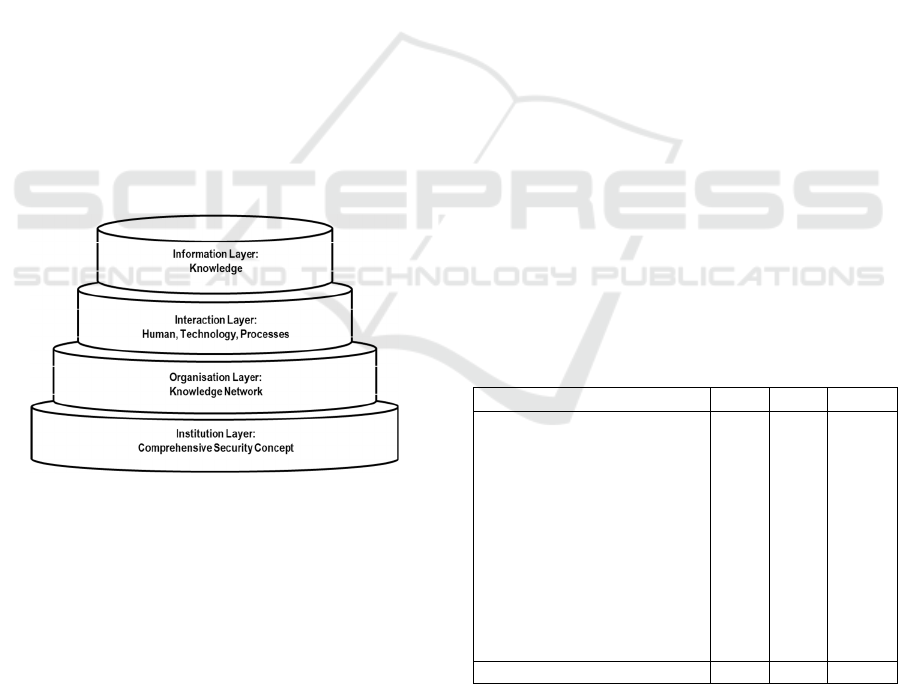
the study, based on which a 4-layer model (Figure 1)
was established as a framework. The base layer,
named as the institution layer, encompasses a
comprehensive security ecosystem and state-level
regulation. The subsequent network layer comprises
various organisations operating in a hybrid-threat
environment. The interaction layer, as the third layer,
facilitates the exchange of knowledge between
organisations. Finally, the fourth layer pertains to the
knowledge itself, which is transferred and developed
among organisations.
Figure 1: 4-Layer Knowledge Management Framework.
The data were collected in two phases: interviews
and a survey. The data collection also included other
elements aimed at a larger research project, the results
of which are reported separately. The organisations
and representatives for interviews were selected in
such a way that they represented each of the seven
vital functions of society, as defined in the Security
Strategy. In the first data collection phase (Ph1),
interview requests were sent to 17 key persons, 15 of
whom agreed to be interviewed, resulting in a
response rate of 88 %. The interviews were semi-
structured and the questions were guided by relevant
knowledge management theories. The interview
consisted of 20 questions tailored to explore each
organisation’s knowledge management practices and
knowledge exchange with other organisations.
Interviews were conducted face-to-face or on the
phone between November 2022 and October 2024,
each lasting 45–70 minutes. The main questions
related to this study were: “How does your
organisation obtain security-related knowledge?” and
“Describe your organisations knowledge transfer
with other organisations”.
The interviews were transcribed and saved in
Microsoft Excel. Theory-guided content analysis
focused on identifying and coding content related to
the established theoretical 4-layer model. As Hsieh
and Shannon (2005) noted, directed content analysis
results can support, contradict, or add to this theory.
The second phase of data collection (Ph2) aimed
to add reliability and generalisability to the results of
the interviews. The survey was conducted using an
electronic Webropol questionnaire distributed via
email to 126 respondents. The respondents were
identified as important members of organisations
involved in the Finnish comprehensive security
ecosystem. The survey was conducted in March 2025
and received 39 responses, yielding a response rate of
31 %. The questionnaire contained 106 multiple-
choice and seven open-ended questions. The main
questions contributing to this study focused on the
intensity, means, and content of transfer between
organisations, as well as facilitators and barriers for
interaction. Table 1 presents the two phases of data
collection.
Table 1: Sample (n=54) divided by the vital functions of
society (Security Committee, 2025).
Function Ph1 Ph2 Total
Mental crisis resilience
Defense capability
Internal security
Leadership
International and EU
activities
Economy, infrastructure and
security of supply
Functional capacity of the
population and services
3
2
3
2
1
2
2
5
6
1
2
2
16
7
8
8
4
4
3
18
9
Total n=15 n=39 n=54
The second dataset included both qualitative and
quantitative data; however, the analysis was
qualitatively oriented. Identified themes and findings
from the previous phase were used as a baseline. The
content of the open-ended questions was coded using
KMIS 2025 - 17th International Conference on Knowledge Management and Information Systems
372

the same process as in Ph1 and added to prior
findings. Quantitative data were referenced to the
interview results, partly confirming the previous
findings. Completely new themes did not emerge
from the second dataset. In conclusion, the results
were improved by combining the interviews and
complementing survey responses.
4 RESULTS
The analysis of the research data revealed complex
knowledge flows within Finland's comprehensive
security ecosystem. Some distinct but interconnected
themes emerged from the data, demonstrating
networked and often self-synchronising practices
rather than hierarchical knowledge flow. Formal
structures were complemented by informal
relationship-based exchanges. The findings express
both multi-source integration and adaptability, as well
as weaknesses and risks. The main findings are
presented next based on the 4-layer model.
4.1 Knowledge Network
The Finnish comprehensive security ecosystem
comprises diverse organisations with varying security
relevance. Every organisation’s knowledge
requirements are unique, as are their connectness in
the knowledge network. According to the findings,
society's vital functions express domain-specific
networks to some extent. More importantly, four
cross-domain categories were identified: security
authorities, administration, critical infrastructure, and
other organisations. All these categories are also
internationally connected.
Centrality and depth of security-related
knowledge varied significantly according to these
categories.
The central actors in a comprehensive security
knowledge ecosystem are security authorities. These
organisations possess and provide the most relevant
security-related knowledge in Finland. As many
respondents mentioned, “We are dependent on the
knowledge of security authorities”. The second
category comprises governmental organisations,
including ministries and agencies, that perform
statutory tasks within their respective domains while
also maintaining comprehensive security obligations.
The findings indicate that governmental
organisations have systematically organised their
information exchanges, establishing regular and well-
institutionalised interagency networks.
The third category consists of organisations that
sustain the critical functions of society. In Finland,
approximately 1,500 organisations, predominantly
from the private sector, hold this designation
(National Emergency Supply Agency, 2025). These
entities seek to maintain profitable operations while
simultaneously fulfilling their statutory or contractual
roles in supply security.
Fourth, a large majority of other organisations,
including numerous businesses, municipalities, and
third-sector organisations, fall outside systematic
security knowledge exchange.
It is also worth mentioning that domain-specific
subnetworks overlap all these categories. They are
particularly important in facilitating topical
information exchange, often on a voluntary basis. An
example is the cybersecurity domain and its
continuous information exchange which benefits all
the participants. However, such specialisation can
also create information silos and coordination
challenges when cross-domain incidents occur.
Some organisations were mentioned frequently in
the research data as key nodes for knowledge transfer.
The government situation center, Security committee,
National emergency supply agency, and Cyber
security center function as knowledge brokers,
following Davenport and Prusak (1998). Knowledge
brokers facilitate the exchange of both research-based
and tacit knowledge at the individual, organisational,
and systemic levels (Ward et al. 2009). The activities
of these knowledge brokers are based, but also limited
to legislation, and thus not ecosystem wide.
4.2 Interaction
Interaction and knowledge transfer between
organisations require a balance of people, technology,
and processes, as often categorised in knowledge
management theory (Chan, 2017). The research
findings are presented accordingly.
The human factor is critical to knowledge transfer
and development. Trust-based personal contacts were
found to substantially enhance knowledge flow,
facilitating deeper knowledge transfer and agility
among organisations. “I just called the guy I know”
as was mentioned in the interviews. Personal contact
from leadership or active experts is often required to
establish an initial connection between organisations.
Human interaction facilitates sharing of tacit
knowledge, which is not possible through other
means. In practice, a representative of a security
authority often provides insight or advice on
comprehensive security matters. These findings
resonate with prior literature. Informal ties often
Knowledge Management in Finnish Comprehensive Security Ecosystem
373
compensate for the limitations of formal coordination
mechanisms (Granovetter, 1985), and trust is a crucial
factor (Csepregi & Papp-Horváth, 2024). In the
context of comprehensive security Valtonen (2010)
suggests that trust, professionalism, and commitment
are fundamental enablers of successful inter-
organisational cooperation and knowledge transfer at
every level, and common security concerns are
emphasised over competitive dynamics.
A technology factor, as data reveals, enables, but
in many cases, also limits, knowledge flows between
organisations. The usability of different means of
communication varied significantly between
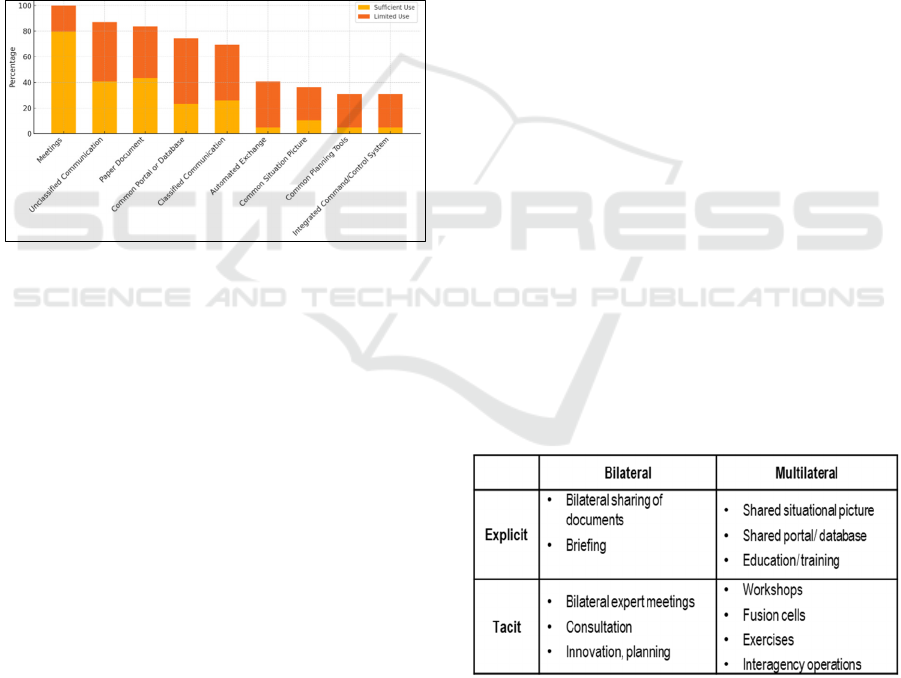
organisations. The following chart (Figure 2) depicts
the survey responses concerning the availability of
different methods for information exchange, scaled as
sufficiently available, limited, or unavailable.
Figure 2: Availability of Information Exchange Methods (n
=39).
The data reveal several key findings. Traditional
methods dominate, as face-to-face meetings and
unclassified communication methods remain the
primary means for exchanging security-related
knowledge. These methods are easy to use and
available everybody. Security considerations also
influence method selection. In addition to face-to-
face meetings, secure networks and paper documents
play a significant role for security authorities who
often prioritise confidentiality over usability. While
basic digital communication is common, integrated
systems such as joint situation awareness applications
or collaborative planning tools show limited
adoption. Automated inter-organisational data
transfers are also rare. Technology primarily
facilitates knowledge transfer, leaving collaboration
as an option for future development.
Technological connectivity was found to mirror
the structure of comprehensive security knowledge
network. Security authorities have their own
classified networks, administration uses limited
restricted networks, and some domain-specific
portals are operated on the Internet. There is no
overlap between these networks, while a large
majority of organisations do not have access to any of
these networks. Limited technological integration is
evident even though there are some well-functioning
elements. The technological gap severely limits
knowledge flows between the entities, while the
majority of organisations have access only to open-
source information.
Processes facilitating inter-organisational
knowledge transfer were noticed to occur bilaterally
and multilaterally, each with distinct advantages and
disadvantages. Bilateral exchanges are prone to
deeper interactions when multilateral knowledge
transfers provide access to wider knowledge and save
time. Most organisations seemed to prioritise bilateral
exchange, since they are easier to organise, typically
more confidential, and involve more trust. Only 21%
of the private companies engage in multilateral
knowledge sharing, while security authorities (100%)
and administration (86%) were regularly involved in
multilateral exchanges. These organisations
consistently conduct also bilateral exchanges.
Explicit knowledge is easier to transfer and,
accordingly, is most commonly shared. Explicit
knowledge is often insufficient, because security-
related information often requires interpretation by
experienced experts. Additionally, organisational
learning requires interplay between explicit and tacit
knowledge, referring to Nonaka´s SECI model
(1994). In sum, inter-organisational knowledge
transfer processes include bilateral and multilateral,
as well as explicit and tacit knowledge transfer
between organisations. The most common processes
observed in the results are shown in Table 2.
Table 2: Knowledge transfer processes. Modified based on
(Alavi&Leidner, 2001, p. 117).
4.3 Facilitators and Barriers
Knowledge management theories suggest that certain
factors can either enhance or cause friction in inter-
organisational knowledge exchange (Nunamaker et
al. 2001; Fang et al., 2013). The survey revealed
KMIS 2025 - 17th International Conference on Knowledge Management and Information Systems
374
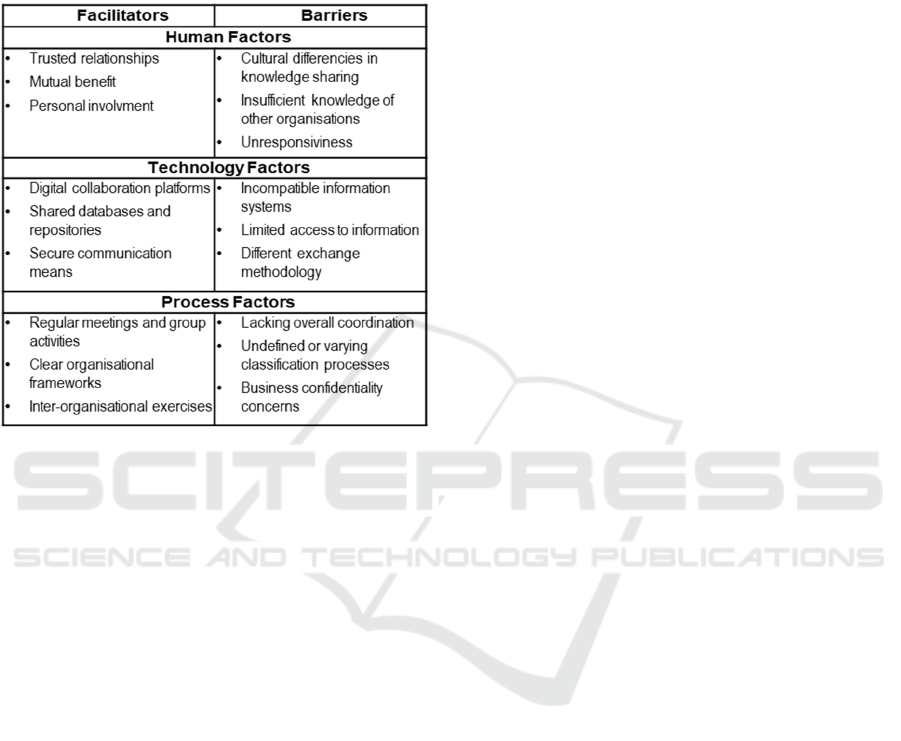
similar findings. The three most frequent human-,
technology-, and process-related factors are listed in
Table 3.
Table 3: Facilitators and barriers to inter-organisational
knowledge transfer.
4.4 Knowledge to Be Managed
Knowledge is valuable only when it is relevant and
timely for the receiving organisation. It also needs to
add value to the knowledge that an organisation
already possesses. According to the findings,
knowledge requirements vary among organisations.
Moreover, knowledge in security contexts is not
static, but fluctuates based on organisational priorities
and situational demands. The challenge seems to be
to identify relevant information from the vast
amounts of incomplete and unreliable data. Hardly
any organisation indicated that the knowledge they
receive fully meets their requirements. This
underlines the importance of organisational
multisource knowledge management and absorptive
capabilities (Cohen & Levinthal, 1990).
Transferred knowledge in the security context
typically includes situational updates, incident
reports, and threat assessments. Knowledge of
protection and resilience is also valuable. Besides
topicality, other important attributes of knowledge
seemed to be the classification level, explisit/tacit
knowledge, and maturity in relation to the DIKW-
pyramid. The results indicate that the most common
transfer is unclassified but sensitive explicit
knowledge, often a written report. Examples of more
sophisticated transfers include the delivery of
authentic fingerprint data related to cyber threats or
secret raw data pertaining to intelligence findings
accompanied by expert interpretation. A higher
sensitivity of knowledge usually requires a habitual
relationship and trust between the organisations
involved. Understanding these attributes is important
for developing systematic knowledge management
arrangements.
5 DISCUSSION
Inter-organisational knowledge sharing is
fundamental to ensuring situational awareness and
operational continuity. This study has explored
knowledge management within Finland's
comprehensive security ecosystem. While the results
reflect subjective perspectives from representatives
of diverse organisations and may not fully capture the
continuously evolving security landscape, they
nonetheless enable the identification of key elements
for enhancing knowledge management efficiency
across a comprehensive security network. The
established theory-based 4-layer model on inter-
organisational knowledge management can capture
the phenomena and main research findings as a
framework, enabling a more comprehensive analysis
of knowledge-sharing practices.
The depth of knowledge transferred between
organisations varies significantly. While security
organisations have accurate and sensitive information
and dynamic interactions, many organisations remain
excluded from systematic security information
sharing. Non-governmental organisations may be
forced to rely on openly available information, which
is often unsystematic. Moreover, the lack of
standardised processes or dedicated personnel to
facilitate network-wide knowledge transfer is
problematic. Consequently, situational awareness
may remain superficial across networks. This
presents a significant challenge for wide and
heterogeneous knowledge networks. Rather than
attempting to maintain uniform high-quality
functioning across the network, it has been pragmatic
to prioritise inter-organisational knowledge
management among critical entities. It is important to
consider that practically any organisation may also
pose societal vulnerability and should be included in
more systematic knowledge sharing.
The Finnish comprehensive security model
operates through a decentralised structure in which
knowledge management responsibilities are
distributed across the network within their respective
domains, rather than hierarchically coordinated by a
Knowledge Management in Finnish Comprehensive Security Ecosystem
375

single entity. The findings indicate that besides
statuory requirements, mutual benefits motivate key
organisations to participate in knowledge-sharing
activities. Although self-synchronisation offers an
alternative approach, it remains limited due to
organisations’ lack of security expertise and access to
sensitive information. Informal links compensate for
formal limitations, as Granovetter (1985) noted. The
importance of active individuals and social networks
was still unexpected. The research findings suggest
that there may be a requirement for appointing
governmental knowledge broker to enhance network-
wide effectiveness by coordinating security
knowledge management and assisting preparedness.
Two main topics for future research have
emerged. First, expanding investigations into the
intenational context and second, a possible paradigm
shift towards Mass Collaborative Knowledge
Management (MCKM) (Borjigen, 2015) that values
knowledge from professional amateurs rather than
solely from exclusive organisations. An example is
provided by voluntary networks of open-source
analysts developing detailed documentation of the
Ukrainian war. Given the diversity of security
knowledge networks, knowledge-sharing challenges,
information proliferation, and AI advancements,
crowdsourcing security knowledge is a conceptual
alternative that is worth studying.
6 CONCLUSION
For an effective comprehensive security knowledge
network, alignment is required across all levels of the
proposed four-layer architecture: a common
conceptual framework, functioning network
structure, established knowledge transfer methods,
and effective delivery of actionable knowledge to
appropriate recipients in suitable formats and in a
timely manner. In addition, organisations need
knowledge absorption and utilisation competency to
identify and conduct necessary activities. According
to the research findings, all of these elements exist
within the current Finnish comprehensive security
ecosystem, but none operate at optimal levels,
indicating substantial room for improvement.
Network coverage, secure electronic communication
methods, and systematic inter-organisational expert
collaboration are the most important areas in need of
improvement. It is also worth mentioning that pre-
established cooperative networks and information
management protocols enable dynamic knowledge
transfer and collaboration during crises.
ACKNOWLEDGEMENTS
This study has received partial financial support from
the Fund of Nils Eduard von Veh.
REFERENCES
Ackoff, R. L. (1999). Ackoff’s best: His classic writings on
management. Wiley. New York. http://archive.org/
details/ackoffsbesthiscl00russ
Alavi, M., & Leidner, D. E. (2001). Review: Knowledge
Management and Knowledge Management Systems:
Conceptual Foundations and Research Issues. MIS
Quarterly,25(1),107–136. https://doi.org/10.2307/
3250961
Andreeva, T., & Kianto, A. (2012). Does knowledge
management really matter? Linking knowledge
management practices, competitiveness and economic
performance. Journal of Knowledge Management,
16(4),617–636. https://doi.org/10.1108/
13673271211246185
Borjigen, C. (2015). Mass collaborative knowledge
management: Towards the next generation of
knowledge management studies. Program, 49(3), 325–
342. https://doi.org/10.1108/PROG-02-2015-0023
Chan, I. (2017). Knowledge Management Hybrid Strategy
with People, Technology and Process Pillars.
Knowledge Management Strategies and Applications.
IntechOpen. https://doi.org/10.5772/intechopen.70072
Cobben, D., Ooms, W., Roijakkers, N., & Radziwon, A.
(2022). Ecosystem types: A systematic review on
boundaries and goals. Journal of Business Research,
142,138–164. https://doi.org/10.1016/
j.jbusres.2021.12.046
Cohen, M., & Levinthal, W. (1990, March). Absorptive
Capacity: A New Perspective on Learning and
Innovation. //classic_papers/absorptive-capacity.html
Csepregi, A., & Papp-Horváth, V. (2024). Overview of
Knowledge Sharing Concept in a Project Environment:
A Systematic Literature Review.
https://papers.academic-conferences.org/index.php/
eckm/article/view/2437/2260
Davenport, T. H., & Prusak, L. (1998). Working
Knowledge: How Organizations Manage what They
Know. Harvard Business Press.
Fang, S.-C., Yang, C.-W., & Hsu, W.-Y. (2013). Inter-
organizational knowledge transfer: The perspective of
knowledge governance. Journal of Knowledge
Management,17(6),943–957. https://doi.org/10.1108/
JKM-04-2013-0138
Galeotti, M. (2019). Russian Political War: Moving Beyond
the Hybrid. Routledge. https://doi.org/10.4324/
9780429443442
Granovetter, M. (1985). Economic Action and Social
Structure: The Problem of Embeddedness | American
Journal of Sociology: Vol 91, No 3. https://
www.journals.uchicago.edu/doi/abs/10.1086/228311
KMIS 2025 - 17th International Conference on Knowledge Management and Information Systems
376

Hsieh, H.-F., & Shannon, S. E. (2005). Three Approaches
to Qualitative Content Analysis. Qualitative Health
Research, 15(9), 1277–1288. https://doi.org/10.1177/
1049732305276687
Huxham, C. (2003). Theorizing collaboration practice.
Public Management Review, 5(3), 401–423. https://
doi.org/10.1080/1471903032000146964
Kebede, G. (2010). Knowledge management: An
information science perspective. International Journal
of Information Management, 30(5), 416–424. https://
doi.org/10.1016/j.ijinfomgt.2010.02.004
Loebbecke, C., van Fenema, P. C., & Powell, P. (2016).
Managing inter-organizational knowledge sharing. The
Journal of Strategic Information Systems, 25(1), 4–14.
https://doi.org/10.1016/j.jsis.2015.12.002
National Emergency Supply Agency. Topical questions
and answers concerning critical infrastructure and
preparedness. Retrieved 21 April 2025, from https://
www.huoltovarmuuskeskus.fi/en/a/topical-questions-
and-answers-concerning-critical-infrastructure-and-
preparedness
Nicolas, R. (2004). Knowledge management impacts on
decision making process. Journal of Knowledge
Management,8(1),20–31. https://doi.org/10.1108/
13673270410523880
Nonaka, I. (1994). A Dynamic Theory of Organizational
Knowledge Creation. Organization Science, 5(1), 14–
37. https://doi.org/10.1287/orsc.5.1.14
Nonaka, I., & Toyama, R. (2003). The knowledge-creating
theory revisited: Knowledge creation as a synthesizing
process. Knowledge Management Research & Practice,
1(1), 2–10. https://doi.org/10.1057/
palgrave.kmrp.8500001
Nunamaker, J. F., Romano, N. C., & Briggs, R. O. (2001).
A framework for collaboration and knowledge
management. Proceedings of the 34th Annual Hawaii
International Conference on System Sciences, 12 pp.-.
https://doi.org/10.1109/HICSS.2001.926241
Phelps, C., Heidl, R., & Wadhwa, A. (2012). Knowledge,
Networks, and Knowledge Networks: A Review and
Research Agenda. Journal of Management, 38(4),
1115–1166. https://doi.org/10.1177/
0149206311432640
Plano Clark, V. L. (2019). Meaningful integration within
mixed methods studies: Identifying why, what, when,
and how. Contemporary Educational Psychology, 57,
106–111. https://doi.org/10.1016/
j.cedpsych.2019.01.007
Polanyi, M. (1958). Personal Knowledge. Routledge.
Premkumar, G., Ramamurthy, K., & Saunders, C. (2005).
Information Processing View of Organizations: An
Exploratory Examination of Fit in the Context of
Interorganizational Relationships. Journal of
Management Information Systems, 22(1), 257–294.
https://doi.org/10.1080/07421222.2003.11045841
Rousseau, D. M. (2006). Is there Such a thing as “Evidence-
Based Management”? Academy of Management
Review,31(2),256–269. https://doi.org/10.5465/
amr.2006.20208679
Security Commitee. (2025). Security Strategy of Society
https://julkaisut.valtioneuvosto.fi/handle/10024/16602
4
Tuomi, I. (1999). Data is more than knowledge:
Implications of the reversed knowledge hierarchy for
knowledge management and organizational memory.
Proceedings of the 32nd Annual Hawaii International
Conference on Systems Sciences. 1999. https://doi.org/
10.1109/HICSS.1999.772795
Valtonen, V. (2010). Turvallisuustoimijoiden Yhteistyö
Operatiivis-Taktisesta Näkökulmasta. National
Defence University. https://www.doria.fi/bitstream/
handle/10024/74154/Valtonen+-
+Turvallisuustoimijoiden+yhteistyo.pdf
van der Borgh, M., Cloodt, M., & Romme, A. G. L. (2012).
Value creation by knowledge-based ecosystems:
Evidence from a field study. R&D Management, 42(2),
150–169. https://doi.org/10.1111/j.1467-
9310.2011.00673.x
Venkatesh, V., Brown, S., & Sullivan, Y. (2016).
Guidelines for Conducting Mixed-methods Research:
An Extension and Illustration. Journal of the
Association for Information Systems, 17(7). https://
doi.org/10.17705/1jais.00433
Vesterinen. (2022). Yrityksiin kohdistuva
hybridivaikuttaminen lisääntynyt.
Keskuskauppakamari. https://kauppakamari.fi/tiedote/
keskuskauppakamarin-selvitys-yrityksiin-kohdistuva-
hybridivaikuttaminen-lisaantynyt-sahkonjakelun-
keskeytyminen-yrityksille-suurin-uhka/
Vodă, A. I., BORTOÅž, S., & ÅžOITU, D. T. (2023).
Knowledge Ecosystem: A Sustainable Theoretical
Approach. European Journal of Sustainable
Development, 12(2), Article 2. https://doi.org/
10.14207/ejsd.2023.v12n2p47
Ward, V., House, A., & Hamer, S. (2009). Knowledge
brokering: The missing link in the evidence to action
chain? Evidence & Policy, 5(3), 267–279. https://
doi.org/10.1332/174426409X463811
Yan, G. (2020). The impact of Artificial Intelligence on
hybrid warfare. Small Wars & Insurgencies, 31(4),
898–917. https://doi.org/10.1080/
09592318.2019.1682908
Öberg, C., & Lundberg, H. (2022). Mechanisms of
knowledge development in a knowledge ecosystem.
Journal of Knowledge Management, 26(11), 293–307.
https://doi.org/10.1108/JKM-11-2021-0814
Knowledge Management in Finnish Comprehensive Security Ecosystem
377
