
Are We Building Sustainable Software? Adoption, Challenges, and
Early-Stage Strategies
Thalita Reis
a
, Andr
´
e Ara
´
ujo
b
, Rodrigo Gusm
˜
ao
c
, Artur Farias
d
, Jos
´
e Silva
e
and
Alenilton Silva
f
Computing Institute, Federal University of Alagoas, Av. Lourival Melo Mota, S/N, Cidade Universit
´
aria, Macei
´
o, Brazil
Keywords:
Green Software Engineering, Sustainability, Software Life Cycle, Energy Efficiency, Best Practices.
Abstract:
The growing environmental impact of digital systems has brought sustainability to the forefront of software
engineering research and practice. Green Software Engineering proposes a set of principles and practices
aimed at reducing the energy consumption and carbon footprint of software systems. This study investigates
the extent to which sustainable development practices are being adopted in the software industry and identifies
the software life cycle stages in which they are applied. A structured literature review was conducted to analyze
empirical evidence based on a set of design and coding practices focused on sustainability. The results reveal
a fragmented and predominantly reactive adoption of these practices, with an emphasis on the development
and maintenance phases. In contrast, earlier stages such as requirements elicitation and prototyping remain
largely unexplored. The study also identifies key challenges, including the lack of standardization, limited
real-world validation, and the absence of practical frameworks aligned with organizational processes. These
findings highlight the need for comprehensive strategies and tools to support the integration of sustainability
into all phases of the software development life cycle.
1 INTRODUCTION
The rising environmental impact of digital technolo-
gies has drawn global concern, especially regarding
the energy use and carbon emissions of software sys-
tems (Patel et al., 2024). As software drives inno-
vation, it increases the demand for computational re-
sources and ecological footprints (Gupta et al., 2021).
In response, Green Software Engineering (GSE) fo-
cuses on integrating sustainability into the software
lifecycle (Atadoga et al., 2024). By embedding eco-
conscious decisions in design, development, deploy-
ment, and maintenance, GSE aims to reduce ecologi-
cal harm while preserving performance and usability
(Atadoga et al., 2024).
The push for GSE adoption stems from the urgent
call for sustainable digital transformation (van Gils
and Weigand, 2020). Governments, stakeholders, and
a
https://orcid.org/0009-0002-4024-0394
b
https://orcid.org/0000-0001-8321-2268
c
https://orcid.org/0000-0003-1993-5044
d
https://orcid.org/0009-0005-5576-124X
e
https://orcid.org/0009-0001-0225-2696
f
https://orcid.org/0009-0008-2989-3996
society are pressuring organizations to meet environ-
mental goals, optimizing data centers, hardware, and
software processes. GSE offers benefits such as re-
duced costs, greater energy efficiency, and stronger
corporate responsibility. Increasing climate aware-
ness reinforces the need to treat energy and carbon
as key non-functional requirements.
Academic and industry initiatives have promoted
GSE through frameworks, metrics, tools, and method-
ologies for sustainable software development (Abur,
2024) (Calero and Piattini, 2015). The Green Soft-
ware Foundation, for instance, provides principles
and resources to guide practice (Chandrasekaran and
Subburaman, 2023). However, despite this progress,
literature still lacks empirical evidence on the real-
world adoption of GSE practices (Danushi et al.,
2024), highlighting the need for further study.
The limited adoption of Green Software Engineer-
ing (GSE) presents key challenges. Without sustain-
ability, software may become inefficient, consume
excessive resources, and incur higher environmen-
tal costs. Development teams often lack awareness,
tools, and guidelines to assess and improve energy
efficiency. This absence of green practices ham-
pers environmental goals and affects scalability, cost-
Reis, T., Araújo, A., Gusmão, R., Farias, A., Silva, J. and Silva, A.
Are We Building Sustainable Software? Adoption, Challenges, and Early-Stage Strategies.
DOI: 10.5220/0013656100003985
Paper published under CC license (CC BY-NC-ND 4.0)
In Proceedings of the 21st International Conference on Web Information Systems and Technologies (WEBIST 2025), pages 113-120
ISBN: 978-989-758-772-6; ISSN: 2184-3252
Proceedings Copyright © 2025 by SCITEPRESS – Science and Technology Publications, Lda.
113

efficiency, and maintainability. Neglecting sustain-
ability in software contributes to broader digital in-
frastructure issues.
This article examines the current adoption of GSE
practices in the software industry. It reviews and syn-
thesizes literature to determine whether GSE princi-
ples are being applied in practice. The central ques-
tion is: Is there documented evidence in the litera-
ture of adopting Green Software Engineering prac-
tices in the software industry? The goal is to enhance
understanding of sustainability in software develop-
ment and guide future research and practice, identify-
ing which practices are adopted and at what stages of
the development life cycle.
The article is organized as follows: Section 2 de-
fines key GSE principles, providing the theoretical
foundation. Section 3 explains the review method-
ology, including study selection, analysis, and main
findings. Section 4 discusses research gaps and chal-
lenges. Section 5 proposes ways to embed sustain-
ability in requirements engineering. Section 6 con-
cludes by summarizing contributions and suggesting
directions for future work.
2 BACKGROUND
This section presents the theoretical background of
this study. It first outlines the core principles of Green
Software Engineering, followed by a set of best prac-
tices proposed by the Green Software Foundation,
which will serve as the basis for analyzing their adop-
tion in the software industry.
2.1 Foundations of Green Software
Engineering
Green Software Engineering (GSE) integrates envi-
ronmental sustainability into the development, de-
ployment, and maintenance of software systems (Pen-
zenstadler et al., 2014). As the demand for computing
resources grows, the environmental impact of soft-
ware, particularly regarding energy consumption and
carbon emissions, has become a critical concern (An-
drae and Edler, 2015) (Belkhir and Elmeligi, 2018).
GSE addresses this challenge by embedding sustain-
ability as a core non-functional requirement across the
software lifecycle (Moreira et al., 2024).
Sustainable software is defined not just by the
code but also by its interaction with hardware, net-
works, and cloud infrastructure (Andrikopoulos and
Lago, 2021). Inefficient algorithms and poor deploy-
ment practices can result in excessive energy con-
sumption (Maryam et al., 2018). Thus, GSE pro-
motes a holistic approach throughout the entire soft-
ware lifecycle, from requirements engineering to de-
commissioning (Raisian et al., 2017).
Sustainable design considers the environmental
impact from the start, using lean development meth-
ods and reusable components to reduce resource
waste (Ibrahim et al., 2023). Modular software facili-
tates updates, extends lifespan, and reduces electronic
waste (Te Brinke et al., 2013). Lightweight applica-
tions and responsive design enable software to run ef-
ficiently on various devices, minimizing the need for
energy-intensive hardware (Turan and S¸ahin, 2017).
Adopting established guidelines and best practices
is essential to supporting sustainable software devel-
opment. These principles form the foundation for
strategies that promote responsible and environmen-
tally conscious engineering (Matthew et al., 2024),
focusing on both technical aspects like code optimiza-
tion and organizational approaches that foster a cul-
ture of sustainability.
2.2 Best Practices for Green Software
Development
The Green Software Foundation has proposed a set
of principles to guide the development of sustainable
software systems, aiming to reduce energy consump-
tion and carbon emissions throughout the software
lifecycle (Green Software Foundation, 2021). This
section presents seven key practices that developers
and organizations can adopt to align software engi-
neering processes with environmental sustainability
goals.
• BP1 - Focus on high-consumption features and
common usage scenarios: Identify and optimize
energy-intensive and frequently used features to
maximize environmental benefits.
• BP2 - Reduce data usage: Minimize unneces-
sary data exchange by using efficient caching,
compressing and aggregating data, and reducing
media and image sizes.
• BP3 - Remove or refactor unused features:
Eliminate obsolete features to improve energy ef-
ficiency, reduce execution overhead, and simplify
future updates.
• BP4 - Eliminate ineffective loops and idle com-
putations: Remove code that consumes energy
without functional benefits, such as unnecessary
attempts to connect to unreachable servers.
• BP5 - Adapt application behavior to power
modes and device conditions: Adjust software
behavior based on device energy state, e.g., reduc-
ing background activities in power-saving mode.
WEBIST 2025 - 21st International Conference on Web Information Systems and Technologies
114

• BP6 - Limit computational accuracy to opera-
tional needs: Avoid excessive precision when un-
necessary, such as approximating geolocation for
locating nearby friends to save energy.
• BP7 - Monitor real-time energy consumption:
Track energy usage during runtime to identify and
optimize high-impact components.
These practices provide a framework for analyz-
ing their adoption by the software industry through-
out the development lifecycle. The Green Software
Foundation’s guidelines are relevant, clear, and influ-
ential in both academic and industrial contexts, mak-
ing them a suitable reference to evaluate current prac-
tices and identify gaps in adopting environmentally
responsible software development approaches.
3 METHODOLOGY
The methodological approach of this study was struc-
tured in three stages, as shown in Figure 1. The first
stage was an exploratory study, which aimed to un-
derstand the context and select sustainable software
guidelines for the research. The guidelines chosen
were those proposed in (Green Software Foundation,
2021), focusing on software design and coding prac-
tices, which served as the basis for analyzing sustain-
able practices in the reviewed studies.
The second stage involved defining a strategy for
the literature review, including selection criteria and
the search string shown in Figure 1. The temporal
scope covered 2013-2024 to include up-to-date re-
search, as green software engineering is an evolv-
ing field. The search was conducted in ACM, IEEE
Xplore, ScienceDirect, Scopus, and Springer, retriev-
ing 802 articles. After applying inclusion and exclu-
sion criteria, 87 relevant articles remained.
In the second phase of analysis, the articles were
further refined based on the application of green soft-
ware engineering practices in the software develop-
ment life cycle or in real or simulated environments.
This resulted in a sample of 18 studies, which were
used for data extraction and analysis. The selected
articles focused on the practical development of sus-
tainable solutions, identifying both contributions and
challenges in the field. The results are presented in
the following section.
4 LITERATURE REVIEW
This section comprises three parts: state-of-the-art
analysis, discussion, and identified challenges. The
first presents key research and approaches aligned
with the study’s guiding questions. The discussion
contrasts findings from selected works, highlighting
thematic intersections. Finally, the challenges outline
gaps and opportunities for future research.
4.1 State of the Art Analysis
This study analyzed eighteen articles on green soft-
ware development, outlining practices for energy ef-
ficiency across the software life cycle. These prac-
tices focus on code analysis and optimization, archi-
tectural decisions, and tool integration, addressing the
increasing demand for computational resources amid
limited energy availability.
A key strategy found is the correlation between
code metrics and energy consumption. Studies like
(Hindle, 2015) and (Sahar et al., 2019) show that
object-oriented attributes (e.g., coupling, complexity,
inheritance) influence energy use. Predictive mod-
els using machine learning, as in (Beghoura et al.,
2014) (Alvi et al., 2021), estimate energy consump-
tion early, guiding eco-conscious development.
Code refactoring and managing energy debt also
reduce energy usage over time. (Maia et al., 2020)
and (Sehgal et al., 2022) show that addressing code
smells lowers energy consumption, especially in mo-
bile apps. The concept of energy debt quantifies the
cost of poor code quality, helping prioritize sustain-
able maintenance.
Studies like (Procaccianti et al., 2016) and (Melfe
et al., 2018) provide evidence-based guidelines for
energy efficiency. The former evaluates MySQL and
Apache, showing reduced energy use; the latter as-
sesses Haskell data structures, emphasizing DRAM
and compiler optimizations, both using robust metrics
and benchmarks.
Tool integration into development environments
supports systematic adoption of green practices.
HADAS (Munoz, 2017) (Munoz et al., 2017), FEET-
INGS (Mancebo et al., 2021), PortAuthority (Ford
and Zong, 2021), and E-Debitum (Maia et al., 2020)
enable energy-aware architecture choices and con-
sumption analysis. Their integration with IDEs
streamlines eco-conscious workflows.
Architectural choices also impact energy perfor-
mance. (Khomh and Abtahizadeh, 2018) and (Zhan
et al., 2014) show that using microservices, load bal-
ancing, and cloud offloading affects energy efficiency.
Selecting suitable patterns improves both sustainabil-
ity and service quality, especially at scale.
Testing and coding practices also contribute. (Jab-
barvand et al., 2016) proposes test suite minimiza-
tion that maintains fault detection while reducing test
Are We Building Sustainable Software? Adoption, Challenges, and Early-Stage Strategies
115
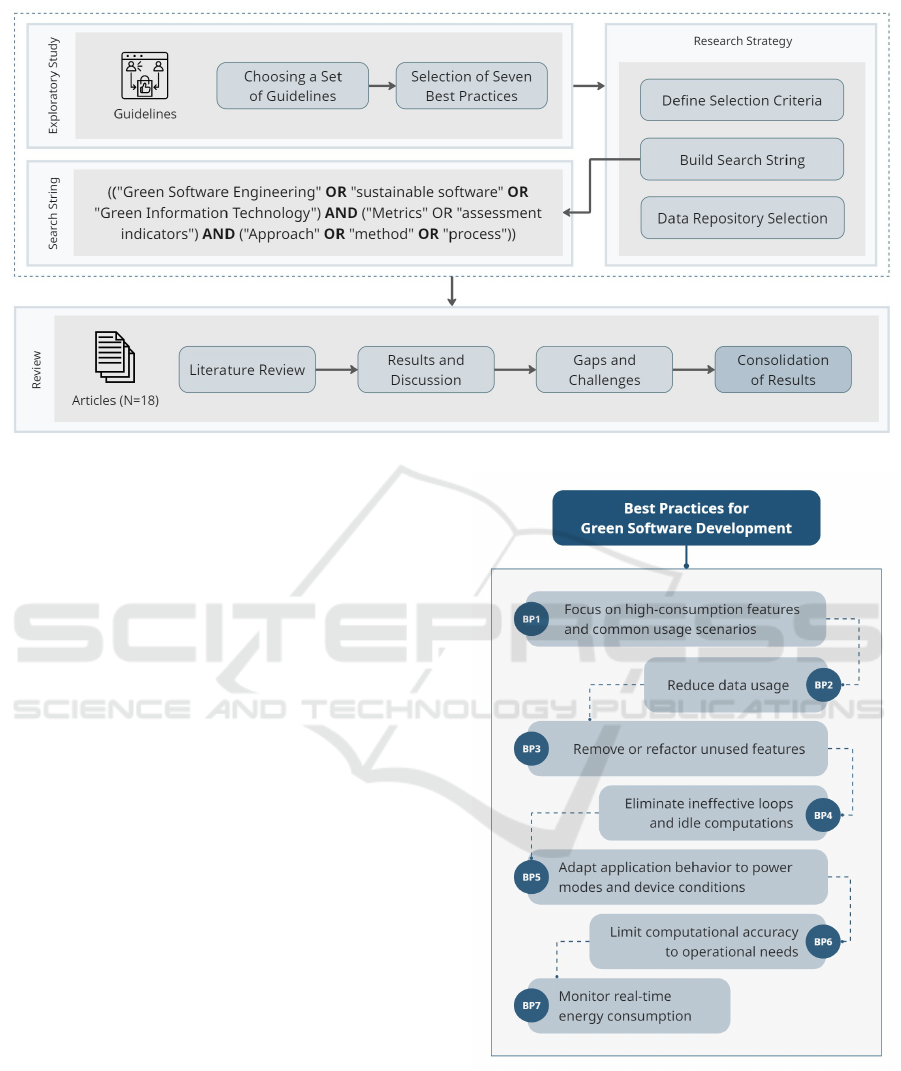
Figure 1: Methodological Approach.
runs. (Rocheteau et al., 2014) confirms empirically
that Java best practices enhance energy efficiency, of-
fering practical eco-design guidance.
Sustainability in real-world and legacy systems is
feasible. (Nguyena and Chitchyan, 2013) shows that
reengineering legacy systems with sustainability in
mind improves performance and reduces CO2 emis-
sions. (Oyedeji et al., 2019) validates a framework
applying the Karlskrona Manifesto, aligning software
with SDGs and promoting incremental, cultural inte-
gration of sustainability.
4.2 Discussion
The articles analyzed were examined using the seven
core design and coding practices outlined in Section
2.2 to identify practical applications of Green Soft-
ware Engineering guidelines. Figure 2 illustrates the
best practices referenced. This investigation mapped
not only the adoption of sustainability-oriented prac-
tices but also the challenges in implementing them
across the software development lifecycle. The analy-
sis reveals both successful green practices and barriers
limiting their broader adoption in the industry.
Table 1 presents a detailed analysis of sustainable
practices in software development. It organizes in-
formation on which practices are adopted and their
presence across the software life cycle phases de-
fined by SWEBOK (Washizaki, 2024). The data re-
veal a limited and fragmented application of the pro-
posed guidelines. While the table includes recur-
ring practices, such as managing energy-intensive fea-
tures, refactoring unused resources, and adapting ap-
plications to usage context, few studies apply multiple
Figure 2: Best Practices for Green Software Development.
practices simultaneously.
Most studies focus on improving code structure,
particularly by removing unnecessary loops, refactor-
ing, and feature control. In contrast, practices involv-
ing runtime environment integration, like real-time
energy monitoring and context-aware adaptation, are
WEBIST 2025 - 21st International Conference on Web Information Systems and Technologies
116
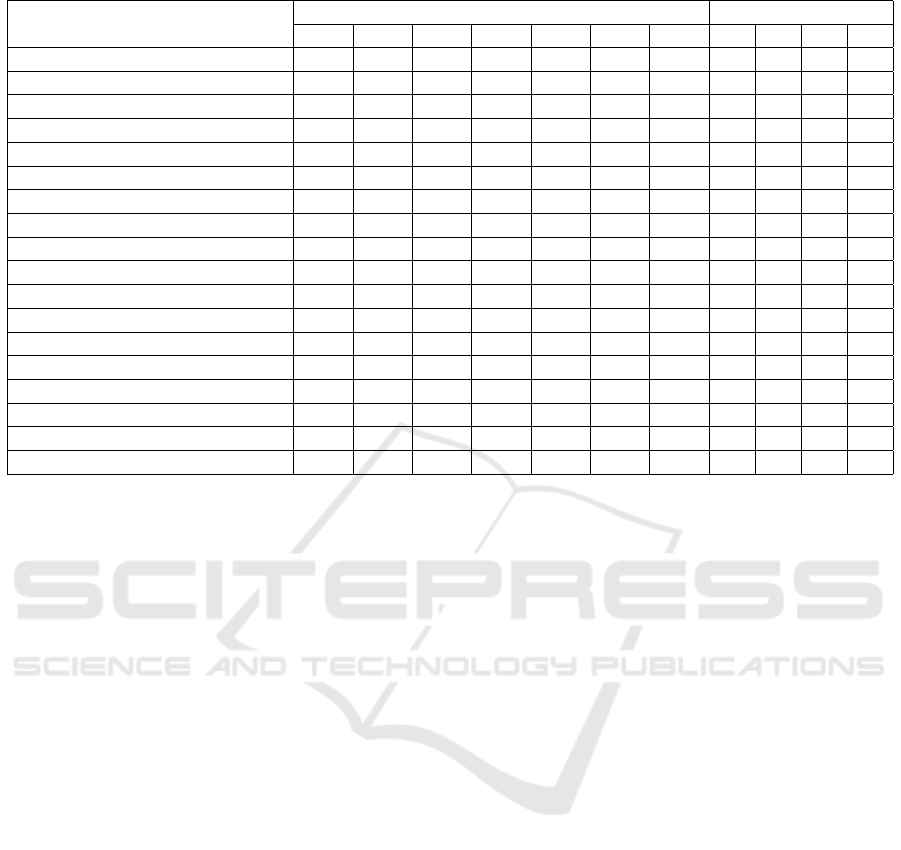
Table 1: Comparative Analysis of Green Software Engineering Practices and Lifecycle Phases.
Related Work
Best Practices Lifecycle Phases
BP1 BP2 BP3 BP4 BP5 BP6 BP7 P1 P2 P3 P4
(Hindle, 2015) • ◦ ◦ ◦ ◦ ◦ ◦ ◦ ◦ • •
(Sahar et al., 2019) • ◦ ◦ • ◦ ◦ ◦ ◦ ◦ • •
(Beghoura et al., 2014) • ◦ ◦ ◦ ◦ ◦ • • ◦ ◦ •
(Zhan et al., 2014) • ◦ ◦ ◦ ◦ ◦ • ◦ ◦ • ◦
(Munoz et al., 2017) • • ◦ ◦ ◦ ◦ ◦ • ◦ • •
(Ford and Zong, 2021) • ◦ ◦ • ◦ ◦ • ◦ ◦ • •
(Khomh and Abtahizadeh, 2018) • ◦ ◦ ◦ ◦ ◦ • ◦ • • ◦
(Munoz, 2017) • • ◦ ◦ ◦ ◦ ◦ • • • •
(Mancebo et al., 2021) • • ◦ ◦ ◦ ◦ • • • • •
(Alvi et al., 2021) • ◦ ◦ ◦ ◦ ◦ ◦ ◦ ◦ • •
(Procaccianti et al., 2016) • ◦ • ◦ • ◦ • ◦ ◦ • ◦
(Melfe et al., 2018) ◦ ◦ ◦ ◦ ◦ ◦ • ◦ ◦ • ◦
(Jabbarvand et al., 2016) • ◦ ◦ • ◦ ◦ ◦ ◦ ◦ • •
(Rocheteau et al., 2014) • ◦ ◦ ◦ ◦ ◦ • ◦ ◦ • ◦
(Oyedeji et al., 2019) • ◦ ◦ ◦ ◦ ◦ • • ◦ • •
(Maia et al., 2020) • ◦ ◦ ◦ ◦ ◦ ◦ ◦ ◦ • •
(Sehgal et al., 2022) • ◦ • ◦ ◦ ◦ • ◦ ◦ • •
(Nguyena and Chitchyan, 2013) • ◦ ◦ ◦ ◦ ◦ • • ◦ • •
Note: P1 = Requirements elicitation and specification; P2 = Prototyping; P3 = Development; P4 = Maintenance and
evolution.
less common. This reflects a dominant focus on inter-
nal software elements, overlooking how software in-
teracts with runtime conditions and hardware, which
limits the impact of green practices.
Regarding life cycle coverage, sustainable prac-
tices are mostly applied during development and
maintenance phases, suggesting a reactive approach.
Early phases like requirements elicitation and proto-
typing are rarely addressed, despite their influence on
later stages. This gap neglects strategic decisions that
could shape sustainability from the outset.
The findings highlight a need to integrate sus-
tainability earlier in the life cycle, including defin-
ing green requirements, energy-aware prototyping,
and designing architectures with built-in sustainable
principles. Additionally, the lack of standardization
across studies hinders comparison, replication, and
the consolidation of a solid theoretical and practical
foundation.
4.3 Challenges and Gaps Identified
The analysis of the state of the art revealed gaps hin-
dering the adoption of sustainable practices through-
out the software life cycle. Many studies focus on
isolated aspects without considering integrated ap-
proaches that align with software project realities.
Additionally, the lack of standardized metrics makes
it difficult to compare findings and replicate results.
Most experiments are conducted in controlled envi-
ronments, which differ from real-world usage condi-
tions. These challenges highlight the need for further
research addressing all stages of the development pro-
cess, from the early phases to the creation of oper-
ational frameworks applicable within organizational
contexts.
Based on this analysis, six key challenges were
identified and are discussed below.
• Limited focus on the early stages of the soft-
ware life cycle: Most studies focus on develop-
ment and maintenance phases, neglecting early
stages like requirements elicitation and prototyp-
ing, which are crucial for defining sustainable
strategies from the start.
• Fragmented adoption of sustainable best prac-
tices: Studies often apply one or two best prac-
tices in isolation, without considering integrated
approaches combining multiple green practices
across development.
• Limited attention to contextual and adaptive
practices: Best practices like adapting to device
contexts and monitoring real-time energy con-
sumption are rarely explored, even though they
are vital for reducing energy waste in dynamic
systems.
• Lack of standardization in terminology, appli-
cation, and measurement: The absence of uni-
Are We Building Sustainable Software? Adoption, Challenges, and Early-Stage Strategies
117
form definitions and evaluation methods hinders
comparison and replication of studies, underscor-
ing the need for standardized terminology and
benchmarks.
• Shortage of longitudinal studies in real usage
environments: Most studies are conducted in
controlled environments, not reflecting real-world
energy behavior. Longitudinal studies are needed
to validate sustainable practices in realistic set-
tings.
• Lack of operational frameworks aligned with
organizational realities: There is a shortage
of practical models to incorporate sustainability
principles into software development processes,
particularly in agile and DevOps environments,
which hinders institutionalization.
These challenges emphasize the need for a com-
prehensive approach to sustainable software develop-
ment. Adopting best practices consistently across all
stages of the software life cycle, alongside applied re-
search, standardized metrics, and frameworks aligned
with organizational realities, will help integrate sus-
tainability into the development process.
5 INTEGRATING
SUSTAINABILITY INTO THE
REQUIREMENTS PHASE
One of the main gaps identified in the literature
concerns the limited attention given to incorporating
green software engineering practices during the early
stages of the software development life cycle. In par-
ticular, the requirements engineering phase, which is
responsible for capturing and specifying stakeholder
needs, is rarely explored as a space for integrating
sustainability concerns. This represents a missed op-
portunity, as many strategic decisions directly affect-
ing energy consumption and environmental impact
are defined at this stage.
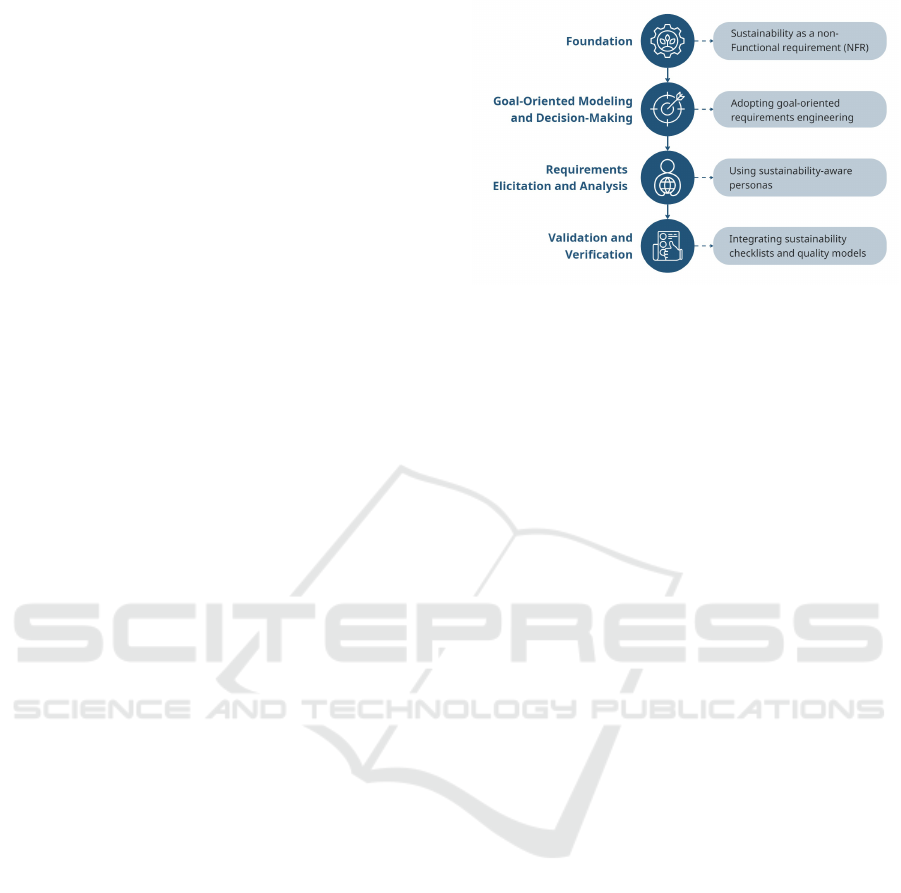
To address this gap, we propose a set of alterna-
tives to support the inclusion of sustainability from
the early stages of the software development process.
These alternatives are illustrated in Figure 3.
First, it is essential to treat sustainability as a non-
functional requirement (NFR) to be elicited, docu-
mented, and validated alongside performance, secu-
rity, and usability. This includes requirements such as
“the system shall minimize energy consumption dur-
ing idle states” or “the application shall allow the user
to select energy-saving modes.”
Second, adopting goal-oriented requirements en-
gineering (GORE) (Uysal, 2022) approaches can be
Figure 3: Strategies for Integrating Sustainability into the
Requirements Engineering Process.
helpful to model sustainability goals explicitly, link-
ing them to functional and technical decisions. Ap-
proaches such as i* (Cabot et al., 2009) and KAOS
(Zardari and Bahsoon, 2011) can support the rep-
resentation of trade-offs between sustainability ob-
jectives and other system goals, promoting more in-
formed decision-making in the early phases.
Third, using sustainability-aware personas and
scenarios during requirements elicitation can help
stakeholders consider the system’s broader environ-
mental impact. For example, specifying usage con-
texts with limited energy availability, such as mobile
or embedded systems in remote areas, can help antic-
ipate adaptation needs in the design phase.
Finally, integrating sustainability checklists and
quality models, such as ISO/IEC 25010 (Qiang et al.,
2024) extended with environmental attributes, into
the validation process can ensure that sustainability
is considered systematically. These practices can as-
sist development teams in identifying and prioritizing
green practices that are both feasible and aligned with
project goals and constraints.
6 CONCLUSIONS
Green Software Engineering (GSE) has emerged in
response to growing environmental concerns in the
software industry. As software systems become crit-
ical across sectors, integrating sustainability into de-
velopment is key for responsible digital transforma-
tion. This study explores whether sustainable prac-
tices are adopted in industry contexts and their appli-
cation throughout the software life cycle.
The analysis showed that while several promis-
ing initiatives exist, sustainability practices are still
limited and fragmented. Code optimization, feature
control, and refactoring are more commonly applied
during development and maintenance, while early
WEBIST 2025 - 21st International Conference on Web Information Systems and Technologies
118

stages like requirements elicitation and prototyping
are largely overlooked despite their potential impact
on sustainability decisions.
This study contributes by proposing alternatives
to integrate sustainability into the often-neglected
requirements elicitation phase, including treating
sustainability as a non-functional requirement, us-
ing goal-oriented modeling, sustainability-aware per-
sonas, and validation tools adapted to environmental
attributes.
The findings also reveal challenges, such as a lack
of context-aware approaches, limited standardization
of metrics and terminology, and a shortage of em-
pirical studies in real-world environments. There is
also a gap in practical frameworks for incorporating
sustainability into established development processes
like agile and DevOps, hindering the development of
a consistent knowledge base.
Future work should focus on creating adaptable
frameworks and tools to support sustainability across
all software development stages, alongside empirical
studies, standardized metrics, and improvements in
real-time energy monitoring techniques.
REFERENCES
Abur, V. (2024). The dimension of green coding in soft-
ware quality control processes. In 2024 9th Inter-
national Conference on Computer Science and Engi-
neering (UBMK), pages 1–6. IEEE.
Alvi, H. M., Majeed, H., Mujtaba, H., and Beg, M. O.
(2021). Mlee: Method level energy estimation—a ma-
chine learning approach. Sustainable Computing: In-
formatics and Systems, 32:100594.
Andrae, A. S. and Edler, T. (2015). On global electricity
usage of communication technology: trends to 2030.
Challenges, 6(1):117–157.
Andrikopoulos, V. and Lago, P. (2021). Software sustain-
ability in the age of everything as a service. Next-
Gen Digital Services. A Retrospective and Roadmap
for Service Computing of the Future: Essays Dedi-
cated to Michael Papazoglou on the Occasion of His
65th Birthday and His Retirement, pages 35–47.
Atadoga, A., Umoga, U. J., Lottu, O. A., and Sodiy, E.
(2024). Tools, techniques, and trends in sustain-
able software engineering: A critical review of cur-
rent practices and future directions. World Journal
of Advanced Engineering Technology and Sciences,
11(1):231–239.
Beghoura, M. A., Boubetra, A., and Boukerram, A. (2014).
Green applications awareness: nonlinear energy con-
sumption model for green evaluation. In 2014 Eighth
International Conference on Next Generation Mobile
Apps, Services and Technologies, pages 48–53. IEEE.
Belkhir, L. and Elmeligi, A. (2018). Assessing ict global
emissions footprint: Trends to 2040 & recommenda-
tions. Journal of cleaner production, 177:448–463.
Cabot, J., Easterbrook, S., Horkoff, J., Lessard, L., Liaskos,
S., and Maz
´
on, J.-N. (2009). Integrating sustainabil-
ity in decision-making processes: A modelling strat-
egy. In 2009 31st International Conference on Soft-
ware Engineering-Companion Volume, pages 207–
210. IEEE.
Calero, C. and Piattini, M. (2015). Introduction to green in
software engineering. Springer.
Chandrasekaran, S. and Subburaman, S. P. (2023). Green-
ing the digital frontier: A sustainable approach to soft-
ware solutions. International Journal of Science and
Research (IJSR), 12(3):1820–1823. Fully Refereed —
Open Access — Double Blind Peer Reviewed Journal.
Danushi, O., Forti, S., and Soldani, J. (2024). Envi-
ronmentally sustainable software design and develop-
ment: a systematic literature review. arXiv preprint
arXiv:2407.19901.
Ford, B. W. and Zong, Z. (2021). Portauthority: Inte-
grating energy efficiency analysis into cross-platform
development cycles via dynamic program analysis.
Sustainable Computing: Informatics and Systems,
30:100530.
Green Software Foundation (2021). 10 recommendations
for green software development. Acesso em: 30 mar.
2025.
Gupta, U., Kim, Y. G., Lee, S., Tse, J., Lee, H.-H. S., Wei,
G.-Y., Brooks, D., and Wu, C.-J. (2021). Chasing car-
bon: The elusive environmental footprint of comput-
ing. In 2021 IEEE International Symposium on High-
Performance Computer Architecture (HPCA), pages
854–867. IEEE.
Hindle, A. (2015). Green mining: a methodology of relating
software change and configuration to power consump-
tion. Empirical Software Engineering, 20:374–409.
Ibrahim, S. R. A., Sallehudin, H., and Yahaya, J. (2023).
Exploring software development waste and lean ap-
proach in green perspective. In 2023 International
Conference on Electrical Engineering and Informat-
ics (ICEEI), pages 1–6. IEEE.
Jabbarvand, R., Sadeghi, A., Bagheri, H., and Malek, S.
(2016). Energy-aware test-suite minimization for an-
droid apps. In Proceedings of the 25th International
Symposium on Software Testing and Analysis, pages
425–436.
Khomh, F. and Abtahizadeh, S. A. (2018). Understanding
the impact of cloud patterns on performance and en-
ergy consumption. Journal of Systems and Software,
141:151–170.
Maia, D., Couto, M., Saraiva, J., and Pereira, R. (2020). E-
debitum: managing software energy debt. In Proceed-
ings of the 35th IEEE/ACM International Conference
on Automated Software Engineering, pages 170–177.
Mancebo, J., Calero, C., Garc
´
ıa, F., Moraga, M.
´
A., and
de Guzm
´
an, I. G.-R. (2021). Feetings: framework
for energy efficiency testing to improve environmental
goal of the software. Sustainable Computing: Infor-
matics and Systems, 30:100558.
Are We Building Sustainable Software? Adoption, Challenges, and Early-Stage Strategies
119

Maryam, K., Sardaraz, M., and Tahir, M. (2018). Evolu-
tionary algorithms in cloud computing from the per-
spective of energy consumption: A review. In 2018
14th international conference on emerging technolo-
gies (ICET), pages 1–6. IEEE.
Matthew, U. O., Asuni, O., and Fatai, L. O. (2024). Green
software engineering development paradigm: An ap-
proach to a sustainable renewable energy future. In
Advancing Software Engineering Through AI, Feder-
ated Learning, and Large Language Models, pages
281–294. IGI Global.
Melfe, G., Fonseca, A., and Fernandes, J. P. (2018). Help-
ing developers write energy efficient haskell through a
data-structure evaluation. In Proceedings of the 6th In-
ternational Workshop on Green and Sustainable Soft-
ware, pages 9–15.
Moreira, A., Lago, P., Heldal, R., Betz, S., Brooks, I.,
Capilla, R., Coroam
˘
a, V. C., Duboc, L., Fernandes,
J. P., Leifler, O., et al. (2024). A roadmap for inte-
grating sustainability into software engineering edu-
cation. ACM Transactions on Software Engineering
and Methodology.
Munoz, D.-J. (2017). Achieving energy efficiency using a
software product line approach. In Proceedings of the
21st International Systems and Software Product Line
Conference-Volume B, pages 131–138.
Munoz, D.-J., Pinto, M., and Fuentes, L. (2017). Green soft-
ware development and research with the hadas toolkit.
In Proceedings of the 11th European conference on
software architecture: companion proceedings, pages
205–211.
Nguyena, N. and Chitchyan, R. (2013). Systems re-design
for sustainability: Petshop case study.
Oyedeji, S., Adisa, M. O., Penzenstadler, B., and Wolf, A.
(2019). Validation study of a framework for sustain-
able software system design and development. sus-
tainable development, 3(4):5.
Patel, U. A., Patel, S., and Nanavati, J. (2024). Towards a
greener future: Harnessing green computing to reduce
ict carbon emissions. In 2024 7th International Con-
ference on Circuit Power and Computing Technolo-
gies (ICCPCT), volume 1, pages 960–969. IEEE.
Penzenstadler, B., Raturi, A., Richardson, D., and Tomlin-
son, B. (2014). Safety, security, now sustainability:
The nonfunctional requirement for the 21st century.
IEEE software, 31(3):40–47.
Procaccianti, G., Fern
´
andez, H., and Lago, P. (2016). Em-
pirical evaluation of two best practices for energy-
efficient software development. Journal of Systems
and Software, 117:185–198.
Qiang, Y., Pa, N. C., et al. (2024). Sustainable software
solutions: A tool integrating life cycle analysis and
iso quality models. International Journal on Ad-
vanced Science, Engineering & Information Technol-
ogy, 14(5).
Raisian, K., Yahaya, J., and Deraman, A. (2017). Sustain-
able software development life cycle process model
based on capability maturity model integration: A
study in malaysia. Journal of Theoretical & Applied
Information Technology, 95(21).
Rocheteau, J., Gaillard, V., and Belhaj, L. (2014). How
green are java best coding practices? In International
Conference on Smart Grids and Green IT Systems,
volume 2, pages 235–246. SCITEPRESS.
Sahar, H., Bangash, A. A., and Beg, M. O. (2019). To-
wards energy aware object-oriented development of
android applications. Sustainable Computing: Infor-
matics and Systems, 21:28–46.
Sehgal, R., Mehrotra, D., Nagpal, R., and Sharma, R.
(2022). Green software: Refactoring approach. Jour-
nal of King Saud University-Computer and Informa-
tion Sciences, 34(7):4635–4643.
Te Brinke, S., Malakuti, S., Bockisch, C., Bergmans, L.,
and Aks¸it, M. (2013). A design method for modular
energy-aware software. In Proceedings of the 28th An-
nual ACM Symposium on Applied Computing, pages
1180–1182.
Turan, B. O. and S¸ahin, K. (2017). Responsive web design
and comparative analysis of development frameworks.
The Turkish Online J. Des. Art Commun, 7(1):110–
121.
Uysal, M. P. (2022). Goal-oriented requirements engineer-
ing approach to energy management systems. In In-
ternational Symposium on Energy Management and
Sustainability, pages 221–230. Springer.
van Gils, B. and Weigand, H. (2020). Towards sustainable
digital transformation. In 2020 IEEE 22nd conference
on business informatics (CBI), volume 1, pages 104–
113. IEEE.
Washizaki, H., editor (2024). Guide to the Software Engi-
neering Body of Knowledge (SWEBOK Guide), Ver-
sion 4.0. IEEE Computer Society.
Zardari, S. and Bahsoon, R. (2011). Cloud adoption: a goal-
oriented requirements engineering approach. In Pro-
ceedings of the 2nd International Workshop on Soft-
ware Engineering for Cloud Computing, pages 29–35.
Zhan, K., Lung, C.-H., and Srivastava, P. (2014). A green
analysis of mobile cloud computing applications. In
Proceedings of the 29th Annual ACM Symposium on
Applied Computing, pages 357–362.
WEBIST 2025 - 21st International Conference on Web Information Systems and Technologies
120
