
Incentive Design in Hedonic Games with Permission Structures
Yuta Akahoshi, Yao Zhang, Kei Kimura, Taiki Todo and Makoto Yokoo
Graduate School of ISEE, Kyushu University, Fukuoka, Japan
Keywords:
Hedonic Games, Diffusion Mechanism Design, Social Networks, Approximation Ratios.
Abstract:
This paper investigates which coalition structure generation algorithms guarantee the incentive of agents to
invite as many colleagues as possible in symmetric additively-separable hedonic games. We first clarify that,
the incentive of invitation is not compatible with each of Nash stability and Pareto efficiency. Furthermore,
we show that the worst-case ratio of social surplus achieved by any algorithm satisfying the incentive of
invitation, compared to the best possible social surplus, is unboundedly small. We then introduce two problem
restrictions to achieve somewhat positive results. More specifically, we showed that, when the utility graph of
a hedonic game only contains three values, {−p,0, p}, for some positive number p, there exists a polynomial-
time algorithm to achieve both the incentive of invitation and 1/n-approximation with respect to the social
surplus.
1 INTRODUCTION
A coalition formation game is one of the central prob-
lem in the field of multi-agent systems. Given set of
multiple agents participating into the game, each of
which has its own characteristics, it is desired to de-
velop a coalition structure generation algorithm that
partitions the whole set of agents into a certain num-
ber of subgroups (coalitions) that appropriately per-
forms according to the given characteristics. Applica-
tions of such coalition formation problems includes,
but not limited to, human resource allocations to jobs
in the labor market and supply-chain management.
In the literature of coalition formation games, a
hedonic game is well-studied, where each agent has a
preference only over the set of coalitions in which he
or she belongs to. An outcome, returned by a coali-
tion structure generation algorithm, is usually evalu-
ated based on various criteria related to some kind of
stability, including Nash stability, individual stability,
and individual rationality. Clarifying the complexity
of showing the existence of stable outcomes has been
one of the research trends in the domain of computa-
tional social choice in last few decades.
In practical situations, however, the set of partic-
ipating agents is not given a priori. Instead, agents
usually invite their colleagues to participate in the
decision making. If we assume that each agent
prefers having more members in his/her coalition,
such an invitation process will be naturally incen-
tivized. On the other hand, if agents dislike some
others, agents may pretend inviting colleagues to the
decision making. The main purpose of this paper is to
design incentive-compatible coalition structure gen-
eration algorithms, which incentivizes agents to in-
vite as many colleagues as possible to the decision
making. Such a research direction has recently been
called as permission structures in the field of coali-
tional games and operations research, and as diffusion
mechanism design in the field of multi-agent systems
and artificial intelligence.
As a first application of the perspective of diffu-
sion mechanism design to the literature of hedonic
games, we focus on a special class of hedonic games,
so called as symmetric additively-separable hedonic
games (SASHG) (Burani and Zwicker, 2003). In an
SASHG, there is an undirected weighted graph, in
which the set of vertices corresponds to the set of
agents. Given a coalition, each agent’s utility is given
as the sum of the weights of the edges connecting the
agent to other members in the coalition. Each agent
then prefers coalitions that give her higher utilities.
At the same time, the set of agents has a permis-
sion structure, given as a directed unweighted graph,
in which the set of vertices again corresponds to the
set of agents. Intuitively, the existence of a directed
edge from agent i to agent j in a permission structure
means that agent i has a right to invite agent j to the
SASHG. We then call agent i as a parent of agent j,
and agent j as a child of agent i. Technically speak-
184
Akahoshi, Y., Zhang, Y., Kimura, K., Todo, T. and Yokoo, M.
Incentive Design in Hedonic Games with Permission Structures.
DOI: 10.5220/0013320400003890
In Proceedings of the 17th International Conference on Agents and Artificial Intelligence (ICAART 2025) - Volume 1, pages 184-195
ISBN: 978-989-758-737-5; ISSN: 2184-433X
Copyright © 2025 by Paper published under CC license (CC BY-NC-ND 4.0)

ing, we consider two variants of incentives of invi-
tations, namely the conjunctive variant and the dis-
junctive variant. In the conjunctive variant, an agent
participates if all her parent invite her. On the other
hand, in the disjunctive variant, an agent participates
if at least one of her parents invites her.
To sum up, the problem we tackle in this paper
is the symmetric additively-separable hedonic games
with permission structures, SASHG-PS in short. An
SASHG-PS instance has two graphs, one of which
is defines an SASHG, and the other defines its per-
mission structures. Given an SASHG-PS instance,
a coalition structure generation algorithm returns a
coalition structure, hopefully guaranteeing incentives
for agents to invite as many colleagues as possible,
along with some stability properties. The main focus
in this paper is then to clarify the existence of such
coalition structure generation algorithms for SASHG-
PS.
In this paper, we first give a formal definition of
the new class of games, SASHG-PS. We then show
three impossibility results and one possibility result,
according to various combinations of stability, fair-
ness, and efficiency properties. We also investigate
approximating the social surplus, defined as the sum
of the utilities of participating agents, by incentive-
compatible algorithms. On this direction, we first pro-
vide a general impossibility result, and then introduce
two problem restrictions under which some positive
results have been clarified.
2 RELATED WORKS
Hedonic games are a special class of coalition for-
mation games, in which each agent only cares about
which members does she have in the same coalition
with her and ignores the structures of other coali-
tions (Dreze and Greenberg, 1980; Bogomolnaia and
Jackson, 2002). Gairing and Savani (2019) focused
on symmetric additively-separable hedonic games
and provided several complexity results on finding
various stable outcomes. Flammini et al. (2021) con-
sidered additively-separable hedonic games from the
viewpoint of strategy-proof mechanism design. The
main difference with this paper is that, while this
paper focuses on information diffusion strategies by
agents, they considered the cases where agents can
misreport their valuation functions. A survey on he-
donic games by Aziz and Savani (2016) summarizes
solution concepts and known results on several vari-
ants of hedonic games, from the viewpoints of algo-
rithms and computational complexity.
The research of diffusion mechanism design, also
known as mechanism design over social networks,
was initiated by Li et al. (2017), which considered
single-item auctions and proposed a strategy-proof
mechanism. After that, several works investigated
strategy-proof resource allocation mechanisms with
monetary compensations, e.g., multi-unit auctions
and redistributions (Zhao et al., 2018; Kawasaki et al.,
2020; Li et al., 2020; Zhang et al., 2020; Jeong and
Lee, 2024). On the other hand, there is limited re-
search on decision making without money from the
perspective of diffusion mechanism design. Recently,
Kawasaki et al. (2021) and You et al. (2022) consid-
ered diffusion mechanism design for house allocation
problems, which do not allow monetary compensa-
tions. Cho et al. (2022) studied two-sided matching
over social networks, and Ando et al. (2024) studied
facility location games. However, as far as the authors
know, this paper is a very first attempt to study hedo-
nic games from the perspective of diffusion mecha-
nism design.
While the paradigm of diffusion mechanism de-
sign has recently been introduced in the field of com-
puter science, a quite similar approach has also been
considered in the field of operations research, which
is known as cooperative games with permission struc-
tures. The two variants of cooperative games with
permission structures, namely the conjunctive vari-
ant (Gilles et al., 1992) and the disjunctive vari-
ant (van den Brink, 1997), has been originally intro-
duced for the domain of general coalitional games.
The main difference between the diffusion mecha-
nism design and the cooperative games with permis-
sion structures is that, while the former considers the
decision making process from the viewpoint of mech-
anism design, the latter is defined consistently with
the traditional cooperative games. The main purposes
of these two directions are therefore a bit different;
diffusion mechanism design focuses on designing al-
gorithms/mechanisms that incentivises agents to in-
vite other agents, and the cooperative games with
permission structures focuses on analysing the exis-
tence of appropriate solution concepts and their char-
acterization/axiomatizations. For more detail on per-
mission structures, please refer to a recent survey on
games with permission structures by van den Brink
(2017).
3 MODEL
As explained in Section 1, the problem we consider
in this paper is defined as a combination of two well-
studied models, namely the symmetric additively-
separable hedonic games and the coalition games with
Incentive Design in Hedonic Games with Permission Structures
185

permission structures. Now we define the model of
symmetric additively-separable hedonic games with
permission structures (SASHG-PS).
Let N be the set of all the potential agents, and let
n := |N| be the number of potential agents. A subset
C ⊆ N is called as a coalition. Given agent i ∈ N, let
N
i
be the set of coalitions that contains i, i.e.,
N
i
:= {C ⊆ N | C ∋ i}
Also, given N, a partition π = {C
1
,C
2
,. ..} of N is
called as a coalition structure, such that
∀k, ℓ(̸= k),C
k
∩C
ℓ
=
/
0
and
[
k=1,2,...
C
k
= N.
Let Π
N
be the set of all the possible coalition struc-
tures that partitions the set N of agents. Furthermore,
given coalition structure π ∈ Π
N
and agent i ∈ N, let
π(i) be the coalition in π in which agent i belongs, i.e.,
π(i) := C ∈ π s.t. C ∋ i.
There is a utility graph G(N,E,w), which is an
undirected edge-weighted graph, where w
e
∈ R de-
notes the weight of edge e ∈ E. For notation sim-
plicity, we assume w
e
̸= 0, i.e., the edges with a zero
weight is removed from the set E of edges. When an
edge e ∈ E has agent (vertex) i ∈ N in one of its end-
points, we denote e ∋ i. Furthermore, when both of
the endpoints of edge e belongs a coalition C, we de-
note e ∈ C. Given utility graph G(N,E, w) and agent
i ∈ N, a symmetric additively-separable preference ≿
i
of agent i, over the set N
i
of coalitions, is defined as
follows:
∀C,D ∈ N
i
,C ≿
i
D ⇔
∑
e∋i|e∈C
w
e
≥
∑
e∋i|e∈D
w
e
.
Also, given utility graph G(N,E,w), agent i ∈ N, and
a coalition structure π ∈ Π
N
, agent i’s utility is defined
as
u
i
(π) :=
∑
e∋i|e∈π(i)
w
e
.
SASHG-PS also has another graph, the permis-
sion graph H(N,A), represented as an unweighted di-
rected acyclic graph. The set of vertices corresponds
to the set of agents N. Also, the set A ⊆ N × N
of directed edges is assumed not to contain multi-
edges and self-loops. The existence of directed edge
(i, j) ∈ A means that agent i can send an invitation
to agent j. Given permission graph H(N, A), the set
O ⊆ N of vertices that have no incoming edges is re-
ferred to as the original agents, who is assumed to
participate in the game even without any invitation.
Given permission graph H(N, A) and agent i ∈ N, let
δ
i
∈ N
≥0
be the distance of agent i, defined as the
minimum distance from an original agent, i.e.,
δ
i
:= min
o∈O
Also, given permission graph H(N,A) and agent i ∈
N, let S(i) be the set of agents (vertices) that agent i
can send an invitation, i.e.,
S(i) := { j ∈ N | (i, j) ∈ A}
An important note here is that, although both the
utility graph and the permission graph are compo-
nents of an SASHG-PS instance, these are not di-
rectly observed by a coalition structure generation al-
gorithm. Instead, agents first decide who to invite to
the game, and then the algorithm is able to observe
who invite which agents and finally who participate
in the game.
To sum up, an instance I(G,H) of SASHG-PS has
two graphs, the utility graph G(N,E, w) and the per-
mission graph H(N,A), where the set N of potential
agents is in common in these two graphs. Now let us
explain how an SASHG-PS proceeds.
1. The Nature determines both the utility graph and
the permission graph, while the both are not di-
rectly observable by anyone.
2. A coalition structure generation algorithm is pub-
licly announced.
3. Observing the description, i.e., the rule of a game,
each agent decide which colleagues to invite to the
game.
4. According to the invitation strategies of the
agents, the set of participating agents is fixed.
Then, the algorithm returns the outcome.
3.1 Optimization Criteria
Before introducing several properties related to sta-
bility, fairness, and efficiency, we first define an eval-
uation criteria for quantitatively measuring the worst-
case performance of coalition structure generation al-
gorithms. A social surplus, defined as the sum of the
utilities of all the participating agents, is a well-known
evaluation criteria in the field of micro-economics.
Definition 1 (Social Surplus). Given SASHG-PS in-
stance, a social surplus SW(π) of a coalition structure
π ∈ Π
N
is defined as
SW(π) :=
∑
i∈N
u
i
(π
i
).
We then define the approximation ratio for the so-
cial surplus, which enables evaluating the worst-case
performance of (potentially incentive-compatible) al-
gorithms, compared to the global optimal solution
that is not necessarily incentive-compatible.
ICAART 2025 - 17th International Conference on Agents and Artificial Intelligence
186

Table 1: Comparisons of four incentive-compatibility properties. Properties on top-left direction is more demanding. No
inclusion relation exists between D-DSIC and C-EPIC.
Equilibrium Concept
Dominant Strategy Ex-Post
Permission Type
Conjunctive C-DSIC C-EPIC
Disjunctive D-DSIC D-EPIC
Definition 2 (Approximation Ratio). Given SASHG-
PS instance I, an optimal coalition structure π
∗
(I) ∈
Π
N
is a coalition structure that has the maximum so-
cial surplus, i.e.,
π
∗
(I) := arg max
π∈Π
N
SW(π).
An approximation ratio α
M
of a coalition structure
generation algorithm M is the minimum ratio of the
social surplus of a coalition structure obtained by the
algorithm, against the optimal social surplus. For-
mally,
α
M
:= min
I
SW(M (I))
SW(π
∗
(I))
.
The optimal approximation ratio is one, and any
algorithm has an approximation ratio weakly less than
one. Designing coalition structure generation algo-
rithms having a larger approximation ratio is desir-
able. If there is an algorithm achieving the approxi-
mation ratio of one, we call it optimal.
3.2 Properties
In this subsection we define several properties that
coalition structure generation algorithms should sat-
isfy. We first define incentive compatibilities. Ac-
cording to the characteristics of SASHG-PS, specifi-
cally the permissions’ types and the equilibrium con-
cepts, we define four variants of incentive compatibil-
ity properties, summarized in Table 1.
Definition 3 (Incentive Compatibility). Given
SASHG-PS instance I(G,H), a coalition structure
generation algorithm M is said to satisfy
• dominant-strategy incentive compatibility for
conjunctive permissions (C-DSIC) if, for each
agent i ∈ N, inviting as many colleagues in S(i)
as possible is a dominant strategy, under the as-
sumption that an agent participates in the game if
and only if all her parents invite her.
• dominant-strategy incentive compatibility for dis-
junctive permissions (D-DSIC) if, for each agent
i ∈ N, inviting as many colleagues in S(i) as pos-
sible is a dominant strategy, under the assumption
that an agent participates in the game if and only
if at least one of her parents invites her.
• ex-post incentive compatibility for conjunctive
permissions (C-EPIC) if, for each agent i ∈ N,
inviting as many colleagues in S(i) as possible
is a best strategy when all the other participating
agents invite as many colleagues as possible, un-
der the assumption that an agent participates in
the game if and only if all her parents invite her.
• ex-post incentive compatibility for disjunctive
permissions (D-EPIC) if, for each agent i ∈ N,
inviting as many colleagues in S(i) as possible
is a best strategy when all the other participating
agents invite as many colleagues as possible, un-
der the assumption that an agent participates in
the game if and only if at least one of her parents
invites her.
By definition, C-DSIC implies both D-DSIC and
C-EPIC, and both D-DSIC and C-EPIC imply D-
EPIC. Between D-DSIC and C-EPIC, there is no in-
clusion relation in general.
We next define stability, fairness, and efficiency
properties that are quite popular in the literature of
hedonic games. Both individual rationality and Nash
stability have been known as a stability property,
where the latter implies the former.
Definition 4 (Individual Rationality). Given SASHG-
PS instance I(G,H), a coalition structure π ∈ Π
N
is
said to be individually rational if
∀i ∈ N, u
i
(π(i)) ≥ 0
holds. A coalition structure generation algorithm M
is said to satisfy individual rationality (IR) if M (I) is
individually rational for any SASHG-PS instance I.
Definition 5 (Nash Stability). Given SASHG-PS in-
stance I(G,H), a coalition structure π ∈ Π
N
is said to
be Nash stable if
∀i ∈ N, u
i
(π(i)) ≥ u
i
(C ∪ {i})
holds for any C ∈ π ∪ {
/
0}. A coalition structure gen-
eration algorithm M is said to satisfy Nash stability
(NS) if M (I) is Nash stable for any SASHG-PS in-
stance I.
Incentive Design in Hedonic Games with Permission Structures
187

Pareto efficiency is one of the most popular effi-
ciency property in the field of economics. Intuitively,
it requires that there is no other outcome that is better
for all the participating agents.
Definition 6 (Pareto Efficiency). Given SASHG-PS
instance I(G,H), a coalition structure π ∈ Π
N
is said
to be Pareto efficient if there is no other coalition
structure π
′
∈ Π
N
such that both
∀i ∈ N, u
i
(π
′
(i)) ≥ u
i
(π(i))
and
∃ j ∈ N,u
j
(π
′
( j)) > u
j
(π( j))
hold. A coalition structure generation algorithm M is
said to satisfy Pareto efficiency (PE) if M (I) is Pareto
efficient for any SASHG-PS instance I.
Envy-freeness is a fairness property, which re-
quires that for each agent, changing her position with
any other agent is not beneficial.
Definition 7 (Envy-Freeness). Given SASHG-PS in-
stance I(G,H), a coalition structure π ∈ Π
N
is said to
be envy-free if
∀i, j ∈ N s.t. π(i) ̸= π( j),
u
i
(π(i)) ≥ u
i
((π(i) \ { j}) ∪ {i})
holds. A coalition structure generation algorithm M
is said to satisfy envy-freeness (EF) if M (I) is envy-
free any SASHG-PS instance I.
In the literature of hedonics games, there are sev-
eral other properties, including individual stability,
contractually individual stability, the core, and the
strict core. For more detail on these solution concepts,
please refer to a survey chapter by Aziz and Savani
(2016).
4 (IM)POSSIBILITIES
We are now ready to present our technical contribu-
tion. We first show that, although all the properties
introduced in the previous section seems to be de-
sirable, various combinations among them result in
the non-existence of algorithms. On the other hand,
Theorem 4 shows that just keeping every participat-
ing agent as a singleton satisfies IR, EF, and C-DSIC.
Theorem 1. There exists no coalition structure gen-
eration algorithm that simultaneously satisfies D-
EPIC and NS.
Proof. Consider an SASHG-PS instance described in
Fig. 1, and focus on the strategic invitation by agent
a. When agent a invite agent c, all the three agents
G(N,E, w) H(N,A)
a
b
c
1
-3
2
a
b
c
Figure 1: An SASHG-PS instance for which D-EPIC and
NS are incompatible, used in the proof of Theorem 1.
G(N,E, w) H(N,A)
a
b
c
d
2 1
-10
2
3
4
a
b
c
d
Figure 2: An SASHG-PS instance for which PE and either
D-DSIC or C-EPIC are incompatible, used in the proof of
Theorem 2.
participate. Then, the unique Nash stable coalition
structure is
π = {{a},{b,c}},
under which agent a’s utility is 0.
When agent a does not invite agent c, there are
only two participating agents a and b. Then, the
unique Nash stable coalition structure is
π = {{a,b}},
under which agent a’s utility is 1. Thus, agent a is
better off by not inviting agent c. Since the permis-
sion graph H(N,A) has only one directed edge, the
weakest variant of IC condition, namely D-EPIC, is
violated.
Theorem 2. There exists no coalition structure gen-
eration algorithm that simultaneously satisfies PE
and either D-DSIC or C-EPIC.
Proof. Consider an SASHG-PS instance described in
Fig. 2, in which there are five Pareto efficient coalition
structures:
1. {{a, b},{c,d}}
2. {{a, c},{b,d}}
3. {{a, b,d},{c}}
4. {{a, c,d},{b}}
5. {{a, b,c,d}}
ICAART 2025 - 17th International Conference on Agents and Artificial Intelligence
188

G(N,E, w) H(N,A)
a
b
c
d
2
1
-10
2
3
4
a
b
c
d
Figure 3: An SASHG-PS instance for which PE, IR, and
D-EPIC are incompatible, used in the proof of Theorem 3.
When a Pareto efficient algorithm returns coalition
structure 1., 2., 3., or 5. above, agent b’s utility is
strictly less than 5. Therefore, agent b has an incen-
tive not to invite agent c; the unique Pareto efficient
coalition structure is {{a,b, d}} if agent c does not
participate, in which agent b’s utility is 5.
When a Pareto efficient algorithm returns coali-
tion 4. above, agent d’s utility is 5. Therefore, agent
d has an incentive not to invite agent b; the unique
Pareto efficient coalition structure is {{a, c,d}} if
agent b does not participate, in which agent d’s utility
is 6.
The existence of these two beneficial manipula-
tions violates both D-DSIC and C-EPIC (and thus C-
DSIC), which completes the proof. Note that D-EPIC
is not violated in this instance, since agent c is not ex-
cluded by any sole manipulation by either agent b or
d.
Theorem 3. There exists no coalition structure gen-
eration algorithm that simultaneously satisfies PE,
IR, and D-EPIC.
Proof. Consider an SASHG-PS instance described in
Fig. 3, in which there are four coalition structures that
is both Pareto efficient and individually rational:
1. {{a, b},{c,d}}
2. {{a, c},{b,d}}
3. {{a, b,d},{c}}
4. {{a, c,d},{b}}
When a Pareto efficient algorithm returns coalition
structure 1., 2., or 4. above, agent a’s utility is strictly
less than 4. Therefore, agent a has an incentive not
to invite agent c; the unique Pareto efficient coalition
structure is {{a,b,d}} if agent c does not participate,
in which agent a’s utility is 4.
When a Pareto efficient algorithm returns coali-
tion structure 3. above, agent d’s utility is 5. There-
fore, agent d has an incentive not to invite agent
b; the unique Pareto efficient coalition structure is
{{a,c, d}} if agent b does not participate, in which
agent d’s utility is 6.
The existence of these two beneficial manipula-
tions, which are independent with each other, implies
that D-EPIC is violated. Thus, IR, PE and D-EPIC
are incompatible.
Theorem 4. There exists a coalition structure gener-
ation algorithm that simultaneously satisfies IR, EF,
and C-DSIC.
Proof. Consider a coalition structure generation al-
gorithm M that returns, for any SASHG-PS instance,
a coalition structure in which every agent constructs a
singleton coalition.
In such an algorithm, every agent has utility zero
for any instance, regardless of the invitation strate-
gies of all the agents. Thus, M satisfies C-DSIC,
the strongest incentive compatibility, and individual
rationality
Furthermore, when a coalition structure π ∈ Π
N
is
such that every agent constructs a singleton coalition,
it holds that
∀i, j ∈ N, (π( j)\ { j})∪ {i} = π(i).
Thus, the condition of envy-freeness is satisfied.
5 DESIGNING APPROXIMATION
ALGORITHMS
The impossibility results presented in the previous
section, regarding the incentive compatibility proper-
ties in SASHG-PS, are quite negative. Now we fo-
cus only on the incentive compatibility and analyze
the worst-case performance of incentive compatible
algorithms with respect to the social surplus.
The theorem below has a quite negative implica-
tion. The property D-EPIC is the weakest among the
four definitions. This theorem states that, even with
the weakest incentive requirement on strategic invita-
tion, there is a chance that the achievable social sur-
plus becomes nearly zero.
Theorem 5. The approximation ratio of any coalition
structure generation algorithm satisfying D-EPIC is
zero.
Proof. Consider an SASHG-PS instance described in
Fig. 4, where the weight m of edge between agents
b and c is sufficiently large. The optimal coalition
structure for this instance is the grand coalition, i.e.,
all the three agents belong to the same coalition, in
which the social surplus is m + 1.
Incentive Design in Hedonic Games with Permission Structures
189

G(N,E, w) H(N,A)
a
b
c
-1
2
m
a
b
c
Figure 4: An SASHG-PS instance for which D-EPIC and
NS are incompatible, used in the proof of Theorem 5.
Since m is arbitrarily large, any coalition structure
generation algorithm that has bounded approximation
ratio must put both agents b and c in a single coalition.
Under such a coalition structure, agent a’s utility is at
most 1.
Also, when agent a does not invite agent b, the op-
timal coalition structure for two agents a and c is the
grand coalition that contains both agents a and c in a
single coalition, in which the social surplus is 2. Thus,
any coalition structure generation algorithm that has
bounded approximation ratio must put both of these
two agents a and c in a single coalition, when agent b
does not participate.
Therefore, agent a has an incentive not to invite
agent b; agent a’s utility is 2 when she does not invite
agent b, while it is at most 1 when she invite agent
b. Since agent a can solely decide the participation
of agent b, such an algorithm violates D-EPIC, the
weakest incentive compatibility.
6 ALGORITHMS FOR
RESTRICTED GRAPHS
In the previous section we have presented a negative
results on the approximability of social surplus by in-
centive compatible coalition structure generation al-
gorithms. A natural question is then how can we over-
come the negative results by introducing some prob-
lem restriction to SASHG-PS.
A quite trivial case is such that the permission
graph H(N, A) has no edge, i.e., A =
/
0, where any
incentive compatibility constraint becomes void and
we can simply apply known algorithms in the litera-
ture. However, when the permission structure is not
observable a priori, which seems to be very likely in
practical situations, assuming such a restriction is not
quite reasonable.
We therefore focus on the restriction to the utility
graph in this paper. At first, we provide a sufficient
condition to guarantee an optimality of the social sur-
plus. Namely, when the edges with non-zero weights
G(N,E, w)
a
b
c
q
r
s
t
-1
3
4
-5
6
Figure 5: An example of forest utility graph.
of a utility graph construct a forest, there exists an
optimal coalition structure generation algorithm that
also satisfies C-DSIC.
Theorem 6. There exists an optimal C-DSIC coali-
tion structure generation algorithm when the utility
graph is given as a forest.
Proof. Consider a coalition structure generation al-
gorithm M that (i) first remove all the negative edges
from the utility graph G and then (ii) choose each of
the connected component in the modified utility graph
as a coalition. Note that, when the original utility
graph G is assumed to be a forest, it is still a forest af-
ter the removal of all the negative edges. Obviously, it
returns the optimal coalition structure for such a forest
graph.
Now let us show that this algorithm M satisfies C-
DSIC. In this algorithm, agent i belongs to the same
coalition with any agent j if and only if there is an
edge with a strictly positive weight. Here, for any
whole set N of agents, any agent i ∈ N, and any subset
N
′
⊆ N such that N
′
∋ i, let π ∈ Π
N
and π
′
∈ Π
N
′
be
the coalition structure provided by M for each of two
participating sets, N and N
′
, of agents, respectively.
Then, we have
u
i
(π(i)) ≥ u
i
(π
′
(i)),
which implies C-DSIC.
Example 1. Now we demonstrate how the algorithm
M proposed in the proof of Theorem 6 works for the
SASHG-PS instance described in Figure 5.
The algorithm first removes all the edges with neg-
ative weights in the utility graph G(N, E,w). In the
figure, there are two such edges, between agents a
and b, and between agent c and s. Then, the algo-
rithm returns each of the connected components as a
coalition. The outcome is therefore,
{{a},{b, q,r}, {c,t},{s},}
which is clearly optimal as it contains all the edges
with positive weights and does not contain any edge
with a negative weight.
ICAART 2025 - 17th International Conference on Agents and Artificial Intelligence
190

G(N,E, w) H(N,A)
a
c
d
b
a
b
c
d
Figure 6: An SASHG-PS instance showing the upper bound
of approximation ratio for the case of n = 3, used in the
proof of Theorem 7. The dashed edge has a positive weight
+p, while the dotted edge has a negative weight −p.
7 ALGORITHMS FOR
RESTRICTED WEIGHTS
Restricting the domain of weights of the utility graph
is also a natural approach to overcome impossibil-
ity results in the literature. Even for our problem of
SASHG-PS, there is a quite trivial case where such
a restriction works. For example, when the weights
of the utility graph is assumed to be non-negative, in
which returning the grand coalition is the optimal.
Here we provide a quite different condition to
guarantee the tight approximability results for the so-
cial surplus, by either D-DSIC or C-EPIC coalition
structure generation algorithms. Namely, while we al-
low the existence of negative weights, all the non-zero
weights have the same absolute value. We first show,
in Theorem 7, that any coalition structure generation
algorithm satisfying either D-DSIC or C-EPIC has an
approximation ratio of at most
1
n
for n = 3, and at
most
1
n−1
for n ≥ 4, which works as an upper bound.
We then show, in Theorem 8, the existence of D-DSIC
algorithm which has an approximation ratio of
1
n
for
odd n and
1
n−1
for even n. That is, the approximation
ratio obtained in this section is asymptotically tight.
We further show that the proposed algorithm runs in
polynomial-time.
Theorem 7. Assume that the weights of the utility
graph are restricted to {−p,0, p} for some constant
p ∈ R
+
. Then, the approximation ratio of any coali-
tion structure generation algorithm satisfying either
D-DSIC or C-EPIC is at most 1/n for n = 3, and
1
n−1
for n ≥ 4.
Proof. We first show the upper bound
1
n
for the case
of n = 3, and then show the upper bound
1
n−1
for the
case of n ≥ 4.
To show the bound for n = 3, we begin with an
SASHG-PS instance with n = 4, described in Fig-
ure 6. Note that the dashed edges in the figure have a
G(N,E, w) H(N,A)
a
b
a
b
Figure 7: An SASHG-PS instance obtained by removing
both agents c and d from Figure 6.
G(N,E, w) H(N,A)
a
c
d
a
c
d
Figure 8: An SASHG-PS instance obtained by removing
agents d from Figure 6.
positive weight +p, and the dotted edges have a neg-
ative weight −p.
Consider that agent b is now willing to strategi-
cally invite her colleagues, agents c and d. When all
those four agents participate, agent b’s utility would
be p in coalition {a,b}, and 0 in any other coalition. If
an algorithm returns a coalition structure where agent
b does not belong to coalition {a, b}, agent b has an
incentive not to invite both agents c and d, resulting in
the graphs shown in Figure 7; agent b’s utility would
then be 1, to guarantee that the approximation ratio
is bounded. The existence of such an incentive vio-
lates both C-EPIC (where agent b can solely prevent
the participation of both c and d) and D-DSIC (where
agent b can still prevent the participation of agents
c and d if agent a also chooses not to invite them).
Therefore, in the case of Figure 6, an algorithm with
a bounded approximation ratio must return a coalition
structure containing a coalition {a, b} as its member.
Note that in this coalition, agent a’s utility is also 1.
Now let us consider that agent a is also willing to
strategically invite agent b (see Figure 8). When agent
b does not participate, agent a’s utility cannot exceed
1; otherwise agent a has an incentive to prevent agent
b’2 participation, violating D-EPIC. Therefore, the
set of possible coalition structures in Figure 8 is one
of the followings:
{{a,c}, {d}}, {{a,d},{c}},
{{a},{c, d}}, {{a},{c}, {d}}.
The maximum social surplus is then 1, while the op-
timal social surplus is 3. Thus the target ratio 1/3 is
proved.
Incentive Design in Hedonic Games with Permission Structures
191
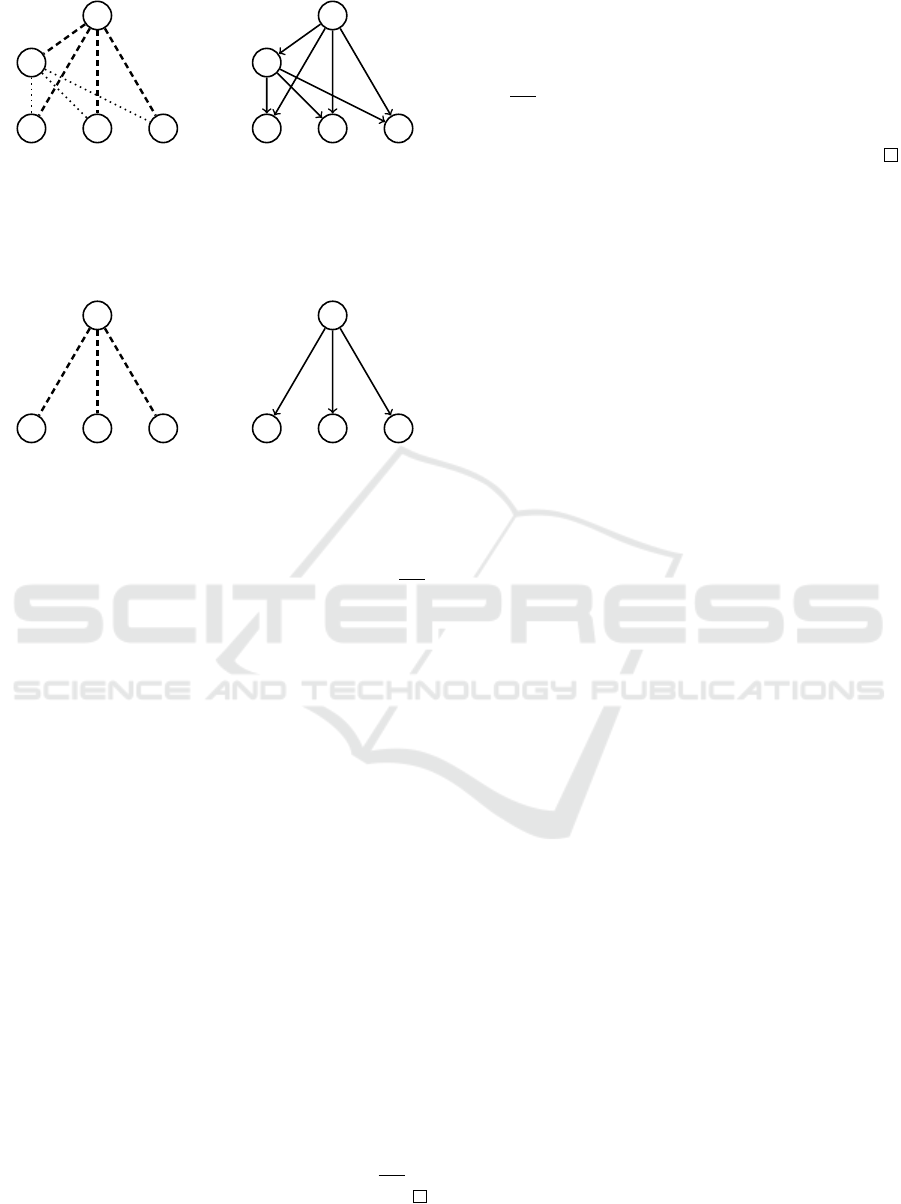
G(N,E, w) H(N,A)
a
b
c
d
x
·· ·
a
b
c
d
x
·· ·
Figure 9: An SASHG-PS instance showing the upper bound
of approximation ratio for the case of n ≥ 4, used in the
proof of Theorem 7.
G(N,E, w) H(N,A)
a
c
d
x
·· ·
a
c
d
x
·· ·
Figure 10: An SASHG-PS instance obtained by removing
agent b from Figure 9.
Now we turn to show that the upper bound is
1
n−1
for the case of n ≥ 4. Consider the case described
in Figure 9, where there are n − 1 agents, agent a is
connected to all the other agents, b, c, d, ···, x, with
an edge with a positive weight +p in the utility graph
G, while agent b is connected to those agents c, d, ···,
x, with an edge with a negative weight −p (except for
agent a). Also, in the permission graph H, both of
agents a and b are able to invite those agents to which
they are connected to in G, respectively.
Since agent b has only one edge with a positive
weight, connected with agent a, agent b’s utility is 1
if and only if coalition {a, b} is in the coalition struc-
ture, and zero otherwise. From a similar argument
with the case of n = 3, coalition {a,b} must be formed
for the case of Figure 9; otherwise both C-EPIC and
D-DSIC are violated. Note that in this case agent a’s
utility is 1.
We then consider that agent a is also willing to
strategically invite agent b (see Figure 10, where there
are n agents). Again, from a similar argument with
the case of n = 3, agent a’s utility cannot exceed 1;
otherwise D-EPIC is violated. Therefore, the possible
coalition structures in Figure 10 are such that agent
a forms a coalition with at most one another agent.
The social surplus is then at most 1, while the optimal
social surplus is n − 1. Thus the target ratio
1
n−1
is
proved.
Theorem 8. Assume that the weights of the utility
graph are restricted to {−p,0, p} for some constant
p ∈ R
+
. Then, there is a polynomial-time coalition
structure generation algorithm that satisfies D-DSIC
and has an approximation ratio of 1/n when n is odd,
and
1
n−1
when n is even.
Proof. The theorem is separately shown in the two
propositions below, Propositions 1 and 2.
We now propose a polynomial-time algorithm that
satisfies D-DSIC and has an asymptotically optimal
approximation ratio. Briefly speaking, the proposed
algorithm tries to find a maximum matching by fo-
cusing on the edges with a positive weights. Obvi-
ously, such a maximum matching can be found in
polynomial time. However, a na
¨
ıve implementation
of maximum matching algorithm fails to satisfy even
D-EPIC, which will be explained later in this section.
Definition 8 (Proposed Algorithm). Given SASHG-
PS instance I, runs the following procedure:
1. Initialization: Remove all the edges with a nega-
tive weight in the utility graph. Also, label all the
edges with a positive weight in the utility graph
with pre-update. Let n be the number of partici-
pating agents, and let h = 1.
2. Construct a linear order ▷ of all the participating
agents so that, for any two agents i, j, if either
• δ
i
< δ
j
, or
• δ
i
= δ
j
and |S(i)| > |S( j)|
holds, then we order i ▷ j, i.e., agent i is more
prioritized than agent j. When both δ
i
= δ
j
and
|S(i)| = |S( j)| holds, we break the tie based on
a consistent way under which agents’ invitation
strategies does not affect.
3. For the most prioritized remaining agent i in the
order ▷:
• Update the weight of all edges e ∋ i that have
labeled as pre-update (if any) with the weight
2
n−h
, and then label them with post-update.
• Let h ← h+1, remove i from the top of the order
▷, and go to 3. if h ≤ n; otherwise go to 4.
4. Obtain a maximum weight matching for the util-
ity graph with updated weights, where the tie-
breaking among the edges with the same (up-
dated) weight is determined based on the linear
order ▷.
Intuitively, the algorithm works like a “serial dic-
tatorship mechanism” in the literature of strategy-
proof mechanism design, which is a powerful tool to
guarantee incentive compatibility in various decision
making situations. First, the most prioritized agent,
say i, in ▷ chooses the whole set of outcomes in
which agent i is matched with another agent. Among
ICAART 2025 - 17th International Conference on Agents and Artificial Intelligence
192

them, the second prioritized agent, say j, chooses a
subset in which agent j is also matched.
It is clear that the proposed algorithm runs in a
polynomial-time. Step 1. completes in O(E). Step
2. is just sorting the agents based on the information
available from the algorithm, which runs in O(N).
Updates in Step 3. occur E times, since every edge
is updated exactly once. Finally, in Step 4., we obtain
the maximum weight matching in a polynomial-time,
e.g., in O(N
2
E) by Edmonds’ algorithm (Edmonds,
1965). Since these steps are processed in a series, the
total runtime is O(N
2
E).
We now demonstrate how the proposed algorithm
works, by applying it to the case of Figure 9.
Example 2. Consider the situation described in Fig-
ure 9, and assume that there are three agents in the
list d, . .., x. That is, there are totally six agents. In
Step 1., the algorithm removes all the negative edges,
and label all the positive edges with pre-update. Then,
in Step 2., the participating agents will be linearly or-
dered. When all the agents participates, the order is,
say,
a ▷ b ▷ c ▷ d ▷ ··· ▷ x.
After that, in Step 3., the weights are updated. Now
that all the remaining positive edges has agent a at
one of their endpoints, all the weights are updated as
2
5
.
By applying a maximum weight matching for
this modified utility graph, with the tie-breaking rule
based on ▷, the edge between a and b is chosen, and
the algorithm terminates. From agent a’s perspec-
tive, removing agent b does not help, since agent a
is already satisfied by being connected with an agent.
Note that the utility is calculated based on the origi-
nal weights of the utility graph.
From agent b’s perspective, any removal of her
colleagues does not help, since agent b is also con-
nected. Note that, if an arbitrary tie-breaking rule
would be used for achieving a maximum weight
matching in Step 4., it may possible that agent c is
matched with agent a. In such a case, agent b has
an incentive not to invite agent b (and possibly all the
others, so that they cannot participate if agent a also
does not invite them ), violating D-DSIC.
We first briefly explain why the proposed algo-
rithm satisfies D-DSIC. Due to space limitations, we
present a proof sketch. Also, Example 2 above will
also help the readers to understand the intuition why
we need to carefully choose the tie-breaking methods.
Proposition 1. When the weights are restricted to
{−p,0, p} for some constant p ∈ R
+
, algorithm 8 sat-
isfies D-DSIC.
Proof Sketch. By definition, the linear order ▷ satis-
fies the property such that, for any agent i, removing
any of her colleagues from the games never changes
the order of the agents who are originally more priori-
tized than agent i. Furthermore, as we have mentioned
in Example 2, using the tie-breaking rule based on ▷
is essential to guarantee D-DSIC. Therefore, there ex-
ists no case in which agent i can get matched and re-
ceives utility +p by removing some of her colleagues,
while agent i would not be matched with anyone by
inviting all her colleagues.
We then present that the proposed algorithm
asymptotically matches the upper bound presented in
Theorem 7. While an approximation ratio O(
1
n
) is
quite negative from the viewpoint of algorithm de-
sign, this is unavoidable as we require incentive com-
patibility property.
Proposition 2. When the weights are restricted to
{−p,0, p} for some constant p ∈ R
+
, algorithm 8 has
an approximation ratio of
1
n
when n is odd, and
1
n−1
when n is even.
Proof. Arbitrarily choose an SASHG-PS instance
with n agents, and let m be the number of unmatched
agents, i.e., the number of singleton coalitions, in the
coalition structure π returned by the proposed algo-
rithm. Since the proposed algorithm only constructs
two-agent matchings as coalitions except for the sin-
gletons, there are
n−m
2
matchings, and thus the social
surplus is
n−m
2
p.
When m is either 0 or 1, it is obvious that adding
an arbitrary edge to the same instance does not in-
crease the number of two-agent matchings. By re-
peating this argument with adding a positive edge, we
finally obtain the complete graph with n vertices as a
utility graph, under which the optimal social surplus
is
n(n−1)
2
p. Thus, the minimum ratio is
1
n−1
for m = 0
and
1
n
for m = 1, which coincides with the theorem
statement.
Now we consider the case of m ≥ 2. First, ob-
serve that there is no edge between any pair of agents
who are left as singletons; otherwise the algorithm
matches these agents, violating the property of maxi-
mum weight matching in the algorithm. Also, observe
that the number of edges among the matched n − m
agents are at most
(n−m)(n−m−1)
2
, which corresponds
to the case where these n − m agents form a clique in
the utility graph.
Now we count the total number of edges between
those two sets of agents, namely the set M
1
of m sin-
gleton agents and the set M
2
of matched n−m agents.
For each pair i, j ∈ M
2
of agents who forms a two-
agent coalition {i, j} ∈ π, the number of edges con-
Incentive Design in Hedonic Games with Permission Structures
193

necting {i, j} and M
1
is at most m, all of which are
connected to the exactly same vertices, say i; oth-
erwise we can find an augmenting path, which also
violates the property of maximum weight matching.
Since there are
n−m
2
matched pairs, the number of
such edges is at most
m(n−m)
2
.
Therefore, the number of edges in the utility graph
is at most
(n − m)(n − m − 1)
2
+
m(n − m)
2
=
(n − m)(n − 1)
2
.
Thus, the ratio of the number of matchings to this
value is at least
1
n−1
, which coincides with the the-
orem statement.
One might feel that, since the algorithm can di-
rectly observe the utility graph among the participat-
ing agents, constructing a grand coalition whenever
all the edges have a positive weight achieves a better
social surplus. However, such an algorithm must also
return as large coalition as possible even with negative
weights; otherwise some agents have incentive to re-
move their colleagues with which edges with a nega-
tive weight exist, violating e.g., D-EPIC. We strongly
believe that there is no much improvement from the
above proposed algorithm, even in the average-case
performance.
8 CONCLUSIONS
In this paper we clarified under which problem re-
strictions an appropriate coalition structure genera-
tion algorithm exist. Restricting the structure of util-
ity graph worked well; we find an optimal algorithm
that also satisfies C-DSIC, the most demanding incen-
tive property. On the other hand, while restricting the
weights provided a slightly positive findings, it might
be possible that under some other weight restriction
we may find an optimal algorithm.
As future works, there still exist various possible
extensions of general hedonic games with permission
structures, including joint manipulations by a group
of agents (also known as group-strategyproofness),
non-obvious manipulability, and randomized decision
making. Also, some combinations of desirable prop-
erties introduced in this paper have not yet com-
pletely clarified, along with those incentive compat-
ibility properties. Furthermore, it would be promising
to clarify the key structure in the utility graphs that is
essential to make the design of incentive compatible
algorithms difficult.
REFERENCES
Ando, R., Kimura, K., Todo, T., and Yokoo, M. (2024).
Parameterized voter relevance in facility location games
with tree-shaped invitation graphs.
Ando, R., Kimura, K., Todo, T., and Yokoo, M. (2025).
Parameterized voter relevance in facility location games
with tree-shaped invitation graphs. To appear in Proceed-
ings of the 19th International Conference and Workshops
on Algorithms and Computation (WALCOM ’25).
Aziz, H. and Savani, R. (2016). Hedonic Games, pages
356–376. In Handbook of Computational Social Choice,
chapter 15. Cambridge University Press.
Bogomolnaia, A. and Jackson, M. (2002). The stability of
hedonic coalition structures. Games and Economic Be-
havior, 38(2):201–230.
Burani, N. and Zwicker, W. S. (2003). Coalition formation
games with separable preferences. Mathematical Social
Sciences, 45(1):27–52.
Cho, S.-H., Todo, T., and Yokoo, M. (2022). Two-sided
matching over social networks. In Proceedings of the
31st International Joint Conference on Artificial Intelli-
gence (IJCAI-ECAI ’22), pages 186–193.
Dreze, J. and Greenberg, J. (1980). Hedonic coalitions: Op-
timality and stability. Econometrica, 48(4):987–1003.
Edmonds, J. (1965). Maximum matching and a polyhedron
with 0,1-vertices. Journal of Research of the National
Bureau of Standards Section B Mathematics and Mathe-
matical Physics, page 125.
Flammini, M., Kodric, B., Monaco, G., and Zhang, Q.
(2021). Strategyproof mechanisms for additively sepa-
rable and fractional hedonic games. Journal of Artificial
Intelligence Research, 70:1253–1279.
Gairing, M. and Savani, R. (2019). Computing stable out-
comes in symmetric additively separable hedonic games.
Mathematics of Operations Research, 44(3):1101–1121.
Gilles, R. P., Owen, G., and van den Brink, R. (1992).
Games with permission structures: The conjunctive
approach. International Journal of Game Theory,
20(3):277–93.
Jeong, S. E. and Lee, J. (2024). The groupwise-pivotal
referral auction: Core-selecting referral strategy-proof
mechanism. Games and Economic Behavior, 143:191–
203.
Kawasaki, T., Barrot, N., Takanashi, S., Todo, T., and
Yokoo, M. (2020). Strategy-proof and non-wasteful
multi-unit auction via social network. In Proceedings
of the 34th AAAI Conference on Artificial Intelligence
(AAAI ’20), pages 2062–2069.
Kawasaki, T., Wada, R., Todo, T., and Yokoo, M. (2021).
Mechanism design for housing markets over social net-
works. In Proceedings of the 20th International Con-
ference on Autonomous Agents and Multiagent Systems
(AAMAS ’21), pages 692–700.
Li, B., Hao, D., and Zhao, D. (2020). Incentive-compatible
diffusion auctions. In Proceedings of the 29th Interna-
tional Joint Conference on Artificial Intelligence (IJCAI
’20), pages 231–237. Main track.
ICAART 2025 - 17th International Conference on Agents and Artificial Intelligence
194

Li, B., Hao, D., Zhao, D., and Zhou, T. (2017). Mechanism
design in social networks. In Proceedings of the 31st
AAAI Conference on Artificial Intelligence (AAAI ’17),
pages 586–592.
van den Brink, R. (1997). An Axiomatization of the Dis-
junctive Permission Value for Games with a Permis-
sion Structure. International Journal of Game Theory,
26(1):27–43.
van den Brink, R. (2017). Games with a permission struc-
ture - A survey on generalizations and applications. TOP:
An Official Journal of the Spanish Society of Statistics
and Operations Research, 25(1):1–33.
You, B., Dierks, L., Todo, T., Li, M., and Yokoo, M.
(2022). Strategy-proof house allocation with existing
tenants over social networks. In Proceedings of the 21st
International Conference on Autonomous Agents and
Multiagent Systems (AAMAS ’22), pages 1446–1454.
Zhang, W., Zhao, D., and Chen, H. (2020). Redistribution
mechanism on networks. In Proceedings of the 19th In-
ternational Conference on Autonomous Agents and Mul-
tiagent Systems (AAMAS ’20), pages 1620–1628.
Zhao, D., Li, B., Xu, J., Hao, D., and Jennings, N. R.
(2018). Selling multiple items via social networks. In
Proceedings of the 17th International Conference on Au-
tonomous Agents and MultiAgent Systems (AAMAS ’18),
pages 68–76.
Incentive Design in Hedonic Games with Permission Structures
195
