
The Species Composition of Weed Plants in Winter Wheat
Komil Bukhorov
1a
, Muhabbat Honkeldieva
1b
, Mukaddas Abduraimova
1c
and Gulnaz Saparova
2d
1
Tashkent State Agrarian University, 100140, University str. 2, Tashkent, Uzbekistan
2
Tashkent Institute of Economics and Pedagogy, 198 Amir Temur street, Chirchik, Uzbekistan
Keywords: Weed Composition, Winter Wheat, Agroecosystem Management.
Abstract: This article presents the results of the study of agrobiocenosis of wheat field. On the basis of the phytosanitary
monitoring for 2020-2022 on the territory of the Tashkent region, it was determined that weeds belong to 14
families, 35 genera and 37 species on the crops of winter wheat. The dominant and most dangerous species
were field C.dactylon (L) Pers. - Bermuda Grass, S.halepense (L) Pers. – Johnsongrass, S.viridis (L) P.B. -
Green Foxtail, Ph.australis (Cav) Trin. - Common Reed, A.retroflexus L. - Red Amaranth, D.sophia (L) Webb
ex Prantl. - Flixweed, A.repens (L) DC. - Russian Knapweed, X.strumarium L. - Common Cocklebur,
C.ochrolepideum Juz. - Cirsium arvense.
1 INTRODUCTION
One of the main economic directions of the
agriculture of our country is to ensure grain
independence. In order to ensure food security, one of
the urgent issues is to expand the planting of wheat
from grain crops and increase its productivity, as well
as obtaining a quality harvest. One of the main tasks
facing agricultural specialists and scientific workers
in our republic is the creation of theoretical and
scientific foundations of wheat cultivation
technology in irrigated farms. One of the most urgent
problems in the creation of this technology is the
development of measures to combat weeds and
diseases in wheat fields (Sheraliev et al., 2001).
In recent years, the yield of wheat crops has
decreased, and weeds play a major role in the
deterioration of product quality. Weeds found in
wheat fields not only absorb water and mineral
substances dissolved in the soil, but also have a
negative effect on the normal development of wheat.
As a result, weeds found in wheat fields interfere with
harvesting and cause a decrease in the quality and
quantity of grain. In addition, weeds remain a source
a
https://orcid.org/0009-0006-4409-0513
b
https://orcid.org/0009-0009-6764-4437
c
https://orcid.org/0009-0008-4227-7530
d
https://orcid.org/0009-0002-8996-4916
of transmission and infection of insects and diseases
in wheat fields (Sheraliev et al., 2001).
This scientific article systematically interprets the
composition of the most common weed species that
negatively affect the good growth and high grain
yield of winter wheat in irrigated fields, and the
degree of weed contamination of wheat field.
2 MATERIALS AND METHODS
Geobotanical methods and programs were used
during the research. During the study of the
composition of weed species in the fields, more than
2000 herbariums were collected, 100 details were
written in the fields of more than 35 farms
specializing in grain growing in the Tashkent region.
The following indicators were used to determine
the species composition of weeds: Flora of
Uzbekistan, chapters I-VI (1941-1962), Indicator of
Central Asian plants, chapters I-IX (1980-1987); S.K.
Cherepanov, Vascular plants of the USSR (1981), A.
Hamidov, M. Nabiev, T. Odilov's indicator of plants
of Uzbekistan (1987). U.P.Pratov, T.Odilov (1995),
Bukhorov, K., Honkeldieva, M., Abduraimova, M. and Saparova, G.
The Species Composition of Weed Plants in Winter Wheat.
DOI: 10.5220/0014270200004738
Paper published under CC license (CC BY-NC-ND 4.0)
In Proceedings of the 4th International Conference on Research of Agricultural and Food Technologies (I-CRAFT 2024), pages 385-390
ISBN: 978-989-758-773-3; ISSN: 3051-7710
Proceedings Copyright © 2025 by SCITEPRESS – Science and Technology Publications, Lda.
385

methodical recommendations were used in writing
new Uzbek names of weeds.
A 5-point scale based on the methods of N.F.
Komarov (1935), M.V. Markov, and N.M. Kulikov
(1964) was used to determine the degree of weed
spread. In this - very rare species "un" - 1 point, rare
species - "sol" - 2 points, common species - "sp" - 3
points, very common species - "cop" - 4 points, a lot
common types - "soc" - 5 points.
Layer formation of weeds was determined by the
method of A.I. Maltsev (1962). Weed Growth Layer:
Layer I - the height of the weed is higher than that of
the cultivated crop; II Layer - the height of the weed
is equal to or half of that of the cultivated crop; III
Layer - the height of the weed is less than half of the
height of the cultivated crop.
Methodical manual of A.Zhorakulov, V.Solovev,
K.Babaev (1985) was used to calculate the degree of
weed coverage of the field (Zhurakulov et al.,1985).
Table 1: Level of weed contamination of fields (5 points).
Points
Annual
sм
2
/pc
The perennials
Contamination
degree
Convolvul
us
arvensis,
Sorghum
halepense
10 m
2
/pc
Weed,
m
2
/ha
1 up to 9 up to 14 up to 23
Very weak
2 9-28 14-42 23-71
Weak
3 28-65 42-98 71-164
Average
4 65-93 98-140 164-234
Strong
5
More
than 93
More than
140
More
than 234
Very strong
The degree of contamination of wheat fields with
weeds is calculated using the following formula:
S = a
⋅
n
1
+ b
⋅
n
2
+ c
⋅
n
3
In this:
S - level of contamination;
a, b, c - various weed quotient;
n
1
, n
2
- number of annual and perennial weeds;
n
3
- the spread area of the weeds.
Fertilization of wheat grain in laboratory
conditions (Naumova, 1960), germination in field
conditions, preservation after wintering,
determination of plant thickness is studied. For this,
by calculating the number of seedlings in the
designated area, the number of seedlings per 1 ha was
determined based on three times the number of
seedlings per 1 m2 on the basis of the information on
the planting rate per 1 ha and the fertility of seeds
(Zhurakulov et al., 1985).
The essence of the computational technique is the
collection of samples and its observation. When
considering diseases, its prevalence and intensity
were taken into account.
Weed prevalence in the field was determined 2
times per season, and the collected data were recorded
in a special diary. This information should reflect the
following:
Farm name, number or name of the field, type and
variety of the crop, types of weeds returned in the
field and their development phases (grassing, tufting,
tuber wrapping, earing, flowering and ripening),
damaged area, type of damage (flat, partially
damaged form), degrees of damage (determined on
the basis of a 5-point scale given below) (Sheraliev et
al., 2001)
Enumeration is carried out during the period when
the main and most serious weeds are growing.
The route method. The number of weeds in
relation to cultivated crops is calculated according to
the following 5-point scale:
The 1st type of weed is rare here and there;
The 2nd type of weeds is more common, but their
quantity does not exceed the number of cultivated
crops;
The 3rd type of weeds is very common, but their
amount does not exceed the number of cultivated
crops;
The 4th type of weeds is more than the number of
crops;
The 5th type of weeds is much more than the
number of cultivated crops.
Each weed species is weighted according to the
scale and an average score of weed infestation in the
field is calculated.
Stationary (permanent plot) method. Monitoring
and recording 4 times in October-November (after
full germination of seeds), March-April (heading),
May (ear formation) and June (before harvesting). In
each case, the number of weeds is first estimated by
eye (as in the route method), then the crop and weed
species are counted separately and directly. For this,
10-15 sample plots of 1 m2 each diagonally are
determined in the field. All phenological observations
are carried out in the fields. The development phase
and growth stage of each type of weed are
determined, weed and crop samples are cut from the
base and weight is measured. The number of weed
seeds mixed with soil and grain is determined using
biological and physical methods (Sheraliev et al.,
2001, Ruziev et al., 2023, Boynazarov et al., 2023).
I-CRAFT 2024 - 4th International Conference on Research of Agricultural and Food Technologies
386
3 RESULTS AND DISCUSSION
Like all types of crops, winter irrigated wheat has its
own biocomplex. Specific weeds, microorganisms
and insects are involved in this process. Cultivation
of plants in a certain environment, under the same
conditions, leads to the widespread spread of
microorganisms and weeds adapted to the type of
crop, and the productivity of crops is sharply reduced
due to their negative effects.
In order to correctly determine the agrotechnical
and chemical control measures used against weeds
among agricultural crops, geobotanical and floristic
studies should be carried out together with the study
of their biology, ecology and role in the accumulation
of infection. Given that information on the species
composition of weeds in irrigated winter wheat fields
is not available in the literature at all Floristic research
was carried out in wheat fields of companies and
farms in Qibray, Tashkent, Pskent, Parkent, Orta
Chirchik, Yangiyol, Chinoz and quyi Chirchik
districts of Tashkent region (table 2) (Bukhorov et al.,
2003, Bukhorov et al., 2023, Zhurakulov et al., 1985,
Sheraliev et al., 2001, Sheraliev et al., 2001, Ruziev
et al., 2023, Boynazarov et al.,2023).
As it can be seen from the data in Table 2, the
largest number of weed species was found in cotton
fields and wheat fields in fields and districts where
agrotechnical activities were poorly conducted. In
particular, the number of weed species is the majority
in the farms of orta Chirchik, quyi Chirchik, and
Pskent districts.
Table 2: Distribution of weeds in irrigated wheat fields in
Tashkent region by districts
№
Districts Researc
hed
areas ha
Number of
families,
pcs
Number of
categories,
pcs
Number
of types,
pcs
1. Kibrai 200 14 48 70
2. Tashkent 180 15 53 78
3. orta
Chirchik
350 30 100 116
4. Pskent 300 23 75 100
5. Parkent 150 16 60 86
6. Yangyol 160 17 62 87
7. Chinaz 250 21 70 95
8. quyi
Chirchik
300 28 86 108
Table 3 shows the composition of weed species
determined in the results of geobotanical and floristic
research conducted in the region and the level of their
contamination of cultivated fields.
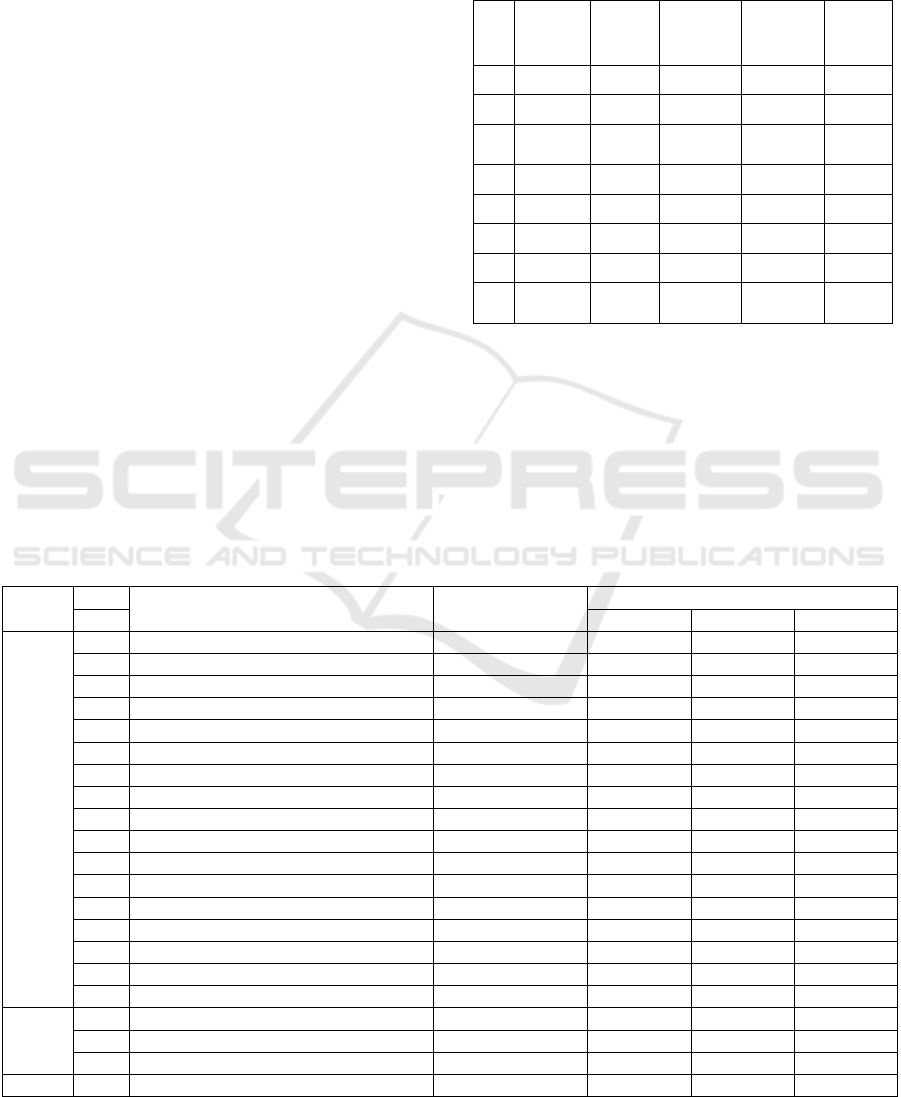
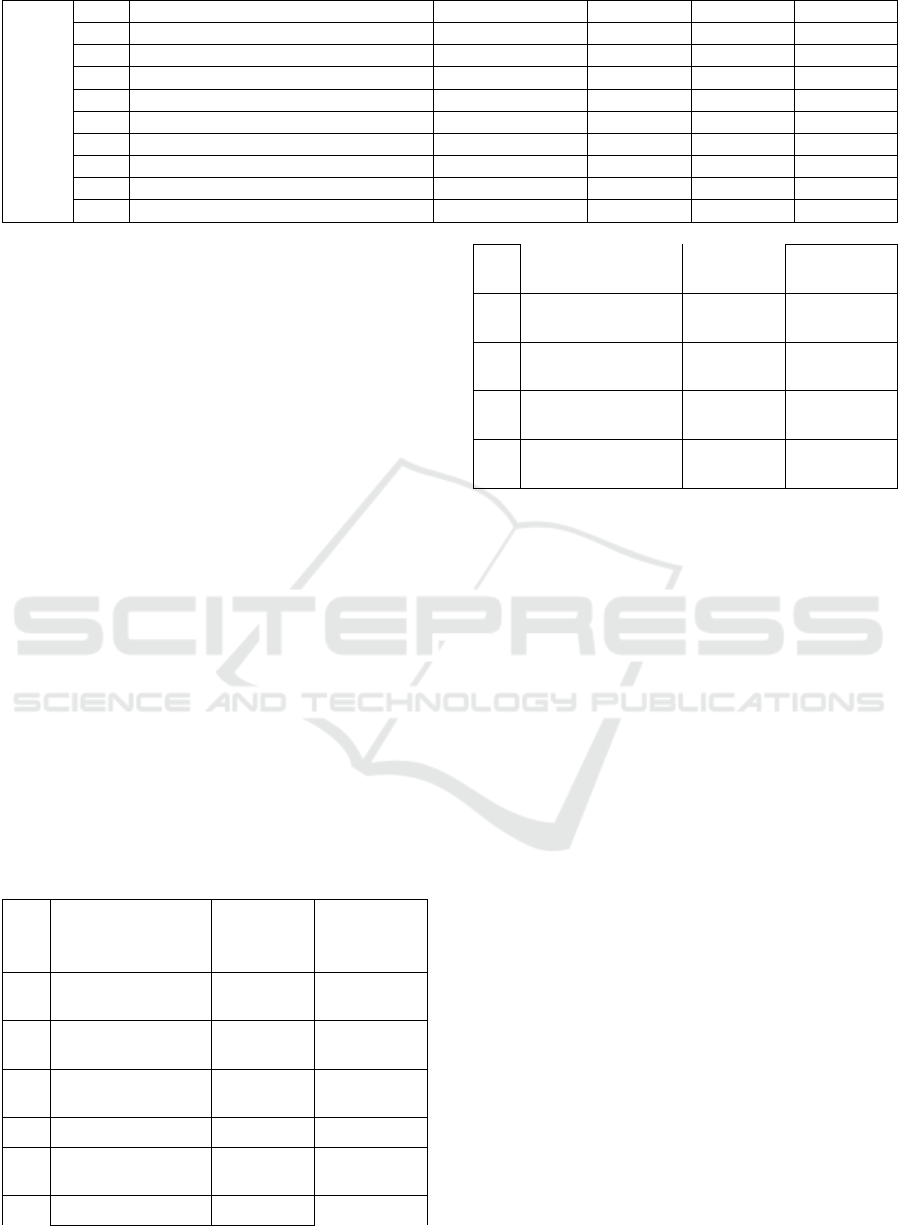
It can be seen from the data in Table 3 that the
weeds found in the agrocenosis of wheat fields of the
region belong to 14 families, 35 genera and 37 species
of higher plants.
Table 3: Species composition of the most common weeds in irrigated winter wheat fields of Tashkent region (2020-2022).
№
Family, genus, species
Biolo
gical type
Contamination degree (points)
2020 2021 2022
I
Poaceae Barnhart
1. Bromus L.
1.1. 1.2. B.tectorum L. Annual 2 2 2
2. Poa L.
2.1. P.bulbosa L. Perennial 2 2 2
3. Avena L.
3.1. A.fatua L. Annual 2 2 2
4. Cynodon Rich.
4.1. C.dactylon (L) Pers. Perennial 3 3 3
5. Sorghum Pers.
5.1. S.halepense (L) Pers. Perennial 3 3 3
6. Agropyron Gaertn.
6.1. A.repens (L) P.B. Perennial 2 2 2
7. Setaria P.B.
7.1. S.viridis (L) P.B. Annual 3 3 3
8. Phragmites Adans.
1.1. 1.2. Ph.australis (Cav) Trin . Perennial 3 3 3
II
Cyperaceae Juss.
1. Cyperus L.
1.1. 1.2. C.rotundus L. Perennial 2 2 3
III Polygonaceae Juss.
The Species Composition of Weed Plants in Winter Wheat
387

1. Rumex L.
1.1. 1.2. R.Drobovi Korov. Perennial 2 2 2
2. Polygonum L.
2.1. P.aviculare L. Annual 2 2 2
IV
Chenopodiaceae Vent.
1. Atriplex L.
1.1. 1.2. A.micrantha C.A.Mey. Annual 2 2 2
1.3. 1.4. A.tatarica L. Annual 2 2 2
2. Chenopodium L.
2.1. Ch.album L. Annual 2 2 2
V
Amaranthaceae Juss.
1. Amaranthus L.
1.1. 1.2. A.retroflexus L. Annual 3 3 3
VI
Caryophyllaceae Juss.
1. Stellaria L.
1.1. 1.2. S.media (L) Cyr. Annual 2 2 2
2. Lepyrodiclis Fenzl.
2.1. L.holosteoides (CAM) F. et M. Annual 3 3 3
VII
Ranunculaceae Juss.
1. Ceratocephalus Moench.
1.1. 1.2. C.testiculatus (Crantz) Bess. Annual 2 2 2
VIII
Brassicaceae Burnelt
1. Sisymbrium L.
1.1. 1.2. S.loeselii L. Annual 2 2 2
2. Capsella Medic.
2.1. C.bursa-pastoris (L) Medic. Annual 3 2 2
3. Descurainia Webb et Berth.
3.1. D.sophia (L) Webb ex Prantl. Annual 3 3 3
IX
Fabaceae Lindl. 2 2 2
1. Alhagi Adans.
1.1. 1.2. A.pseudalhagi Desf. Perennial 2 2 2
2. Glycirrhiza L.
2.1. G.glabra L. Perennial 2 2 2
3. Vexibia Rafin.
3.1.V.pachycarpa (Schrenk ex C.A.Mey)
Jakovl.
Perennial 2 2 2
4. Medicago L.
4.1. M.lupulina L. Biennial 2 2 2
5. Melilotus Mill.
5.1. M.officinalis (L.) Pall. Biennial 2 2 3
X
Zygophyllaceae R.Br.
1. Tribulus L.
1.1. 1.2. T.terrestris L. Annual 2 2 2
XI
Convolvulaceae Juss.
1. Convolvulus L.
1.1. 1.2. C.arvensis L. Perennial 2 2 2
XII
CuscutaceaeDumort
1. Cuscuta L.
1.1. 1.2. C.approximata Babling. Annual 2 2 2
XIII
Boraginaceae Juss.
1. Asperugo L.
1.1. 1.2. A.procumbens L. Annual 2 2 2
XIV
Asteraceae Dumort.
1. Acroptilon Cass.
1.1. 1.2. A.repens (L) DC. Perennial 3 3 3
2. Xanthium L.
I-CRAFT 2024 - 4th International Conference on Research of Agricultural and Food Technologies
388
2.1. X.strumarium L. Annual 3 3 3
2.2. X.spinosum L. Annual 2 1 2
3. Lactuca L.
3.1. L.serriola L. Biennial 2 2 2
4. Cichorium L.
4.1. C.intybus L. Perennial 2 2 2
5. Taraxacum L. Ex Wigg.
5.1. T.officinale Web. Perennial 2 2 2
6. Cirsium Adans.
6.1. C.ochrolepideum Juz. Perennial 3 3 3
The most common family is Poaceae Barnhart,
which includes 4 genera and 4 species.
Amaranthaceae Juss. - Aerva Lanata Juss 1 category,
1 species, Caryophyllaceae Juss. - Dianthus 1
category, 1 species, Brassicaceae Burnelt –
Plumboginaceae 1 category, 1 species, Asteraceae
Dumort. - asteridae Weeds in 3 categories and 3 types
are an example (Bukhorov et al., 2003, Bukhorov et
al., 2023, Ruziev et al., 2023).
Most importantly, during the research, it was
found that the number of weeds in the cultivated
fields is increasing year by year. An increase in the
types of weeds detected over time is observed from
the third year.
The composition of weed species found in the
wheat agrocenosis is largely related to the occurrence
of weeds specific to the type of crop sown in rotation.
Annual fall and overwintering weeds in cotton fields
germinate from the same period as winter wheat.
Such weeds include species such as Descurainia
sophia, Capsella bursa-pastoris, Sisymbrium loeselii,
Thlaspi perfoliatum, Brassica campestris, Vaccaria
segetalis, Turgenia latifolia, Spinacia turkestanica,
Stellaria media, Lepyrodiclis holosteoides, Scandix
pectin-veneris, Lamium amplexicaule, Cirsium
ochrolepideum (Table 4).
Table 4: The amount of weeds per 1 м
2
№ Types of weeds
Number of
weeds,
pieces/ м
2
Contamina
tion degree,
points
1 Capsella bursa-
pastoris
43-60 3
2 Ceratocephalus
testiculatus
22-48 2
3 Lamium
amplexicaule
21-28 2
4
Fumaria vaillantii 14-28 1
5 Spinacia
turkestanica
18-27 2
6
Stellaria media 28-48 2
7 Euphorbia
helioscopia
7-14 1
8 Nonnea
melanocarpa
28-56 2
9 Lepyrodiclis
holosteoides
22-46 3
10 Sisymbrium
loeselii
7-22 2
11 Descurainia
sophia
38-78 3
As can be seen from the data in the table, the
largest number of weeds was Descurainia Sophia -
38-78, Capsella bursa-pastopis - 43-60, Nonnea
melanocarpa - 28-56. The level of these weeds
contaminating the fields was also 2-3 points. This
ephemeral weed does not cause severe damage to
winter wheat, as its vegetation period is completed
until the winter wheat plant produces an ear, i.e. in the
first decade of May.
Among the winter weeds that continue their
vegetation in the spring, such as Roemeria refracta,
Papaver pavoninum, Nonnea melanocarpa, Fumaria
vaillantii, Ranunculus arvensis, Neslia apiculata,
Atriplex tatarica do not have a negative effect on the
growth and development of winter wheat.
For crops in winter wheat fields, weeds that
continue to grow after the earing phase cause
significant damage to winter wheat. They are located
in the upper layer of the crop ear in the wheat field,
and when harvesting, their seeds are collected mixed
with wheat grain. Weeds whose seeds are found
together with wheat grain include Cirsium
ochrolepideum, Descurainia sophia, Sisymbrium
loeselii, Sorghum halepense, Melilotus officinalis,
Vicia ervilia, Convolvulus arvensis, Galium tricorne,
Galium aparine, Acroptilon repens.
According to the researches, annual weeds found
around wheat fields are Avena fatua, Bromus
tectorum, Setaria viridis, Echinochloa crus-galli,
Sisymbrium loesellii, Descurainia sophia, Euclidium
syriacum, Xanthium strumarium, belonging to
families such as Poaceae, Brassicaceae, Asteraceae,
Papaveraceae, Chenopodiaceae, Roemeria refracta,
The Species Composition of Weed Plants in Winter Wheat
389

Atriplex tatarica species are dangerous weeds for
wheat fields.
4 CONCLUSIONS
In conclusion, it can be said that the lack of timely
control of such weeds around the fields causes a sharp
decrease in the winter wheat yield in the wheat
agrocenosis. Because such weeds are representatives
of local wild flora, they have the characteristic of
rapid vegetative reproduction. Especially, among
them, Acroptilon repens, Hyoscyamus niger, Datura
stramarium, Heliotropium lasiocarpum, etc are also
found around the plantations.
REFERENCES
Boynazarov B., Berdiyev T., Temirov U., Ganiev P.,
Usanbaev N. Production of bentonite and humus
natural organic substances from fluoride compounds
E3S Web of Conferences 377, 03012 (2023) 1-9 p.
https://doi.org/10.1051/e3sconf/20233 7703012
ICECAE 2022.
Bukhorov K., Belolipov I.V., Sheraliev A. Wheat field
weeds. // Agriculture of Uzbekistan. 2003. No. 10. 22-
23 p.
Bukhorov K.Kh., Honkeldieva M.T., Ergashev B.N.
Floristic composition of weeds in winter wheat crops. //
Bulletin of Science and Education 2023. No. 12 (143).
Part 3. Rus.IF.: 3.58. P.12-16.
Ruziev Sh, Honkeldieva M., Sayfiyeva M., Bukhorov K.
Spread, Damage and Control Measures of the Powdery
Mildew Disease of Grain Crops // International
Scientific and Practical Conference on "Issues of
Conservation and Protection of Biodiversity" E3S Web
of Conferences journal 22.05.2023.
Sheraliev A.Sh., Bukhorov K.Kh., Ruziev A. Weeds-
accumulators of Fusarium wilt infection. // Plant
protection and quarantine. 2001. No. 5. p. 34.
Sheraliev A.Sh., Bukhorov K.Kh., Species composition of
fungi of the genus Fusarium affecting cultivated and
weed plants of Uzbekistan. // Mikologiya i
fitopatologiya. 2001. Vol.35. Vol..2. P.44-47.
Zhurakulov A., Soloviev V.P., Bobaev K. Methodology for
accounting for the degree of contamination of cotton
crops and other crops in the crop rotation system
Tashkent. Publishing house. "Fan". UzSSR. 1985.
I-CRAFT 2024 - 4th International Conference on Research of Agricultural and Food Technologies
390
