The Influence of Germanium and Silicon on the Mechanical
Properties of Al-Cu Alloys
Sarvar Tursunbaev
1a
, Mukhayyokhon Saidova
1b
, Sharofuddin Mardonakulov
1c
,
Mohichekhra Boltaeva
2d
, Nilufar Isakulova
3e
and Shohruh Hudoykulov
1f
1
Tashkent State Technical University, 100095, University str. 2, Tashkent, Uzbekistan
2
Jizzakh Branch of the National University of Uzbekistan, Jizzakh, Uzbekistan
3
Uzbekistan State University of World Languages, 100138 Tashkent, Uzbekistan
Keywords: Microalloying, Mechanical Properties, Al-Cu Alloys.
Abstract: The article describes the process of microalloying an aluminum-copper alloy with germanium and silicon
oxides. Germanium oxide is part of an alloy enclosed in a special aluminum coating. 5% silicon is added to
the alloy compared to the same amount of charge. germanium oxide, on the other hand, is introduced in
various amounts from 0.1% to 0.3% compared to the charge. The samples were cast in an electric resistance
furnace at a temperature of 750 °C. The hardness and wear resistance of the obtained samples in terms of
mechanical properties were tested by experiments. The microstructures of the samples were analyzed using a
metallographic microscope. Changes in the microstructure and mechanical properties of the samples were
studied by comparison with samples without the addition of germanium oxide and silicon. The article also
develops a graph of the dependence of mechanical properties on alloying elements. Based on the experiments
conducted, the article presents the authors' conclusions on the last of them.
1 INTRODUCTION
The growing demand for non-ferrous alloys has led to
an increase in experience and research aimed at
further improving their properties. Changing their
composition by including various elements in the
composition of non-ferrous alloys also leads to an
improvement in the properties of alloys (Dai et al.,
2022, Zakharov and Fisenko, 2017, Rooy, 1990,
Shaw et al., 2003, Tang et al., 2013). Currently,
advanced research centers are conducting various
studies in this direction. A number of scientific
studies, including on aluminum alloys, are aimed at
obtaining high-quality foundry products with an
increase in their casting and mechanical properties
(Efzan et al., 2014, Zebarjad and Sajjadi, 2014,
Azarniya et al., 2019). The world's leading countries
a
https://orcid.org/0000-0003-2516-3597
b
https://orcid.org/0009-0007-0870-4802
c
https://orcid.org/0009-0008-0964-3519
d
https://orcid.org/0009-0007-5354-3999
e
https://orcid.org/0000-0001-9646-4640
f
https://orcid.org/0009-0002-0144-9236
in this field are Canada, the USA, Japan, China,
Sweden, Germany, Russia, Ukraine and others. In the
above-mentioned countries, as well as in Uzbekistan
in subsequent years, due to the increase in the number
of non-ferrous alloys in the production of foundry
products in the foundry sector of the industry, great
attention is paid to creating a technology for
producing high-quality, durable foundry products
based on an effective method that ensures resource
conservation. (Novák et al., 2023, Tursunbaev et al.,
2023a,b, Nosir and Bokhodir, 2023, Turakhujaeva et
al., 2023). The article analyzes the change in the
properties of D16 grade aluminum alloy from
aluminum-copper alloys by including germanium
oxide and silicon in its composition.
Tursunbaev, S., Saidova, M., Mardonakulov, S., Boltaeva, M., Isakulova, N. and Hudoykulov, S.
The Influence of Germanium and Silicon on the Mechanical Properties of Al-Cu Alloys.
DOI: 10.5220/0014270000004738
Paper published under CC license (CC BY-NC-ND 4.0)
In Proceedings of the 4th International Conference on Research of Agricultural and Food Technologies (I-CRAFT 2024), pages 381-384
ISBN: 978-989-758-773-3; ISSN: 3051-7710
Proceedings Copyright © 2025 by SCITEPRESS – Science and Technology Publications, Lda.
381
2 MATERIALS AND METHODS
The D16 grade aluminium alloy contains 94.7%
aluminium. On the other hand, copper, the main
alloying element, is 4.9%. A resistance furnace was
used to melt the samples. The furnace used is mainly
designed for the manufacture of small parts, up to 3
kg of metal can be liquefied in the crucible. The
furnace crucible is made of graphite material, which
helps to cast liquid metal without sticking to the base
of the crucible (Kholmirzaev et al., 2023, Ma et al.,
2023, Nodir et al., 2022).
The hardness of the samples obtained in the
experiments was measured by the Brinell method. At
the same time, there should be no oil, rust, scratches
on its surface, it should be smooth and smooth. For
this, the surface is ground on a fine-toothed egg or
grindstone. The smallest thickness of the sample (s)
must be at least ten times greater than the depth of the
submerged trace of the submerged ball (H): in this
case, the value of S 10 H is determined by the
formula:
ℎ
0.102𝑃
𝜋𝐷𝐻𝐵
where R is the load on the sample, N or kg.k; D is the
diameter of the sphere, mm; HB is the Brinell
hardness of the material " kg / mm2. The hardness of
the test sample according to Brinell (HB).
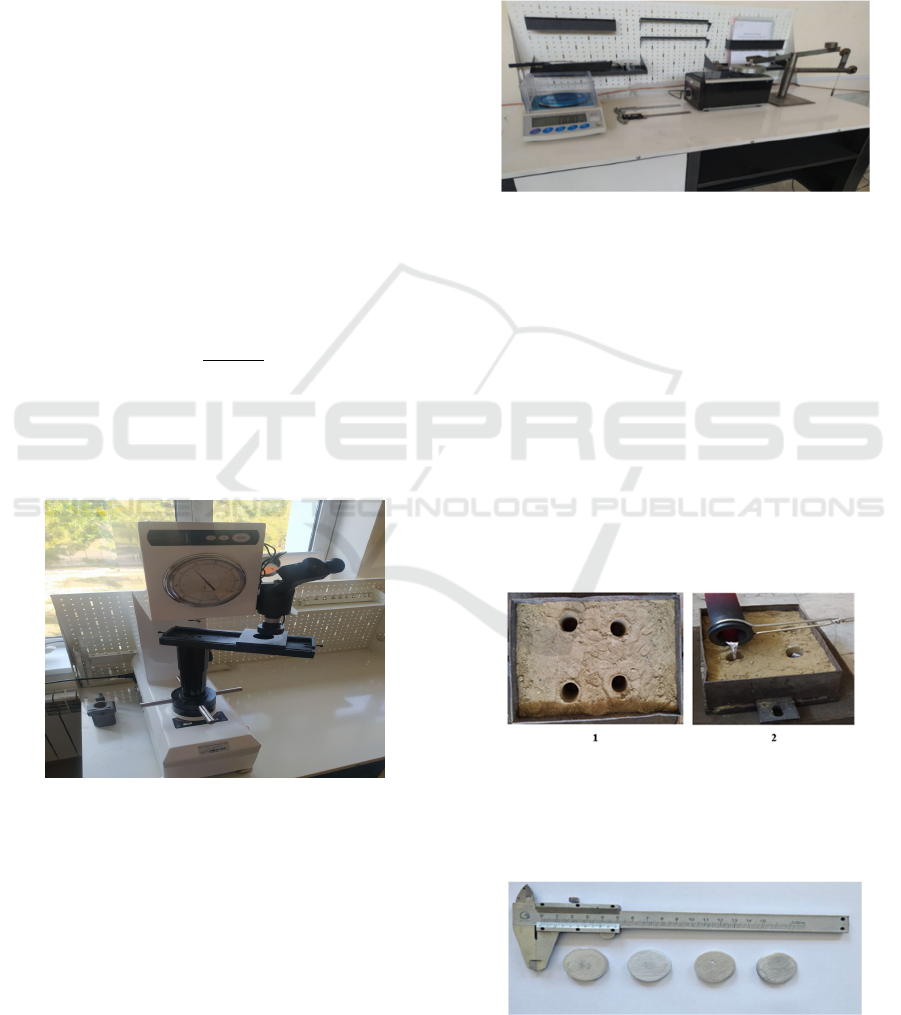
Figure 1: Hardness tester model 187.5 F HBRV.
Experiments used the HBRV -187.5 F model
hardness tester (Fig.1). The sample size was prepared
in a 35x5mm circle shape and a Brinell Press was
used.
Abrasive wear is the destruction of a material as a
result of mechanical influences, when a cutting and
scratching action occurs in the presence of a relative
velocity of movement of solid particles or particles.
Abrasive wear occurs when two pairs of parts come
into contact with each other under mutual friction,
and the hardness of one material is higher than that of
the other.
The wear resistance of the samples was
determined in experiments on a diamond disk device
(Fig.2). Wear resistance was determined by weight
loss. At certain intervals, the samples were held on a
rotating disk under the same force.
Figure 2: A device with a diamond disc that determines
wear resistance.
3 EXPERIMENTS AND RESULTS
Samples were cast according to the chemical
composition shown in Table 1. The samples were
melted in a resistance furnace at a temperature of 750°
C. The samples were poured into sand-clay molds
(Fig. 3). In experiments, 0.1% to 0.3% germanium
oxide was introduced into the aluminum alloy. After
germanium oxide was introduced into later samples
in the same composition, silicon was added as an
alloying element in an amount of 5% compared to the
charge.
Figure 3: Mold for samples (1) and casting process (2).
To determine the hardness of the cast samples, first
cutting was performed on a lathe, and then grinding
of the samples (Fig.4).
Figure 4: Polished samples.
I-CRAFT 2024 - 4th International Conference on Research of Agricultural and Food Technologies
382
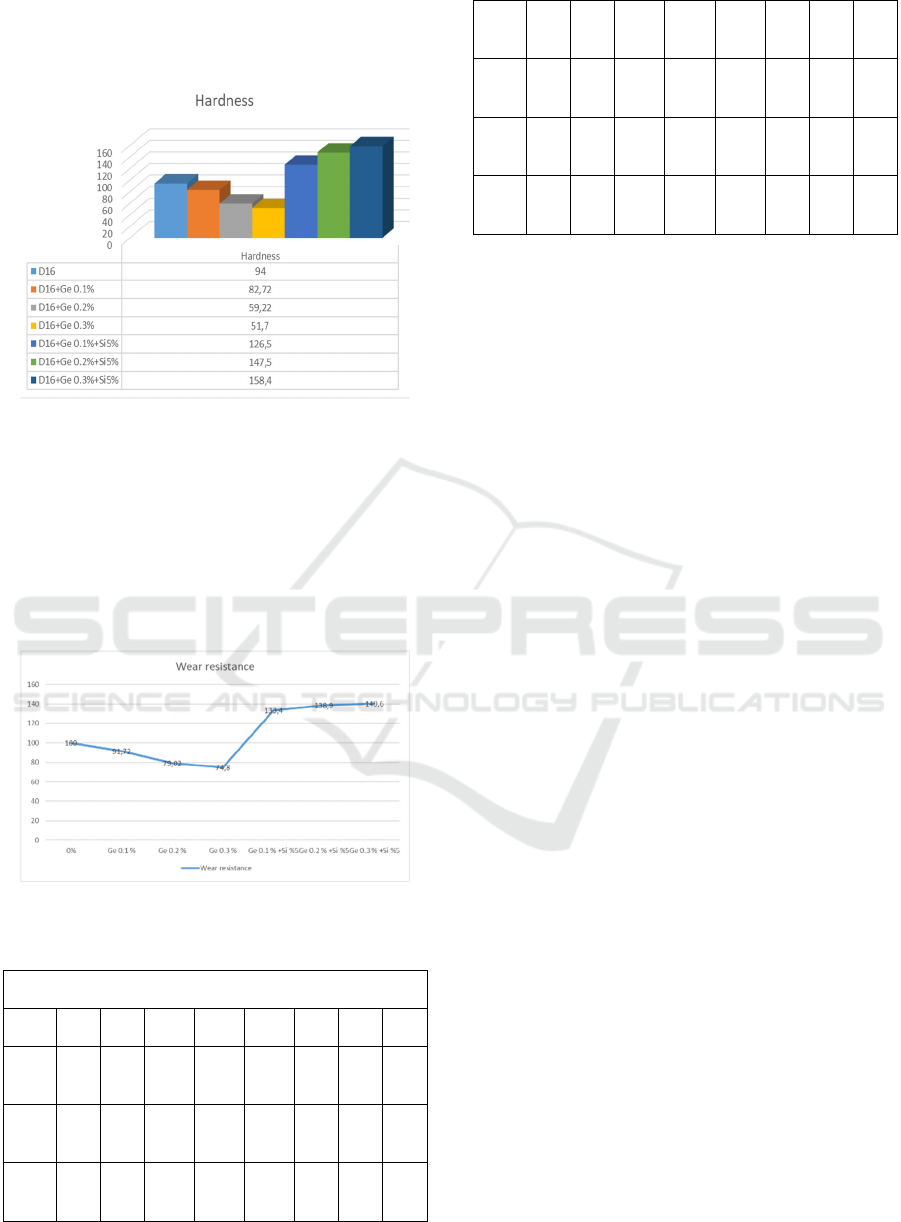
The hardness of the samples from three points
was checked and the average was calculated. The
measurement results are given in Figure 5 below.
Figure 5: Hardness measurement results.
The wear resistance of the cast samples was tested
using a device for measuring wear resistance using 6
minutes of the same force, i.e. using a device with a
force of 3 Newton. The wear resistance was
determined by differences in the weight of the
samples before and after the tests. Wear resistance
was carried over as a percentage of weight loss, and
link graph were developed (Fig.6.).
Figure 6: Link graph.
Table 1: Chemical composition of samples.
Percentage of elements in mass accounting, %
Al Si Fe Cu Mn Mg Ti Zn Ge
91-
94,7
0,5 0,5
3,8-
4,9
0,3-
0,9
1,2-
1,8
0,1 0,3 -
91-
94,7
0,5 0,5
3,8-
4,9
0,3-
0,9
1,2-
1,8
0,1 0,3 0,1
91-
94,7
0,5 0,5
3,8-
4,9
0,3-
0,9
1,2-
1,8
0,1 0,3 0,2
91-
94,7
0,5 0,5
3,8-
4,9
0,3-
0,9
1,2-
1,8
0,1 0,3 0,3
91-
94,7
5,5 0,5
3,8-
4,9
0,3-
0,9
1,2-
1,8
0,1 0,3 0,1
91-
94,7
5,5 0,5
3,8-
4,9
0,3-
0,9
1,2-
1,8
0,1 0,3 0,2
91-
94,7
5,5 0,5
3,8-
4,9
0,3-
0,9
1,2-
1,8
0,1 0,3 0,3
4 CONCLUSIONS
Experiments have shown that the introduction of
germanium oxide into the alloy led to a decrease in its
mechanical properties. Including the hardness of
Germanium oxide, as the content increased, the
hardness decreased to 38-40%. The wear resistance
has also decreased, respectively, as well as the
hardness. In subsequent studies, the addition of
silicon to the aluminium alloy led to an increase in
mechanical properties. The introduction of more than
5% silica into the sample compared to the charge
increased the hardness of the samples to 40-58%, and
the wear resistance to 33-40%. According to the
research results, it was found that germanium in
germanium oxide, remaining in the process of
liquefaction of the alloy in the aluminium-copper
system, improved the microstructure of the alloy,
which led to an increase in the mechanical properties
of samples with a silicon element.
REFERENCES
Azarniya, A., Taheri, A. K., & Taheri, K. K. (2019).
Recent advances in ageing of 7xxx series aluminum
alloys: A physical metallurgy perspective. Journal of
Alloys and Compounds, 781, 945-983.
Dai, Y., Yan, L., & Hao, J. (2022). Review on micro-
alloying and preparation method of 7xxx series
aluminum alloys: progresses and prospects. Materials,
15(3), 1216.
Efzan, E., Kong, M. N., Kok, C. K. (2014). Effect of
alloying element on Al-Si alloys. Advanced materials
research, 845, 355-359.
Kholmirzaev,N.,Turakhodjaev,N.,Saidmakhamadov,
N.,Khasanov, J.,Saidkhodjaeva, S., & Sadikova, N.
(2023) Development of Technology of Making Shafts
from Steel Alloy 35XGCL. In International Conference
on Reliable Systems Engineering (pp. 216-223). Cham:
Springer Nature Switzerland.
The Influence of Germanium and Silicon on the Mechanical Properties of Al-Cu Alloys
383

Ma, Z., Zhong, T., Sun, D., Qian, B., Turakhodjaev, N.,
Betsofen, S., & Wu, R. (2023). Microstructure and
Anisotropy of Mechanical Properties of Al-3Li-1Cu-0.4
Mg-0.1 Er-0.1 Zr Alloys Prepared by Normal Rolling
and Cross-Rolling. Metals, 13(9), 1564.
Nodir, T., Sherzod, T., & Shukhrat, C. (2022).
Technologies for extraction of copper from copper slag
by flotation. International Journal of Mechatronics and
Applied Mechanics, (11), 45-51.
Nosir, S., & Bokhodir, K. (2023). Development of
Liquefaction Technology 280X29NL to Increase the
Strength and Brittleness of Castings. Lecture Notes in
Networks and Systems, 534 LNNS, 105–
115.https://doi.org/10.1007/978-3-031-15944-2_10
Novák, P., Benediktová, D., Mestek, S., Tsepeleva, A., &
Kopeček, J. (2023). Aluminum alloys with natural ratio
of alloying elements manufactured by powder
metallurgy. Journal of Alloys and Compounds, 931,
167440.
Rooy, E. L. (1990). Introduction to aluminum and
aluminum alloys. In Properties and selection:
nonferrous alloys and special-purpose materials (pp. 3-
14). ASM International.
Shaw, L., Villegas, J., Luo, H., Zawrah, M., & Miracle, D.
(2003). Effects of process-control agents on mechanical
alloying of nanostructured aluminum alloys.
Metallurgical and Materials Transactions A, 34, 159-
170.
Tang, Z., Gao, M. C., Diao, H., Yang, T., Liu, J., Zuo, T.,
& Egami, T. (2013). Aluminum alloying effects on
lattice types, microstructures, and mechanical behavior
of high-entropy alloys systems. Jom, 65, 1848-1858.
Tursunbaev, S., Turakhodjaev, N., Odilov, F.,
Mardanokulov, S., & Zokirov, R. (2023)a. Change in
wear resistance of alloy when alloying aluminium alloy
with germanium oxide. E3S Web of
Conferences,401.https://doi.org/10.1051/e3sconf/2023
40105001
Tursunbayev, S., Turakhodjayev, N., Mardanokulov, S.,
Zokirov, R., & Odilov, F. (2023)b. The effect of lithium
on the mechanical properties of alloys in the Al-Li
I-CRAFT 2024 - 4th International Conference on Research of Agricultural and Food Technologies
384
